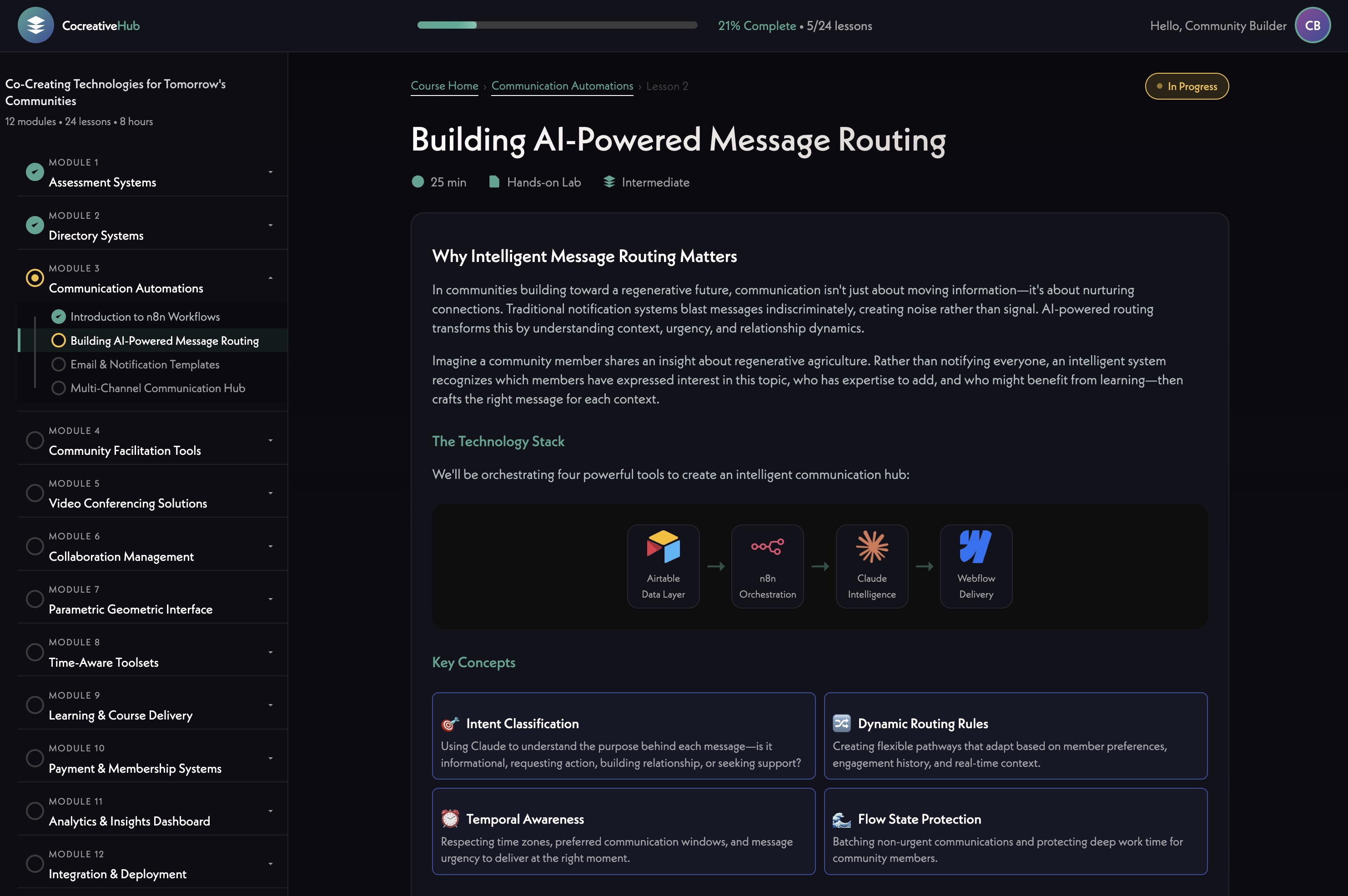




The central focus of this meeting was consolidating the Wave event website into a single, streamlined landing page. Currently, the Wave site and a separate ticket page exist independently, creating a fragmented buyer journey — and with the European volunteer team in Lisbon actively running pop-up events, and the Time and Space marketing agency pressing hard for updated materials for ad campaigns, the urgency to get this cleaned up was palpable (03:32).
James confirmed that Munya has been working in Figma [tag="webflow"] on redesign concepts — no changes pushed to Webflow yet — and the plan is to merge the Wave and ticket pages into one unified page, incorporating all the structural notes Mariko had compiled during her drive from LA to Flagstaff (07:04). The goal is a tighter, more intentional page with clear calls to action, the speaker lineup front and center, community videos and quotes accessible without deep scrolling, and a navigation bar that lets returning visitors jump directly to what they need — tickets, FAQ, testimonials — rather than grinding through a long scroll (01:13:55).
James also proposed using Airtable [tag="airtable"] to manage the speaker lineup rather than the manual folder-and-filename approach used previously. Speakers can be entered into Airtable with a status toggle, and the site will update automatically when a speaker is marked as ready to publish (05:49). This was quickly agreed upon as the right move.
[technology="Directory Systems"]
Hera outlined the ticketing challenge: two separate Ticket Tailor events had been created to serve US dollar and euro pricing, but the goal is now to have a single Wave page where the correct ticket widget appears automatically based on the visitor's location (10:40). James identified a free geolocation API that handles up to 1,000 requests per day and said he could have the location detection script live on the Wave page the same evening (12:11).
The agreed UX approach: the page defaults to the visitor's local currency based on IP detection, with a visible toggle button — "Switch to USD" or equivalent — so that, for example, an American traveling in Europe can still pay in dollars if that suits their bank (15:27). As an interim measure while the geolocation script is being implemented, Hera suggested adding clearly visible buttons in both the hero section and near the ticket widget at the bottom of the page, linking directly to the appropriate checkout for European visitors (21:50). A reciprocal USD button will also be added to the Cascais page (25:21).
The current confirmed pricing structure is a base of $650 USD for entrance, converted to the euro equivalent, with scholarship discount codes handling deeper discounts rather than separate price tiers. Scholarship applications trigger automated code delivery — no manual intervention needed (36:37).
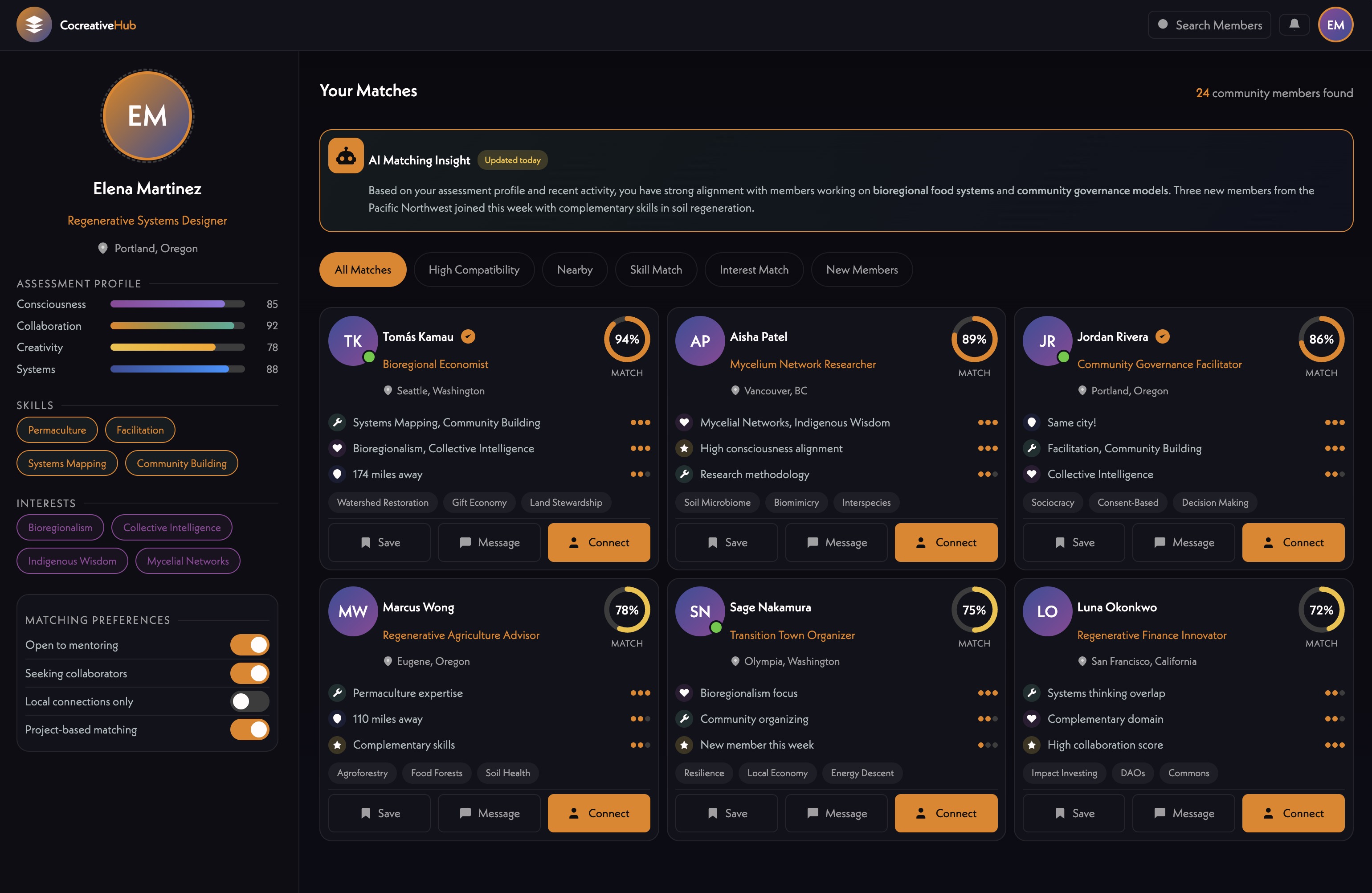
James walked through the next major app frontier: the matching feature (37:41). The UI is already built. The backend challenge is generating a score matrix efficiently — rather than running a computationally heavy algorithm across every user pair, the first layer of matching will distill each user's tags, domains, and seeking/offering data into simple numeric scores. Users with closely matching numbers get a high match score; divergent profiles get a low one. This approach is computationally lightweight and scales as the user base grows.
The second layer brings in Claude [tag="claude"] — feeding each user's "About Me" and purpose responses alongside their tag data into an agentic prompt that generates qualitative match analysis. Starting with the top 25 numeric matches per person, Claude outputs a readable explanation of why two people should connect. These results will be saved so that matched users can share them — "the HoloBot said we should connect, check this out" — without requiring the other person to run their own process (42:00).
[technology="Intelligent Matching Algorithms"]
Mariko reflected at length on her own assessment experience, noting that it felt accurate, reflective, and trustworthy — exactly the quality signal needed for the matching layer to feel credible to new users (46:52). The team agreed that assessments will be especially powerful when they start confirming what users already intuitively know about their relationships with colleagues, building trust in the system's suggestions for people they don't yet know.
[technology="Assessment Systems"]
James pointed to broader potential: beyond individual matching, assessments can help working groups understand their collective makeup — team strengths, team shadows, who needs support, who should lead on what. This framing positions the tools not just as onboarding features but as ongoing collaboration infrastructure (51:14).
[technology="Collaboration Management Tools"]
Mariko shared that a contract with Hubcast Media and Peter Young is nearly finalized for a global live broadcast of the Wave event (59:52). The strategic opportunity here is significant: rather than simply streaming on Hubcast's platform, the team wants to route global viewers directly into the Holomovement ecosystem — requiring profile creation to access the stream, enabling live chat, and offering donation options including monthly giving. The profile becomes the ticket in (01:04:27).
James noted that if viewers are required to create a profile to tune in, they're immediately inside the platform — and will discover everything else that's there (01:04:33). This also sets up the 2027 vision: a fully hybrid event where Holon hubs in cities around the world host local viewing parties and potentially broadcast their own live feeds — rooftop concerts, community gatherings — feeding into a central broadcast. The Wave event team wants to test a few of these nodes with existing Holon hubs (Asheville, DC, Sedona, and ideally one in Australia or Asia) as a pilot for the 2027 model (01:02:20).
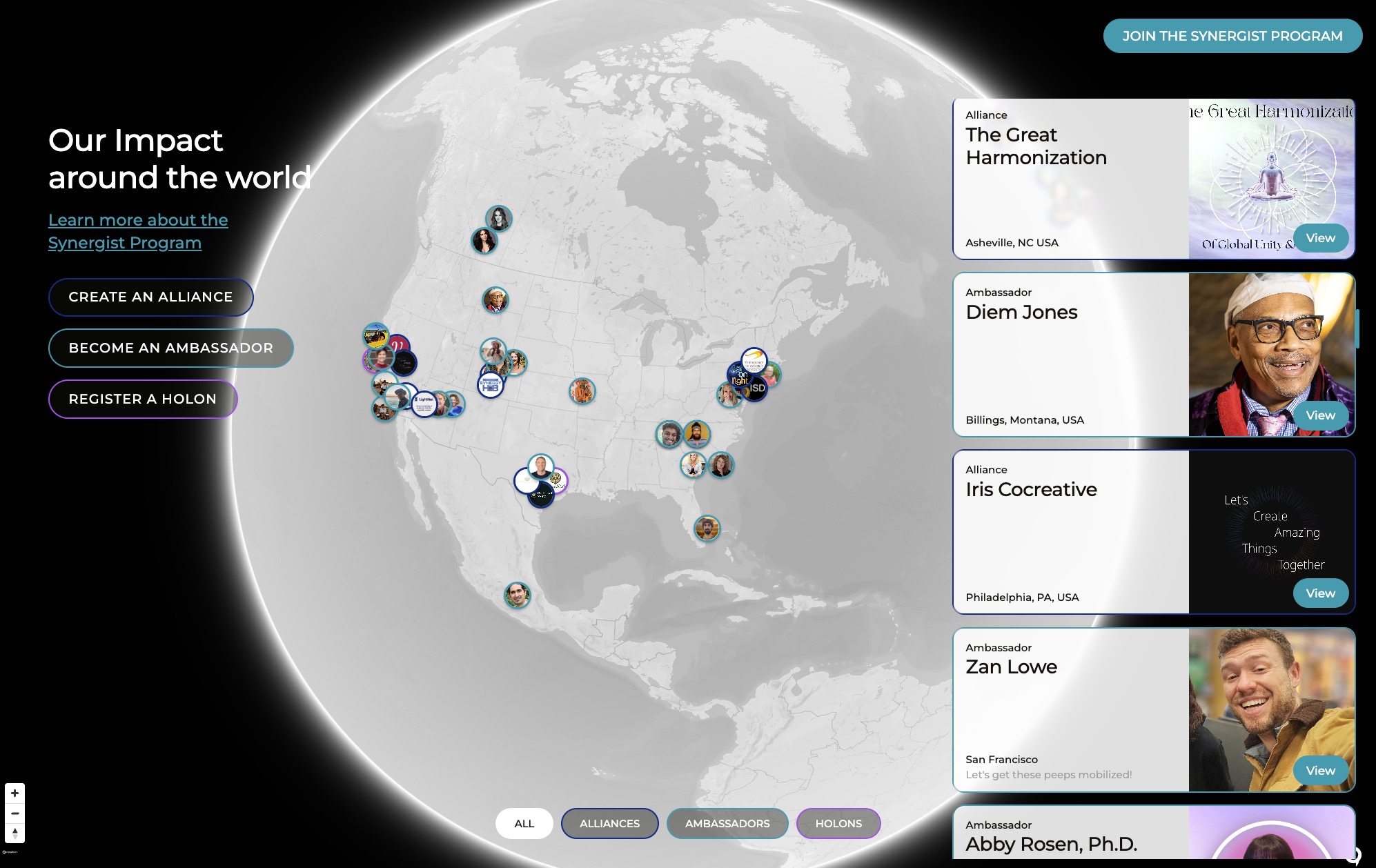
James also shared a prototype media archive interface he'd built for a separate art project — a globe-based [tag="mapbox"] player with filters by location, event, and experience, with a pop-out video player that stays active while browsing (01:07:14). This architecture maps directly onto what the Holomovement ecosystem needs for archiving keynotes, performances, and community media from events. Videos could be uploaded within 48 hours of recording and made available for on-demand viewing, organized by speaker or session.
[technology="Video Conferencing Solutions"]
[technology="Community Facilitation Tools"]
A broader conversation emerged around how to frame the platform's value — particularly in philanthropic funding contexts. Mariko described a recent funding call where someone questioned whether donors could really invest in "technology," and the team reframed it: the sell isn't the tech stack, it's the vision of what the technology makes possible (53:08).
James put it clearly: most technology today is optimized for individual users and individual psychology — selling things to single people. The Holomovement platform is building toward something rarer — tools optimized for collectives, for understanding cultural groups, for facilitating interconnectivity between beings and communities (56:13). If aligned groups can adopt similar toolsets, learn from each other, and rapidly iterate on what actually aids transformative impact — sharing formats, community engagement approaches, facilitation practices across the network — that shared learning is itself enormously valuable from a research and impact perspective (54:37).
Mariko flagged this framing as something worth pulling directly into funding decks (55:47).
---
James Redenbaugh
Mariko Pitts
Hera Rose
The central focus of this meeting was consolidating the Wave event website into a single, streamlined landing page. Currently, the Wave site and a separate ticket page exist independently, creating a fragmented buyer journey — and with the European volunteer team in Lisbon actively running pop-up events, and the Time and Space marketing agency pressing hard for updated materials for ad campaigns, the urgency to get this cleaned up was palpable (03:32).
James confirmed that Munya has been working in Figma [tag="webflow"] on redesign concepts — no changes pushed to Webflow yet — and the plan is to merge the Wave and ticket pages into one unified page, incorporating all the structural notes Mariko had compiled during her drive from LA to Flagstaff (07:04). The goal is a tighter, more intentional page with clear calls to action, the speaker lineup front and center, community videos and quotes accessible without deep scrolling, and a navigation bar that lets returning visitors jump directly to what they need — tickets, FAQ, testimonials — rather than grinding through a long scroll (01:13:55).
James also proposed using Airtable [tag="airtable"] to manage the speaker lineup rather than the manual folder-and-filename approach used previously. Speakers can be entered into Airtable with a status toggle, and the site will update automatically when a speaker is marked as ready to publish (05:49). This was quickly agreed upon as the right move.
[technology="Directory Systems"]
Hera outlined the ticketing challenge: two separate Ticket Tailor events had been created to serve US dollar and euro pricing, but the goal is now to have a single Wave page where the correct ticket widget appears automatically based on the visitor's location (10:40). James identified a free geolocation API that handles up to 1,000 requests per day and said he could have the location detection script live on the Wave page the same evening (12:11).
The agreed UX approach: the page defaults to the visitor's local currency based on IP detection, with a visible toggle button — "Switch to USD" or equivalent — so that, for example, an American traveling in Europe can still pay in dollars if that suits their bank (15:27). As an interim measure while the geolocation script is being implemented, Hera suggested adding clearly visible buttons in both the hero section and near the ticket widget at the bottom of the page, linking directly to the appropriate checkout for European visitors (21:50). A reciprocal USD button will also be added to the Cascais page (25:21).
The current confirmed pricing structure is a base of $650 USD for entrance, converted to the euro equivalent, with scholarship discount codes handling deeper discounts rather than separate price tiers. Scholarship applications trigger automated code delivery — no manual intervention needed (36:37).
James walked through the next major app frontier: the matching feature (37:41). The UI is already built. The backend challenge is generating a score matrix efficiently — rather than running a computationally heavy algorithm across every user pair, the first layer of matching will distill each user's tags, domains, and seeking/offering data into simple numeric scores. Users with closely matching numbers get a high match score; divergent profiles get a low one. This approach is computationally lightweight and scales as the user base grows.
The second layer brings in Claude [tag="claude"] — feeding each user's "About Me" and purpose responses alongside their tag data into an agentic prompt that generates qualitative match analysis. Starting with the top 25 numeric matches per person, Claude outputs a readable explanation of why two people should connect. These results will be saved so that matched users can share them — "the HoloBot said we should connect, check this out" — without requiring the other person to run their own process (42:00).
[technology="Intelligent Matching Algorithms"]
Mariko reflected at length on her own assessment experience, noting that it felt accurate, reflective, and trustworthy — exactly the quality signal needed for the matching layer to feel credible to new users (46:52). The team agreed that assessments will be especially powerful when they start confirming what users already intuitively know about their relationships with colleagues, building trust in the system's suggestions for people they don't yet know.
[technology="Assessment Systems"]
James pointed to broader potential: beyond individual matching, assessments can help working groups understand their collective makeup — team strengths, team shadows, who needs support, who should lead on what. This framing positions the tools not just as onboarding features but as ongoing collaboration infrastructure (51:14).
[technology="Collaboration Management Tools"]
Mariko shared that a contract with Hubcast Media and Peter Young is nearly finalized for a global live broadcast of the Wave event (59:52). The strategic opportunity here is significant: rather than simply streaming on Hubcast's platform, the team wants to route global viewers directly into the Holomovement ecosystem — requiring profile creation to access the stream, enabling live chat, and offering donation options including monthly giving. The profile becomes the ticket in (01:04:27).
James noted that if viewers are required to create a profile to tune in, they're immediately inside the platform — and will discover everything else that's there (01:04:33). This also sets up the 2027 vision: a fully hybrid event where Holon hubs in cities around the world host local viewing parties and potentially broadcast their own live feeds — rooftop concerts, community gatherings — feeding into a central broadcast. The Wave event team wants to test a few of these nodes with existing Holon hubs (Asheville, DC, Sedona, and ideally one in Australia or Asia) as a pilot for the 2027 model (01:02:20).
James also shared a prototype media archive interface he'd built for a separate art project — a globe-based [tag="mapbox"] player with filters by location, event, and experience, with a pop-out video player that stays active while browsing (01:07:14). This architecture maps directly onto what the Holomovement ecosystem needs for archiving keynotes, performances, and community media from events. Videos could be uploaded within 48 hours of recording and made available for on-demand viewing, organized by speaker or session.
[technology="Video Conferencing Solutions"]
[technology="Community Facilitation Tools"]
A broader conversation emerged around how to frame the platform's value — particularly in philanthropic funding contexts. Mariko described a recent funding call where someone questioned whether donors could really invest in "technology," and the team reframed it: the sell isn't the tech stack, it's the vision of what the technology makes possible (53:08).
James put it clearly: most technology today is optimized for individual users and individual psychology — selling things to single people. The Holomovement platform is building toward something rarer — tools optimized for collectives, for understanding cultural groups, for facilitating interconnectivity between beings and communities (56:13). If aligned groups can adopt similar toolsets, learn from each other, and rapidly iterate on what actually aids transformative impact — sharing formats, community engagement approaches, facilitation practices across the network — that shared learning is itself enormously valuable from a research and impact perspective (54:37).
Mariko flagged this framing as something worth pulling directly into funding decks (55:47).
---
James Redenbaugh
Mariko Pitts
Hera Rose
Implement geolocation API script on Wave page to auto-display correct ticket widget by region with manual currency toggle
Use free geolocation API (up to 1,000 requests/day) to detect visitor IP and display correct ticket widget in local currency. Include visible toggle button (e.g., 'Switch to USD') so travelers can override to their preferred currency. James indicated this could be live same evening as meeting. (12:11)
Add interim Euro and USD buttons to Wave page hero section and ticket widget area, and reciprocal USD button to Cascais page
Interim measure while geolocation script is being implemented. Add clearly visible buttons in hero section and near ticket widget linking directly to appropriate checkout for European vs US visitors. Also add reciprocal USD button to the Cascais page. (22:07)
Duplicate and merge Wave page and ticket page into one consolidated Webflow landing page per Mariko's structural notes
Merge the existing separate Wave page and ticket page into a single unified landing page in Webflow. Clean up layout and structure based on Mariko's WhatsApp notes compiled during her drive from LA to Flagstaff. Ensure clear CTAs, speaker lineup front and center, community videos and quotes accessible without deep scrolling, and navigation bar for returning visitors to jump to tickets, FAQ, testimonials. (07:04)
Set up Airtable speaker sync so speaker profiles auto-publish to Wave page when status is toggled
Configure Airtable base for speaker lineup management with a status toggle field. When a speaker is marked as ready to publish, their profile auto-updates on the Wave page via direct CMS connection. Replaces manual folder-and-filename approach used previously. (05:49)
Check in with Munya on Figma designs and coordinate design contributions for merged Wave page
Munya has been working in Figma on redesign concepts for the Wave page. No changes have been pushed to Webflow yet. Coordinate to incorporate her design work into the consolidated page build. (01:12:55)
Fix assessment profile view glitch causing user scores to remain stuck when navigating between profiles
Bug fix: when navigating between user profiles, assessment scores remain stuck/stale rather than updating to reflect the currently viewed profile. (45:00)
Build matching backend numeric score matrix as first layer and Claude agentic analysis as second layer for qualitative match output
First layer: distill each user's tags, domains, and seeking/offering data into simple numeric scores for computationally lightweight matching. Second layer: feed top 25 numeric matches per user along with 'About Me' and purpose responses into Claude agentic prompt to generate qualitative match analysis. Save results so matched users can share them. UI already built. (41:00, 42:00)
Begin planning live broadcast integration architecture including profile-gated stream access, live chat, and donation flow for Hubcast Media partnership
Route global viewers into Holomovement ecosystem by requiring profile creation to access the Hubcast Media live stream. Enable live chat and donation options including monthly giving once inside. Profile becomes the ticket in. Contract with Hubcast Media and Peter Young nearly finalized. (59:52, 01:04:27)
Send zip file of print assets and vector/Illustrator files from Panama designer to James for Wave page visual design
Mariko to send zip file containing print assets and vector/Illustrator files from Panama designer to James for use in Wave page visual design work. (26:12)
Forward updated US ticket pricing with base $650 structure to Hera for euro conversion alignment
Send confirmed US ticket pricing (base $650 for entrance) to Hera so she can calculate and confirm euro equivalent pricing alignment. (34:09)
Pull and send community video quote transcriptions from Asheville interview reels for embedding in Wave page testimonials section
Transcribe and send community video quotes from Asheville interview reels to James for embedding in the Wave page testimonials/community videos section. (01:14:30)
Continue onboarding users into the app and encourage all new members to complete the assessment
Ongoing effort to onboard new users into the Holomovement app and drive assessment completion. Assessment completion is critical for the matching system's data quality and for building trust in the platform's suggestions. (43:35)
Send Mariko a comparative pricing table showing US vs euro ticket prices side by side to confirm alignment before publishing
Create and send a side-by-side comparison table of US dollar vs euro ticket prices to Mariko so both parties can confirm pricing alignment before the updated pricing is published on the Wave page. (18:40)
Confirm scholarship discount codes are correctly configured against updated base pricing
Verify that scholarship discount codes in Ticket Tailor are correctly set up relative to the updated base pricing of $650 USD. Scholarship applications trigger automated code delivery — no manual intervention needed. (35:15)
Update euro Ticket Tailor event to reflect correct pricing based on confirmed US base of $650
Update the euro-denominated Ticket Tailor event pricing to reflect the euro equivalent of the confirmed $650 USD base price once alignment with Mariko is confirmed. (36:06)
Test Wave page geolocation feature using a VPN once James has the script live
Once James implements the geolocation API script on the Wave page, Hera should test it using a VPN to simulate a European visitor and verify the correct euro ticket widget appears and the currency toggle functions properly. (20:17)
Confirm all key sections from Wave ticket page have been migrated to main Wave page before separate ticket page is retired
Before the separate ticket page is retired/taken down, confirm that all critical sections and content from that page have been successfully migrated into the consolidated Wave landing page. (01:16:45)
European localized landing page for Wave event targeting European ticket buyers. Major consolidation underway: merging separate Wave page and ticket page into single unified landing page with clear value proposition, speaker lineup front and center, community videos/quotes accessible without deep scrolling, and navigation bar for returning visitors to jump directly to tickets/FAQ/testimonials. Geolocation-based ticket pricing implemented using free API (1,000 requests/day) to auto-detect visitor location and display appropriate currency widget (USD vs Euro) with manual toggle override for travelers. Default base pricing $650 USD with euro equivalent. Interim solution adds visible Euro/USD buttons in hero section and near ticket widget while geolocation script completes. Airtable speaker sync replacing manual folder-filename approach - speakers entered in Airtable with status toggle, auto-publishing to site when marked ready. Design work by Munya in Figma not yet pushed to Webflow. Structural notes compiled by Mariko during LA-Flagstaff drive being incorporated. Time and Space marketing agency pressing for updated materials for ad campaigns. European volunteer team in Lisbon running pop-up events creating urgency for consolidated page. Scholarship discount codes handling deeper discounts against base pricing rather than separate tiers. Scholarship applications trigger automated code delivery without manual intervention. Global broadcast partnership now integrated with Hubcast International bringing livestream capability and interactive engagement features including watch parties (3-5 confirmed with Ibiza live), evening broadcast shows (2-hour produced content), and potential app embedding via collaboration with Hubcast developer Emilio Lopez.
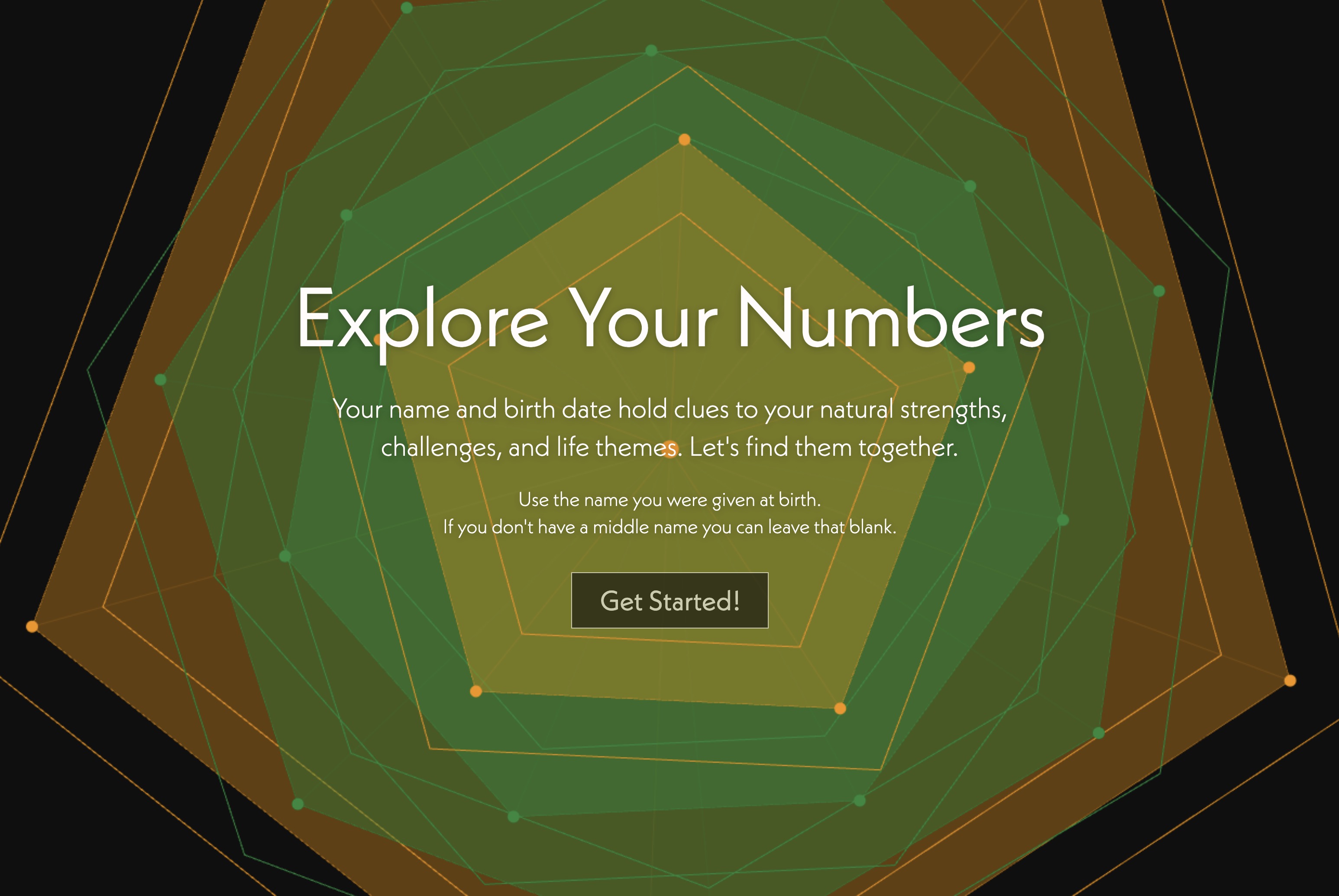
Assessment system with AI-powered engagement features feeding automation workflows. Data from assessments, clicking patterns, lesson completion, and call attendance triggers personalized communication including immediate tailored emails, weekly progress updates, connection recommendations based on profile matching, and proactive check-in offers when engagement drops. Guatemala-specific assessment page created requiring customized copy. Current synergist directory demonstrates existing assessment capabilities: members complete form triggering automated n8n and Claude AI analysis of responses about purpose, projects, and ancestral wisdom influences. System generates personalized feedback and recommends connections to other synergists based on compatibility, facilitating introductions via email without exposing addresses. Also suggests relevant podcast episodes. No-login approach removes participation barriers while enabling intelligent matching and communication. Strategic shift to progressive engagement model: members start with basic five-minute profile setup (name, website, purpose statement, location), then complete more detailed assessments later. Each completed assessment adds elements to profile and unlocks new features. Gamification includes AI-generated icons, tarot card archetypes, or numerology graphics appearing on profiles as users complete different assessments. Incremental assessment launch strategy releasing new assessments every week or ten days leading to Wave event, using Ripple gatherings and Miracle Club to promote participation. Partnership opportunities with experts for themed assessments (Don Beck for Spiral Dynamics, Vedic astrologer for astrology, iOS Zone of Genius team for their assessment). Critical reassessment of assessment strategy prioritizing basic intake form capturing most important factors: development level, experience, life stage, purpose, and current needs as primary assessment for matching foundation. Systems like Gene Keys and numerology recognized as requiring belief in astrology/numerology to feel relevant, limiting universal applicability. Focus shifting to actionable, practical data enabling computational matching based on clear criteria rather than archetypal personality typing. When matching collaborators, users need to understand skills, experience, current needs, and project involvement rather than personality scores. AI-driven matching requires developmental stage, experience level, project involvement, and specific needs to avoid misaligned matches like pairing serial entrepreneurs with college freshmen. Meeting confirmed approach of using simple 1-to-10 scale assessments for numerical scoring and spider graphs but deferring complex compatibility scores for MVP. AI interpretation via Claude for free-text fields and nuanced alignment, direct computation for explicit matches like shared affiliations or complementary skill requests. Michael coordinating with Emmanuel on potential assessment questions to gauge user alignment. Team now planning 5-6 domain assessment (5 makes pentagram shape, 6 makes star shape) using simple multiple choice format outputting 1-10 scores per metric with spider graph visualization (37:24). Demonstrated working client assessment as reference - multi-screen flow with logic-based classification, no agentic analysis required. Key design principles: spectrum-based framing rather than qualitative scoring ('does this sound like you or not?' vs 'how good are you at this?'), questions should feel neutral and interesting to avoid test-taking bias (MMPI/Myers-Briggs problem of answering how you want to appear), completable in 10 minutes or less, more candidate questions per domain than needed for culling weak ones (40:52, 48:29). Mariko advocated for including at least one fun gift-like assessment (e.g. numerology mandala tool) people would do for the experience that enriches profile organically without feeling like data extraction (41:56). James floated longer-term vision of garden of assessments users can choose from with power to decide which assessments inform matching - astrological/numerological inputs become opt-in rather than default. New numerology mandala tool demonstrated building visual in real time as user types, team expressed integration interest (43:44). Michael Shaun starting shared document immediately with candidate domain names and draft questions for team review, holding internal review with Hera before broader socialization (40:52, 52:43). Working prototype built with five-domain assessment featuring slider-based positioning system across spectrums (22:37). Five domains: Holonic Worldview (separative/analytic to holistic/integrative), Purpose Orientation (exploring/emergent to directed/activated), Pro-Social Stance (deep one-on-one to community-wide/systemic), Collaborative Capacity (independent to collective), Time Horizon (near-term to long-arc/generational). Results render as nine-pointed spider graph and bar chart. Slider format keeps assessment accessible without overwhelming users (25:36). Community-level visualization capability floated - overlaying 100 profiles to reveal collective orientation of holons or comparing holons against each other (29:17). Next development step: adding archetype outputs (e.g., 'super connector') with brief descriptive text for each result profile. Assessment data feeds optionally into matching algorithm with users able to decide matching criteria when requesting analysis, though some default criteria apply automatically (36:00). Prototype ready for Holomovement team Thursday meeting demo (40:46). 03-31 meeting revealed spider graph assessment essentially unreadable without tutorial - 19 items across overlapping axes makes results incomprehensible (10:54). Team verdict: spider graph is good eye candy but doesn't deliver snapshot value. Simplified one-question assessment with triangulation output confirmed as right path forward, not using spider graph format (14:58). Working prototype committed for following day. Michael Shaun flagged standing to-do: writing one-page descriptive blurbs for each assessment area so AI can return robust grounded responses to user queries - Google Doc format for now (57:04). Mariko testing showed assessment accurate and trustworthy, validating credibility needed for matching layer to work for new users. Assessment confirms what users intuitively know about existing relationships, building trust for recommendations with unknown people (46:52). Beyond individual matching, assessments help working groups understand collective makeup - team strengths, shadows, support needs, leadership roles. Positions tools as ongoing collaboration infrastructure rather than just onboarding features (51:14). New triangular assessment visualization mentioned in meeting at 57:00 as co-designed by James. Assessment now functional with improved output format and ready for core team onboarding (meeting 05-04).
Intelligent matching feature triggered by 'Match Me' button on member cards or directory view generating dynamic side-by-side comparison between two members. System displays numerical compatibility score (1-100) shown on hover to avoid feeling like rating system, with loading/analysis animation making generation feel intentional and interesting (26:00). Match modal shows meaningful dimensions including complementary skills, needs/offers alignment, shared alliances, overlapping domains of interest, developmental stage, and geographic proximity - surfacing why people matched rather than just that they matched (19:02, 27:24). Implementation architecture: first layer distills each user's tags, domains, and seeking/offering data into simple numeric scores for lightweight computational matching. Users with closely matching numbers get high match score; divergent profiles get low score. This approach scales as user base grows without computational burden. Second layer uses Claude feeding each user's About Me and purpose responses alongside tag data into agentic prompt generating qualitative match analysis. Starting with top 25 numeric matches per person, Claude outputs readable explanation of why two people should connect. Results saved so matched users can share them - 'the HoloBot said we should connect, check this out' - without requiring other person to run own process (42:00). System designed as sticky gamified feature incentivizing profile completion - incomplete profiles result in lower matchability or 'unmatchable' status serving as playful motivator (24:35). Match generation happens on-demand rather than pre-computed to allow real-time incorporation of latest profile updates and assessment completions. Prioritizes actionable information over personality typing: what someone is working on, what help they need, what skills they offer, their experience level, and developmental stage. Avoids problematic mismatches like pairing serial entrepreneurs with college freshmen by incorporating context-aware filtering. Integration with assessment data enables queries across network like 'who should I collaborate with on this project?' or 'who can provide funding?' Technical architecture combines Supabase for profile data retrieval, Claude API for compatibility analysis, and custom JavaScript for interactive modal interface. Future enhancement could incorporate mutual matching where both parties express interest before facilitating introduction. System represents platform's 'killer app' - intelligent algorithmic connection-making that surfaces possibilities people would never discover through manual browsing alone. Current UI mockup under review with team feedback that original version felt more alive while newer version reads as sleeker but more corporate with less warmth and weaker visual hierarchy (27:13, 38:04). Key design feedback includes moving Reach Out and View Profile CTAs to bottom of card where users naturally scan (36:41), replacing tag-only displays with short generative sentences explaining connections in plain language with matched tags highlighted inline (33:42, 35:34), adding left-column recommended connection list for easy scanning (39:40), enabling match view trigger from profile pages via 'show me my connection' button for both recommendations and relationship deepening (42:01), and using yellow color more heavily to mark person-to-person connection territory (42:32). Match bars per domain could appear as visual shorthand but not primary read. Design approach references Strava's AI-written post-ride sentences that create more engagement than data dashboards (35:34) and Pattern app's astrology-based compatibility presentation (39:53). Matching feature approximately two weeks out with new design elements expected Monday (44:37, 45:13). 03-31 meeting detailed tag-based matchmaking architecture: profiles generate seeking/offering/domain/focus tags through onboarding, periodic function compares every profile against every other producing alignment score based on complementary tags and overlapping domains (01:01:36). Directory view displays highest-alignment profiles larger and left-aligned, decreasing by alignment rightward. Same data infrastructure powers matching grid view designed in Figma showing matched profiles above Living Network view. Sean actively working on implementation (01:00:56). Assessment data will feed into system making new assessment a dependency for full matchmaking. Meeting 05-04 confirmed working connections page with map-based and list-based views showing alignment scores, click-through to detailed comparison, and Connect button triggering n8n agentic analysis sending both profiles to Claude for domain-specific reports (00:10-00:22).
Integration of Hubcast International global live broadcast partnership for Wave event routing global viewers directly into Holomovement ecosystem. Strategic approach requires profile creation to access stream, enabling live chat and donation options including monthly giving. Profile becomes the ticket in, immediately placing viewers inside platform where they discover all other features. Contract with Hubcast Media and Peter Young finalized with production team (Peter, Delanne, Tess) confirmed for on-site support. Technical infrastructure includes multi-camera main stage capture, dedicated evening broadcast set with PTZ system, Stage Timer run-of-show management via Google Sheets, and Mentimeter interactive polling. Watch parties confirmed at 3-5 locations including Ibiza operating behind paywall with Zoom-based feed injection allowing global-to-local-to-global audience participation. 2-hour produced evening shows designed for linear distribution (Roku, etc.) with full long-form content available on-demand. Interactive engagement strategy includes stretch breaks every 35-45 minutes featuring app onboarding walkthroughs, Mentimeter quizzes, and theme-specific chat rooms aligned with six Wave domains where remote viewers contribute ideas read from stage. Potential single sign-on integration between Hubcast Creator Hub and Holomovement App explored with developer Emilio Lopez enabling seamless profile handshake and subscriber-only content tiers. Hubcast team arrives Portugal April 27th with setup/testing April 29th and checkout June 1st. Social team (Andrew, Connie, Kayla Ray) coordinating on-location capture including Sunday closing party at Crocodile Armis. Marty K. Casey identified as ideal main host pending availability confirmation. 2027 vision established for fully hybrid event where Holon hubs in cities worldwide host local viewing parties broadcasting their own feeds - rooftop concerts, community gatherings - feeding into central broadcast. Pilot testing planned with existing Holon hubs in Asheville, DC, Sedona, and ideally Australia or Asia. Media archive interface prototyped using globe-based player with filters by location, event, and experience, with pop-out video player staying active while browsing. Videos uploaded within 48 hours of recording made available for on-demand viewing, organized by speaker or session. Platform positioned as collective infrastructure optimized for groups sharing formats, engagement approaches, facilitation practices representing research and impact value critical for philanthropic funding contexts. Current meeting (06-23) demonstrated proven viability of embedded Zoom broadcast approach with translator channels for simultaneous translation supporting live course format, validating technical architecture for both conference broadcasting and course delivery use cases (22:12). Zoom integration maintains specialized translation functionality Holos doesn't replicate natively while leveraging Holos video spaces for participant-led informal gatherings.
00:00:01
Mariko Pitts: Oh, my goodness. What a day so far, huh? Here. This meeting is being recorded.
00:00:11
Hera: Okay, let me.
00:00:14
Mariko Pitts: All right. Hey, James, can you hear us?
00:00:16
James Redenbaugh: Yeah. Can you hear me?
00:00:18
Mariko Pitts: Yeah. Okay, I can see mouth. I just see your camera all over.
00:00:28
Hera: Oh, my God. James, how are you?
00:00:31
Mariko Pitts: I know. He's been up like crazy, like 3, 4am Once, I'm like, are you sleeping or.
00:00:39
James Redenbaugh: No, not enough. And I've been at the dentist like every day. I had to go in on Friday and then they just finished my root canal this morning. I'm just getting home.
00:00:49
Mariko Pitts: Oh, good.
00:00:50
James Redenbaugh: So I'm like all numbed up.
00:00:53
Hera: Oh, my God.
00:00:54
Mariko Pitts: Oh, you had a root canal. That's awful.
00:00:56
James Redenbaugh: Sucks. Yeah, the worst.
00:01:01
Hera: Already because it takes a while, but then when it hits you, you'll need a lot of leaning into the. The moment.
00:01:15
James Redenbaugh: Oh my God.
00:01:18
Mariko Pitts: Well, geez, you poor thing. Um, you. Yeah. Just kind of figure out what you're holding. Then how can we help you? Especially with your. This.
00:01:32
James Redenbaugh: The. I was trying to avoid the root canal for a long time and the pain was so bad and now it's so much better after I got it done. Yeah, it's just. It's sore and. And my gums hurt, but tooth pain when the nerve is inflamed, there's nothing like it.
00:01:55
Mariko Pitts: Did you get a feeling? Did you add to do the thing or you just. Did they just lock it up or did you just pull the tooth?
00:02:01
James Redenbaugh: They. They locked it up. It's in there. They took out the nerve, all the roots of it and. And filled it up and I put it there. Putting a crown on it. It's got a temporary crown. I gotta go back tomorrow and get the permanent crown.
00:02:23
Mariko Pitts: Yeah. All right. Well, okay. Amidst all that, there's all kind of crazy stuff happening on our end.
00:02:31
James Redenbaugh: Yeah. How are you guys doing? What's going on over there?
00:02:36
Mariko Pitts: We have our team, so Manuel, Laura, Michael, Sean, and Alex, I think. Have you met Alex? Okay, good. Yeah. So they're all in Lisbon right now doing the volunteer party. We have pop up events happening, so we're trying to get as much cleaned up and simplified as possible. And then we've got this, the Time and Space European team, right, the marketing agency who's like barking on our necks for like an updated website and cleaning up stuff and new flyers, everything that we need to get to them because they're doing ads and everything soon. So they're creating ad videos and you know, for socials and all that stuff now. But there's a lot that guys that's got to get cleaned up at least according to what they need for Europe, you know, and there's things that I'm noticing too, like, you know, like we've been talking about, you know, this weekend, the website and stuff of simplifying. It's just overly complicated, you know, and it doesn't need to be.
00:03:32
James Redenbaugh: Yeah.
00:03:33
Mariko Pitts: So what do we want to do? I need to get the website done, like asap, but also at the same time. Yeah, yeah, the Wave site and also like, you know, Hera made some big changes on some pricing for Europeans. And you know, we're shifting some things right now, but those are for the ticket pages, the ticket tailor pages specifically. But I, you know, I definitely want to get all widgets, everything onto one page. And so we do have some questions on, I think, conversion for the, you know. Well, I'll let her talk about that because she's holding that piece. But yeah, I think all in all, we need to just figure out a couple things of how we want to move forward with the website. Have you made any changes based off of the stuff I sent over or are we thinking. What are you thinking where you're at?
00:04:26
James Redenbaugh: I had Munya jump into Figma and so we haven't done anything in webflow yet.
00:04:34
Mariko Pitts: Okay, that's probably good though.
00:04:36
James Redenbaugh: Yeah, I sent her everything that we've been talking about.
00:04:41
Mariko Pitts: Okay.
00:04:42
James Redenbaugh: And so she's been working on design and I haven't checked in with her yet. I'll check in with her in her morning in Bali. So my evening.
00:04:52
Mariko Pitts: Okay, yeah, I'll work on. I need to get the speaker lineup up too. So probably. What. What's the best way to do that? Because some of the speakers are already. That are coming back. We already have that. So, you know, I just need to update it and add the ones that aren't on there. But essentially I remember it being a little bit of a process. So I think what we did is send you the, you know, a folder with all the headshots and then like in the. This, like the title of the image, it's like their name and then their, like the organization or whatever it was, you know, like author or something like that. I can't remember. We just kind of put it in the title of the picture and then so it was all kind of there in one folder. How would you want to do that? You want me to do the same kind of thing like that or.
00:05:42
James Redenbaugh: Well, that sounds like a pretty 2025 way to do it.
00:05:45
Mariko Pitts: Oh, no. What do we. What's the best way to do this? I need to get it up done too.
00:05:49
James Redenbaugh: How would you feel about using airtable to keep them organized? Then you can input them into airtable when they're ready to go. We can change the status in airtable to publish, and then I can set it up so that it's automatically synced with the site as you guys are putting speakers in there, then the site updates automatically.
00:06:14
Hera: Okay, that sounds really good.
00:06:17
Mariko Pitts: How fast could that be implemented, though?
00:06:21
James Redenbaugh: Faster than doing it manually.
00:06:23
Mariko Pitts: Okay. And that's. Are we keeping the same layout or are we going to do a different layout?
00:06:29
James Redenbaugh: Any layout we want.
00:06:30
Hera: Okay.
00:06:31
Mariko Pitts: Whatever is the best, quickest and most efficient. It doesn't need to be the same one that is currently. Because I think it was like this one that's moving and there were some complications with it. So I think we need to figure out the best way to kind of get these headshots up and all that. Like. Yeah, and maybe this might be some elements of what you've already designed for the app. Maybe that. Maybe there's something there that makes it easy to upload that information and it works easy. You know what I mean?
00:07:04
James Redenbaugh: Why don't I spend some time today duplicating the existing wave page, merging them into one, the wave and the ticket page, cleaning things up and blocking things out based on what we were talking about in WhatsApp. And then we'll see what design contributions Munya wants to make in terms of having it feel great.
00:07:37
Mariko Pitts: Okay.
00:07:39
James Redenbaugh: And. And then I can plug in an airtable and get that synced to make adding speakers easy and ready to go. And. And then we can move fast and get this up in the next. Next couple of days. What is the status of the. The print materials files?
00:08:09
Mariko Pitts: I should have them actually any moment now. I'm waiting for a couple things. Let me check. I already have it. Let's see.
00:08:19
James Redenbaugh: Because I love those kind of purple psychedelic graphics we've got going on there. I'd love to weave some of that stuff in there as well.
00:08:30
Mariko Pitts: Yeah. So, okay, so I'm getting an edible file. He's been working on the. My guys in Panama who's designing it. And let's see. It's giving me the edible file ready for print in approximately an hour. That was actually a couple hours ago. So I'm trying to figure out where he's. What's that? But there's a lot happening with that. So what we're doing is rushing the postcard that needs to get printed out, like tomorrow morning and European time so they can have it available for their event tomorrow night. But those. You know, I could probably ask him. There's so many other things that they're developing. Right. There is the full speaker lineup on speaker templates for announcements. All those templates are coming with this new design. What exactly do you need? Do you want them like illustrative. What exactly do you need? I'm just trying to figure out so I can ask him to make this real streamline.
00:09:33
James Redenbaugh: Any vector assets that he can send that he used to create that. So any Vector Illustrator files that he has would be great.
00:09:45
Mariko Pitts: Okay. Okay, I'm just texting him now about that. All right. Hera, do you want to update James on what happened with the tickets and all that? And so to make sure. Because while we're talking about this wave website, to make sure that the right components are on the new page.
00:10:06
Hera: Yeah, exactly. So currently, and we've mentioned that to you earlier a couple of days ago, that right now we. To simplify the. The buyer journey, we just want to focus on having one. A landing page and instead of having two groups like one for the European page and then the. A separate ticket page, we want it to be. We want to implement just the T Geo tagging features that automatically triggers them being led to either the European ticket page or the. The existing.
00:10:40
Mariko Pitts: The.
00:10:40
Hera: The main one.
00:10:41
Mariko Pitts: The, the.
00:10:42
Hera: The U.S. prices. So basically everybody that that's in Europe are going to see European prices. Everybody that's outside of Europe are going to see it are going to see dollar prices. So I'd love to know what you need to implement that from ticket Taylor. We've had conversations with support. They can't do the automatic triggering because. And that's why I ended up creating the two events. I actually. Because they said the best way to do that is if we're using webflow, which we are just. Do we need to do some magic on that that will automatically trigger them to the alternate widget. So yeah, I'd love to know what's possible and what you need. You need as well.
00:11:32
James Redenbaugh: I don't think I need anything. I guess.
00:11:36
Hera: How, how many hours do you need to implement this? I think that's also because it feels like everybody's asking about a good timeline for that. Mikhail. Is that how he say his name?
00:11:51
Mariko Pitts: Marco?
00:11:52
Hera: Is that.
00:11:52
Mariko Pitts: Yeah, Mikhail. Mikhail.
00:11:55
Hera: Just texted Alex again to ask when that's gonna be ready. I feel it's something that's urgent for them because they're doing all the promotions in. In Portugal right now. Yeah. What would be a good timeline for.
00:12:09
Mariko Pitts: That.
00:12:11
James Redenbaugh: One Sec, let me read this. So. I think there's. We need to use a geotagging API key. There's one here that is free for up to 1,000 requests a day. Then if we go above that, we can swap in a paid program. This should be pretty easy for me to set up. I can do it today.
00:12:59
Hera: Okay, perfect. Mar. How do you want the journey to be? Do you want everybody to stay in the, the entire journey to stay in the wave page or. Okay, maybe this is a James question because right now my assumption, the only solution that I have in mind is first page in the user journey is wave page. Then when the system notices that they're in Europe, they're going to be, when they reach the payment widget, they're going to be taken to the European page instead. The European checkout page. That being said, I'm wondering if there's a way that instead of them being taken to the, the other page that we created, the Cascais or the wave ticket space page, is there a way that we, the widget changes? I mean that gets activated in the website itself. You know how like we have the, the checkout widget at the bottom of the page that if when the system notices that they're in Europe it's going to show us European prices instead of the US prices.
00:14:07
Mariko Pitts: We can also, for simplicity, if it doesn't, we can just choose like a drop down box or something and they choose, you know, US prices or euro and then the widget shows or something. You know, maybe something like that. But we just, because we just have, we have two widgets for do two different. We had to create two different, you know, payment pages because of the, the prices for the currency change.
00:14:30
Hera: Yeah, we have two different pages and two ticket tailor events tied to each of those pages.
00:14:36
Mariko Pitts: But that, but I don't want all these pages. I just want widgets on the wave page. That's it. I want all these other things.
00:14:44
Hera: Yeah.
00:14:44
Mariko Pitts: Is that possible, James?
00:14:46
James Redenbaugh: Yeah, that's what I'm thinking. And we're talking about combining the wave page and the ticket page into one page. Right?
00:14:53
Mariko Pitts: In one page. And all those notes that I sent you were basically from all those pages into one. I just put it like come got rid of a bunch of shit and then put it together in some way.
00:15:02
James Redenbaugh: Yeah. So the, the script will just show based on location. It will show the widget according to where they are. And then I think if it doesn't matter to you guys whether they pay in dollars or euros, we should give them the Option where it can default to their currency. But maybe we have a button like switch to USD here.
00:15:27
Mariko Pitts: That's what I'm thinking, a button, something simple.
00:15:31
James Redenbaugh: Because somebody might be in Europe, but they're American and they want to pay in dollars or vice versa.
00:15:40
Mariko Pitts: Yeah, it depends on where their bank accounts are and things like that. Sometimes it's easier to just pay in US dollar if your bank is a US Bank.
00:15:47
James Redenbaugh: Yeah.
00:15:48
Hera: But also, Mark, I just want to flag this, that the prices in Europe are so different from the dollar counterparts. So is that okay?
00:15:58
Mariko Pitts: How much different now? I thought they were all the same now, except it's just converted.
00:16:02
Hera: It's so it's different because we lower the price. The price this specifically for the locals and we slashed another discount on top of it, right?
00:16:14
Mariko Pitts: Yeah. But didn't they just come up with 650 across the board and then there's just a discount for codes for scholarship. Oh yeah, it's.
00:16:22
Hera: Oh yeah, yeah, that's true. It's.
00:16:23
Mariko Pitts: We just changed the whole thing to like 650 again. And then it's just the conversion. It's the same thing. Oh my God.
00:16:29
Hera: Yeah, yeah.
00:16:30
Mariko Pitts: Girl, you're lost the whole day. You just fixed this whole thing right? A minute ago.
00:16:34
Hera: Yeah.
00:16:34
Mariko Pitts: Like you literally just change these prices.
00:16:37
Hera: Yeah, but it's still different though. It's still lower. It's still significantly lower if you put them side by side for Europe.
00:16:44
Mariko Pitts: How. How does that work? I don't understand if they're equivalent now because.
00:16:50
Hera: Okay, let me show you. Because the base price. We didn't. We could talk about this separately. I mean, we don't have to do it. Do you want to do it now?
00:16:59
Mariko Pitts: No. I think maybe I need to better understand though, because on my understanding based off of these messages that have been going around this morning, is that we're just creating one base price, 650 for entrance like it has been. And then it's 200 additional or something for the four day, you know, and then there's basically. And then the room charge is completely. It's whatever the rooming is attached to the entrance fee. It's just same thing. It's super simple.
00:17:25
Hera: We talked about it in the previous phone call that we, we restructured the US prices differently. When. Do you remember when we had that multiple simulations on what the different prices when we had those three types and those were based on like a larger ticket base plus hotel. But then the ticket base gets to be lower depending on which, which, which ones, which ticket year we chose. This was back at last year. This was back in November last year. So that being said, it's not a base amount. The base amount is not the same for the dollar prices.
00:18:04
Mariko Pitts: Okay, I need to look at that again.
00:18:06
Hera: So then do you remember back then the true cost of the participants is like a thousand dollars.
00:18:12
Mariko Pitts: Yeah, no, I get that. But things have just shifted. So it's like it's fine because it's. The base price for an entrance ticket is 650. That's what we decided. And it's whether it's euro. It's converted to whatever that is in euro. Yeah, but the US dollar price is 650. The conversion of that is the same thing of whatever it is in euro. And then the roomings. There's nothing different than that. We just need to make sure that you. We update the US pricing to be reflected.
00:18:40
Hera: Yeah, that's what I. Yeah, what I'm gonna do after this is send you just a quick comparative like a table that showing.
00:18:46
Mariko Pitts: Okay. Yeah, do that so I can understand. Because right now we need to get clear before it all goes on one page.
00:18:51
Hera: Exactly. Exactly. Yeah.
00:18:52
Mariko Pitts: Okay. Okay. All right, cool. All right, so. So you'll work on that. James, let us know what you. How long you think that would take. Because even if it's just more of like what you're talking about today. Moving, moving things on the one page, but we can't disturb the Holy moment cascade link yet just because they're using it for the next two days, you know, they're in action. So we can't really disturb the links per se. We just need to kind of. Unless we'll give them a different update. I am for the postcard though. I am sending them directly to the wave page now instead of the Cash Cash page. Just because I have a feeling that we'll have. We'll just want to send them there and at least just get a button directly to the euro ticket page to. To buy or the widget. I'd rather do that.
00:19:48
James Redenbaugh: Yeah. I can start with. The first thing I'll do is I'll get the script working on the wave page and then the next thing I'll do is improve the wave page and combine it with the ticket page. The location detection should work on the wave. On the primary wave page this evening.
00:20:16
Hera: Okay.
00:20:17
Mariko Pitts: Okay, perfect, perfect, perfect. Let's do that. And let me know when you get it ready for testing and then I can pop on and look at that.
00:20:24
James Redenbaugh: Cool. We can use VPNs to test the location.
00:20:28
Mariko Pitts: Okay, that's perfect.
00:20:29
Hera: Yeah, I Think it makes sense for us to have a button in the wave page for the European. For the Qashqai page? Just for now. Only between now and that, whenever the geotagging feature, geolocation feature is activated. Because there could be.
00:20:47
Mariko Pitts: Fine. We could do something like that, I guess. Yeah, yeah.
00:20:50
Hera: Could we do that?
00:20:51
Mariko Pitts: This is quick. Just in case people end up going to the regular web page. Yeah.
00:20:55
Hera: Because definitely people will be going there.
00:20:59
Mariko Pitts: Yeah. Because they can go to. If they go to holoma.net to learn more and they hit wave, it's going to take them directly to the web page, not the European stuff.
00:21:06
James Redenbaugh: So.
00:21:06
Hera: Because they will be in an event, probably 30 minutes.
00:21:11
Mariko Pitts: So.
00:21:12
Hera: Yeah, just. We could put that.
00:21:14
Mariko Pitts: They're already in it, aren't they?
00:21:16
Hera: Hold on, let me.
00:21:17
Mariko Pitts: They're already thin. In the event.
00:21:20
Hera: I. Okay, okay. Yeah, I think that was my time, but it's okay.
00:21:25
Mariko Pitts: We need to just. I think it's important. You're right. To just put something really quickly on the wave page that says, you know, to access your something. What do we want to call it? Like a European button? You know, for European. The paying euro. Click here or something like that or.
00:21:42
Hera: Yeah, something like that.
00:21:43
Mariko Pitts: You know, we need to make a clear button and then that just takes them directly to that. The ticket page. To the cascade page.
00:21:50
Hera: Yeah, maybe, you know, maybe one button near the. The. Should we do one button in the hero box, the hero section, and then another in the ticket section at the bottom. So there's two touch points.
00:22:07
Mariko Pitts: Yeah. Because in the hero section, we need to have get tickets in there too. It needs to be very clear. Call to actions now soon. So if you want to put. Get tickets and you put us, you know, US dollar and euro and then they just click on one or the other. That's fine, I think.
00:22:25
Hera: Oh, yeah, the get your ticket one. Yes.
00:22:30
Mariko Pitts: Just for now, I guess I'm trying to figure out.
00:22:34
James Redenbaugh: So in here, A button at the bottom here to pay in euros, click here.
00:22:48
Mariko Pitts: Okay. I mean, that's fine. Is it just. Wait, where did they click on. I can't remember. So if I click on the three day. Or is it that box right above the pan Europe here?
00:23:02
James Redenbaugh: The widget shows up here on the front end that looks like this.
00:23:13
Mariko Pitts: Okay. So that needs to go kind of.
00:23:15
James Redenbaugh: Above that then up here.
00:23:18
Mariko Pitts: Yeah, because that's too big of a widget and they're just looking at prices. So before they. Yeah, it needs to go up and maybe a little bit more different color. That really stands out.
00:23:28
James Redenbaugh: Maybe it goes in Here. And let's wrap.
00:24:17
Mariko Pitts: Okay. I got the new postcard. Man, he really did fix up those Vector files. I mean, those Illustrator files pretty nicely.
00:24:29
James Redenbaugh: Like this.
00:24:30
Mariko Pitts: Yeah, exactly. That's clear.
00:24:35
James Redenbaugh: And I'll have it go right to the tickets section.
00:24:52
Mariko Pitts: Perfect. Yeah, just right to the page. To the. To the widget. Right. Perfect. Hold on one second. I want to go check out this postcard files and see if he sent me. Need.
00:25:21
James Redenbaugh: Did we have a USD button on the Cash Gaish page?
00:25:27
Mariko Pitts: We should do that too. We don't. Yeah, let's do the same thing. Just the opposite.
00:26:05
James Redenbaugh: Okay, that should work.
00:26:12
Mariko Pitts: Okay, I think I have some. Right. It looks like we got some more. Pull the files from this. I'm gonna. I'm gonna forward you the. A zip file for the postcards. And I believe there's Illustrator files and stuff in that.
00:26:29
James Redenbaugh: Okay. Okie dokie.
00:30:32
Hera: Mar. I sent you a message. Wait, I think it's still. Yeah, you see it? Yeah.
00:30:38
Mariko Pitts: Okay, I'm gonna get to.
00:30:54
James Redenbaugh: Buttons are working.
00:30:56
Mariko Pitts: Yay.
00:30:59
Hera: I saw it. I was in the page just now.
00:31:01
Mariko Pitts: I love it.
00:31:10
Hera: It's crazy how important co Working calls could be.
00:31:14
Mariko Pitts: Not too long though. Like. Like calls like. Wait, Hera. I'm just looking at these. Whoop. The. Is this the new pricing that. This looks like the one that you and I discussed. Is that correct?
00:32:14
Hera: The euro one?
00:32:15
Mariko Pitts: Yeah.
00:32:15
Hera: Yeah.
00:32:16
Mariko Pitts: This is the one you and I did.
00:32:19
Hera: Yes, yes, yes.
00:32:20
Mariko Pitts: This is not the one that Michael. Sean. And then we're talking about today, correct?
00:32:25
Hera: No, this is.
00:32:27
Mariko Pitts: Okay, but that's. That's the latest and that's what needs to get changed to the pricing. The new pricing that they gave you.
00:32:35
Hera: What's the. Has he. Has he.
00:32:37
Mariko Pitts: Did you miss that? Yeah, because they were hoping that they need to get that up like asap. That was the whole part of the year.
00:32:44
Hera: Hold on.
00:32:45
Mariko Pitts: I did.
00:32:47
Hera: Oh, my God. I think it's still. I. I followed up on that actually, and he didn't.
00:32:52
Mariko Pitts: Yeah, and he said. But there was a bunch of emails. There was a bunch of messages about it. Let me. It's in the. Hold on, I'll forward it to you. Give me a minute. I'll forward it to you. Because I was like. Yeah, because you were saying that. I was like, girl, you missed out. Where's the other new pricing? It's way simpler now.
00:33:11
Hera: Oh, my goodness. Okay, okay, okay.
00:33:13
Mariko Pitts: Did you find it or. Hold on, let me find it. Oh, no, no.
00:33:16
Hera: This is still the dollar.
00:33:23
Mariko Pitts: 658.
00:33:25
Hera: 53 Day.
00:33:27
Mariko Pitts: Oh my gosh. It's in helm. That's where it's at. I know she put it in helm because Laura forwarded it to you. Oh, wait, maybe.
00:33:41
Hera: Okay. In Ops, I think. Oh my goodness. Okay. Yeah, I think the.
00:33:49
Mariko Pitts: Oh, right here. It's in here. Let me forward it to you right now. Two hours. Okay. Okay. Okay.
00:33:59
Hera: I can see it. It's a. It's a what? We've decided based on the US Prices.
00:34:04
Mariko Pitts: Yeah. And I'm just putting it directly into your message right now. Yeah.
00:34:08
Hera: Okay.
00:34:09
Mariko Pitts: Okay. So we just convert that. Those prices are what stays on the US price. So we need to make sure that's on the US page and then it's converted to euro. Exactly. Onto their page. You know what I mean? And the only difference is that we'll give them the scholarship option. If people want to get a discount, a heavier discount, they just apply for the scholarship and then we give them those codes automatically. You see what I mean? But the base price across the board is going to be the same. So we just need to make sure it's equivalent for US and euro. And then when they apply for the scholarship, no matter what currency they're going to get, you know, they pay in. They usually. They can get the yellow one. Boom. Or the love code and then it drops the price. That's what they were talking about to simplify it. Okay. 4 Day 8, 50.
00:35:08
Hera: My goodness. I've created the code, but for some reason I missed this one. What happened? And the code is in the same message.
00:35:15
Mariko Pitts: Yeah, that was like girl. Because no, they're about to get a hell of a discount. If that's the case, we need to get that changed. Like, because I saw somebody wanted the code that he got the YOLO code or something like that. And then. But it wasn't activated yet, remember I think in. But someone was already applying for a scholarship, so. But we need to make sure it's not according to that low, low price.
00:35:44
Hera: Well, it seems like the same ticket prices that we've had, only the four day ticket where the private room is.
00:35:51
Mariko Pitts: Higher because the private room is. It's more expensive than the shared room.
00:35:59
Hera: Okay. Okay. So. Okay, it looks like I need to revert to the old prices that I. That's already in the car.
00:36:06
Mariko Pitts: I think it's the same ones. It's pretty much the same ones on the US page, I think. Or it might be a little bit cheaper on the four day. I think. But double check that and then just convert it to the European one. And just remember it's just scholarships. When if somebody Wants a big discount they can get us, apply for a scholarship. And then we automated it for the codes to come. So it's a trust thing. You know, once they do the application and then they choose if they can pay 25% or 75% of it, then they get a code automatically after they submit, and it gives them the code to book immediately. So we don't have to do anything else except for let it happen. You know, encourage people if they. If they. If they need support. This. Just encourage them to choose to do the scholarship fund.
00:36:49
James Redenbaugh: Mm.
00:36:51
Mariko Pitts: And then just choose what currency. It doesn't really matter to us now.
00:36:56
Hera: Okay, I'm going to connect from my phone so that.
00:37:00
Mariko Pitts: Okay, yeah, you go ahead and do that. That's important. Yeah, that's really important. At least get the European numbers up and corrected. Okay. All right. How are we doing on the basic app stuff now? Get to a quick update on the other stuff.
00:37:24
James Redenbaugh: Basic app.
00:37:25
Mariko Pitts: The basic app stuff outside of the Wave website. That's crazy. And taking up all our time.
00:37:31
James Redenbaugh: Yeah.
00:37:31
Hera: Oh. Oh,.
00:37:34
Mariko Pitts: Yeah, I got you. Okay. She's like, oh.
00:37:42
James Redenbaugh: So the next frontier is matching, And. Oh, great. We've got some feedback coming in. Feature requests, Mostly feature requests here in. On the app feedback page. The next big thing is matching, and we have the UI built out for that already.
00:38:22
Mariko Pitts: Oh, really?
00:38:23
James Redenbaugh: Cool, huh? Well, for the. A few things I'll show you.
00:38:33
Mariko Pitts: Okay. Do you have to leave at the top of the hour by any chance, or.
00:38:40
James Redenbaugh: I can go over a little bit.
00:38:41
Mariko Pitts: Okay, cool. I can go over a little bit, too, because I know we're working on a thousand things together, but.
00:38:48
James Redenbaugh: Actually, sure, yeah, I can.
00:38:50
Mariko Pitts: I'm good.
00:38:54
James Redenbaugh: We're not seeing the picture here yet, but. So this field will show those suggested connections. The difficult thing I'm trying to solve now on the back end is generating tables of scores for each person to score every other person. And so basically everybody in the directory has. Has tags and domains, and then seeking tags and offering tags, and we're using those, we can distill those down to, like, simple numbers and then start. The first layer of matching will just start with those numbers. So if you and I have similar tags and similar domains, and if I have seeking that matches your offering and we distill those down to numbers, it should be really computationally easy to give a high match score for you and I and a low match score for me and somebody who doesn't have those matching numbers. And then we can more easily have processes that generate these numbers for everybody so that we can populate this kind of field without running a computationally intensive matching algorithm for every person and every other person on the platform, especially as we start to have hundreds of people on here. Complicated. So this first layer will be a kind of it. Well, it will give this interface where we can explore people that are likely matches. And then the. The Y axis is just proximity, and so we all have latitude and longitude. And so whoever's latitude and longitude is most similar to mine is going to be closer to the top. And it'd be cool to even change. Like, hey, I'm in Portugal this week. Who's close to me right now, you know, and. And filter that way. And then the next step is what we already did with the prototype, which is running everybody's text data through an agentic automation to create more detailed matching with analysis. So essentially we feed everybody's about me and purpose responses in addition to the tag and domain data into a Claude prompt and ask Claude, essentially, you know, what. What users in this directory should they connect with? Starting with these first 25 likely matches based on their numbers, and then it will output those. Those responses into a nice UI that they can view and we'll want to save those so that people can come back to them. And then also so the matches could see them. So if the algorithm decides that you and I should connect, I can see that. But then I could also message you and say, hey, the holo bot said that we should connect. Check this out. And then you could see that match as well. Without.
00:42:53
Mariko Pitts: That's cool.
00:42:54
James Redenbaugh: Without running your own process. So that could be cool. So that's the next thing I want to get running this week and starting with just people to people, and then we can do people to groups. That'll be a little differently when we start to include, you know, recommendations for Holons as well.
00:43:21
Mariko Pitts: Okay, I like that. All right, sounds good. All right, so in the time being, I'll just keep getting everybody in and then I should have them all do the assessments now then.
00:43:35
James Redenbaugh: Yep, yep, have them do the assessment. You saw it shows up on the page.
00:43:40
Mariko Pitts: Yeah, it was cool.
00:43:43
James Redenbaugh: Let's see yours. I haven't seen it yet. See how you score.
00:43:50
Mariko Pitts: How did I score?
00:43:52
James Redenbaugh: We can also do simple matching with just the assessment.
00:44:02
Mariko Pitts: Yeah, I mean, I think that's cool too.
00:44:04
James Redenbaugh: Yeah, not surprising. Very integrative.
00:44:09
Mariko Pitts: Yeah, wasn't too surprising. But it was really cool to see it, though. It was cool to see kind of like the layers of, like, where kind of I'm more integrated and, you know, and it's like, oh, this is really interesting.
00:44:23
James Redenbaugh: Yeah, because it's not. It's cool to see where it falls on the path here because, like, to the right of the line is going to be more visionary, and to the left of the line is more grounded. Yours is pretty similar to mine. I'll show you mine real quick. Michael. Shawn's was pretty similar as well.
00:44:45
Mariko Pitts: Really?
00:44:46
James Redenbaugh: Yeah.
00:44:48
Mariko Pitts: Oh, yeah.
00:44:49
James Redenbaugh: Oh, yeah. No, wait.
00:44:51
Mariko Pitts: Is that mine? That looks like mine. Is it? No, like, that looks like mine.
00:44:56
James Redenbaugh: Oh, that's weird. This is a glitch because I was just viewing yours.
00:45:00
Mariko Pitts: Yeah, it's stuck on mine.
00:45:02
James Redenbaugh: It's stuck on yours, but it's showing.
00:45:08
Mariko Pitts: I was like, damn, we're like twins. What are you talking about? That's crazy.
00:45:12
James Redenbaugh: Whoa. This is nuts.
00:45:14
Mariko Pitts: That's so crazy. God, man, we really think alike. I knew we were octurian and all, but damn. That's a little too much.
00:45:22
James Redenbaugh: Yeah. Strange. I got. I gotta look into that. It was very similar. I have. I think I have two.
00:45:28
Hera: Oh, my God.
00:45:29
Mariko Pitts: That's super cool.
00:45:30
James Redenbaugh: Two greens.
00:45:31
Mariko Pitts: Yeah, I think I remember. Well, before you went to mine, I remember seeing yours and it was like that. Yeah.
00:45:36
James Redenbaugh: Yeah.
00:45:38
Mariko Pitts: That's funny, though. Yeah, that's a glitch.
00:45:40
James Redenbaugh: I'm gonna fix that if they're all stuck on you. No, Michael, Sean's is different here.
00:45:44
Mariko Pitts: Oh, yeah. This is way different, actually. He's less integrated.
00:45:50
James Redenbaugh: He's less. He's less grounded.
00:45:52
Mariko Pitts: Yeah, he's less grounded. Not surprised, my vachon. That's funny.
00:46:04
James Redenbaugh: Yeah, I think my. I had holistic Pierre, and I had transformation down here as well.
00:46:12
Mariko Pitts: Okay. Yeah, it was. It was fun, actually. I. I think I got something out of it. And I was like, oh, okay, this is good. Like, yeah, it felt pretty good. And I think the descriptors and stuff helped, too. So I was like, okay. Yeah, it's a good starting point. Like, it can always go. It can get better. But I felt like I'm not feeling like I'm missing anything right now when I did it. And that was important. It's like, you do an assessment that I get something satisfying out of it. And it was. Yes. And at the same time, it was like, oh. The first thing for me was looking at, like, it's satisfying, but it also really hits the mark. Like, it does feel me.
00:46:52
James Redenbaugh: Huh?
00:46:53
Mariko Pitts: And I was like, yeah. From what I understand about myself, if I'm looking in the mirror, that actually does feel. And it was called back to me in a really good mirror. So I was like, okay, that's Fantastic. I'm learning a little bit more, but I feel like also if I'm new to the hol movement and on these questions and these categories, it's very. It's like obviously complex and deep, and I like that for the whole movement. It's very intelligent. Like, these questions are different. It's like, oh, okay, you guys created something different here. There's something else, you know, that the typical personality assessments and things like that. So I was like, okay, this is new. So great job on that. James, when you develop this, this is very intelligent. You can tell there's multi layers to this, which is good. And you want that for, like, the holo movement assessment, especially the very first one,.
00:47:43
James Redenbaugh: I'll be interested to see some responses of some, like, people outside of our world. Like, I want to have my dad do it and see how he would score.
00:47:53
Mariko Pitts: Yeah.
00:47:55
James Redenbaugh: Because I feel like most people on the hollow movement team are going to be in this upper quadrant or leaning visionary. But yeah, I'd be. It'd be curious to get some. Get some random, Random responses in here. And I'm very excited to add more assessments as well.
00:48:17
Mariko Pitts: Yeah, the assessment thing is going to be a very. It's a sticky thing, I think it's going to be, especially when it adds into the matching aspect of it because it just gives so much more complexity and nuance to things like that. It's like, oh, okay. It's like, I'm really learning more about even our teammates than, you know, than I would have known. And. And the other thing is, like, it's going to be interesting for me to see when the matching does take place and, you know, the assessments are added into the matching, those that I'm more connected with, like, already, you know, so it's going to be interesting to see if I'm actually higher matched with people that I have actually, like, a really stronger connection to, let's say, just on our team, you know what I mean? To see how that works out. Like, like, oh, okay. All right. So it's speaking into. Does it tell you what you already know? And then it's. And then you can trust it. You know what I mean? And that's a huge deal for us to find out. Like, right now, this assessment, it's like, yeah, what I know about myself, I can trust the assessment because there's something. There's a lot of truth of what I already recognize about myself. So I can lean into, like, oh, this is interesting. I can absorb this information. I'm willingly able to absorb the Information. And I think it's going to be important with the assessments too, to figure out, like, oh, you and I, James, were really connected and we actually really like each other and we work well together. And it's like, well, this makes sense. So it's, you know, it's like it's telling me something that's confirming or re, you know, validating what I already know, but it also provides something new, you know, so then I'll trust the, you know, the assessment. For people that I don't know, it's like, hey, you know, we probably might be great friends because the people that I'm higher match with, I'm actually really good friends with them too, you know, so you can trust it. So I like that. So, yeah, that's going to be really interesting to see too.
00:50:07
James Redenbaugh: Yeah.
00:50:07
Mariko Pitts: But so far we're on the right track, I feel. That was really big feedback from what I noticed.
00:50:11
James Redenbaugh: Awesome. When doing it, I think there's a ton of potential to explore in the context of facilitating collaboration and holons, because these tools help us understand each other. The more we understand each other, the more we can do together. And I'm sure there's other kinds of assessments we can weave into this that can help working groups stay on the same page, leverage everybody's skill, get the most out of collaborative agreements and see, okay, who's who on the team is going to like, get something, enroll, and who's going to need a little more support. And, you know, who should we leverage for this and who should we leverage for that and what is the makeup of this team look like and what's our team strength here that we don't have to worry about? And what's a. Our team shadow where we're all kind of lacking in one domain, so we should be aware of that. Stuff like that can be. Can be really cool beyond the individual.
00:51:14
Mariko Pitts: I think this is really gonna do some amazing things the way we're utilizing it, you know. Yeah, this is cool, these systems. I'm really loving it because, like, I'm noticing we actually had a funding call, I think it was last week, and one of the calls and the talk topics was like, technology. And it's like, you know, when we're talking about philanthropic donations and inviting people in and things like that, because we're not really. This isn't like an investor, proper traditional investor deck, you know, the holy movie. You've got to have some philanthropic, like, you know, you're donating, you're putting money and investing into different types of REI or I and Impact and things like that. Right. And also eventually there are, there can be some revenue avenues because, you know, we do have an app, we do have an engine for good, we do have events, there are potentials to that. But right now the main people that we're really looking at are more Emmanuels and Laura. But they're also, you know, they can then have access to a bigger community by coming in and tangibly looking and actually experiencing and seeing transformative action. And you know, and we can sense that and see that and connect on that. So I think that's a really good thing. But one of the other things was talking about just the technology. Someone was like, well, what if we're, you know, we can't really ask them to invest in our technology? And it's like, no, you're asking it to invest in the actual way that we're utilizing technology in a way. What's the vision behind what this technology and how we're utilizing it and creating it and what's the, what's it for? Because not a lot of groups need what we're building. But this is not like, you know, this is AI. This is not, you know, it's like everybody can have access to AI, we're just utilizing it in a different way that really serves, serve something bigger. So it's like, yeah, someone can go replicate what we're doing, but what they need to do it at this level and how we're connecting people on a bigger level from trans, you know, and, and connecting these groups and hubs and all that. This is huge. What could be doing from the massive level? Because we're already doing it to bring people in from a movement perspective rather than. Yeah, someone can definitely take our map and recreate that through some technology. It's not about selling the technology component. It was actually about more of how we're using technology to build out a vast ecosystem that are multi layers plugged into it. And it's like. But it was kind of interesting. I was just kind of throwing it back because how we're utilizing it is really interesting. And I think that's the bigger sell point, you know, rather than the tech itself. I mean, these are all things that anybody can pick up and put together. You know what I mean?
00:53:53
James Redenbaugh: Well, not anybody, but. Yeah, well, every.
00:53:56
Mariko Pitts: Not anybody, anybody.
00:53:58
James Redenbaugh: But everything is, you know, if it can't be reverse engineered today, it can tomorrow.
00:54:04
Mariko Pitts: Exactly, yes. I mean, you know, I mean, somebody will, can figure it out. I'm sure there's someone there, but.
00:54:09
James Redenbaugh: Yeah, but if we can get a bunch of aligned groups using similar tool sets, learning from each other, that's hugely valuable to get, you know, from a, a research perspective alone to see together what aids in transformative impact. What,.
00:54:37
Mariko Pitts: That's a big deal. What aids and transformative impact, that's a really big one.
00:54:40
James Redenbaugh: What tools make a big difference. And getting people collaborating on these tools and rapidly iterating them and then sharing what works, rippling it through the system like hey, this. And it doesn't even have to be just a technology tool, but like this five minute stand up format works really well for our group to get energy flowing in the beginning of meetings. Let's pass that around the network and share that. And you know, or this way of engaging with the local community in, you know, rural Kenya worked really well for us. And maybe that can work over here in Mongolia, things like that.
00:55:22
Mariko Pitts: That's amazing. From a research data point of how we're utilizing and you know, connecting with all of these different types of people and groups is going to be. That is a really big point and I think a lot of people will be really interested in investing in that too because it creates a whole new foundation of how we operate and connect in the world. It redefines what radical collaboration can look like with new tools that we're testing.
00:55:45
James Redenbaugh: Yeah, and I think that's a sell point.
00:55:47
Mariko Pitts: That's a good way to actually put that in our debts actually. That's a huge point to bring forward, I feel.
00:55:53
James Redenbaugh: And I think that point is built on a perspective that is still pretty rare in the western world and especially in the tech world that's very focused on individuals and individual thought, individual users, individual psychology, where that's not actually the nature of reality. Like we are groups, we are collectives, we are individual expressions of bigger collectives. And our tech doesn't understand the collective yet. It's been trying to understand how do I sell as many things as possible to single users. And it's very optimized for that. And we don't have tools and systems that are optimized for, for bettering communities and understanding like cultural groups and perspectives and the interconnectivity of beings. So there's so much potential in that and opportunity in that if we can get out of the selling crap to individuals view and market and look for return on investments in, in groups.
00:57:13
Mariko Pitts: Yeah, okay, that's fantastic. I'm glad I brought that up because that'll be a nice piece that I'll pull and pull aside for other thinking and for the Group to come to really consider and see it. I love your way of looking at it, especially because you're building this thing. I. I'm pretty sure you are. You understand kind of like how important this is from a technological perspective of what we're building and especially from group formations and group action, what we're building and it's the magic, you know, with it. What could be. When we get a lot of people utilizing this system, it's going to be good. Oh, one thing to share. I don't know if I told you, I'm pretty sure I might mention it but we are doing the global broadcast now with hubcast Media and so I don't know if you met Peter Young in Canada.
00:58:13
James Redenbaugh: I hung out with him in his studio in.
00:58:17
Mariko Pitts: In Vancouver.
00:58:18
James Redenbaugh: In Vancouver? Yeah.
00:58:19
Mariko Pitts: Shut the fuck up. You went there? That's crazy.
00:58:22
James Redenbaugh: Yeah, because we. We were on a panel together and then I was flying through Vancouver and I stayed at his place. Yes.
00:58:30
Mariko Pitts: Okay, so okay, so you already know the drill then and you've actually been in the field like okay.
00:58:36
James Redenbaugh: Yeah. And we're both evolutionary leaders now. They. They made me.
00:58:39
Mariko Pitts: They got you an el?
00:58:41
James Redenbaugh: Yeah, they got me in there.
00:58:45
Mariko Pitts: Sucker.
00:58:47
James Redenbaugh: I know, right?
00:58:49
Mariko Pitts: I was like, no, I have to bow out, you guys. I can't. No, it's. No, I can't, I can't.
00:58:54
James Redenbaugh: You don't want to be amongst the likes of.
00:58:57
Mariko Pitts: No.
00:58:57
James Redenbaugh: They're trying to get and oh my God.
00:59:03
Mariko Pitts: I was like, no. Okay. They've been trying for years. I was like, it's anomaly guys. I'm not. I'm not interested. Oh God. And they definitely need me more of me, you know, color wise. You. I was like, no, no, I can't be your token today. Plus I just know the system and the organization so well. I'm like, I can't. No know but that's funny. You got caught. All right, so you guys are your els. But anyway, so we did sign or we're about to finish that contract and it will be going global. So we need to talk about bring. We'll talk to Peter a bit more because I would like to use this opportunity to bring those people directly into our back end into our community to watch it. So they create their profiles and then their watching the live stream directly from our site.
00:59:52
James Redenbaugh: Cool. Yeah great idea.
00:59:54
Mariko Pitts: Yeah. And we can have the other way. I mean we can definitely have it on the. On. I can't remember exactly his streaming service too. We should probably do both his creator hub but I would like to really push people into our ecosystem. So that might be a great way to get them in. They create their profiles, connect, do the assessments and then basically boom, they have access to the live stream and then we can do suggested donations, things like that. I know, you know, we can kind of want to do a range so we can test out the engine for good money thing. But I would like to get them chat too. Yep.
01:00:30
James Redenbaugh: Like seeing people live, popping in be fantastic.
01:00:36
Mariko Pitts: So think about how we want to play with that because we're going to need to get the peter and that's the plan. So I'm gonna, my, the US marketing team is now gonna be starting to focus on the marketing to really bring in the global web for the, you know, the global audience into the web broadcast. And then the European marketing is going to be hitting the ground hard to get physical people on the ground into the event. So we're shifting gears because, you know, with the way the world's going right now in flights and roar, we got to focus on Europe. And you know, there are some US people that are still trying to figure it out. They want to come, but they're going to be more scholarships. But mainly you're focused on Europe anyway. So this is the time hard hitting for Europeans to get in, get when that we're in Europe. And then I will focus on US and the broader, different, you know, segments of the world or the US for the web based platform. So it'll be good. There's going to be some really cool stuff. We'll talk about the trip treatment and what we're doing. But this is for the bigger. We're testing out what 2027 is going to be, which is going to be a much bigger hybrid and I might even be in the studio and we might even do it in Vancouver. And then mostly it's just kind of doing it kind of like the Olympic way. You know how the Olympics are. You know, you're getting actual live footage or there you're seeing what's happening on the ground yet then it goes to like, you know, the broad pre recorded, you know, taping of what happened earlier in the day depending on when we go live, you know, so there's a lot of that that's actually being weaved in. But cool. You know, we're bringing and also activating whole lawns all over the world to actually be hubs or nodes so to speak, where we can send cameras there, set them up. There could be live concerts like somewhere on a rooftop in Jerusalem that is piped in and a host there and so you're bringing in all of these different feeds from the. AT has the nodes or the whole on groups anywhere. So that's for 2027. And we want to kind of test maybe a couple of these different locations, activate the current whole on hubs like Asheville, D.C. sedona, I can't remember. We need maybe one in Australia or something. We need or in one in Asia or something like that, just to kind of test out different continents.
01:02:53
James Redenbaugh: And Philadelphia.
01:02:56
Mariko Pitts: Philadelphia, what are you talking about? You're going to be over here, you're gonna be with us in Portugal, but you know what I mean. So we're going to test the model out with a small group so that it can be replicated in a bigger way in 2027. So keep that in mind. But we should start thinking now about how we want to develop. What does that interface look like? Because this is the great opportunity for us to bring in a lot of people. I literally got an email today from Deborah's list wishing well. Someone wrote and was like, it'd be really great if these things were online so that. So more people can tune in and do. Because it's like a waste of fossil fuels to come in. And you know, it's like, yeah, it's great to get a hug and to be in. In coherence with the right people, but right now with what's happening in the world, like, how can we participate? I was like, girl, it's about to be, you know, we're about to talk about it. And so we do need. And that's where it's going. We're going wave global. It's not, not, you know, next it'll be wave global. And it's like we'll choose a location where we can broadcast and have a very small group of people that are with us in the field. But mainly it's going to be globalized. It's going to be, yeah, you know, bigger ways of how we're tuning in and create watch parties or hangout parties or little hubs everywhere in the world, you know, for the event. So yeah, so think about that now. Yeah, it'd be great for chatting and some other ways to make it really enticing. They bring them in. But this is that this is a great way to utilize how to bring in a global audience into the. Into our ecosystem. You know what I mean? Use. That's why I was like, I'm really excited about that. So.
01:04:27
James Redenbaugh: And if we force people to make a profile, you know, to tune in, then they're like on the platform already.
01:04:33
Mariko Pitts: Exactly, exactly.
01:04:35
James Redenbaugh: They're like, oh, look what else is here.
01:04:37
Mariko Pitts: Exactly. It's like all the tools and stuff. There's sell points in there and it's like, okay. And then a donation that they can do monthly, they can do one time just to get in. It's totally fine. And we'll figure that out. So we need to think about that. But it's a great opportunity for us to really build out the ecosystem at the.
01:04:52
James Redenbaugh: For the Win breakout rooms. We can do. We could do a virtual conference space even. You know, we could have a, A floor plan of a hollow movement virtual center and different rooms that people can go in that are always open see, like who's in the garden. You know what conversation is happening out there. Can I pop into that? Can I leave something on this wall over here? Can I contribute to this art piece? Can I pop into the auditorium where we have a playlist of music and performances going at all times? Anything's possible.
01:05:37
Mariko Pitts: Yep, exactly. I think it's going to be fantastic. Yeah. And that's it. And I think the profile is actually kind of like their ticket in some way. It's like you fill out your profile and then, you know, it's like we. So that we can better connect you to people who are also watching and tuning in. Maybe there's an assessment there where not so much an assessment there per se, but like then maybe I guess we can match some people who are actually, you know, I don't know if we need to do all that actually. No, I scratch that. But essentially, I mean they're. If they come in and do a profile anyway, they're going to be matched anyway with anything else going on. But yeah, okay. I think it's going to be. It'll be cool. Get them in and have them playing in the, in the ecosystem and tuning in and being a part of the wave now and give them something else to do while they're in, you know, their time zone.
01:06:36
James Redenbaugh: Sounds good.
01:06:37
Mariko Pitts: Yeah. We could also put in because we can actually put in full videos from like the, from Vancouver because even though we're creating the bog broadcast per day, the actual videos can then live. Can be uploaded like in the next 48 hours or something to it so that they can go watch one keynote specifically, you know, rather than the full broadcast. So we can create the media archive should live in there anyway start to live in our. Our database, in our ecosystem. So we. Let's think about that. How are we going to figure that out?
01:07:10
James Redenbaugh: Great. Awesome.
01:07:11
Mariko Pitts: No,.
01:07:14
James Redenbaugh: I Already built this.
01:07:16
Mariko Pitts: Oh, my God.
01:07:19
James Redenbaugh: This way. To do a media archive, a very dynamic way. I built this for sharing about conscious musicians and artists and things like that. So it has the globe interface, but it also has these filters, and then it has this player that can pop out here while you're exploring and viewing stuff. And of course, it'll go to Flat. Flat view as well, so something to think about.
01:07:56
Mariko Pitts: Well, that's. It's pretty intense. It's very cool. I actually really like how you did the. The map colors based off of the terrain.
01:08:05
James Redenbaugh: It's just. I just. It's kind of random.
01:08:09
Mariko Pitts: Okay. Because I was like, that's crazy. Is that terrain? I was like, I don't think there's that much desert, but.
01:08:16
James Redenbaugh: I want to do one that's bioregions. But I put this up in a weekend for an art project.
01:08:23
Mariko Pitts: Oh, you did? Okay.
01:08:25
James Redenbaugh: For this Artist of Possibility magazine, but figured out a lot of cool stuff, so it's great for media libraries and things like that.
01:08:38
Mariko Pitts: Okay. Oh, that's cool. That's very cool. All right. Yeah.
01:08:47
James Redenbaugh: To think about.
01:08:49
Mariko Pitts: Yeah. I don't know if we want to do two maps per se, given on our side.
01:08:55
James Redenbaugh: I'm thinking more like, when the wave really becomes global, if we have different things happening around the Earth at the same time, we can use the map to show, like, this group's tuning in from this part of the world, contributing this thing.
01:09:16
Mariko Pitts: But I do think it'll be cool to start to integrate, like, not now, but later, like, events and experiences that are happening. And it can be one of those things where you're filtering. It's like, events, experiences, and you can tune in where what's happening in Madrid or what's happening in Spain in general or whatever, you know, and. And that can live on the map as well, you know, in different ways.
01:09:40
James Redenbaugh: Yeah.
01:09:42
Mariko Pitts: As long as it doesn't get too overwhelming. Because I already can see. We have to look at, like, how that's where. When it gets so busy that you're rarely relying on the assessments and then being able to zoom into where you want to go. Like, I'm using it specifically and intentionally then for the map, you know, because if. Let's say there's thousands of people on there and right now it's like, yeah, you can click on a profile and it's like, okay. But, you know, if they're overlapping and we become available dots that are lit up all over the world to be able to zoom into, like, just California and then zoom in where I'm Going and then see from there, like maybe I hit a button and say, match me with the best people in this in la, you know, and it's like, okay, show me the matching or the people are matched to this area and I'll reach out to him because I'm coming, you know, or something like that. People are going to have to use it more intentional than that. So it's great from an overview to see and feel who's there or who's kind of like minded or who's in this whole community. But then when you. And assessments will help me fine tune what I'm actually there for. If it's like needs what I'm looking for or if I'm traveling, I'd like to use the map to find out like, you know, who's who and what's happening or that kind of thing, you know. So just thinking about that from that perspective, like how. What's the intentional use for it and all those potential ways of how we would use a map, you know.
01:11:10
James Redenbaugh: Yeah, yeah, cool.
01:11:14
Mariko Pitts: Just like events and experiences. That would be really cool too to see like later when we're adding that in, you know, and it'd be great. People can upload their event. And I was like, okay, all these alliances and festivals. Yeah, I got to be at the Festival of Consciousness and it's like, that's in May and I'm going to Costa Rica in July for another big event. It's like, oh, these are events that, you know, our partners that are coming in. It'd be great to have them in there and then anybody can see where they are on the map, like, and go to it as well. You know, it helps the whole ecosystem and all the partners and alliances coming in. So I think it's a, it's a win. But I think that's like the next couple phases after we get this going, you know. But that's really enticing for other people to come in, you know, when they see how many people are utilizing it and then also, you know, building out their profiles. But I think events and experiences are one of those things that people can soon upload into a map, you know.
01:12:05
James Redenbaugh: Yeah, yeah, yeah.
01:12:08
Mariko Pitts: That's coming.
01:12:09
James Redenbaugh: Events and experiences working before the wave starts.
01:12:14
Mariko Pitts: Okay, we can look at that then. That sounds good. Not necessarily. If we can get everything else locked in, because now we got the global broadcast pieces too to kind of add in. We can do that later. But that can also come after the event, I think, to the events and experiences. Not a priority once we. But you Know, once we get alliances, then we build it out. And if it's easy to plug and play, then cool. But if not, we can wait with all the other things that we want to get going first. But. Okay, all right, so why don't we wrap up then? What's our next step? So we got the Wave website piece that you're gonna work on now today. Does Munya have any new designs or something?
01:12:55
James Redenbaugh: She's thinking I'm gonna look in Figma after this call, and otherwise I'll check in with her when she's up in Bali time.
01:13:02
Mariko Pitts: Okay. Yeah, simplify, simplify, simplify. Get in on one page and then let's figure out how to make it juicy and like, you know, clickable. Definitely want to have, you know, get tickets immediately in the call to action at the top. That button can probably change, like right now, you know, to like, get tickets and take you directly to the widgets, you know, because there's people who already seen it a thousand times and they're like, okay, I'm ready to make the purchase, you know, instead of having to go through all the loops trying to figure out how to get to the ticket page. But we need to tighten up our call to actions. Get tickets, get the speaker lineup up, move some things around. We got a lot of information, some good information, but it's just buried. Like, why now? Sections need to move up, you know, things like that. And then talk to Munya how she can really make it, you know, juicy based off of some of these AI platforms that, you know, the prototypes that we've been seeing are pretty cool. Yeah, they lack a lot of something there, but at least it's. They give you the most, I think, the most important segments that we should have right away when people are scrolling.
01:14:03
James Redenbaugh: Yeah, I think if we combine that structure with some of the life that we already have, some more pictures, slash video and the purple vibes from the poster stuff, then it can be really toit.
01:14:22
Mariko Pitts: Yeah. I also, like, I'm going to send you quotes that I'm pulling from transcripts from our interview reels from actual Asheville. I'll send you quotes. I'm. I actually got a bunch of them right now. I'm just transcribing them in Descript and then I'm send those over. But we can also use those videos that we have. I'll put those videos and have it like, we need a section that says here from the community, you know, that sort of thing. And then they can watch the 21 minute video of what People are saying on the ground, you know, instead of. We have quotes kind of scattered in the nice quote blocks in the website, but also the section where it's like the. Just the images are great. And then there's also the video section, you know, the gallery video section of like here from the community. I was also thinking in the, you know, the hero sub, I guess, what is it? The. The kind of hamburger, you know, area where we can actually toggle down. And then there's just. Basically, people can quickly choose, you know, you know, a bunch of different things like the gallery or hear from the community. We just. We can make it quicker for them to navigate the page to go where they're going. And they need to go because we can click on FAQ or, you know, testimonials or whatever we want to call it, you know, buy ticket, you know, just make it very simple so they can navigate a lot easier too. And I think we might want to do that rather than just the continuous scrolling to try to figure it out. Because at this point in the game, anybody who's coming to ready to buy the ticket has already been on the website and already seen it enough times where they're now ready to buy. So we just need to get them to wherever they need to get faster.
01:16:07
James Redenbaugh: Yeah. Great.
01:16:09
Mariko Pitts: Okay. All right, cool. All right, team. Well, James, let me know how it goes with the Wave page and text me when you're ready for me to look at it, and I will jump on that. I'm available today. Go ahead, Harry.
01:16:21
Hera: So currently our flow is Wave website, and then when they click Get Tickets, they still get taken to the Wave tickets page where they. Where they could toggle to the. Between the Europe and the USD version of the win. Now, I just want to clarify moving forward for. To. For the. For the version with the geolocation feature. We're not going to use the Wave tickets page anymore, right? Everything will be in the Wave page.
01:16:48
James Redenbaugh: Yeah.
01:16:49
Hera: Okay. Okay, perfect.
01:16:50
James Redenbaugh: Okay, one. One Wave page.
01:16:55
Mariko Pitts: One Wave page. And let me just confirm that the.
01:17:00
Hera: Are we gonna move some of the. Some of the sections from the Wave tickets page page to the main Wave page? Because there's a lot of really good information about the. The three day and the fourth day in there.
01:17:15
Mariko Pitts: I. I already did. I. Okay, like I said, the HERS components. Move that over here. I already did that with James. Okay. He's got a bunch of my crazy. During my road trip from LA to Flagstaff, I did all that in a car on my phone. I was like sending him screenshots move this. Put this here. Put this above here. So let him there.
01:17:36
Hera: Yeah, we.
01:17:37
Mariko Pitts: We made it work. I made it work. So, yeah, I took all the information and moved it into one. One area. So we're good to go.
01:17:46
James Redenbaugh: Cool. Cool.
01:17:48
Mariko Pitts: All right.
01:17:49
James Redenbaugh: Okay.
01:17:50
Mariko Pitts: Good job, team. We'll talk soon. Good call. All right, bye.
01:17:52
James Redenbaugh: Ciao.







.svg%20(1).png)


.png)