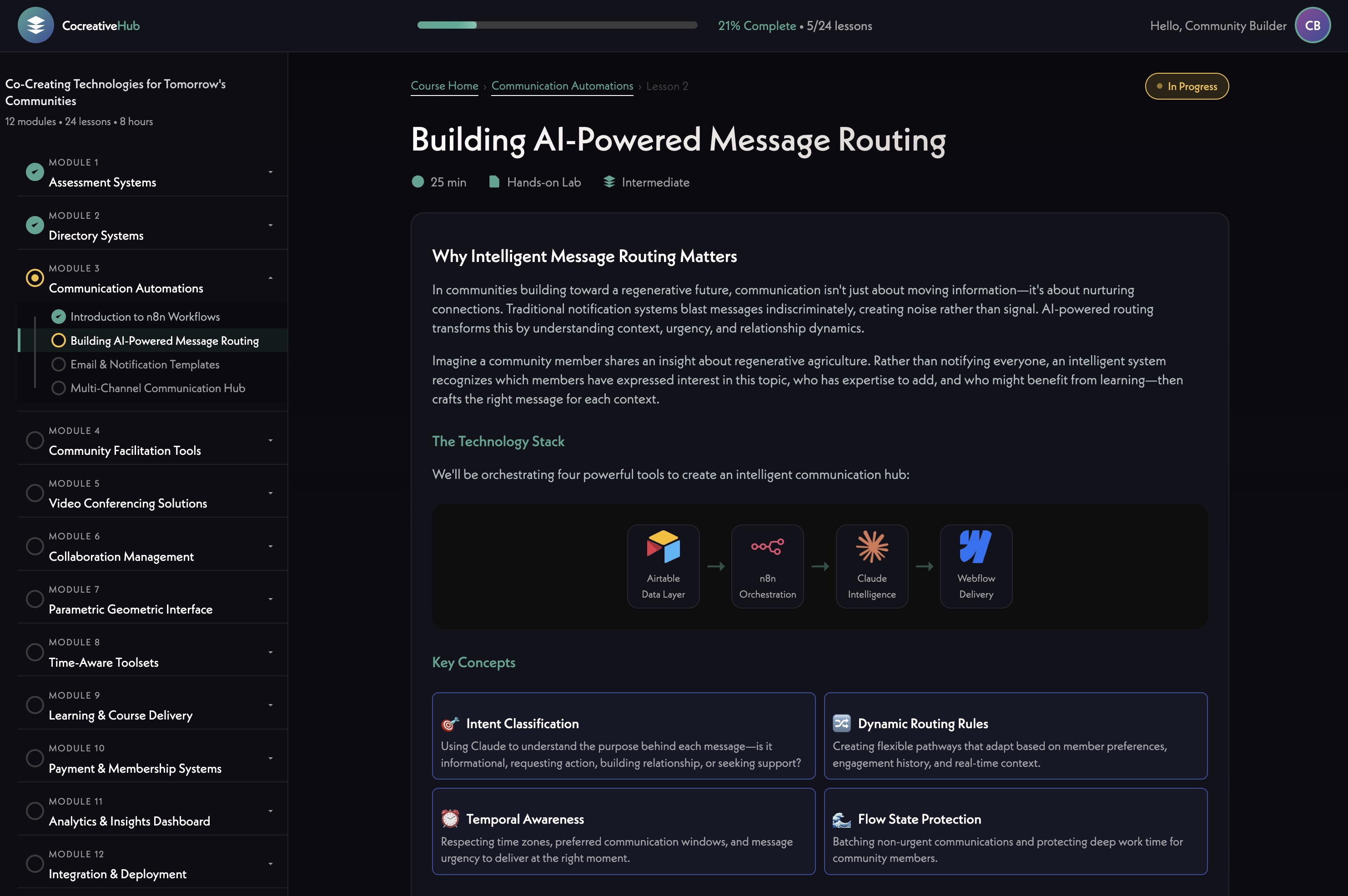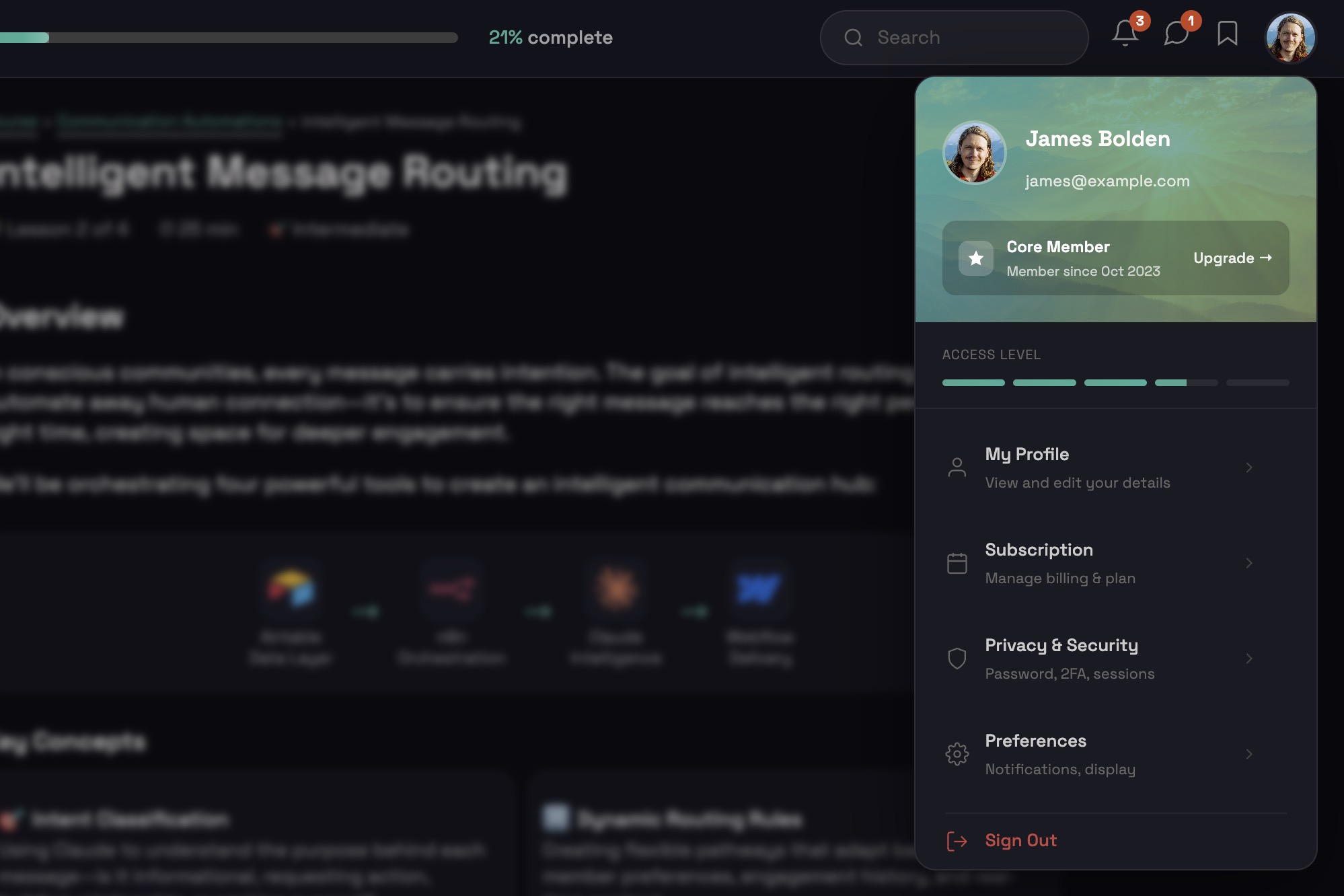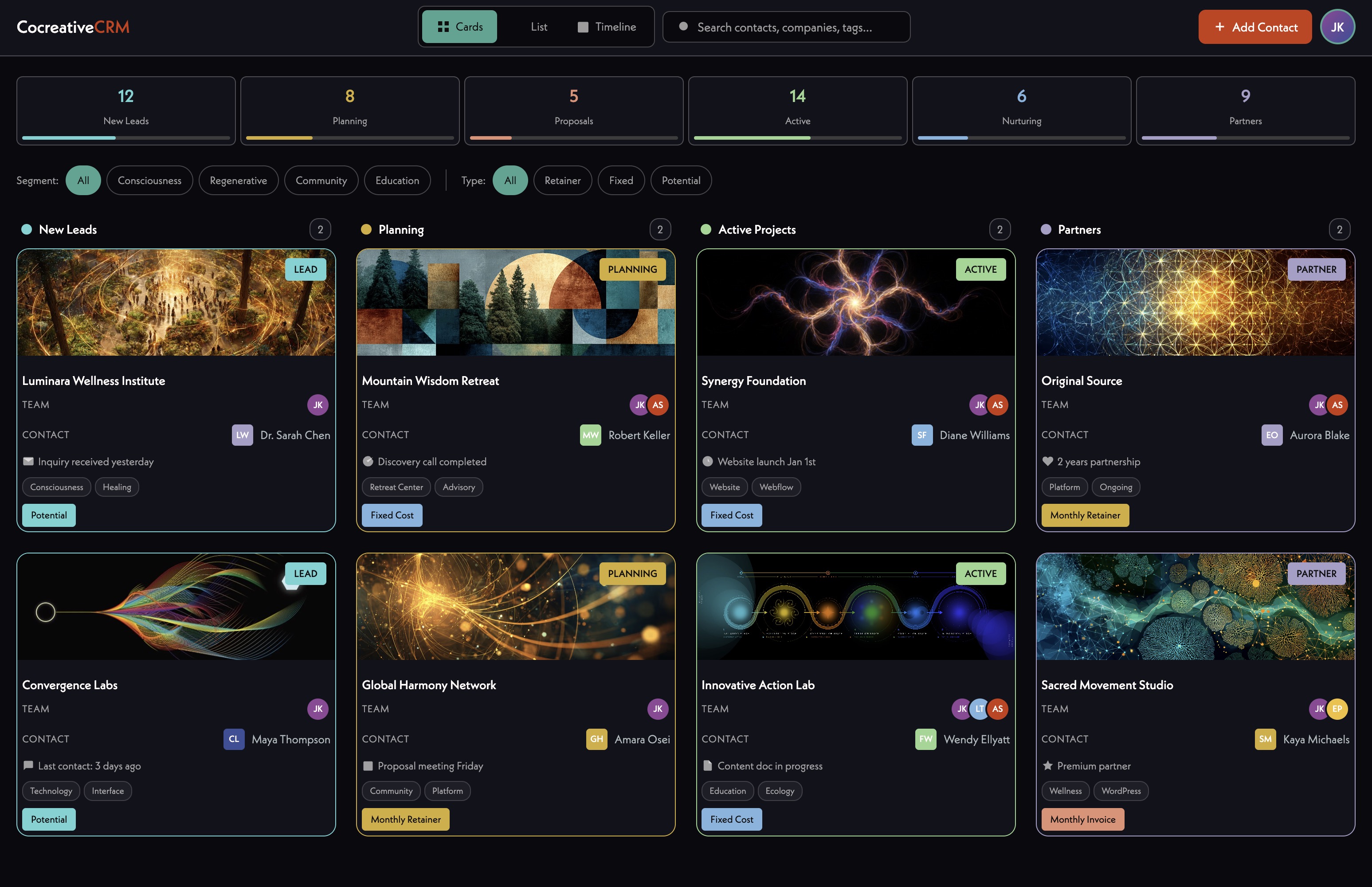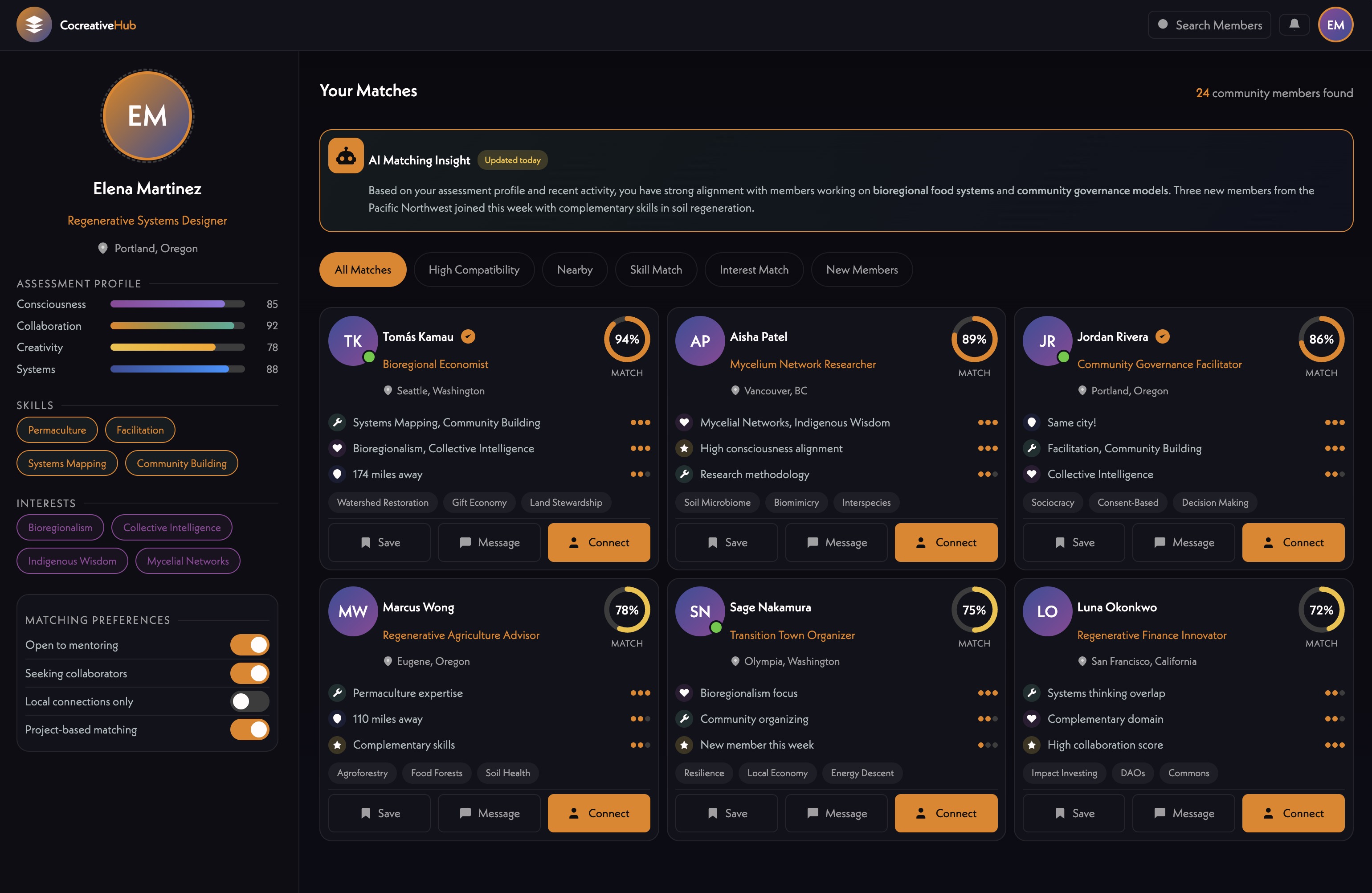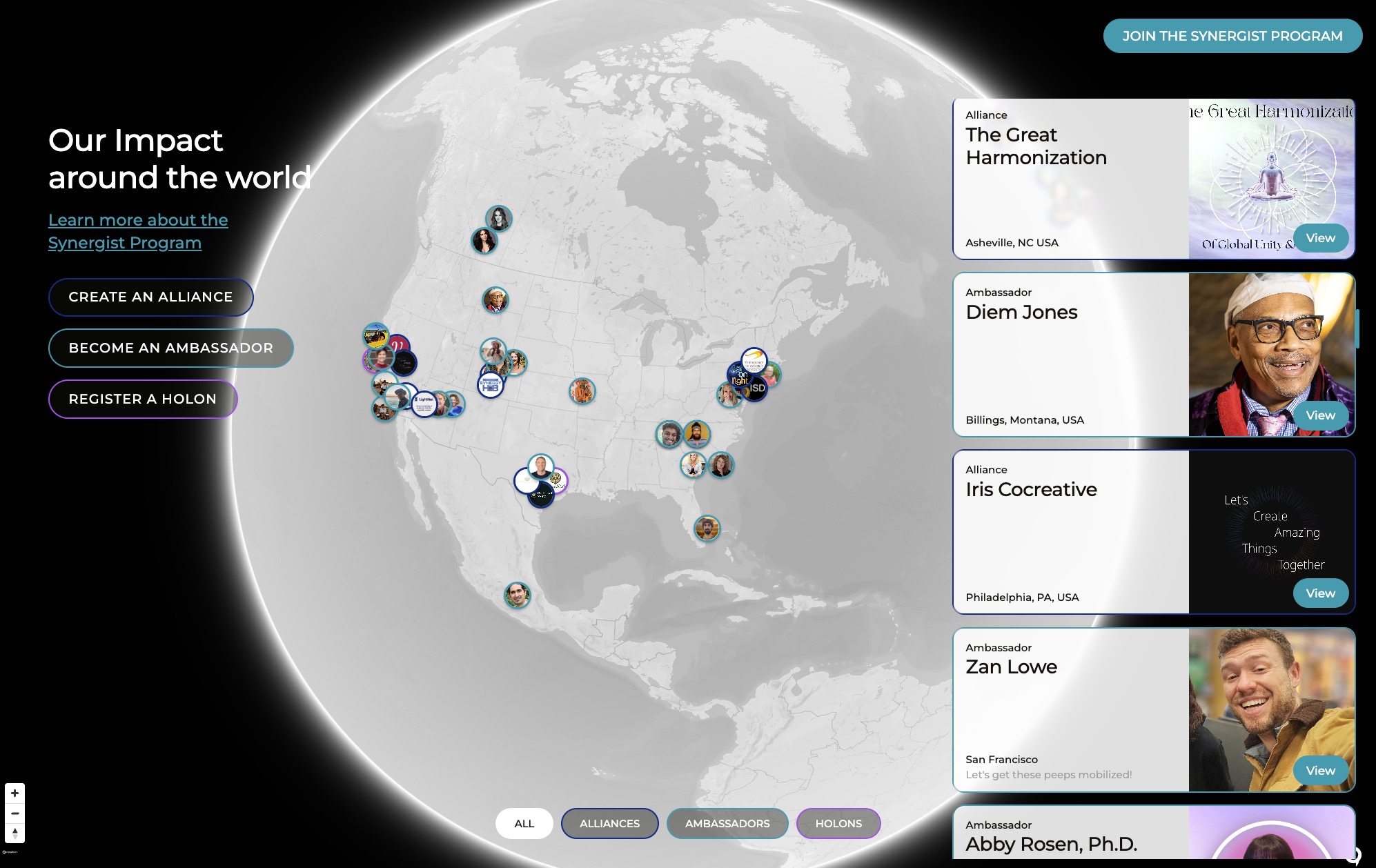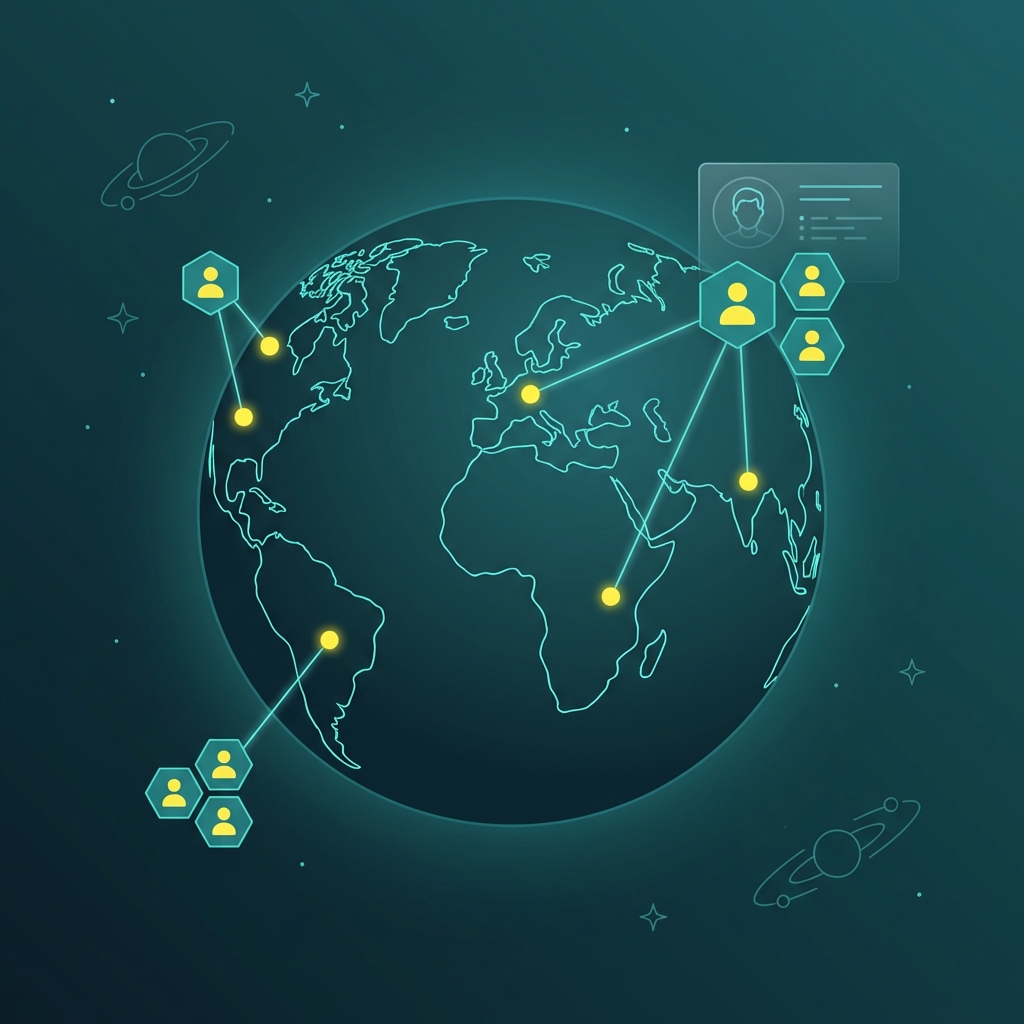




James walked the team through the new 3D globe navigation built with a lightweight custom rendering approach — no full Mapbox [tag="mapbox"] tile loading, just continent outlines — which keeps performance smooth and fluid (05:52). The globe features a toggle for switching to a flat view, hover-activated profile cards, and connection lines between members and their holons. People appear as yellow dots and holons as teal hexagons, with holons algorithmically placed at the center of their members rather than geolocated (01:22).
[technology="Parametric Geometric Interfaces"]
The live version is already pulling real profile data, with headshots appearing on hover (03:51). Michael Shaun flagged a scaling concern: the zoom doesn't resize nodes, so dense regions like the U.S. East Coast would become unreadable at scale. The team agreed that photos should appear on hover only to keep the graphical line-drawing style clean and scannable (04:44). Michael Shaun also suggested borrowing from Google Maps' progressive zoom behavior — at a certain depth, the globe could transition into a list or directory view showing nearby members, potentially integrated with matching (05:04).
James noted this architecture gives them full control to implement exactly that kind of layered zoom experience down the road (06:18). The map page will be forced to dark mode since the glowing member dots work best against a dark background — everyone agreed this is the right call (19:06).
James demoed the full sign-up and profile creation process, walking through it with a dummy user (09:38). The current approach is a linear, step-by-step flow — sign up, then complete your profile before accessing the directory. The team discussed whether to allow people to skip ahead and browse first, but Michael Shaun argued for keeping the linear flow initially to ensure data quality and prevent half-finished accounts cluttering the database (11:21). The consensus was to start strict and relax later if needed.
[technology="Custom Membership System"]
Key profile creation decisions:
The team discussed the tension between dark and light UI themes. Mariko shared that the Holomovement brand originally started dark, shifted to a brighter white/teal theme to align with values of joy, expansion, and awareness (13:54). The consensus: dark backgrounds should use a deep teal rather than pure black, and light mode should avoid stark white — perhaps incorporating subtle background patterns or gradients (14:35). Both modes should feel distinctly Holomovement. James confirmed the current prototype already uses a dark teal rather than true black, and he'll refine it further (16:39).
The holon creation flow mirrors the profile flow but needs refinement. Michael Shaun pushed for more action-oriented questions — instead of "Describe your holon," ask "What's your holon's project?" and instead of "Purpose," ask "What outcome do you hope to achieve?" (20:01). Hera suggested adding a definition of what a holon is right at the start, and the team agreed that completing a holon should require at least three members (21:09).
Hera outlined two user journeys for holon formation (22:08):
[technology="Communication Automations"]
For people who want to start a project but don't have three members yet, the team explored several approaches:
[technology="Intelligent Matching Algorithms"]
Mariko cautioned against letting incomplete holons clutter the platform — better to channel seekers through communication tools or a simple board than to create half-formed entities in the directory (24:24). Hera shared experience from a San Francisco tech community built on Webflow [tag="webflow"] that used profile tags for matchmaking (investors seeking founders, founders seeking co-founders) with an "Ask to be intro" button triggering automated double-opt-in introduction emails (29:40). The team found this pattern highly relevant.
[technology="Directory Systems"]
James also noted the need to define holon admin roles within the creation flow and to make member additions work as invitations rather than automatic adds (32:52). Color-coding will be refined: teal for holons (brand-aligned), yellow for synergists, with alliances to be introduced later (33:27).
James and Moenja have been working on UI designs in Figma and shared several directions (33:49):
For the directory cards, the team chose larger vertical player cards over horizontal layouts for the initial view — they feel more gamified and engaging, especially for displaying top matches (37:52). Horizontal cards may work better for expanded lists in the future. The vertical cards also maintain visual continuity with the Holomovement homepage's masonry grid (38:50).
Michael Shaun was clear: polish what exists before adding new features (39:46). No feeds or posting boards yet — focus on making the current profile creation, holon creation, directory, and map views work reliably and look great.
James committed to delivering by next Monday (41:20):
The team plans to seed the platform this week by having all core team members complete profiles and create holons. Monday/Tuesday: everyone finishes their profiles. Wednesday: each team member creates additional holons for groups they're part of, generating real invitation flows. Thursday's core team call will open with a review of the experience and feedback collection (43:53).
Hera raised the holon microgrants workflow — the team agreed it needs planning but shouldn't be built into the beta yet. A simple waitlist/join-the-beta page could go up early for promotion, with the full grants application gated behind holon tenure or activity requirements that still need definition (42:13).
James Redenbaugh
Mariko Pitts
Hera Barrameda
Michael Shaun Conaway
James walked the team through the new 3D globe navigation built with a lightweight custom rendering approach — no full Mapbox [tag="mapbox"] tile loading, just continent outlines — which keeps performance smooth and fluid (05:52). The globe features a toggle for switching to a flat view, hover-activated profile cards, and connection lines between members and their holons. People appear as yellow dots and holons as teal hexagons, with holons algorithmically placed at the center of their members rather than geolocated (01:22).
[technology="Parametric Geometric Interfaces"]
The live version is already pulling real profile data, with headshots appearing on hover (03:51). Michael Shaun flagged a scaling concern: the zoom doesn't resize nodes, so dense regions like the U.S. East Coast would become unreadable at scale. The team agreed that photos should appear on hover only to keep the graphical line-drawing style clean and scannable (04:44). Michael Shaun also suggested borrowing from Google Maps' progressive zoom behavior — at a certain depth, the globe could transition into a list or directory view showing nearby members, potentially integrated with matching (05:04).
James noted this architecture gives them full control to implement exactly that kind of layered zoom experience down the road (06:18). The map page will be forced to dark mode since the glowing member dots work best against a dark background — everyone agreed this is the right call (19:06).
James demoed the full sign-up and profile creation process, walking through it with a dummy user (09:38). The current approach is a linear, step-by-step flow — sign up, then complete your profile before accessing the directory. The team discussed whether to allow people to skip ahead and browse first, but Michael Shaun argued for keeping the linear flow initially to ensure data quality and prevent half-finished accounts cluttering the database (11:21). The consensus was to start strict and relax later if needed.
[technology="Custom Membership System"]
Key profile creation decisions:
The team discussed the tension between dark and light UI themes. Mariko shared that the Holomovement brand originally started dark, shifted to a brighter white/teal theme to align with values of joy, expansion, and awareness (13:54). The consensus: dark backgrounds should use a deep teal rather than pure black, and light mode should avoid stark white — perhaps incorporating subtle background patterns or gradients (14:35). Both modes should feel distinctly Holomovement. James confirmed the current prototype already uses a dark teal rather than true black, and he'll refine it further (16:39).
The holon creation flow mirrors the profile flow but needs refinement. Michael Shaun pushed for more action-oriented questions — instead of "Describe your holon," ask "What's your holon's project?" and instead of "Purpose," ask "What outcome do you hope to achieve?" (20:01). Hera suggested adding a definition of what a holon is right at the start, and the team agreed that completing a holon should require at least three members (21:09).
Hera outlined two user journeys for holon formation (22:08):
[technology="Communication Automations"]
For people who want to start a project but don't have three members yet, the team explored several approaches:
[technology="Intelligent Matching Algorithms"]
Mariko cautioned against letting incomplete holons clutter the platform — better to channel seekers through communication tools or a simple board than to create half-formed entities in the directory (24:24). Hera shared experience from a San Francisco tech community built on Webflow [tag="webflow"] that used profile tags for matchmaking (investors seeking founders, founders seeking co-founders) with an "Ask to be intro" button triggering automated double-opt-in introduction emails (29:40). The team found this pattern highly relevant.
[technology="Directory Systems"]
James also noted the need to define holon admin roles within the creation flow and to make member additions work as invitations rather than automatic adds (32:52). Color-coding will be refined: teal for holons (brand-aligned), yellow for synergists, with alliances to be introduced later (33:27).
James and Moenja have been working on UI designs in Figma and shared several directions (33:49):
For the directory cards, the team chose larger vertical player cards over horizontal layouts for the initial view — they feel more gamified and engaging, especially for displaying top matches (37:52). Horizontal cards may work better for expanded lists in the future. The vertical cards also maintain visual continuity with the Holomovement homepage's masonry grid (38:50).
Michael Shaun was clear: polish what exists before adding new features (39:46). No feeds or posting boards yet — focus on making the current profile creation, holon creation, directory, and map views work reliably and look great.
James committed to delivering by next Monday (41:20):
The team plans to seed the platform this week by having all core team members complete profiles and create holons. Monday/Tuesday: everyone finishes their profiles. Wednesday: each team member creates additional holons for groups they're part of, generating real invitation flows. Thursday's core team call will open with a review of the experience and feedback collection (43:53).
Hera raised the holon microgrants workflow — the team agreed it needs planning but shouldn't be built into the beta yet. A simple waitlist/join-the-beta page could go up early for promotion, with the full grants application gated behind holon tenure or activity requirements that still need definition (42:13).
James Redenbaugh
Mariko Pitts
Hera Barrameda
Michael Shaun Conaway
Polish UI across profile creation, directory, and holon views for delivery by Monday
February 24, 2026
Deliver polished UI across all existing views including profile creation, directory, and holon views. Focus on visual refinement and consistency rather than new features. Discussed at 39:46 and 41:20.
Implement member invitation flow for holons with automated email triggers
February 24, 2026
Build member invitation functionality for holon creation where founders can enter emails for missing members, triggering invitation emails with accept/confirm flows and follow-up reminders after three weeks of non-response. Supports both pathways: three existing members tagging accounts together, and one/two registered members inviting others. Discussed at 22:08 and 32:52.
Display holons on globe map and enforce dark mode on map page
February 24, 2026
Get holons displaying on the globe map as teal hexagons algorithmically placed at the center of their members rather than geolocated. Force dark mode on the map page since glowing member dots work best against dark background. Discussed at 01:22 and 19:06. Part of Monday delivery commitment at 41:20.
Start shared Google Doc for collaborative editing of profile questions, domain labels, and tag language
February 20, 2026
Create shared Google Doc enabling collaborative refinement of all user-facing questions, prompts, labels, and microcopy across profile creation, holon creation, and directory interfaces. Support action-oriented language improvements like changing 'Describe your holon' to 'What's your holon's project?' and 'Purpose' to 'What outcome do you hope to achieve?' Discussed at 20:01 and 40:24.
Push all core team members to complete profiles within next two days
February 18, 2026
Coordinate with all core team members to ensure everyone completes their profiles by Monday/Tuesday as part of platform seeding strategy. This generates real profile data for testing and validates the user experience before broader beta launch. Discussed at 43:53 and 44:02.
Lead Thursday core call with profile and holon creation experience review and feedback session
February 20, 2026
Open Thursday's core team call with structured review of everyone's profile creation and holon creation experience. Collect feedback on UX, bugs, confusing language, and feature requests. This follows the Monday/Tuesday profile completion and Wednesday holon creation seeding activities. Discussed at 44:02.
Complete own profile setup in beta platform
February 18, 2026
Complete personal profile in the beta platform as part of core team seeding and to experience the user flow firsthand. Mentioned at 00:24.
Document all holon creation user journey options discussed in meeting
February 20, 2026
Create comprehensive documentation of all holon creation pathways discussed: (1) three existing members tagging accounts together, (2) one/two registered members inviting others via email, (3) seekers using 'looking for members' tags in directory, (4) holon board for project postings, (5) matchmaking through directory search. Include technical considerations and team decisions for each pathway. Discussed throughout 22:08-32:52.
Draft microgrant application flow, gating requirements, and waitlist page concept
February 24, 2026
Define holon microgrant application workflow including tenure/activity requirements for eligibility, application process, and simple waitlist/join-the-beta page that could launch early for promotion before full grants system is built. Team agreed grants functionality shouldn't be built into beta yet but needs planning. Discussed at 42:13.
Encourage core team to submit feedback through in-app feedback form during testing
February 20, 2026
Promote use of the in-app feedback form (already live at 40:54) among core team members during profile creation and holon formation testing. Ensure bugs, UX issues, and feature requests are being captured systematically. Discussed at 44:19.
Complete own profile in beta platform
February 18, 2026
Complete personal profile setup in the beta platform as part of core team seeding. Experience the user flow firsthand and be ready to create holons by Wednesday. Mentioned at 06:50.
Create additional holons by Wednesday to seed platform with real data
February 19, 2026
After completing own profile, create multiple holons for groups and projects currently involved in. This generates realistic test data, validates the three-member model, and exercises the invitation flow with real users. Part of Wednesday seeding phase discussed at 43:53 and 44:41.
Refine dark mode teal background color to align with Holomovement brand values
February 24, 2026
Adjust dark background to use deep teal rather than pure black, aligning with Holomovement brand values of joy, expansion, and awareness. Light mode should avoid stark white and potentially incorporate subtle background patterns or gradients. Both modes should feel distinctly Holomovement. Discussed at 13:54, 14:35, and 16:39.
Add hover-only photo display to globe map to maintain clean graphical style
February 24, 2026
Ensure profile photos only appear on hover rather than displaying constantly on the globe map. This keeps the line-drawing graphical style clean and scannable while still showing profile details on interaction. Team consensus at 04:44.
Implement friendly nudge when users skip bio field in profile creation
February 24, 2026
Add gentle encouragement prompt when users attempt to proceed without completing their bio field during profile creation. Photo and bio should be strongly encouraged to ensure data quality. Discussed at 12:42.
Add engaging loading screen copy during AI profile generation
February 24, 2026
Create engaging loading screen copy (e.g., 'making connections', 'finding your tribe') to keep users entertained during profile generation and AI banner image creation. Discussed at 15:15.
Make holon creation questions more action-oriented focusing on projects and outcomes
February 24, 2026
Revise holon creation questions to be more action-oriented: change 'Describe your holon' to 'What's your holon's project?' and 'Purpose' to 'What outcome do you hope to achieve?' This makes the creation process more concrete and accessible. Discussed at 20:01. Should be handled in the collaborative Google Doc.
Add holon definition text at start of holon creation flow
February 24, 2026
Include clear definition of what a holon is at the beginning of the holon creation process to help new users understand the concept before they start creating. Suggested by Hera at 21:09.
Enforce three-member minimum requirement for holon completion
February 24, 2026
Implement business logic requiring at least three confirmed members before a holon can go live in the directory. This prevents incomplete holons from cluttering the platform. Team consensus at 21:09 and 24:24.
Define holon admin roles within creation flow
February 28, 2026
Define and implement admin role system for holons within the creation workflow. Make member additions work as invitations rather than automatic adds. Discussed at 32:52. This needs architectural planning beyond the immediate Monday delivery.
Implement directory filter tags including 'looking for members' and 'looking for a holon'
March 7, 2026
Add user-selectable tags enabling filtered discovery of people seeking collaborators or projects to join. Supports organic holon formation without requiring a separate holon board initially. Discussed at 26:00 and 28:16. Not part of immediate Monday delivery per 'polish before adding features' guidance at 39:46.
Explore progressive zoom behavior transitioning globe to list view at deep zoom levels
March 15, 2026
Research and prototype progressive zoom behavior borrowed from Google Maps patterns where deep zoom transitions from globe visualization to list/directory view showing nearby members. Could integrate with matching algorithms at this layer. Discussed at 05:04 and 06:18. This is a future enhancement not needed for beta.

Add gradient background to alignment graph for improved readability
February 24, 2026
Add gradient background to the connection strength visualization graph to improve readability of overlapping bubbles. Suggested by Michael Shaun at 35:01. Part of UI refinement work with Moenja.
Strategic enhancement of directory system integrating with membership capabilities to enable member profile management, progressive assessment completion, and intelligent matching. Members can log in and edit their profiles directly with information stored in Supabase for flexible content management. Progressive engagement model starts with basic five-minute setup (name, website, purpose statement, location), then enables detailed assessments later. Each completed assessment adds profile elements and unlocks features including AI-generated visual representations (icons, tarot archetypes, numerology graphics). Integration with Claude AI enables sophisticated queries like 'who should I collaborate with on this project?' or 'who can provide funding?' across network assessment data. Advanced features include weekly emotional mapping interface with six-axis emotional space (excitement, nervousness, grief, etc.) aggregating into community climate visualizations. Reimagined map interface using flat Earth projection with layered filtering showing member locations, funding flows, collaborative connections, project relationships. Multiple view modes from simplified default to complex multi-layered 'Arcturian' views. Integration with Engine for Good grant program where applications link to member profiles, creating incentive structure for profile completion. Team pivoted to prioritize directory system over LMS development. Player card approach focuses on game-like profiles emphasizing what someone is doing (project/mission) and what help they need for AI-powered matching. System summarizes lengthy inputs into concise scannable formats. MVP launch target February 15 with login capability, profile editing, and integrated assessments. Beta testing program follows to identify next priority features. Critical development discussion revealed MapBox visualization provides initial visual interest but limited practical value beyond local connections - intelligent matching algorithms represent the true 'killer app' rather than map visualization. Profile data strategy shifting from personality assessments to actionable information: developmental stage, experience level, current project involvement, specific skills, and active needs. Visual consistency issues identified with user-uploaded images requiring standardization. Question emerged whether Holons function as independent entities or collections of individual members, requiring data architecture decisions. Simplified terminology 'members and groups' proposed over 'Holons' for newcomer clarity. Basic intake form planned capturing development level, experience, life stage, purpose, and current needs as primary assessment for matching foundation. Player card UI concept introduced featuring icons to symbolize key information, AI-generated summaries to condense lengthy responses, and achievement badges displaying completed courses, assessments, and accomplishments. Design iteration process planned where team scans test cards to validate information hierarchy. Sandbox database creation for core team to fill out profiles and review each other's player cards as real-world test. Prototype development progressing with profile creation, editing, viewing, and password resets functional in Supabase. Munia developing first draft UI designs. Team agreed to reduce text density, create more visual/scannable interfaces. Multiple views prototyped: alliance view, profile editing, directory search (list and map-based), member profiles, holon profiles. Core intake fields defined: name, date of birth, email, phone/SMS/WhatsApp, location, purpose/mission, gifts and requests, alliance affiliations, short bio (150 words max), photo. Matching deferred from numerical compatibility scores to simpler connection signals: complementary skills, matching needs/offers, alliance overlap, geographic proximity, shared purpose domains. AI interpretation via Claude for free-text fields, direct computation for explicit matches. App functionality to be hosted on separate subdomain (app.holomovement.net) with member-specific navigation, syncing public profile data to main site member globe. End of February target for core team interactive prototype. 3D globe navigation now live with lightweight custom rendering approach using continent outlines without full Mapbox tile loading for smooth performance (05:52). Globe features toggle for flat view, hover-activated profile cards, connection lines between members and holons. People appear as yellow dots, holons as teal hexagons algorithmically placed at center of members (01:22). Profile creation flow implemented as linear step-by-step process requiring profile completion before directory access (09:38). Photos strongly encouraged with friendly nudges if skipped, social profiles optional. AI-generated banner images based on user bios producing resonant results (15:47). Light/dark mode toggle available inheriting system settings by default (16:39). Dark backgrounds using deep teal rather than pure black, light mode avoiding stark white to maintain Holomovement brand feel (14:35). Vertical player cards chosen for directory view over horizontal layouts for gamified engaging presentation (37:52). Team seeding platform this week with core team members completing profiles Monday/Tuesday, creating holons Wednesday, reviewing experience Thursday core call (43:53). Polish focus prioritized over new features with delivery target Monday February 17 (41:20). New bento-style profile layout introduced with rounded corners, centered tagline, framed profile image, and subtle background color differentiation between sections (14:21). Rich text field with optional image upload added to represent projects or organizations more expressively beyond plain text (32:10). Testimonials system (potentially rebranded as 'Send Some Love' or 'Share the Love') enables mutual endorsements with reciprocal vouching mechanics (34:54). Field feature replacing 'wall' concept allows users to post updates and collaborative content with pinning capability (39:43). Long-term vision includes drag-and-drop section ordering for personalized profile storytelling. Assessment display framework showing sliders across domains added as visible badges on profiles. Seeking/Offering keywords auto-distilled from freeform text using AI summarization to aid readability and matching. On-demand match experience triggered by 'Match Me' button generates side-by-side comparison modal with numerical score (1-100, shown on hover), loading animation, and meaningful dimensions including complementary skills, needs/offers alignment, shared alliances, overlapping domains (26:00, 19:02). Match score and comparison view designed as sticky gamified feature incentivizing profile completion (24:35). Domain categories refined: 'Economics and New Systems' → 'Economics and Collaborative Commerce', 'Governance and Social Change' split into 'Collaborative Governance' and separate social change, 'Spiritual Activism and Inner Development' → 'Spirituality and Consciousness', additions include Ethics and Philosophy, Science, Leadership and Facilitation as 12th domain, potential Psychology embedded in community/relationships (43:00-48:22). Onboarding copy and tooltip language prioritized for clarity on unfamiliar terms with short hover descriptions (one sentence max). Implementation timeline: 7-10 day dev window for new design style, Field feature, preliminary matching functionality followed by internal testing with core four, then broader core team rollout (41:07, 40:08). First impressions prioritized with cautious rollout protocol to ensure solid initial experience. Messaging icon refined from email-style button to message icon to better reflect in-platform nature (13:29). Notifications aggregate into single indicator on Holon icon with changing number rather than multiple dots. Three profile image preview styles (circle, square, doorway/vertical) included in signup flow to ensure photos work across all use cases (07:44). In-app messaging system now live using custom-built architecture with no per-message cost, styled similar to iMessage with unread message counts, conversation threading, and future group chat capability (09:37). Email notifications handled via Resend - free up to 3,000 emails/month, then $20/month for up to 50,000 (23:56). Holon management flow improved with clear delegation model between members and admins using invitation system rather than automatic adds (04:08). Location automation uses lightweight AI call to convert entered location into coordinates for near real-time map updates (26:27). Saving bug affecting profile updates, feedback, and location syncing identified and resolved during meeting (26:27). Community consent flow being added as pop-up on first messaging use with scrollable community agreements and required checkboxes covering non-partisanship, anti-spam, entity usage rules, and conduct standards (18:00). GDPR compliance considerations noted with Webflow plugin available for data erasure rights and cookie consent (17:46). Pay What You Want contribution system now under active development with slider UI allowing users to select suggested range ($15-$20/month) with secondary scholarship tier option for lower amounts. Two-screen approach framed as gift rather than discount with wave-based slider visual showing increasing amplitude. System includes familiar Stripe checkout supporting Link, Amazon Pay, and other methods. PayPal integration planned for better international accessibility (18:35, 19:30). Working wave-amplitude slider prototype built with predefined moments shifting wavelength visually, translatable directly into payment UX (19:47). Prototype ready for core team testing within next couple days with front-end UI included (53:10). Thursday core team meeting target for showcase (54:22). Modal menu interface introduced featuring compact notification/settings control with light mode toggle - described as small detail that meaningfully elevates experience (38:05). Three developers now working on Webflow implementation: Sean (Ohio, senior), Siam (Pakistan, junior), with Ivan handling less bandwidth due to outside client work (34:00). Profile creation, editing, and regeneration flows confirmed working (04:14). Holon page active development with wheel of faces arc rendering, domain icons, and My Holons view improvements (04:14). Empty state for My Holons will show helpful message plus grid of all existing Holons to orient new users (21:50). Profile edit mode link navigation disabled to prevent losing unsaved changes (27:08). Profile image edit icon made more prominent (30:58). Banner image regeneration icon will get rollover tooltip explaining 'replace your banner' functionality (32:25). Skills rating feature demoed allowing users to rate themselves with visual bar indicators (44:04). Location map tooltip added showing actual location name on hover (23:11). Profile creation link added directly to member modal enabling logged-in users to re-run full onboarding flow (42:31). Test accounts and Holons being cleaned up before team-wide invite (06:47). Core team onboarding structured as daily feature drip: Day 1 profile creation, Day 2 assessment prototype, following days Holons/map/matching features one at a time (16:11). Homepage updates in progress including background color correction, animation circle restoration, scroll sequence improvements, auto-scroll implementation, mobile type scaling, icon-only logo, and updated CTA button (44:35). Dynamic map will become hero element of homepage with card preview leading to login/profile creation for non-members (52:57). Tag-based matchmaking architecture outlined: profiles generate seeking/offering/domain/focus tags, periodic comparison produces alignment scores, directory displays highest-alignment profiles larger and left-aligned (01:01:36). Sean actively working on matching grid view implementation (01:00:56). Wave event preparation targeting participants leaving activation day already inside at least one Holon using app as live tool (58:30). James confirmed ready to lead app presentations at wave event. One-to-two minute intro video of ecosystem planned for wave event (01:00:07). Platform designed as coordination layer - not an organization but a medium, connective tissue, energetic petri dish for collaboration to grow (20:30). Wave serves as on-ramp for Saturday-Monday - people get on the spaceship, then continue exploring projects, holons, and neighbors in platform Tuesday onward. 'We come together and create these big bonfires. We want ways to keep these campfires burning through the year' (55:30). Post-Wave system successfully operational with Portugal map section densely populated showing honeycomb patterns around Lisbon and Spain hubs. Meeting 06-16 identified map zoom scaling issue (13:53) - member dots need to proportionally shrink as users zoom in to maintain functionality at high-density locations. Profile image tooltip needed under editing icons since users don't know how to change pictures. Homepage globe visibility toggle required since names and locations display without explicit opt-in. Profile tab renamed from 'About' to 'Info' and repositioned as first tab for better UX.
Define data architecture and entity management approach for organizational units within the system establishing framework for how users, individuals, and groups are categorized. Core user model establishes everyone enters system as Individual first ensuring platform's primary impact centers on connecting people rather than organizations. After creating individual profile, users can join or create Holons (project-based groups with specific outcomes and impact goals) and affiliate with Alliances (mission-aligned organizations sharing values with Holomovement but may not have active projects within system). Holons are project-oriented requiring three administrators for security and continuity - if one administrator becomes inactive, two others maintain access to manage Holon profile. Multi-step creation process: one person drafts Holon and identifies two other administrators by email, those two individuals receive confirmation emails, and once they confirm participation (creating individual profiles if needed), Holon profile goes live. Founding three administrators have full editing access with ability to elevate additional members to administrative status later. Alliances represent mission-aligned organizations where users can self-declare affiliation similar to LinkedIn company profiles without formal approval. Team using themselves as first test group creating individual profiles, registering businesses as Alliances, and forming Holons based on actual project work. This validates system architecture with real-world use cases, demonstrates transparency showing how Holomovement operates internally, and dissolves inside-versus-outside dynamic that often exists in community platforms. Sandbox database initially with core team members to test system before expanding to broader team and migrating existing user data. Matching hierarchy established: Individual to Individual (priority 1), Individual to Holon (priority 2), Holon to Individual (priority 3), Holon to Holon (priority 4). Alliance-to-Alliance connections happen primarily through leadership conversations rather than software. Hybrid taxonomy strategy combining fixed high-level categories with AI-generated flexible sub-tags. Seven to nine fixed categories each with icon and visual identity providing newcomers clear 'lay of the land.' AI agent may automatically generate and organize categories based on how people describe their Holons allowing adaptive evolution as community grows. Key matching information includes developmental level, life stage, purpose, needs and offers, domain focus, formalization level, activity level, and geographic location. Critical filtering categories for initial launch: domain/focus (what group works on), what group needs (funding, visibility, structure), what group offers (projects, learning, mentorship, impact, belonging), activity level (active, dormant, occasional), formalization level (informal, loose, institutional). Self-assessment data like Human Design and numerology incorporated into player cards providing deeper understanding beyond skills and experience. Meeting confirmed simplified explanations for onboarding: 'a holon is a group of people with a shared project or outcome' rather than full theoretical framework. Alliance affiliations limited to community-relevant entities. Core intake fields finalized: name, DOB, email, phone/SMS/WhatsApp, location, purpose/mission, gifts and requests, alliance affiliations, short bio (150 words max), photo. Holon creation flow needs action-oriented questions: 'What's your holon's project?' instead of 'Describe your holon' and 'What outcome do you hope to achieve?' instead of 'Purpose' (20:01). Definition of holon should appear at start of creation flow (21:09). Two primary user journeys for holon formation: three members already on platform simply tag accounts together, or one/two members registered with creator entering emails for missing members triggering automated invitation emails with accept/confirm flows and three-week follow-up reminders for non-response (22:08). For people wanting to start project without three members yet, solutions include holon board functioning like job posting board with tag-based browsing (28:16), directory tags like 'looking for members' or 'looking for a holon' for filtered discovery (26:00), or encouraging registration as individuals first to use matching and search for finding collaborators before forming holons organically (25:34). Team cautioned against incomplete holons cluttering platform - better to channel seekers through communication tools or simple board (24:24). San Francisco tech community Webflow example used profile tags for matchmaking with 'Ask to be intro' button triggering automated double-opt-in introduction emails (29:40). Holon admin roles need definition within creation flow with member additions working as invitations rather than automatic adds (32:52). Color-coding refined: teal for holons (brand-aligned), yellow for synergists, alliances introduced later (33:27). Core team seeding platform this week: Monday/Tuesday profile completion, Wednesday holon creation for real groups generating invitation flows, Thursday core call reviewing experience and collecting feedback (43:53). Holon eligibility checklist pop-up being drafted explaining what Holon is and confirming three or more people with active transformative project before surfacing creation flow (27:44). Pop-up may eventually include dropdown of existing Holon examples or carousel of most relevant active Holons surfaced via matching algorithm (31:46).
Custom membership system architecture for user authentication, progress tracking, and database management using Supabase for backend. Requirements include real database for user progress (not cookies), journal entry capture, API triggers for membership status and course purchases, and progress tracking across sessions. Decision made to build custom solution on Supabase rather than Member Stack. Includes Stripe integration for subscription management and automatic access revocation when subscriptions lapse. Multiple products may connect to same membership tier with bundled offerings granting multiple memberships from single purchase. Part of Phase One development with $16K-$29K budget. Requires hiring Supabase specialist for implementation. Timeline aligned with LMS development for February 10th launch. Authentication spike will establish foundation with Supabase login functionality on MAST template, implementing user profiles, password management, and session handling. System will sync membership status between Stripe and Supabase for automated access control. Backend successfully operational with membership login and content gating complete using Supabase and Stripe. Profile editing integration in progress to connect with directory system. Backend approximately 90% complete with primary goal to deliver working version on Holomovement site for team testing this week allowing account creation, login, and profile data editing. Front end minimal at this stage consisting mainly of login pages until profile pages developed. Profile creation flow now implemented as linear step-by-step process requiring profile completion before directory access. Sign-up flow includes friendly nudges for empty bios when hitting next, optional social profiles with language like 'you can always come back later' to reduce drop-off, loading screen during profile generation with engaging copy like 'making connections', AI-generated banner images based on user bios, and light/dark mode toggle inheriting system settings by default. System enforces profile completion to ensure data quality and prevent half-finished accounts cluttering database. Dark backgrounds use deep teal rather than pure black, light mode avoids stark white to maintain Holomovement brand feel. Simplified pill-style member modal implemented with collapsed/expanded states showing two lines by default, expanding on hover to reveal icons for messages, Holons, and light/dark mode toggle. Notifications aggregate into single indicator on Holon icon with changing number rather than multiple dots. Three profile image preview styles (circle, square, doorway/vertical) included in signup flow to ensure photos work across all use cases. In-app messaging system now live using custom-built architecture with no per-message cost, styled similar to iMessage with unread message counts, conversation threading, and future group chat capability. Email notifications handled via Resend - free up to 3,000 emails/month, then $20/month for up to 50,000. Holon management flow improved with clear delegation model between members and admins using invitation system rather than automatic adds. Location automation uses lightweight AI call to convert entered location into coordinates for near real-time map updates. Saving bug affecting profile updates, feedback, and location syncing identified and resolved during meeting. Community consent flow being added as pop-up on first messaging use with scrollable community agreements and required checkboxes covering non-partisanship, anti-spam, entity usage rules, and conduct standards. GDPR compliance considerations noted with Webflow plugin available for data erasure rights and cookie consent. Pay What You Want contribution system now under active development with slider UI allowing users to select suggested range ($15-$20/month) with secondary scholarship tier option for lower amounts. Two-screen approach framed as gift rather than discount with wave-based slider visual showing increasing amplitude. System includes familiar Stripe checkout supporting Link, Amazon Pay, and other methods. PayPal integration planned for better international accessibility. Working wave-amplitude slider prototype built with predefined moments shifting wavelength visually, translatable directly into payment UX. Prototype ready for core team testing within next couple days with front-end UI included. Thursday core team meeting target for showcase. Modal menu interface introduced featuring compact notification/settings control with light mode toggle - described as small detail that meaningfully elevates experience. Three developers now working on Webflow implementation: Sean (Ohio, senior), Siam (Pakistan, junior), with Ivan handling less bandwidth due to outside client work. Profile creation, editing, and regeneration flows confirmed working as of 03-31 meeting. Profile creation link added directly to member modal enabling re-run of full onboarding flow. Core team onboarding structured as daily feature drip starting with profile creation. 03-31 crash test revealed critical blocking issues preventing core team demo: n8n automation pipeline failing to complete profile data processing reliably, social links not saving due to LinkedIn field dependency, AI-generated cover image and tagline entering loop state without completing, JSON input error halting holon creation mid-flow, logout bug on holon detail page, light mode broadly non-functional requiring toggle to be hidden entirely, profile content fields not populating after form submission. Team consensus: crash test failed, reconvening following day to retest after critical fixes. Zero tolerance for processes locking up or halting before core team demo - visual imperfections acceptable but no mid-flow stoppage permitted. Hubcast partnership introduces potential single sign-on integration explored with developer Emilio Lopez enabling seamless profile creation handshake between broadcast access and Holomovement App reducing friction for new users discovering platform via livestream. Profile creation becomes the access ticket for global broadcast viewers immediately placing them inside ecosystem where they discover collaboration features. System now functional and operational with core team beginning onboarding process (meeting 05-04). Post-Wave deployment successful with members actively using platform. Critical gaps identified in 06-16 meeting: users cannot delete accounts (GDPR violation with European user base), users cannot remove themselves from Holons, stewards cannot remove members, automatic member addition on Holon creation needs approval workflow, privacy controls needed for Holon visibility, homepage globe displays names/locations without explicit opt-in requiring visibility toggle, cookie consent banner required for European compliance, Stripe webhook test-mode errors surfacing. Account deletion and member management now top cleanup priorities.
Comprehensive redesign of About page focusing on clear value proposition and ecosystem messaging. Key objectives include answering 'What is Holomovement?' immediately in hero section for first-time visitors from ad campaigns with concise statement explaining Holomovement as global network of gatherings, initiatives, and collaborators. Replace 'Underview Effect' section with 'Holomovement Effect' content focused on collective higher frequency states, emotional scale awareness, and conscious choice. Underwater wave imagery relocated to Wave page where more appropriate. Animation development showing text transitions incorporating logo movement connected to scroll. Visual hierarchy improvements to balance Purpose Earth partnership integration without overwhelming Holomovement branding. Creation of partners CMS collection for logos displayed in random order to avoid hierarchical implications as partnerships grow. Refinement of copy emphasizing 'living ecosystem' or 'operating system' positioning rather than just 'movement,' making initiative more fundable and easier to understand. Ecosystem serves as infrastructure for emergence, supporting complex living systems fostering higher frequency states and radical collaboration. Ongoing iteration to make language as plain-spoken and inspiring as possible. Potential renaming of page from 'About' to 'Manifesto' to better reflect content nature. About page redesign complete with Iván and Melina finalizing design elements. Design reached 100% approval with development taking one to two days to implement on live site. Implementation complete and integrated. Partner logo normalization in progress with Hera working with Ivan to standardize sizing, invert colors where needed, make backgrounds transparent, and implement grid layout for clean intentional presentation (45:54, 46:20). Purpose Earth project slider section being added showcasing funded projects - four from 2025 and two from 2024 totaling around 572,000 people across 64 projects in 35 countries (52:11). Hera has assembled content and Jill has added photos and support details to collaborative document (51:39). Michael Shaun provided simple wireframe with horizontal slider and dot indicators which design team will elevate (49:01). Slider cards will be compact with pop-up or modal for deeper project detail (53:08). Engine for Good graphic needs recreation in current brand style by Munia (53:19). Slider format designed to be replicable for future microgrant showcases tied to Engine for Good waves (51:18). Homepage and About page animation work in progress requiring prioritization following style shift from dark teal to lighter white-world aesthetic. 03-31 meeting confirmed About page nearly complete with final implementation needed - James checking with Yvonne on status (53:29).
Custom 3D globe navigation system for member and holon visualization using lightweight rendering approach with continent outlines rather than full Mapbox tile loading for smooth performance. Globe features toggle between 3D and flat views, hover-activated profile cards showing member photos and information, and connection lines visualizing relationships between members and holons. Members appear as yellow dots, holons as teal hexagons with algorithmic placement at center of member clusters rather than geographic coordinates (01:22). System pulls real profile data dynamically with headshots appearing on hover (03:51). Dark mode enforced on map page since glowing member dots work best against dark backgrounds using deep teal rather than pure black (19:06, 14:35). Future enhancements include progressive zoom behavior borrowing from Google Maps patterns - at certain zoom depth globe transitions to list or directory view showing nearby members with potential matching integration (05:04). Architecture provides full control for implementing layered zoom experiences. Scaling considerations addressed including node resizing on zoom to prevent dense regions like U.S. East Coast from becoming unreadable (04:44). Photos appear only on hover to maintain clean graphical line-drawing aesthetic. System represents parametric approach to data visualization translating member relationships and geographic data into spatial interactive experience. Globe visualization provides initial visual interest but team recognizes intelligent matching algorithms represent true platform value beyond map display. Custom rendering approach gives platform distinctive visual identity while maintaining performance at scale. Connection axis visualization refined with subtle dividing line and potential arrowheads to make 'strong alignment / broader exploration' spectrum immediately readable at a glance (11:03). Logarithmic-style axis gives more visual space to closer connections. Color system expanded with distinct colors for Seeking and Offering states, and individual colors per domain tag (08:30). Highlight color flagged as slightly too dark for readability requiring palette revision. Newer version of globe interface now features animated lines rising over sky, wrap/unwrap hologram-like animation on globe itself, and nation borders being added for better member orientation (21:29). Team responded enthusiastically calling it 'a big hit' with strong positive reception. Design refinement notes: nation borders should be kept close to background color so continent outlines pop more strongly, transparency/see-through hologram effect on globe noted as striking and intentional. Prototype ready for core team testing within next couple days targeting Thursday showcase (53:10, 54:22). 03-31 crash test identified map rendering worse than previous version requiring revert to last stable state while addressing country vs continent line contrast issue (09:37). James working on making country border lines lighter while keeping continent outlines more prominent but encountering rendering quirk where national borders drawn twice (once per country) making them appear heavier than intended.
Communication automation workflows supporting holon formation through multiple pathways. Primary workflow handles three-administrator holon creation process: founding member drafts holon and identifies two additional administrators by email, system sends automated confirmation emails to identified administrators requesting participation acceptance, recipients create individual profiles if needed before confirming, and once both confirmations received holon profile goes live (22:08). Workflow includes three-week follow-up reminder emails for non-responding invitees. Secondary workflows support users seeking to form holons without existing team members including potential holon board posting system functioning like job board with tag-based browsing for project ideas seeking members (28:16), automated double-opt-in introduction emails connecting individuals tagged as 'looking for members' or 'looking for a holon' based on San Francisco tech community Webflow model where 'Ask to be intro' button triggers email introductions without exposing addresses (29:40, 26:00), and recommendation emails suggesting potential collaborators through matching algorithms before holon formation (25:34). All workflows designed to channel holon formation energy productively while preventing incomplete or abandoned holons from cluttering directory (24:24). Implementation requires n8n workflow development, email template creation, Supabase database triggers for status tracking, and integration with existing member invitation system being built by James (32:52). Workflows support broader strategic goal of ensuring every holon has committed multi-person leadership from inception. Team seeding workflows this week through real holon creation Wednesday generating actual invitation flows for testing and refinement (43:53). Email notifications to be completed before next core team onboarding push (51:42). 03-31 crash test revealed JSON input error halting holon creation mid-flow with 'Unexpected JSON input' error encountered on holon naming step, blocking primary workflow from completing (34:44).
Collaborative refinement of all user-facing questions, prompts, labels, and microcopy across profile creation, holon creation, and directory interfaces to ensure language is action-oriented, clear, and aligned with Holomovement brand voice. Key principles include using action-oriented questions for holons: 'What's your holon's project?' instead of 'Describe your holon' and 'What outcome do you hope to achieve?' instead of 'Purpose' (20:01). Simplified explanations for onboarding defining holons as 'group of people with shared project or outcome' rather than full theoretical framework. Profile creation flow needs friendly encouraging language when users skip recommended fields like bio ('you can always come back later') to reduce drop-off while maintaining data quality (12:42, 12:30). Loading screens should include engaging copy like 'making connections' or 'finding your people' to maintain user engagement during processing (15:15). Domain labels, tag categories, and filtering language require collective input to ensure accessibility for newcomers while maintaining conceptual accuracy. Alliance terminology and holon board language need clarity. James started shared Google Doc for collaborative editing of profile questions, domain labels, and tag language (40:24). Document allows async contribution from team members with diverse perspectives including Mariko's community voice, Hera's user journey expertise, Michael Shaun's clarity focus, and James' technical constraints understanding. Copy refinement impacts user experience across entire platform determining whether interfaces feel welcoming and clear or confusing and overwhelming. Ongoing process rather than one-time task as platform evolves and user feedback emerges. Initial focus on core profile and holon creation flows with directory filtering language following. Domain categories refined during meeting: 'Economics and New Systems' → 'Economics and Collaborative Commerce', 'Governance and Social Change' split into 'Collaborative Governance' and separate social change, 'Spiritual Activism and Inner Development' → 'Spirituality and Consciousness', additions include Ethics and Philosophy, Science, Leadership and Facilitation as 12th domain, potential Psychology embedded in community/relationships (43:00). Mariko flagged that unfamiliar terms like 'collaborative commerce' might cause people to skip domains they actually belong in requiring clear inviting onboarding copy and tooltip language (48:22). Short hover descriptions agreed upon (one sentence max) rather than full paragraphs. Testimonials system potentially rebranded as 'Send Some Love' or 'Share the Love' to feel warm and mutual rather than formal (34:54). Holon eligibility pop-up language being drafted by Hera drawing from existing Synergist page content and prior Holon documentation Mariko will share (27:44, 29:52). Michael Shaun will refine community agreement language and add checkbox structure with AI consent language layered in (19:22). 03-31 crash test identified wording issue in holon creation where phrase 'actively collaborating' may cause users in early ideation phases to feel they don't qualify - word 'actively' should be removed (33:53).
00:00:00
Boldly NOW: Onto that demo or is it not my problem?
00:00:02
James Redenbaugh: No, my. My domain was needing to be renewed, so I renewed it, and it. You should. It should work now.
00:00:13
Mariko Pitts: Okay. Is that. Is that the same thing that was happening with Susan or something?
00:00:17
James Redenbaugh: Any. Yeah, everything. Everything was down today because of that.
00:00:24
Mariko Pitts: All right. Cool to do my profile set up, too.
00:00:27
Boldly NOW: Oh, very nice. Yeah, that's. That's a nice. There's definitely a nice feeling about that. Love. Nice. And also a much, much more beautiful experience.
00:00:41
James Redenbaugh: Isn't that cool?
00:00:42
Boldly NOW: Yeah, yeah, it's great. And even the flat looks better this way. But I love the toggle point. That's. That's nice. You see it, Marco?
00:00:52
Mariko Pitts: No, no, I'm going to it right now.
00:00:54
Boldly NOW: I can share the screen if you want.
00:00:56
Mariko Pitts: Oh, yeah, go ahead. Share that way. And I don't have to focus on setting it up until after the call, but. But yeah, show me what you got.
00:01:07
Boldly NOW: So this is the globe navigation. I'm just clicking and spinning. Look at there. It's from upside down. It's got a toggle over here for going to flat view.
00:01:20
Mariko Pitts: Nice.
00:01:22
James Redenbaugh: And then you see, you can hover over the profiles and people show up. And I made the. The people yellow. And the holons are teal hexagons, and they're algorithmically placed in the center of the people. So I'm not geolocating the holons. They're just automatically showing up between the people that comprise them, which works out pretty well. And then when you hover over them, it will highlight the lines that connect them. So you can see.
00:02:02
Mariko Pitts: Oh, I see. Yeah. That one is a really good example.
00:02:05
James Redenbaugh: Yeah.
00:02:06
Boldly NOW: It seems that the.
00:02:07
Mariko Pitts: We need.
00:02:09
Boldly NOW: The zoom is a bit janky.
00:02:11
Mariko Pitts: Right?
00:02:12
Boldly NOW: Because it's not scaling. It's scaling everything.
00:02:16
Mariko Pitts: Oh, no.
00:02:19
Boldly NOW: Because if you look at what happens in the United States, if you had 50 of these things in the east coast, it would be. We need to have. We need to have a different experience when you zoom in so that somehow can resize those circles. But overall, I think it's fantastic.
00:02:37
Mariko Pitts: I love that.
00:02:37
James Redenbaugh: It's good.
00:02:38
Boldly NOW: It's good. It's good. Wow factor for sure.
00:02:43
Mariko Pitts: And then so when you scroll over, like, one of the yellow dots, it brings out the profile. We're gonna have, like, their photo or something in the.
00:02:49
Boldly NOW: Yeah. Where the. That's probably where the little.
00:02:50
Mariko Pitts: Where the la.
00:02:52
Boldly NOW: Yeah.
00:02:53
James Redenbaugh: Mm.
00:02:55
Mariko Pitts: That's cool.
00:02:55
James Redenbaugh: Yeah. Yeah.
00:02:57
Mariko Pitts: Okay. Oh, yeah, I like it.
00:03:01
James Redenbaugh: I'll show you real quick. Where's. What happened to my window? Here we go. On the live site, I'VE got a version of this. So the one we were just looking at is all dummy data, but this one is using actual profile data. So we can see the people that create profiles are showing up on this globe and we can click in. And I need to fix this hover so that it persists. In theory, we could click in there. I haven't got the Holons showing up yet, but that'll. That'll be there soon.
00:03:51
Mariko Pitts: That's fantastic. And I see that, yeah, the headshots are in there as well now. Yeah, yeah, those are different views. So we now have the map, we have the directory, which is just, you know, straightforward image forward. A little bit more detail in their player cards.
00:04:09
James Redenbaugh: Yeah. And I'll share this real quick. Also, while we're talking about map stuff, we can have those avatars show up on the map as well. So we don't have to wait until they hover. We can, we can see the people.
00:04:30
Boldly NOW: It's funny because I like the graphic nature of the lines. And there again, as we start to scale up, the pictures are going to become hard to read.
00:04:43
James Redenbaugh: Yeah.
00:04:44
Boldly NOW: I think I want to get the picture when I go over them, not the wide view.
00:04:49
James Redenbaugh: Okay.
00:04:51
Mariko Pitts: I think that's. Yeah. Better as well. Interconnectivity, the way the lining and how it's connecting to the whole lawns and all that, I think that's a lot better.
00:05:04
Boldly NOW: There's a PC UX that we might steal from in Google Maps. If you just keep zooming in, you eventually hit Street View.
00:05:13
Mariko Pitts: Yeah.
00:05:14
Boldly NOW: At some point, just suddenly you're looking at Street View and you didn't say, hey, now I'm going to go to Street View. This thing. We can do the same thing. When you get close enough to a local geometry geography, it could just pop up a list, you know, like, then you go to the list view. Here's all the people in your area. Basically. I just, I'm just trying to think about, this will work great for 30 when it's 10,000 people and there's, you know, 400 people and organizations in New York City or 500 or a thousand. Like, how are we going to deal with that level of complexity? And I don't think we don't. We don't have to design for that now, but we just have to think about, like, what's the thing that's going to last us the longest before we're having to redesign because there's too many people on it.
00:05:52
James Redenbaugh: Yeah, yeah. And why this works so well now. It's so Fluid and loads really fast is because I'm Simply using a 3D globe with a line that outlines the continents. It's not loading all of Mapbox, so there's no, you know, borders or streets or things like that.
00:06:16
Boldly NOW: No, that's great. That's so great.
00:06:18
James Redenbaugh: Yeah, we have full control over it. So we could do that where we zoom in, you know, at a certain level of zoom, then it loads a different kind of interface and even connect that to matching so that it shows you, you know, who am I most. Who should I connect with while I.
00:06:35
Boldly NOW: Yeah, who should I connect with? I'm going to Amsterdam. Who should I connect with in Amsterdam? That would be exactly.
00:06:40
Mariko Pitts: That's super cool.
00:06:41
James Redenbaugh: Yeah.
00:06:44
Mariko Pitts: Okay. Fantastic. That was fantastic. So I will definitely create my profile. Now that we got that piece up.
00:06:50
Boldly NOW: And going, I created a profile, I think. Did I finish it? I don't know if I finished.
00:06:53
Mariko Pitts: I think I started it, but I was on my phone and I was like, I need to do this on my computer. Just move. I can move so much faster. So I gotta, I gotta pause.
00:07:02
Hera Barrameda: I was able to do mine yesterday.
00:07:09
James Redenbaugh: Well, let's talk about the profile creation UI then. Okay.
00:07:16
Boldly NOW: Before we talk about that, this 10,000 foot view, how did you do this week?
00:07:20
James Redenbaugh: Yeah, great question. I'm really stoked with what we have now. I'm really. I didn't expect to have the map view working already, so that's great. We've got login working. Had a few hurdles and, and glitches and then a weird one today when I realized my domain was down. But it's mostly been working really well every time I test it. And it's, it's easy to edit, easy to customize. Claude, 4.6 Opus 4.6 came out last week, which is so much better than 4.5 which was already incredible. So that's been helping a lot with the workflow and I've already been playing with weaving it into assessment automations and things like that for more complicated tasks. And so I've also updated the, the Airtable and the Kanban with some things. But overall we're, we're looking really good. I want to show you guys some more UI designs today that Munia and I have been working on and talk about that and yeah, lay out next steps for getting this more usable. I'd love to see what, what will make this helpful and interesting for our group and see what. Who's our next beta test group. Also probably within the Holland Women organization that we want to get using this and yeah, we can lay out targets around that. Great.
00:09:17
Mariko Pitts: Great.
00:09:17
Boldly NOW: Now, now we get the overview. Now tell us, what are you going to tell us?
00:09:22
James Redenbaugh: Well, I thought first thing we could do is walk through the profile creation UI and just see if this is the best approach because I made some decisions there and see what's going to work best for us. So I can, we can just create a profile together.
00:09:38
Mariko Pitts: Okay.
00:09:44
James Redenbaugh: So let's call it, call this person Jeff Holonic in Salt Lake City for some reason. And Jeff works for me and his password is password, don't tell anyone. So I thought the simple, you know, simple sign up, low barrier to entry. We collect people's usernames and then we want them to go through the, My thinking is we want them to go through the full profile creation, answer some questions, upload a photo, things like that. And if they don't do it, we can automate emails and say, hey, you signed up, don't forget to create your profile, things like that. Alternatively, we could let people go right into the directory if we want them to have that experience and then set it so their profile isn't public until they answer certain questions. And we don't, we don't have to do this one step at a time flow. We can. Let it be, you know, they see their profile page, they see the fields and they enter it, everything together. We can discuss what's, what's going to be best here.
00:11:21
Boldly NOW: Okay, I, I would say, I would say to, let's just have people do things linearly at first and see if we get anybody either failing to progress or somebody in our team saying wow, that's just too much stuff or that kind of thing. I don't want to just presume that we can't get people to get through the profile setup because if they don't set up their profile right, then we could end up with a bunch of garbage in our database. Like half completed accounts without pictures, without any questions answered. Maybe we should expect to a different level of behavior than somebody just, you know, downloading a random app. Yeah, I think I might have stuck at the, at the entering in my social profiles. I don't know how important are my social profiles. Maybe that's a later one. What do you guys think?
00:12:22
Hera Barrameda: I added only one.
00:12:24
Boldly NOW: You added one. See there, that's interesting. Maybe you can make it optional.
00:12:30
James Redenbaugh: They're all optional actually. But we can add more language to say like you can always come back later and add these or certain things like that.
00:12:37
Boldly NOW: I'd love to get them to get their picture and their. Their basic things put in there.
00:12:42
James Redenbaugh: Yeah.
00:12:44
Boldly NOW: And this I'd love for them to have say something here.
00:12:47
James Redenbaugh: Yeah, yeah.
00:12:50
Boldly NOW: If they hit the next button, I would love to see it say, come on, give it a try. If it's empty, then come on, at least try.
00:12:59
James Redenbaugh: Mm.
00:13:05
Boldly NOW: Question. I know we're sort of somebody. You mentioned that the UI UX world experience in the website, where we're a lot in a white and teal world. And I notice you keep designing color on black, which is very popular right now. Is that a. A choice at this point? I mean, if we. If you. Are we, like, are we heading in that direction? Do we want to experiment and look at, you know, kind of different. Different setups, you know, white backgrounds or, you know, dark. Dark teal backgrounds or things like that? How are we gonna. How are we gonna move towards a branded environment? I guess is a question I'm asking.
00:13:44
Mariko Pitts: Yeah, we started with black. We did start with dark already originally. It was very dark, and then we shifted to the white. A brighter theme. So.
00:13:54
Boldly NOW: And how did you feel about Marco? How'd you feel like after you went to the lighter world? Did you feel that represented the feeling of the brand more or.
00:14:04
Mariko Pitts: It did.
00:14:05
Boldly NOW: It did.
00:14:05
Mariko Pitts: Because when you're. When we were going into joy and Holman effect and more this, you know, more expansion and just like being aware, the cleaner and brighter, it was more about the energy frequency. The darker was like a little bit more sciency and deeper and more.
00:14:21
Boldly NOW: I did like the map against the dark, but, you know, you can do James, like, if we do dark spaces, you can do that kind of super dark. It's almost on there now. Maybe it is a dark teal right there instead of black. I think that is.
00:14:35
Mariko Pitts: That looks like elements. I think we like both elements. We still can go light and dark, you know, things like that.
00:14:41
Boldly NOW: But I think as long as the dark. The dark background's not black, it's. It's kind of a dark teal. I think it'd be great.
00:14:47
James Redenbaugh: I agree. Yeah. The. The questionnaire has this dark teal. I like, I like that for the site. Real quick. I kind of glazed over the. The categories and the tags because I wanted to get back to the profile. Okay. After the. While the profile is creating. It's a simple loader, but I want to add something in there to keep them entertained. To say, like, we're.
00:15:15
Boldly NOW: Making connections.
00:15:17
James Redenbaugh: Yeah, making connections. We're creating this profile for you. Wow. It interesting. So the, The. The banner image doesn't take the input of the profile. Picture. But it's funny, the profile picture that I chose for Jeff is very similar to what the AI made for the banner image based on his bio, maybe.
00:15:47
Mariko Pitts: Information.
00:15:48
James Redenbaugh: Yeah, Very, very strange.
00:15:50
Mariko Pitts: That's interesting.
00:15:50
James Redenbaugh: I've been loving these banner images that it's making.
00:15:53
Hera Barrameda: Yeah, I loved mine too. It's so cool.
00:15:57
James Redenbaugh: And so on color, we do have this theme toggle. So I'm, I'm a big fan of letting people decide if they want it to be light or dark, and it should inherit people's system settings by default. But I think both work well for the, for the brand. And I think that, yeah, dark should be not quite black and, and it's not quite black now, but it could be a little more teal and light. You know, pure white is a little intense. Maybe we want a little background pattern going on in there or something.
00:16:39
Boldly NOW: But yeah, and there's. You've been using some of those fades from teal to white too. That, that helps to kind of give some, some feeling of a horizon line and stuff like that. That helps.
00:16:47
Mariko Pitts: Yeah. Yeah, I like the gradients a lot.
00:16:54
James Redenbaugh: So now Jeff's in here, he can see his profile, he can edit things and save them. We can add, you know, more fields, more questions, more possibilities. The, the domains is something to discuss as a group. I think we could use some, some images for these and come up with descriptions for them.
00:17:23
Boldly NOW: Images or icons? Yeah, noun, project, style.
00:17:28
James Redenbaugh: And right now people can select as, you know, as many of these as they want. So we would get some users that select them all. They're like, oh yeah, these all sound good. And some that are like, oh, I belong to this one. And we might want to decide, you know, how do we want to do people pick a primary one? What are we using these for? Do we want to limit their selection to three? Then it'll be a more helpful kind of gating tool. And, and then in the director, we can sort by those domains. Who selected what? We don't have a sort by tags function yet, but that's coming. We can look at synergists or holons and we can search by any. Name or skill or location, things like that. Nice. Yeah. In theory, it's not referencing all fields right now. Yeah. And then I put the map on a whole different page just because it's a pretty different interface.
00:18:50
Boldly NOW: That doesn't. That does not look good. Yeah, we gotta force, we gotta force that one. It's not a choice.
00:18:58
Mariko Pitts: We gotta go dark on that map. Oh, God.
00:19:06
James Redenbaugh: And we can do that. And it Works well as like the only thing on the page also.
00:19:14
Boldly NOW: I think it does for sure.
00:19:17
Mariko Pitts: Especially because each being is lighting up. So we are the light. And I think that's cool.
00:19:22
James Redenbaugh: So.
00:19:24
Hera Barrameda: Yeah.
00:19:25
Boldly NOW: Yeah, I think it's good.
00:19:26
Mariko Pitts: Yeah. Just go with something like that.
00:19:29
James Redenbaugh: Okay, cool. And then holon creation is very similar process right now to the profile creation. Used a lot of the same resources here. Yeah. Describe the whole. On purpose of the whole lawn, etc. Is it going to be public or private?
00:20:01
Boldly NOW: So I want to just make a note, maybe her make a note of that. Those, those first two questions. Let's challenge those. They were a little bit alike. That the one back. Yeah. I mean I almost want to say what's your project? I want to get. Get. I wanted to be so action oriented. So one is. One is. Instead of describe your hole on what's your colon's project? Would be the first question I'd ask them. So you don't know what your project is. You're probably not a hole on yet.
00:20:34
James Redenbaugh: Yeah.
00:20:35
Boldly NOW: And then what's your purpose? Might be better to say what's your project? And what's your. What's your intended or hoped hope for outcome? What do you want to achieve? Or what do you want to. Outcome versus purpose is a little bit hard for somebody who's just come together through other people the first time.
00:20:52
Hera Barrameda: And then also let me know if, if you think that for that particular page, the very first one. Can you go back? James, do you think that it would make sense for us to have like a, to. To have like some sort of like definition of terms here? Like holons are a group of three or more people working on a project.
00:21:09
Boldly NOW: In order to complete farming a holon, you have to have, you know, three. Three administrators sign up.
00:21:14
Mariko Pitts: Yeah.
00:21:16
Boldly NOW: In order to complete the setup, you'll need to have at least three people in your holon that way. People. Because a lot of people might just say, oh, I want to create a hole on when I. I mean, I guess you could create an advertising for, for other people. Hold on. But it wouldn, it wouldn't be a, A complete. Hold on. I meant there's a new distinction.
00:21:35
Mariko Pitts: Maybe it's a checkbox. Maybe it's a checkbox. It's a kind of an assessment first before it goes to. Let's begin something like a couple questions. Three or more. I have three or more people. I have a conscious project that is. With a goal of conscious impact or something. You know, something like that. Just like three questions. If they, if they hit yes. On those then they can go to begin and if they don't then they say, you know, then maybe the AI can basically say come back when you know you can, when you accomplish this or whatever.
00:22:05
Boldly NOW: Yeah, maybe. Go ahead.
00:22:08
Mariko Pitts: Okay.
00:22:08
Hera Barrameda: And also I'm thinking like there, I'm thinking there are two types of journey. A Holon that has like three members already registered in the directory and then a Holon with one or two members registered and the other one is still not part of the ecosystem. So I'm wondering whether the two journeys could look like create. If three of them are already in the directory, all they need to do is just tag their accounts. Or if only one is registering for the entire group, then the other, that first person could add email of the other members and then automatically the system will send them an email. You've been registered by a whole on team member and then click accept to confirm that you're a part of this holon. And then say in our system we could like have like a filtering option where like say after a three week period if this two other one or two other people did not respond, did not accept the invitation, we're going to and we're going to notify that that person registered the whole on to. To basically follow up with them.
00:23:12
Boldly NOW: Yeah, that's a good use case Hera for sure. I think that makes sense. The other use case what is if I want to. If I want to start a project but I don't have three can we have a not on the map like a place like a find a whole long place or like like searching for, you know, searching for.
00:23:32
James Redenbaugh: For.
00:23:33
Boldly NOW: For members. Is that, is that. I mean because people might actually meet through the the app too.
00:23:45
James Redenbaugh: Yeah, I think it's a good idea.
00:23:48
Boldly NOW: Kind of like a place that it displays. Maybe it could also be create a whole on and if you don't take the boxes it could say look for members or look for a project that's already. That's looking for members. Maybe that could be a use path. Marco, you're thinking hard there. What do you think?
00:24:10
Hera Barrameda: Think of a cool name for that. I'm like imagining it serves kind of a waiting room for like it's a.
00:24:17
Boldly NOW: Little bit like that.
00:24:18
Hera Barrameda: Yeah.
00:24:21
Boldly NOW: You're muted Marco.
00:24:24
Mariko Pitts: Yeah, I'm just wondering if we just do. It feels a little messy. If we're doing that waiting room thing. We're just. You're just going to have a bunch of half ass like Holons that are waiting. I'm wondering if we just like basically in like the communication like rooms like a discord, like a room of like Holons that looking. I'm seeking. I'm seeking partners or whatever. And people post. Where can we post? You know, and then people can sign up or something. It's just like, yeah, you know, there's another, there's another. We need a board for that. I'd rather them not actually create a whole on and then muddy up our platform rather than.
00:24:59
Boldly NOW: Yeah, there's another. There's another journey we could consider which is, oh, you have an idea. Well now register as a person and then now go get matched with people who have similar ideas you do and start talking with them. And when you've come together to find a make a whole on, then you can come back and just the whole. We want them to use the matching capacity and searching by key terms and things like that so they can. I mean, so we just need to say that there's a user journey. It's like, oh, you don't have three people yet. We'll go on the app and start searching for people.
00:25:34
Mariko Pitts: And you can also encourage them to reach out to the people that the matchmaking people were introducing them to for a reason and say, hey, maybe there's a whole on waiting to happen here.
00:25:42
Boldly NOW: Yeah, there can also be whole lines that are, that are open or closed too. Right? Open lines means they want more members. Okay. So maybe that's a. Maybe that's a better ultimate because we want to get them into communication, not just posting stuff and nobody ever responded.
00:25:59
James Redenbaugh: Okay.
00:26:00
Hera Barrameda: Yeah. I'm also thinking maybe another way to also easily filter them right now is, you know, when they register and they add filters or like tags to their profile, we could tag. They could pick like looking for. Looking for new members in my whole line or like something. Let's like a very, very short phrase for that or looking for a whole lot like something like that. So that way when people are in the directory and they're looking for Holons, all they need to do is like click the Holons looking for members tag and then they're gonna see all the people who are. Who have all of these ideas but needing for new members or if they're. Or if they're people who are looking for. Or if they're Holons looking for members, they can click people who are looking for Holons and then it's gonna. The directory is going to populate that and then that's maybe where we could test the matching. The whether that's going to be like the simple like send an email to both of them and then when they click yes, the system is going to automatically, automatically send them an email or if it's going to create a new chat within the platform. It depends. But yeah, I'm thinking that that could be an option too.
00:27:13
Boldly NOW: Eric, can you do me a favor? Can you write all that down that comes out of this chat and then we can, we can look at it as a, like a set of options and we can start to build about what we think the most simple UX for people is right now.
00:27:27
Hera Barrameda: Yeah, because the reason I'm sharing that is because I was part of this community back in, it's a San Francisco based tech community and we literally back then it was, it was also built on webflow. Everybody was either looking for a co founder or working on an idea or like fundraising. So all of those like the angel investors or like investors were looking for ideas to fund will all just need to like click the tag looking for funding. And then they're going to see all those founders and founders are looking for co founder. Just need to, to click the tag looking for a co founder and then they're going to see all those people and then they click that profile. They're going to see the card and details about that person.
00:28:08
Boldly NOW: Yeah. Now we don't have, we don't have chat feature on the roadmap yet, do we James?
00:28:13
Mariko Pitts: No, but what are we.
00:28:15
James Redenbaugh: No.
00:28:16
Mariko Pitts: So what if we did something just like a job posting board? I mean this could be as simple as like Craigslist used to be. I mean literally, if it's like the first director, if you click on, create a whole on and then we answer those three questions. Let's say they don't have three members. We can say post your home on. Post your idea.
00:28:31
James Redenbaugh: Yeah.
00:28:32
Mariko Pitts: You know, and it just goes to a whole on board. And then this is where people can, you know, based on the, you know, you want them to tag it, you want them to choose, you know, the kind of the directory or whatever we're calling it, you know, and then people can basically do a search and see it's oh, it's permaculture. I'm interested in this. You know, and then the same thing on this page could be for anyone who shows up and doesn't have a whole on. It's like, well what would you like to check the, the whole on board of what's available? Yeah.
00:28:59
Hera Barrameda: You know, and then they can just.
00:29:00
Mariko Pitts: Click that and go directly to the board. But it should be, it can be as simple. Just I don't think we should go into full development or something really elaborate because we do want people on their own and taking the initiative and figuring their out to come up with, you know, something. But I do want to be able to capture some things and that could be a popular job, like a job board essentially, you know, which is listing them out and, and tag searchable type stuff. Yeah.
00:29:26
Hera Barrameda: And also quick context. Michael. Sean. So going back to that community. So I actually one of those people who overused that feature. The, the features the tag specifically for pitch review. So what I did is I looked for people who are offering pitch review. I.
00:29:40
Mariko Pitts: And that.
00:29:40
Hera Barrameda: So every profile has a bo at the, the, at the bottom of the card that says Ask to be intro. So when you click Asked to be intro, a popup is going to show up where you could add your email and add your message to that person. And then automatically when I click send, the system is going to send an intro email to both of us separately to that person first. Separately. And then basically the, the, the system is going to email that person saying hey, Harold wants to connect with you. Would you like to meet her? So when that person clicks. Yes. The system is automatically going to generate an introductory email with the two of us in the copy. In the email.
00:30:23
Mariko Pitts: Interesting. Okay, well let's write it, write it down. I think that's something we look at because this is a nice bridge off component of what we're thinking about to capture those that are broken. Broken hole ons. You know, what do we do with the broken ones that don't really know what, they're not full yet. You know, it's like, okay, but there is a great idea and there's a great, there's a lot of passion behind it, you know, so. Okay, sorry, go ahead, James. Let's, let's move forward. I actually have another call at the top of the hour, so. And I'm like, we're in my zoom, so I'll need the zoom.
00:30:59
James Redenbaugh: So yeah, I think just to add to what we're all saying, we should consider maybe a short video explaining the purpose of Holons and these requirements. If not a, You know, a detailed, you know, maybe infographical explanation of what we're doing here to make sure everybody gets it.
00:31:34
Boldly NOW: Yes. If we can't, if we can't do a good job of the infographic, we can make a video, but I'd rather have it be graphical so people don't have to watch, don't have to click to watch a video. So they just get what they need to do.
00:31:46
James Redenbaugh: Yeah, cool. And then yeah, we definitely want to enable folks to select members and also we need to add functionality to define who's the admin. And these should probably be invitations to join right now people are just added automatically and then we also want to add the feature to invite folks to the platform if they're not on there and specify are they, are we inviting them to be a member or are we inviting them to be an admin? So then the Holon's created right away. There's no auto banner generation right now, although we can add that. And right now Holon profiles look very similar to people profiles, a little different. Except of course we can see the people there.
00:32:52
Mariko Pitts: And.
00:32:54
James Redenbaugh: Yeah, they will show up on the map soon. They show up in the directory and I think we need to decide on a, a color scheme for different things. I'm using yellow for synergists. Holons have become kind of purple. But I think that we might want to go with the teal, the brand teal for Holons probably.
00:33:27
Boldly NOW: I think so.
00:33:29
James Redenbaugh: Because that's really the, the core. And then we're going to want to introduce alliances in here as well. That's not there yet.
00:33:41
Mariko Pitts: And.
00:33:44
James Redenbaugh: Yeah, let me hop over to Figma again.
00:33:49
Mariko Pitts: Okay.
00:33:57
James Redenbaugh: So here we can see more of what the, what we're thinking the actual UI could look like. Probably want to go with a center aligned nav to match the parent website with the logo on the left and the member info on the right. Synergist directory has a lot of these different fields that we can discuss. A big beautiful search bar, handy tools, different ways to view things. We're playing with this idea when we get into connections of how to visualize connection strength so it's not so linear. So over here we have strong alignment on the left and then broader exploration on the right. It's kind of a graph. We could even connect something else like distance to the Y axis.
00:35:01
Boldly NOW: I would suggest that. Just a quick note on the ux, the, I couldn't see the strong alignment. So if you had a gradient that went between the two of them that capsulated that whole box. And so one, the type is white and the other type was, was dark because I could see that it was kind of a gradient from one to the other would help me get down the line. And then I, I do believe that the top to bottom could be interesting as well. It could be location near to you, far, far away.
00:35:31
James Redenbaugh: Yeah.
00:35:34
Boldly NOW: I think if you do that. Absolutely. They end up With a lot of. Of bubbles overlapping.
00:35:41
James Redenbaugh: Huh. Could be fun. And we could set it up so that they don't, they don't overlap.
00:35:49
Boldly NOW: Limit the number of bubbles, of course, as well.
00:35:52
James Redenbaugh: Yeah. Yeah.
00:35:53
Boldly NOW: Okay, that's cool.
00:35:55
James Redenbaugh: We could also make, you know, stronger. Learn alignments larger and weaker ones smaller. Playing with, put putting people in a kind of isometric grid down here.
00:36:10
Mariko Pitts: Yeah.
00:36:10
James Redenbaugh: Kind of honeycomb style instead of just a grid and. Or a grid that matches the masonry style grid on the hollow movement homepage. This could be interesting showing synergists and holons together. Also playing a horizontal card orientation over here. And so, yeah, I think we want to hone in on a solid graphic style. The prototype is already styled somewhat, but there's a lot of arbitrary decisions in there. Yeah. And if we want to go with a light and dark mode options, I want to start developing the light theme in parallel as well. Yeah.
00:37:12
Boldly NOW: I mean, what do you guys think? Do we just want to go with the, the horizontal or vertical player cards for now?
00:37:19
Mariko Pitts: I like it better. I like it.
00:37:21
Boldly NOW: These mapping things are really fun, but I'm afraid they're going to take a lot of time to, to get right versus a grid is pretty easy to get right right off the bat.
00:37:31
Mariko Pitts: It's cleaner and I can see more about the people. It's. It makes me lean in and want to actually learn more about them rather than just looking at facial headshots.
00:37:39
Boldly NOW: And is there more, is there more information on the, on the, the vertical ones or same information?
00:37:46
James Redenbaugh: Same information, same information.
00:37:48
Boldly NOW: Bigger pictures, how do you feel about them?
00:37:49
James Redenbaugh: Are.
00:37:52
Boldly NOW: Big pictures, little pictures of circles?
00:37:56
Mariko Pitts: I guess it just depends like if we're looking at the top 10, like my highest, my top 10 matches. I think it's fine for the bigger grid if you maybe if I say show me my, the top 20 or top 15, then it goes to the horizontal. You know, it just depends. Maybe we just shift the way we want to view it, you know, depending on how many people.
00:38:19
Boldly NOW: I think that's a future feature.
00:38:22
Mariko Pitts: Yeah. But I mean, if we start with the top 10, I like the, I like the, the bigger ones.
00:38:29
Boldly NOW: Okay.
00:38:32
Mariko Pitts: It just feels way more gamified and engaging for me when I look.
00:38:36
Boldly NOW: Okay, great.
00:38:37
James Redenbaugh: Yeah, cool.
00:38:40
Hera Barrameda: Me too.
00:38:41
Boldly NOW: So let's focus on that then.
00:38:42
James Redenbaugh: James.
00:38:43
Mariko Pitts: Okay.
00:38:46
Boldly NOW: Remember, our goal is to get something functional that we can start using as a team.
00:38:50
James Redenbaugh: Yeah.
00:38:50
Mariko Pitts: And I like that it matches the homepage too, in some way. There's some continuity there.
00:38:58
James Redenbaugh: Okay, well, we'll keep tracking on that. Yeah.
00:39:06
Boldly NOW: What, what, what will we get this week. What's the, what's the goal?
00:39:11
James Redenbaugh: Good question. So we could focus.
00:39:16
Boldly NOW: You're not supposed to say that. Like I'm like, oh my God. You should not. It shouldn't be a question. What we're going to do is we're going to go this way.
00:39:28
James Redenbaugh: Well, I think we can decide what should be priority because either I can focus on polishing the functionality that we have and the design or I can add more things like a feed, like an ability to post to a board kind of thing.
00:39:46
Boldly NOW: Yeah, make the things that we've got work right now like all the way. I think that's the most important thing. And then we can add. We can decide to add on top of that.
00:39:56
James Redenbaugh: Cool. Then let's implement a more polished ui. Let's implement the member invitation function in the Holons and. It would be great if you guys can, maybe we can start a, a Google Doc or something to look at the languaging of the, the questions and the domains and things like that so we can consciously choose those things and pop that language in there. We want to get more testers in here collecting feedback. I added just so everybody here knows when you're testing things, there's an app feedback form and if you're logged in, you can log your feedback right here, request a feature, report a bug or just give general feedback.
00:40:54
Boldly NOW: Okay, great.
00:40:57
James Redenbaugh: Works pretty well. And yeah, we want to get the whole on the Holon view on the map working. Figure out if light mode works on that or we'll just force dark mode. Yeah. By the end of this week, by next Monday we should have a much more solid version of all of this.
00:41:20
Boldly NOW: So Mara, do you want to suggest that everybody on the core team have this done and at least put in like one hole on. Maybe we can set up the core team hole on right off the bat and send them all out emails for the core team. How can you do that?
00:41:37
Mariko Pitts: Yeah, that'd be fantastic. I think we should do that.
00:41:40
Boldly NOW: That way everybody on the core team should get an email to come fill out their profile and join the core team.
00:41:44
James Redenbaugh: Hold on.
00:41:45
Hera Barrameda: Yeah, and then, and then also while we're working on it, Michael, Jean Mar. Let me know if we. It's. We can also, we can also start planning the, the user journey for the whole on micro grants to see how that's going to look like, how the, how that's going to look like for this platform. Because I mean we have a form set up but when we have this launched, we'd rather have all of that go through here?
00:42:13
Boldly NOW: Yes. Okay, well that's, that's definitely, let's definitely talk about that. I don't know if we should talk about that. Because we want to. Because we want to have the whole journey. Like what do we expect them to do before they can apply for a grant? Are we going to expect that in this beta launch or not? Or let's just think that through. Maybe just in Slack together we can start a specific chat about like how do we see that working? And obviously I think even in the beta section we may not even want it to be available to people unless we send them the link to it specifically to have that invitationally certainly all the way up until the wave and then after the wave we have to have it ready to go or maybe. Yeah, something like that. We just, let's just say coinciding with the way we want to be able to have people go sign up for grants, but they can only be. But are they going to have to have been a hole on for three months before they even get that option or are they going to have to have a certain amount of activities? So that's something we're going to have to think through because right now we don't have a way to log activities.
00:43:21
Hera Barrameda: I'll think about it. Yeah, I'll think about it over the next couple of days too because I'm thinking a good way to also promote it. Even though it's not open, it's like just have a very simple page, right. Basically saying like about the whole on micro brands with a bottom that says apply to be waitlist or apply to be invited.
00:43:41
Boldly NOW: Yes, I join the waitlist.
00:43:43
James Redenbaugh: Yeah.
00:43:44
Hera Barrameda: Yes, yes.
00:43:44
Boldly NOW: Join the beta class or something like that.
00:43:47
Hera Barrameda: Yeah, exactly.
00:43:48
Mariko Pitts: Like a very.
00:43:49
Hera Barrameda: Yeah, yeah, we could think about it.
00:43:50
Mariko Pitts: Okay.
00:43:51
Hera Barrameda: I love it.
00:43:52
Boldly NOW: Okay, great. That's what.
00:43:53
Mariko Pitts: So for this week though, for now, do we really just want to encourage everyone in the core team to get their profiles created for now and then we want to follow and then use.
00:44:02
Hera Barrameda: A lot of that.
00:44:02
Mariko Pitts: Our agenda for the core call on Thursday to go through and get their feedback, we're gonna need how did it go?
00:44:08
Hera Barrameda: How did it go?
00:44:09
Mariko Pitts: How did their experience? So I think we, the three of us need to lead that and I would like to start our quartile call. So we do need to push everyone to get their profiles done in the next two days. Few days. Yeah.
00:44:19
Hera Barrameda: And yeah, and also I'd love to encourage them to send their feedback as they're testing it because the feedback is actually viewed by everybody. Yeah.
00:44:27
James Redenbaugh: Great.
00:44:28
Mariko Pitts: Yeah. Okay.
00:44:30
Boldly NOW: And then I. I guess we could seed era. We could make our whole on for the app group. Let's all see a couple of hold ons is what I'm trying to say.
00:44:41
James Redenbaugh: Let's.
00:44:41
Boldly NOW: Let's try to get the core people in really quickly. And then maybe Wednesday, wait till we get some people in. It'd be easier to fill it up with people that are already in there. And then Wednesday, each of us is going to make a couple of more holons for other groups that we're in. So people get more invitations and then when they can go in and, you know, if. Acknowledge that they're part of a whole line, if James has that working. But that'll give us a robust sense of, hey, let's look at the whole lines. Well, here's all of our holons, or as many as we can get up there. That would be great. And I think it would give people a better experience on Thursday just to have that. And then it'll also give us a sense of, like, what works and doesn't work.
00:45:22
James Redenbaugh: Cool.
00:45:23
Mariko Pitts: Okay, great. All right, fantastic.
00:45:27
Boldly NOW: I think we're done with.
00:45:29
Mariko Pitts: I know. Look at that. I love that. Great job, team.
00:45:37
James Redenbaugh: Okay, guys. Wonderful.
00:45:40
Boldly NOW: And have fun. James, don't sleep.
00:45:43
James Redenbaugh: All right? Can't. Can do. No problem.
00:45:47
Mariko Pitts: That's so funny.
00:45:48
James Redenbaugh: Take care.
00:45:49
Mariko Pitts: Love you guys. Bye.







.svg%20(1).png)


.png)