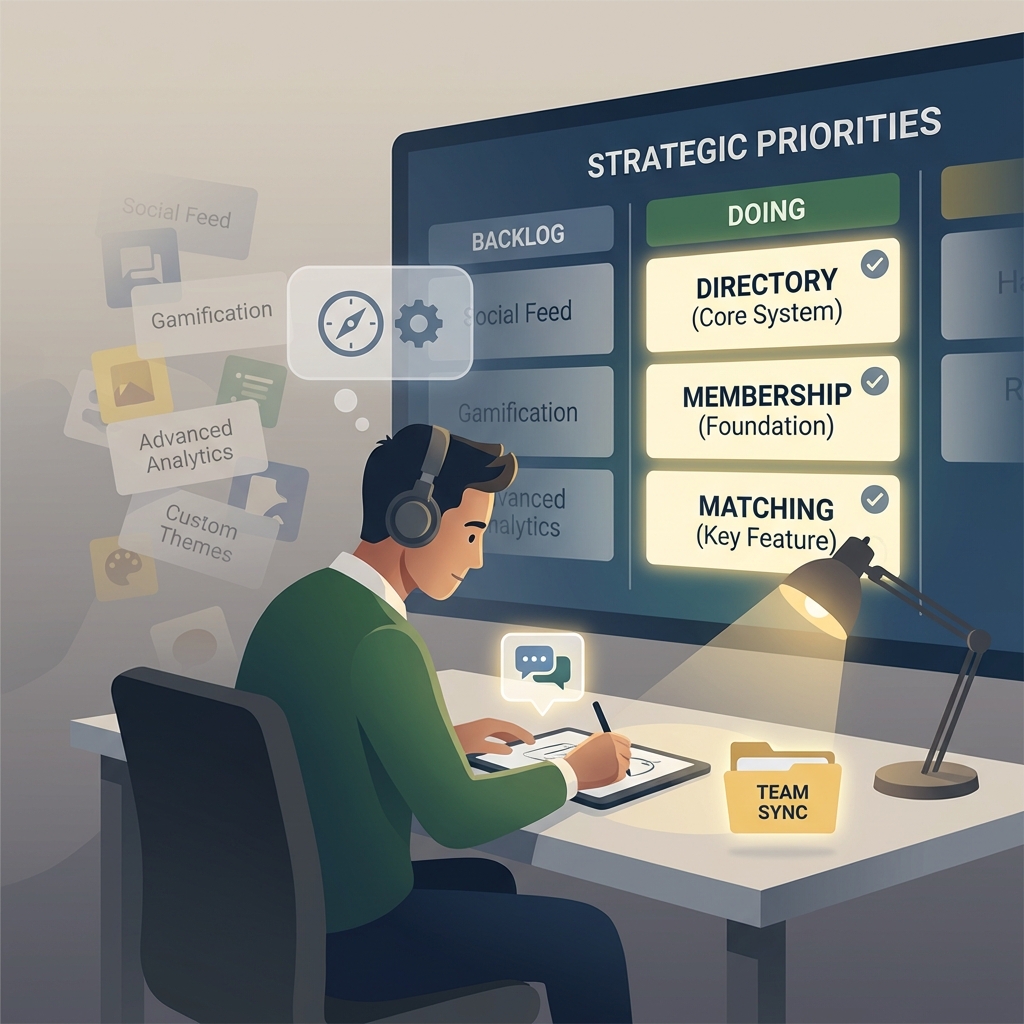


The team discussed a significant shift in development priorities, moving away from simultaneous feature development toward completing specific systems before expanding scope. Ivan (referred to as "Boldly NOW" in transcript) emphasized the need to avoid spreading development efforts too thin, noting that the Holomovement organization has historically struggled with polishing deliverables to completion (05:41). Unlike traditional design-documentation-then-code approaches, James is building with a more iterative, prototype-and-revise methodology that requires careful management to ensure features reach production quality rather than remaining perpetually "good enough" (04:08).
The immediate development focus has shifted to prioritizing the directory system and membership system [tag="webflow"] over other planned features (13:01). James confirmed this redirection, noting that while substantial work has been completed on assessments and the LMS, these are now on the back burner in favor of getting the directory system functional with user profile editing capabilities (13:27).
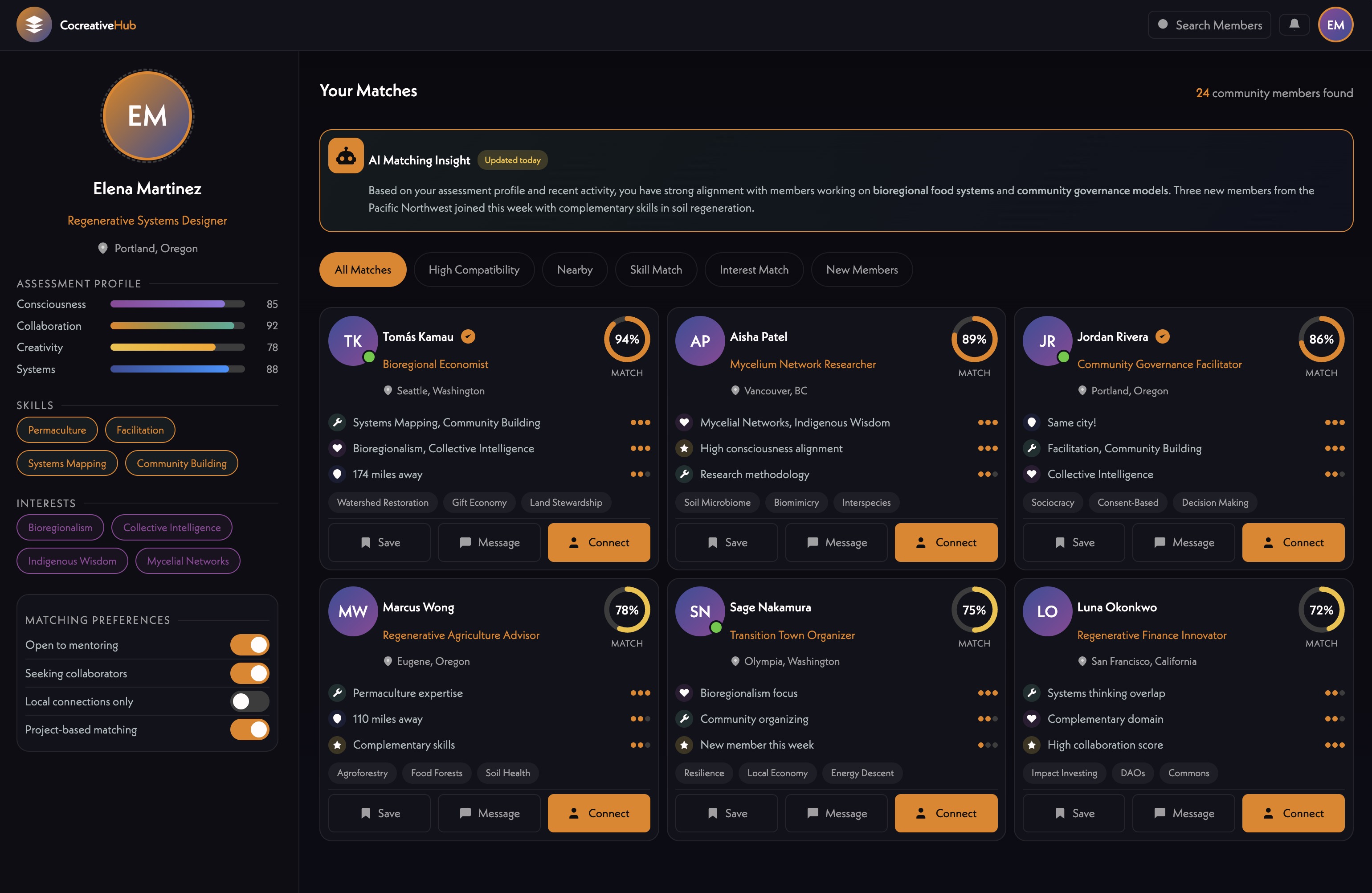
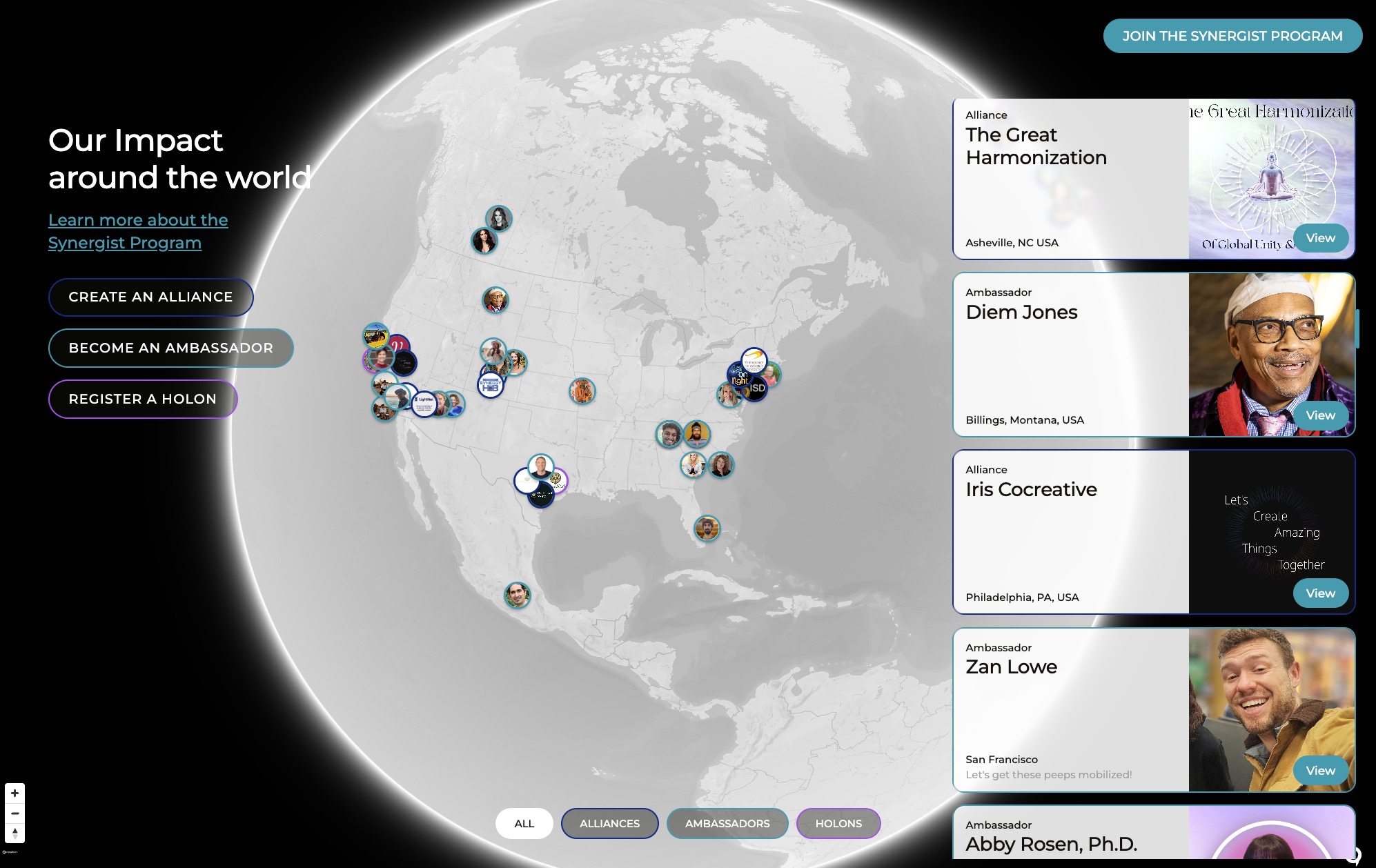
The existing directory interface received critical feedback regarding its visual approach and usability. While the globe-based map visualization using MapBox [tag="mapbox"] provides initial visual interest, Ivan questioned its long-term utility, suggesting it offers a "cool" first impression but limited practical value beyond finding local connections (16:24). The current card-based profile display suffers from inconsistent image assets, with users uploading non-square images that get truncated, resulting in a visually inconsistent experience (15:12).
The team acknowledged that geographic proximity is not the primary organizing principle for this network. Instead, the intelligent matching algorithms represent the "killer app" rather than the map visualization (17:17). Ivan stressed ensuring that MapBox [tag="mapbox"] implementation doesn't drive the matching logic, but rather serves the more critical data-driven matching system.
[technology="Directory Systems"]
[technology="Intelligent Matching Algorithms"]
Discussion centered on what profile information truly enables effective matching versus what creates visual interest. Current profile data includes developmental assessments like Gene Keys and purpose archetypes, but Ivan argued for prioritizing practical, actionable information. When someone seeks a backend developer or project collaborator, they need to quickly understand "what's your jam" - skills, experience, and current needs - rather than personality typing scores (18:52).
James described an early prototype that provided match explanations, showing why two people might collaborate well, though this was tested with only 20 users (19:50). Ivan emphasized that with 10,000 users, the system's value would increase exponentially, but only if the matching criteria focus on developmental stage, experience level, project involvement, and specific needs rather than purely archetypal assessments (22:23).
Key profile elements identified as essential:
Ivan noted that personality typing systems like Gene Keys, Enneagram, and numerology may offer personal insight but lack practical utility for AI-driven matching unless someone has deep expertise in industrial psychology (24:56). The risk is matching a serial entrepreneur seeking investors with a college freshman, creating misaligned expectations and system distrust (23:07).
[technology="Assessment Systems"]
The membership system encompasses profile management, subscription handling via Stripe [tag="stripe"], and privacy/security preferences (21:47). However, the business model remains unclear regarding whether memberships will be paid, with discussion of potentially offering free introductory memberships through May as a beta period (14:09).
A critical architectural question emerged around whether Holons (collaborative groups) function as independent entities in the system or as collections of individual members. Currently, the map suggests Holons are discrete users, but the data collection and reporting mechanisms for group entities remain undefined (29:54). James explained that a Holon could range from an informal monthly discussion group to a 500-person corporation with HR departments, creating significant variation in how group data would be captured (30:15).
Ivan suggested simplifying to "members and groups" rather than the term "Holons," which many newcomers find unfamiliar (31:27). This connects to the broader challenge that the Holomovement needs clearer onboarding narratives explaining what a Holon is and why users should create or join one (31:24).
The team identified that Holons might generate valuable "data exhaust" through planning tools and meeting notes that could inform matching algorithms, though this raises concerns about AI processing costs if analyzing large volumes of meeting transcripts (32:09).
Rather than elaborate personality assessments, the team discussed creating a basic intake form that captures the most important factors: development level, experience, life stage, purpose, and current needs (23:53). This would serve as the primary assessment everyone completes when entering the system, providing the foundational data for matching without requiring extensive time investment.
The challenge with incorporating systems like Gene Keys [tag="claude"] is that they require belief in astrology or numerology to feel relevant, limiting their universal applicability (24:56). Ivan referenced Carl Jung's observation that archetypal systems work because individuals see what they need to see and ignore irrelevant data - a selective perception that humans excel at but AI may struggle to replicate (25:54).
The priority is actionable, practical data that enables computational matching based on clear criteria (26:36). James expressed excitement about designing "generative taxonomy" not just for individuals but for Holons and groups, recognizing that people exist within organizational contexts that should inform matching logic (27:41).
A significant portion of the discussion addressed development workflow and estimating. Ivan requested understanding how James decides weekly priorities, revealing that the current project management tool is custom-built in Webflow [tag="webflow"] and approximately 75% complete - creating less clarity than the previous ClickUp system (35:06). This resulted in James "running around every day figuring out who's doing what" rather than working from clear priorities (35:06).
Ivan proposed adopting sprint methodology with weekly planning sessions to establish goals, track actual hours against estimates, and build understanding of development velocity and pricing accuracy (38:22). The first development phase showed 40% cost variation, suggesting either unclear feature definitions or unclear development paths (35:45). Better estimation discipline would provide confidence in pricing and help identify when additional resources or decisions are needed (38:55).
James agreed to create a simple Kanban view showing current priorities, what's in progress, and what's needed, with estimated effort hours and comparison to previous weeks' estimates (37:25). Ivan emphasized this doesn't need elaborate tooling - even a text document listing five active initiatives with effort estimates would suffice (37:30).
The automated meeting notes system that generates "initiatives" was flagged as unreliable, with an AI agent that is "liberal in the creation of initiatives" and produces content that "nobody's actually looking at" (37:09). Ivan requested James not reference these auto-generated initiatives until the team establishes a clearer, manually-curated priority system (37:16).
The communication automations [tag="n8n"] currently planned are relatively simple, focusing primarily on email [tag="gmail"] rather than SMS after Ivan shared a cautionary experience of unexpectedly high SMS costs from a previous app project (33:01). In-app notifications for the web application were discussed as a future consideration but not immediate priority (33:43).
Ivan strongly advocated for holding off on communication automation development until the directory and membership systems reach completion, avoiding the pattern of partially-finished features that characterize some Holomovement projects (32:43).
[technology="Communication Automations"]
The team agreed to establish regular Monday meetings with a flexible structure: start by reviewing weekly priorities and dependencies, address critical decision needs first, then review completed work if available (40:19). Ivan emphasized not needing full hour-long meetings, preferring to end early when objectives are met (40:26).
Ivan outlined his preferred decision-making process: someone identifies a need, stakeholders make proposals in Slack, and if only one proposal emerges without objections, the team proceeds with that approach rather than waiting indefinitely (42:07). This addresses the Holomovement's tendency toward extended ideation cycles without reaching polished execution.
James committed to updating the initiatives to reflect the agreed priority plan and creating the Kanban view for shared visibility (40:49). He identified the most critical need as collaborative strategy development for the matching system: clarifying how to think about individuals versus Holons and defining matching criteria (41:23).
Ivan (Boldly NOW)
James Redenbaugh
The team discussed a significant shift in development priorities, moving away from simultaneous feature development toward completing specific systems before expanding scope. Ivan (referred to as "Boldly NOW" in transcript) emphasized the need to avoid spreading development efforts too thin, noting that the Holomovement organization has historically struggled with polishing deliverables to completion (05:41). Unlike traditional design-documentation-then-code approaches, James is building with a more iterative, prototype-and-revise methodology that requires careful management to ensure features reach production quality rather than remaining perpetually "good enough" (04:08).
The immediate development focus has shifted to prioritizing the directory system and membership system [tag="webflow"] over other planned features (13:01). James confirmed this redirection, noting that while substantial work has been completed on assessments and the LMS, these are now on the back burner in favor of getting the directory system functional with user profile editing capabilities (13:27).
The existing directory interface received critical feedback regarding its visual approach and usability. While the globe-based map visualization using MapBox [tag="mapbox"] provides initial visual interest, Ivan questioned its long-term utility, suggesting it offers a "cool" first impression but limited practical value beyond finding local connections (16:24). The current card-based profile display suffers from inconsistent image assets, with users uploading non-square images that get truncated, resulting in a visually inconsistent experience (15:12).
The team acknowledged that geographic proximity is not the primary organizing principle for this network. Instead, the intelligent matching algorithms represent the "killer app" rather than the map visualization (17:17). Ivan stressed ensuring that MapBox [tag="mapbox"] implementation doesn't drive the matching logic, but rather serves the more critical data-driven matching system.
[technology="Directory Systems"]
[technology="Intelligent Matching Algorithms"]
Discussion centered on what profile information truly enables effective matching versus what creates visual interest. Current profile data includes developmental assessments like Gene Keys and purpose archetypes, but Ivan argued for prioritizing practical, actionable information. When someone seeks a backend developer or project collaborator, they need to quickly understand "what's your jam" - skills, experience, and current needs - rather than personality typing scores (18:52).
James described an early prototype that provided match explanations, showing why two people might collaborate well, though this was tested with only 20 users (19:50). Ivan emphasized that with 10,000 users, the system's value would increase exponentially, but only if the matching criteria focus on developmental stage, experience level, project involvement, and specific needs rather than purely archetypal assessments (22:23).
Key profile elements identified as essential:
Ivan noted that personality typing systems like Gene Keys, Enneagram, and numerology may offer personal insight but lack practical utility for AI-driven matching unless someone has deep expertise in industrial psychology (24:56). The risk is matching a serial entrepreneur seeking investors with a college freshman, creating misaligned expectations and system distrust (23:07).
[technology="Assessment Systems"]
The membership system encompasses profile management, subscription handling via Stripe [tag="stripe"], and privacy/security preferences (21:47). However, the business model remains unclear regarding whether memberships will be paid, with discussion of potentially offering free introductory memberships through May as a beta period (14:09).
A critical architectural question emerged around whether Holons (collaborative groups) function as independent entities in the system or as collections of individual members. Currently, the map suggests Holons are discrete users, but the data collection and reporting mechanisms for group entities remain undefined (29:54). James explained that a Holon could range from an informal monthly discussion group to a 500-person corporation with HR departments, creating significant variation in how group data would be captured (30:15).
Ivan suggested simplifying to "members and groups" rather than the term "Holons," which many newcomers find unfamiliar (31:27). This connects to the broader challenge that the Holomovement needs clearer onboarding narratives explaining what a Holon is and why users should create or join one (31:24).
The team identified that Holons might generate valuable "data exhaust" through planning tools and meeting notes that could inform matching algorithms, though this raises concerns about AI processing costs if analyzing large volumes of meeting transcripts (32:09).
Rather than elaborate personality assessments, the team discussed creating a basic intake form that captures the most important factors: development level, experience, life stage, purpose, and current needs (23:53). This would serve as the primary assessment everyone completes when entering the system, providing the foundational data for matching without requiring extensive time investment.
The challenge with incorporating systems like Gene Keys [tag="claude"] is that they require belief in astrology or numerology to feel relevant, limiting their universal applicability (24:56). Ivan referenced Carl Jung's observation that archetypal systems work because individuals see what they need to see and ignore irrelevant data - a selective perception that humans excel at but AI may struggle to replicate (25:54).
The priority is actionable, practical data that enables computational matching based on clear criteria (26:36). James expressed excitement about designing "generative taxonomy" not just for individuals but for Holons and groups, recognizing that people exist within organizational contexts that should inform matching logic (27:41).
A significant portion of the discussion addressed development workflow and estimating. Ivan requested understanding how James decides weekly priorities, revealing that the current project management tool is custom-built in Webflow [tag="webflow"] and approximately 75% complete - creating less clarity than the previous ClickUp system (35:06). This resulted in James "running around every day figuring out who's doing what" rather than working from clear priorities (35:06).
Ivan proposed adopting sprint methodology with weekly planning sessions to establish goals, track actual hours against estimates, and build understanding of development velocity and pricing accuracy (38:22). The first development phase showed 40% cost variation, suggesting either unclear feature definitions or unclear development paths (35:45). Better estimation discipline would provide confidence in pricing and help identify when additional resources or decisions are needed (38:55).
James agreed to create a simple Kanban view showing current priorities, what's in progress, and what's needed, with estimated effort hours and comparison to previous weeks' estimates (37:25). Ivan emphasized this doesn't need elaborate tooling - even a text document listing five active initiatives with effort estimates would suffice (37:30).
The automated meeting notes system that generates "initiatives" was flagged as unreliable, with an AI agent that is "liberal in the creation of initiatives" and produces content that "nobody's actually looking at" (37:09). Ivan requested James not reference these auto-generated initiatives until the team establishes a clearer, manually-curated priority system (37:16).
The communication automations [tag="n8n"] currently planned are relatively simple, focusing primarily on email [tag="gmail"] rather than SMS after Ivan shared a cautionary experience of unexpectedly high SMS costs from a previous app project (33:01). In-app notifications for the web application were discussed as a future consideration but not immediate priority (33:43).
Ivan strongly advocated for holding off on communication automation development until the directory and membership systems reach completion, avoiding the pattern of partially-finished features that characterize some Holomovement projects (32:43).
[technology="Communication Automations"]
The team agreed to establish regular Monday meetings with a flexible structure: start by reviewing weekly priorities and dependencies, address critical decision needs first, then review completed work if available (40:19). Ivan emphasized not needing full hour-long meetings, preferring to end early when objectives are met (40:26).
Ivan outlined his preferred decision-making process: someone identifies a need, stakeholders make proposals in Slack, and if only one proposal emerges without objections, the team proceeds with that approach rather than waiting indefinitely (42:07). This addresses the Holomovement's tendency toward extended ideation cycles without reaching polished execution.
James committed to updating the initiatives to reflect the agreed priority plan and creating the Kanban view for shared visibility (40:49). He identified the most critical need as collaborative strategy development for the matching system: clarifying how to think about individuals versus Holons and defining matching criteria (41:23).
Ivan (Boldly NOW)
James Redenbaugh

Create proposal for matching system strategy distinguishing individuals from groups/Holons
January 30, 2026
Develop strategy clarifying how to think about individuals versus Holons in matching system. Define matching criteria prioritizing actionable information: developmental stage, experience level, current project involvement, specific skills, and active needs rather than personality assessments. Post question in Slack for team input and stakeholder proposals.
Create simple Kanban view showing current priorities with effort estimates
January 27, 2026
Build Kanban view or simple text document listing current priorities, in-progress work, and needed items. Include estimated effort hours and comparison to previous weeks' estimates. Doesn't require elaborate tooling - even five active initiatives with effort estimates would suffice. Focus on manual curation rather than auto-generated AI initiatives.
Post matching system strategy question in Slack for team input
January 24, 2026
Post question about individual versus Holon matching approach in Slack channel. Enable stakeholder proposals following decision-making process: identify need, gather proposals, proceed with single unopposed solution. Address architectural questions about Holon entity management and matching criteria.
Update initiatives to reflect agreed priority plan focusing on directory and membership systems
January 27, 2026
Revise initiative priorities and descriptions to reflect directory system and membership system as top priorities. Deprioritize LMS and communication automation features until directory completion. Update status and timelines accordingly.
Review weekly priorities and identify resource needs or dependencies
January 27, 2026
Provide ongoing feedback on weekly priorities during Monday meetings. Identify resource needs, dependencies, or blockers requiring team decisions. Ensure development work aligns with strategic priorities and business model clarity.

Design basic intake form capturing development level, experience, life stage, purpose, and current needs
February 8, 2026
Create streamlined intake assessment focusing on actionable matching criteria rather than personality typing. Include: developmental stage, experience level, life stage, purpose statement, current project involvement, specific skills, and what person is actively seeking. This serves as primary assessment everyone completes for matching foundation.
Address profile image standardization to resolve visual consistency issues
February 10, 2026
Resolve visual inconsistency in directory card display caused by users uploading non-square images that get truncated. Establish image requirements, provide guidance to users, or implement automatic cropping/formatting to ensure consistent card-based profile appearance.
Clarify business model regarding paid vs free memberships and beta period
February 1, 2026
Define membership pricing model and whether free introductory memberships will be offered through May as beta period. Clarify this before completing Stripe integration and membership system features. Discussion referenced offering potentially free memberships initially.
Establish sprint planning and weekly goal-setting process
January 27, 2026
Implement weekly sprint planning sessions establishing development goals, tracking actual hours against estimates, and building understanding of development velocity. Document first sprint outcomes showing estimated vs actual effort. Use to improve future estimation accuracy and pricing confidence.
Strategic enhancement of directory system integrating with membership capabilities to enable member profile management, progressive assessment completion, and intelligent matching. Members can log in and edit their profiles directly with information stored in Supabase for flexible content management. Progressive engagement model starts with basic five-minute setup (name, website, purpose statement, location), then enables detailed assessments later. Each completed assessment adds profile elements and unlocks features including AI-generated visual representations (icons, tarot archetypes, numerology graphics). Integration with Claude AI enables sophisticated queries like 'who should I collaborate with on this project?' or 'who can provide funding?' across network assessment data. Advanced features include weekly emotional mapping interface with six-axis emotional space (excitement, nervousness, grief, etc.) aggregating into community climate visualizations. Reimagined map interface using flat Earth projection with layered filtering showing member locations, funding flows, collaborative connections, project relationships. Multiple view modes from simplified default to complex multi-layered 'Arcturian' views. Integration with Engine for Good grant program where applications link to member profiles, creating incentive structure for profile completion. Team pivoted to prioritize directory system over LMS development. Player card approach focuses on game-like profiles emphasizing what someone is doing (project/mission) and what help they need for AI-powered matching. System summarizes lengthy inputs into concise scannable formats. MVP launch target February 15 with login capability, profile editing, and integrated assessments. Beta testing program follows to identify next priority features. Critical development discussion revealed MapBox visualization provides initial visual interest but limited practical value beyond local connections - intelligent matching algorithms represent the true 'killer app' rather than map visualization. Profile data strategy shifting from personality assessments to actionable information: developmental stage, experience level, current project involvement, specific skills, and active needs. Visual consistency issues identified with user-uploaded images requiring standardization. Question emerged whether Holons function as independent entities or collections of individual members, requiring data architecture decisions. Simplified terminology 'members and groups' proposed over 'Holons' for newcomer clarity. Basic intake form planned capturing development level, experience, life stage, purpose, and current needs as primary assessment for matching foundation. Player card UI concept introduced featuring icons to symbolize key information, AI-generated summaries to condense lengthy responses, and achievement badges displaying completed courses, assessments, and accomplishments. Design iteration process planned where team scans test cards to validate information hierarchy. Sandbox database creation for core team to fill out profiles and review each other's player cards as real-world test. Prototype development progressing with profile creation, editing, viewing, and password resets functional in Supabase. Munia developing first draft UI designs. Team agreed to reduce text density, create more visual/scannable interfaces. Multiple views prototyped: alliance view, profile editing, directory search (list and map-based), member profiles, holon profiles. Core intake fields defined: name, date of birth, email, phone/SMS/WhatsApp, location, purpose/mission, gifts and requests, alliance affiliations, short bio (150 words max), photo. Matching deferred from numerical compatibility scores to simpler connection signals: complementary skills, matching needs/offers, alliance overlap, geographic proximity, shared purpose domains. AI interpretation via Claude for free-text fields, direct computation for explicit matches. App functionality to be hosted on separate subdomain (app.holomovement.net) with member-specific navigation, syncing public profile data to main site member globe. End of February target for core team interactive prototype. 3D globe navigation now live with lightweight custom rendering approach using continent outlines without full Mapbox tile loading for smooth performance (05:52). Globe features toggle for flat view, hover-activated profile cards, connection lines between members and holons. People appear as yellow dots, holons as teal hexagons algorithmically placed at center of members (01:22). Profile creation flow implemented as linear step-by-step process requiring profile completion before directory access (09:38). Photos strongly encouraged with friendly nudges if skipped, social profiles optional. AI-generated banner images based on user bios producing resonant results (15:47). Light/dark mode toggle available inheriting system settings by default (16:39). Dark backgrounds using deep teal rather than pure black, light mode avoiding stark white to maintain Holomovement brand feel (14:35). Vertical player cards chosen for directory view over horizontal layouts for gamified engaging presentation (37:52). Team seeding platform this week with core team members completing profiles Monday/Tuesday, creating holons Wednesday, reviewing experience Thursday core call (43:53). Polish focus prioritized over new features with delivery target Monday February 17 (41:20). New bento-style profile layout introduced with rounded corners, centered tagline, framed profile image, and subtle background color differentiation between sections (14:21). Rich text field with optional image upload added to represent projects or organizations more expressively beyond plain text (32:10). Testimonials system (potentially rebranded as 'Send Some Love' or 'Share the Love') enables mutual endorsements with reciprocal vouching mechanics (34:54). Field feature replacing 'wall' concept allows users to post updates and collaborative content with pinning capability (39:43). Long-term vision includes drag-and-drop section ordering for personalized profile storytelling. Assessment display framework showing sliders across domains added as visible badges on profiles. Seeking/Offering keywords auto-distilled from freeform text using AI summarization to aid readability and matching. On-demand match experience triggered by 'Match Me' button generates side-by-side comparison modal with numerical score (1-100, shown on hover), loading animation, and meaningful dimensions including complementary skills, needs/offers alignment, shared alliances, overlapping domains (26:00, 19:02). Match score and comparison view designed as sticky gamified feature incentivizing profile completion (24:35). Domain categories refined: 'Economics and New Systems' → 'Economics and Collaborative Commerce', 'Governance and Social Change' split into 'Collaborative Governance' and separate social change, 'Spiritual Activism and Inner Development' → 'Spirituality and Consciousness', additions include Ethics and Philosophy, Science, Leadership and Facilitation as 12th domain, potential Psychology embedded in community/relationships (43:00-48:22). Onboarding copy and tooltip language prioritized for clarity on unfamiliar terms with short hover descriptions (one sentence max). Implementation timeline: 7-10 day dev window for new design style, Field feature, preliminary matching functionality followed by internal testing with core four, then broader core team rollout (41:07, 40:08). First impressions prioritized with cautious rollout protocol to ensure solid initial experience. Messaging icon refined from email-style button to message icon to better reflect in-platform nature (13:29). Notifications aggregate into single indicator on Holon icon with changing number rather than multiple dots. Three profile image preview styles (circle, square, doorway/vertical) included in signup flow to ensure photos work across all use cases (07:44). In-app messaging system now live using custom-built architecture with no per-message cost, styled similar to iMessage with unread message counts, conversation threading, and future group chat capability (09:37). Email notifications handled via Resend - free up to 3,000 emails/month, then $20/month for up to 50,000 (23:56). Holon management flow improved with clear delegation model between members and admins using invitation system rather than automatic adds (04:08). Location automation uses lightweight AI call to convert entered location into coordinates for near real-time map updates (26:27). Saving bug affecting profile updates, feedback, and location syncing identified and resolved during meeting (26:27). Community consent flow being added as pop-up on first messaging use with scrollable community agreements and required checkboxes covering non-partisanship, anti-spam, entity usage rules, and conduct standards (18:00). GDPR compliance considerations noted with Webflow plugin available for data erasure rights and cookie consent (17:46). Pay What You Want contribution system now under active development with slider UI allowing users to select suggested range ($15-$20/month) with secondary scholarship tier option for lower amounts. Two-screen approach framed as gift rather than discount with wave-based slider visual showing increasing amplitude. System includes familiar Stripe checkout supporting Link, Amazon Pay, and other methods. PayPal integration planned for better international accessibility (18:35, 19:30). Working wave-amplitude slider prototype built with predefined moments shifting wavelength visually, translatable directly into payment UX (19:47). Prototype ready for core team testing within next couple days with front-end UI included (53:10). Thursday core team meeting target for showcase (54:22). Modal menu interface introduced featuring compact notification/settings control with light mode toggle - described as small detail that meaningfully elevates experience (38:05). Three developers now working on Webflow implementation: Sean (Ohio, senior), Siam (Pakistan, junior), with Ivan handling less bandwidth due to outside client work (34:00). Profile creation, editing, and regeneration flows confirmed working (04:14). Holon page active development with wheel of faces arc rendering, domain icons, and My Holons view improvements (04:14). Empty state for My Holons will show helpful message plus grid of all existing Holons to orient new users (21:50). Profile edit mode link navigation disabled to prevent losing unsaved changes (27:08). Profile image edit icon made more prominent (30:58). Banner image regeneration icon will get rollover tooltip explaining 'replace your banner' functionality (32:25). Skills rating feature demoed allowing users to rate themselves with visual bar indicators (44:04). Location map tooltip added showing actual location name on hover (23:11). Profile creation link added directly to member modal enabling logged-in users to re-run full onboarding flow (42:31). Test accounts and Holons being cleaned up before team-wide invite (06:47). Core team onboarding structured as daily feature drip: Day 1 profile creation, Day 2 assessment prototype, following days Holons/map/matching features one at a time (16:11). Homepage updates in progress including background color correction, animation circle restoration, scroll sequence improvements, auto-scroll implementation, mobile type scaling, icon-only logo, and updated CTA button (44:35). Dynamic map will become hero element of homepage with card preview leading to login/profile creation for non-members (52:57). Tag-based matchmaking architecture outlined: profiles generate seeking/offering/domain/focus tags, periodic comparison produces alignment scores, directory displays highest-alignment profiles larger and left-aligned (01:01:36). Sean actively working on matching grid view implementation (01:00:56). Wave event preparation targeting participants leaving activation day already inside at least one Holon using app as live tool (58:30). James confirmed ready to lead app presentations at wave event. One-to-two minute intro video of ecosystem planned for wave event (01:00:07). Platform designed as coordination layer - not an organization but a medium, connective tissue, energetic petri dish for collaboration to grow (20:30). Wave serves as on-ramp for Saturday-Monday - people get on the spaceship, then continue exploring projects, holons, and neighbors in platform Tuesday onward. 'We come together and create these big bonfires. We want ways to keep these campfires burning through the year' (55:30). Post-Wave system successfully operational with Portugal map section densely populated showing honeycomb patterns around Lisbon and Spain hubs. Meeting 06-16 identified map zoom scaling issue (13:53) - member dots need to proportionally shrink as users zoom in to maintain functionality at high-density locations. Profile image tooltip needed under editing icons since users don't know how to change pictures. Homepage globe visibility toggle required since names and locations display without explicit opt-in. Profile tab renamed from 'About' to 'Info' and repositioned as first tab for better UX.
Custom membership system architecture for user authentication, progress tracking, and database management using Supabase for backend. Requirements include real database for user progress (not cookies), journal entry capture, API triggers for membership status and course purchases, and progress tracking across sessions. Decision made to build custom solution on Supabase rather than Member Stack. Includes Stripe integration for subscription management and automatic access revocation when subscriptions lapse. Multiple products may connect to same membership tier with bundled offerings granting multiple memberships from single purchase. Part of Phase One development with $16K-$29K budget. Requires hiring Supabase specialist for implementation. Timeline aligned with LMS development for February 10th launch. Authentication spike will establish foundation with Supabase login functionality on MAST template, implementing user profiles, password management, and session handling. System will sync membership status between Stripe and Supabase for automated access control. Backend successfully operational with membership login and content gating complete using Supabase and Stripe. Profile editing integration in progress to connect with directory system. Backend approximately 90% complete with primary goal to deliver working version on Holomovement site for team testing this week allowing account creation, login, and profile data editing. Front end minimal at this stage consisting mainly of login pages until profile pages developed. Profile creation flow now implemented as linear step-by-step process requiring profile completion before directory access. Sign-up flow includes friendly nudges for empty bios when hitting next, optional social profiles with language like 'you can always come back later' to reduce drop-off, loading screen during profile generation with engaging copy like 'making connections', AI-generated banner images based on user bios, and light/dark mode toggle inheriting system settings by default. System enforces profile completion to ensure data quality and prevent half-finished accounts cluttering database. Dark backgrounds use deep teal rather than pure black, light mode avoids stark white to maintain Holomovement brand feel. Simplified pill-style member modal implemented with collapsed/expanded states showing two lines by default, expanding on hover to reveal icons for messages, Holons, and light/dark mode toggle. Notifications aggregate into single indicator on Holon icon with changing number rather than multiple dots. Three profile image preview styles (circle, square, doorway/vertical) included in signup flow to ensure photos work across all use cases. In-app messaging system now live using custom-built architecture with no per-message cost, styled similar to iMessage with unread message counts, conversation threading, and future group chat capability. Email notifications handled via Resend - free up to 3,000 emails/month, then $20/month for up to 50,000. Holon management flow improved with clear delegation model between members and admins using invitation system rather than automatic adds. Location automation uses lightweight AI call to convert entered location into coordinates for near real-time map updates. Saving bug affecting profile updates, feedback, and location syncing identified and resolved during meeting. Community consent flow being added as pop-up on first messaging use with scrollable community agreements and required checkboxes covering non-partisanship, anti-spam, entity usage rules, and conduct standards. GDPR compliance considerations noted with Webflow plugin available for data erasure rights and cookie consent. Pay What You Want contribution system now under active development with slider UI allowing users to select suggested range ($15-$20/month) with secondary scholarship tier option for lower amounts. Two-screen approach framed as gift rather than discount with wave-based slider visual showing increasing amplitude. System includes familiar Stripe checkout supporting Link, Amazon Pay, and other methods. PayPal integration planned for better international accessibility. Working wave-amplitude slider prototype built with predefined moments shifting wavelength visually, translatable directly into payment UX. Prototype ready for core team testing within next couple days with front-end UI included. Thursday core team meeting target for showcase. Modal menu interface introduced featuring compact notification/settings control with light mode toggle - described as small detail that meaningfully elevates experience. Three developers now working on Webflow implementation: Sean (Ohio, senior), Siam (Pakistan, junior), with Ivan handling less bandwidth due to outside client work. Profile creation, editing, and regeneration flows confirmed working as of 03-31 meeting. Profile creation link added directly to member modal enabling re-run of full onboarding flow. Core team onboarding structured as daily feature drip starting with profile creation. 03-31 crash test revealed critical blocking issues preventing core team demo: n8n automation pipeline failing to complete profile data processing reliably, social links not saving due to LinkedIn field dependency, AI-generated cover image and tagline entering loop state without completing, JSON input error halting holon creation mid-flow, logout bug on holon detail page, light mode broadly non-functional requiring toggle to be hidden entirely, profile content fields not populating after form submission. Team consensus: crash test failed, reconvening following day to retest after critical fixes. Zero tolerance for processes locking up or halting before core team demo - visual imperfections acceptable but no mid-flow stoppage permitted. Hubcast partnership introduces potential single sign-on integration explored with developer Emilio Lopez enabling seamless profile creation handshake between broadcast access and Holomovement App reducing friction for new users discovering platform via livestream. Profile creation becomes the access ticket for global broadcast viewers immediately placing them inside ecosystem where they discover collaboration features. System now functional and operational with core team beginning onboarding process (meeting 05-04). Post-Wave deployment successful with members actively using platform. Critical gaps identified in 06-16 meeting: users cannot delete accounts (GDPR violation with European user base), users cannot remove themselves from Holons, stewards cannot remove members, automatic member addition on Holon creation needs approval workflow, privacy controls needed for Holon visibility, homepage globe displays names/locations without explicit opt-in requiring visibility toggle, cookie consent banner required for European compliance, Stripe webhook test-mode errors surfacing. Account deletion and member management now top cleanup priorities.
Assessment system with AI-powered engagement features feeding automation workflows. Data from assessments, clicking patterns, lesson completion, and call attendance triggers personalized communication including immediate tailored emails, weekly progress updates, connection recommendations based on profile matching, and proactive check-in offers when engagement drops. Guatemala-specific assessment page created requiring customized copy. Current synergist directory demonstrates existing assessment capabilities: members complete form triggering automated n8n and Claude AI analysis of responses about purpose, projects, and ancestral wisdom influences. System generates personalized feedback and recommends connections to other synergists based on compatibility, facilitating introductions via email without exposing addresses. Also suggests relevant podcast episodes. No-login approach removes participation barriers while enabling intelligent matching and communication. Strategic shift to progressive engagement model: members start with basic five-minute profile setup (name, website, purpose statement, location), then complete more detailed assessments later. Each completed assessment adds elements to profile and unlocks new features. Gamification includes AI-generated icons, tarot card archetypes, or numerology graphics appearing on profiles as users complete different assessments. Incremental assessment launch strategy releasing new assessments every week or ten days leading to Wave event, using Ripple gatherings and Miracle Club to promote participation. Partnership opportunities with experts for themed assessments (Don Beck for Spiral Dynamics, Vedic astrologer for astrology, iOS Zone of Genius team for their assessment). Critical reassessment of assessment strategy prioritizing basic intake form capturing most important factors: development level, experience, life stage, purpose, and current needs as primary assessment for matching foundation. Systems like Gene Keys and numerology recognized as requiring belief in astrology/numerology to feel relevant, limiting universal applicability. Focus shifting to actionable, practical data enabling computational matching based on clear criteria rather than archetypal personality typing. When matching collaborators, users need to understand skills, experience, current needs, and project involvement rather than personality scores. AI-driven matching requires developmental stage, experience level, project involvement, and specific needs to avoid misaligned matches like pairing serial entrepreneurs with college freshmen. Meeting confirmed approach of using simple 1-to-10 scale assessments for numerical scoring and spider graphs but deferring complex compatibility scores for MVP. AI interpretation via Claude for free-text fields and nuanced alignment, direct computation for explicit matches like shared affiliations or complementary skill requests. Michael coordinating with Emmanuel on potential assessment questions to gauge user alignment. Team now planning 5-6 domain assessment (5 makes pentagram shape, 6 makes star shape) using simple multiple choice format outputting 1-10 scores per metric with spider graph visualization (37:24). Demonstrated working client assessment as reference - multi-screen flow with logic-based classification, no agentic analysis required. Key design principles: spectrum-based framing rather than qualitative scoring ('does this sound like you or not?' vs 'how good are you at this?'), questions should feel neutral and interesting to avoid test-taking bias (MMPI/Myers-Briggs problem of answering how you want to appear), completable in 10 minutes or less, more candidate questions per domain than needed for culling weak ones (40:52, 48:29). Mariko advocated for including at least one fun gift-like assessment (e.g. numerology mandala tool) people would do for the experience that enriches profile organically without feeling like data extraction (41:56). James floated longer-term vision of garden of assessments users can choose from with power to decide which assessments inform matching - astrological/numerological inputs become opt-in rather than default. New numerology mandala tool demonstrated building visual in real time as user types, team expressed integration interest (43:44). Michael Shaun starting shared document immediately with candidate domain names and draft questions for team review, holding internal review with Hera before broader socialization (40:52, 52:43). Working prototype built with five-domain assessment featuring slider-based positioning system across spectrums (22:37). Five domains: Holonic Worldview (separative/analytic to holistic/integrative), Purpose Orientation (exploring/emergent to directed/activated), Pro-Social Stance (deep one-on-one to community-wide/systemic), Collaborative Capacity (independent to collective), Time Horizon (near-term to long-arc/generational). Results render as nine-pointed spider graph and bar chart. Slider format keeps assessment accessible without overwhelming users (25:36). Community-level visualization capability floated - overlaying 100 profiles to reveal collective orientation of holons or comparing holons against each other (29:17). Next development step: adding archetype outputs (e.g., 'super connector') with brief descriptive text for each result profile. Assessment data feeds optionally into matching algorithm with users able to decide matching criteria when requesting analysis, though some default criteria apply automatically (36:00). Prototype ready for Holomovement team Thursday meeting demo (40:46). 03-31 meeting revealed spider graph assessment essentially unreadable without tutorial - 19 items across overlapping axes makes results incomprehensible (10:54). Team verdict: spider graph is good eye candy but doesn't deliver snapshot value. Simplified one-question assessment with triangulation output confirmed as right path forward, not using spider graph format (14:58). Working prototype committed for following day. Michael Shaun flagged standing to-do: writing one-page descriptive blurbs for each assessment area so AI can return robust grounded responses to user queries - Google Doc format for now (57:04). Mariko testing showed assessment accurate and trustworthy, validating credibility needed for matching layer to work for new users. Assessment confirms what users intuitively know about existing relationships, building trust for recommendations with unknown people (46:52). Beyond individual matching, assessments help working groups understand collective makeup - team strengths, shadows, support needs, leadership roles. Positions tools as ongoing collaboration infrastructure rather than just onboarding features (51:14). New triangular assessment visualization mentioned in meeting at 57:00 as co-designed by James. Assessment now functional with improved output format and ready for core team onboarding (meeting 05-04).
AI-powered project management system that automatically generates meeting summaries, assigns action items, and allows team members to update tasks without logging in. System analyzes meetings to create and manage initiatives automatically with live task editing functionality. Future development includes conversational agent for team members to interact with for questions like 'what should I be working on this week?'. Includes both advanced features (Kanban boards) for power users and simplified overview views for quick status checks. Hera collaborating on project management features bringing experience from previous tech company product work. Current system approximately 75% complete but creating less clarity than previous ClickUp system, resulting in daily prioritization uncertainty rather than clear task lists. Automated meeting notes system flagged as unreliable with AI agent liberal in initiative creation producing content nobody reviews. Development discussion revealed need for manual curation rather than relying on auto-generated initiatives. Priority is creating simple Kanban view showing current priorities, in-progress work, and needed items with estimated effort hours and comparison to previous estimates. Sprint methodology proposed with weekly planning sessions to establish goals, track actual hours against estimates, and build understanding of development velocity. Better estimation discipline would provide confidence in pricing and identify when additional resources or decisions needed. Even simple text document listing five active initiatives with effort estimates would suffice rather than elaborate tooling.
Define data architecture and entity management approach for organizational units within the system establishing framework for how users, individuals, and groups are categorized. Core user model establishes everyone enters system as Individual first ensuring platform's primary impact centers on connecting people rather than organizations. After creating individual profile, users can join or create Holons (project-based groups with specific outcomes and impact goals) and affiliate with Alliances (mission-aligned organizations sharing values with Holomovement but may not have active projects within system). Holons are project-oriented requiring three administrators for security and continuity - if one administrator becomes inactive, two others maintain access to manage Holon profile. Multi-step creation process: one person drafts Holon and identifies two other administrators by email, those two individuals receive confirmation emails, and once they confirm participation (creating individual profiles if needed), Holon profile goes live. Founding three administrators have full editing access with ability to elevate additional members to administrative status later. Alliances represent mission-aligned organizations where users can self-declare affiliation similar to LinkedIn company profiles without formal approval. Team using themselves as first test group creating individual profiles, registering businesses as Alliances, and forming Holons based on actual project work. This validates system architecture with real-world use cases, demonstrates transparency showing how Holomovement operates internally, and dissolves inside-versus-outside dynamic that often exists in community platforms. Sandbox database initially with core team members to test system before expanding to broader team and migrating existing user data. Matching hierarchy established: Individual to Individual (priority 1), Individual to Holon (priority 2), Holon to Individual (priority 3), Holon to Holon (priority 4). Alliance-to-Alliance connections happen primarily through leadership conversations rather than software. Hybrid taxonomy strategy combining fixed high-level categories with AI-generated flexible sub-tags. Seven to nine fixed categories each with icon and visual identity providing newcomers clear 'lay of the land.' AI agent may automatically generate and organize categories based on how people describe their Holons allowing adaptive evolution as community grows. Key matching information includes developmental level, life stage, purpose, needs and offers, domain focus, formalization level, activity level, and geographic location. Critical filtering categories for initial launch: domain/focus (what group works on), what group needs (funding, visibility, structure), what group offers (projects, learning, mentorship, impact, belonging), activity level (active, dormant, occasional), formalization level (informal, loose, institutional). Self-assessment data like Human Design and numerology incorporated into player cards providing deeper understanding beyond skills and experience. Meeting confirmed simplified explanations for onboarding: 'a holon is a group of people with a shared project or outcome' rather than full theoretical framework. Alliance affiliations limited to community-relevant entities. Core intake fields finalized: name, DOB, email, phone/SMS/WhatsApp, location, purpose/mission, gifts and requests, alliance affiliations, short bio (150 words max), photo. Holon creation flow needs action-oriented questions: 'What's your holon's project?' instead of 'Describe your holon' and 'What outcome do you hope to achieve?' instead of 'Purpose' (20:01). Definition of holon should appear at start of creation flow (21:09). Two primary user journeys for holon formation: three members already on platform simply tag accounts together, or one/two members registered with creator entering emails for missing members triggering automated invitation emails with accept/confirm flows and three-week follow-up reminders for non-response (22:08). For people wanting to start project without three members yet, solutions include holon board functioning like job posting board with tag-based browsing (28:16), directory tags like 'looking for members' or 'looking for a holon' for filtered discovery (26:00), or encouraging registration as individuals first to use matching and search for finding collaborators before forming holons organically (25:34). Team cautioned against incomplete holons cluttering platform - better to channel seekers through communication tools or simple board (24:24). San Francisco tech community Webflow example used profile tags for matchmaking with 'Ask to be intro' button triggering automated double-opt-in introduction emails (29:40). Holon admin roles need definition within creation flow with member additions working as invitations rather than automatic adds (32:52). Color-coding refined: teal for holons (brand-aligned), yellow for synergists, alliances introduced later (33:27). Core team seeding platform this week: Monday/Tuesday profile completion, Wednesday holon creation for real groups generating invitation flows, Thursday core call reviewing experience and collecting feedback (43:53). Holon eligibility checklist pop-up being drafted explaining what Holon is and confirming three or more people with active transformative project before surfacing creation flow (27:44). Pop-up may eventually include dropdown of existing Holon examples or carousel of most relevant active Holons surfaced via matching algorithm (31:46).
Establish sprint methodology and weekly planning discipline to improve estimation accuracy, development velocity tracking, and pricing confidence. Current project management creating less clarity than previous ClickUp system with daily prioritization uncertainty. First development phase showed 40% cost variation suggesting unclear feature definitions or development paths. Implement weekly planning sessions establishing goals, tracking actual hours against estimates, and building understanding of development patterns. Create simple Kanban view or text document showing current priorities, in-progress work, and needed items with estimated effort hours and comparison to previous estimates. Focus on manual curation rather than relying on auto-generated AI initiatives which have proven unreliable. Weekly meetings start with priority and dependency review, address critical decisions first, then review completed work if available. Shorter meetings preferred ending early when objectives met. Decision-making process: someone identifies need, stakeholders propose solutions in Slack, proceed with single unopposed proposal rather than indefinite ideation cycles. Addresses Holomovement pattern of extended ideation without reaching polished execution.
Custom learning management system (LMS) development on Webflow enabling self-paced courses, video content, progress tracking, quizzes, and certifications. Strategic decision to build custom LMS rather than using Boldly or Thinkific to support live-to-evergreen content workflow and global product sales. System requirements include real database for user progress (not cookies), journal entry capture, API triggers for membership status and course purchases, and progress tracking across sessions. Decision made to build on Supabase backend rather than Member Stack for authentication and data management. Phase One budget $16K-$29K with commitment to higher end. Development timeline six weeks: weeks one-two for Supabase foundation and user dashboard connected to Webflow CMS, week three for Stripe integration and membership access control, weeks four-five for testing and email integrations, polish and testing complete by January 25th for February 10th launch. Three-tier collection structure: courses, modules, lessons. Content authoring process uses detailed scripts functioning as recipes specifying exact interactivity types (checkbox, multiple choice), interaction flows, and content sequencing aligning activities with content flow rather than separate homework sections. Format supports live-to-evergreen workflow ensuring technical structure supports global sales rather than just live delivery. Team using themselves as first test group to validate system with real-world use cases before broader deployment. Authentication spike establishes foundation with Supabase login functionality on MAST template implementing user profiles, password management, and session handling. Backend successfully operational with membership login and content gating complete. Profile editing integration in progress to connect with directory system. LMS moved back to active priority to support Choose Love course launch with Boldly course content as test videos for validation before committing to Choose Love timeline. Development continuing at reduced pace while directory system remains primary focus.
00:00:00
James Redenbaugh: Pretty good. It's super snowy here.
00:00:05
Boldly NOW: You're in Philadelphia?
00:00:07
James Redenbaugh: I'm in Philadelphia, yeah.
00:00:09
Boldly NOW: I did a little background on you.
00:00:12
James Redenbaugh: I just asked.
00:00:16
Boldly NOW: What'S up.
00:00:18
James Redenbaugh: You're in Portugal?
00:00:19
Boldly NOW: No, I'm in the Netherlands, near Amsterdam. Emmanuel kind of gave me a little bio on you. It was kind of sparse, but.
00:00:35
James Redenbaugh: Yeah. I grew up here in Philly. Lived in California most of my adult life. But if I wasn't digital nomading. But now I'm back here for a few years.
00:00:47
Boldly NOW: Yeah. And you like it or it's convenient.
00:00:51
James Redenbaugh: For now in a cute neighborhood that we like a lot but we want to get back to either the west coast or back to Europe.
00:01:01
Boldly NOW: Some.
00:01:03
James Redenbaugh: Somewhere San.
00:01:06
Boldly NOW: Have you lived over here before?
00:01:09
James Redenbaugh: Not for more than three months at a time.
00:01:12
Boldly NOW: Yeah.
00:01:13
James Redenbaugh: But I've spent a lot of time there.
00:01:15
Boldly NOW: Yeah, that, that. That's familiar. We have a lot of American based friends that are trying to spend more time over here and they really struggle. Yeah, we. We're all Italian citizens. My wife's mother was Italian, so my wife and the kids got Italians and ship just kind of instantaneously. And then eventually I got mine and we've lived over. We've lived in Italy a lot, Spain a little bit and then just new here. Three years here. We'll probably go back to Italy or Spain after a while. We have college age. No, they're both graduated. We have young twenties aged daughters here and they want us to stay nearby for a while, so. That's right. It is a really sane place to live as far as social services and trains and roads and like all the things that make life easy.
00:02:12
Boldly NOW: They've got it going on here in the Netherlands. Better than Italy for sure. Italy's a bit insane. Some of the governance stuff. And then Spain is better on the governance stuff, but still not as easy and smooth as it is here. Everything is like civil servants here are nice to you on the phone, try to help. It's the craziest thing and never seen that before.
00:02:37
James Redenbaugh: I can't imagine.
00:02:38
Boldly NOW: Yes, like you're being friendly to me is what's wrong with you being helpful. The Dutch are so direct, you know. Also if you're doing something right, they'll tell you that too. It's kind of really flat out.
00:02:50
James Redenbaugh: So it's.
00:02:51
Boldly NOW: You never, you never. There's no, there's no nuances that as an expat that you're. You're needing to know because they'll just let you know in Italy they'll stare at you, and you're like, okay, I did something wrong. I don't know what's going on.
00:03:08
James Redenbaugh: Nice.
00:03:09
Boldly NOW: Here they just come out and tell you, okay, well, thanks for meeting. We should do this a bunch. I spent some time on the development plan. I'd like to go over that with you a little bit and like to go over just understanding a little bit more how you work. It seems that you're building in a way that's. Novel for me. And some of the tools are, you know, I've kind of researched some of them and I kind of got a sense of how things work. But I think the thing is it kind of the build it, look at it, revise it approach is really different than my more, let's say, traditional background of design, documentation, user experience, design, visual design. Then we do coding like it. And, and so there's a lot. There's a. Just some different processes here.
00:04:08
James Redenbaugh: And I'm.
00:04:09
Boldly NOW: I'm happy to give that, you know, like to go along for the ride with that. But I will be looking for. Be looking for places where, you know, something's put together and working. But the user experience is often trying to, like, help us figure out what that means, what that's like. And I think a lot of times, you know, if I read down this thing, because there's not a. I read down the paper, there's not a general user experience flow. I don't know how these things get in here. Do they just get bolted on later? Is it just like one, you know, like, is there a menu? Like, I don't know how the things I see, the parts and pieces, I don't know how they function. Maybe you don't know how they function yet either, but we'll.
00:04:53
Boldly NOW: I want to kind of help keep an eye on that and mostly just making sure that we don't, you know, we don't grow a forest of options, that we have some really clearly defined user journeys and paths and stuff like that. Yeah, that's kind of. That's kind of what I see. And then I want us to. And I want to go through this, but I, and I know that Marco has. Will have a lot to say about this, but I really want us to function on. Work on getting things complete as we go down the list. Not, not trying to develop too many of the things on the list simultaneously, but really trying to get them complete and get them to the point where you get the feedback you need, you get the time to revise things.
00:05:41
Boldly NOW: You probably have noticed inside the holy movement. There's a, there's endless cycles of ideation and kind of trying to figure out what will be and what won't. And then some things at the end I never feel that I don't get the polish. A lot of times in the, even with documents or anything, it's just like something gets made, it's good enough, everybody moves on, somebody gets made. And I think that's partly because of, and there's nothing wrong with that. That's just, that's just something I've noticed that I don't think that works very well with software. I don't think, I don't think if we, if we stop before something gets polished, it's good enough. Like we don't want to bake in a bunch of things that are, you know, not all the way finished where the way we want them.
00:06:27
Boldly NOW: So I just want to say that I'll try to keep an eye on that. Try to keep us focused on getting things really complete as we move on.
00:06:33
James Redenbaugh: Yeah, there's also a lot of like, oh, there's a event coming up in a week and wouldn't it be cool if we had X, Y and. And let's see if we can do it and then go for it. And that leads to a lot of rapid prototyping and iteration and cool ideas and things have come out of that process that we wouldn't have otherwise thought of. And that alone doesn't lead to building a sustainable, stable product.
00:07:09
Boldly NOW: Well, the investment's going up right now too. I mean with a small investment doodling and kind of spending the time, whatever seems interesting is okay. When you start to get the bigger investments, it's like, oh no, we don't want to noodle around and end up at the end of the process without something that's designed to order designed what we want to function the way we want it, to test it against that to see if it does it. And then I think the biggest thing that, well, that I'm being asked to be kind of responsible for is that we make things that impact the financial viability of the non organization positively. That it's, you know, like the whole movement's been great at money going out but not super great at money coming in. And so that's a.
00:08:02
Boldly NOW: We're, we're on a. Yeah, we're on a timeline to reverse that. So I'm going to try to help to figure that out as best we can and I consider a little bit a lot of the stuff, you know, the stuff in the way it's being done on webflow and stuff like that. Also to be. I'm okay with it being experimental in the sense that, you know, the, you know, if we do ever get to product land and apps and things like that, there's a, you know, there's, there'll be a different, there'll be different things we'll do with it, you know. You know, and I have kind of researched some of the development processes. How do we get out of webflow and into apps and things like that.
00:08:43
Boldly NOW: And it takes us right back into, you know, CMS and like JavaScript and all the things that we do to build hybrid apps. Apps yet have. Not yet. Well, to my taste, I don't, I've seen some people making AI apps that have made it to the app store. They've not been super impressive. So maybe even in the next 12 months, 18 months, that whole thing matures a lot more and we can see how we can get to. Yeah.
00:09:17
James Redenbaugh: Yeah. But I think. A hybrid approach is always going to best.
00:09:26
Boldly NOW: Oh yeah, you don't want to do, you really never don't want to do. Especially if you're doing stuff on the web you don't want to do native apps. It doesn't.
00:09:35
James Redenbaugh: No, no. And also I don't imagine fully vibe coding an app, you know, that ever being the cutting edge. We want hardcore developers in there checking work and it can, there's great tools for prototyping and iterating rapidly and developing pieces of things. But I've seen too many horror stories about big holes in these fully generated apps that lead to chaos.
00:10:05
Boldly NOW: Yeah, no, I'm down with the vibe, but it's definitely not my, it's not my world. I've been working on a project called vibesite, which is really helping us to iterate on investment type websites. When people are trying to raise funding and stuff like that and wanting to present a bunch of data into data rooms and stuff like that. I've been working with a guy on that and it's fucking crazy how quick like the team goes away and a week later there's like, you know, every, like everything that we've developed is all different a week later. So there's something to say about that, about the, you know, like, you know, websites, you know, like some of the websites we've developed with really great copywriters and really great visual designers every four years maybe.
00:10:56
Boldly NOW: I mean like it's a, it's a big heavy lift to do that work and hear this. I mean this stuff doesn't look. It stuff looks a bit vibe coded to me. Like all this stuff looks the same to a certain degree. So it doesn't, it definitely doesn't have, you know, like especially a great visual designer, you know, is really worth everything. Especially if you, if it's a project that they get really inspired by. You can end up with some just dramatically beautiful work. But it's really slow. I mean and that's that. I think that's the thing we'll figure out and learn while we're. I guess everybody's learning it on the fly too. It's not just me. Okay, can we look at the project a little bit and then you can just fill film.
00:11:37
Boldly NOW: I just want to get filled in the kind of in between and then maybe you in like what's between the lines I guess is what I mean by that. And, and then maybe you can help me talk towards more. I noticed there's another, this other page and some other pieces that had.
00:12:00
James Redenbaugh: Like.
00:12:00
Boldly NOW: Some more timeline type stuff on it. So you feel it's. Help me get oriented. That'll be helpful for me. So from what I understand the. What had been intended was were going to work on the assessment what you're calling the custom membership system which really does not do my brain well because we talk about content management systems as CMS and now you get the same three letters for. So it's custom. So a membership system which I, after I read it they're like okay, I get this.
00:12:32
James Redenbaugh: We can come up with a better name for it.
00:12:36
Boldly NOW: We could just call it the membership system would be fine for me. I want to talk about this communication automations and make sure I understand better. Online learning class. So this the LMS portion of it? Yeah, let's just talk about those three. So that. Oh, so those three. Wait, let's not talk about those. So then this directory system is what I guess you've switched your focus onto right now instead of those first three things?
00:13:01
James Redenbaugh: That's right. So those, the. Well those four things were. We're still, we've done a ton on assessments and the lms we're still working on it, but it's more on the back burner right now and shifting focus back to the directory system, what we already have on the site into something where people can log in, edit their profiles.
00:13:27
Boldly NOW: So is that including the membership system as well?
00:13:31
James Redenbaugh: Yeah.
00:13:32
Boldly NOW: Okay, so membership system for right now, include the sales component, linking to Stripe and all this stuff.
00:13:39
James Redenbaugh: Yeah, but we need a timeline for that because I don't right now there's not a clear plan on are we selling? You know, that's one thing to talk about. Or what's a. Is there a pro level membership? Is it. People are already synergists, they've already signed up. What do they get if they're paying for it? So that's unclear. But that's. We're working on Stripe right now.
00:14:09
Boldly NOW: Yeah, I don't know if that Stripe has to function. I mean, everybody may get a free membership and maybe that would be a. The narrative is that. I don't know if we call things beta anymore, but in this introductory period that everybody gets a free membership, but that's going to be through, you know, may or something like that might be a way to look at it. Okay, so you've been. So this is getting developed now. You're working on it. Okay. And then you've been working. I just, I just want to say there's. There's some. I'm seeing here. Some. Yeah, like, I just want to say there's a visual style here that's kind of appealing at the top of this. And I just personally don't find this. These little cards super compelling. Like they look because.
00:15:12
Boldly NOW: And the biggest problem is that everybody, Nobody knows that they have to put a square asset in here. So many of these assets get, you know, the sides give it get truncated and the little image that gets uploaded, you know, often doesn't look super great.
00:15:27
James Redenbaugh: Yeah, this needs a rethink. This is something we did pretty fast before the wave event last year, and it's got some cool aspects, but it definitely needs a rethink. And I'm excited to build a fuller means of exploring the profiles because right now this is the only interface for seeing who's there. There's no search or grid view or anything like that. And. And we definitely need that.
00:15:59
Boldly NOW: Yeah, I think, I mean, there's. It's a. It's a problematic thing because the, the Earth type thing is visually interesting, but unless you're literally just going down to your town, mm, it's not that useful. Like, maybe you go travel once or twice and you like, you're gonna look at it kind of once.
00:16:24
James Redenbaugh: And where people are is not the most important thing in this network.
00:16:30
Boldly NOW: It does show that there are people around the Earth. So it is. The, the user experience to me seems to be. To be like, cool. The first time and then questionable after that. I wonder if there's a way that we have like maybe like right now you've got views that are based upon who you are, but maybe there was, there would be just a view based upon. Here's the Earth and here's the, like, here's the network, here's the seeing the planet style, here's seeing like a search window style that you could, you know, filter by a few things and then it would pop up a list of people, maybe a more finely tuned list. And then the player card design might be interesting. I don't know. You should, we should all think about it, maybe talk to Marco about it.
00:17:17
Boldly NOW: Yeah, it's not, it's not hugely important. It's not hugely important from the directory, but it becomes really dramatically important from the matching part. So this thing you say here, intelligent matching algorithms. Because now, I mean this is the killer app. The map is not the killer app. The map is just a clever thing. Right. And I want to make sure actually that the mapping software, what's it called? Map, map box, map. I want to make sure the mapbox isn't wagging the tail on the intelligent matching algorithms and the data that we collect about people. Right. Because that's really the much more important thing. Thing. The map's never going to connect to people. Except if I zoom in on my town and I go, who's that? And I go out for coffee with them.
00:18:07
Boldly NOW: But, but really what we're much, I think which is much more important is that we are able to match people globally. That's a really important thing. And so the, and then the. I, I'm looking, I'm gonna look at this a little bit closer. What you've got here, this has kind of like a data driven piece, bits of information. But what if I'm looking for somebody? Like if you wanted to hire a, like if you wanted to hire a back end database developer, you probably wouldn't want to see their scores so much as, well. What the do you do? Like, like what is your jam? You know, like give me a paragraph about your jam is what are your skills? Like you'd want to see that really quickly, right?
00:18:52
Boldly NOW: And the same thing's true of everything is we want to know, like I'd like to work with you, James, but I want to know what you're about really quickly. Because if what you're about is the match for what I'm looking for, and that has to be done by the way the out. The, the Claude can do a match, but that just gets us a list. Right. And then the human has to go in and say, oh, is this a match? And then if they, they like somebody enough to reach out and talk with them, then they're going to continue that. Right. So we want to give them those key pieces of information and I think we could do a little workshop on that with, with Marco as well. But I have some ideas.
00:19:32
James Redenbaugh: Cool. Yeah, the prototype I made had. It gave a few pieces of information, including an explanation as to why they're a match. Yeah. Which was really nice. And that was a, you know, very much V0. There's a ton of possibility there.
00:19:50
Boldly NOW: Yeah, I remember that. I did, I did that one.
00:19:53
James Redenbaugh: Cool.
00:19:53
Boldly NOW: Yeah, well, I think. But there was only like 20 people in the database.
00:19:57
James Redenbaugh: Yeah.
00:19:59
Boldly NOW: A little bit less interesting than if there's 10, you know, 10,000 people there. Yeah. I think this purpose, worldview purpose, you know, I think there should be, we, because we're asking people to be in Holons and companies and projects should be really key. What is your project? And you can tick a box and say, I don't yet have a project or I'm looking to join a project or this is my project. And then, and then I think really the most important thing that's not on here is what do I need? What am I looking for? Which could be anything from companionship to. I need a backend developer who can handle, you know, large databases with that change over time. Yeah, like I need somebody who can deal with databases that have some dynamic qualities. Well, that's really specific. Right.
00:20:49
Boldly NOW: So I think it's a little bit like that. Is this, is this something that's, this is scheduled for February, March. Is this something that you have on your calendar now?
00:21:01
James Redenbaugh: Yeah, definitely. It's. And I'm prioritizing this sooner.
00:21:08
Boldly NOW: Okay. So it seems that this combined with this is a, is kind of the most urgent right now. And that also feeds a little bit.
00:21:17
James Redenbaugh: Into.
00:21:20
Boldly NOW: The membership system. Obviously when we've got member data or user data, you know, that's all that's all in the same, it's all the same world. Know what their membership is because you got, you know, profile and subscription privacy, security preferences. So all that stuff eventually, you know, is part of the same system to a certain degree with different front ends.
00:21:47
James Redenbaugh: Yeah. And, and the assessment system is an important factor. Yeah.
00:21:55
Boldly NOW: So I mean, I, I think the things that are in here. Gene Keys Purpose ARCHETYPE I think all those things are really interesting to people and maybe useful to the matching. But I certainly think you said it.
00:22:14
James Redenbaugh: Here.
00:22:16
Boldly NOW: I certainly think that what I really want to know is developmental stage.
00:22:22
James Redenbaugh: Right.
00:22:23
Boldly NOW: Like, you know, if I'm somebody who's had three impact startups and sold them, had massive exits and run teams of hundreds of people, then I'm a really different person than somebody that's, you know, working a 9 to 5, dreaming about doing something purpose driven. Right. And, and so I want to be able to by the way and that person might be a really great person for the person who's done a bunch of startups to form another team around a project they're looking for. But they're going to have to know what like we have to know we can't match them as equals or we're going to end up with, you know, you're going to end up with people saying this system doesn't work.
00:23:07
Boldly NOW: I mean here I'm looking for investors for my next project and you just match me with a, you know, 18 year old person who's a freshman in college. It's like, that's no bueno. So when I think of the assessment, I think of like what kind of assessment can we do that really lets us know developmentally where they are and yeah, short enough to do that. It's not, you know, a two hour process.
00:23:34
James Redenbaugh: I think there should be a kind of basic intake form that is an assessment but it's like everybody does this on their way into the system and gets it the most important factors like development level and experience and life stage and stuff like that.
00:23:53
Boldly NOW: Yeah. And probably what I'm looking for.
00:23:58
James Redenbaugh: Yeah.
00:23:58
Boldly NOW: Needs and why I'm here, like oh, why I'm here.
00:24:01
James Redenbaugh: Purpose.
00:24:02
Boldly NOW: Okay. Because that once you have that stuff and you have my project and the skills or the matches I'm looking for now this thing works really well and you know, there are some personality typing, matching things that have worked pretty well and there's a shit ton of people out there peddling them. I mean there are so many people that have a, like I'm going to now analyze who you are type and sped out a bunch of stuff most of them have never studied, you know, industrial psychology, which is the area that this stuff is, you know, rooted in. And so they're, they're kind of all half baked if you ask me. And even, you know, Gene Keys is really great Unless you don't happen to believe in astrology. You know, numerology is really great. Unless you don't happen to believe in numerology.
00:24:56
Boldly NOW: And so we want to get to things that make, I mean, that make practical. That are practical for people for this.
00:25:06
James Redenbaugh: Yeah.
00:25:07
Boldly NOW: And that we really, we really. Because then the connections will be practical and then maybe later, James, somebody smarter than me will figure out how to make whatever you learn from gene keys help you to make a better hold on together or numerology or things like that. I mean, maybe it helps. And so in some cases maybe helps people. I mean, I've got my gene keys isn't the one, but the enneagram is the one my friends are all fucking nuts for. Well, the gene keys things too. Like, oh, I'm a manny. I'm a manny Gin, by the way, James, I hope you know a lot about me now. I think that said, like a true Manny Gin, you might say. Yeah, typical, right? So, but I, I think for the most part what we want is like really actionable data.
00:25:54
Boldly NOW: Not, you know, like Carl Jung always said that any, any archetypal system that reflects something about you. You will see what you need to see for yourself out of it. So that means that gene keys and all those things are really good about us discovering something for ourself because we just ignore the data that doesn't compute, we kick it out. But an AI may not be so good at that, at figuring out what's extraneous data for people and matching them. And maybe it gets really good at it. I don't know, maybe they become the next, the AI becomes the next good tarot reader for all I know. But I think I want to be just said like, what does the practical thing look like? And then does it work?
00:26:36
Boldly NOW: Like when people come in, do they feel like it works so they're getting good matches?
00:26:40
James Redenbaugh: Yeah. The agentic part of the automation is key, obviously, and how we design the prompt and what goes into that. But there's also a lot of computational matching that we can do based on how we design the system. That's the part I'm really excited to get into with you to think about from the top down. Not just how are we categorizing people, but how can we think about generative taxonomy for not only individuals in action in the system, but also I think just as importantly the holons and the groups and the entities that they're a part of, because they are inextricable if we just have a bunch of individuals in the system and it's just matching individuals, that can be helpful, but I think it can be 10 times more helpful if there's an awareness also, what groups are they a part of?
00:27:41
James Redenbaugh: What are those groups doing? What are the categories of the groups? How do they exist in the ecosystem?
00:27:47
Boldly NOW: Yeah.
00:27:48
James Redenbaugh: And, you know, what roles are people playing in these different.
00:27:52
Boldly NOW: And I think what you just said, if we can come up with, you know, numerical scores, then. Then that doesn't require AI to analyze. We can say A plus B equals C, and that's really easy. Which is the whole world that I've been mostly used to. So. Yes, I think that's. That's. I think that's really great. I think. I think we start with just the individual first. You know, like, trying to do scoring based upon a holon would be interesting than scoring a company. Companies actually might be easier than a holon, actually, if we just consider them all individuals. Just how. Where do we get the data from?
00:28:31
James Redenbaugh: Is the. Who.
00:28:33
Boldly NOW: Who fills out the data for those things? That's a. It's a little bit. A little bit more. There's a journey for the user to. To go through to do that. Whatever the. A user in that case is. Is a holon a user. I mean, that's what the. The map makes me assume that. But I don't know that's. Oops, I'm past the map. But I don't know that's true. I don't know that a holon is an individual. And I don't know that an alliance, which I hate that term organization would be much better for me on alliance. I mean, like, that's where the companies go. Like, every time I go there, it's like, is that a company or is that a nonprofit? Like. Or is that just like I'm aligned with. With team UAE for cycling. So they're like, is that an alliance?
00:29:26
James Redenbaugh: I think should be. I mean, through the directory system, I think we should have holons and people or synergists or whatever we want to call them. And you know, an alliance is a partnership. They can have a partners page if you're an official partner or whatever. But a partner can also be a whole on. And a holon is a. Is a group, an organization. It could be a family. It could be, you know, incorporated. It could be unincorporated. It could be loose.
00:29:54
Boldly NOW: So it could be. It could be. It could be members and members and. And groups.
00:30:03
James Redenbaugh: Organizations that have a phone Call, you know, once a month to talk about science. Or it could be a 500 person organization, you know, with the HR department and a C corp.
00:30:15
Boldly NOW: I think it's just making that clear would be helpful. We can, that's another thing. But so I think if we talk about assessment, this kind of makes me feel like they're, they kind of get matched like a company gets matched to a company like an individual. Which is fine as long as I can. As long as there's some human input component to that. Right. Because the company's not all going to put in or a hole on like all. And all three of them may not be reporting on the whole on so. Or they may be but it's just there's a gap for me in what we expect the users to do. That's new, that's. It's a unique user behavior which most of the times means they're not going to do it.
00:30:55
Boldly NOW: Yeah, well people are not going to take a unique user journey unless they're really compelled to do so.
00:31:00
James Redenbaugh: Yeah, we need to define and invite and create a story around what is a Holon. I think it's very integral to the Holao movement. A lot of people in this world like myself have been, are very versed in the term Holon for like decades and Grocket and a lot of people are also coming in and what's a whole like. Hold on.
00:31:24
Boldly NOW: That sounds like that's a totally new term for people.
00:31:27
James Redenbaugh: Yeah.
00:31:28
Boldly NOW: At least if it was individuals and Holons it would be a lot easier. And then Holons could be attached to the user journey of the engine for good. And getting micro grants like that there's a journey that if you, that these people over here started over there and that's what they did first is they formed the Holon and they and then they did the whatever data input that's needed to do to give the Holon information to see if it's matchable. And by the way we, if we get them to later on you have some planning tools. If we get them to plan meetings and stuff, then that becomes a lot of data exhaust.
00:32:09
Boldly NOW: Especially if they've got any kind of note taking stuff, you could end up with a lot of exhaust data that we are able to do the analysis of a Holon with. If they did it directly through. Of course we have to be careful because you could end up with some really high AI costs. You're sucking up all their meeting data and analyzing it all the time. But that's gonna be a later project. Okay, so here's, I'm gonna. Now just to kind of move this forward to some requests. I'm going to request that, you know, this says hi right now. I'm going to request that we like really hold off on this until we've got some of these things. Complete communications is pretty simple right now, but basically because it's mostly just email, we don't want to be doing sms.
00:33:01
Boldly NOW: I learned that the hard way. I had an app that sent out SMS's to people and then I got my first month's bill and I'm like, holy shit. Like, I didn't know you could spend thousands of dollars sending out SMS's from your app. So we just turned it off. We developed the app. We developed the part it was with. Was it Trulia? Yeah, and then we just turned it off. We literally just turned the feature off after spinning the die develop. So sms, we may not want to do email for sure. In app notifications where you don't have an app, you've got a web app. So if they're on the, if they've got the site open, you might get some kind of notification.
00:33:41
James Redenbaugh: Yeah, eventually.
00:33:43
Boldly NOW: That was pretty simple. I think. So I think all of those, I would really like to see these start to get complete in one way before moving on to these things and talking about these things down here. Yeah, I think that's. For me, that's the main thing I wanted to communicate is that we don't, you know, stretch too far out into the, to the. For future material. The second thing I would really like to do is for I, I'll just ask, how do you decide what you're going to do every week?
00:34:17
James Redenbaugh: Good question. So right now our project management tool is something we've built into our webflow site and have been working on for the last year. And it's like 75% of the way there, which is annoying. You know, in many ways it was better when were just using ClickUp and it didn't have all the features we wanted, but it, you know, it had everything we needed to say on top of everything and have clarity. And right now we don't always have clarity. And so I'm like running around every day figuring out who's doing what, what do I need to get to whom?
00:35:06
Boldly NOW: Well, I mean, so I'm really used to any kind of Sprint methodology, at least in terms of what you're saying. You know, if we were to meet on a Monday and say this week we're working on, this is what we hope to have accomplished by the end of the week and be able to say, this is what we got to. This is what we, you know, like we thought were going to do 10 hours work. We did 15 so far. Does those start to create these? I mean, you've got really large cost variations. I think in the first phase was like a 40% variation in cost. I'm like, okay, so we really don't know how much time it's going to take to develop these features. It could because we don't have a clear definition of the features.
00:35:45
Boldly NOW: It could because we don't have a clear definition of the development path.
00:35:48
James Redenbaugh: So we're also steering, you know, based on, you know, if were trying to fit a lot into any one of these features, the cost is going to be higher and we're sticking more to the lower end on things and streamlining stuff and, you know, not adding a bunch of features to things. But yeah, I think we, you know, right now we have a number of initiatives that we're tracking. We should set up a simple Kanban view somewhere to look at, you know, what are we prioritizing right now? What's getting done, what's needed?
00:36:27
Boldly NOW: Yeah, there was this stuff is that I got to. From the meeting notes I discovered when I was, when I went back down the breadcrumbs in the meeting notes, I found all this other stuff here. Is this, is this.
00:36:43
James Redenbaugh: Yeah. Accurate? Well, somewhat so recently I built into my meeting automator an agent that will update these initiatives automatically. And it is liberal in the creation of the initiatives. So most of these are generated and it's helpful, but nobody's actually looking at these things and.
00:37:09
Boldly NOW: Okay, then I should not be looking at them because then I'll be calling you all the time saying, hey, James, what about this? It's supposed to be done this week.
00:37:16
James Redenbaugh: Yeah. And so I want to make just a simple Kanban view for now to show you what are we actually prioritizing? What are we.
00:37:25
Boldly NOW: For all I care, it can be text.
00:37:29
James Redenbaugh: Cool.
00:37:30
Boldly NOW: And here's the five things we're working on. Here's the, you know, here's the estimated effort hours that we're putting into them. And then a real quick thing. This is what we estimated last week and this, we came in, this is only for me just to get us a feeling of our efficiency. Like, do we know we're doing at least week to week? And are we, are we, are we good at estimating? If we're really bad at estimating, then I, then my, then I assume that overall we have a poor understanding of the pricing of it. If we're really good at estimating, then I have a really good confidence that we understand the pricing of it. And both of those things, I think are just really good information. There's nothing, there's no. Yeah, there's no yeah.
00:38:22
Boldly NOW: There's no big deal behind it other than that it would be just really great to know. And I think that when I've talked to Marika about it, she's just like, her eyes kind of glaze over, like, oh, you've never project managed a software product before. I get it. Like, it doesn't even seem it's going to occur to you that we know what those things are. And then also, then you can also start signaling to me if there are resources you need, you know, that either aren't on your team or some like, or just like, hey, we need to decide about this assessment or these things. What, what is going to be important.
00:38:55
Boldly NOW: And then I can make sure that we get, we don't just have a conversation about it, but something happens to make sure that you get, you know, design ideas or whatever it is. And I mean, you see, you'll see. I, I don't. And I'll give video feedback, I'll give all kinds of things, get you information really quickly. But I want to make sure that you've got a kind of responsiveness and tie to the holo movement team. And then I'll do my best to wrangle the, you know, Marco's really great when she's got time to spend time with things and then you might not see her for, you know, a while. I'm sure you know that.
00:39:32
James Redenbaugh: Yeah. Yeah.
00:39:34
Boldly NOW: So, so I can try to be, just help you to kind of get the things you need to get in time as well. So if you could think in those terms, like, how can you get me something that helps me understand on Monday? Then we can start the meeting just kind of chatting about that really quickly. You can let me know if there's some big dependencies in the next week or two, and then we can focus those meetings on those topics first so that we get that done. And then we can do some review if there's something that's, you know, ready to be looked at and et cetera. I think, I think that'll make a lot of sense. And then we can keep a call in the calendar and use it or not use it as needed. That works for you? Yep.
00:40:19
James Redenbaugh: Yeah, sounds good.
00:40:21
Boldly NOW: And I'm really great with finishing a call before the end of the hour.
00:40:26
James Redenbaugh: Great. Awesome.
00:40:30
Boldly NOW: I don't need the full hour's attention.
00:40:33
James Redenbaugh: That's rare.
00:40:36
Boldly NOW: Like right now, I'm done. How about you?
00:40:38
James Redenbaugh: I'm done. I'm just going to update these initiatives so that they are active based on our plan and what we're doing.
00:40:48
Boldly NOW: Okay.
00:40:49
James Redenbaugh: And I'm going to add. I don't know about you, but I love a Kanban view where we can see what's, you know, what's moving across the page. So I'm going to add that into engagements and I think the biggest thing that we need input on and to develop as a team is what were talking about this strategy for. How are we thinking about individuals and holons and you know, what criteria are we matching?
00:41:23
Boldly NOW: Great, let's. Why don't you pop that into the slack now just as a. Like this is the thing we need to think through and then I'll think about it first and I'll probably make a proposal in there. So I, I like this process of somebody asked for something and then I asked. Then I let people make proposals and we make a decision. If only one person makes a proposal then, and nobody else comments on it, then I just think we should take, we should go with that proposal. Unless somebody like some just because otherwise we end up either waiting or just not having a clear idea about what we're going to do. So if you put that in there, I can think about it, make a proposal and make sure. See if I can get it in front of Mariko.
00:42:07
James Redenbaugh: Cool.
00:42:08
Boldly NOW: And I think we, I mean it's okay to be simple. We're going to deal with, we're really going to deal with members and hold ons because that's most important to engines for good partnerships. Can we could just have something called alliances or partnerships where they're just nothing. We don't develop anything on them, we just build them as placeholders and hold them for now. If there's nothing inside of the user experience journey that we're building that is going to be done with them. Either we turn them off, which would be my preference. Or we use them as a parking lot and don't really do anything with them.
00:42:41
James Redenbaugh: Cool.
00:42:42
Boldly NOW: Okay. Thank you for meeting James. And do you want to let me know in the. In the slack if you like this meeting time? It's probably okay for me.
00:42:52
James Redenbaugh: Sounds good.
00:42:52
Boldly NOW: Yeah, we might have a. If it could be a little bit earlier, that might better because I think there's a seven o' clock call. Always least and I probably need to eat dinner at some point. Yeah, if you could do it hour earlier on average, that would be great.
00:43:05
James Redenbaugh: Yes.
00:43:06
Boldly NOW: Okay.
00:43:08
James Redenbaugh: All right.
00:43:09
Boldly NOW: You good?
00:43:10
James Redenbaugh: Have a good night.
00:43:10
Boldly NOW: Yeah. Ciao. Ciao. Bye.







.svg%20(1).png)


.png)