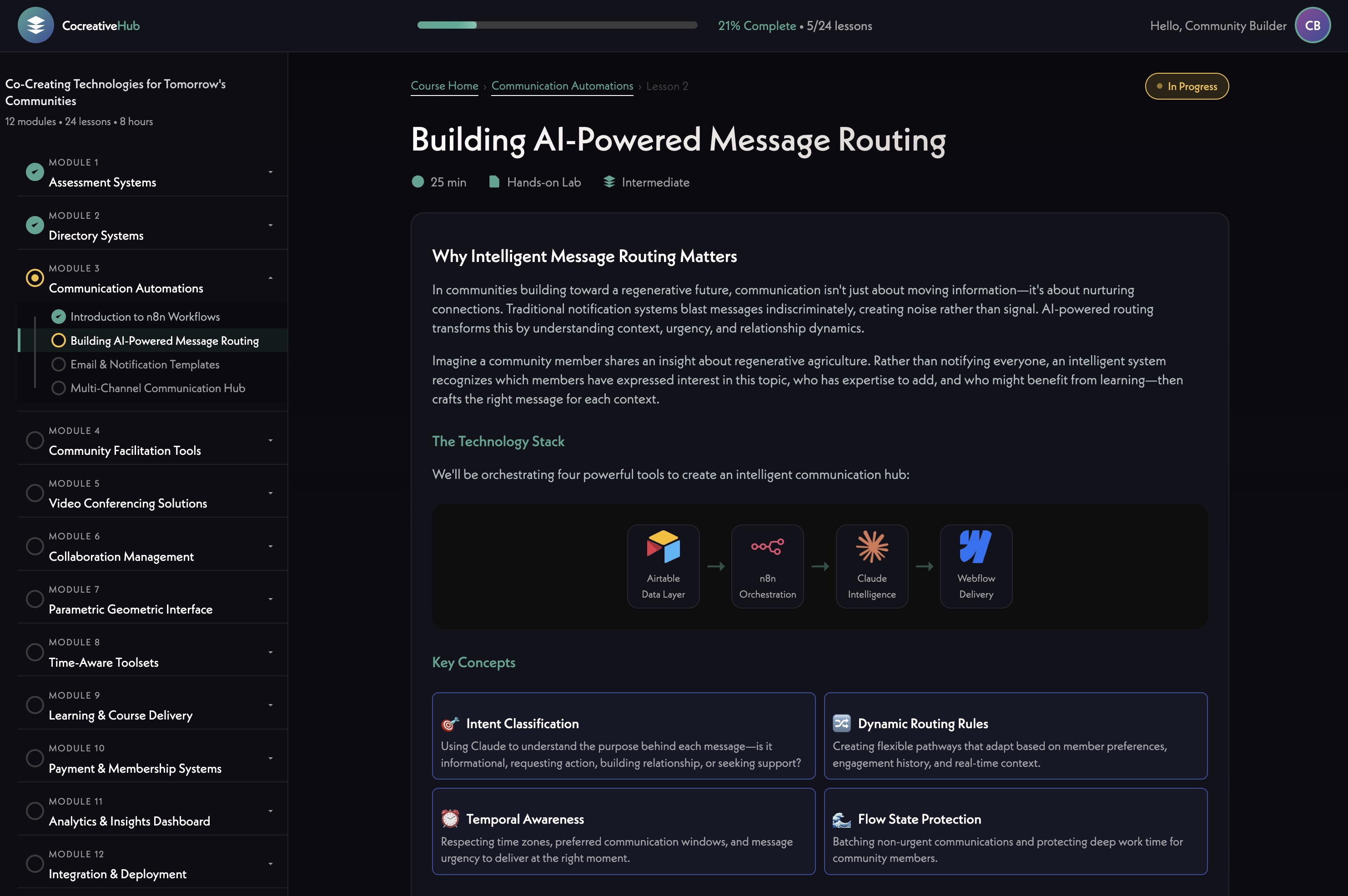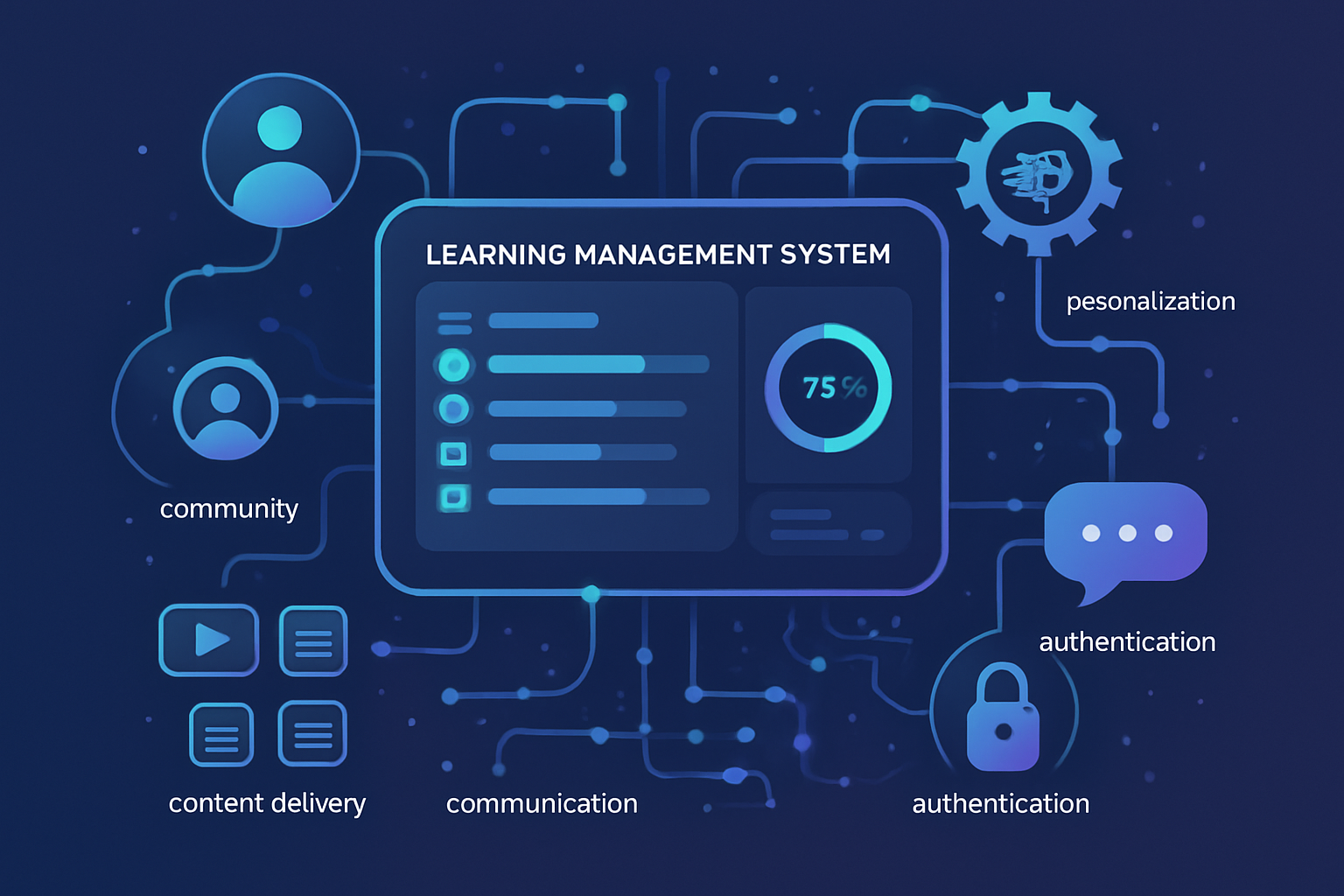





James proposed building a custom learning management system instead of using Kajabi or similar platforms (04:55). The custom system would be built directly into the existing Webflow website, offering modules, lessons, progress tracking, and user login capabilities while maintaining full design control and integration with the broader Holomovement ecosystem.
[tag="webflow"]
Building on Webflow provides several strategic benefits:
The system integrates with communication automations based on user behavior (06:25). Automated responses can trigger based on assessment data, lesson completion, call attendance, or engagement patterns—sending personalized encouragement, connection recommendations, or check-in offers from Jill when participants fall behind.
[technology="Online Learning Platforms"][technology="Custom Membership System"][technology="Communication Automations"]
Michael-Shaun shared extensive background building learning management systems and expressed both enthusiasm and caution about custom development (07:25). His experience with Boldly and other platforms highlighted important considerations around complexity, timeline, and infrastructure requirements.
Michael-Shaun outlined the full scope of components needed beyond just course delivery:
He acknowledged Kajabi's all-in-one appeal despite not loving the platform personally (08:18). Hot Mart Latin America successfully processes $50 million in annual course sales using Kajabi—demonstrating the platform works at scale even if it's not innovative.
The most important piece is user experience design according to Michael-Shaun's course development experience (18:31). Most LMS platforms use horizontal accordion-style architecture that "people hate"—it's efficient to replicate like worksheets in school, but nobody enjoys the experience.
His Boldly platform uses a screen-based philosophy versus endless scrolling (20:17):
Course completion is a bigger challenge than course sales (19:35). Anything compelling continued engagement matters more than flashy features. Live cohorts help with completion rates since people show up even if they don't complete homework between sessions.
James has built "tons of learning management systems" primarily using Learndash on WordPress but is transitioning everything to Webflow in 2025 (10:01). Many of his clients have generated millions in revenue on these platforms. IRIS is now building a reusable system deployable across multiple client projects simultaneously.
[tag="learndash"]
The approach starts with lowest-hanging fruit for rapid testing and iteration (10:01). Rather than building everything at once, the team will get core features working with real users and build from there based on actual needs and feedback.
James confirmed the system can scale to mobile apps when needed (32:23). Webflow generates clean HTML, CSS, and JavaScript that can be exported entirely or used to build parallel native apps syncing with the same databases. The key is determining app-specific use cases and excluding unnecessary web features.
Regarding timeline, James expressed confidence in delivering a functional system by February with his team's support (46:35). It will be a busy month but achievable for getting the first cohort into the platform.
The harder technical challenge is membership logins, not content delivery (26:46). James has extensive experience with Member Stack and Outseta on Webflow. While Webflow's built-in membership capability is limited, IRIS identified an opportunity to build something more customizable and cost-effective long-term.
[tag="memberstack"]
Michael-Shaun requested specification of all minimum viable features for proper evaluation (29:15):
James emphasized that simply displaying content is relatively easy—creating lesson layouts poses fewer technical hurdles than building the synergist map (27:15). The membership authentication and user management systems require the deeper architectural work.
Mariko highlighted AI components as key for engagement and support (12:44). The system can now leverage data and automation in sophisticated ways that weren't possible before, particularly for personalization and proactive outreach.
[tag="claude"][tag="n8n"]
James described the integration as "a box of crayons" where colors blend beautifully (13:40). User data from assessments, clicking patterns, lesson completion, and call attendance feeds into automation workflows. The system can send:
[technology="Assessment Systems"][technology="Intelligent Matching Algorithms"]
Michael-Shaun noted too many AI possibilities exist and emphasized giving users things they actually like to do versus impressive features (15:34). Custom assessment feedback and predictive learning journeys hold huge value, but require well-developed teaching systems to deliver on those predictions.
Predictive learning remains premature for current Holomovement stage (16:48). This approach requires extensive content libraries and learning paths that don't yet exist. Michael-Shaun cautioned against over-engineering for theoretical future capabilities.
Jill has been developing course templates, homework structures, and exercises drawing inspiration from sources like The Artist's Way (38:10). She created frameworks offering multiple exercise options to accommodate different learning styles—introverts versus extroverts, reflective versus active learners.
Initial templates include:
Jill called homework "quests" to make engagement more playful (38:10). Each week includes suggested readings separate from interactive exercises and personal practices. She's working with presenters to incorporate their specific resources and expand wisdom offerings.
Mariko emphasized the critical distinction between live delivery and evergreen product creation (34:14). The live cohort can flow organically through Zoom sessions, but the evergreen version requires precise chunking, structure, and technical formatting for global sales.
"We have to think technical first, get this right, and then plug what we do live into it" (34:48). The most efficient approach structures everything for long-term evergreen sales rather than just getting live content out quickly.
Michael-Shaun offered to collaborate directly on digital course scripting (36:01). He emphasized that Jill shouldn't have to learn this complex process alone—he can jump into documents immediately to provide suggestions and guidance.
Scripts function as detailed recipes for CMS authoring (45:23). Michael-Shaun's approach writes everything as if someone could take the course directly from the script:
He requested Jill align activities with content flow for session one (40:03). Rather than listing separate homework sections, the script should show: content section → relevant interactive activity → meditation → next content section. This mirrors how digital courses actually sequence rather than live session structure.
Michael-Shaun estimated 4-5 hours of authoring time per chapter with more time spent on editing and design than technical authoring (23:15). Building in parallel systems (both Kajabi and custom platform) remains feasible during development phase.
The team unanimously decided Emmanuel must be the consistent host for all course sessions (42:13). Initial plans involved rotating hosts alongside rotating presenters, but this approach creates too many problems.
Multiple practical and strategic reasons support this decision:
As Mariko noted, "This is essentially his course. It can't be me or something. It has to be him" (43:24). Emmanuel is trained in their process for holding containers and knows exactly what needs to happen within time limits.
The decision was made while Emmanuel was absent: "He should have been on this call. You've been outvoted and you're the sole host" (44:32). Jill will relay this decision at their Monday meeting.
All Wave attendees receive the course for free as a gift regardless of when they purchase tickets (36:47). This includes anyone buying tickets in March or beyond—there's no deadline cutoff for this benefit.
Jill confirmed this messaging starts rolling out Tuesday and has 17 people already on the waiting list (48:02). The course simultaneously launches as both a live cohort experience and a sellable evergreen product, with new participants able to start anytime.
Mariko emphasized the importance of having systems ready for the January 27 launch (46:45). The first cohort needs direct access to the membership portal with the course and other initial resources already available, creating seamless onboarding.
The team needs dedicated Slack channels for focused infrastructure development (48:12). Michael-Shaun requested a project specifically for web infrastructure development to enable easy document collaboration with James visible to relevant team members.
The discussion revealed complexity around Slack Connect integration:
James committed to creating appropriate channel structure and inviting Michael-Shaun as a single-channel guest for infrastructure collaboration (50:13). This separates sprint-specific LMS development from general homepage and website discussions.
Michael-Shaun raised critical questions about eventual app architecture (30:11). While web development can sprawl with extensive menus and features, mobile apps face severe interface constraints. Planning now for how web systems translate to app experiences prevents future rebuilding.
Michael-Shaun's platforms used hybrid development allowing simultaneous desktop and app creation (30:56). This approach avoids building everything twice—the same codebase responds to different contexts if architected properly from the start.
James confirmed Webflow exceeds WordPress and Kajabi for app compatibility (31:25). Webflow generates clean foundational code (HTML/CSS/JavaScript) that can be taken off the platform entirely or used to build parallel apps syncing with the same databases.
The key question: What's the app use case? (32:31). Not all website features belong in mobile apps—successful mobile experiences carefully select essential functions rather than cramming everything in.
James created a specific assessment page route for Guatemala participants requiring tailored copy (56:14). Currently it uses general Synergist Program language, but the team can edit it themselves now that access is configured.
Mariko provided James with updated copy via text including the assessment title change and first-click description. Hera confirmed they still need the Guatemala-specific header description above the fold.
James proposed building a custom learning management system instead of using Kajabi or similar platforms (04:55). The custom system would be built directly into the existing Webflow website, offering modules, lessons, progress tracking, and user login capabilities while maintaining full design control and integration with the broader Holomovement ecosystem.
[tag="webflow"]
Building on Webflow provides several strategic benefits:
The system integrates with communication automations based on user behavior (06:25). Automated responses can trigger based on assessment data, lesson completion, call attendance, or engagement patterns—sending personalized encouragement, connection recommendations, or check-in offers from Jill when participants fall behind.
[technology="Online Learning Platforms"][technology="Custom Membership System"][technology="Communication Automations"]
Michael-Shaun shared extensive background building learning management systems and expressed both enthusiasm and caution about custom development (07:25). His experience with Boldly and other platforms highlighted important considerations around complexity, timeline, and infrastructure requirements.
Michael-Shaun outlined the full scope of components needed beyond just course delivery:
He acknowledged Kajabi's all-in-one appeal despite not loving the platform personally (08:18). Hot Mart Latin America successfully processes $50 million in annual course sales using Kajabi—demonstrating the platform works at scale even if it's not innovative.
The most important piece is user experience design according to Michael-Shaun's course development experience (18:31). Most LMS platforms use horizontal accordion-style architecture that "people hate"—it's efficient to replicate like worksheets in school, but nobody enjoys the experience.
His Boldly platform uses a screen-based philosophy versus endless scrolling (20:17):
Course completion is a bigger challenge than course sales (19:35). Anything compelling continued engagement matters more than flashy features. Live cohorts help with completion rates since people show up even if they don't complete homework between sessions.
James has built "tons of learning management systems" primarily using Learndash on WordPress but is transitioning everything to Webflow in 2025 (10:01). Many of his clients have generated millions in revenue on these platforms. IRIS is now building a reusable system deployable across multiple client projects simultaneously.
[tag="learndash"]
The approach starts with lowest-hanging fruit for rapid testing and iteration (10:01). Rather than building everything at once, the team will get core features working with real users and build from there based on actual needs and feedback.
James confirmed the system can scale to mobile apps when needed (32:23). Webflow generates clean HTML, CSS, and JavaScript that can be exported entirely or used to build parallel native apps syncing with the same databases. The key is determining app-specific use cases and excluding unnecessary web features.
Regarding timeline, James expressed confidence in delivering a functional system by February with his team's support (46:35). It will be a busy month but achievable for getting the first cohort into the platform.
The harder technical challenge is membership logins, not content delivery (26:46). James has extensive experience with Member Stack and Outseta on Webflow. While Webflow's built-in membership capability is limited, IRIS identified an opportunity to build something more customizable and cost-effective long-term.
[tag="memberstack"]
Michael-Shaun requested specification of all minimum viable features for proper evaluation (29:15):
James emphasized that simply displaying content is relatively easy—creating lesson layouts poses fewer technical hurdles than building the synergist map (27:15). The membership authentication and user management systems require the deeper architectural work.
Mariko highlighted AI components as key for engagement and support (12:44). The system can now leverage data and automation in sophisticated ways that weren't possible before, particularly for personalization and proactive outreach.
[tag="claude"][tag="n8n"]
James described the integration as "a box of crayons" where colors blend beautifully (13:40). User data from assessments, clicking patterns, lesson completion, and call attendance feeds into automation workflows. The system can send:
[technology="Assessment Systems"][technology="Intelligent Matching Algorithms"]
Michael-Shaun noted too many AI possibilities exist and emphasized giving users things they actually like to do versus impressive features (15:34). Custom assessment feedback and predictive learning journeys hold huge value, but require well-developed teaching systems to deliver on those predictions.
Predictive learning remains premature for current Holomovement stage (16:48). This approach requires extensive content libraries and learning paths that don't yet exist. Michael-Shaun cautioned against over-engineering for theoretical future capabilities.
Jill has been developing course templates, homework structures, and exercises drawing inspiration from sources like The Artist's Way (38:10). She created frameworks offering multiple exercise options to accommodate different learning styles—introverts versus extroverts, reflective versus active learners.
Initial templates include:
Jill called homework "quests" to make engagement more playful (38:10). Each week includes suggested readings separate from interactive exercises and personal practices. She's working with presenters to incorporate their specific resources and expand wisdom offerings.
Mariko emphasized the critical distinction between live delivery and evergreen product creation (34:14). The live cohort can flow organically through Zoom sessions, but the evergreen version requires precise chunking, structure, and technical formatting for global sales.
"We have to think technical first, get this right, and then plug what we do live into it" (34:48). The most efficient approach structures everything for long-term evergreen sales rather than just getting live content out quickly.
Michael-Shaun offered to collaborate directly on digital course scripting (36:01). He emphasized that Jill shouldn't have to learn this complex process alone—he can jump into documents immediately to provide suggestions and guidance.
Scripts function as detailed recipes for CMS authoring (45:23). Michael-Shaun's approach writes everything as if someone could take the course directly from the script:
He requested Jill align activities with content flow for session one (40:03). Rather than listing separate homework sections, the script should show: content section → relevant interactive activity → meditation → next content section. This mirrors how digital courses actually sequence rather than live session structure.
Michael-Shaun estimated 4-5 hours of authoring time per chapter with more time spent on editing and design than technical authoring (23:15). Building in parallel systems (both Kajabi and custom platform) remains feasible during development phase.
The team unanimously decided Emmanuel must be the consistent host for all course sessions (42:13). Initial plans involved rotating hosts alongside rotating presenters, but this approach creates too many problems.
Multiple practical and strategic reasons support this decision:
As Mariko noted, "This is essentially his course. It can't be me or something. It has to be him" (43:24). Emmanuel is trained in their process for holding containers and knows exactly what needs to happen within time limits.
The decision was made while Emmanuel was absent: "He should have been on this call. You've been outvoted and you're the sole host" (44:32). Jill will relay this decision at their Monday meeting.
All Wave attendees receive the course for free as a gift regardless of when they purchase tickets (36:47). This includes anyone buying tickets in March or beyond—there's no deadline cutoff for this benefit.
Jill confirmed this messaging starts rolling out Tuesday and has 17 people already on the waiting list (48:02). The course simultaneously launches as both a live cohort experience and a sellable evergreen product, with new participants able to start anytime.
Mariko emphasized the importance of having systems ready for the January 27 launch (46:45). The first cohort needs direct access to the membership portal with the course and other initial resources already available, creating seamless onboarding.
The team needs dedicated Slack channels for focused infrastructure development (48:12). Michael-Shaun requested a project specifically for web infrastructure development to enable easy document collaboration with James visible to relevant team members.
The discussion revealed complexity around Slack Connect integration:
James committed to creating appropriate channel structure and inviting Michael-Shaun as a single-channel guest for infrastructure collaboration (50:13). This separates sprint-specific LMS development from general homepage and website discussions.
Michael-Shaun raised critical questions about eventual app architecture (30:11). While web development can sprawl with extensive menus and features, mobile apps face severe interface constraints. Planning now for how web systems translate to app experiences prevents future rebuilding.
Michael-Shaun's platforms used hybrid development allowing simultaneous desktop and app creation (30:56). This approach avoids building everything twice—the same codebase responds to different contexts if architected properly from the start.
James confirmed Webflow exceeds WordPress and Kajabi for app compatibility (31:25). Webflow generates clean foundational code (HTML/CSS/JavaScript) that can be taken off the platform entirely or used to build parallel apps syncing with the same databases.
The key question: What's the app use case? (32:31). Not all website features belong in mobile apps—successful mobile experiences carefully select essential functions rather than cramming everything in.
James created a specific assessment page route for Guatemala participants requiring tailored copy (56:14). Currently it uses general Synergist Program language, but the team can edit it themselves now that access is configured.
Mariko provided James with updated copy via text including the assessment title change and first-click description. Hera confirmed they still need the Guatemala-specific header description above the fold.
LMS infrastructure
February 1, 2026
Develop core LMS features including modules, lessons, progress tracking, and user login. Prioritize lowest-hanging fruit for rapid testing. Team expects functional system by February with support from IRIS team.
Create infrastructure development Slack channel and invite Michael-Shaun
December 23, 2025
Set up dedicated infrastructure development channel within Holomovement workspace (not IRIS workspace). Invite Michael-Shaun as single-channel guest for collaboration. Separate from general homepage/website discussions.
Finalize membership system approach for team review next week
December 27, 2025
Decide between Member Stack or custom solution. Present phase one and phase two proposal for membership portal features. Meeting scheduled next week focused on membership system architecture decisions.
Update Guatemala assessment page with provided copy changes
December 20, 2025
Update Guatemala-specific assessment page with copy from Mariko including title change and first-click description. Add Guatemala-specific header description above the fold per Hera's confirmation.
Document all LMS parts and pieces needed for course operation
December 27, 2025
Share course script templates with Jill showing authoring format
December 23, 2025
Provide script examples demonstrating detailed recipe format for CMS authoring. Show how to specify interactivity types, interaction flows, and content-to-activity sequencing. Enable Jill to start scripting process.
Collaborate with Jill on scripting session one with content-to-activity flow
January 10, 2026
Work directly with Jill on session one script. Align activities with content flow rather than separate homework sections. Show: content section → relevant interactive activity → meditation → next content section sequencing.
Provide feedback on minimum viable features specification
December 30, 2025
Review James's specification of all minimum viable LMS features when available. Evaluate based on experience with Boldly and other platforms. Ensure critical components included: real database, journal capture, API triggers, progress tracking.
Meet with Emmanuel Monday to discuss course finalization and host structure
December 23, 2025
Relay team decision that Emmanuel must be sole consistent host for all course sessions. Discuss content finalization and presenter coordination. Emmanuel was absent from meeting where decision was made.
Align session one activities with content flow for scripting process
January 3, 2026
Restructure session one to show content-to-activity sequencing rather than separate homework sections. Prepare for Michael-Shaun's scripting collaboration. Format for digital course delivery rather than live session structure.
Continue developing exercise options for different learning styles
January 20, 2026
Expand framework with multiple exercise options (meditation, journal prompts, embodiment exercises, real-world implementation) accommodating introverts vs extroverts, reflective vs active learners. Use 'quests' terminology for playful engagement.
Coordinate with presenters to integrate their resources and wisdom offerings
January 20, 2026
Work with course presenters to incorporate their specific resources, teachings, and materials into course structure. Expand wisdom offerings beyond core content. Ensure presenter contributions align with evergreen format.
Review phase one and phase two proposal for membership portal features
December 22, 2025
Schedule meeting next week focused on membership system architecture decisions
December 26, 2025
Meeting to discuss membership system architecture (46:45)
Provide Guatemala-specific copy for assessment page header
December 26, 2025
Copy needed for Guatemala assessment page (56:14)
Continue to support infrastructure development coordination and Slack channel organization
December 26, 2025
Assessment system with AI-powered engagement features feeding automation workflows. Data from assessments, clicking patterns, lesson completion, and call attendance triggers personalized communication including immediate tailored emails, weekly progress updates, connection recommendations based on profile matching, and proactive check-in offers when engagement drops. Guatemala-specific assessment page created requiring customized copy. Current synergist directory demonstrates existing assessment capabilities: members complete form triggering automated n8n and Claude AI analysis of responses about purpose, projects, and ancestral wisdom influences. System generates personalized feedback and recommends connections to other synergists based on compatibility, facilitating introductions via email without exposing addresses. Also suggests relevant podcast episodes. No-login approach removes participation barriers while enabling intelligent matching and communication. Strategic shift to progressive engagement model: members start with basic five-minute profile setup (name, website, purpose statement, location), then complete more detailed assessments later. Each completed assessment adds elements to profile and unlocks new features. Gamification includes AI-generated icons, tarot card archetypes, or numerology graphics appearing on profiles as users complete different assessments. Incremental assessment launch strategy releasing new assessments every week or ten days leading to Wave event, using Ripple gatherings and Miracle Club to promote participation. Partnership opportunities with experts for themed assessments (Don Beck for Spiral Dynamics, Vedic astrologer for astrology, iOS Zone of Genius team for their assessment). Critical reassessment of assessment strategy prioritizing basic intake form capturing most important factors: development level, experience, life stage, purpose, and current needs as primary assessment for matching foundation. Systems like Gene Keys and numerology recognized as requiring belief in astrology/numerology to feel relevant, limiting universal applicability. Focus shifting to actionable, practical data enabling computational matching based on clear criteria rather than archetypal personality typing. When matching collaborators, users need to understand skills, experience, current needs, and project involvement rather than personality scores. AI-driven matching requires developmental stage, experience level, project involvement, and specific needs to avoid misaligned matches like pairing serial entrepreneurs with college freshmen. Meeting confirmed approach of using simple 1-to-10 scale assessments for numerical scoring and spider graphs but deferring complex compatibility scores for MVP. AI interpretation via Claude for free-text fields and nuanced alignment, direct computation for explicit matches like shared affiliations or complementary skill requests. Michael coordinating with Emmanuel on potential assessment questions to gauge user alignment. Team now planning 5-6 domain assessment (5 makes pentagram shape, 6 makes star shape) using simple multiple choice format outputting 1-10 scores per metric with spider graph visualization (37:24). Demonstrated working client assessment as reference - multi-screen flow with logic-based classification, no agentic analysis required. Key design principles: spectrum-based framing rather than qualitative scoring ('does this sound like you or not?' vs 'how good are you at this?'), questions should feel neutral and interesting to avoid test-taking bias (MMPI/Myers-Briggs problem of answering how you want to appear), completable in 10 minutes or less, more candidate questions per domain than needed for culling weak ones (40:52, 48:29). Mariko advocated for including at least one fun gift-like assessment (e.g. numerology mandala tool) people would do for the experience that enriches profile organically without feeling like data extraction (41:56). James floated longer-term vision of garden of assessments users can choose from with power to decide which assessments inform matching - astrological/numerological inputs become opt-in rather than default. New numerology mandala tool demonstrated building visual in real time as user types, team expressed integration interest (43:44). Michael Shaun starting shared document immediately with candidate domain names and draft questions for team review, holding internal review with Hera before broader socialization (40:52, 52:43). Working prototype built with five-domain assessment featuring slider-based positioning system across spectrums (22:37). Five domains: Holonic Worldview (separative/analytic to holistic/integrative), Purpose Orientation (exploring/emergent to directed/activated), Pro-Social Stance (deep one-on-one to community-wide/systemic), Collaborative Capacity (independent to collective), Time Horizon (near-term to long-arc/generational). Results render as nine-pointed spider graph and bar chart. Slider format keeps assessment accessible without overwhelming users (25:36). Community-level visualization capability floated - overlaying 100 profiles to reveal collective orientation of holons or comparing holons against each other (29:17). Next development step: adding archetype outputs (e.g., 'super connector') with brief descriptive text for each result profile. Assessment data feeds optionally into matching algorithm with users able to decide matching criteria when requesting analysis, though some default criteria apply automatically (36:00). Prototype ready for Holomovement team Thursday meeting demo (40:46). 03-31 meeting revealed spider graph assessment essentially unreadable without tutorial - 19 items across overlapping axes makes results incomprehensible (10:54). Team verdict: spider graph is good eye candy but doesn't deliver snapshot value. Simplified one-question assessment with triangulation output confirmed as right path forward, not using spider graph format (14:58). Working prototype committed for following day. Michael Shaun flagged standing to-do: writing one-page descriptive blurbs for each assessment area so AI can return robust grounded responses to user queries - Google Doc format for now (57:04). Mariko testing showed assessment accurate and trustworthy, validating credibility needed for matching layer to work for new users. Assessment confirms what users intuitively know about existing relationships, building trust for recommendations with unknown people (46:52). Beyond individual matching, assessments help working groups understand collective makeup - team strengths, shadows, support needs, leadership roles. Positions tools as ongoing collaboration infrastructure rather than just onboarding features (51:14). New triangular assessment visualization mentioned in meeting at 57:00 as co-designed by James. Assessment now functional with improved output format and ready for core team onboarding (meeting 05-04).
Digital course scripting for evergreen product creation with Michael-Shaun's methodology. Scripts function as detailed recipes for CMS authoring, specifying exact interactivity types (checkbox, multiple choice), interaction flows, and content sequencing. Format aligns activities with content flow rather than separate homework sections. Michael-Shaun estimates 4-5 hours authoring time per chapter. Process enables editing on paper before time-consuming CMS building. Focus on live-to-evergreen workflow ensuring technical structure supports global sales rather than just live delivery.
Custom learning management system (LMS) development on Webflow enabling self-paced courses, video content, progress tracking, quizzes, and certifications. Strategic decision to build custom LMS rather than using Boldly or Thinkific to support live-to-evergreen content workflow and global product sales. System requirements include real database for user progress (not cookies), journal entry capture, API triggers for membership status and course purchases, and progress tracking across sessions. Decision made to build on Supabase backend rather than Member Stack for authentication and data management. Phase One budget $16K-$29K with commitment to higher end. Development timeline six weeks: weeks one-two for Supabase foundation and user dashboard connected to Webflow CMS, week three for Stripe integration and membership access control, weeks four-five for testing and email integrations, polish and testing complete by January 25th for February 10th launch. Three-tier collection structure: courses, modules, lessons. Content authoring process uses detailed scripts functioning as recipes specifying exact interactivity types (checkbox, multiple choice), interaction flows, and content sequencing aligning activities with content flow rather than separate homework sections. Format supports live-to-evergreen workflow ensuring technical structure supports global sales rather than just live delivery. Team using themselves as first test group to validate system with real-world use cases before broader deployment. Authentication spike establishes foundation with Supabase login functionality on MAST template implementing user profiles, password management, and session handling. Backend successfully operational with membership login and content gating complete. Profile editing integration in progress to connect with directory system. LMS moved back to active priority to support Choose Love course launch with Boldly course content as test videos for validation before committing to Choose Love timeline. Development continuing at reduced pace while directory system remains primary focus.
00:00:03
Jill Robinson: Okay.
00:00:08
Michael-Shaun: Crisis, crisis, crisis.
00:00:12
Boldly NOW: I don't know.
00:00:13
Michael-Shaun: There's a. That's my doorbell ring.
00:00:17
Boldly NOW: Sorry, I'll be right back.
00:00:19
Michael-Shaun: It's two flights down, so it's going.
00:00:21
Boldly NOW: To take a while.
00:00:26
Mariko Pitts: James, what are your thoughts on all this before we shift?
00:00:30
James Redenbaugh: I think there's a lot of good stuff here and I agree that a lot of value can come out as simplification and kind of tumbling these things. And I'm excited to match some of these words to visuals because that's a big piece of it as well. You know, we want to tell two sides of the story at once to hit both hemispheres of the brain. And yeah, I think it needs working. I want it to, you know, feel more human. Like, the more I engage these models, the more I can kind of hear. Hear when it. When a bot is speaking to me or a human. But I think it's an awesome starting place and there's a lot of great stuff here and we can workshop it.
00:01:36
Jill Robinson: Yeah.
00:01:39
Mariko Pitts: Okay.
00:01:41
Michael-Shaun: I will update this. James, I don't have an email address for you.
00:01:47
James Redenbaugh: I'll put it in the chat or I'm on the meeting link. It's just james@iris-co creative.com.
00:01:59
Michael-Shaun: Got it.
00:02:01
Mariko Pitts: All right, here comes Jill. Let's see who else.
00:02:09
Michael-Shaun: Okay, I've shared that all through Google for everybody also.
00:02:14
Boldly NOW: Look for it there.
00:02:16
Mariko Pitts: Cool. Hey, Jill. Amazing. Thanks.
00:02:18
Jill Robinson: Michael.
00:02:19
Mariko Pitts: Good to see you. How's it going?
00:02:22
Jill Robinson: Doing okay. How you guys doing? Good.
00:02:24
Mariko Pitts: Good, good. We're running from all kind of different projects to projects, but this is the same on for course. Huh? I'm.
00:02:31
Jill Robinson: I'm on the right time. Or am I like an hour?
00:02:34
Mariko Pitts: No, you're totally. You're okay. All point. We're. It's a. We're also. We were just meeting on some whole website stuff, actually.
00:02:43
Jill Robinson: Okay.
00:02:44
Mariko Pitts: And Microsoft was pitching something around, simplifying some pieces to tell it, you know, for people to quickly grasp, like what is the holo moment. So we're just doing custom tweaks here, which is great and amazing, but it's the same crew staying on for the same. I put it intentionally above so we could roll into the course bit because obviously with James, we're, you know, as, you know, we're redefining or designing the whole membership platform. And Michael, Sean, everybody's on that same team. So because the course is coming up so fast, we need to have James to understand a bit more about what's happening so he can. We can figure out the platform that is living. We Were thinking, James, you could probably share a little bit of what we're thinking from the not using a Kajabi but building our own and what that might look like. I think that might be helpful for even Michael, Sean and Jill to really kind of conceptualize here of how the we can actually utilize the platform now rather than waiting until it's evergreen and plopping it in. So maybe it might be good there. Maybe we start there and then Jill or what do you think? Maybe Jill. Yeah, maybe let's start there and just talk about the system per se of how this could potentially work. Let's start about this with the system because it makes sense. This is not. At first I was thinking, oh, it's not, it's okay. We can tweak it a little bit because we can wait for the evergreen after the live course comes. But then I was like, wait a minute, we might need that now for homework and different places for them to come, the cohort to come together. So yeah, talk to us a little bit about that James, real quick.
00:04:17
James Redenbaugh: Great. Yeah, why don't I share some screen. Also first I'll share mine. Surrounded by little kitties.
00:04:40
Hera Barrameda: Is Emmanuel joining us today.
00:04:45
Mariko Pitts: He might be with Will keeping right now. So not so that's okay.
00:04:55
James Redenbaugh: So yeah, we've been talking about lots of things and in the app ecosystem and most recently about the learning management platform possibilities you guys were considering like Kajabi or something like that. And instead I'm proposing we build a custom LMS that has all those same features or whichever ones we need because we are building that anyway irises as a team and so yeah, we've been talking about what requirements that system needs kind of building on the standards that have evolved in learning management systems online where we have modules and lessons and they're easily navigatable and they track user progress and people can mark things as complete and of course have a login. We're figuring out membership system and we can build this all onto the existing webflow website. So we offer the course there, they log on there, all the contents there. We can design the content however we want, of course, and then also design communication automations based on the experience that we want to create with inputs including any assessments that they fill out, but also data on how are they participating in the course, are they showing up for the calls, are they doing the lessons, are they marking them as complete or not so the system can respond to them automatically and say, you know, you're Doing great. Here's a suggestion. Or we saw you answered this to the question the other day. We recommend connecting with this person or we notice you signed up for the course but you haven't been joining the calls. You want to schedule 20 minutes with Jill to talk about it or you know, whatever you guys come up with as the right course of actions. We can, we can play with those kind of things. So yeah, is that a good intro, understanding, catch up on what we're talking about here? Yeah.
00:07:25
Michael-Shaun: Having built a few LMSs, I know.
00:07:27
Boldly NOW: I know that game in and out.
00:07:32
Michael-Shaun: I guess there's buckets worth of questions. Do we want an app based experience?
00:07:39
Boldly NOW: Yes or no. Are we? And what if we don't? And then like anytime we go to our own systems, which are a couple.
00:07:50
Michael-Shaun: Of options, then we have the additional.
00:07:54
Boldly NOW: Need of, you know, doing, choosing a landing page software platform, email campaign software platform billing and all those other additional elements which we can, which you can it certainly, I mean that's the direction went with boldly and detecting. If we use that platform, we'd have to do that too. So the benefit of Kajabi is it's all rolled into one.
00:08:18
Michael-Shaun: I don't like Kajabi necessarily, but it.
00:08:21
Boldly NOW: Actually functions and a lot of people sell courses on there other than my own platform. The other platform I'm on as a.
00:08:30
Michael-Shaun: Teacher is with Unity and they do.
00:08:33
Boldly NOW: Hot Martin Latin America which is one.
00:08:36
Michael-Shaun: Of the similar kind of thing to.
00:08:36
Boldly NOW: Kajabi and they do Kajabi here and it works, it works really well. And they're pushing, you know, $50 million worth of course sales a year. So they're doing a lot of it and I've talked to them a number of times about building custom systems.
00:08:52
Michael-Shaun: And like why aren't you on Kajabi? And they're just like, because it works.
00:08:56
Boldly NOW: And so I think there's just, I just, I understand that it's not my cup of tea. I'm always better for building.
00:09:04
Michael-Shaun: Solutions, especially.
00:09:05
Boldly NOW: Because we can build in solutions that.
00:09:09
Michael-Shaun: Incentivize the behaviors we want out of.
00:09:12
Boldly NOW: Out of our participants. But there is a lot of complexity that would just have to be. To be handled. I don't know who in the team would handle some of that complexity. And even if we go to Kajabi, there has to be somebody that builds landing pages for the courses and stuff like that anyway. So it's just probably worth taking a moment and mapping out like what does it take to build, launch and deliver a course A digital course and yeah, think through all those elements. And for you, James, are you thinking.
00:09:54
Michael-Shaun: About grabbing somebody else's LMS software and bolting onto that or building yours from the ground up?
00:10:01
James Redenbaugh: We're working on building it from the ground up. I've built a ton of learning management systems largely on Learndash and WordPress. We used to be a WordPress shop for a long time. A lot of my clients have done like millions in revenue on Learndash and it's great and, you know, WordPress is great and we're done with WordPress in 2025 and so we're figuring out how to do everything that learndash and Member Press does in webflow and building a system that we can maintain across multiple projects. So different client. We're building this for different clients at the same time and starting with the lowest hanging fruit, getting people testing it out and getting things working and then building on from that. So it's a journey, but it's, you know, after years of working in webflow now and different systems and too much time in the ins and outs of learndash and other systems, we've also built things for people on Kajabi and Udemy and Circle and stuff like that. And it's time because it's easier than ever to do our own thing.
00:11:33
Michael-Shaun: Would you imagine being able to build.
00:11:35
Boldly NOW: A, an ampified version of that Elements LMS in time or.
00:11:42
James Redenbaugh: Yeah, definitely. I think that's the end goal and I foresee that becoming easier and easier as well. You know, every year it's easier to build an app, but in the short term to be able to just rapidly iterate on a webflow site and take advantage of CMS and other database tools that are easy to plug in? I feel like that's the way to go. If we had, you know, a bunch of courses to launch for the Hollow movement and we wanted to start pushing them asap, you know, I wouldn't recommend this route, but because we're talking about one course that's being given away to free. For free to wave participants. And you know, we're also doing these other things. I feel like this is a solid option.
00:12:42
Michael-Shaun: Okay, cool.
00:12:44
Mariko Pitts: And we will also sell it too though. But yeah, but yeah, I think it is a nice sweet gift for people already spending like $2,000 for it to come to a wave. Yeah, yeah, a nice addition. Could you talk a little bit more about the AI components of the things that could be weaved in through it now, I don't think we really gotten into that. Yeah, see that really kind of helping with engagement, you know, and support. Because this is where, like I was mentioning, this is really where Michael Shawn has shine and the engagement, a deeper engagement for his courses and things like that. The retention and, you know, how engaging and gamifying it is for people when they go through something or. And then what they kind of read from the collective and the data from the collective and things like that. But I think you're talking about other things that we can now do with AI to kind of really support people through the journey too.
00:13:40
James Redenbaugh: Yeah. So we have this box of crayons that we can now play with and. And it's melting and all the colors are bleeding together in this beautiful way, to use a weird metaphor. But because we can. We can take the data that we can get from people using a system on the site or submitting responses or answering questions or clicking a button, and then feed that into any kind of automation like we see that we're doing with the assessments. You know, people can create a profile and end up over here in this way. We can tailor an email to them based on what they're answering. We can do the same kind of thing based on how they're engaging with the course. Both immediately you complete a. A lesson and you get an email that's tailored to you based on your profile and the question. Or periodically every week, we send out 50 emails to all the participants that has the information that we want to share with everybody and information that's pertinent to them. You know, you completed so much of this course or you answered this thing or whatever it's. And I think of it as a box of crayons because I want to make it available and see how, you know, work with you guys in how the course wants to unfold and what's going to be valuable for the participants and then find a solution for.
00:15:26
Mariko Pitts: Okay, cool. Any questions on that or additions or pushback or what do we want? Yeah.
00:15:34
Michael-Shaun: The AI integration of things. There's so many possibilities for that.
00:15:44
Boldly NOW: The, The.
00:15:45
Michael-Shaun: In fact, there's too many possibilities.
00:15:46
Boldly NOW: And what I know about user behavior.
00:15:48
Michael-Shaun: Is we need to give them things that they like to do versus all.
00:15:51
Boldly NOW: The kind of cool things that we can give them. So definitely custom feedback around assessment tools. And there's a whole thing that we're doing in edutech right now where it's predictive learning journeys. And so I think there's a huge value in that I mean, if you have a predictive learning trainer, you kind of know where people are, where the deficits are, where they're heading. You can kind of custom create a journey for them, but you have to have a very well developed system of teaching to deliver that. You can't, you can't, like here's a learning journey, but we have no way to help you to achieve that journey. And so right now with all the movement, you know, having a course is, it's probably doesn't lend itself to that yet.
00:16:48
Michael-Shaun: Yeah, there's lots of, there's lots to talk.
00:16:49
Boldly NOW: A lot of experience that I have in this for sure that we could talk about. The question that really is like, how do we do that in a way that serves the whole movement the best? I think. And I, yeah, I know because I have so much my own background and experience and I have a hard time separating what I've done from what could be done in a kind of open ended context. It's like, oh, well, if I were to start over again, what would I start over and do? I think that's the way that it occurs to me. And then I, to be honest with you, I think, oh my God, I don't think I'd ever start over again. Like, I don't know if I would go back, you know, like after, you know, six, seven, ten years of developing these things. It's like, but what, like how do you make movement forward?
00:17:32
Michael-Shaun: So that's something I can think about.
00:17:33
Boldly NOW: It a little bit more. I could talk to James about what we've done and what are all the pieces and parts that are in the background of the work that I already have and maybe there's some value proposition there.
00:17:49
James Redenbaugh: I don't know.
00:17:49
Boldly NOW: I mean, it's probably worth thinking about though, versus and then actually having a critical analysis. Is it? Hey, well, maybe Michael, Shawn, you're grumpy old man about this. It's a perfect time to reconsider all this. So many more different things can be done. So that's the what's present for me more than any kind of honest assessment of what James is talking about or any kind of like qualitative assessment just like, oh, wow, okay.
00:18:24
Michael-Shaun: And I want to say that also.
00:18:25
Boldly NOW: You know, like the one thing.
00:18:26
Michael-Shaun: That, the one thing that is.
00:18:31
Boldly NOW: In my experience maybe the most important piece of this is the user experience design. And I think there's a, most of the models that are out there are basically the same thing. They're all horizontal Stack. They're all accordion style architecture and people hate them. It's really, it's really not a, it's like the worksheet was the most efficient way to get you to do things in school. But there was no kid in the room that liked the worksheet. Like it was not that it wasn't, it wasn't a desirable user experience. It's just one that was easy to replicate. And so I think a lot of learning management systems are like that. It's like it's really easy to do this and duplicate that user experience. But nobody really likes it. Nobody says oh wow, I had a great experience taking that course. And so that's something that I think about as long as like so we know one of the biggest problems is not selling courses but getting people to complete courses. So anything that compels them to continue along the journey. By the way, Jill Live is one.
00:19:35
Michael-Shaun: Of the ways that we compel people.
00:19:36
Boldly NOW: To go along the journey. They may not take any actions, but they might show up and at least consume the content.
00:19:45
Mariko Pitts: Okay, and what's the, I mean besides when you're talking about the design of it, are you thinking more what are what have you noticed that people actually enjoy better? And the formatting for the LMS stuff.
00:19:58
Michael-Shaun: We designed the style of interaction that.
00:20:02
Boldly NOW: We did which is all on the same, we call it the, you know, the same screen. There's no scrolling up and down type things. All the actions, all the materials replace on the stage one after the other.
00:20:16
Mariko Pitts: Just like more scrolling that way.
00:20:17
Michael-Shaun: Kind of just that everything is based.
00:20:21
Boldly NOW: In kind of screens type philosophy versus like a web kind of an endless scrolling web model. So that seems to be a bit more satisfying. Being able to jump back so that.
00:20:34
Michael-Shaun: It feels like a space versus it feels like a list I guess is probably the best way to put that.
00:20:39
Boldly NOW: That they feel in a space for their learning. And then of course that your system is able to give them the option.
00:20:45
Michael-Shaun: To go directly back to that space and continue learning.
00:20:49
Boldly NOW: A lot of the obviously feedback characteristics are really important in that. Like how do you give instantaneous feedback that's all non AI feedback. It's just literally feedback about what they're learning and in the journey. That's up to the course designer to think through what you want them to think about. Now I'm going to be helping with.
00:21:15
Michael-Shaun: Course design on the digital side. So obviously we've got the skill to.
00:21:18
Boldly NOW: Be able to do those things.
00:21:19
Michael-Shaun: So then that, yeah, I think it's the right time to ask this question, Marco.
00:21:24
Boldly NOW: Like where do we put it and what would be the value of building something from the ground up? And could that be done in any now. Yeah, at the end of January type thing and in any kind of meaningful way. And, and if not, you know, are we, is it a, you know, is this a six month production? Obviously you can do beta type things. Is this a longer production? What is the Q and A process off of that? Can we sell products based upon things that may, you know, not always work? Those are some of the questions.
00:22:01
Mariko Pitts: Well, I think then that's a great question. That's something that I was pondering too when the other day when James first presented it to me and I was thinking, okay, it's more of like what can be done now, where it's, it works where, you know. And I was thinking, you know, what the. If it can be done, I think it's nice to strive for, to go ahead and move forward with it. But the idea, it could just be where, because it's live, we actually have, we have a choice here. We can actually bring the homework into this learning platform or we keep it outside of that and keep it fully live and then evergreen it and move it fully evergreen into it later. Which gives us like phase two. We give more time where we have until it's completed, the course is completed to then move it into the LMS system that we're building. So we could do it that way and the homework is through. You know, I mean we could, you know, it can be simple. I mean we can put it into email formats and reminders and things like that. You know, I mean, we can do a scratch based thing that's, you know, and automated through that.
00:23:11
Michael-Shaun: But there's no reason you couldn't do a parallel construction with a kajabi as well.
00:23:15
Boldly NOW: I mean it's just authoring time, which is not going to be crazy. I would estimate that with each chapter we're talking about a handful of hours per chapter to author, something like four or five hours to do all of the authoring of each thing. You're going to spend more time editing and designing than you're going to spend on actually the authoring process. And then you could build it in both or as soon as the new system's up, you could build it in both and just decide when it's robust enough to switch over or things like that.
00:23:47
Michael-Shaun: I don't think the community, the live.
00:23:49
Boldly NOW: Community is not going to mind.
00:23:50
Michael-Shaun: The thing is that if we, if.
00:23:52
Boldly NOW: We don't build it in January, that means you get one cohort going through. But you can't start somebody in March, for example. You can't start an evergreen. Like we could start people really in, in February. Even if we had a, if we were pulling the material out of the live and cutting it and putting it into, start selling it or having those people that didn't make the live cohort in January could start taking it automatically. So.
00:24:24
Michael-Shaun: Yeah, I mean, I guess the real question long term is what's the value proposition?
00:24:29
Boldly NOW: How does it cost to develop. What is the value of it when it's developed all of those things, I think. And then how do you develop the other pieces around that like all the other pieces you need?
00:24:40
Mariko Pitts: Well, I think the value is that they're in one. Hold on, let me just say. I just think the value is that we do create. It's more benefit to create lms that they're logging into one place where then they have, you know, access to the, all the other resources and things. So it's an easier, seamless, you know, one login get on into it and then you're basically at that point seeing whatever your, you know, the engagement when you, if you decide to, you know, if you come up on a wall and you're seeing the synergist map but you want to communicate with people, then it's like you. The option at that point to pay to Jo, you know, for deeper access. But to have people in the same ecosystem, I think it's a benefit, more benefit now and to utilize anytime we're bringing, we're putting ourselves and creating new cohorts or new segments and beta groups. You want to be thinking about how to they where they're ultimately going to be, which is in that one spot. I don't like the idea of putting people into Kajabi now and then having to move them into something else. If we're building it. So we either build it and we do something different where we wait and you know, if we can't get this up and going now by the time it launches where we can utilize that and get people into playing behind in the scene, behind the scenes in that, then we need to be able to get it ready by the time this course completes and then we just move an evergreen product into it or something like that, but we test it. So that's my thinking of It But I do like the idea if it's good to go that we keep that we can also sell the product but that you know, as it's actually live and then other people can, you know, we can start selling the course either way and people can come in wherever they're at. I like that. And just kind of plug it right in. I like that. That's really efficient. But it's just where are we? Because when a learning management LMS system also needs the membership portal kind of there in some way too. So there's kind of a double whammy. There are other infrastructure pieces that need to be added or running before we, you know, I guess or maybe James, you would see it differently. Do we, you know.
00:26:46
James Redenbaugh: No, I mean we need.
00:26:49
Mariko Pitts: Log basic logins and stuff like that but maybe we don't need the membership portal completed yet.
00:26:56
James Redenbaugh: Not if the, I mean if we're just making the content available and people aren't marking things as complete. I mean actually we could do that with cookies. We don't necessarily need a membership login but it's definitely a nice to have and that's actually the harder piece that we're working on than the content delivery. The structure of an LMS is relatively simple. It's the logins in creating a membership system on the website that's the hard part and that's something we've been working on and it's something we've done a lot on webflow sites using Member Stack and Outsata. The built in membership capability in webflow is super limited but we realized an opportunity to do it better ourselves in a way that's more customizable and tailorable and cheaper in the long term. So we're figuring that out and. But even if we had to use Member Stack or one of these other tools that we know well, we could do that to get people online accessing the content that they want and you know, putting that content in front of their eyes is pretty easy. You know, creating the layouts for the lessons and whatnot. There's not huge technical hurdles there. You know, it's harder to create the synergist map than a lot of these things. And I think that there's a huge advantage to having it all in one place where we can build things like the synergist map and the synergist directory and have the courses right there if you're doing co learning and down the road, you know, we'll build whole on things and resources for groups instead of a separate platform for learning. That's you know, where you have to make your own profile over there and it might be different from what you're making on the website. And so yeah, that's the main advantage in my mind of doing it there.
00:29:15
Michael-Shaun: So James, can you specify what those like all those like minimum viable features would be? And so like just to get an.
00:29:23
Boldly NOW: Idea of what the features need to be developed, development time and that would, you know, like so and there's some.
00:29:30
Michael-Shaun: I think, I think it's really critical.
00:29:32
Boldly NOW: That it's not, it's a database. It's not based upon cookies that people's progress if they want to, if you know we're going to hopefully they're going to have journal entry type entries that those can be captured, all that stuff. So a real database for people, an ability to do, to, you know, to have use APIs to trigger off of, you know, whatever card experience we have to trigger, whether a membership is live, whether somebody's bought a course, all those things.
00:29:57
Michael-Shaun: I think that would be great.
00:29:59
Boldly NOW: Then we can make a good, I mean and maybe that can be done rapidly. Maybe you've got some code in the can, I don't know. And then, and I really want to actually though make sure that we all think about and keep thinking about, well.
00:30:11
Michael-Shaun: Yes, we could develop something on the.
00:30:13
Boldly NOW: Web that could be great and sprawling. But how does that work into some kind of app architecture which is kind of by nature an app. An app can't be sprawling. There's not enough menu and user interface space on a phone to have huge sprawling spaces. But how does that get eventually brought down into the web? I don't know if webflow allows for you to build things that get pulled down same kind of code that gets pulled down into responsive that allows us to build hybrid apps. That's the way we did everything was hybrid. It wasn't native apps. And so were able to develop for desktop and app simultaneously. But I think those would be really great to know as well. Obviously I think Mark has got a great vision for this and that vision it's okay if it takes a while, but I think we have to just want to make sure that it's possible. But it's not like, oh, now it's time to develop app. We've actually gotta rebuild everything from the ground up because it's this actually stuff is great for web, but not really great for developing app stuff. So that process. Really good to know too.
00:31:25
James Redenbaugh: Yeah, it's super possible. A lot more possible than WordPress was. A lot more possible than Kajabi. I know Kajabi has their own app, but if you want to add your own features to that, you're screwed. But web. You know why I love webflow is it. It's basically just a tool for generating, rapidly generating HTML, CSS and JavaScript. And at any point if we wanted to, we could take the whole site that we have and take it off of webflow, take all that code and do whatever we want with it. People do that all the time. Or you know, we leave the. The web side of things on. On webflow and have a parallel app that's built out of the tools that we've built into webflow. But of course, you know, needs to function differently but syncs live with everything that's happening there.
00:32:23
Michael-Shaun: As long as your databases are.
00:32:25
Boldly NOW: The same, then it should work work well.
00:32:27
Michael-Shaun: And then I think with the app you just, you have to figure out.
00:32:30
Boldly NOW: What the, what the use case for.
00:32:31
Michael-Shaun: The app is and exclude the other things.
00:32:35
Boldly NOW: Definitely don't want to bring all features of the website and then other thing.
00:32:40
Michael-Shaun: I mean so that would be.
00:32:41
Boldly NOW: Just be great. Like I don't know if you've, if.
00:32:43
Michael-Shaun: You'Ve got expertise in doing that, but at least knowing what that process is like would be really great and how.
00:32:48
Boldly NOW: That that's possible. And I can certainly help with thinking about like what goes into the app world in time.
00:33:00
Michael-Shaun: Yeah, I mean like think at Marco.
00:33:01
Boldly NOW: You're right. If, if you know, in February there could be something that's functioning that.
00:33:06
Michael-Shaun: Would be super cool.
00:33:10
Boldly NOW: And then, and then what I can also do just a little bit Marco in the coming weeks is just at least on my side for us.
00:33:19
Michael-Shaun: Like here's all the parts and pieces. Here's all the things you need to run and develop a course.
00:33:23
Boldly NOW: Here's the parts and pieces and I can send that back to James and make sure that we're thinking the same about all the parts and pieces.
00:33:33
James Redenbaugh: You were muted, Mark.
00:33:35
Jill Robinson: Muted.
00:33:38
Mariko Pitts: But no, I was muted. Yeah. I'm just saying that and making sure that what Jill's already and Emmanuel has already developed fits into that scheme things and then if there's anything else additional that we need to be thinking about and that's the one thing I want right now to support Jill with is because of there's so many different components and how we need to break this and chunk it down and you know, and how it feeds into A system, you know, it's easier to just go on live and do a course and run a curriculum. It's very difficult to chop it up for an excellent product after that continues to sell. And that is our main objective no matter what. At the end of the day it's so nice to just be able to flow live. But we have to be thinking of like, we have to keep. Create structure for this to sell. Everything has to be evergreen for this to go globally. We can't, nothing that we build now has to be. We can't think of it from a perspective of like just get it out there and then you know, just throw out another one hour, you know, course of a zoom and see if that's going to do something for someone. It just doesn't work that way, you know, so we actually have to really be thinking technical first get this right and then and plug it what we do live into it, you know, so the most efficient way of doing this possible. So, so this will just help Jill basically create and tweak anything that needs to be done now. You know, like regular structure. Is it a meditation? There's a two minute, two to five minutes. Emmanuel has to introduce this thing and then from there we know it's.
00:35:20
Jill Robinson: Did you see medication Maro that I sent?
00:35:24
Mariko Pitts: No. I'd like you to go over it actually. Why don't we just go through and get some of the updates on what you guys revised since we had that last conversation. But that will help us, you know, to chunk it down to understand. So I think. Yeah, but that's, I think that's the main thing and I just want to make sure that's very clear. It's like we have to be very efficient with this and do this right and in highest quality possible to really get this out there the way we needed to get it out there. Because honestly it's the long term stuff that's going to make more money that's going to feed the ecosystem than it is the live course.
00:36:00
Boldly NOW: Yeah.
00:36:01
Michael-Shaun: And Jill, I'm here the minute you want to start like just making stuff up. I'm happy to jump into documents with.
00:36:09
Boldly NOW: You and give suggestions. It's.
00:36:10
Michael-Shaun: You don't have to, you don't have.
00:36:11
Boldly NOW: To learn how to do this on.
00:36:15
Jill Robinson: Yeah, I, I was gonna say I did upload the documents. I have to slack to the channel and I should be able to comment and add suggestions to. I'm sorry, am I breaking up?
00:36:29
Michael-Shaun: Oh, you're doing just fine.
00:36:30
Mariko Pitts: No, you're fine.
00:36:31
Jill Robinson: No. Okay.
00:36:31
Mariko Pitts: Sorry.
00:36:32
Jill Robinson: My. I keep freezing and it's throwing me off. So those are in. So I did break it down into like, possible a template for each presenter to have to be like, this is the time you're working with instead of kind of a free for all.
00:36:47
Mariko Pitts: So.
00:36:47
Jill Robinson: But definitely would love everyone's feedback on that because like I said, I've never done that and the exercises too. But I did want to see what some of our presenters wanted to suggest. So that's not finished. But a quick question about, like, the tech and the evergreen. Right now we're pushing that all wave attendees receive the course for free as a gift. But it launches the 27th. So do we have a plan for anyone that buys a ticket like in March? Are they still getting it for free?
00:37:16
Mariko Pitts: They'll receive it. That's why it's important to have it Evergreen.
00:37:19
Jill Robinson: Okay. So I'll just. I'll keep that on there and not have a deadline and we'll just have a way to share it with anybody that starts.
00:37:27
Mariko Pitts: Yeah. And you can also start to write that into the camp. I know you probably are already because we discussed this for Visibility Team, but to write that in the messaging now and moving forward, people will be receiving the course.
00:37:38
Jill Robinson: Oh, yeah. Yep. It's going out. It'll start as of Tuesday.
00:37:43
Mariko Pitts: Okay, fantastic. I figured you were probably already on that though, so. All right. You want to go over kind of what has been updated from the last conversation we had last week?
00:37:53
Jill Robinson: Sure. So the course content itself. Emmanuel and I are meeting on Monday. So I don't have any updates on that yet about like finalizing hosts and just making sure the. The layout is what Emanuel envisions. But I will share. So I did started the first three sessions with like the. The kind of course homework and then I called them like quests. But we can like the challenges on the off week to implement and just trying to make it fun. I took a. I'm a fan of the artist's way. So I from what you guys were talking about last week with like introverts and extroverts, you have different. You're drawn to different types of exercises. So I have a start a list 4. I would like to get a couple more options that kind of. And then I kind of write choose one that you're totally drawn to. Choose one you resist and try. I try to kind of get that. But everything obviously is up for feedback and changing. But I don't know if you have. If you're able to. Does everybody have access. I can share the link in the chat.
00:39:08
Michael-Shaun: This looks really good, Jill.
00:39:11
Jill Robinson: Oh, thank you.
00:39:12
Mariko Pitts: Yeah. And I'm wanting to talk more with.
00:39:15
Jill Robinson: The presenters because I know they'll have some, you know, resources and ways to broaden the wisdom that they have, and I want to implement that. And of course, I took Marco from your list, but I did try to add some. I kind of, I do have a, A template of like a meditation, you know, a journal prompt and then like kind of an embodiment and then something to get out in the world or. But I want to expand this. So like I said, I'm all all ears for suggestions.
00:39:49
Boldly NOW: Yeah, I think.
00:39:51
Michael-Shaun: I mean, like, this is a great start. I think what could be really great.
00:39:55
Boldly NOW: For me is if, you know, these are the actions and activities.
00:40:03
Michael-Shaun: How do the actions and activities align with the content? See, when you do the live version, you're not going to stop your live.
00:40:11
Boldly NOW: Conversation and give somebody two days to do an activity and then come back to the conversation. So what I'd really be interested is like, just for this first one is like, so I think you, in your flow, you had three content sections and one meditation. If you like, if you could think about it like we would do.
00:40:27
Michael-Shaun: If I was to think about it in a digital flow, like we do this content section, then what part of.
00:40:32
Boldly NOW: The interactive thing would come next? And then there'd be dimensions next.
00:40:36
Michael-Shaun: So like if. And you don't have to say exact. You don't have to like that the whole copy block of everything is going.
00:40:41
Boldly NOW: To be said, but just the topic.
00:40:43
Michael-Shaun: And theme, like this is a topic.
00:40:45
Boldly NOW: Here's a couple of sentences about what that means. And then I can go from this document into the way we do a script for the digital product, and I could just start scripting it from right now, from the best I understand it and ask you questions. And then once we have one week script done, it'll all make complete sense to you. You'll be like, oh, that's not so hard. I totally understand what you're talking about now, Michael.
00:41:12
Michael-Shaun: Sean. So I think it's just to have.
00:41:15
Boldly NOW: To be able to take that first week and turn it into script would be really fantastic.
00:41:24
Michael-Shaun: Obviously some of this, like the homework, like homework, like suggested reading, is different.
00:41:28
Boldly NOW: Than exercises and personal practice. I'm interested in the exercise and personal practice stuff for right now.
00:41:34
Jill Robinson: Okay, that's great feedback. Thank you. I'll just take some notes.
00:41:39
Mariko Pitts: Okay, that sounds good. I think you two should probably work together on that. Then I really just work, focus on session one, dial that in, and then we can all see kind of like where it's going to go from there. The other thing I was thinking, though, because I know that Emanuel wants to keep it a little bit more diverse, and there's a bunch of different hosts and there's a bunch of different guests. I was considering that he might need to just be the host, that we have a consistent host, and then there's a special guest, you know, and so every time.
00:42:11
Jill Robinson: Huh. I agree.
00:42:13
Hera Barrameda: Yeah.
00:42:13
Mariko Pitts: It's too much to have a new host plus a new guest leading or a special person leading the whole thing. We need to have some continuity. And I think him introducing, you know, setting it up, and then we have something consistent for the course, too. You know, it's like. We all know, it's like Emmanuel is gonna be the visionary, is going to kind of prep us and show us, tell us what's coming. He introduces the speaker, but we need someone that can hold the field. You know what I mean? The container. We can't just have random ass people coming in holding the container for something this important. So if he is trained as he's working with us in his process, to hold the container, and he knows exactly what he has to do, and in his time limit, then he can keep things on track or come in or do something or say something that we need to do to cut something off or something, because he understands the bigger structure. So we need someone that's doing it. And if it's not, it has to be him, because this is essentially he. This is his course. It can't be me or something. It has to be him essentially. So I think we're going to need to. You need to kind of talk to him about that and see if he can do that, because I know he's planning on being present for each one, isn't he? Yeah, I mean, he needs to be the main host.
00:43:24
Jill Robinson: Yeah, I agree. And I said that. I think he was like, oh, no, I want to spread. But it would also make it so much easier to, like, every minute counts with just one hour of content. I was like, you're losing, you know, 10 minutes from, like, welcoming and then introduction and then.
00:43:40
Mariko Pitts: So, yeah, for no reason, because they can just be special guests and they can present. There's a presenter and then there's the host. He's the host who's in. The presenter is the person that's essentially leading the content. That's fine, but he needs to be someone that's cold in the structure of the. Of the container.
00:43:57
James Redenbaugh: Yeah.
00:43:57
Michael-Shaun: And the person that he's.
00:44:00
Boldly NOW: Their valued guide. The guide changes week to week.
00:44:03
Michael-Shaun: Then you like, who's this person?
00:44:05
Boldly NOW: Why am I. Why do I trust them now to teach me?
00:44:08
Mariko Pitts: Exactly.
00:44:09
Michael-Shaun: Like, if there's somebody in him, it's like, oh, I. I trust that he's brought somebody on that's a good person to have on.
00:44:15
Mariko Pitts: Exactly. We don't have to restart this whole thing of introductions all the time. It's just like, go right in, go around, go right in. You know what I mean?
00:44:22
Jill Robinson: Agree.
00:44:24
Mariko Pitts: Okay, so can you just relay back. Does anyone disagree with that? That he has now been outvoted and he needs to hold the space?
00:44:32
Michael-Shaun: They have elected you to be the sole host.
00:44:35
Mariko Pitts: You're the sole host. You should have been on this call. Emanuel.
00:44:41
Michael-Shaun: Was formed. We decided for you.
00:44:44
Jill Robinson: The quorum has been met.
00:44:49
Mariko Pitts: Go with it. All right, so can you relay that to him, Joe, on Monday? Our meeting's Monday, so ye just related on Monday.
00:44:57
Jill Robinson: Yep.
00:44:58
Mariko Pitts: Okay, good. Yeah.
00:44:59
Jill Robinson: So do you have a template that you were talking about for the script of, like, a layout that you might be able to share, if that you.
00:45:06
Boldly NOW: I do.
00:45:07
Michael-Shaun: I do have some scripts I can share with you.
00:45:09
Jill Robinson: That'd be amazing.
00:45:11
James Redenbaugh: Yeah.
00:45:12
Mariko Pitts: I can.
00:45:12
Michael-Shaun: I can send you something and so.
00:45:14
Boldly NOW: You can see how I do it. I mean, and I.
00:45:16
Jill Robinson: We.
00:45:17
Michael-Shaun: We basically write. We write a script as if you will.
00:45:23
Boldly NOW: It's like a recipe for building in the cms.
00:45:26
Michael-Shaun: So we'll say checkbox or multiple choice will actually spell out what the interactivity is, what the type of interactivity is.
00:45:35
Boldly NOW: What the interactions are.
00:45:37
Michael-Shaun: We write all that down as if.
00:45:39
Boldly NOW: You were to be able to. If you could actually take the course from the script.
00:45:43
Jill Robinson: Okay.
00:45:44
Michael-Shaun: There's nothing left to the imagination in the script.
00:45:47
Boldly NOW: It's like everything's written down so that then when you go to author, it's. It's easy to edit on paper. It's hard to edit once you've. It's time consuming to edit something you've already built in the. In the. In the cms, so.
00:46:00
Jill Robinson: Okay, perfect.
00:46:03
Mariko Pitts: All right, cool. All right, so what else. Anything else that we need to be aware of right now, Talk through. You guys, Michael, Sean, Jill, you guys set up some meetings. If you need to go through the script, kind of play with that and get that designed. James, how are you feeling about where we're at with the lms? Do you want to move forward with that? Like we're thinking and you feel like this is something tangible that we can get done within obviously a month and move it forward, you know, because it's a month essentially. Yeah.
00:46:35
James Redenbaugh: Yeah, definitely. It's going to be a bitty. A busy month, but I've got good help and I think it's worth doing.
00:46:45
Mariko Pitts: Yeah. Yeah. So. All right. And the plan is basically to get it up and going before that way we are moving people into the portal. Essentially they're coming into the portal and this group is going to have access to the portal with first access to the course itself and some of the other things that we'll kind of have initially in there.
00:47:08
Jill Robinson: Like.
00:47:10
Mariko Pitts: We'Ll. We'll go through that again because I have to look through some of your. Your proposal to phase ones and phase two and all that. So once I. Once we keep tweaking that, we'll get a better idea of what's also in the room as resources and other things when they land into that. But the course will be there, so that's a big deal. So. Okay. Yeah. And I think we'll just keep talking about what the. The membership stack. Membership stack or something else of. We need to figure out that out so we can put another meeting together for next week to really talk through that. And I know Michael, Sean, you're going to want to be on that too. So we'll get more of these meetings together for the web development piece of that now that we're really hyper focused and figure out as we dial in what phase one looks like, which includes obviously the course and you know, the LMS platform stuff. So. All right, Anything else here I am.
00:47:59
Jill Robinson: 17 people that are interested. They're on the waiting list.
00:48:02
Mariko Pitts: Fantastic. Love it. On the waiting list you set up.
00:48:09
Boldly NOW: Or I guess I could to make sure.
00:48:12
Michael-Shaun: Let's set up a project on the. On Slack for the infrastructure development. We'll call it Web Infrastructure Development.
00:48:20
Jill Robinson: Harry, did you set it up? I am not Slack savvy, but I'm on there. But here I added the resources to that channel. Is that the one?
00:48:32
Michael-Shaun: Yeah, that's the course one. We need one for the. The software.
00:48:36
Mariko Pitts: Oh, did we just keep it in H1HM? I002 James, I think that's your Slack group, right, that we're invited into for all the technical stuff for the website.
00:48:49
Hera Barrameda: Yeah, we're working on different stuff right now. So I suggest we will keep. Let's keep a different channel for. Specifically for the lms because this is essentially a sprint specifically for the LMS.
00:48:59
Mariko Pitts: Or the web development. I think it needs to be one for web development.
00:49:03
Hera Barrameda: Is that what you were.
00:49:04
Mariko Pitts: You.
00:49:04
Hera Barrameda: You were referring to Michael Sean.
00:49:07
Michael-Shaun: All the infrastructure pieces we've been talking about.
00:49:10
Mariko Pitts: Yeah, all infrastructure pieces. Okay.
00:49:12
Jill Robinson: Okay.
00:49:12
Mariko Pitts: LMS is in part of. Is in phase one. So phase one needs to be in one group. We can't have like LMS and then something else. And membership stack groups. Yeah. Got a way to send.
00:49:22
Michael-Shaun: To get documents easily collaborated with.
00:49:24
Boldly NOW: With James that where other people can see as we're doing that.
00:49:27
Mariko Pitts: Yeah. But James, I know that the group that you and Ivan invited us into was better because of your system. I think. I0002 it's your internal one for Holomoon. Do you want to create a new project a group for us specifically for the infrastructure project.
00:49:50
James Redenbaugh: Sure, I can do that.
00:49:51
Mariko Pitts: Yeah. Because I know. I think there's a specific reason why you guys were on that one that was working for your internal systems.
00:49:58
Jill Robinson: Right.
00:50:00
Mariko Pitts: And I think that's probably better because I know you have different sections and files. But also let's invite Michael Sean into that group too.
00:50:12
James Redenbaugh: Sure.
00:50:13
Mariko Pitts: Can we do that email address for me, James?
00:50:22
James Redenbaugh: Great.
00:50:25
Mariko Pitts: Yeah. Because you're the channel owner. I can't. Maybe I can add people, can I? Yeah, maybe I can. Hold on a second.
00:50:47
James Redenbaugh: Adding michael to the holo new homepage.
00:50:49
Mariko Pitts: 1 yeah, I think so. Not be added.
00:51:12
James Redenbaugh: Yeah.
00:51:12
Mariko Pitts: You're gonna have to do it. Okay. On your end I think go.
00:51:21
Boldly NOW: All right.
00:51:22
Mariko Pitts: We'll figure it out. But yeah. Okay. If you're gonna.
00:51:25
Jill Robinson: You did.
00:51:25
Mariko Pitts: Okay.
00:51:26
James Redenbaugh: Great. Yeah.
00:51:28
Mariko Pitts: And then let's just get one for the whole. For the infrastructure project for that one. Just so it separates.
00:51:34
James Redenbaugh: Huh. On it.
00:51:44
Mariko Pitts: Yeah. Because the other one needs to be. It's all general stuff. But that's good for like Michael Sean, what you presented today for the home page. That would be an dash I. That's the whole. That's the overall stuff that Ivan can really help with. But some of this other stuff that we're looking at this is. It's a whole other proposal whether something, you know, bigger. It's a bigger aspect but that's the general stuff. That's an easy thing that we can do for you know, homepage. Any of those kind of stuff tweaks. That's. That's going to be the general.
00:52:12
Michael-Shaun: Hello Movement channel would just ping me. Ping me James, with where I'm supposed.
00:52:18
Boldly NOW: To put things in. So I like it kind of clear about that.
00:52:24
Michael-Shaun: So that's joining your.
00:52:27
Boldly NOW: There we go. Actually I see. See something. H o o HMI I002 yeah.
00:52:39
Mariko Pitts: I think I just tagged you in something too, just to. Sure if you're in it yet. But that's weird.
00:52:49
Michael-Shaun: I'm seeing a.
00:52:54
Boldly NOW: See an accept button, but I don't see that it's allowing me to do anything.
00:52:58
Michael-Shaun: Maybe it comes through email.
00:53:01
Mariko Pitts: Yeah, it says you're not. You're a single channel guest. I don't have access to this channel.
00:53:07
Michael-Shaun: Maybe they have to invite me to the channel broadly before it invites me to the channel.
00:53:13
Hera Barrameda: But I think I saw you were able to tag Michael Sean already. So he just needs to.
00:53:17
Boldly NOW: Yeah.
00:53:21
Mariko Pitts: Yeah, I think there's something. Just some tech stuff on the update there, but I think he's probably access the new.
00:53:27
Michael-Shaun: So it goes. Will it show up on the holo moment thing? Is that what happens? No, unable to say Slack connect invitations. So it sounds okay. Can I ask, am I joining Iris's Slack?
00:53:43
Mariko Pitts: Yes. Oh, this one is Irises.
00:53:45
Michael-Shaun: Yeah, I got an email asking me the wrong place then. So I should be seeing.
00:53:52
Boldly NOW: Oh, I do see that. Hold on.
00:53:56
Michael-Shaun: Join the conversation. Yeah, a new.
00:54:02
James Redenbaugh: IT should invite you as a. As a single channel guest. But then.
00:54:08
Michael-Shaun: I'm just checking out this out.
00:54:11
Hera Barrameda: Let's go within the Hola Movement Slack group.
00:54:16
Michael-Shaun: It should be the Iris Slack group.
00:54:17
Boldly NOW: Is what we just said.
00:54:21
Hera Barrameda: It's Iris's Slack channel, but it's integrated.
00:54:25
Mariko Pitts: Into the whole movement.
00:54:26
Jill Robinson: So.
00:54:26
Boldly NOW: Yeah, it's integrated.
00:54:29
Jill Robinson: Yeah.
00:54:30
Hera Barrameda: Because like right now, like say for. It's supposed to show up within the whole Movement Slack workspace, but it's actually an invitation. Yeah, it's.
00:54:39
Mariko Pitts: It's an.
00:54:40
Michael-Shaun: I went to do that. It said I didn't have the right to associate my Holy Movement account with his. So let's just see what happens. Give me a second.
00:54:51
Mariko Pitts: Okay.
00:54:52
Hera Barrameda: See if I could add you here.
00:54:53
Mariko Pitts: Hold on. I. I think I can.
00:54:58
James Redenbaugh: I think we. We've got to put the infrastructure channel on the Hollow Movement one because I can. Everybody who's on the Hollow Movement channel in my Slack is a single channel guest and I'd have to make everybody a member to make.
00:55:13
Mariko Pitts: Okay, we'll do it on our end then.
00:55:16
James Redenbaugh: Cool. And then I can be a single channel guest over there.
00:55:20
Mariko Pitts: Yeah. Okay. And we'll. We'll bring Ivan in as well. Right.
00:55:32
James Redenbaugh: I've gotta run. Gotta go catch a train.
00:55:37
Mariko Pitts: Oh, right on. Okay, cool. Oh my goodness. Oh my God. My God, Juniper.
00:55:51
Jill Robinson: So cute.
00:55:52
Mariko Pitts: Oh, wait, James, did you see the text where I gave you some copy for the assessment form?
00:55:57
James Redenbaugh: I did.
00:55:58
Mariko Pitts: It's already the title change and at least that first copy. I think when you first click on it. The assessment.
00:56:05
James Redenbaugh: I. Yeah, check it out again. Actually, I updated a few things on the.
00:56:10
Hera Barrameda: I think you still need the description for Guatemala, right?
00:56:14
Jill Robinson: The. The.
00:56:14
Hera Barrameda: At least for the header, the top of the.
00:56:16
Mariko Pitts: Above the fold.
00:56:19
James Redenbaugh: Yes. Yeah.
00:56:20
Hera Barrameda: Because he created a specific page for everybody that's in Guatemala. Like, anybody who fills out. Yeah. So, Joe, what did I say? Joel James earlier asked if we want to add copy specifically for that route that's tailored to that, because right now it's a general synergist program.
00:56:40
Mariko Pitts: Copy, copy. Okay. But we should be able to edit that ourselves, right? Is that just a.
00:56:47
James Redenbaugh: You can.
00:56:48
Hera Barrameda: Oh, I think we can.
00:56:49
James Redenbaugh: Yeah.
00:56:49
Mariko Pitts: Yeah.
00:56:49
James Redenbaugh: I gotta run. Text me about it.
00:56:52
Mariko Pitts: All right, sounds good. All right. Bye again.
00:56:54
James Redenbaugh: See you, guys.
00:56:55
Mariko Pitts: Anything else? Joe, you good to go? Good. Yeah. All right, cool. We'll talk soon. Have a good weekend.
00:57:02
Jill Robinson: Have a great weekend. Bye.







.svg%20(1).png)


.png)