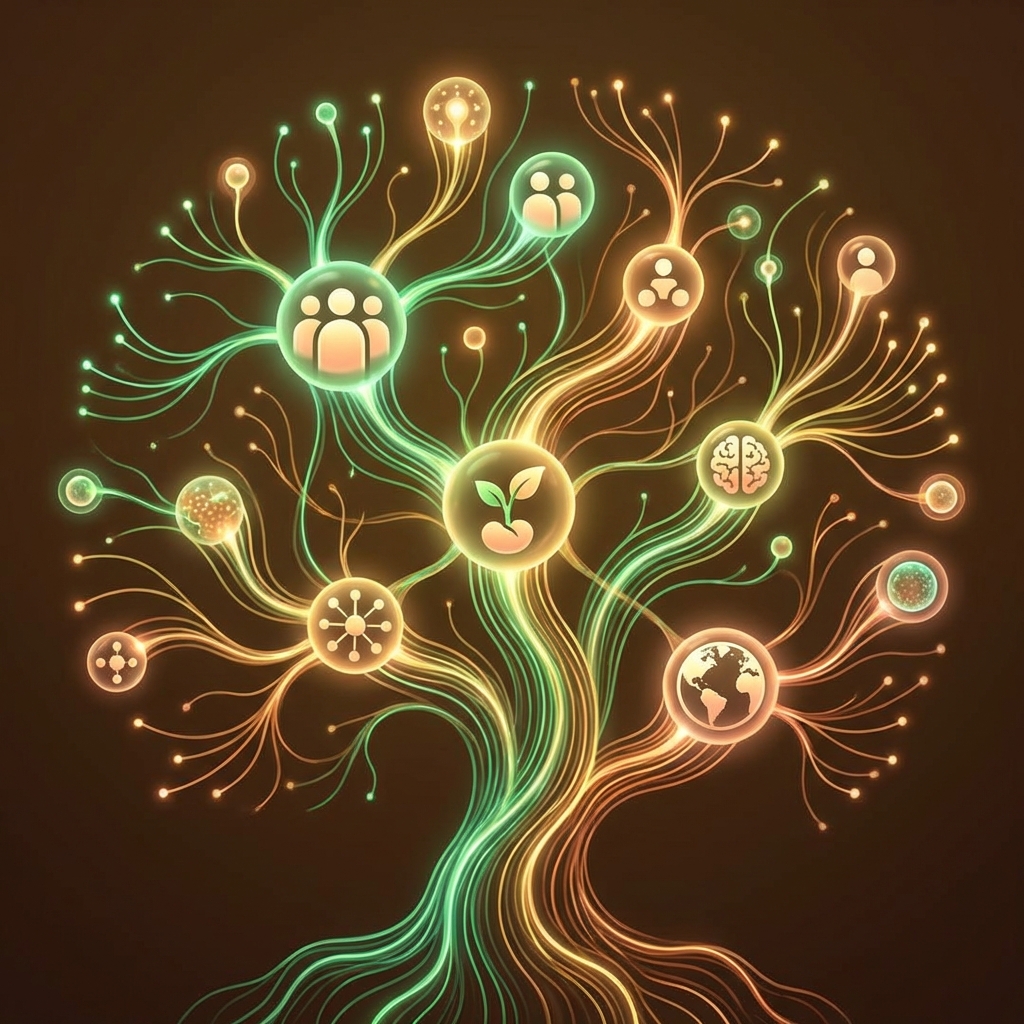




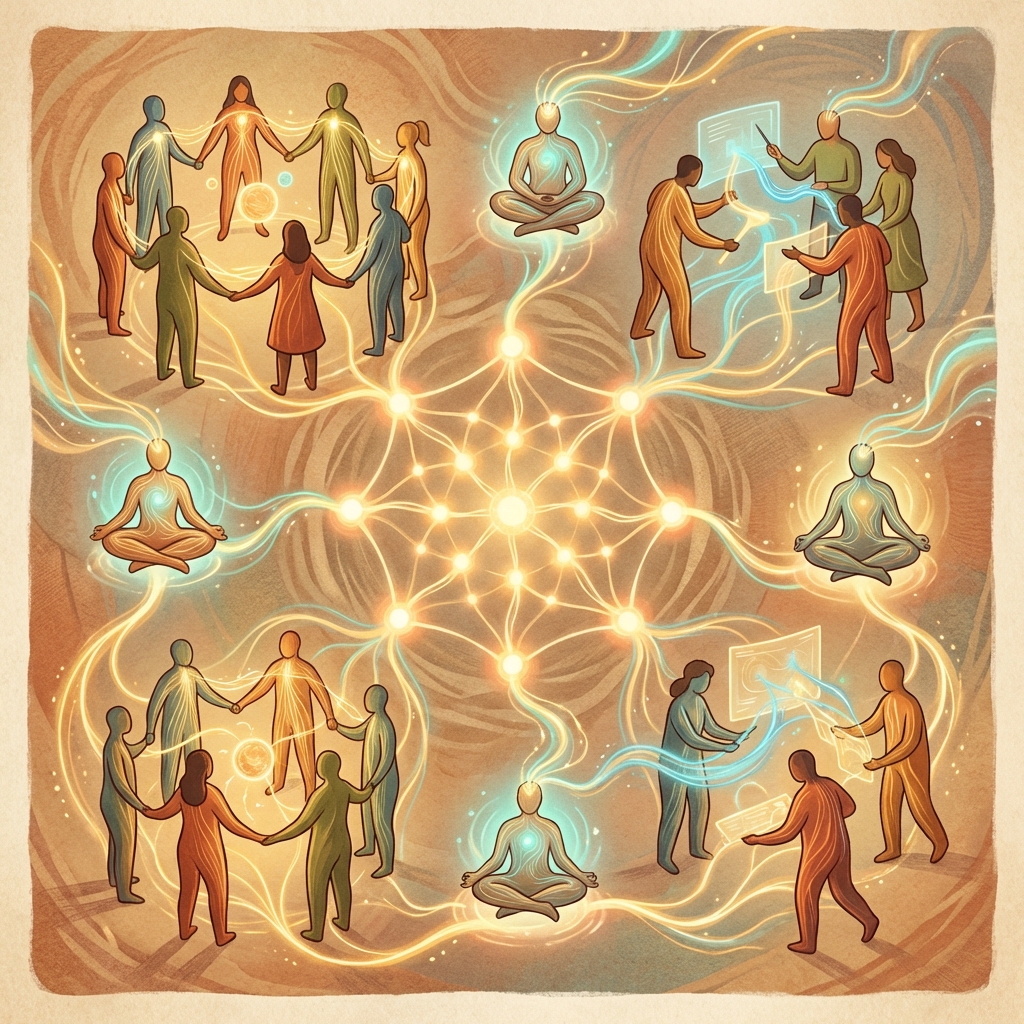
Mariko Pitts led a crucial rebranding discussion that shifts how Holomovement positions itself (42:00). Rather than simply calling it a "movement," the team agreed to define Holomovement as a living ecosystem or operating system that catalyzes movements globally. This reframing emphasizes the tangible infrastructure being built rather than just the outcome, making the initiative more fundable and easier to understand.
The ecosystem serves as infrastructure for emergence, supporting complex living systems that foster higher frequency states and radical collaboration. As James Redenbaugh noted, "ecosystem" is the more accurate descriptor since "movement" is already embedded in the name. The team acknowledged that while these are still metaphors, they need to continue refining language to be as plain-spoken and inspiring as possible. Michael Sean referenced the Mark Twain quote about writing short letters requiring more time, emphasizing that simplifying complex ideas is an ongoing iterative process.
Hera presented the Ripple Tracker prototype, a global behavior-building tool designed to help reach 3.5% of humanity through daily gratitude practices (02:45). The tracker enables users to log gratitude, prayers, and moments of grace, operating on principles from David Hawkins' "Power vs. Force" work on emotional frequencies. The goal is to get 100 million people performing one action daily with zero friction, creating a ritual-driven ecosystem of emotional well-being.
The Ripple Tracker functions as an outward-facing activation layer complementing the Holomovement app. While the main app is inward-facing for already activated members (high context, high trust, optimized for depth and belonging), the Ripple Tracker serves newcomers with low friction entry points. Hera described it as "the garden before people get inside the house" with multiple pathways to different entry points.
Michael Sean recommended examining the app "Altered," which uses AI dialogue to engage users in psychedelic journaling and provides daily community snapshots (12:45). The key insight is using AI not to mimic humans but to provide perception we can't access otherwise, like synthesizing community emotional trends. This aligns with feeding AI collective consciousness data rather than just transactional requests.
[technology="Community Facilitation Tools"]
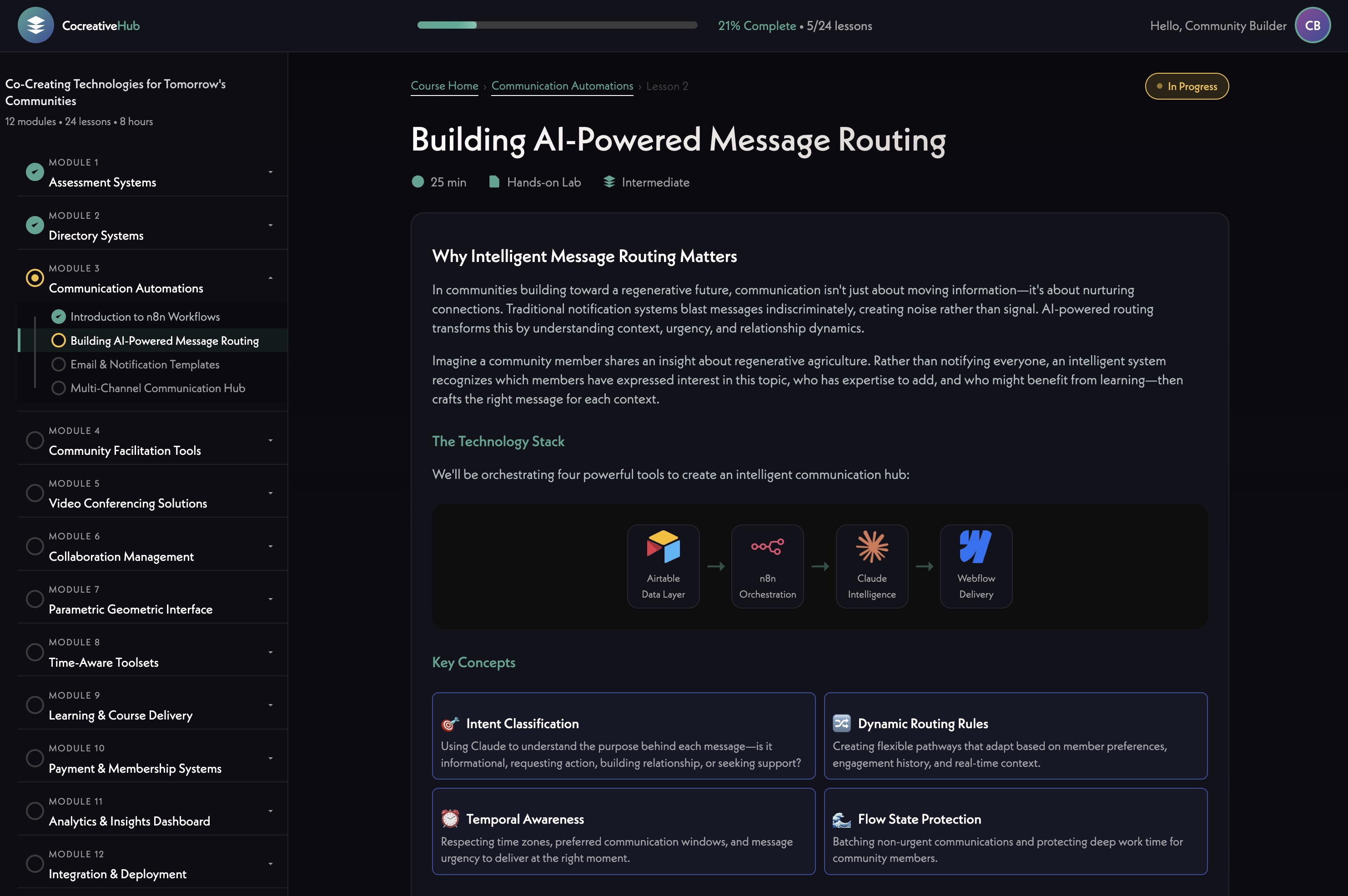
James Redenbaugh provided an update on the Learning Management System development using Webflow [tag="webflow"] (21:03). The team has successfully implemented authentication with login, signup, and user field editing capabilities. They're structuring content with three collection levels: courses, modules, and lessons, using relational fields in both directions.
A key technical consideration is that Webflow [tag="webflow"] CMS collections aren't built to be nested, so the hierarchy will be an illusion in URLs. However, as Michael Sean confirmed, meaningful URLs aren't necessary as long as breadcrumbs provide clear navigation on screen. The system includes draft mode, scheduled publishing, and content gating based on membership levels.
For membership management, the team discussed using expiration dates rather than tracking payment status directly (13:19). This approach simplifies the integration with Stripe [tag="stripe"], as the system only needs to know the expiration date, not whether someone missed a payment. Stripe [tag="stripe"] would simply extend the expiration date upon successful payment, making it easier to switch between monthly, semi-annual, or annual memberships.
Mariko emphasized bringing Michael Sean's expertise on course engagement beyond just the sale point, focusing on actual user experience and completion. They plan to use one of his existing courses as test content for development and design.
[technology="Online Learning Platforms"]
[technology="Custom Membership System"]
The team reviewed the About page design with emphasis on making the value proposition immediately clear. Hera raised the important question of whether the hero section alone answers "What is Holomovement?" for first-time visitors arriving through ad campaigns (38:30). She suggested adding a concise statement that directly explains Holomovement as a global network of gatherings, initiatives, and collaborators.
Michael Sean provided feedback on visual hierarchy and the Purpose Earth integration (33:00). While the pop of color from the Purpose Earth logo is valuable, it was sized too prominently, making it feel like visitors had landed on a Purpose Earth page rather than Holomovement's About page. The team agreed to create a partners CMS collection [tag="webflow"] for logos that can be displayed in random order to avoid hierarchical implications as more partnerships develop (36:03).
Discussion of the "Underview Effect" section led to recognition that this underwater wave imagery and concept better fits the Wave page than the About page (26:17). The team agreed to replace it with content about the "Holomovement Effect" focused on collective higher frequency states, emotional scale awareness, and conscious choice. James presented an early animation draft showing text transitions that will incorporate logo movement and can be connected to scroll (40:27).
Mariko proposed potentially renaming the "About" page to "Manifesto" to better reflect the nature of the content (01:01:40).
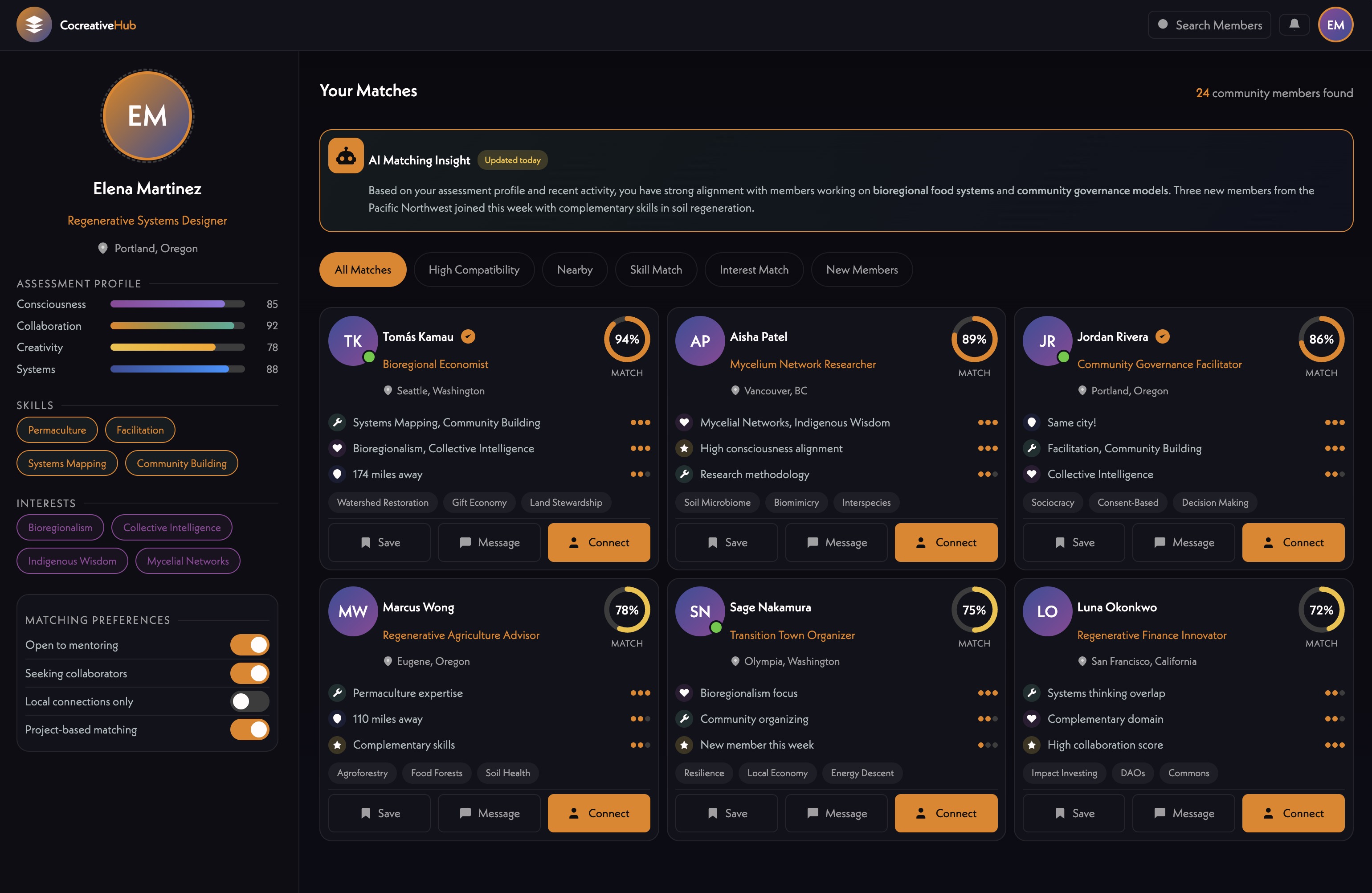
The team shifted priorities to emphasize the directory system over LMS development in the near term (55:05). Michael Sean advocated for a video game perspective on user profiles, calling them "player cards" rather than bio pages (56:29). This gamification approach focuses on information that enables AI-powered matching rather than what individuals want to express about themselves.
The key data points identified are: what someone is doing (their project/mission) and what help they need. With this information, AI [tag="claude"] can facilitate meaningful connections. The system should summarize even lengthy user inputs into concise card formats to maintain scannability and enable effective matching algorithms. James agreed to schedule a separate meeting within the week specifically to discuss directory system questions and player card design (56:02).
[technology="Intelligent Matching Algorithms"]
[technology="Directory Systems"]
The microgrant program discussion revealed an important strategic pivot (58:20). The team established a range of $1,500 to $5,000 per grant, with flexibility based on the first Wave project budget and potential matching grants from partners like Kinship Earth.
Michael Sean shared a transformative reframing from a conversation earlier that day: positioning these as angel grants to startups rather than just community project funding (59:14). This perspective opens possibilities for convertible notes or return mechanisms where successful projects could return 2x, 3x, or 5x the initial grant. The key principle is that generosity should feed the Engine for Good, creating a sustainable funding cycle for the ecosystem. The team plans to select three exemplary model projects initially to set standards and ensure the system tells a good story while technical infrastructure develops (01:00:58).
The team discussed communication tools, ultimately deciding on iMessage as the primary channel since most participants are iPhone users and find it easier to track than WhatsApp groups (19:40). They scheduled a follow-up meeting for Thursday at 2pm Eastern for James and Michael Sean to dive deeper into directory system details, which Mariko won't need to attend as she'll be traveling in Charleston, South Carolina.
Hera
James Redenbaugh
Michael Sean
Mariko Pitts
Mariko Pitts led a crucial rebranding discussion that shifts how Holomovement positions itself (42:00). Rather than simply calling it a "movement," the team agreed to define Holomovement as a living ecosystem or operating system that catalyzes movements globally. This reframing emphasizes the tangible infrastructure being built rather than just the outcome, making the initiative more fundable and easier to understand.
The ecosystem serves as infrastructure for emergence, supporting complex living systems that foster higher frequency states and radical collaboration. As James Redenbaugh noted, "ecosystem" is the more accurate descriptor since "movement" is already embedded in the name. The team acknowledged that while these are still metaphors, they need to continue refining language to be as plain-spoken and inspiring as possible. Michael Sean referenced the Mark Twain quote about writing short letters requiring more time, emphasizing that simplifying complex ideas is an ongoing iterative process.
Hera presented the Ripple Tracker prototype, a global behavior-building tool designed to help reach 3.5% of humanity through daily gratitude practices (02:45). The tracker enables users to log gratitude, prayers, and moments of grace, operating on principles from David Hawkins' "Power vs. Force" work on emotional frequencies. The goal is to get 100 million people performing one action daily with zero friction, creating a ritual-driven ecosystem of emotional well-being.
The Ripple Tracker functions as an outward-facing activation layer complementing the Holomovement app. While the main app is inward-facing for already activated members (high context, high trust, optimized for depth and belonging), the Ripple Tracker serves newcomers with low friction entry points. Hera described it as "the garden before people get inside the house" with multiple pathways to different entry points.
Michael Sean recommended examining the app "Altered," which uses AI dialogue to engage users in psychedelic journaling and provides daily community snapshots (12:45). The key insight is using AI not to mimic humans but to provide perception we can't access otherwise, like synthesizing community emotional trends. This aligns with feeding AI collective consciousness data rather than just transactional requests.
[technology="Community Facilitation Tools"]
James Redenbaugh provided an update on the Learning Management System development using Webflow [tag="webflow"] (21:03). The team has successfully implemented authentication with login, signup, and user field editing capabilities. They're structuring content with three collection levels: courses, modules, and lessons, using relational fields in both directions.
A key technical consideration is that Webflow [tag="webflow"] CMS collections aren't built to be nested, so the hierarchy will be an illusion in URLs. However, as Michael Sean confirmed, meaningful URLs aren't necessary as long as breadcrumbs provide clear navigation on screen. The system includes draft mode, scheduled publishing, and content gating based on membership levels.
For membership management, the team discussed using expiration dates rather than tracking payment status directly (13:19). This approach simplifies the integration with Stripe [tag="stripe"], as the system only needs to know the expiration date, not whether someone missed a payment. Stripe [tag="stripe"] would simply extend the expiration date upon successful payment, making it easier to switch between monthly, semi-annual, or annual memberships.
Mariko emphasized bringing Michael Sean's expertise on course engagement beyond just the sale point, focusing on actual user experience and completion. They plan to use one of his existing courses as test content for development and design.
[technology="Online Learning Platforms"]
[technology="Custom Membership System"]
The team reviewed the About page design with emphasis on making the value proposition immediately clear. Hera raised the important question of whether the hero section alone answers "What is Holomovement?" for first-time visitors arriving through ad campaigns (38:30). She suggested adding a concise statement that directly explains Holomovement as a global network of gatherings, initiatives, and collaborators.
Michael Sean provided feedback on visual hierarchy and the Purpose Earth integration (33:00). While the pop of color from the Purpose Earth logo is valuable, it was sized too prominently, making it feel like visitors had landed on a Purpose Earth page rather than Holomovement's About page. The team agreed to create a partners CMS collection [tag="webflow"] for logos that can be displayed in random order to avoid hierarchical implications as more partnerships develop (36:03).
Discussion of the "Underview Effect" section led to recognition that this underwater wave imagery and concept better fits the Wave page than the About page (26:17). The team agreed to replace it with content about the "Holomovement Effect" focused on collective higher frequency states, emotional scale awareness, and conscious choice. James presented an early animation draft showing text transitions that will incorporate logo movement and can be connected to scroll (40:27).
Mariko proposed potentially renaming the "About" page to "Manifesto" to better reflect the nature of the content (01:01:40).
The team shifted priorities to emphasize the directory system over LMS development in the near term (55:05). Michael Sean advocated for a video game perspective on user profiles, calling them "player cards" rather than bio pages (56:29). This gamification approach focuses on information that enables AI-powered matching rather than what individuals want to express about themselves.
The key data points identified are: what someone is doing (their project/mission) and what help they need. With this information, AI [tag="claude"] can facilitate meaningful connections. The system should summarize even lengthy user inputs into concise card formats to maintain scannability and enable effective matching algorithms. James agreed to schedule a separate meeting within the week specifically to discuss directory system questions and player card design (56:02).
[technology="Intelligent Matching Algorithms"]
[technology="Directory Systems"]
The microgrant program discussion revealed an important strategic pivot (58:20). The team established a range of $1,500 to $5,000 per grant, with flexibility based on the first Wave project budget and potential matching grants from partners like Kinship Earth.
Michael Sean shared a transformative reframing from a conversation earlier that day: positioning these as angel grants to startups rather than just community project funding (59:14). This perspective opens possibilities for convertible notes or return mechanisms where successful projects could return 2x, 3x, or 5x the initial grant. The key principle is that generosity should feed the Engine for Good, creating a sustainable funding cycle for the ecosystem. The team plans to select three exemplary model projects initially to set standards and ensure the system tells a good story while technical infrastructure develops (01:00:58).
The team discussed communication tools, ultimately deciding on iMessage as the primary channel since most participants are iPhone users and find it easier to track than WhatsApp groups (19:40). They scheduled a follow-up meeting for Thursday at 2pm Eastern for James and Michael Sean to dive deeper into directory system details, which Mariko won't need to attend as she'll be traveling in Charleston, South Carolina.
Hera
James Redenbaugh
Michael Sean
Mariko Pitts
Send Ripple Tracker pitch deck and prototype video to Michael Sean for review
January 22, 2026
Provide materials for Michael Sean to review and provide integration feedback on how Ripple Tracker connects with Holomovement platform strategy.
Explore adding completion line to Purpose block on About page
January 25, 2026
Add statement to Purpose block clarifying modes of action (gatherings, initiatives, collaborators) to immediately answer 'What is Holomovement?' for first-time visitors.
Create iMessage group for core team communication
January 21, 2026
Set up iMessage group for team since most participants are iPhone users and find it easier to track than WhatsApp.
Update project milestones reflecting directory system prioritization over LMS - Edit 2
January 22, 2026
Schedule meeting within one week to discuss directory system and player card design
January 23, 2026
Set up dedicated meeting with Michael Sean (and potentially others) to dive deeper into directory system questions and player card approach. Thursday 2pm Eastern suggested as option.
Develop partner CMS for dynamic logo display with random ordering
January 27, 2026
Create Webflow CMS collection for partner logos that displays them in random order to avoid hierarchical implications as partnerships grow. Addresses Purpose Earth logo sizing and positioning issues.
Continue LMS authentication, gating, and course content structuring work
February 10, 2026
Maintain development momentum on authentication system, content gating based on membership levels, and three-tier collection structure (courses, modules, lessons) while directory system becomes primary focus.
Refine About page animation with logo movement integrated to scroll
January 27, 2026
Develop text transition animation incorporating logo movement connected to scroll position. Early draft presented in meeting shows direction.
Review Ripple Tracker materials and provide integration feedback
January 25, 2026
Review pitch deck and prototype video from Hera. Provide feedback on how Ripple Tracker integrates with Holomovement platform strategy, particularly around AI implementation and community engagement model.
Lead microgrant program refinement and Engine for Good integration
February 1, 2026
Refine angel grant positioning, convertible note structure, return mechanisms (2x, 3x, 5x), and three model project selection strategy. Ensure program tells good story while technical infrastructure develops.
Improve About page visuals and animations to express higher frequency themes
February 1, 2026
Refine visual design elements and animations to better express collective higher frequency states, emotional scale awareness, and conscious choice themes for Holomovement Effect section.
Provide LMS course content for testing and development
January 27, 2026
Share one of Michael Sean's existing courses to use as test content for LMS development and design validation. Focus on actual user experience and completion rather than just sale point.
Review and simplify copy across About page emphasizing living ecosystem positioning
January 30, 2026
Edit and refine copy throughout About page to emphasize 'living ecosystem' or 'operating system' positioning rather than just 'movement.' Make language as plain-spoken and inspiring as possible.
Draft Holomovement Effect content to replace Underview Effect section
January 27, 2026
Create content focused on collective higher frequency states, emotional scale awareness, and conscious choice to replace underwater wave imagery and Underview Effect section which will move to Wave page.
Provide partner logos for CMS implementation
January 27, 2026
Gather and provide logos for partners to populate new partners CMS collection for dynamic random-order display on About page.
Determine first Wave project budget and grant amounts
January 31, 2026
Finalize budget for initial Wave project grants within $1,500-$5,000 range and determine how many grants to award. Consider matching grant opportunities with partners like Kinship Earth.
Custom learning management system (LMS) development on Webflow enabling self-paced courses, video content, progress tracking, quizzes, and certifications. Strategic decision to build custom LMS rather than using Boldly or Thinkific to support live-to-evergreen content workflow and global product sales. System requirements include real database for user progress (not cookies), journal entry capture, API triggers for membership status and course purchases, and progress tracking across sessions. Decision made to build on Supabase backend rather than Member Stack for authentication and data management. Phase One budget $16K-$29K with commitment to higher end. Development timeline six weeks: weeks one-two for Supabase foundation and user dashboard connected to Webflow CMS, week three for Stripe integration and membership access control, weeks four-five for testing and email integrations, polish and testing complete by January 25th for February 10th launch. Three-tier collection structure: courses, modules, lessons. Content authoring process uses detailed scripts functioning as recipes specifying exact interactivity types (checkbox, multiple choice), interaction flows, and content sequencing aligning activities with content flow rather than separate homework sections. Format supports live-to-evergreen workflow ensuring technical structure supports global sales rather than just live delivery. Team using themselves as first test group to validate system with real-world use cases before broader deployment. Authentication spike establishes foundation with Supabase login functionality on MAST template implementing user profiles, password management, and session handling. Backend successfully operational with membership login and content gating complete. Profile editing integration in progress to connect with directory system. LMS moved back to active priority to support Choose Love course launch with Boldly course content as test videos for validation before committing to Choose Love timeline. Development continuing at reduced pace while directory system remains primary focus.
00:00:02
Mariko Pitts: This meeting is being recorded. Hey, YouTube, let me know if you can hear me. Okay, let's see here. Start this meeting. I see. Let's see. I hope you guys had a good weekend. Let me just see what's going on here. Hold on a second. All right, I think we need a couple minutes right here for.
00:00:37
Hera: Yeah, for James.
00:00:38
Mariko Pitts: Okay.
00:00:39
Hera: Michael's already here. I think Michael Sean is having his lunch right now.
00:00:43
Mariko Pitts: I know. I'm trying to have a bite to eat, too, at breakfast. While we're at it.
00:00:49
Hera: I could also have a bite my midnight snack. Go and see.
00:00:53
Mariko Pitts: Damn. But Michael, Shawn's not. When he comes back, though, maybe you can tell him a little bit about the ripple tracker, because I know James wants us to start going, but this might be a good time to really talk about that.
00:01:16
Hera: Not sure how. How, like, how soon James is going to be. Gonna be out, but.
00:01:23
Mariko Pitts: Well, I think you can just talk about the basic idea so we can start to integrate it and think about it.
00:01:30
Boldly NOW: Sorry, guys. I'm like, back to back, so I'm like, trying to eat a new snack.
00:01:37
Mariko Pitts: No worries. We're all done. Back to back. I'm trying to get a bite to eat in too.
00:01:42
Boldly NOW: I don't want you to watch me eat my. My apple Muslim granola.
00:01:47
Mariko Pitts: I don't want you to see me eating this quiche right now. This delicious quiche.
00:01:53
Boldly NOW: Sounds good.
00:01:54
Mariko Pitts: Hold on.
00:01:55
Boldly NOW: Yeah, I get to look at your. Your como hawk haircut, which is a bonus.
00:02:02
Mariko Pitts: Yeah. Moving away from that, which is kind of crazy having hair on the side. So. Yeah. I'm still not sure how I feel about that, but I like it. I like it, though. I do. It's just the growing out stage has been like.
00:02:17
Boldly NOW: Yeah, I can imagine. Hi, guys.
00:02:24
Mariko Pitts: Hey there.
00:02:26
Boldly NOW: Good to. Good to see you.
00:02:28
Mariko Pitts: Good to be having.
00:02:29
Boldly NOW: Good to be having this conversation.
00:02:31
Mariko Pitts: Yeah, exactly. Hera, do you want to talk to share a little bit about the ripple chakra while we're having a quick bite? Waiting for. Okay.
00:02:45
Hera: Okay. Yeah, sure. Sure. I was like, checking some of the. I was trying to pull. Trying to pull the Canva document or maybe I should just go ahead and send the. The video. So Michael Sean could also review it after the call, but. So, yeah. Michael Sean. Oh, my goodness. So the ripple tracker. So the ripple tracker is something that I've put together. I've created a prototype on it. I've had, like, I've put together some pitch deck about it before. Before Kashkaish. So it's really like. It's really like answering a Question for me, like, when I joined the whole movement, one of the first things that really got stuck in my head was like there's a systems document that Marico put together with. With another per. Like with another friend Birute before. And one of the things that's. That's, that's written there is whatever goals is to hit is to reach point five percent of humanity. So that is like something like as somebody who's like been in tech also have gone through all the like the incubator ecosystem and like all those talks about like building something for scale, I'm like ooh. And also like for somebody who's geeked out on that, I'm like what is like one very simple action that when done every single day regularly can trigger you know, trigger a new behavior and you know, can. Can potentially you know, bring us to critical critical mass. So yeah, so the, the thing that I've put together is really just a tracker for, for happiness, for. For moments of grace which could either be gratitude, a miracle or a prayer. So those are. It will start with those two things. It's literally just a website with a button in the middle with, with a. With a bottom that's asking you to log something that you're grateful for. Log a prayer or lug a moment of, of kindness that happened today. Like a miracle that happened today. So gratitude, miracles and prayers. So yeah that's really what it start like how it started so from. But really like for me, more than just more than it being a tracker, it's really like building a new global behavior. You know, just like how dual lingo taught the world languages, calm soul meditations. This one teaching the world how to feel again. But really like for me the why is I really am a fan of David Hawkins work power versus force where he. Where he geeked out on like you know, on, on.
00:05:16
Mariko Pitts: On.
00:05:17
Hera: On our frequency and how a lot of you and how are. How are emotional on the different. How our different emotions have a certain frequency attached to it and how a lot of humans are operating below the frequency of courage below and, and just helping aund. And I was like geeking out on some numbers on that in the pitch. I'm going to send you the pitch deck but in the deck it's, it's. It said we need even. We need either 12 avatars. I know we need either 9 avatars vibrating at the highest level which is the frequency. The. The frequency of 1000 or. Or a hundred thousand people crossing from the threshold threshold of fear to courage, which is the level 100 to offset all the negativity that's happening in the world. And for me that's kind of like, this is like, kind of like my way to do it. How do I get a hundred thousand people logging gratitude? Like operating from a. Try getting, getting, vibrating to the frequency of 540 every single day. So that's kind of like where I'm coming from. And I feel like for me to reach 3.5% of humanity, we need behavior at scale, right? And the real question for me isn't how do I make people feel gratitude? It's like how do I get 100 million people do one action every day with zero friction? So that's what that, for me, what, that's what, that's what that platform unlocks. But for me it isn't just psychology. It's really like, it's really a lot of things. It's emotional technology, but it's also very powerful because everybody may think that one ripple is just one ripple and it's something small, but it could also start away. I see it as a way to create a ritual driven ecosystem of emotional well being where schools, organizations, brands can partner with us for white labeled portals. Say, for example, I'm thinking of Purpose Earth. Purpose Purpose Earth is doing a lot of wonderful things. And I feel if currently the, the relationship is with Purpose Earth and the grantee, but what if you add another layer in the, in this relationship which are corporations, for example. Like see what if ripple like a ripple. Like I'm thinking, for example. One of the things that's inspiring me is when I was working on a prototype, my daughter saw it and I'm like, mom, I would use that every day. I would love my friends to use this. So in my mind I could imagine a school of 5,000 students doing this, doing a 21 day challenge. And at the end of a challenge, an organization sponsors a project, a Purpose Earth project. Like it unlocks funding for a Purpose Earth project. So the school, I mean the school gets to practice gratitude. The organization gets eyes on, on, on a CSR project that they're doing. You know, the, they get eyes on whatever project that they're supporting and Purpose Earth gets more funders. Like so, so, so there's a lot of. So it's, it starts from, it's, it's really like the deck that I'm going to share is a lot about how one simple action could snowball into many things. So yeah, and I feel like a lot of it needs to be because I created this before the whole movement ecosystem, I could see that a lot of it needs to be in the whole movement app. But I also mentioned to Marco that a lot of it also needs to be a separate whole movement layer, activation slash engagement layer. Because within the whole movement ecosystem we're really building for conversion for nurturing already existing community members, for deft, for identity, for. For really like going deeper with everybody that's within the the community. So it's, it's inward facing. It's for already activated members, learners, holons, lions. So it's identity based, relational and deep. Whereas the ripple tracker is outward facing. Like it brings. It's for me like the role is. It brings participate participation to, to scale through a very low friction ritual which is gratitude, release, release, releasing whatever it is that they're worried about through pairs. And then we could turn that into ripple circles or public campaigns and yeah, those kinds of things. So really like, like, like I said to miracle just before this, the app is for people that are like the ripple tracker is for people that are not in yet and also for people that are already within the community. Who wants to do this as a daily practice. So low context, low trust, low commitment. And then the holo movement app is like high.
00:10:14
Mariko Pitts: It.
00:10:14
Hera: It optimizes for belonging, for readiness for depth. And if we optimize for newcomers in the whole movement app, the app would feel sh. For shallow for already existing members. And if we optimize for depth for people who just met us or people like I'm just thinking high school students for example, who will use the ripple. We lose majority of the new participants too if we, if we're optimizing for depth. So there has to be a layer that's more like public. I mean more outward facing, not public facing because both of them are public facing. Feel like it's a. It kind of like it feels like a. The garden before people get inside the house. And then the, the bigger action will be inside the house for sure. But it just feels like, oh, this little playground that's gonna take you oh, this is gonna take you to this door. And then this other playground leads you to the back door. And this, this other playground leads you to a window that can be another, another entrance to the house. But that's what I'm thinking about. So that's like there's a lot of things there and there's a pitch deck and there's a video that I've put together. It's a.
00:11:20
Mariko Pitts: Let, let's let Michael, Sean and jump in real quick. Because that's a lot of information.
00:11:24
Boldly NOW: Yeah. First of all, you know, I think if it's. I mean, it could be. It could be something that's not entertaining for people if they do it a couple times and don't get anything back from it. But there's an app called Altered that we should look at. Oops, I just locked up an app called Altered that. That does. That does. Basically, if you will, it's a psychedelic journaling app. So you just, you go on there and you just say what you, you, I, I. And it can be from meditation to drugs to emotions, all kinds of things. But that's not the point. The point is that you put your thing, you put your. Your journal in there. Your prompt could be, what are you grateful for today? And you type what you're grateful for. I mean, I would probably do that a few times, especially if I could see how many people were grateful or grateful around me. But the thing this app does that's really, really sticky is that it has AI dialogue. So it'd have a chat with you, like, well, what about that? But the thing that's super cool is every day it sums up what's moving in the community. The community's grateful for X, Y and Z. The community is grateful for this. They're worried about this. So then you get this snapshot, this daily snapshot of people's. Of people's gratitude. And I think that could be. I think that would just be so cool you'd want to come check exactly what the day's weather forecast is, what today's gratitude is.
00:12:45
Hera: Yeah, I love it. That's exactly what's in the prototype. I'm going to send you the video, Michael, Sean, and also the deck. But because James is already here, I'm going to just wrap it up. But the prototype has different ways of viewing that data. And that's why, because it's also in a map format. It also has to reflect. And I mean, if we plan, if we end up deciding to do this, all of this also has to live. It has to be viewable within the whole movement. Apps as apps as well. Yeah. And it's going to show you.
00:13:14
Boldly NOW: It should be a phone app that has a database. Anyway, go look at. Go look at Altered that.
00:13:19
Hera: Yeah.
00:13:21
Boldly NOW: Spend a half an alt. Alt erd altered. Choose a state of mind just to see if you have to go a little bit. You have to do a little bit with it, but then you start to get these. What?
00:13:32
Hera: Sorry, Sorry. Do you know the per. The founder of this one because like this is crazy familiar and I'm not sure if this guy is one of my cohort mates in this incubator I was part of back in the.
00:13:42
Boldly NOW: It's super rough design. It drives me absolutely crazy, but it's.
00:13:46
Mariko Pitts: Really, really effective rough.
00:13:48
Boldly NOW: It is rough.
00:13:49
Mariko Pitts: I was like, oh, what is that design?
00:13:50
Boldly NOW: No, no, it's. It's super rough design. And I tried to figure them out because I, I was interested in. I like partner. I say hey, let's do this just for states of consciousness. Let's say like let's. I. There's all these different cool states of consciousness. Let's use it to track that. But I couldn't find anybody to email. I couldn't. I couldn't really find somebody. There's an altered info at altered whatever. But anything about. But I have been very, very. I think it's a very unique use of. Of AI to collect reflections of people and then reflect them back. Like what are the themes that are coming up? I think, I think that that kind of helps us tap into the subconscious or the subconscious movements or, or things that are going on that we don't have access to otherwise. And I think that's. Those are killer AI apps. AI apps that mimic being human are not killer apps. AI apps that give us a sense of perception that we can't get without AI. That's a killer app. Like you can't.
00:14:49
Mariko Pitts: That's what I'm thinking too. But that's actually something we were talking about with James partly with the emotional cloud thing of what, you know, I don't know if we call emotional cloud but. But something of that sort. And, and just. So James Heroes was Harrow is giving Michael Sean a little bit of a idea of this ripple tracker prototype that she had designed. Wait like months maybe, maybe sometime last year. And she was thinking really cool. A gamified way of. You know, I mean she'll go into it and I think just her just share. When you share the. The proposal, the one pager with James too because it might be a cool different way of how we integrate components of that into what we're designing for that. But now is the time to actually look at that because we're designing something like this. You know, it's like. And maybe there's a really cool way that something that she's really pulled out of the ether that could be a way of how we go about some of these things and things that are tracking or people are sharing their emotions and different gratitude. So she's looking at how we're measuring, like higher frequency states and things like that in different ways. So anyway, but yeah, that's where we were. And I think we should all look at that. And so that's why I wanted her to kind of explain to Michael Sean kind of what she's working on, or at least, you know, she's really feeling that probably bring through again. So it'd just be one of those things that we should all kind of look at and see if we can pull from that or utilize some of this stuff. But anyway, so. But I think we're all kind of in the same field anyway. We're already picking up.
00:16:19
Hera: Yeah, yeah, of course.
00:16:20
Mariko Pitts: Some of this stuff. Yeah. And how AI can really reflect back what's happening in the global community on an emotional scale really is a bigger, I think, something that we tapped in last week and something. I think this is coming up. And even Michael Sean thinks it's quite exciting too, and is usually utilizing it on an app already in some way.
00:16:38
Hera: And also, just very briefly, what I like about what we're doing and also like the Ripple Tracker is because a lot of people have been employing scientists to program AI, Program different things into AI, whether that's maternal instincts or like teaching AI how to feel and stuff like that. They're doing that. Basically. They're hiring, like, really talented people, talented engineers, talented scientists to do that. But I feel like what they're also missing is getting, like global, like, you know, collective consciousness to actually feed AI with all the beautiful things in the world as well. Because right now, when we use all these AI tools, we're using it from a transactional perspective. But what if we get hundreds of millions of people to log beautiful stuff into AI? Whether that's moments of grace, magnetic prayer, or like something that you're grateful for, then I feel like that's a really good way of teaching AI, that there's, There's. There's better things than just creating, just fulfilling a task.
00:17:41
Mariko Pitts: Okay. Yeah, yeah, I agree.
00:17:44
Boldly NOW: And I'm. I'm thinking pragmatically, chat engines cost money. We have to pay for every chat.
00:17:49
Mariko Pitts: Yeah.
00:17:50
Boldly NOW: A bunch of data and give you a snapshot about what's going on in the world is not very expensive. I mean, it could be.
00:17:56
Mariko Pitts: Yeah.
00:17:57
Boldly NOW: You could be a terabyte of data and get it crunched really quick for not. Not a huge amount of money is like. Like, dialogue costs a lot more money is what I'm trying. Not terabytes a lot, lot. But, you know, you could use a.
00:18:07
Mariko Pitts: We could.
00:18:10
Hera: And Also server. Server requirements too crazy.
00:18:14
Mariko Pitts: It's all text more stuff, right? Yeah. All right, let's jump in. Michael Sean will be joining us on he. The Times for our weekly calls work for him. So thank God we all four of us can really kind of jam this out and just I want everybody on the same page because we're all building different things. I'm Michael Sean and I met Friday. I think it was Friday, right? Something like that. Anyway, last. The one of the last big working days last week and really kind of got him updated a bit on what we were. Our last meeting last week as well. And certain elements that I really want his expertise on, like the lms. He and I actually discussed that we could bring one of his courses in to the LMS to test it. And you actually have that. And that will be something that we can start building in, you know, and designing around right now, which is excellent. So we can immediately get you content, James, for you and Ivan to start playing and plugging in. I really want Michael Shawn behind the scenes in LMS too, because like I said, his expertise with course and more of the. The engagement is important because it's not. It's not. He's beyond the sell point. Like we can sell a course, but then most people don't realize they don't care what happens after you sell the course. You know, his expertise comes into actually the user experience and them utilizing it and doing the course, keeping them engaged. And so I really want his expertise on that. So maybe, James, you could give a very high level update on where things are now and what you guys have built out. Just so. Just in case I might have missed something, ensuring a bit of an update with Michael Shawn, but I just want him kind of touch point on a lot of different things. Just so everybody feels that we're contributing and all our expertise and you know, there's things that we're missing or whatnot. Let's just get the whole team on it. So. And I also created a WhatsApp group for all of us, and I think that's probably the best one. Unless Michael Jean, you're probably on iPhone, aren't you? You're iPhone user. Yeah. Okay. We could probably just use iMessage too, because I know a lot of us, we all do iMessage if we don't want to do WhatsApp too. Okay. So we can maybe. Harry, you can create an imessage one. Maybe that will work. I don't know if James prefers iMessage or WhatsApp, but I know we're all kind of working on imessage right now currently.
00:20:32
James Redenbaugh: I do either whatever's best.
00:20:36
Boldly NOW: That would be my only imessage group ever.
00:20:39
Mariko Pitts: Oh, is it? Maybe that works. I have too many WhatsApp groups. I can't even keep track of it alone. I'm like, what is this? I'm like, okay, oh, that's a whole mover group. I didn't somehow missed that. I don't know what group popped up now.
00:20:53
Hera: You know, now I'm realizing why you're faster to reply and imessage because I can see it.
00:20:59
Mariko Pitts: It makes sense to me. Like everything else is like a thousand different things and in spam message groups too, that have been created and I'm like, oh, got to get out of that, get out of this, you know? So, yeah, it's easier for me to see things on imessage too. Anyway, that's why we're quick to respond. So anyway, okay, so want to start with a quick update, James, on what's happening on your end?
00:21:21
James Redenbaugh: And yeah, so high level, we've been focusing on figuring out the authentication system to how to build that into webflow in a reliable way. And now we've got login and sign up working and figured out how to allow users to edit fields. And so that opens up a world of possibilities. Playing with different ways to structure the LMS content. I'm thinking that we want to use the, the cms and there's a number of decisions to make around that. Right now we have three different course hierarchies like we talked about, courses, modules and lessons. And then we have relational fields in both directions connecting things. So of course knows what lessons it contains and Alessa knows what course it's a part of. But it'll be great to have some actual content to play with so we can start to see what that'll actually look like and make sure that that's the route that we want to go. Because the way that webflow CMS works is, you know, each collection is. They're not really built to be nested. The nestedness will be an illusion unless we build it a different way. So a lesson won't be@holomovement.net course module lesson unless we set up redirects for that. It'll be Hollowmovement.net lessons that lesson. But when you're on the page, you can see what course you're on, what module you're in.
00:23:08
Boldly NOW: We don't need the URLs to say anything meaningful. It can just Be gibberish. As long as you have have some kind of breadcrumb on the, on the screen that, that indicates the nested nature that I can go up and down a level. I think you're fine.
00:23:19
James Redenbaugh: Yeah. Great. So, yeah, and we're, we're improving our ability to gate content that should be ready as well. So people sign up and they'll, you know, we can decide what they have access to at what level.
00:23:37
Boldly NOW: Draft mode.
00:23:39
James Redenbaugh: Yeah.
00:23:40
Boldly NOW: Do we have that already published mode?
00:23:45
James Redenbaugh: It's, it's not 100% yet.
00:23:47
Boldly NOW: I guess it doesn't matter because we don't have any users. But I mean that's a, that's obviously a great one. And if you can always do publish. Time and date is. I saw another thing that's really handy, but that may be later.
00:24:00
James Redenbaugh: Time and date.
00:24:02
Boldly NOW: Yeah. So if I build a lesson, I can have an unlock date, time and date. So I build it.
00:24:10
James Redenbaugh: Yeah. So that's built into the web cms. You can schedule things to be published and save things as graphs and whatnot.
00:24:20
Boldly NOW: Okay, great. And then so there's a thinking about that. You talked about the gating and how people get in and obviously with membership you have this, this ongoing on off switch, if you will. Right. I'm. I've either paid my membership or I didn't pay my membership in one of our products. We finally figured out an easy solution to that and that was that there's always an expiration date of the membership and if you pass the expiration, expiration date, you no longer have a membership. And then what, what we would get Stripe to do is just extend the expiration date and then we don't have to. The software doesn't need to know if you missed your payment or anything like that. It doesn't need to have any awareness other than the fact what, what date is the expiration date of the membership. Also it makes it really easy between switching between monthly, semi, annual or annual memberships because the software there again doesn't need to know any of that. Just needs to know on this. And this, you know, this, this, this gets passed on this trigger. I set the date to this and then, then it's that. So you might think about that. As far as the way it interacts with Stripe is I think where we're, where we're at right now.
00:25:37
James Redenbaugh: Yeah.
00:25:38
Boldly NOW: Okay, great.
00:25:41
Mariko Pitts: Okay, great.
00:25:43
James Redenbaugh: And I saw your about page feedback. It's all really great, good insight and I, I love the idea that we're moving down the page and then as we're Getting into the underview effect, it should feel like we're going underwater, you know, and have a nice transition there.
00:26:03
Mariko Pitts: Oh, question about that. Because that's one thing that I want I had on my list to talk about. I don't understand why the underview effect has anything to do with the about page. It should be the hole in movement effect, not the underview effect. The underview effect is a theme for just the wave.
00:26:17
Boldly NOW: For the wave. Yeah. I have to say, and I apologize, I did not go back to the original copy. I just literally confronted what I saw on the page because I was doing a loom video. And then. Okay, so I didn't. I didn't. I did notice some things that seem like. Like the hierarchy was slightly switched. Like Purpose Earth was above whatever that extra line is. I think I've got it right here, but I can. Yeah, here it is. I'm looking. Yeah. Like real impact, real change, I think is a headline. And Purpose Earth was larger. So sometimes I don't. And I. But I also just kind of played with a little bit. I don't know if I dislike that sometimes I'm happy with happy accidents, but I. I'll look to see if the. If what we were trying to do, because we're talking. We're talking about the waves and the waves. And then. Then there's a section about that we put in there about the underview effect. I just have to decide if we want that or not.
00:27:14
Mariko Pitts: I think it'd be good to have the whole of an effect a bit more about that, which is more the overall higher frequency and elevations kind of what we've just been talking about in the beginning. It's really like the collective, you know, in practice of higher frequency. And what does that create, you know, more of how does that affect the individual? How does that affect the collective? So I think a statement about that is really important. That is something that we definitely bring in all the time. The basis of the wave itself is that that's the ultimate goal is to get more people into higher frequency more of the time and in practice and starting to notice those things. So to be in the Holman effect is to be in a higher frequency more of the time and conscious of it and conscious choice. Right. So I think that's a great place for the. About tangible, expression, feeling. The emotional scale is a great way to actually kind of tune into where you are, you know what I mean? And how you're. Where you're creating from. So let's just draw something up about that for that section. Just, just, just. You know, I like the idea what you created. It's just more like I'm just flipping the topic.
00:28:25
Boldly NOW: Yeah, I think, I think, I think you're maybe right. And then, and now I. Now I wonder if we didn't create something that might be cool for the wave.
00:28:33
Mariko Pitts: Yeah, it could be actually. Yeah.
00:28:36
Boldly NOW: I found these really cool shots of underwater with a wave, like the, the wave rolling past the camera from underwater. And this is. They're kind of very, very. Yeah, they have that, that effect. Like what is, what am I looking at? It's like, oh my God, I'm looking at a wave. I'm seeing the wave. So it looks more like a, a spiraling tube than it does like a thing like this. And then it just, it just kind of blows your mind anyway, so I'll take a look at that again. And I didn't, I haven't looked at the, I mean the weight page right now has that video of people dancing and having a good time. So that might be a better sales thing. But there might be a place on the page when we talk about the underview effect that we can maybe use that footage for that. And then I will think about. I like the idea of the holo movement effect, the frequencies. So maybe something we show something that shows, you know, shows frequency. Not a specific frequency, but that. Some frequency climbing as part of the visual aesthetic of that little thing. And I'll look at the copy of that. I did take a note on holomoon effect.
00:29:40
Mariko Pitts: Okay, perfect, perfect. And we'll play with that. Other than that, I really like it. I think I haven't looked at your video though. Michael. Sean. So I know you sent one, but I haven't been able to review that. So. But I can look at that on.
00:29:53
Boldly NOW: What, what do we do to, to. Yeah, make it visually pop.
00:29:56
Mariko Pitts: More visually. Okay, I'm fine with that. But yeah, go with it. Trust me.
00:30:04
James Redenbaugh: Yeah, it is an about page. So we don't want it to be too busy. But some of your comments I think can make it even less busy so it'll balance out. I totally agree about the universe rooted in wholeness. We need to come up with something up there that says that but in a, in a brand aligned way. And then, you know, where we have the facts down there, some kind of infographic that feels good, but with some images, you know, we want to keep seeing people.
00:30:49
Boldly NOW: The images could also be screened with, you know, it's like a white opaque over the top. It could be some things where the number is strong, but then you see the image or even mouse over, we can reveal the people. I don't know, I don't, I don't think it needs to be super challenging. But it also could be a thing where you nest the number in a colored cube that kind of overlays the image a little bit. And then the image is there full as it is. But that, that we really think that the thing there is to get the data in front of you versus right now we're getting the pictures, we're getting the story. The pictures are telling, but that's not the story. That the story of the numbers is pretty cool. Especially if you've never heard of the Holy movement. You come there, it's like, oh, we're not talking about something that, that, that's like a new thing. We're talking about something that's really got momentum is what we're trying to say in that section.
00:31:38
James Redenbaugh: Totally.
00:31:42
Boldly NOW: And that's a, that's actually a pretty trendy thing right now that the big data call outs on pages. I'm seeing that really a lot. I think, I think the reason why is that people are not reading websites anymore. They're scrolling them and so they're not, they're not actually reading. A lot of people don't read any copy blocks at all. I know that's really horrendous to copywriting. Like I just won't read. If it's got more than three words, I'm not going to read it. But I think for people, you know that how do you get them past 8 seconds or how do you get them to remember something and they're only going to spend eight seconds, then it's got to be, you know, something that leaves a, like a instantaneous perception of the thing.
00:32:25
Mariko Pitts: Yeah, I agree. We want this to be fascinating and absorbable. It's like, oh, okay. So one of those key points that they're hitting, I like that a lot.
00:32:33
Boldly NOW: And then if they want to read the copy, then they get the nuance and the depth of it. If they don't, then they got something. I think that's what I'm always trying to get to is like, like I don't want to just create a website that's a bunch of big words, no copy and no depth at all. I don't want to create a story like that, but I also don't want to create one that, that's awful. So fill the copy. People that don't even scroll it, they're like, oh, I can't can't handle this too much. Okay.
00:33:00
Mariko Pitts: I think the other thing, I'm just looking over at the. Just the Figma design really quickly. One thing, I would also suggest bringing that Purpose Earth logo down. It's just too big, actually. If I'm scrolling and then it's like, it's great. It grabs your attention. That section grabs your attention. But then I'm kind of like, this is the first time I'm seeing really purpose. Or like, what is this? Like, so it's almost like it's too big because it's the first kind of big introduction to Purpose Earth.
00:33:26
Boldly NOW: Yeah.
00:33:27
Mariko Pitts: It needs to be seen, but it's just. It can't just overtake all Hollywood or anything like that. It's just like. Oh, like, all of a sudden, it feels like I just landed on the Purpose Earth webpage. I think.
00:33:38
Boldly NOW: I think that. I think the way it's supposed to be is that we're supposed to see a headline that's real impact and real change in Purpose Earth is supposed to be an example. Be the. The conduit.
00:33:46
Mariko Pitts: Exactly. Yeah. Examples.
00:33:48
Boldly NOW: Example ones that kind of felt like it was a little bit reversed. But I think the Purpose Earth logo looks good. I mean, I guess what I like about it on the page is it's got. It's just got a pop of color.
00:33:59
Mariko Pitts: Yeah, I agree, too. I like the pop, but it's just too much pop for what it is. I mean. Yeah. Like, I scrolled and I'm like, oh, how do I end up on the Purpose first page? Like, because, you know, it's a scrollable page. I was like, oh, okay. This is a lot. So it matters. Yeah. It shouldn't matter more than the Hollow Moment logo, especially on our about page, the branding itself. So that's something. Just find a balance with it. But I think it's important to showcase it absolutely. On this page. Yeah. So I feel. I mean, touch points are great. I love. Let me think about which logos. We do have a lot of different partners that we should showcase on those logos, and I pretty much have most of them, if not all the logos that I can send you that I would want on the page for those collaboratives. Like, I think it's more of not all of them, but I would say we can make a point of it being an example of or something like that, and maybe it's a few of them, and then you can load more or something like that as it grows. But we might want to look at a different way where this is. Because it's Going to expand at some point. Let me get her in here. It's going to expand in some way. So what's the best way to showcase that, you know, when more and more groups are coming in and things like that? I don't want to make sure. I want to make sure we don't have like a hierarchy either. I think that's because it's not like sponsorship necessarily. It's just like maybe it's something that changes on its own. Like it can move. You know, it's not like the bubbles necessarily of the synergist maps and stuff, but essentially it's just like something that it can change and it's not. It's almost like an automatic variation or something like that.
00:35:46
James Redenbaugh: You know, you could show them in random order.
00:35:49
Mariko Pitts: Yeah, something like that. I just don't want it to feel like it's a hierarchy when you first see the first group of them.
00:35:55
James Redenbaugh: And we should start a partners CMS type with their logos so they're easy to add and update. And then we can just give them.
00:36:03
Mariko Pitts: A. Yeah, okay, about that makes sense.
00:36:06
James Redenbaugh: Page ones will show up there because, you know, then we could use the same thing on. On Wave pages and anywhere else to just show a list of partners. A lot of people put them in sliders that are sliding across.
00:36:22
Mariko Pitts: Right.
00:36:23
James Redenbaugh: But I don't love that because when they're all visible, people will see the ones that they recognize first. And that's what we want. We want people to see like, oh, I know that organization and this one. They're not going to sit there and watch like a banner go by for five minutes.
00:36:42
Mariko Pitts: Yeah, right, okay.
00:36:43
James Redenbaugh: Until they see the one they like.
00:36:47
Mariko Pitts: Okay. Hara, did you say welcome back? I don't know if your Internet dropped, but we're looking at that. The about page. Was there anything that you wanted to add around some of the edits?
00:36:59
Boldly NOW: Yeah.
00:37:00
Hera: So I was planning to share this on Slack because I wasn't able to. I love Michael Sean's feedback on the underview effect, but I also like, because we're talking about it being more fitting for the Wave page, one thing that I want you guys to weigh in on is whether we could also use that section to make sure that it answers. I'm thinking from like, from the point of view of like a. Our website's visitors. A lot of them might be new people that are meeting us for the first time because of all the ad campaigns that we're doing. And I. I'm thinking maybe we could also just like add some tweaks so that that hero section could. Could answer the most important question that they'll at that they'll get when they open the about page, which is okay, but what really is a holo movement? I mean, that page I know is designed to answer all of that, but I'm wondering if we could just make tiny tweaks so that the hero section alone would give them that answer right away. But maybe it's just a copy tweak. But what do you think, Michael? Sean, Because I. I am thinking like maybe we could just do. Maybe it could also be, you know how like right now we have the implicate and also like the whole movement paragraph in the right side. Maybe it could just be like a. I know that we're doing that in the front page too. We included Michael Shawn's animations and. And. But I'm like thinking, yeah, maybe we could just add a very short line. Like a whole movement is a global network of gatherings, initiatives, collaborators, helping people act. And you know, it could be whatever that Michael. Yeah, Michael Sean. Feels most effective.
00:38:48
Boldly NOW: Yeah, I just. I just lost the wet. I just lost the this. I just lost the. The page.
00:38:54
Mariko Pitts: But.
00:38:57
Boldly NOW: Like I said, I got one open to get the copy of it and I can't find the damn ones the. Dang.
00:39:04
Hera: My problem is I found it again.
00:39:06
Boldly NOW: Okay.
00:39:06
Hera: Okay. My problem is I. I don't know what's happening with. With Google right now, but it's not loading in my Zoom while I'm on. In my Chrome while I'm on Zoom. I can open it from my. My. My tab earlier, but not now, but I could open it from my phone, but it's so small right now. But yeah, those are my. The first things that came to my head. Yeah. Came up.
00:39:25
Boldly NOW: So maybe that if we expand. James, we're doing an image of the universe or something like that. It couldn't be even framed by that semicircle or something that we've done on the other pages. Then as we scroll, maybe we do have a line of type that's somewhat like said. And I hope that your figma caught exactly. We should. Because I was panicking trying to find my web page that was going. Now I've lost. Now I've lost your. Your Fireflies page now too. So I'm completely. Well, I'm on board. I'm unhinged. I'm completely unhinged right now. But yes, I think that would be a good idea that. To put that not on the about page we're talking about. Yeah, it could be something like That I don't know.
00:40:12
James Redenbaugh: Yeah, yeah. Let's have a look at this. This is the first draft of the animation we were talking about. It's a little glitchy, but we have the text.
00:40:25
Hera: I'm so excited.
00:40:27
James Redenbaugh: The time, and then the hollow movement and the rest of things. And this can be connected to scroll. And I think that it just needs, like, a big animated version of the logo moving in the background, doing something interesting, and then coming into place as the logo above the holo movement on the last slide.
00:40:51
Mariko Pitts: Great.
00:40:52
Boldly NOW: And do we say the holo moment or just holo moment?
00:40:55
Mariko Pitts: Holo moment.
00:40:57
Boldly NOW: Yeah. Thought so.
00:40:58
James Redenbaugh: Yeah, you said the whole movement, so I put D in there.
00:41:02
Boldly NOW: But yeah, that's if. If you catch me making newbie mistakes. Because now it's really starting to come hit me. Like, every time I see the. Done now, it looks wrong.
00:41:12
James Redenbaugh: Cool.
00:41:13
Mariko Pitts: One of the things speaking. Speaking of, I think is a great point, and it was something I was thinking about this weekend that here brought up specifically around like. Like the answer to the question of what it really is. And since this is what we're doing, this whole point of this whole thing is to really land that in, like, eight seconds. I think we need to rebrand how we're calling it, and I think we need to remove movement, maybe just in some way, and call it a living ecosystem. And it's. It's a more fundable. It's an actual tangible system. We're orchestrating something, and it catalyzes a movement. And I think catalyzing a movement is an outcome, but we need to. We need to say it's an operating system, it's a living ecosystem for artists, blah, blah, blah, blah. So. So, you know, immediately by saying that, you're plugging into something that supports the outcome and is creating an outcome of a movement. So it's a movement of movements, but it's a living ecosystem, which is what we're building, that's fundable. That's something that people immediately like, oh, okay. Like, what is this ecosystem? And then when you say, let me join it, I'm joining the ecosystem. Right. You know what I mean? Look at that, baby. Oh, my God. Michael. Sean. Jesus. Fucking it up. So it's like it's a living ecosystem that catalyzes movements, it catalyzes a movement. And this is a movement of movements because of the philosophy of what the whole movement represents. So if we shift the. We need to just shift it. I'm thinking, because of what we're finally building and what the technology is able Allowing us to finally build, which has always been, you know, from the beginning, like I said, we always needed a community. We needed an ecosystem for the community to be. To feel each other, to operate together, to be out of the silos. So I always knew we were building an ecosystem. We just never had one yet. So. And in the beginning, we were just calling it a movement. Movement more around the outward focus, the outcome. Like, we're living an outcome now, but that really deters people. People are like, what does a movement mean? How can you call it a movement yet when we're not there yet? And it's like, okay, you know, I understand that. That, you know, I can say we can have it now, we can also have it later at the same time. And you can call it that. I don't find there's a problem with that. But at the same time, it throws people off because the general. You know, the general public looks at a movement as something that's already established. It's got to be something where you created an outcome of that based off of some kind of action. So I think we need to lead forward right now with the action, which is what we're actually are. And that's essentially what we are first and foremost. So how does that feel for you guys? Like, obviously we can play with it a little bit, but I. I think we need to just rebrand. We just need to reshift this thing because we're utilizing it. We just need to state it very clearly now.
00:44:00
Boldly NOW: I just pulled the notes out of the. The Firefly. Yeah, it's great what you said. It, of course, summarized it. But all the movements being defined as a living ecosystem, rather than just a movement ecosystem serves as a tangible operating system designed to support and catalyze movements globally, to bring communities out of silos by fostering collaboration, collective action. It's great. I mean, catalyzing movements. The ecosystem's goal is to create a movement of movements, I think. Let me actually just ponder that notion. Yeah, let me ponder that. Because it may. May impact some of the copy about the. About this movement page.
00:44:42
Mariko Pitts: I think it will, and I think that's why I'm saying it now that I thought about it. Yeah, yeah, yeah, yeah.
00:44:47
Boldly NOW: So I'm. I'm gonna actually.
00:44:51
Mariko Pitts: Yeah, because we're building an infrastructure for emergence, which, you know, and so that infrastructure is so important right now because that's what's lacking out there. And there's no infrastructure out there that I can think of that is actually supporting all of these different fields coming together. To be in that radical collaborative state. Right. To have that happen, to not be now silent. That's what we're creating. That's why it's so juicy. And this is actually what's going to keep this goddamn thing funded. This is it. Right. So it's like we. To be emergent, we have to create the structure of something that is alive. That's why I say a living ecosystem. And this is something where we put. That actually puts the engine for good to the forefront. It brings it forward.
00:45:33
Boldly NOW: Yeah. Right now we've got. We've got the. On the about page. We. That's where that. That section is kind of coming together about real, real impact, real change was. Is really the introduction to the engine for good. I. I don't think we want to say it right now and I think we want to have it at least launched as a.
00:45:55
Mariko Pitts: As a. Yeah. Launch it first and then we can shift section three.
00:45:58
Boldly NOW: That real impact, real change which in the copy it does that deadline powered by Purpose Unity. We want to. We'll want to then expand that section to talk about the engine for good on the website just as a general primer. And then we'll want to have a link to a page that's. Or that's either that's kind of got a lead on about. And then how do you apply. Should be on that. But we'll get there in. When did we say we're going to get there, Mariko? In March 1st. Beginning of March. End of March. We would do the launch campaign.
00:46:29
Mariko Pitts: Yeah, I think so. That's what we're shooting for right now. Yeah. Okay. I think that. I think this feels really good, honestly. I think let's just talk about the infrastructure. What we're holding. We're holding complex, you know, complexity living systems that support emergence and higher frequency. And I think that huge. That's huge. And it's something that becomes, you know, a resilient system held together by community that supports belonging. That's it. That's really it. And it makes it a lot easier. It's actually really refreshing to talk about from that perspective because movements are emotional, they're energy. And that the energy is like I said, it's the output. And when we say we're catalyzing a movement and it's the movement of movements, that's another way of saying the energy that we're doing because we can feel it at a wave. You can feel what we're catalyzing. And so. But we really do need to talk about the living ecosystem to me, that is the juiciest thing of complex systems in such a living, different architecture that we're building with new technology that supports the whole. That's it to me. And it's the. And it's the philosophy, the whole movement. Remember, it's always the philosophy. And I think people get that really confusing. Confused with the David Bohm. It's the philosophy that we're bringing into it, that cat that is a part of that. It's the foundational philosophy as whole of movement. That wholeness, emotion piece and all that that comes with that is a poetic way of saying, hey, this is. This is a foundation or an actual formula to live a life, you know? So that's essentially what we're saying. But I like it. Let's just Mike Vashan play with that. You're already on it anyway. I think this is great. Let's tweak it. But I think that's pretty much where we need to go. And I don't see anybody saying anything else about that.
00:48:36
James Redenbaugh: Yeah, I think it's great. I think it's much more inaccurate to say it's an ecosystem and movement is in the name. So we don't need to say it too much. It's in there.
00:48:46
Mariko Pitts: Exactly.
00:48:48
James Redenbaugh: But it's very much. And it's very much an ecosystem. And we should be aware. Ecosystem is a metaphor. I think you also use the metaphor of an operating system, which is another aspect. And yeah, I wonder what other. What other words we can put up on the board that are more literal, even maybe literally define it, because it is a. It is much more like an ecosystem. And we need new words for these new things. But yeah, I want to make sure it's tangible and clear for people. Grounded.
00:49:29
Mariko Pitts: Yeah, it makes sense. Yeah, maybe operating system, but it's a little drier, but it makes sense. People can understand a little more of that too, than even ecosystem. It actually gives it a little bit more.
00:49:41
James Redenbaugh: But operating also a metaphor because that's, you know, just from another. In another way. It's more ego. Yeah.
00:49:53
Mariko Pitts: Yeah.
00:49:53
Hera: I love that we're talking about this because actually one of the next things that I also want to want you guys to weigh in on is also the like related to the purpose block. So love it. Purpose statement is concise and strong. Good visual hierarchy. I'm like, wondering though, if we can. So we're. So we're introducing coherence, right? And we're talking about making sure that everything is anchored to action. And like, we do it immediately. And I like this direction Right now, because I feel like I, I really am aligned with everything you said, Mar. So I'm like, wondering if we should complete the loop in that paragraph and just finish it with a line with that, with an actual. With that. That, that. That serves as that single concrete translation whether that means we do this through gatherings, partnerships, and collaborative initiatives. And I'm, I'm saying this because a lot of people want it to be said straight to them. Like, just go straight to the point. What exactly do you do? And I love it that we're currently reached a point where we want to be very clear about what we do, not just what we stand for. And I know that the Impact House is meant to, To. To present that, but some people want it to be said straight to their face. And I want, I want, I want you, Michael Sean James, also, because of your experience working on UI ux, what you. What do you feel about it? I mean, it could be like mine. Like, everything that I shared, basically, is just, you know, very tiny tweaks that might make a difference.
00:51:25
Boldly NOW: Yeah, I think, I think that's. What's the Mark Twain quote. I would have written you a short letter if I had more time. And so what you're saying, yes, we want to say it as plainly as possible. It could, you know, like, we, we're. We're going to get as close to that as we can right now. In six months, we'll probably look back and say, oh, my God, why were we so complicated if, like, now we could say it like this? And so just. It really takes time. I mean, if you think about classic advertising and branding, you know, the ad taglines think different. I mean, that, that, that nobody just said, hey, let's do think different. I was like, yeah, let's do that. That sounds great. You know, like, it was at the end of, you know, probably three years of hard work to get to two words and then. And not only that, but, you know, 100 teams try to get to that, and they don't, you know, 99.9 of them don't get to a summation that's, that's like that. And so we just have to keep trying. And I think for me, I'm. I feel a little bit. I feel overwhelmed by the complexity of it, and I'm a complex guy and, and, you know, it's like I'm, I'm like four months into this and. And so my brain is really working to, to try to simplify, to get rid of words that we like. It's bad enough we have to say implicate and explicit. I mean really, it's, that's, that's like, that's like having four eyes, you know, like we have, we have to do it, but it's a, it's hard. So the more we can get the things to feel like plain spoken, inspiring, but plain spoken, the better. So we don't put people off. But it's, it's going to take, it's going to take a while. And I think this, this about pages, you know, it's like if we could say it in, in four sentences that would be great, but instead we're going to have to do a whole about page to try to communicate that. And I think that's okay for right now, but we want that. We really want that. We want it. You know what? Been doing some research about how many, how many founders actually refer people to their websites. And most people these days are saying, no, go to my LinkedIn, don't go to my website because of this exact problem that it's so hard because it's almost like you're fixing something that maybe shouldn't be as fixed when you're growing and evolving. And that brings to a whole another level of thinking of how does this become live and dynamic by what we're saying? Like those Firefly notes. Wouldn't it be freaking awesome if, if the system showed us about a new about page at the end of our conversation and we could, we could say yes or. And then we meet in two weeks and talk about it again. It could update it. That's, that's kind of where we need to be heading. It's going to take a while, but for us that we have to have the courage to continue to try to say it again and again even though it becomes exhausting because eventually we will get to, we'll get to the point where we read it and go like, wow, that's really great. When somebody who's never seen it reads it, they'll go, wow, that's really great. It just might, just might take us a few times.
00:54:25
Mariko Pitts: Okay. Yeah.
00:54:27
Boldly NOW: Last minute. James, I have your overall app development digital ecosystem buyers creative, co creative and just, I, I just need, I don't, we can't do it now maybe and I can meet a day or two. I just want to understand what the milestones are and I mean it looks really pretty but like, I want to understand what the milestones are, what the bits and pieces are that we need to be looking at and giving feedback on and when. And it doesn't have to be on this page. I just need to kind of get a much more of a. A detailed project plan thing so I can schedule it.
00:55:05
James Redenbaugh: After our last call, we discussed deprioritizing the LMS and reprioritizing the directory system. So it's in flux right now. But we. I'll make. I'll update milestones on our engagement page and I'll share that with the group. Great.
00:55:28
Boldly NOW: And vis a vis that the. The indexing approach to people, I'd really like just to have a conversation about what questions we're asking people. What is the information that's most fruitful in my top level thought is I want to know what they're doing, what's their project, their mission project, and I want to know what help they need. If I had that information in that card, then AI could help match us a lot better.
00:55:54
James Redenbaugh: Yeah. Maybe we could have another meaning before a week from now to discuss more about the directory. I'm happy to make time for that.
00:56:02
Boldly NOW: Me too.
00:56:04
James Redenbaugh: Right.
00:56:05
Boldly NOW: Because that. That underpins a lot of. Of. Of. Of everything. I mean and. Yeah. And then how do you boil the player card down? How do we keep. Even if somebody puts four paragraphs in. Can we summarize in a sentence or two ourselves with AI to make sure their player card is.
00:56:22
James Redenbaugh: Yeah.
00:56:24
Hera: Should we look under time? Oh, sir. Go ahead, Michael.
00:56:29
Boldly NOW: No, no. I was just gonna say my brain is always thinking of the video game perspective on this type thing. That's why I keep saying player cards versus, you know, somebody's bio page. Because I want. I want the system to feel like it has that kind of. Of like a video game, like well thought through. This is what you need to know about this character or the character you're going to play or whatever it is in the kind of game world. Because that'll make it easier for us to create AI rules about how to match people. If we think of it in those terms versus thinking of what would a person want to express. I'm much more interested in what is the information that. That helps the game of connection work best.
00:57:08
James Redenbaugh: Exactly. Exactly. Yeah. We were talking about it a lot as a game in our last meeting. And I think that's to think about it. I think that's the way the web's feeling in general, hopefully.
00:57:18
Boldly NOW: Okay, Harold, do you want to do the time conversation?
00:57:23
Hera: What do you think about meeting on Thursday to 2pm Eastern?
00:57:30
Mariko Pitts: This is after the.
00:57:33
Hera: Thursday call bar.
00:57:35
Mariko Pitts: That's not gonna work for me. I have another meeting. I just plugged in for that okay, but you guys can actually do it. I don't need to be on that call, per se. I just want this to keep moving and I really need. It's mainly for James and. And Michael Sean to kind of play on this together.
00:57:53
Hera: Okay. Because another option is before the wave call on Wednesday too.
00:57:58
Mariko Pitts: No, not. Not for me because I'm trying. I'm in South Carolina right now, so I'm in Charleston. Okay. Okay. Even. And I'm gonna ask you Michael Sean and Hara to kind of. I'm not gonna be able to join that. Them, unfortunately. The. What's the other calls that we have today? The micro grant one. Can you guys hold it down? Merely Michael Sean on the engine for good. That piece is really important to kind of make sure it's going into the ecosystem. You know, I don't want any. Just, you know, it's got to plug into everything we're doing. Okay. Remember that. Yeah. You both know that.
00:58:27
Boldly NOW: I made some notes on that document. Questions I had was the range, do we want it? I think Laura was thinking like 1500 would be the minimum grant. I think it's fine.
00:58:37
Mariko Pitts: Fine. 1500 to 5. I think we need to figure out what the first project, like, first budget is for the wave, like, how much are we gonna award? You know, we might be able to have. We might have some matching grant possibilities with Kinship Earth, so it could be something else. But I think we just need to figure out the minimum and the max. Right now. I think 1500-5 is probably fine.
00:58:59
Boldly NOW: And I had a call with a really interesting woman today in tech and she said, oh, you're going to be funding. You're going to be doing angel grants to startups. And I thought, yes.
00:59:12
Mariko Pitts: Yeah.
00:59:14
Boldly NOW: Like, my brain is like, oh, we're going to get people to give out cookies on a Saturday afternoon to all people. And now I'm like, no, we're going to be funding startups. Like, yes. Like, no. Like five grand could actually get a startup off the ground a little bit.
00:59:29
Mariko Pitts: Yeah, exactly.
00:59:30
Boldly NOW: Oh, my brain completely switched on. And I want to take a little bit of time to think about that, but we should seriously think about that because if we're funding startups, they may need to give us our money back times two or times three or times five.
00:59:43
Mariko Pitts: Oh, God. Yeah.
00:59:45
Boldly NOW: I mean, it's like, if you think about it, it's like, how does the movement get funded? It might get funded by. By giving people money that give us convertible notes and they give us money back. We don't need to be an Owner of. Of a startup.
00:59:55
Mariko Pitts: But no, no, that.
00:59:57
Boldly NOW: That somehow our. Our. The generosity needs to feed the engine for good. That's. That's what all I say about that.
01:00:03
Mariko Pitts: Okay. Yeah. And.
01:00:06
Hera: Yeah, and just quickly last week also, we talked about choosing. I mean.
01:00:11
Mariko Pitts: Yeah, wait, hold on, wait, hold on. Before we go into that, James, you need to leave in like right now and do we need to figure out a time.
01:00:18
James Redenbaugh: Yeah, I'm leaving this week. I can make it work.
01:00:21
Mariko Pitts: Work. Okay, so good. You guys meet on Thursday or something at one time.
01:00:26
Boldly NOW: Yeah.
01:00:30
James Redenbaugh: All right, see you guys.
01:00:31
Mariko Pitts: All right, thanks, James. All right, go ahead, Harry. I have a couple more minutes if you want to just kind of jam for.
01:00:36
Hera: Yeah, because Michael Sean is still here. Because you know how last week there was like, somebody raised it. I forgot if it was Jill or somebody else. But about the possibility of just choosing three really good potential model projects. And I really like that idea. I think that's how. Because that's what's going to set the standard for the next projects that we're going to fund.
01:00:58
Boldly NOW: Yeah, I think that's that because we were talking about the problem of setting up the system so that it worked. And I said we should just have a couple that we're going to feed to the system, but we already kind of already picked them out. That. That makes it so that we don't have to. We don't have to rely on whatever building working, like, working in a short period of time. We want to make sure we tell a good story. Oh, yeah, I gotta hop to. I'll see you here at the micro grant conversation. We'll have a little conversation.
01:01:31
Hera: Okay.
01:01:32
Mariko Pitts: Okay. Oh, by the way, you guys, real quickly, why don't we. What do you think about calling it Manifesto rather than about.
01:01:40
Boldly NOW: Yes, let me think about it.
01:01:42
Mariko Pitts: Okay. Think about it. Something we're called to, right? Okay. All right, bye.
01:01:46
Hera: I love Manifesto. It's a little different than Michael Sean.







.svg%20(1).png)


.png)