


Michael Shaun returned that morning from Colombia, where he'd led an executive coaching retreat in Bogotá that surfaced six or seven prospective Holomovement participants — including a 70-year-old widow eager to contribute. He described the retreat audience as "people that have means, money, personal wealth and desire," noting how well the Holomovement message lands with business-world audiences who have means and openness (00:53:35).
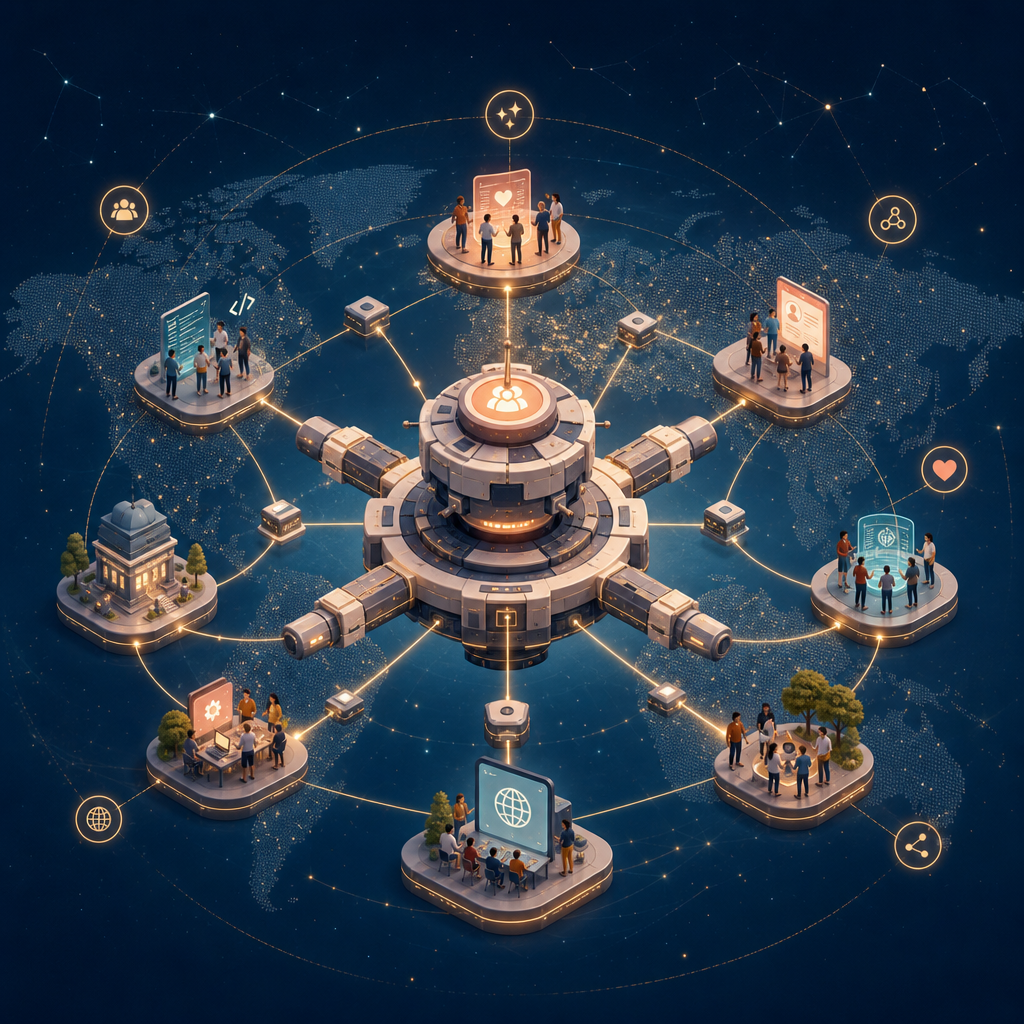
Michael Shaun introduced a new framing for how the Holomovement tech ecosystem should evolve (06:25): "We are building the Holomovement version of the International Space Station." The hub is built — now collaborators (like "China making a lab" or "Russia adding solar panels") can build modules that bolt onto the architecture using shared tools. This frames the platform as a coordination layer where collaborative quorum decides which features integrate into the whole.
The team agreed this needs a simple one-pager describing the tools and standards [tag="webflow"] [tag="supabase"] so external developers can build compatible modules.
Michael Shaun outlined the proposal he's drafting for Kevin Triplett, who has $200K available and wants to onboard his community of open-source collaborators working on "new economics software for a better future" onto the Holomovement app.
Rachel correctly emphasized keeping the proposal scope tight — what's being asked for can largely be done with what's already built. Michael Shaun is finalizing the proposal in the next two days.
The team aligned on language: "Alliances" describes the space between two entities, not the entities themselves. Organizations/projects should be called something else — possibly just "organizations" or kept as holons. Hubs should also be represented in the system.
James demoed the new /connection page, which calculates relationships between users based on assessment data and loads efficiently on page render.
[technology="Intelligent Matching Algorithms"]
Michael Shaun pushed for stronger narrative output over raw data display (12:12): "It just has to tell me a story." The astrology analogy: people gravitate toward what resonates and ignore what doesn't — so the AI doesn't need to be perfect, it needs to be evocative.
Specific recommendations:
Mariko affirmed the deeper analysis approach: "I lean in, I'm looking at this like, oh, okay, what's more."
Michael Shaun raised expanding profile inputs beyond what users type: scrape LinkedIn posts, personal websites, GitHub [tag="github"] activity. The system doesn't need to store this — it can pull live whenever a match is calculated, dramatically deepening signal quality.
[technology="Assessment Systems"]
Reviewing the current ecosystem state (under 20 members):
[technology="Directory Systems"]
The plan: get core team fully onboarded first, then have Jill draft an email inviting existing map users into the new ecosystem [tag="gmail"]. Replace the current homepage map with the new app map once matching is live (likely end of next day). James will embed a logged-out version on holomovement.net that prompts sign-in to interact.
Michael Shaun shared a framing exercise mapping collaborative commerce principles to what the platform actually does. Six of roughly six major collaborative-commerce dimensions matched cleanly to existing app functionality. The platform is essentially a coordination layer — and the Engine for Good isn't just an economic model but the deep data-mining infrastructure that finds matches between humans, capital, and projects (membership flows, micro-grants, collaborative funding rounds).
This becomes the investor narrative: "We're doing all this deep data analysis to find these best matches and create these things." Mariko's original December/January document needs a refresh to align with current state.
The second half introduced the Hubcast production team: Peter Young (founder, technical director / on-location producer), Delanne "D" (location producer), and Tess (content producer, post archives, based in LA/Vancouver).
Peter set the tone: this isn't a passive viewing experience. Michael Shaun reinforced — two hours is a long attention ask, and the broadcast needs to be a genuinely interactive third-screen experience that captures viewers as Holomovement members, not just spectators.
Peter walked through Hubcast's workflow: a Google Sheet run-of-show imports into Stage Timer (cloud-based, multi-role URLs for viewer countdowns, operators, agendas, lobby monitors). Mark will operate switching/directing and should be on future calls.
Sample 120-minute show structure includes:
[technology="Video Conferencing Solutions"]
Michael Shaun proposed embedding stretch breaks every ~35-45 minutes with QR-code-driven prompts that pull viewers into the Holomovement app — e.g., "Build your profile now," "Drop your Spiritual Ecology idea in the chat." James and Peter discussed:
[technology="Communication Automations"]
Peter demoed Hubcast's Creator Hub — a content-creator infrastructure supporting events (virtual/in-person/hybrid), channels, articles, films, courses (LMS), and zoom rooms with paywall/subscription/free tiers. The Holomovement Creator Hub becomes a discovery surface that drives traffic into holomovement.net for the deeper experience, not a competing destination.
[technology="Online Learning Platforms"]
The Wave will pilot 3-5 registered watch parties (Ibiza confirmed). Hubcast's control room can inject the broadcast into a participant's Zoom room and pull their video back into the main show, enabling bidirectional global-to-local-to-global flow. Watch parties sit behind the Holomovement paywall — registered access only, never open.
Both teams aligned: 2026 Wave is the proof-of-concept, 2027 is the global reveal. Test interactivity flows, capture what worked/didn't, and start 2027 planning in June. As Michael Shaun put it, "every inch we can take forward into 2027 now will be really valuable."
[technology="Collaboration Management Tools"]
Quick operational items covered in the Alex/Mariko sidebar:
Michael Shaun Conaway
James Redenbaugh
Mariko Pitts
Alex Melnyk
Peter Young (Hubcast)
Delanne (Hubcast)
Tess (Hubcast)
Michael Shaun returned that morning from Colombia, where he'd led an executive coaching retreat in Bogotá that surfaced six or seven prospective Holomovement participants — including a 70-year-old widow eager to contribute. He described the retreat audience as "people that have means, money, personal wealth and desire," noting how well the Holomovement message lands with business-world audiences who have means and openness (00:53:35).
Michael Shaun introduced a new framing for how the Holomovement tech ecosystem should evolve (06:25): "We are building the Holomovement version of the International Space Station." The hub is built — now collaborators (like "China making a lab" or "Russia adding solar panels") can build modules that bolt onto the architecture using shared tools. This frames the platform as a coordination layer where collaborative quorum decides which features integrate into the whole.
The team agreed this needs a simple one-pager describing the tools and standards [tag="webflow"] [tag="supabase"] so external developers can build compatible modules.
Michael Shaun outlined the proposal he's drafting for Kevin Triplett, who has $200K available and wants to onboard his community of open-source collaborators working on "new economics software for a better future" onto the Holomovement app.
Rachel correctly emphasized keeping the proposal scope tight — what's being asked for can largely be done with what's already built. Michael Shaun is finalizing the proposal in the next two days.
The team aligned on language: "Alliances" describes the space between two entities, not the entities themselves. Organizations/projects should be called something else — possibly just "organizations" or kept as holons. Hubs should also be represented in the system.
James demoed the new /connection page, which calculates relationships between users based on assessment data and loads efficiently on page render.
[technology="Intelligent Matching Algorithms"]
Michael Shaun pushed for stronger narrative output over raw data display (12:12): "It just has to tell me a story." The astrology analogy: people gravitate toward what resonates and ignore what doesn't — so the AI doesn't need to be perfect, it needs to be evocative.
Specific recommendations:
Mariko affirmed the deeper analysis approach: "I lean in, I'm looking at this like, oh, okay, what's more."
Michael Shaun raised expanding profile inputs beyond what users type: scrape LinkedIn posts, personal websites, GitHub [tag="github"] activity. The system doesn't need to store this — it can pull live whenever a match is calculated, dramatically deepening signal quality.
[technology="Assessment Systems"]
Reviewing the current ecosystem state (under 20 members):
[technology="Directory Systems"]
The plan: get core team fully onboarded first, then have Jill draft an email inviting existing map users into the new ecosystem [tag="gmail"]. Replace the current homepage map with the new app map once matching is live (likely end of next day). James will embed a logged-out version on holomovement.net that prompts sign-in to interact.
Michael Shaun shared a framing exercise mapping collaborative commerce principles to what the platform actually does. Six of roughly six major collaborative-commerce dimensions matched cleanly to existing app functionality. The platform is essentially a coordination layer — and the Engine for Good isn't just an economic model but the deep data-mining infrastructure that finds matches between humans, capital, and projects (membership flows, micro-grants, collaborative funding rounds).
This becomes the investor narrative: "We're doing all this deep data analysis to find these best matches and create these things." Mariko's original December/January document needs a refresh to align with current state.
The second half introduced the Hubcast production team: Peter Young (founder, technical director / on-location producer), Delanne "D" (location producer), and Tess (content producer, post archives, based in LA/Vancouver).
Peter set the tone: this isn't a passive viewing experience. Michael Shaun reinforced — two hours is a long attention ask, and the broadcast needs to be a genuinely interactive third-screen experience that captures viewers as Holomovement members, not just spectators.
Peter walked through Hubcast's workflow: a Google Sheet run-of-show imports into Stage Timer (cloud-based, multi-role URLs for viewer countdowns, operators, agendas, lobby monitors). Mark will operate switching/directing and should be on future calls.
Sample 120-minute show structure includes:
[technology="Video Conferencing Solutions"]
Michael Shaun proposed embedding stretch breaks every ~35-45 minutes with QR-code-driven prompts that pull viewers into the Holomovement app — e.g., "Build your profile now," "Drop your Spiritual Ecology idea in the chat." James and Peter discussed:
[technology="Communication Automations"]
Peter demoed Hubcast's Creator Hub — a content-creator infrastructure supporting events (virtual/in-person/hybrid), channels, articles, films, courses (LMS), and zoom rooms with paywall/subscription/free tiers. The Holomovement Creator Hub becomes a discovery surface that drives traffic into holomovement.net for the deeper experience, not a competing destination.
[technology="Online Learning Platforms"]
The Wave will pilot 3-5 registered watch parties (Ibiza confirmed). Hubcast's control room can inject the broadcast into a participant's Zoom room and pull their video back into the main show, enabling bidirectional global-to-local-to-global flow. Watch parties sit behind the Holomovement paywall — registered access only, never open.
Both teams aligned: 2026 Wave is the proof-of-concept, 2027 is the global reveal. Test interactivity flows, capture what worked/didn't, and start 2027 planning in June. As Michael Shaun put it, "every inch we can take forward into 2027 now will be really valuable."
[technology="Collaboration Management Tools"]
Quick operational items covered in the Alex/Mariko sidebar:
Michael Shaun Conaway
James Redenbaugh
Mariko Pitts
Alex Melnyk
Peter Young (Hubcast)
Delanne (Hubcast)
Tess (Hubcast)
Finalize and send Kevin Triplett community onboarding proposal and MOU
Finalize proposal scoping Phase One ($50K) for onboarding Kevin Triplett's open-source community using existing platform functionality. Phase Two includes deeper Claude integration for project alignment matching. Send within 2 days of meeting.
Reach out to core team members to complete profiles on the Holomovement app immediately
Proactively contact core team members to ensure they complete their profiles on the Holomovement app before broader launch. Current ecosystem has under 20 members. Incomplete profiles should not appear publicly.
Refresh Holomovement collaborative commerce white paper final 3-4 pages with Lol
Complete refresh of white paper mapping collaborative commerce principles to platform functionality. Six major collaborative-commerce dimensions already mapped to existing app functionality. Final 3-4 pages remaining. Update to align with current platform state for investor narrative.
Prepare voiceover and walkthrough content explaining collaboration layer for Wave broadcast onboarding moments
Create walkthrough and voiceover content that explains the Holomovement collaboration layer concept for interactive broadcast moments during Wave event. Content used during stretch breaks and QR-code-driven engagement sequences pulling viewers into the app.
Ship n8n connection-analysis automation sending both profiles to Claude for domain-specific reports
Complete and deploy the n8n agentic analysis automation triggered by Connect button that sends both profiles to Claude for domain-specific reports covering purpose, needs/offers, complementary skills, journey phase, and alignment nature. Target completion end of day.
Add intermediary tags and domains-in-common layer before triggering full Claude agent analysis on connection cards
Add an intermediary UX layer on connection cards that shows shared tags and domains between two users before requiring the full agent analysis to run. Reduces friction and gives users immediate signal without waiting for full Claude processing.
Add map filter controls allowing filtering by tag, domain, and skill on the connections map view
Implement filter button on the map view similar to the directory, allowing users to filter members by tag, domain, and skill. Feedback from demo indicated this is a key UX improvement for navigating the member map.
Fix View Profile button click target on connection cards to ensure proper navigation
Fix the click target issue on the View Profile button on connection cards identified during the 05-04 demo. Button is not responding correctly to clicks.
Build GPT image automation to reframe user-uploaded profile images for circular avatar and 9:16 display contexts
Develop GPT-powered automation that processes user-uploaded profile images and generates optimized versions for circular avatar display and 9:16 frame contexts. Current image aspect ratios are breaking in these display contexts. Route uploads through automation to auto-generate all required variants.
Update Wave sales page tier copy from two-way to three-way pricing structure
Update the Wave event sales page pricing section to reflect three-way pricing tier structure instead of current two-way layout.
Send Jill style guide assets for Wave broadcast and platform design alignment
Send style guide assets to Jill to ensure design consistency across broadcast content, email drafts, and platform communications.
Connect with Emilio Lopez from Hubcast on broadcast and app integration including potential SSO
Schedule and conduct integration call with Emilio Lopez (Hubcast developer) to discuss embedding Hubcast stream into holomovement.net, single sign-on between Holomovement and Hubcast so a profile creates membership in both systems, and technical architecture for broadcast-app integration.
Migrate Holomovement app to app.holomovement.net subdomain when matching system is production-ready
Move the Holomovement app to app.holomovement.net once the matching system is live and production-ready. Also embed a logged-out version on holomovement.net that prompts sign-in to interact. Replace current homepage map with new app map once matching is live.
Have Jill draft invitation email to existing map users welcoming them into the new Holomovement ecosystem
Coordinate with Jill to draft an email inviting existing Holomovement map users into the new platform ecosystem. Email should explain the enhanced capabilities including matching, profiles, and holons.
Coordinate Hera and Claire to register Hubcast team members and provide Wave access codes
Work with Hera and Claire to register the Hubcast production team (Peter, Delanne, Tess, Mark) on the Holomovement platform and provide them with Wave event access codes.
Confirm Marty Kay Casey availability to serve as main Wave broadcast host
Check availability of Marty Kay Casey to serve as main trained host for Wave global broadcast. Team noted she is trained and knows Holomovement. Rachel floated as magical/lighter co-host counterbalance.
Produce Lola Bolzano personalized promotional video and graphics via Amanda for publicist approval
Coordinate with Amanda to produce personalized promotional video and graphics for Lola Bolzano. Content must be approved by her publicist before distribution. Lola confirmed pending publicist sign-off.
Send Wave run-of-show Google Sheet to Peter Young and Delanne from Hubcast
Share the Wave event run-of-show Google Sheet with the Hubcast production team (Peter Young and Delanne) for import into Stage Timer. Hubcast uses Stage Timer for cloud-based show timing with multi-role URLs.
Plan dynamic broadcast host locations including closing party segment at Crocodile venue
Develop plan for dynamic host locations throughout the Wave broadcast, including a closing party segment at the Crocodile venue. Part of broadcast production logistics for Wave Portugal.
Update full Wave headliner list including Mark Vanderheiden and Lola Bolzano
Update the complete Wave headliner list to include Mark Vanderheiden (DJ set + Seven Conscious Things leadership piece) and Lola Bolzano (pending publicist sign-off) along with all other confirmed speakers.

Submit Wave noise permit with Paolo following rider receipt
Alex Melnyk to finalize and submit noise permit application working with Paolo once the rider has been received. Permit nearly ready per meeting.
Text Amanda in Visibility group to ship Jennifer Hill speaker graphic so she can pivot promotion from Fifth Empire to Wave
Alex to text Amanda in the Visibility group to ship Jennifer Hill's speaker graphic immediately so Jennifer can shift her promotional activity from Fifth Empire to the Wave event.
Confirm Mark Vanderheiden DJ equipment requirements and secure proper headshot for promotional materials
Alex to confirm what DJ equipment Mark Vanderheiden needs for his set at Wave and obtain a proper headshot for use in promotional graphics and headliner materials.
Respond to Lola Bolzano's agent regarding Wave set times by tomorrow
Alex to respond to Lola Bolzano's publicist/agent regarding her set times at the Wave event. Response required by the day after the meeting.
Coordinate Michael Sebastian rooming with Facel for Wave Portugal accommodations
Alex to arrange for Michael Sebastian to room with Facel during the Wave Portugal event.
Share Stage Timer training materials and run-of-show template structure with Holomovement team
Peter Young from Hubcast to share Stage Timer onboarding/training materials and the run-of-show template structure with the Holomovement team. Stage Timer is cloud-based with multi-role URLs for viewer countdowns, operators, agendas, and lobby monitors.
Schedule integration call between Emilio Lopez from Hubcast and James Redenbaugh for broadcast-app technical integration
Peter Young to schedule a dedicated technical integration call between Hubcast developer Emilio Lopez and James Redenbaugh to work through broadcast stream embedding, SSO, and app integration architecture.
Provide Holomovement team access to Global Earth Repair hybrid event recording for broadcast reference
Peter Young to provide the Holomovement team with access to the Global Earth Repair hybrid event as a reference example of Hubcast's broadcast production capabilities and interactive format.
Coordinate Wednesday equipment handoff to Mariko via Tess near LAX
Peter Young to coordinate logistics for Wednesday equipment handoff to Mariko, facilitated via Tess near LAX. Equipment includes tunnel and cameras.
Pull Gina's Peace Beds at Home watch party messaging for Wave watch party reference
Delanne from Hubcast to retrieve Gina's Peace Beds at Home watch party messaging as a reference template for the Wave watch party program. Wave will pilot 3-5 registered watch parties including Ibiza.
Set up Mentimeter demo for next Wave planning meeting to show low-friction audience interaction capability
Delanne from Hubcast to prepare and demo Mentimeter for the next Wave planning meeting. Mentimeter provides low-friction anonymous audience interaction with results visible on-stream during broadcast.
Loop Mark into upcoming Wave planning calls as switching and directing lead for broadcast
Delanne to ensure Mark (switching/directing lead for Wave broadcast) is included in upcoming planning calls. Mark will operate switching and directing during the live broadcast.
Assemble broadcast equipment kit including tunnel and cameras for Wednesday LAX handoff to Mariko
Tess from Hubcast to assemble the equipment kit (tunnel plus cameras) for the Wednesday handoff to Mariko near LAX. Hubcast brings two camera systems — a PTZ rig for main room and a separate kit for broadcast/interview area.
Create one-pager developer standards document describing tools and standards for building compatible Holomovement platform modules
Create a simple one-pager describing the tools and standards (Webflow, Supabase, etc.) so external collaborators can build compatible modules that bolt onto the Holomovement platform architecture. Framed around the International Space Station metaphor where collaborators build modules using shared infrastructure standards.
Standardize Holomovement platform terminology clarifying Alliances, Holons, Organizations, and Hubs across all materials
Implement team consensus on terminology: 'Alliances' describes the space/relationship between entities (not the entities themselves). Organizations/projects to be called 'organizations' or kept as 'holons'. Hubs to be represented in the system. Update Wave site 'Partners' section to be relabeled 'Alliances' and repositioned beneath Global Broadcast section.
Explore data exhaust profile enhancement by pulling live data from LinkedIn, personal websites, and GitHub to deepen matching signal
Investigate system for pulling live data from external sources (LinkedIn posts, personal websites, GitHub activity) to enrich matching signal quality without requiring users to manually input information. Data pulled live at match-calculation time rather than stored. Michael Shaun raised this as an opportunity to dramatically deepen signal quality.
Design and implement AI-generated connection images placing two matched users in shared symbolic context
Explore generating AI images that place two matched users in a shared symbolic or visual context as part of the connection experience. Michael Shaun raised this as a way to make the matching experience more evocative and narrative-driven rather than data-heavy.
Improve connection narrative output to lead with 1-2 sentence summary followed by expandable detail sections
Restructure Claude-generated connection analysis output to lead with a compelling 1-2 sentence narrative summary (Strava-style), then allow users to expand into detailed sections. Replace single-word descriptors like 'relational' with full phrases people can parse. Make numerical score boxes (archetype match, distance) more visually prominent against the green background.
Fix incomplete member profiles to prevent them from appearing publicly in the directory
Implement logic to prevent incomplete member profiles from displaying publicly in the directory. Raised during review of current ecosystem state — profiles like Moenja's should not be visible until sufficiently complete.
Fix auto-generated holon icons and resolve type-on-image text collision design issues
Improve auto-generated holon icons (current technology holon icon described as looking 'like a bug running across the floor'). Fix text-on-image collision issues for labels like 'Pro Social' and 'Iris' that are overlapping problematically. Review and fix admin permissions on holons so organizers like Michael Shaun can access tech team admin.
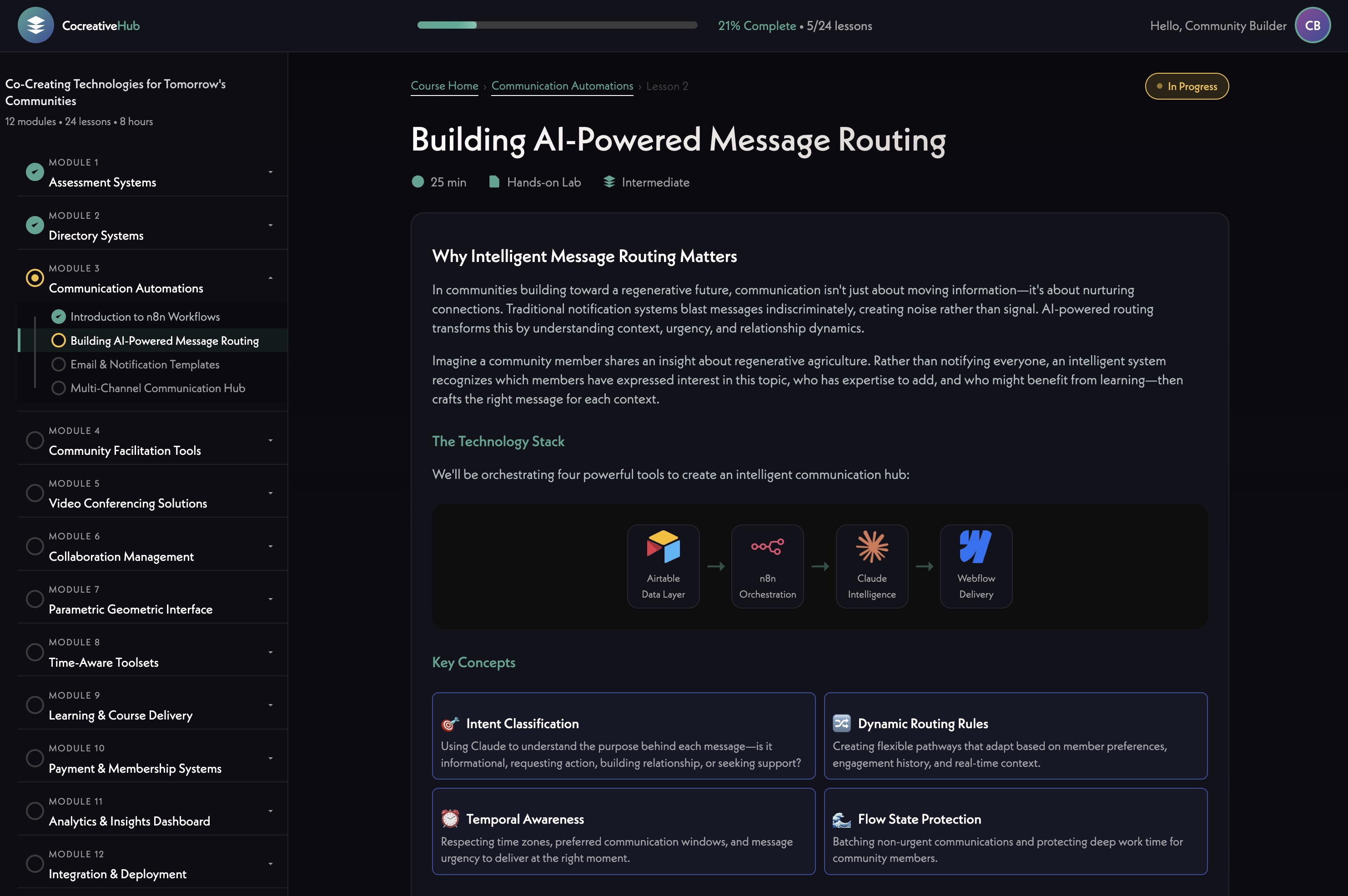
Assessment system with AI-powered engagement features feeding automation workflows. Data from assessments, clicking patterns, lesson completion, and call attendance triggers personalized communication including immediate tailored emails, weekly progress updates, connection recommendations based on profile matching, and proactive check-in offers when engagement drops. Guatemala-specific assessment page created requiring customized copy. Current synergist directory demonstrates existing assessment capabilities: members complete form triggering automated n8n and Claude AI analysis of responses about purpose, projects, and ancestral wisdom influences. System generates personalized feedback and recommends connections to other synergists based on compatibility, facilitating introductions via email without exposing addresses. Also suggests relevant podcast episodes. No-login approach removes participation barriers while enabling intelligent matching and communication. Strategic shift to progressive engagement model: members start with basic five-minute profile setup (name, website, purpose statement, location), then complete more detailed assessments later. Each completed assessment adds elements to profile and unlocks new features. Gamification includes AI-generated icons, tarot card archetypes, or numerology graphics appearing on profiles as users complete different assessments. Incremental assessment launch strategy releasing new assessments every week or ten days leading to Wave event, using Ripple gatherings and Miracle Club to promote participation. Partnership opportunities with experts for themed assessments (Don Beck for Spiral Dynamics, Vedic astrologer for astrology, iOS Zone of Genius team for their assessment). Critical reassessment of assessment strategy prioritizing basic intake form capturing most important factors: development level, experience, life stage, purpose, and current needs as primary assessment for matching foundation. Systems like Gene Keys and numerology recognized as requiring belief in astrology/numerology to feel relevant, limiting universal applicability. Focus shifting to actionable, practical data enabling computational matching based on clear criteria rather than archetypal personality typing. When matching collaborators, users need to understand skills, experience, current needs, and project involvement rather than personality scores. AI-driven matching requires developmental stage, experience level, project involvement, and specific needs to avoid misaligned matches like pairing serial entrepreneurs with college freshmen. Meeting confirmed approach of using simple 1-to-10 scale assessments for numerical scoring and spider graphs but deferring complex compatibility scores for MVP. AI interpretation via Claude for free-text fields and nuanced alignment, direct computation for explicit matches like shared affiliations or complementary skill requests. Michael coordinating with Emmanuel on potential assessment questions to gauge user alignment. Team now planning 5-6 domain assessment (5 makes pentagram shape, 6 makes star shape) using simple multiple choice format outputting 1-10 scores per metric with spider graph visualization (37:24). Demonstrated working client assessment as reference - multi-screen flow with logic-based classification, no agentic analysis required. Key design principles: spectrum-based framing rather than qualitative scoring ('does this sound like you or not?' vs 'how good are you at this?'), questions should feel neutral and interesting to avoid test-taking bias (MMPI/Myers-Briggs problem of answering how you want to appear), completable in 10 minutes or less, more candidate questions per domain than needed for culling weak ones (40:52, 48:29). Mariko advocated for including at least one fun gift-like assessment (e.g. numerology mandala tool) people would do for the experience that enriches profile organically without feeling like data extraction (41:56). James floated longer-term vision of garden of assessments users can choose from with power to decide which assessments inform matching - astrological/numerological inputs become opt-in rather than default. New numerology mandala tool demonstrated building visual in real time as user types, team expressed integration interest (43:44). Michael Shaun starting shared document immediately with candidate domain names and draft questions for team review, holding internal review with Hera before broader socialization (40:52, 52:43). Working prototype built with five-domain assessment featuring slider-based positioning system across spectrums (22:37). Five domains: Holonic Worldview (separative/analytic to holistic/integrative), Purpose Orientation (exploring/emergent to directed/activated), Pro-Social Stance (deep one-on-one to community-wide/systemic), Collaborative Capacity (independent to collective), Time Horizon (near-term to long-arc/generational). Results render as nine-pointed spider graph and bar chart. Slider format keeps assessment accessible without overwhelming users (25:36). Community-level visualization capability floated - overlaying 100 profiles to reveal collective orientation of holons or comparing holons against each other (29:17). Next development step: adding archetype outputs (e.g., 'super connector') with brief descriptive text for each result profile. Assessment data feeds optionally into matching algorithm with users able to decide matching criteria when requesting analysis, though some default criteria apply automatically (36:00). Prototype ready for Holomovement team Thursday meeting demo (40:46). 03-31 meeting revealed spider graph assessment essentially unreadable without tutorial - 19 items across overlapping axes makes results incomprehensible (10:54). Team verdict: spider graph is good eye candy but doesn't deliver snapshot value. Simplified one-question assessment with triangulation output confirmed as right path forward, not using spider graph format (14:58). Working prototype committed for following day. Michael Shaun flagged standing to-do: writing one-page descriptive blurbs for each assessment area so AI can return robust grounded responses to user queries - Google Doc format for now (57:04). Mariko testing showed assessment accurate and trustworthy, validating credibility needed for matching layer to work for new users. Assessment confirms what users intuitively know about existing relationships, building trust for recommendations with unknown people (46:52). Beyond individual matching, assessments help working groups understand collective makeup - team strengths, shadows, support needs, leadership roles. Positions tools as ongoing collaboration infrastructure rather than just onboarding features (51:14). New triangular assessment visualization mentioned in meeting at 57:00 as co-designed by James. Assessment now functional with improved output format and ready for core team onboarding (meeting 05-04).
Custom membership system architecture for user authentication, progress tracking, and database management using Supabase for backend. Requirements include real database for user progress (not cookies), journal entry capture, API triggers for membership status and course purchases, and progress tracking across sessions. Decision made to build custom solution on Supabase rather than Member Stack. Includes Stripe integration for subscription management and automatic access revocation when subscriptions lapse. Multiple products may connect to same membership tier with bundled offerings granting multiple memberships from single purchase. Part of Phase One development with $16K-$29K budget. Requires hiring Supabase specialist for implementation. Timeline aligned with LMS development for February 10th launch. Authentication spike will establish foundation with Supabase login functionality on MAST template, implementing user profiles, password management, and session handling. System will sync membership status between Stripe and Supabase for automated access control. Backend successfully operational with membership login and content gating complete using Supabase and Stripe. Profile editing integration in progress to connect with directory system. Backend approximately 90% complete with primary goal to deliver working version on Holomovement site for team testing this week allowing account creation, login, and profile data editing. Front end minimal at this stage consisting mainly of login pages until profile pages developed. Profile creation flow now implemented as linear step-by-step process requiring profile completion before directory access. Sign-up flow includes friendly nudges for empty bios when hitting next, optional social profiles with language like 'you can always come back later' to reduce drop-off, loading screen during profile generation with engaging copy like 'making connections', AI-generated banner images based on user bios, and light/dark mode toggle inheriting system settings by default. System enforces profile completion to ensure data quality and prevent half-finished accounts cluttering database. Dark backgrounds use deep teal rather than pure black, light mode avoids stark white to maintain Holomovement brand feel. Simplified pill-style member modal implemented with collapsed/expanded states showing two lines by default, expanding on hover to reveal icons for messages, Holons, and light/dark mode toggle. Notifications aggregate into single indicator on Holon icon with changing number rather than multiple dots. Three profile image preview styles (circle, square, doorway/vertical) included in signup flow to ensure photos work across all use cases. In-app messaging system now live using custom-built architecture with no per-message cost, styled similar to iMessage with unread message counts, conversation threading, and future group chat capability. Email notifications handled via Resend - free up to 3,000 emails/month, then $20/month for up to 50,000. Holon management flow improved with clear delegation model between members and admins using invitation system rather than automatic adds. Location automation uses lightweight AI call to convert entered location into coordinates for near real-time map updates. Saving bug affecting profile updates, feedback, and location syncing identified and resolved during meeting. Community consent flow being added as pop-up on first messaging use with scrollable community agreements and required checkboxes covering non-partisanship, anti-spam, entity usage rules, and conduct standards. GDPR compliance considerations noted with Webflow plugin available for data erasure rights and cookie consent. Pay What You Want contribution system now under active development with slider UI allowing users to select suggested range ($15-$20/month) with secondary scholarship tier option for lower amounts. Two-screen approach framed as gift rather than discount with wave-based slider visual showing increasing amplitude. System includes familiar Stripe checkout supporting Link, Amazon Pay, and other methods. PayPal integration planned for better international accessibility. Working wave-amplitude slider prototype built with predefined moments shifting wavelength visually, translatable directly into payment UX. Prototype ready for core team testing within next couple days with front-end UI included. Thursday core team meeting target for showcase. Modal menu interface introduced featuring compact notification/settings control with light mode toggle - described as small detail that meaningfully elevates experience. Three developers now working on Webflow implementation: Sean (Ohio, senior), Siam (Pakistan, junior), with Ivan handling less bandwidth due to outside client work. Profile creation, editing, and regeneration flows confirmed working as of 03-31 meeting. Profile creation link added directly to member modal enabling re-run of full onboarding flow. Core team onboarding structured as daily feature drip starting with profile creation. 03-31 crash test revealed critical blocking issues preventing core team demo: n8n automation pipeline failing to complete profile data processing reliably, social links not saving due to LinkedIn field dependency, AI-generated cover image and tagline entering loop state without completing, JSON input error halting holon creation mid-flow, logout bug on holon detail page, light mode broadly non-functional requiring toggle to be hidden entirely, profile content fields not populating after form submission. Team consensus: crash test failed, reconvening following day to retest after critical fixes. Zero tolerance for processes locking up or halting before core team demo - visual imperfections acceptable but no mid-flow stoppage permitted. Hubcast partnership introduces potential single sign-on integration explored with developer Emilio Lopez enabling seamless profile creation handshake between broadcast access and Holomovement App reducing friction for new users discovering platform via livestream. Profile creation becomes the access ticket for global broadcast viewers immediately placing them inside ecosystem where they discover collaboration features. System now functional and operational with core team beginning onboarding process (meeting 05-04). Post-Wave deployment successful with members actively using platform. Critical gaps identified in 06-16 meeting: users cannot delete accounts (GDPR violation with European user base), users cannot remove themselves from Holons, stewards cannot remove members, automatic member addition on Holon creation needs approval workflow, privacy controls needed for Holon visibility, homepage globe displays names/locations without explicit opt-in requiring visibility toggle, cookie consent banner required for European compliance, Stripe webhook test-mode errors surfacing. Account deletion and member management now top cleanup priorities.
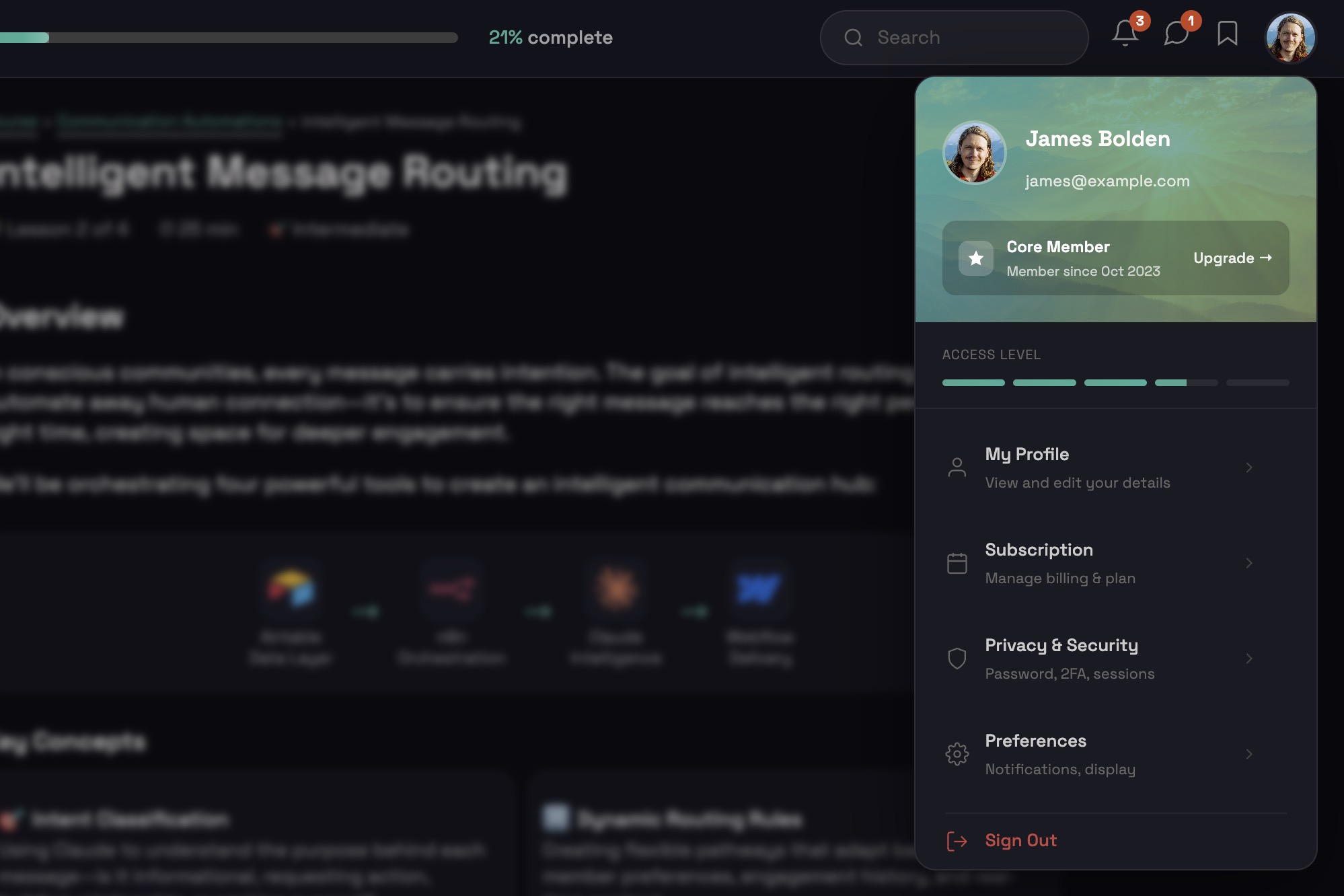
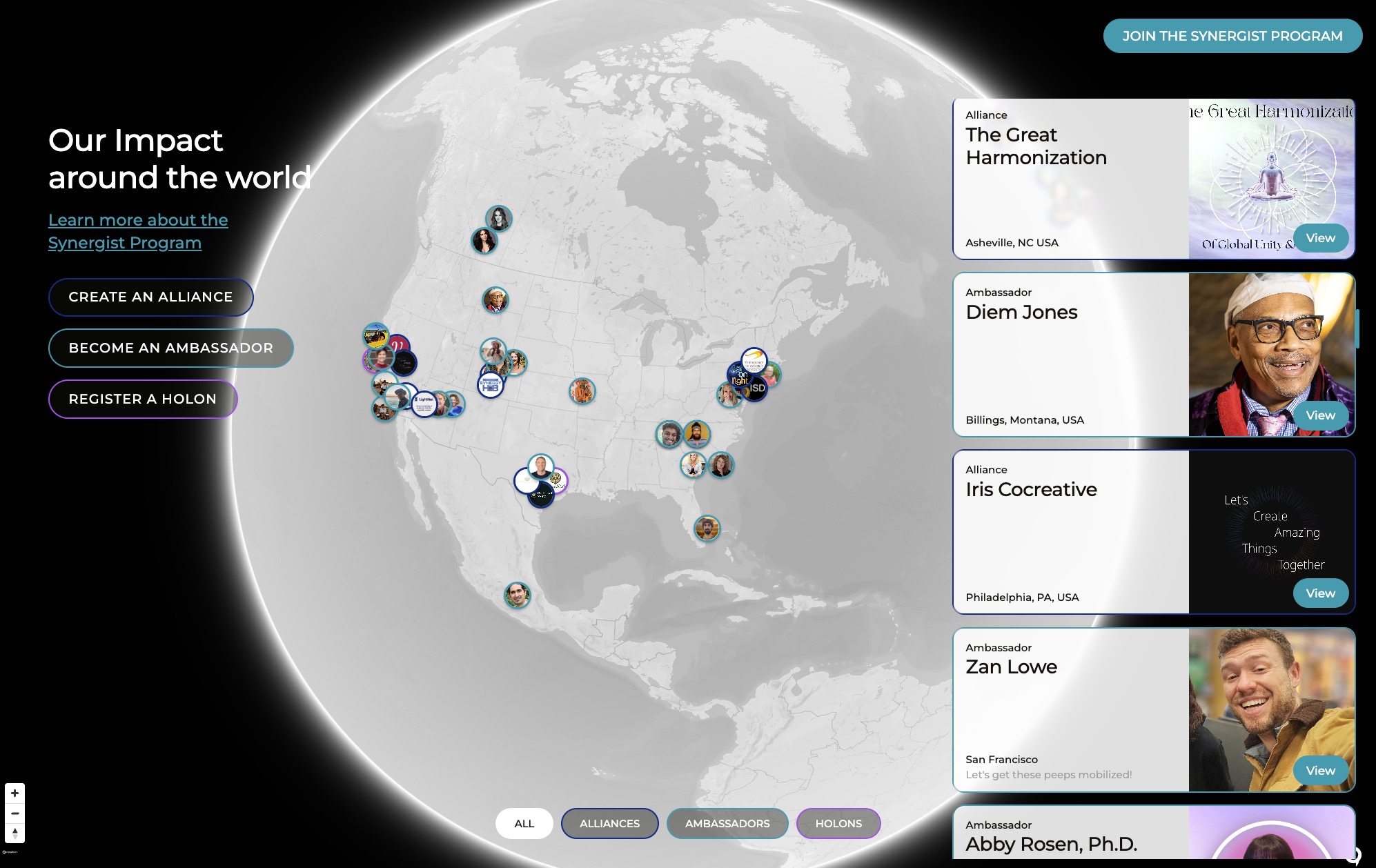
Strategic enhancement of directory system integrating with membership capabilities to enable member profile management, progressive assessment completion, and intelligent matching. Members can log in and edit their profiles directly with information stored in Supabase for flexible content management. Progressive engagement model starts with basic five-minute setup (name, website, purpose statement, location), then enables detailed assessments later. Each completed assessment adds profile elements and unlocks features including AI-generated visual representations (icons, tarot archetypes, numerology graphics). Integration with Claude AI enables sophisticated queries like 'who should I collaborate with on this project?' or 'who can provide funding?' across network assessment data. Advanced features include weekly emotional mapping interface with six-axis emotional space (excitement, nervousness, grief, etc.) aggregating into community climate visualizations. Reimagined map interface using flat Earth projection with layered filtering showing member locations, funding flows, collaborative connections, project relationships. Multiple view modes from simplified default to complex multi-layered 'Arcturian' views. Integration with Engine for Good grant program where applications link to member profiles, creating incentive structure for profile completion. Team pivoted to prioritize directory system over LMS development. Player card approach focuses on game-like profiles emphasizing what someone is doing (project/mission) and what help they need for AI-powered matching. System summarizes lengthy inputs into concise scannable formats. MVP launch target February 15 with login capability, profile editing, and integrated assessments. Beta testing program follows to identify next priority features. Critical development discussion revealed MapBox visualization provides initial visual interest but limited practical value beyond local connections - intelligent matching algorithms represent the true 'killer app' rather than map visualization. Profile data strategy shifting from personality assessments to actionable information: developmental stage, experience level, current project involvement, specific skills, and active needs. Visual consistency issues identified with user-uploaded images requiring standardization. Question emerged whether Holons function as independent entities or collections of individual members, requiring data architecture decisions. Simplified terminology 'members and groups' proposed over 'Holons' for newcomer clarity. Basic intake form planned capturing development level, experience, life stage, purpose, and current needs as primary assessment for matching foundation. Player card UI concept introduced featuring icons to symbolize key information, AI-generated summaries to condense lengthy responses, and achievement badges displaying completed courses, assessments, and accomplishments. Design iteration process planned where team scans test cards to validate information hierarchy. Sandbox database creation for core team to fill out profiles and review each other's player cards as real-world test. Prototype development progressing with profile creation, editing, viewing, and password resets functional in Supabase. Munia developing first draft UI designs. Team agreed to reduce text density, create more visual/scannable interfaces. Multiple views prototyped: alliance view, profile editing, directory search (list and map-based), member profiles, holon profiles. Core intake fields defined: name, date of birth, email, phone/SMS/WhatsApp, location, purpose/mission, gifts and requests, alliance affiliations, short bio (150 words max), photo. Matching deferred from numerical compatibility scores to simpler connection signals: complementary skills, matching needs/offers, alliance overlap, geographic proximity, shared purpose domains. AI interpretation via Claude for free-text fields, direct computation for explicit matches. App functionality to be hosted on separate subdomain (app.holomovement.net) with member-specific navigation, syncing public profile data to main site member globe. End of February target for core team interactive prototype. 3D globe navigation now live with lightweight custom rendering approach using continent outlines without full Mapbox tile loading for smooth performance (05:52). Globe features toggle for flat view, hover-activated profile cards, connection lines between members and holons. People appear as yellow dots, holons as teal hexagons algorithmically placed at center of members (01:22). Profile creation flow implemented as linear step-by-step process requiring profile completion before directory access (09:38). Photos strongly encouraged with friendly nudges if skipped, social profiles optional. AI-generated banner images based on user bios producing resonant results (15:47). Light/dark mode toggle available inheriting system settings by default (16:39). Dark backgrounds using deep teal rather than pure black, light mode avoiding stark white to maintain Holomovement brand feel (14:35). Vertical player cards chosen for directory view over horizontal layouts for gamified engaging presentation (37:52). Team seeding platform this week with core team members completing profiles Monday/Tuesday, creating holons Wednesday, reviewing experience Thursday core call (43:53). Polish focus prioritized over new features with delivery target Monday February 17 (41:20). New bento-style profile layout introduced with rounded corners, centered tagline, framed profile image, and subtle background color differentiation between sections (14:21). Rich text field with optional image upload added to represent projects or organizations more expressively beyond plain text (32:10). Testimonials system (potentially rebranded as 'Send Some Love' or 'Share the Love') enables mutual endorsements with reciprocal vouching mechanics (34:54). Field feature replacing 'wall' concept allows users to post updates and collaborative content with pinning capability (39:43). Long-term vision includes drag-and-drop section ordering for personalized profile storytelling. Assessment display framework showing sliders across domains added as visible badges on profiles. Seeking/Offering keywords auto-distilled from freeform text using AI summarization to aid readability and matching. On-demand match experience triggered by 'Match Me' button generates side-by-side comparison modal with numerical score (1-100, shown on hover), loading animation, and meaningful dimensions including complementary skills, needs/offers alignment, shared alliances, overlapping domains (26:00, 19:02). Match score and comparison view designed as sticky gamified feature incentivizing profile completion (24:35). Domain categories refined: 'Economics and New Systems' → 'Economics and Collaborative Commerce', 'Governance and Social Change' split into 'Collaborative Governance' and separate social change, 'Spiritual Activism and Inner Development' → 'Spirituality and Consciousness', additions include Ethics and Philosophy, Science, Leadership and Facilitation as 12th domain, potential Psychology embedded in community/relationships (43:00-48:22). Onboarding copy and tooltip language prioritized for clarity on unfamiliar terms with short hover descriptions (one sentence max). Implementation timeline: 7-10 day dev window for new design style, Field feature, preliminary matching functionality followed by internal testing with core four, then broader core team rollout (41:07, 40:08). First impressions prioritized with cautious rollout protocol to ensure solid initial experience. Messaging icon refined from email-style button to message icon to better reflect in-platform nature (13:29). Notifications aggregate into single indicator on Holon icon with changing number rather than multiple dots. Three profile image preview styles (circle, square, doorway/vertical) included in signup flow to ensure photos work across all use cases (07:44). In-app messaging system now live using custom-built architecture with no per-message cost, styled similar to iMessage with unread message counts, conversation threading, and future group chat capability (09:37). Email notifications handled via Resend - free up to 3,000 emails/month, then $20/month for up to 50,000 (23:56). Holon management flow improved with clear delegation model between members and admins using invitation system rather than automatic adds (04:08). Location automation uses lightweight AI call to convert entered location into coordinates for near real-time map updates (26:27). Saving bug affecting profile updates, feedback, and location syncing identified and resolved during meeting (26:27). Community consent flow being added as pop-up on first messaging use with scrollable community agreements and required checkboxes covering non-partisanship, anti-spam, entity usage rules, and conduct standards (18:00). GDPR compliance considerations noted with Webflow plugin available for data erasure rights and cookie consent (17:46). Pay What You Want contribution system now under active development with slider UI allowing users to select suggested range ($15-$20/month) with secondary scholarship tier option for lower amounts. Two-screen approach framed as gift rather than discount with wave-based slider visual showing increasing amplitude. System includes familiar Stripe checkout supporting Link, Amazon Pay, and other methods. PayPal integration planned for better international accessibility (18:35, 19:30). Working wave-amplitude slider prototype built with predefined moments shifting wavelength visually, translatable directly into payment UX (19:47). Prototype ready for core team testing within next couple days with front-end UI included (53:10). Thursday core team meeting target for showcase (54:22). Modal menu interface introduced featuring compact notification/settings control with light mode toggle - described as small detail that meaningfully elevates experience (38:05). Three developers now working on Webflow implementation: Sean (Ohio, senior), Siam (Pakistan, junior), with Ivan handling less bandwidth due to outside client work (34:00). Profile creation, editing, and regeneration flows confirmed working (04:14). Holon page active development with wheel of faces arc rendering, domain icons, and My Holons view improvements (04:14). Empty state for My Holons will show helpful message plus grid of all existing Holons to orient new users (21:50). Profile edit mode link navigation disabled to prevent losing unsaved changes (27:08). Profile image edit icon made more prominent (30:58). Banner image regeneration icon will get rollover tooltip explaining 'replace your banner' functionality (32:25). Skills rating feature demoed allowing users to rate themselves with visual bar indicators (44:04). Location map tooltip added showing actual location name on hover (23:11). Profile creation link added directly to member modal enabling logged-in users to re-run full onboarding flow (42:31). Test accounts and Holons being cleaned up before team-wide invite (06:47). Core team onboarding structured as daily feature drip: Day 1 profile creation, Day 2 assessment prototype, following days Holons/map/matching features one at a time (16:11). Homepage updates in progress including background color correction, animation circle restoration, scroll sequence improvements, auto-scroll implementation, mobile type scaling, icon-only logo, and updated CTA button (44:35). Dynamic map will become hero element of homepage with card preview leading to login/profile creation for non-members (52:57). Tag-based matchmaking architecture outlined: profiles generate seeking/offering/domain/focus tags, periodic comparison produces alignment scores, directory displays highest-alignment profiles larger and left-aligned (01:01:36). Sean actively working on matching grid view implementation (01:00:56). Wave event preparation targeting participants leaving activation day already inside at least one Holon using app as live tool (58:30). James confirmed ready to lead app presentations at wave event. One-to-two minute intro video of ecosystem planned for wave event (01:00:07). Platform designed as coordination layer - not an organization but a medium, connective tissue, energetic petri dish for collaboration to grow (20:30). Wave serves as on-ramp for Saturday-Monday - people get on the spaceship, then continue exploring projects, holons, and neighbors in platform Tuesday onward. 'We come together and create these big bonfires. We want ways to keep these campfires burning through the year' (55:30). Post-Wave system successfully operational with Portugal map section densely populated showing honeycomb patterns around Lisbon and Spain hubs. Meeting 06-16 identified map zoom scaling issue (13:53) - member dots need to proportionally shrink as users zoom in to maintain functionality at high-density locations. Profile image tooltip needed under editing icons since users don't know how to change pictures. Homepage globe visibility toggle required since names and locations display without explicit opt-in. Profile tab renamed from 'About' to 'Info' and repositioned as first tab for better UX.
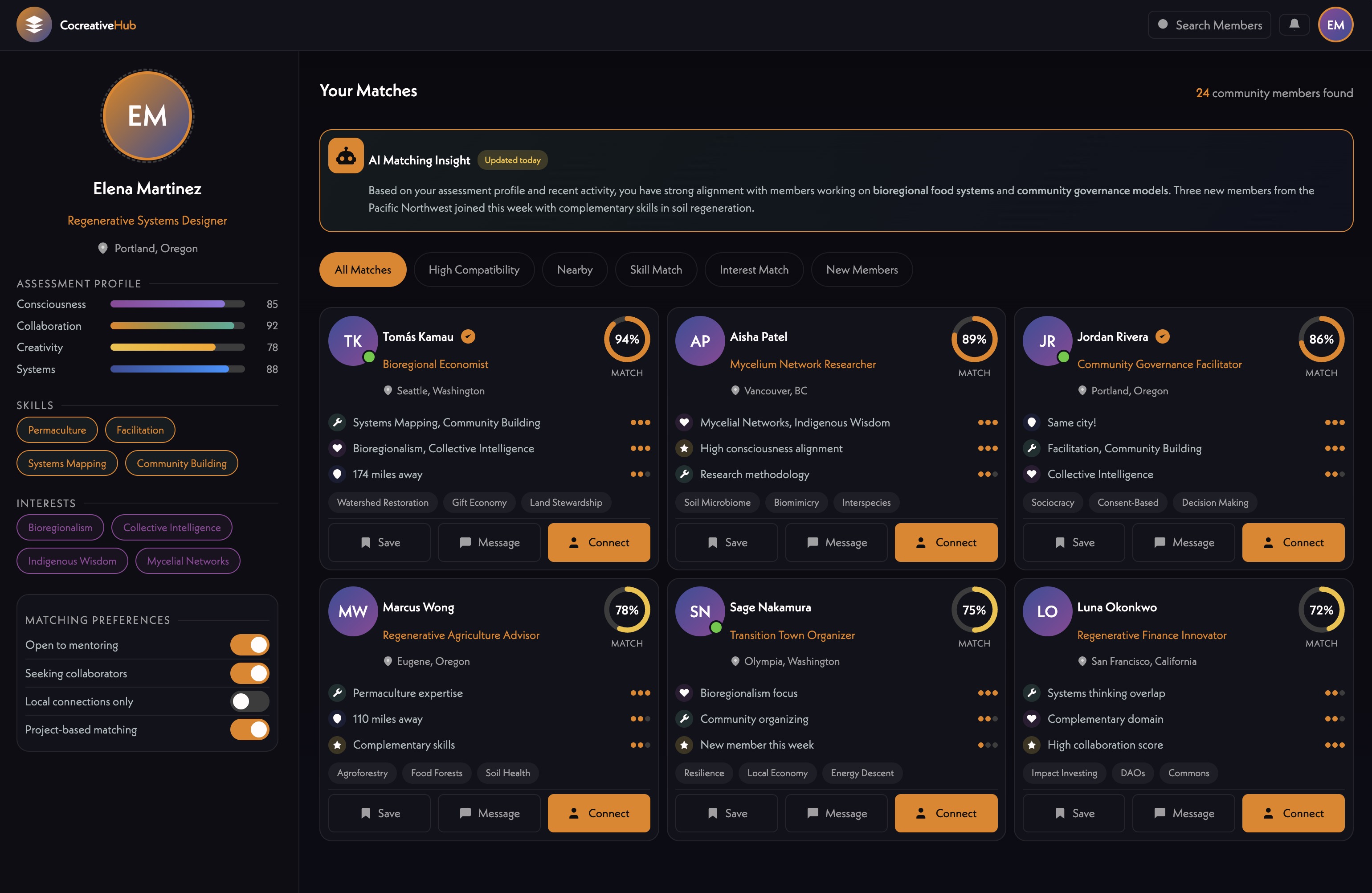
Intelligent matching feature triggered by 'Match Me' button on member cards or directory view generating dynamic side-by-side comparison between two members. System displays numerical compatibility score (1-100) shown on hover to avoid feeling like rating system, with loading/analysis animation making generation feel intentional and interesting (26:00). Match modal shows meaningful dimensions including complementary skills, needs/offers alignment, shared alliances, overlapping domains of interest, developmental stage, and geographic proximity - surfacing why people matched rather than just that they matched (19:02, 27:24). Implementation architecture: first layer distills each user's tags, domains, and seeking/offering data into simple numeric scores for lightweight computational matching. Users with closely matching numbers get high match score; divergent profiles get low score. This approach scales as user base grows without computational burden. Second layer uses Claude feeding each user's About Me and purpose responses alongside tag data into agentic prompt generating qualitative match analysis. Starting with top 25 numeric matches per person, Claude outputs readable explanation of why two people should connect. Results saved so matched users can share them - 'the HoloBot said we should connect, check this out' - without requiring other person to run own process (42:00). System designed as sticky gamified feature incentivizing profile completion - incomplete profiles result in lower matchability or 'unmatchable' status serving as playful motivator (24:35). Match generation happens on-demand rather than pre-computed to allow real-time incorporation of latest profile updates and assessment completions. Prioritizes actionable information over personality typing: what someone is working on, what help they need, what skills they offer, their experience level, and developmental stage. Avoids problematic mismatches like pairing serial entrepreneurs with college freshmen by incorporating context-aware filtering. Integration with assessment data enables queries across network like 'who should I collaborate with on this project?' or 'who can provide funding?' Technical architecture combines Supabase for profile data retrieval, Claude API for compatibility analysis, and custom JavaScript for interactive modal interface. Future enhancement could incorporate mutual matching where both parties express interest before facilitating introduction. System represents platform's 'killer app' - intelligent algorithmic connection-making that surfaces possibilities people would never discover through manual browsing alone. Current UI mockup under review with team feedback that original version felt more alive while newer version reads as sleeker but more corporate with less warmth and weaker visual hierarchy (27:13, 38:04). Key design feedback includes moving Reach Out and View Profile CTAs to bottom of card where users naturally scan (36:41), replacing tag-only displays with short generative sentences explaining connections in plain language with matched tags highlighted inline (33:42, 35:34), adding left-column recommended connection list for easy scanning (39:40), enabling match view trigger from profile pages via 'show me my connection' button for both recommendations and relationship deepening (42:01), and using yellow color more heavily to mark person-to-person connection territory (42:32). Match bars per domain could appear as visual shorthand but not primary read. Design approach references Strava's AI-written post-ride sentences that create more engagement than data dashboards (35:34) and Pattern app's astrology-based compatibility presentation (39:53). Matching feature approximately two weeks out with new design elements expected Monday (44:37, 45:13). 03-31 meeting detailed tag-based matchmaking architecture: profiles generate seeking/offering/domain/focus tags through onboarding, periodic function compares every profile against every other producing alignment score based on complementary tags and overlapping domains (01:01:36). Directory view displays highest-alignment profiles larger and left-aligned, decreasing by alignment rightward. Same data infrastructure powers matching grid view designed in Figma showing matched profiles above Living Network view. Sean actively working on implementation (01:00:56). Assessment data will feed into system making new assessment a dependency for full matchmaking. Meeting 05-04 confirmed working connections page with map-based and list-based views showing alignment scores, click-through to detailed comparison, and Connect button triggering n8n agentic analysis sending both profiles to Claude for domain-specific reports (00:10-00:22).
Integration of Hubcast International global live broadcast partnership for Wave event routing global viewers directly into Holomovement ecosystem. Strategic approach requires profile creation to access stream, enabling live chat and donation options including monthly giving. Profile becomes the ticket in, immediately placing viewers inside platform where they discover all other features. Contract with Hubcast Media and Peter Young finalized with production team (Peter, Delanne, Tess) confirmed for on-site support. Technical infrastructure includes multi-camera main stage capture, dedicated evening broadcast set with PTZ system, Stage Timer run-of-show management via Google Sheets, and Mentimeter interactive polling. Watch parties confirmed at 3-5 locations including Ibiza operating behind paywall with Zoom-based feed injection allowing global-to-local-to-global audience participation. 2-hour produced evening shows designed for linear distribution (Roku, etc.) with full long-form content available on-demand. Interactive engagement strategy includes stretch breaks every 35-45 minutes featuring app onboarding walkthroughs, Mentimeter quizzes, and theme-specific chat rooms aligned with six Wave domains where remote viewers contribute ideas read from stage. Potential single sign-on integration between Hubcast Creator Hub and Holomovement App explored with developer Emilio Lopez enabling seamless profile handshake and subscriber-only content tiers. Hubcast team arrives Portugal April 27th with setup/testing April 29th and checkout June 1st. Social team (Andrew, Connie, Kayla Ray) coordinating on-location capture including Sunday closing party at Crocodile Armis. Marty K. Casey identified as ideal main host pending availability confirmation. 2027 vision established for fully hybrid event where Holon hubs in cities worldwide host local viewing parties broadcasting their own feeds - rooftop concerts, community gatherings - feeding into central broadcast. Pilot testing planned with existing Holon hubs in Asheville, DC, Sedona, and ideally Australia or Asia. Media archive interface prototyped using globe-based player with filters by location, event, and experience, with pop-out video player staying active while browsing. Videos uploaded within 48 hours of recording made available for on-demand viewing, organized by speaker or session. Platform positioned as collective infrastructure optimized for groups sharing formats, engagement approaches, facilitation practices representing research and impact value critical for philanthropic funding contexts. Current meeting (06-23) demonstrated proven viability of embedded Zoom broadcast approach with translator channels for simultaneous translation supporting live course format, validating technical architecture for both conference broadcasting and course delivery use cases (22:12). Zoom integration maintains specialized translation functionality Holos doesn't replicate natively while leveraging Holos video spaces for participant-led informal gatherings.
On-site production coordination with Hubcast International team for Wave Portugal including equipment logistics, venue scouting, crew coordination, and technical infrastructure setup. Hubcast team (Peter Young, Delanne, Tess Cacciatore) arrives April 27th with equipment including two systems plus PTZ stands. Local rentals required: heavy cabling, power distribution, tripod for main camera, and grip/lighting package. Evening broadcast set location to be scouted by Mariko upon arrival requiring separate dedicated space from main stage with PTZ system. Multi-camera main stage capture with audio interface from AV company. Social team (Andrew, Connie, Kayla Ray) coordinating on-location capture including Sunday closing party at Crocodile Armis venue with live segments, backgrounds, and music fade-ins. James bringing additional mirrorless cameras (R8, R5) and lenses; Michael Shaun has Leica R primes available. Light hair and makeup support for on-camera talent. Setup and testing scheduled April 29th. Checkout June 1st morning with possible Airbnb extension. Mark (Hubcast switching/control room director) to be looped into future calls for detailed advance prep. Registration codes and logistics coordination handled by Hera and Claire via WhatsApp group. Future media-team-wide call scheduled once run of show finalized to brief videographers and social team on roles. Stage Timer run-of-show management system built from Google Sheet master document with operator controls, stage viewer countdown, and moderator agenda enabling cloud-based operation. Sample 120-minute broadcast structure includes opening sequence, day-in-review montage, keynote features, host reflections, community stories blocks, live interviews, stretch breaks, global interaction segments, feature films, and preview of next day. Marty K. Casey identified as ideal main host pending availability confirmation with Rachel floated as co-host for lighter moments. Breakout rooms generally not captured with possible exception for Spoon Betty workshop.
Development of interactive content modules for broadcast engagement including app onboarding walkthrough videos, Mentimeter quiz content, theme-specific chat room prompts, and stretch break sequences. Strategic framework established at 31:30: every 35-45 minutes insert interactive moment breaking passive viewing pattern. Primary content types include short walkthrough videos demonstrating Holomovement App profile setup followed by QR code prompts for immediate action, Mentimeter quizzes and polls projected as third-screen experience using proven format from prior Hubcast events (Riane Eisler reference), theme-specific chat rooms aligned with six Wave domains (Collaborative Commerce, Sacred Ecology, Catalytic Philanthropy, Impact Infrastructure, Emerging Consciousness, Seed Studio) where global viewers drop ideas to be read from stage bringing remote audiences into in-room sticky-note exercises, guided reflection moments, and live Q&A segments. Content must support both 2-hour produced evening shows and full long-form content streams. James producing app onboarding walkthrough videos explaining collaboration layer, profile creation flow, and platform features for broadcast integration. Delanne preparing Mentimeter demo example for next meeting. Michael Shaun developing paper edit of sample evening show as team alignment artifact. Content strategy balances digestible highlights for linear distribution (Roku, etc.) with deeper engagement pathways driving viewers toward on-demand full content and app ecosystem. All interactive modules designed to convert passive viewers into active platform participants with profile creation as core conversion metric.
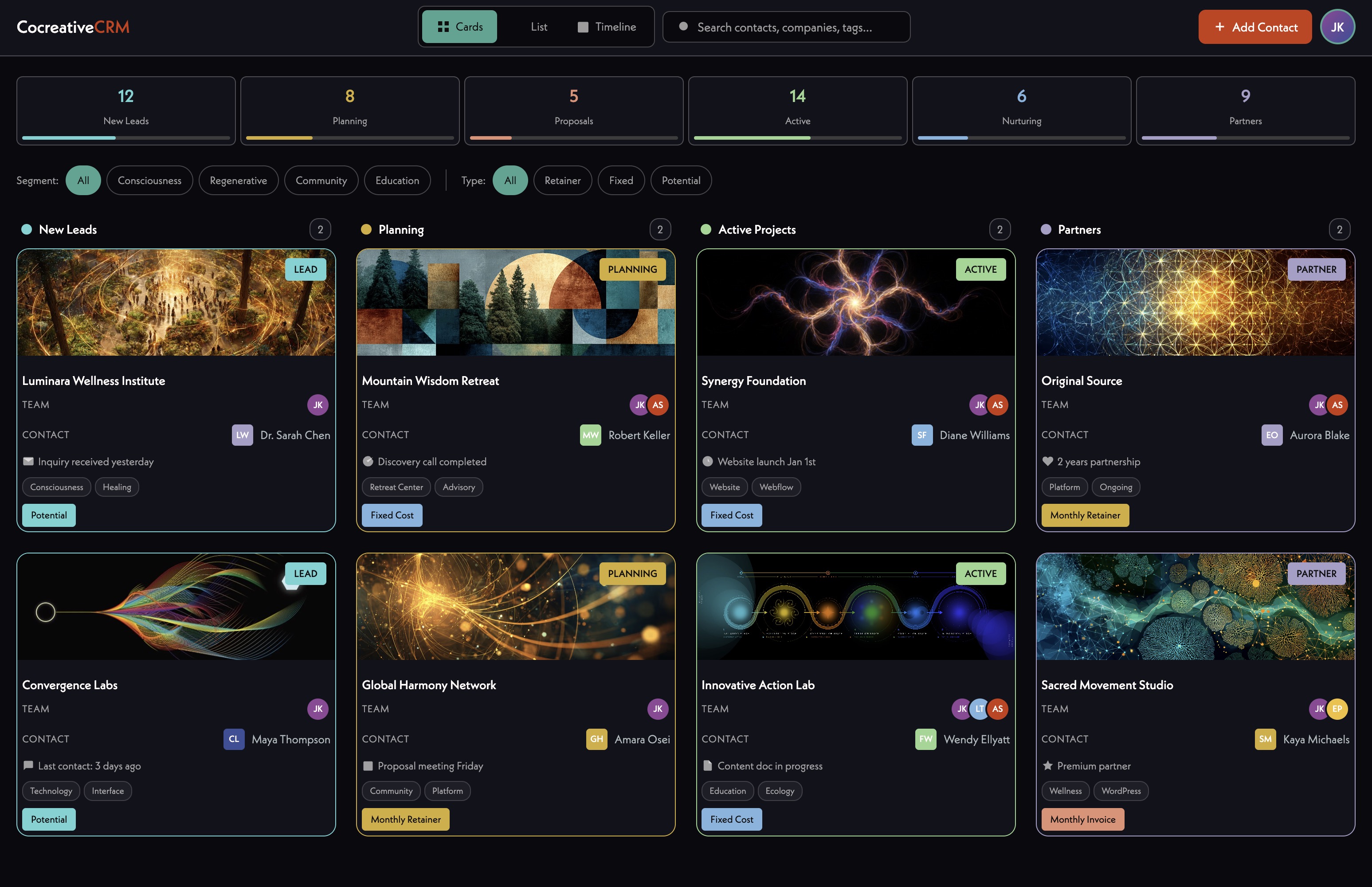
Onboarding proposal for Kevin Triplett's community of open-source collaborators working on 'new economics software for a better future' onto Holomovement platform. Kevin has $200K available for community technology integration. Phase One ($50K) uses existing platform functionality to onboard community members as individuals, establish holons for active projects, and enable matching system for collaboration discovery. Phase Two explores deeper Claude integration to understand project alignment more sophisticatedly, potentially feeding GitHub links and Claude Code outputs into matching engine for technical project analysis. Proposal positions Holomovement as coordination layer and 'International Space Station' where external developers can build compatible modules using shared tooling (Webflow, Supabase) that bolt onto core architecture. Requires simple one-pager describing platform tools and standards for external developers. Scope intentionally kept tight around what's already functional rather than promising new development. Proposal being finalized within 2 days for Kevin's review. Represents significant validation of platform architecture as infrastructure for collaborative communities beyond Holomovement's own network. Meeting discussion at 00:00-07:25.
Creation of developer documentation and standards enabling external collaborators to build compatible modules that integrate with Holomovement platform architecture. Framed around 'International Space Station' metaphor where hub is built and partners can add compatible modules using shared tooling. Documentation needs to describe Webflow front-end architecture, Supabase backend structure, authentication patterns, API endpoints, data models, and integration standards. Enables collaborative quorum to decide which features integrate into whole platform rather than centralized development. Required for Kevin Triplett engagement and future partnerships where external developers need clear technical specifications. Simple one-pager format initially describing tools and standards, expandable to full technical documentation as external integrations mature. Represents shift toward open platform architecture where Holomovement provides coordination layer and others build specialized functionality. Meeting discussion at 06:25.
UX refinements to connections/matching interface based on team feedback during 05-04 demo. Key improvements include: adding intermediary layer showing tags/domains in common before triggering full Claude agentic analysis to provide instant lightweight connection signals (14:22), adding filter controls to map view enabling filtering by tag, domain, and skill similar to directory (15:14), fixing View Profile button click target on connection cards (20:21), enhancing visual hierarchy to make number boxes (archetype match, distance) more prominent against green background, replacing single-word descriptors like 'relational' with parsable phrases, strengthening narrative output by leading with 1-2 sentence summary then expandable detail (Strava-style per 12:12), exploring AI-generated connection images placing two users in shared symbolic context. Design refinements prioritize storytelling over raw data display following Michael Shaun's feedback: 'It just has to tell me a story' (12:12). System architecture already functional, initiative focuses on polish and usability improvements. Quick turnaround expected with James implementing n8n connection-analysis automation by end of day (22:34). Meeting discussion 00:10-00:22.
GPT-powered image automation to automatically reframe user-uploaded profile images for multiple display contexts across platform. User uploads get processed to generate optimized versions for circular avatars, 9:16 vertical frames (doorway style), and square thumbnails. Solves current problem where single uploaded image breaks visual consistency across different UI contexts causing aspect ratio collisions and poor framing. Uses GPT vision API to intelligently crop and reframe images maintaining subject focus and compositional integrity. Automated pipeline triggered on image upload with processed versions stored in Supabase for dynamic retrieval. Similar to existing AI banner image generation but focused on user photo optimization. James proposed solution during meeting review of directory visual inconsistencies (25:33). Quick implementation expected given existing AI image pipeline patterns already in use for banner generation.
Profile enrichment system pulling live data from external sources to enhance matching signal quality without requiring users to manually input information. Potential sources include LinkedIn posts, personal website content, GitHub activity, published articles, social media presence. Data pulled dynamically during match calculation rather than stored permanently, respecting privacy while deepening connection analysis. System feeds enriched profile data into Claude matching analysis providing more dimensional understanding of users' work, interests, expertise, and communication patterns. Enables matching based on actual demonstrated activity rather than just self-reported profile fields. Architecture uses API integrations or web scraping to gather public data, caches temporarily during match generation, then discards. Could dramatically improve match quality especially for users with minimal profile completion. Raised by Michael Shaun during connection demo discussion (00:22). Deferred to future phase given complexity and privacy considerations requiring careful design.
Refresh of Holomovement white paper mapping collaborative commerce principles to platform functionality creating investor-ready narrative. Michael Shaun completed framing exercise showing six major collaborative commerce dimensions match cleanly to existing app features. Platform functions as coordination layer with Engine for Good providing deep data-mining infrastructure finding matches between humans, capital, and projects through membership flows, micro-grants, and collaborative funding rounds. Update builds on Mariko's original December/January document requiring alignment with current platform state and strategic positioning. Final 3-4 pages remaining with Lol for completion. Document serves as funding narrative showing how platform embodies collaborative economic principles through technical architecture and engagement design. Meeting discussion at 00:38-00:40.
Production of short walkthrough videos demonstrating Holomovement App features for broadcast integration during Wave event interactive moments. Videos explain collaboration layer concept, profile creation flow, holon formation, matching system, and platform navigation in digestible segments suitable for stretch break QR-code prompts. Content designed to convert passive broadcast viewers into active platform participants by showing tangible value and immediate next steps. Videos must be production-ready with voiceover explaining features clearly for audiences discovering Holomovement for first time. Strategic use during 35-45 minute intervals throughout broadcast to maintain engagement and drive profile creation as core conversion metric. James producing content with Michael Shaun providing walkthrough/voiceover (01:36:24). Critical dependency for interactive broadcast strategy requiring completion before Wave event. Meeting discussion at 01:35-01:40.
Clarification and standardization of terminology across platform addressing current confusion around Alliances, Organizations, Holons, and Hubs. Team consensus (05:00-05:30): 'Alliances' describes relationship/space between entities not the entities themselves, Organizations/Projects may need different label than Holons, Hubs require distinct representation in system. Affects user-facing copy, database schema, profile categorization, and strategic communications. Resolution needed before Kevin Triplett proposal finalization and broader platform rollout. Simple classification system defining: what constitutes individual vs group entities, when to use Holon vs Organization terminology, how Hubs differ from Holons, what Alliances actually represent, how entities relate to each other. Impacts profile creation flows, directory filters, matching logic, and onboarding copy. Quick turnaround possible as primarily semantic/terminology challenge rather than technical architecture change. Meeting discussion at 05:00-05:30.
00:00:02
Mariko Pitts: When did you get back from Columbia?
00:00:04
Michael Shaun Conaway: 10:00 Clock this morning.
00:00:06
Mariko Pitts: Okay. Yeah. No, you're just pushing through right now.
00:00:10
Michael Shaun Conaway: This meeting is being recorded.
00:00:12
Mariko Pitts: I am just like that.
00:00:17
Michael Shaun Conaway: It's been good, though. I've got. I've suddenly gained the ability to understand Rachel. It's like, you know, like sometimes you. Have these miracle transitions where, you know,. Like, this kind of revelatory experience happens. Lately, she's been speaking and I've actually been making sense of it.
00:00:39
Mariko Pitts: I'm not really sure if that's a good thing.
00:00:41
Michael Shaun Conaway: It's like, what's the opposite of speaking in tongues? I'm listening in tongues.
00:00:47
Delanne @ Hubcast: That's hilarious.
00:00:49
Michael Shaun Conaway: But you know that she's actually. You know what we're talking about Kevin Triplett.
00:00:53
Mariko Pitts: And.
00:00:54
Michael Shaun Conaway: And I found that if I just keep an exact transcript of what she says and shove it into AI and say, please help me make sense of.
00:01:02
Mariko Pitts: This, it comes out somehow.
00:01:06
Michael Shaun Conaway: Pull the salient elements out of this. Delete all the filler words anytime. She does fractal, remove that.
00:01:13
Mariko Pitts: Oh, yeah, yeah.
00:01:14
Michael Shaun Conaway: And actually, it's really helping because I can. Instead of interjecting, I can. She did what she does, which is kind of. Which is kind of cool. She actually invents narrative really easily. She tells a story.
00:01:27
Mariko Pitts: She does. She tells the story.
00:01:28
Michael Shaun Conaway: She told a story and she's like, we were having this problem understanding things and we had to figure it out. So we looked for software and we couldn't find anything. And then we invented our way to do them. Like, I just listened and I. Like, in the end, I. I mean, it had to be completely rewritten. But the. No, but the instinct really. No, the instinct is really good. I think. Her instinct.
00:01:52
Mariko Pitts: I've been working with her on the app piece actually, and I think she's got it a little bit more dialed in and a really good.
00:01:57
Michael Shaun Conaway: We went through it today and we actually. We actually. I'm actually writing in the next two. Days a proposal for Kevin. This is what we're going to do. This is what you're going to pay us. And this. And so I'll feed that through to you, you guys, and you can see.
00:02:09
Mariko Pitts: If we give you. We should give you the recording of our last meeting.
00:02:12
James Redenbaugh: Hey, James.
00:02:13
Mariko Pitts: Hey.
00:02:14
Michael Shaun Conaway: Hey, James. Hey, James. James. Congratulations on finishing the Spoon Bing site. I mean, not the Spoon Bing site, the. The pro.
00:02:23
HUBCAST INTERNATIONAL: The.
00:02:24
Michael Shaun Conaway: The.
00:02:25
James Redenbaugh: The.
00:02:25
Michael Shaun Conaway: The purpose site. Now I know why our shit's not done.
00:02:31
James Redenbaugh: What purpose site?
00:02:33
Michael Shaun Conaway: That. The. I'm really tired. So this is going to take. This is going to take me some effort. Zinka site. She showed it to us on the, on the call last Thursday night. And all I could think of is like, that wasn't. That wasn't me doing with his d. That wasn't me.
00:02:50
James Redenbaugh: That wasn't guilty.
00:02:52
Michael Shaun Conaway: What about Shamini? You're working with Shamini.
00:02:55
James Redenbaugh: I'm talking to Shamini.
00:02:59
Michael Shaun Conaway: No, you didn't do Zenka site.
00:03:02
James Redenbaugh: Okay, No, I didn't do Zenka sight.
00:03:05
Mariko Pitts: Oh, my God, you guys are hilarious. It's like, we can, we can send.
00:03:09
Michael Shaun Conaway: I probably should have done that. She said it was a really efficient process.
00:03:15
Mariko Pitts: That's wrong.
00:03:17
Michael Shaun Conaway: That's wrong.
00:03:19
Mariko Pitts: Don't listen to m. Hey, you guys get to see each other in person.
00:03:23
Michael Shaun Conaway: Turn that zoom and center thing off. Do you. Do you know that you have the zoom and center thing going on here?
00:03:29
Mariko Pitts: Yeah, it keeps moving everywhere. I can't. How do you do it? Okay, hold on. Let's see.
00:03:34
Michael Shaun Conaway: Yeah, I think it's under video preferences. It's like the weirdest.
00:03:40
Mariko Pitts: I'm not using my.
00:03:41
Michael Shaun Conaway: It's like you got some cinema verite,. You know, college student in your, in. Your, in your house while you're talking. We're in a frame like this now we're going to move with the camera. The camera's going to living.
00:03:53
Mariko Pitts: It's so messed up. Okay, hold on. See here.
00:03:56
Michael Shaun Conaway: No, James, I'm just picking on you. But, but if we get Kevin triplets to. To do what he's going to do, then that, that at least a portion. Of that money needs to be earmarked for building what we're building.
00:04:09
James Redenbaugh: Definitely.
00:04:10
Mariko Pitts: No, totally. Did she get back to us about how much he's willing to invest for the next. He said about two.
00:04:17
Michael Shaun Conaway: So we talked about it, that he had, he had $200,000 to do this. And I'll tell you what he wants to do. It's pretty simple. And I think we actually, we actually took the first, first layer of this. Right with what we have right now. He wants to bring all these people that are working on, I don't know, it's the. It's a new software version of new economics software for a better future. But there's a bunch of people working on these projects in kind of an open source type environment and he wants to onboard them all onto the app and so that they can put their stuff in. What are they doing, what are they working on, what do they need help on? And then we can, we can do the matching thing with them. And I just, I just talked to her. I'm like, well, they could put in the. What I'm, you know, like what I have to offer. They could put the descriptions project, they. Could build whole lines. I'm like, they could already do all that. The only thing that we would want to do in phase two, I said look for phase one. Well, onboard them.
00:05:14
Mariko Pitts: Yeah.
00:05:15
Michael Shaun Conaway: With what we've got in phase two, we can. Then we can dig into Claude and trying to understand, like right now, James, you have to let me know that our. Just let me know our matching stuff's working today. I'll be super happy that.
00:05:31
Mariko Pitts: What's working, what's not working.
00:05:33
Michael Shaun Conaway: Because. Because we can. Because we can do it with Holons and we can do. We have got to get. We have got to get clear on that. That word that we're calling organizations because it's. It's alliances. Do you know that you use the. Use that. Like we have individuals, we have holons. Those are both groupings of people doing something. And then alliances is a thing between two things. It's not a thing.
00:05:54
Mariko Pitts: Yeah.
00:05:55
Michael Shaun Conaway: So we just call them. We can call them companies or projects or organizations.
00:06:00
Mariko Pitts: We need to put hubs on there too.
00:06:04
Michael Shaun Conaway: I don't. You don't want. We don't need partners in that way because everybody is a partner. Actually, everybody in the system is a partner.
00:06:11
James Redenbaugh: You're.
00:06:12
Michael Shaun Conaway: We're already part of a field of collaboration, so we need a word for organizations. We could just.
00:06:17
Mariko Pitts: That's not alliances.
00:06:18
Michael Shaun Conaway: That's not alliances. Alliances speaks about the space between and. It's all the space between. But once we get so that he can onboard individuals, he can onboard or onboard projects as whole lawns. And then. And then we ultimately want to do the same thing of matching hold ons to people and hold ons to hold. Ons that we're doing with Claude right now. And I think that's really what he's talking about. The second phase is actually refining the matching so that if two people are working on parts of a similar project. Space, that it understands that obviously with Claude, it should be able to. And if they could feed it links. To Claude code and stuff like that, they could. It could probably. It could probably do some great stuff. James, if we do this with this guy, it means you're going to have. A bunch of nerds up your bum telling you how to do your work,. Because they're all going to have an opinion you're going to have. Okay, so now let me tell you my next thing. This is. This is my. I've got the metaphor to how we're going to evolve this whole thing. We are building the holo movement version. Of the International Space Station. So we have built. We have built the hat. The hub. The hub of the. The space station. And China's going to come along and make us a little lab and Russia is going to come along and make us some. Some solar panels. And so that's. I want to get this before we get to you guys especially get to the day. Oh, I just did it again. You just moved. You just zoomed.
00:07:41
Mariko Pitts: I can't figure it out. How do I smoke?
00:07:45
Michael Shaun Conaway: Whatever you have smoked today, just. I. I just flew in from Bolivia. Oh. I was not doing cocaine. If you think that's what Bolivia under. Click on the arrow and tick off the box that says auto frame my video.
00:07:59
Mariko Pitts: It. It. I took it off and then it did it. It wasn't even on when it was first doing it, so I don't exactly know.
00:08:06
Michael Shaun Conaway: You gotta, you gotta. Are you on your iPad?
00:08:08
Mariko Pitts: I'm on my laptop and it's doing it worse now, I think.
00:08:12
Michael Shaun Conaway: Seasick?
00:08:14
Mariko Pitts: Yeah. Let me put it back on.
00:08:17
Michael Shaun Conaway: So think about this, James. And I really, I want you to. As soon as you get all this, this, this code done for the site, we just need it. We just need something like to just a one page thing of like here's the tools we're using. If you want to build for the. International Space Station or the, the Holo movement hub for software or whatever we. Want to call it. Then if you. If you build in these ways using these same tools and it naturally fits and bolts on and a collective quorum of people decides it's a feature we. Want and we can just integrate it in. So that way we build by collaboration, you know, all the way through the software. I think it's a. I think it's. And I couldn't figure out how to talk about it until I came up. With the International Space Station.
00:09:00
Mariko Pitts: That's pretty good analogy on it. Yeah, I like that.
00:09:04
Michael Shaun Conaway: No, Marco's on the funding call earlier. Not Marco.
00:09:07
HUBCAST INTERNATIONAL: Hera.
00:09:08
Michael Shaun Conaway: I'm going to mess all kinds of. Shit up because I'm tired.
00:09:11
Mariko Pitts: It's like. No, not okay.
00:09:14
Michael Shaun Conaway: James, would you tell us what's working.
00:09:16
Mariko Pitts: This week that funding calls? No, no, it's the ripple call. Ripple.
00:09:21
Michael Shaun Conaway: No, we had the funding call an. Hour and a bit ago.
00:09:23
Mariko Pitts: Okay. Yeah, no, it's. The ripple call is happening. Right?
00:09:26
HUBCAST INTERNATIONAL: Yeah.
00:09:27
Michael Shaun Conaway: Okay, James.
00:09:28
Mariko Pitts: Got it.
00:09:29
HUBCAST INTERNATIONAL: Cool.
00:09:29
Michael Shaun Conaway: What's working?
00:09:32
James Redenbaugh: So these are displaying weird right now, but this is actually working.
00:09:39
Michael Shaun Conaway: And connection apps.
00:09:41
James Redenbaugh: Yeah. So you can Go to slash connection and it will show you your relationship to all the other people down here. This is kind of work in progress, but this shows you what's, how it's working and what's being calculated and what's going on. But it's super cool. It uses the assessment data. I can click any of these people and see more specifically where we align. And it's all just calculated when I go to the page based on their assessment data. And I figured out how to make it really efficient so loads super fast.
00:10:30
Michael Shaun Conaway: This is all just assessment data then.
00:10:33
James Redenbaugh: Right now this is just assessment data.
00:10:35
Michael Shaun Conaway: Okay. And then trick two would be, would be my profile page as well, right? Yes.
00:10:41
James Redenbaugh: And that I'm working on the N8N automation. So what it does on the profile page, I'm adding a button called Connect. We can also click Connect from the connection page or you know, really wherever we want to give people this option to do an analysis and then it sends their profile data and the target person's profile data to N8N and then we're doing these agentic analyses in these different domains to send back a report. And that is almost working. But we can't demo it right now. But later today this will be, this will be live and show you in these different areas content about why we should connect, what we can do together, what's possible. And then we could do the same thing for Holons if we want. That's super easy. Now that we figured this out.
00:11:45
Michael Shaun Conaway: Yeah. And just a couple of questions about, about what we've got right now. So I've got the people on the map. Seems like it's, it's heavy on data and thin on words. So I've got like, you've got the. Score match, type alignment, proximity, shared domains,. Then one sentence of copy and then all the, the areas of connection.
00:12:12
James Redenbaugh: Yeah, no, I'm thinking we'll have. Actually, no, no, I just talk about.
00:12:17
Michael Shaun Conaway: The one, the one, the one that. We have right now. The one that you showed me at the beginning.
00:12:22
James Redenbaugh: So click on with the initial map analysis.
00:12:25
Michael Shaun Conaway: Yeah, we get, we get another view of this.
00:12:30
James Redenbaugh: Well, I wanted to, I want to have this work without agents so that users can see it immediately. Okay. But.
00:12:43
Michael Shaun Conaway: This, so there's a, there's a. So when I go into Strava, it gives me a two sentence thing that. Describes my ride and then there's a button to click more and then it spins and, and you can tell it's. Doing the same thing. It spit out like a sentence and then you can expand that to get a full, a more. Bigger, bigger area of copy. I mean if somebody gave you your,. Your astrology reading, which nobody gives me. One because I don't ask but. And you got just, here's all your transits where your stars are, you'd be like, so the. What it's. It's not until somebody says what it. All means that that it makes any difference. So you've got to give them the, the narrative. You got to tell the story about why this person should be. You should connect with them.
00:13:30
James Redenbaugh: Yeah. And seeing this now, I wonder if we should have it include more than just the connection assessment because, you know, I could take this data and do a little quick agent that you know, would tell me me and Susan are aligned in all these domains, but we're less aligned in ecological identity and economic orientation. But what does this really tell me about Susan? And you know, and that's my idea for the deeper analysis that it takes about 45 seconds and it does, it uses the whole profile and does everything. And that's super cool. But we could have an intermediary layer where we at least look at like do we have tags in common? Do we have.
00:14:22
Michael Shaun Conaway: Yeah.
00:14:25
James Redenbaugh: Domains in common?
00:14:27
HUBCAST INTERNATIONAL: And.
00:14:30
James Redenbaugh: You know, we don't have like friends on this platform yet.
00:14:35
Michael Shaun Conaway: I think we could also, we could. Also have a filter button by the map too and choose like, like we. Did on the directory. Just add that layer. So like do they. I only want to see people with this tag, for example. Yeah. Or I only want to see people with this skill. Or there may not skills but this.
00:14:52
Delanne @ Hubcast: What's.
00:14:53
Michael Shaun Conaway: What are those. Those domains. I want to see just people from. Technology, for example, and the tag AI or something like you like that so you can actually say what you want. I, I think this is really super great, James. I'm interested, I'm interested in trying to. Elevate the narrative part for sure. Now that now it could you remember with like astrology is a great example. Because you know, Carl Jung said that why astrology is so great is it taps into these, you know, these common, these, these collective consciousness things, these archetypes and people ignore the stuff that doesn't fit and hear the stuff, hear the stuff that does fit. You know, so the, that we, we automatically gravitate towards the things that, that. We resonate with in narrative. So it doesn't act. It just has to be something that,. That tells a story about why I'm, I should be meeting Susan and then I'll pick up the pieces that are important. To me or are not. I don't, I don't think I'm going to try to say is that the. AI doesn't have to be perfect in this regard here. It just has to tell me a story.
00:16:01
James Redenbaugh: Yeah.
00:16:04
Michael Shaun Conaway: So a filter there would be good. And then I guess, I wonder. Click, go click on one of those things again. Marco, tell me what you think here would. Do you want to see all of these, these areas, this, this holonic worldview, purpose, orientation. Do you want to see all that data right when you click on them? I think I'd rather just see a. Little who they are in there and. Maybe even there's a triangle. Tell me more than, than how it matches mine exactly. I would like to be able to fold that out like that to be like dig into the data type thing.
00:16:37
James Redenbaugh: But I don't know what if I saw my triangle and theirs over there.
00:16:45
Mariko Pitts: But too much. But I kind of like this actually. Honestly, on the other side, I mean I'm like it. I lean in, I'm looking at this like oh, okay. What's more, I mean if I look at the triangles max, I still don't know what that means. So I need a little bit more. But I like the way this is gonna run.
00:17:02
Michael Shaun Conaway: Let me, let me just look at it. Pro social stance. So you. That's you, right? James, you and. And. And Marco. Aligned. Yeah. So you're matched.
00:17:15
James Redenbaugh: You're.
00:17:16
Michael Shaun Conaway: You aligned on relational. Which I'm not really sure I know what that means. I mean.
00:17:23
Mariko Pitts: Yeah.
00:17:25
Michael Shaun Conaway: Collaboration, faster, adaptive. I'm. I'm not really with a single word. I just don't know if I know what it means.
00:17:30
Mariko Pitts: Yeah, we need to, we need more.
00:17:33
HUBCAST INTERNATIONAL: Yeah.
00:17:33
Michael Shaun Conaway: So that's why we have to go. I think we need to go to the narrative. Maybe if it was this. There's this like a phrase. Hey, you should meet Maro because. And it could pick out a tag or something like that. Just a two sentence thing that you could have. A button says more. We could go or go button that says go to the full assessment. Which we need a long bar that says this usually takes. Normally takes a minute. And then maybe like, like if we focused on like here's two areas that you're really complic. Very complimentary. Pro social stance and economic orientation. Then it gave you a little sentence. About each one of those like what it means. And then you could do a button for a deeper dive. I just want to get the, the thing that people. When they, you know, because that. The people's notion, people's desire to scan. First and read later that if there's a way to just give them like,. Like bite sized sinks, there's like a. Couple sentences they can read and then the top where it said the numbers. Do those. I mean those numbers seem cool. Archetype match.
00:18:40
Mariko Pitts: Yeah. I like the, I like the numbers.
00:18:43
Michael Shaun Conaway: Oh distance apart. So I, I feel like these are,. Are lost because the. Maybe they get a little lost because the boxes are green and the tech they kind of just sit back into the the screen. I would love to see something that.
00:18:56
Mariko Pitts: They could pop more.
00:18:57
Michael Shaun Conaway: Yeah.
00:19:00
James Redenbaugh: Yeah. I think we should see. We could, we should see what domains we have in common. What tags. A quick sentence.
00:19:15
Mariko Pitts: I think maybe sentence and then domain. I don't think especially when you scroll over them. And then, I mean and then if you click on it it can go to something a little bit more detailed like what you have on the side here scrolling just before I click on it and then it shows me more.
00:19:33
Michael Shaun Conaway: Yeah. The other thing is you mentioned it like doing overlay triangles. We could actually not do an overlaid triangle. You could just do a new triangle that was a composite of the two. So it showed that like a circle around each thing. I. I don't want to do that now because that takes some design work.
00:19:49
Mariko Pitts: Yeah. I don't know about now but it.
00:19:51
Michael Shaun Conaway: Could be something we come back to. Okay, so just go now. Show us the stuff you're working on. That's not on the one. We're looking at the, the matching by. Profile where you're showing that to me. A minute ago here this recommended. Is that on the same page More important. Oh by the way when you click. On the View Profile full profile it. Breaks on that that tab of like the we just wanted open with all the bars on it. If you at the bottom there's a button that says View Profile.
00:20:21
James Redenbaugh: Oh yeah. You have to click it harder. It's like touch sensitive. I'm just kidding. I will fix that. Okay, so who's recommended this? I think Will actually recommended. I think. Well my thought was when we have more people.
00:20:44
Mariko Pitts: Yeah.
00:20:46
James Redenbaugh: We would have a recommended section on this page that would show you like your top five connections and then invite you to do an analysis of each one. And this is the template for the analysis would actually which would actually be a new page that's generated every time the person runs it.
00:21:08
Mariko Pitts: Okay.
00:21:08
Michael Shaun Conaway: So.
00:21:10
James Redenbaugh: And this, this is what I'm working on in NNN which takes the profile data will run the run the analysis and then send content back for each of these domains but that content's actually going to be a value for each one. So like it'll quantitize our our purpose match between 1 and 100 and write a little paragraph about why our purposes align as well as needs and offers complementary skills journey phase match which it would derive from different answers and also tags if we have similar like events or things in our tags and alignment nature which would also include like are we on the same O line together? Yeah.
00:22:03
Michael Shaun Conaway: So once you have a. A few sentences for each of those. Then can you do a like a can AI can agent now read those and say something in general like a generalizable statement.
00:22:15
HUBCAST INTERNATIONAL: Yeah.
00:22:15
James Redenbaugh: I think we should have a intro paragraph.
00:22:19
Alex Melnyk: Yeah.
00:22:19
Mariko Pitts: A good intro paragraph would be solid. Yeah.
00:22:21
James Redenbaugh: Mm. Cool.
00:22:23
Michael Shaun Conaway: Okay. Super cool. What what of this and when of this will be ready for people to try. You said you'd have the other thing working today.
00:22:34
James Redenbaugh: Yeah. My hope is like later today and.
00:22:37
Michael Shaun Conaway: Let me just go to the directory. And see how many people might have come onto the. The network. We're still under 20 people.
00:22:50
Mariko Pitts: Yeah. We can. We can invite a few people in though.
00:22:54
Michael Shaun Conaway: Yeah.
00:22:54
Mariko Pitts: I. I think Kevin Triplett, he can come in. There's a couple people I think a handful of people that we can invite in that just kind of work with.
00:23:02
Michael Shaun Conaway: Okay, great. When and is this is. Has there been any bugs in any of that this past week? Did you guys find anything that's.
00:23:12
Mariko Pitts: I haven't heard anything. It looks like there's more going on. The visibility team got their whole line up. That's to going great.
00:23:19
Michael Shaun Conaway: I just tried to join a.
00:23:20
HUBCAST INTERNATIONAL: Hold on.
00:23:20
Michael Shaun Conaway: So that the button at least works.
00:23:23
Mariko Pitts: That's good.
00:23:24
Michael Shaun Conaway: So I tried to join the tech team. Hold on. We'll see if they let me in now.
00:23:29
James Redenbaugh: We'll see. Am I the tech admin? No.
00:23:33
Mariko Pitts: I don't know.
00:23:34
Michael Shaun Conaway: No.
00:23:34
James Redenbaugh: Probably just I'm a member.
00:23:36
Michael Shaun Conaway: Remember I was supposed to have three. Three admin people.
00:23:39
James Redenbaugh: Right?
00:23:42
Michael Shaun Conaway: Definitely have.
00:23:43
Mariko Pitts: Shouldn't you be an admin? What happened there? Kevin probably sent us a message.
00:23:52
Michael Shaun Conaway: Maybe. Maybe one of us or maybe all. Of us should go through and scratch. Our heads and make a bunch more hold ons for different groups are already in right now. Is the icon in the technology one? Is that a self generated icon? Is that.
00:24:09
James Redenbaugh: Somebody put that in.
00:24:11
Michael Shaun Conaway: Somebody put that in. So it's not one of those ones that does by itself.
00:24:16
HUBCAST INTERNATIONAL: Okay.
00:24:16
Michael Shaun Conaway: It's kind of cool.
00:24:18
Mariko Pitts: Yeah, it's interesting.
00:24:22
James Redenbaugh: We could. We could also do the little chip.
00:24:27
Michael Shaun Conaway: Looks like a bug running across the floor.
00:24:30
Mariko Pitts: It's weird. Yeah, it's weird.
00:24:33
HUBCAST INTERNATIONAL: Oh yeah.
00:24:34
James Redenbaugh: Weird.
00:24:35
Michael Shaun Conaway: Yeah. We need to tell people about. About vertical versus horizontal images. It's a bit in the. On the page. Most of them look pretty. Pretty.
00:24:44
Mariko Pitts: Right now.
00:24:45
Michael Shaun Conaway: Even Pro Social, like the. It breaks the image, breaks the boundaries. Oh, it doesn't fit in the circle very well either.
00:24:52
James Redenbaugh: The visibility team isn't super visible.
00:25:00
Michael Shaun Conaway: Okay.
00:25:00
James Redenbaugh: Nor is mine.
00:25:06
Michael Shaun Conaway: Yeah. You think we could get AI to eventually solve that? It just look and says, okay, this is a succo image. Let's squeeze it down. Let's like, let's reposition it.
00:25:16
James Redenbaugh: We can actually. I can feed their image into a GPT image to automation and give it instructions to position it in a particular frame and give it a particular aspect.
00:25:33
Michael Shaun Conaway: It looked good in a circle and. It'd look good in a. In a 9 by 16 frame.
00:25:37
Mariko Pitts: Yeah, I think it'd be good to give that a shot. Yeah.
00:25:41
Michael Shaun Conaway: That way when people come to the page, it all looks cool.
00:25:44
Mariko Pitts: I agree.
00:25:45
Michael Shaun Conaway: Oh, the visibility team stole the. The wave artwork.
00:25:52
Mariko Pitts: Damn.
00:25:52
HUBCAST INTERNATIONAL: Then.
00:25:58
James Redenbaugh: We could also generate images for connections. So if I do a connection analysis, make an image of me and that person like somewhere relevant to our share.
00:26:09
Michael Shaun Conaway: Yeah. Because that's actually brilliant in a sense. If people know that. You could say. And you just get a little title, you know, I don't know. Connection, Connection, Vision, Connection.
00:26:28
Mariko Pitts: Good.
00:26:29
Michael Shaun Conaway: Yeah. Okay, so we need to get people. On the team on the app.
00:26:36
James Redenbaugh: Yeah.
00:26:36
Michael Shaun Conaway: We need to say that this is a suggestion. This is not a suggestion anymore.
00:26:42
Mariko Pitts: Yeah. Who's got to look at who's missing besides manual, which. Yeah, get that. Keep telling them. Get your butt on here.
00:26:56
Alex Melnyk: Let the.
00:26:59
Michael Shaun Conaway: We got somebody without a name. His name is not showing up on her picture.
00:27:06
Mariko Pitts: Where's Monya?
00:27:07
James Redenbaugh: Monia? She's got a completed profile.
00:27:12
Michael Shaun Conaway: Oh, she's got an incomplete profile and she shouldn't be allowed on the page.
00:27:20
Mariko Pitts: Oh yeah.
00:27:20
Michael Shaun Conaway: See, like Pro Social has type in. Their image and we're putting type over the things.
00:27:27
James Redenbaugh: Huh.
00:27:28
Michael Shaun Conaway: Iris as well.
00:27:30
HUBCAST INTERNATIONAL: Right.
00:27:31
Michael Shaun Conaway: Because you. So it's got type and type, which is always a bit of an evattle.
00:27:36
James Redenbaugh: Yeah.
00:27:40
Michael Shaun Conaway: Okay. Well, so I guess, I guess we should certainly. I'll, you know, make a shout out to the people that make sure and get their. I'll do it right now. The core team people at least.
00:27:53
Mariko Pitts: Yeah. Let's just get them all on there now.
00:27:56
Michael Shaun Conaway: When. James, what's your thinking? When to move this over to the holomovement.net server?
00:28:05
James Redenbaugh: Do we have a name for it?
00:28:07
Michael Shaun Conaway: The app itself. App.holemovement.net yeah.
00:28:13
James Redenbaugh: The Holomovement app. Whenever we want. It's just changing the domain.
00:28:19
Mariko Pitts: Yeah. When do we get the map on? Replace the map currently onto the homepage.
00:28:27
Michael Shaun Conaway: When he finishes this stuff.
00:28:29
Mariko Pitts: Yeah. Probably get more people in it or what? Which one? Because we can also invite those people into that. The people that are already on the old map. That's the first group to bring them in.
00:28:40
Michael Shaun Conaway: How hard is it to put it in there without. With like the interactive activity we talked about. We click on it says, you know, log into the app, type thing.
00:28:49
James Redenbaugh: Easy. I just embed a version of this page without the navigation and it's a. It will already show the map without. Without the content if you're not logged in.
00:29:02
Mariko Pitts: Okay.
00:29:02
Michael Shaun Conaway: Okay, I guess, I guess, I guess. On our launch day, which maybe could. Be next week, have the.
00:29:10
Mariko Pitts: Switch it over. Let's just get a little bit more people in it. Now that we feel pretty confident and it's not as glitchy. Let's get more people in it, build their assessments. We could. I can have Jill send an email out to everybody who's actually already done the map and move them into the ecosystem.
00:29:27
HUBCAST INTERNATIONAL: Yeah,.
00:29:30
Michael Shaun Conaway: Okay.
00:29:30
Delanne @ Hubcast: Let's.
00:29:30
Michael Shaun Conaway: Let's, let's do a little brainstorming. Names.
00:29:35
Mariko Pitts: I was thinking something around, like, symbiosis, but that's too weird. Too many syllables.
00:29:40
Michael Shaun Conaway: Yeah, I think anything that has, like. Yeah, collaboration. Collaboration that, that, you know, like, what. Is it with a coordination layer? Like, that's the meaning. Obviously not those words. I had a little. I have a little thing here. I'll show you. Well, I can just show you in abacus really quick. Can I share?
00:29:59
Mariko Pitts: Sure.
00:30:06
Michael Shaun Conaway: Okay, you have to stop sharing.
00:30:08
James Redenbaugh: Oh, sorry.
00:30:11
Michael Shaun Conaway: Okay, this is in regards to this, like, trying to figure out how all. These pieces that we're building together are. Are how they are. And so is it here?
00:30:21
James Redenbaugh: Is that that one?
00:30:23
Michael Shaun Conaway: No, not that one. Hold on. Oh, where was I working? Oh, I think it's Enchant GTP instead of this one. I have, I have. I am probably like Most people now, AI schizophrenic. I'm using Abacus. Has all of them in one. And then I had had ChatGPT the longest and like. Oh, my God. What? Like, this is like, we're totally, like,. Totally clicking on all the time.
00:30:49
James Redenbaugh: I need an AI to manage my AIs.
00:30:51
Mariko Pitts: I was thinking the same thing.
00:30:56
Michael Shaun Conaway: Sitting here. Nope, that's not the one. Oh, sorry. Now I'm going to take you down. I've got somewhere where I mapped collaborative commerce and the tech platform out and it was kind of interesting. Where is that this morning?
00:31:21
Delanne @ Hubcast: Let's see.
00:31:22
Michael Shaun Conaway: Hold a moment.
00:31:25
Mariko Pitts: Oh, yeah. Okay. I didn't realize that.
00:31:32
Michael Shaun Conaway: All right, I'm gonna stop sharing and then we'll carry on. I'll see if I can find it, but. And I'll pull up that thing again and just work on names. But that the. Basically collaborative commerce has all these definitions and things. And I just said, do an analysis. Of what we're doing in the tech. Lab and match it up. And it was like. It was like, like of the five. Or six major details of collaborative commerce,. I thought that it made about six really good matches. Like, you're talking about this as a. Framework, and here's what it is in the. In the. In the software. I'm trying to think of. Trying to. I was working on, like, trying to. Tell a cohesive narrative to Vince about what we're doing. And so I think that's. That's pretty cool that it matches up. That well already, you know, So, I mean, if you think of collaborative commerce as a coordination layer, it's the space in which people coordinate and come together. And so the app, right now, really all we have is a coordinating layer feature to it. It's all around the coordination of creating these. Yeah, well, and then the thing that was. I was working on that was on the screen for a second, but is it that we're not like all of these things even. Like, the engine for good is not. Just an economic model. It's actually the way that you do the deep mining of the data of people and find matches. And so you're finding matches between human beings and you're finding matches for how capital needs to flow into these things, whether it be by the membership stuff and the micro grants, or it be by people coming together and deciding to. One of the reasons that they collaborate is around something called funding, like somebody actually getting money together. And that's a really good. That sounds really good that we're. James, we're doing all this deep data. Analysis to be able to find these kind of best matches and create these things. So I think that's the story I want to start telling to some of these investors, especially ones that might want to put stuff into the tech, which is great. I mean, Mark, I need to go back to your original document from December, January. We probably all need to. As soon as we get to this, get this.
00:33:49
Mariko Pitts: Yeah, we'll have to do a. Refreshing to see exactly where we are and where things are.
00:33:55
Michael Shaun Conaway: But this is. This is a really great idea because Where James is right now, we've got. Enough stuff on the front end that we can get the data and he's on that. The spark that I think is really where we take off is actually getting really good analysis. This is everything else has been prepping for this phase.
00:34:12
James Redenbaugh: Yeah. And we get to benefit from all the, you know, the latest developments in the models and leverage their intelligence. And it's a pretty unique opportunity here because we all have access to these models. Everybody can prompt ChatGPT, but, you know, we can ask it questions about what it can find on, on the web. And here we have a kind of, you know, playground and environment and portal where these models can access real humans doing real things, sharing themselves and their purpose, and use that as input in dynamic ways to leverage these models to co create awesome stuff together.
00:34:57
Michael Shaun Conaway: Yeah, I just. When you just mentioned that anybody can search for things that I'd like to. So the other thing that, that we. Can add to our data fields is data exhaust. We can go scrape their blog posts on LinkedIn. We can. You know, usually it's harder to get. To social media posts because they're usually visual or video, but LinkedIn and all. That kind of stuff, we can just go. If they're putting their LinkedIn profile there,. We just go and, and suck all that stuff up. And then now we're starting to do. Matching not only just based upon what. They typed in, but what they've typed in for the past 10 years. I mean, you start to get a really deep amount of information on somebody, like really quick. Like really, really quick. And it doesn't have to hold all that information. It doesn't have to hold the information in our database either. I mean, every time somebody pulls that up, it just goes back to LinkedIn and sees what's there or whatever.
00:35:51
James Redenbaugh: LinkedIn and you know, their own websites too. So many people have their own websites.
00:35:57
Michael Shaun Conaway: Yeah, absolutely.
00:35:57
James Redenbaugh: What they've put on there and we can scrape all that.
00:36:02
Michael Shaun Conaway: And yeah, GitHub. I mean, let's think of our software developers, GitHub and the things or whatever, whatever the GitHub. What's currently GitHub. I heard that Claude has now been in something that's. Take Figma out of business.
00:36:16
Mariko Pitts: Like Jesus did it.
00:36:19
James Redenbaugh: It's not yet mediocre. It's okay.
00:36:24
Mariko Pitts: I'm gonna take the guy, he's like already on it.
00:36:29
Michael Shaun Conaway: I'm an Adobe Illustrator guy, so I'm definitely out of date, I guess.
00:36:34
James Redenbaugh: By the way, I saw the light net website you mentioned. It looks like they made it with Vercel. I've been seeing a lot of websites like this lately.
00:36:44
Michael Shaun Conaway: I thought you did it because I didn't think anybody else is as smart as that, so. Oh, I'm just giving you the props now.
00:36:51
Mariko Pitts: Just turning it up in all different directions.
00:36:53
Michael Shaun Conaway: No, the way, the way, I mean, the way she talked about it, I. Thought, oh, it must have been James because it did sound like the kind of thing you would think of to do.
00:37:04
James Redenbaugh: Yeah.
00:37:05
Michael Shaun Conaway: I haven't looked at light now. Did you work on the lightness stuff in the beginning?
00:37:10
James Redenbaugh: No, no, I've never worked with them.
00:37:13
Michael Shaun Conaway: Well, I'm not going to introduce you.
00:37:17
James Redenbaugh: I know. Zanka.
00:37:20
Michael Shaun Conaway: I'm just kidding.
00:37:22
HUBCAST INTERNATIONAL: Yes.
00:37:25
Michael Shaun Conaway: I'm your anti business development guy.
00:37:27
James Redenbaugh: Yeah.
00:37:27
HUBCAST INTERNATIONAL: Great.
00:37:28
Michael Shaun Conaway: I need that. Okay, so I'm looking. Oh yeah. This whole. Oh, this site. Well, no, this. This doesn't look. I was on my phone when I was on this call. This does not look. The whole light net side is what she did.
00:37:43
James Redenbaugh: Yeah, the whole thing is Vercel. It looks like.
00:37:45
Michael Shaun Conaway: Oh yeah. This is not nearly as cool as what you're doing. So sorry. If I'd seen it, I probably would. Have known it wasn't you.
00:37:51
Mariko Pitts: No, no. James is on the next leather next level.
00:37:57
James Redenbaugh: I went to look at a client site I made years ago to show it to somebody and they've replaced it with a Vercel site and it's totally lame. And I'm like, why? Like, what happened? I guess they wanted the ease of just prompting whatever changes that they want. But they all look the same.
00:38:21
Michael Shaun Conaway: Yeah, this is. This is. I'm not. I'm not pressed for that. Sorry. I mean, I mean I'm not depressed with that.
00:38:26
HUBCAST INTERNATIONAL: I don't know what the other side.
00:38:27
Michael Shaun Conaway: Looks like, but. I'm just saying, James,. I can harsh on anybody's work.
00:38:34
James Redenbaugh: Great.
00:38:35
Michael Shaun Conaway: Like, isn't that what our job is as creatives? Like say what's good? Like they could definitely. And the AI era has just been. Really hard for that because AI makes. Things that are like B minus all the time. Time anybody can get to B minus.
00:38:47
James Redenbaugh: Like it's really good at B minus. Yeah.
00:38:50
Michael Shaun Conaway: Yeah. And so. And. But then what's happening is, is that like now you look at this and if this had been done a year. Ago, like that's totally cool. And now you're looking at. It's like that totally looks like Vercel. I think that's which. What happened in when everybody was having. Chat GPT write their emails for the first year and the second year, people Are like, that's chat. GPT. I don't know how you can know, but you know. I mean, I don't know exactly how you know. But you do know now. I mean, everybody didn't know at the beginning and now you know.
00:39:16
James Redenbaugh: I. I had my AI write a blog post about writing with AI and about why how we tell what. There's certain tells. There are these patterns.
00:39:25
HUBCAST INTERNATIONAL: Yeah.
00:39:26
Michael Shaun Conaway: What's the use of language is. It's just slightly. It's slightly. It's slightly right. And it doesn't know how to make mistakes or choose the wrong word a little bit or. Or you know what we do in humans, we. We make. We use the wrong word or the wrong phrase and then we. It actually. It affects us the same way. It doesn't AI. But it sounds totally like you can't. We haven't yet taught an AI to organically meander their way through words.
00:39:54
James Redenbaugh: Yeah. When I share this article with it though, it tends to. It tends to do better. It'll do less EM dashes. I even tell it to like, you know, to like curse or go outside of the box or be a little ridiculous.
00:40:10
Michael Shaun Conaway: You know what I read all the time, Novels and things like that. The EM dash has been in use. For a long time. We can't remove it from the English language now. Just because.
00:40:18
Mariko Pitts: You can't. Yeah, just because GPTs are doing it. Yeah.
00:40:22
James Redenbaugh: We just don't want to overuse it.
00:40:23
Mariko Pitts: I. Yeah, exactly.
00:40:25
James Redenbaugh: I use it now in my own writing when I'm not.
00:40:28
Michael Shaun Conaway: It's a good. It's a good.
00:40:29
James Redenbaugh: It's a good thing.
00:40:30
Mariko Pitts: I'm starting to do it too.
00:40:31
James Redenbaugh: It does a helpful thing.
00:40:33
Mariko Pitts: Yeah.
00:40:33
James Redenbaugh: Just not in every sentence. But then also AI will tend to like the sentences tend towards a certain length, which always sounds. It feels kind of robotic and rhythmic and it's not interesting and it doesn't really help with digestion of information.
00:40:49
Michael Shaun Conaway: Yeah. Okay. What. So takeaways from today. We want to get this thing going. And we want to get people on.
00:41:00
Mariko Pitts: I think it's now feeling pretty good. I'll go play with it myself again just before. And then sign off. And then let's. Let's do some outside of the core team invites.
00:41:10
James Redenbaugh: Cool.
00:41:11
Michael Shaun Conaway: Now let's get the rest of core team on here too.
00:41:13
Mariko Pitts: Yeah.
00:41:14
Alex Melnyk: Should you.
00:41:14
Mariko Pitts: Do you think I should have the people that are already on the map just email them directly special invites. I think that's a good one.
00:41:23
James Redenbaugh: Let's wait until. Because I really think matching will be ready to go.
00:41:27
Mariko Pitts: Oh, right.
00:41:28
James Redenbaugh: Of the day.
00:41:29
Mariko Pitts: Okay. We can do it tomorrow or something. Just let. We'll test it when. When you're done. We can do it like end of day tomorrow and do some invites. But I can have Joe at least start an email.
00:41:37
James Redenbaugh: Yeah, draft the email. Okay, cool. I got to send Jill some style guide stuff.
00:41:46
Mariko Pitts: Okay. Oh, that's right. I think she's asking about an update on that. That's good. Okay, that sounds really good. We have another call, don't we? We. We have Peter. Right. Coming up. Okay.
00:42:01
James Redenbaugh: Huh.
00:42:03
Mariko Pitts: Okay, good.
00:42:04
Michael Shaun Conaway: Is that on the same line or a different one?
00:42:06
Mariko Pitts: I think it's on my line.
00:42:13
James Redenbaugh: I'm gonna go make a coffee then.
00:42:16
Mariko Pitts: Sounds good.
00:42:17
James Redenbaugh: All day. So I should probably caffeinate and I'll.
00:42:26
Mariko Pitts: See you guys there. All right, sounds good.
00:42:28
Alex Melnyk: I'll join.
00:42:29
Mariko Pitts: We'll just close this up and then come back.
00:42:31
James Redenbaugh: Cool.
00:42:32
Mariko Pitts: Can I ask you a question?
00:42:33
Michael Shaun Conaway: She's coming back.
00:42:34
Mariko Pitts: Oh,.
00:42:37
Alex Melnyk: She's gonna be right back at eight with Peter.
00:42:40
Mariko Pitts: What's up?
00:42:41
Alex Melnyk: Hey, Soul on the rider, it said my guitarist, Michael Sebastian. Is Michael coming with Facel?
00:42:49
Mariko Pitts: Yes, yes. That's his other person that's going to.
00:42:51
Alex Melnyk: Be rooming with us. Both of those writers will need them. Okay.
00:42:55
Mariko Pitts: Yeah, we need both of those. Did you see that Joanna is coming?
00:43:00
Alex Melnyk: Yeah, I just saw that was confirmed. I was just gonna let Mikhail know because.
00:43:05
Mariko Pitts: It's okay. Do we need it. Do we need anything for her or. She. I can't even remember what her. Is she a dj primarily? Does she do anything else?
00:43:13
Alex Melnyk: I think she's just like a guitarist and she does kind of like ecstatic dance stuff.
00:43:17
Mariko Pitts: She's a guitarist? I think so. Okay. I need to check her out. But she's got local. She's more local. Right. The local audience.
00:43:26
Alex Melnyk: Local. We don't need a room for her. Absolutely not.
00:43:29
Mariko Pitts: Okay, good.
00:43:30
Alex Melnyk: It's an expat. She's not from. She's not Portuguese or anything.
00:43:34
Mariko Pitts: Okay, good.
00:43:36
Alex Melnyk: Yeah.
00:43:38
Mariko Pitts: All right. I need to update. I need to update the big. The full headliner list. You know what I mean? The full headline. So now I think we gotta add Mark and then Lola.
00:43:49
Alex Melnyk: Wait, you said Mark.
00:43:50
Michael Shaun Conaway: Mark Vander?
00:43:52
Mariko Pitts: Oh, yeah. Mark has to go on there.
00:43:53
Alex Melnyk: I thought you meant Buckley. Then for a minute I was like,.
00:43:56
Mariko Pitts: Oh, no, no, no. Actually think about it.
00:44:00
Alex Melnyk: Texting me independently, asking me about him being out the way, so.
00:44:05
Mariko Pitts: Oh, shut up. Really?
00:44:06
Alex Melnyk: Yes.
00:44:07
Mariko Pitts: He's really trying to get in now. Yeah,.
00:44:13
Alex Melnyk: He said, do you have a slot for me?
00:44:14
Michael Shaun Conaway: There's tickets. You just go on the website, click.
00:44:17
Alex Melnyk: The button he told me that he told Emmanuel three months ago that he wanted to come to the way.
00:44:24
Michael Shaun Conaway: Yeah, but he wanted money. He told Emmanuel as well.
00:44:26
Alex Melnyk: But he didn't tell Emmanuel that three months ago. He just told Emmanuel recently, I think.
00:44:30
Mariko Pitts: That he wants money or just that he's.
00:44:32
Michael Shaun Conaway: He always wants money.
00:44:33
Mariko Pitts: He always wants money. That's the difference. Yeah, that's different.
00:44:36
Alex Melnyk: So there were a bunch of more people to add, but there were some that are more important than others. Mark Vanderheiden's important. And yeah, I would love it if we could get a post for Jennifer Hill so we could get her promoting.
00:44:50
Michael Shaun Conaway: I have, I. They send me something I'm supposed to. Fill out with for me too. So I have not promoted yet.
00:44:55
Mariko Pitts: I'm pretty sure if we have her head, she already has her speaker graphic. We just have to have Amanda send it directly over to her to do it.
00:45:02
Alex Melnyk: Let's do that. Because she's going to be at. She's speaking at Fifth Empire as well this weekend and she's also promoting the hell out of Fifth Empire. So now we want to start promot.
00:45:14
Mariko Pitts: She's going to switch. Yeah, switch gears. And I saw that. Okay, can you just text Amanda in the visibility group and say get something ready. Get Jennifer Hill ready and get that over to her. Yeah, that's all we need because what did I tell her? They did the Facel stuff with the quotes and videos and stuff like that. But we can do one for Jennifer and just get her and do a.
00:45:33
Alex Melnyk: And then is Amanda sending the stuff to people or does it all go through Ali?
00:45:38
Mariko Pitts: No, Amanda's doing it. Yeah, they're working together on the elements to add for carousel posts and things like that. But yeah, Amanda's can send it directly over.
00:45:47
Alex Melnyk: Okay. And then Lola Balano's publicity person got back to us to say she's sharing it with Lola and she'll just confirm whether.
00:45:59
Mariko Pitts: Yeah, but I need to send her. I need to go through and create a new video or add her to a video and then choose one of her headshots and create, you know, some personalized graphics for her and then we'll send that over too. So that. That was just a graphic with her name on it, right? Yeah, I'm sure they're going to want her to be in a bigger print, which I probably put her up anyway. And, you know, do we want a little bit.
00:46:29
Alex Melnyk: You're copied, I think, on that email. Do you want to respond about what else you're going to send or do you just want to do It.
00:46:36
Mariko Pitts: I just need to make it. I'm gonna have. I'm gonna have Amanda make it and then send it over for approval. I don't need to talk to her first. I just need to read something and put it over there. Yeah, okay. That way it's approved.
00:46:46
Alex Melnyk: We can.
00:46:47
Mariko Pitts: We can move it forward really quickly and get it scheduled with all the others.
00:46:50
Alex Melnyk: Now that I have the rider, I think I can finish work with Paolo to get that noise permit, kind of.
00:46:57
Mariko Pitts: Oh, fantastic. Okay.
00:46:59
Alex Melnyk: Tomorrow and try to see if we can get that submitted.
00:47:02
Mariko Pitts: And then who else do we need for tech writers? I'm just thinking out, like, additional tech writers.
00:47:09
Alex Melnyk: Well, we got a new one for Yorgis, I think, and I haven't looked to compare it or I was going.
00:47:15
Mariko Pitts: To send the new one over probably.
00:47:17
Alex Melnyk: So it's really just. What about Ocean? What about Ocean?
00:47:23
Mariko Pitts: What about Mark Vanderheim? Because now he's going to do the DJ piece with the. The Seven Conscious Things leadership piece with the DJ set up. We need to see. We need to see if he needs. Well, he's local. Hopefully he has all of his equipment. He's bringing, you know, his DJ set. I mean, all that.
00:47:41
Alex Melnyk: Yeah, I'm hoping, too. This is.
00:47:44
Mariko Pitts: Ask him, though. Okay.
00:47:47
Alex Melnyk: His headshot was horrible. What he said.
00:47:49
Mariko Pitts: I didn't. I didn't see any of this traveling yesterday. I saw that he was sending it. I just haven't.
00:47:55
Alex Melnyk: He's. He didn't really have a headshot. I'm like, how could he?
00:47:59
Mariko Pitts: That's so strange that he doesn't have a headshot. A proper headshot yet.
00:48:04
Alex Melnyk: And. Oh, we need to update you on the conversation about. We had with Rachel about Kevin Triplett. Michael. Sean. You did that already?
00:48:16
Michael Shaun Conaway: Yeah, just in this call I talked about. I was making a proposal.
00:48:20
Mariko Pitts: Okay.
00:48:21
Alex Melnyk: She's saying that he'll drop 50k. Well, to have a whole. A tech hole on.
00:48:27
Michael Shaun Conaway: No. To onboard his community onto the app and. And make sure that.
00:48:32
Alex Melnyk: And that can be independent of the conversation about, like the tech conversation with.
00:48:37
Michael Shaun Conaway: No, no, I think. I think she made it clear that. I mean, I think I'm clear. Don't add any more into it.
00:48:42
Mariko Pitts: Okay.
00:48:43
Alex Melnyk: You're going to propose.
00:48:44
Michael Shaun Conaway: I think the thing is that. That Rachel's right about. It's like. No, it's pretty simple. What I told them we could. We could do all that stuff that they're talking about. The kind of crazy future of, you know, collaboration in the tech space is not what we're talking about doing. Just talking about getting these all These people on the app and then being able to match them, put their projects together, which we can do already. And that's what we're. That's what we're building right now. It doesn't have to have.
00:49:09
Mariko Pitts: It's just more of the tech layer that James knows about. More of the code, the IP stuff, the protocol stuff and how that would look.
00:49:21
Michael Shaun Conaway: We don't do that in phase one anyway. 50K. We get the whole community on phase two. We look at.
00:49:26
Alex Melnyk: Let's get this. Yeah. Microsoft's going to write up some kind of proposal.
00:49:30
Michael Shaun Conaway: I've already got a draft but contract.
00:49:33
Alex Melnyk: And get some money in the door, huh?
00:49:34
Mariko Pitts: Exactly. Because he can put. He said he can do at least two to three month funding right away now that we can put towards our app and everything else. And I know that James needs a bill so a lot of that can be covered and then keep it moving and then we start to consider. But we need the proposal and the MOU develop first.
00:49:51
Michael Shaun Conaway: Yeah. Or the. Or the.
00:49:54
Mariko Pitts: There's up to 200k there. Yeah.
00:49:57
Alex Melnyk: Oh, is this the logos up on the website?
00:49:59
Michael Shaun Conaway: Yeah. I'm not sure. I think they should may pull on the. On the Wave site. I think we should maybe not have. The Spiritual Life TV channel be one. Of the ones at top.
00:50:07
Alex Melnyk: It is.
00:50:08
Mariko Pitts: They're the main sponsor.
00:50:09
Michael Shaun Conaway: Their main sponsor. Can we get them a better logo?
00:50:13
Mariko Pitts: Which one? I think. I think James cleaned that logo up actually.
00:50:17
Michael Shaun Conaway: Oh yeah. That literally looks like something that somebody built in 1984.
00:50:21
Mariko Pitts: It's too big. It is, it is. But we can make all the background.
00:50:25
Michael Shaun Conaway: And stuff like that.
00:50:26
Alex Melnyk: Make it smaller. For sure.
00:50:28
Michael Shaun Conaway: If they're the lead sponsor, then let's. Put it like that.
00:50:31
Mariko Pitts: Just leave it. Yeah, we'll leave it. That's Olivia Hansen.
00:50:36
Alex Melnyk: Oh, okay. I didn't get that. Rachel sent me a few more. You've got Dow up there. Great. United Planet. Oh, she'll be happy to see this.
00:50:47
Mariko Pitts: And some. I need to add more of the speakers now.
00:50:50
Alex Melnyk: The Origins. I sent you the origins one in WhatsApp weeks ago.
00:50:56
Mariko Pitts: Do you need me to log to my WhatsApp? Then we can put it in.
00:51:01
Alex Melnyk: I can resurface it. But where would I send. Where do you want me to send it?
00:51:07
Mariko Pitts: Ideally in the Tech Act. But the.
00:51:10
Alex Melnyk: I can send it to Michael. I can send it to Michael. Sean. And then he can put it.
00:51:14
Mariko Pitts: Since. Yeah. Your thing is. Yeah, we just need to add it into. From there. Added into the.
00:51:22
Alex Melnyk: And what about Consciousness Group? Will we put conscious 500 up here too?
00:51:27
Mariko Pitts: Do you want that? We can. We can. At this point, it's just like. It looks good to have them up. Just put them in there. I don't care.
00:51:33
Alex Melnyk: Yeah, I think so. I just. It feels like, you know, there's a lot more.
00:51:38
Michael Shaun Conaway: You think it should be above the. FAQ or below the faq.
00:51:45
Alex Melnyk: Global 27. We're doing 27.
00:51:51
Mariko Pitts: Yeah. And then it's. But that's the minimum because, remember, we did a scale essentially, so they can donate more is right up in there.
00:51:58
Alex Melnyk: Cool. I don't know. I don't know if you saw Rachel's comment that the. The euro button doesn't work. It works for me just fine. I don't know what button.
00:52:10
Michael Shaun Conaway: Get tickets.
00:52:11
Alex Melnyk: Get tickets where you go for US Prices or euro prices. She said it.
00:52:15
Mariko Pitts: It changes. It's fine. It does.
00:52:17
Alex Melnyk: She probably just doesn't understand how to read it.
00:52:21
Michael Shaun Conaway: It's already in euros.
00:52:22
Alex Melnyk: Yeah, but click there.
00:52:23
Mariko Pitts: Yeah, it works fine.
00:52:25
Alex Melnyk: It works.
00:52:26
Mariko Pitts: It's fine. I just don't think she understands how it works. Now.
00:52:29
Michael Shaun Conaway: I. Now the rest of the type. Oh, the rest of type should not move around, but it does.
00:52:36
Mariko Pitts: What's happening?
00:52:37
Michael Shaun Conaway: The copy is different on each one.
00:52:39
Alex Melnyk: And then. Are you putting up.
00:52:40
Mariko Pitts: No, I need to change that then. Correct. I didn't realize that I should probably change that because I need to add the. Have them just copy that. I can't make the change actually, James, do that the three ways, because I changed it from two to three. That's what it is. Okay.
00:52:57
Michael Shaun Conaway: So I wanted to say I. So this, this seminar I did on Saturday was with a woman that does executive coaching in. In Colombia. In Colombia and bogota, and there's 15 students there, and they're all like executives, and they all speak English fluently. And. And at the end of the day,. I told them about the Holo movement, and I would have got six or. Seven of them to come if they didn't have to vote in the elections that weekend. You can't. There's no absentee ballot. There's no mail in ballot. If they want to be part of. The political process, they literally have to. Be feet on the ground. But I do have. I do have one. One of my students is coming in the volunteering. And then one woman said, I'm coming anyway. She's like. And she's. She's. She's a. She was. Her house in this huge house we did it in. She's obviously got money and she's 70. Her husband passed away this year. She's. She was like, I think that I have got so much to contribute to this. It's like, you, let's go. Let's find out what you got, girl. She's already great. Yeah. So. But it's interesting how. Well, if you've got the right people in the room. How well, I mean, this was all about, you know, we did. We did crazy breath work, like holotropic breath work while eye gazing and doing, you know, intense things. Right. And so it's like. It's like that. But. But. But people that are also in the business world already. So when we mentioned this, there's like, oh, I'm. I want to know about that. So it's good. It's really an interesting. It seems that. That, you know, that. And that's not going through people that are already involved in things like this. This is just people who have means, money, one thing, Personal money and personal wealth and desire. So I think there's something to learn for sure. I mean, they obviously trusted me by the point that I had taken them where I'd taken them and brought them back safely.
00:54:47
Alex Melnyk: So Marica might need. Well done.
00:54:50
Mariko Pitts: Well done.
00:54:51
Michael Shaun Conaway: Yeah. I didn't lose any of them.
00:54:53
Alex Melnyk: She might need a cup of coffee before the next call.
00:54:56
Mariko Pitts: No, I'm okay. Alex, you're getting. All right.
00:55:00
Alex Melnyk: Lola Bolzano wants. Agent wanted to know all the acts and set time for her, so I put that in the WhatsApp thread. If you could just respond to Mark.
00:55:10
Mariko Pitts: By tomorrow, that'd be good. Okay. Alex, are you getting on this call?
00:55:16
Michael Shaun Conaway: I sure get on this call.
00:55:17
Mariko Pitts: I am. I'm.
00:55:19
Michael Shaun Conaway: Columbia was great. You spent time there. I hadn't. I hadn't gone to the coast before. That coastline is amazing. Believing we were at the Toron Toronto Park national park and the banyan trees with all kinds of plants growing on them, like the full on jungle experience. It was so beautiful.
00:55:36
Mariko Pitts: Wow.
00:55:37
Michael Shaun Conaway: I was. I was actually kind of rocked, actually. I've been. I've been to tropical places all over the world.
00:55:41
Mariko Pitts: It's incredible. Yeah, it's incredible. I actually considered living there. Yeah, that's. It's amazing.
00:55:48
Michael Shaun Conaway: Yeah.
00:55:50
Mariko Pitts: Wait, should I move the partners up to the. Just below the global broadcast section, or should I just move it up underneath the speakers? What do you think?
00:56:05
Michael Shaun Conaway: Yeah, maybe.
00:56:06
Mariko Pitts: I mean, it might be a little too much visually from speakers.
00:56:09
Michael Shaun Conaway: Maybe. Maybe after the venue, before pass waves,.
00:56:15
Mariko Pitts: I could just do it underneath the. Honestly, I could just do it right underneath the global broadcast and then just put okay in the menu and just say partners or sponsors or something. Our partners up there and people really want to see who our partners are. They can just click that. Okay, should we call them, let's call them alliances, right?
00:56:39
Michael Shaun Conaway: For this one, I think those are really alliances.
00:56:41
Mariko Pitts: That's what these are, really alliances.
00:56:45
Michael Shaun Conaway: So that, that group of, of people. Want me to come back and do a seven day retreat in, in, in January. So really like Columbia, like, it's like all these places, I'm, I just so, so surprised. I like really, it's delightful now I'm. Doing it for a living, obviously, but it is so delightful when, I don't. Know, just some part in the world says, we're gonna have you come do this thing. This is like, so these people, like I had the people I've been working. With Latin America that we did the. Retreat with and all these people were interested in the treat, but they'd never really met me. I'd done kind of like an online thing with them. They're like, what else could we do? I said, well, I can do a. One day retreat in Bogota if you can get a space. I'll just stay an extra couple days. And now they're all. So it's, it's. I just think like, like being a. Messenger for all of these kinds of. Things is, is, it's really a good. Time to be doing it. It's really a good time to have. This message, all of this stuff in. The midst of this chaos. When you can give them that sense. Of expanded consciousness, you can really alter their state. You can give them the feeling of, of love and then you can give. Them a feeling of hope that actually. We're not in this life. Like, we're not, the planet isn't fucked up. We're, we're not screwed by all the crazy stuff going on because we can do things. And they get, they get the message. Of small and local. I think, I think especially maybe, maybe. In these developing, you know, southern world. Country developing countries, maybe it's even more intense because they've, they've known this for a long time. They've known this kind of up government and stuff like that for, you know, decades and decades. So they know that it has to come from, you know, the heroic acts or the collaborative acts of groups of people.
00:58:26
Mariko Pitts: I don't know.
00:58:27
Michael Shaun Conaway: It left me feeling really inspired both by the work I'm doing and the work that we're doing at Holy Movement again. Yeah, I was a little burnt, so it was good to get a couple of days away from screens. Oh my God.
00:58:38
Mariko Pitts: Yeah. I was gonna say no, that's good. I had a feeling it was really good for you to get out of there. Yeah.
00:58:46
Michael Shaun Conaway: The white papers. The white paper is just basically done. Lol and I are down to like the last couple, three or four pages going, going through it and getting all the data.
00:58:54
Mariko Pitts: Okay, great. Can't wait to see that new one later.
00:58:57
Michael Shaun Conaway: Yeah, yeah, that's. And I'm, I'm like, I told Rachel she has to read it because she can't go off and tell people what we're doing if she doesn't understand that piece. You have to get like under, like intuition. Going to get you so far.
00:59:11
Mariko Pitts: Exactly. What's going on. Peter, good to see you. Good to see you.
00:59:16
HUBCAST INTERNATIONAL: I got Delan coming in here. She's just logging in from Rock, so we'll have. And then Tess is actually. She might show up. She's getting on a plane from New York.
00:59:26
Mariko Pitts: I know I get to see you tonight.
00:59:27
HUBCAST INTERNATIONAL: Yeah, actually, I want to talk about that because are you, Are you on Wednesday? Are you around on Wednesday during the day?
00:59:35
Mariko Pitts: I am around. It just depends sometimes.
00:59:38
HUBCAST INTERNATIONAL: Okay.
00:59:38
Michael Shaun Conaway: So she.
00:59:39
HUBCAST INTERNATIONAL: Well, there's a couple extra items I. We want to package it into a nice, simple, little small package for you. So.
00:59:45
Mariko Pitts: So you want to wait.
00:59:47
HUBCAST INTERNATIONAL: Yeah, Wednesday. She has to be back in the LAX area on Wednesday.
00:59:51
Mariko Pitts: Oh, what time?
00:59:53
HUBCAST INTERNATIONAL: Well, we're, we're going to coordinate that right now and just. She's going to try and come in, but we can text back and forth because I want to send you not only the tunnel, but there's these little cameras and I want to send one of them with you so you can plug that all in so I can check.
01:00:08
Mariko Pitts: Oh, fantastic.
01:00:08
Alex Melnyk: That's.
01:00:09
Mariko Pitts: Just give me the set. I'll be, I'll be here. I leave Friday. Friday.
01:00:13
HUBCAST INTERNATIONAL: Yeah. She didn't have them in the kit that she has coming back from New York, but she will put it all together and then we'll just give it to you a little bag. You can just throw it in there.
01:00:20
Mariko Pitts: That's. That's perfect. That's perfect.
01:00:22
Michael Shaun Conaway: Awesome. Awesome.
01:00:25
Mariko Pitts: Then I can meet her outside of the airport, actually, before she can.
01:00:27
HUBCAST INTERNATIONAL: Yeah, exactly. She can come in. You can come in your area because LAX is, as we all know, is a. Yeah, it's.
01:00:33
Mariko Pitts: It's a mess.
01:00:34
HUBCAST INTERNATIONAL: Yeah. So cool.
01:00:37
Michael Shaun Conaway: But just driving in that HorseShoe is a 30 minute ordeal.
01:00:42
Mariko Pitts: It's a thing. It's a thing.
01:00:44
HUBCAST INTERNATIONAL: It's a thing, man. Well, I can't believe how close you are to the, to the, to the neighborhood. So you're literally Right next to Runway. What is it?
01:00:54
Mariko Pitts: Yeah, yeah, yeah, I'm just. Yeah, this is right there. Five, 10 minutes away, depending on. Yeah, it's a good thing.
01:01:01
HUBCAST INTERNATIONAL: Yeah. So this is D, everybody. D. I think it's easiest to call.
01:01:07
Delanne @ Hubcast: Her D. I just renamed it. Maybe I'll say D instead, but. Hi, everybody. Nice to meet you.
01:01:14
Mariko Pitts: It's good to meet you. We've heard so many good things about you, Peter.
01:01:17
Delanne @ Hubcast: Likewise, likewise.
01:01:20
Mariko Pitts: And I think Tess has joined us too. It's fantastic.
01:01:23
HUBCAST INTERNATIONAL: Oh, so she's coming in? Yeah, she's coming in as well.
01:01:26
Delanne @ Hubcast: She was flying around.
01:01:27
HUBCAST INTERNATIONAL: He's boarding up. She's boarding a plane. But she said she could at least listen in. Tess is our content producer going to be based out of. Out of North America. So she is. There she is. So she is going to be responsible for the studio side of the content aggregation, making sure we get all the bits and pieces.
01:01:46
Mariko Pitts: Okay.
01:01:47
HUBCAST INTERNATIONAL: Making sure we have her post archives put up. So she's. She's. She works with delanne. If Delan's the location producer, she's part of the team of the studio on the content side, making sure everybody has everything they need.
01:02:01
Delanne @ Hubcast: And she's awesome.
01:02:06
Mariko Pitts: You guys are all awesome.
01:02:07
Alex Melnyk: Hi, Marie.
01:02:08
Mariko Pitts: Good to. Good to meet you, Tess. I'm looking forward to meet you in person in a couple days.
01:02:14
HUBCAST INTERNATIONAL: Yeah, I mentioned America.
01:02:15
Mariko Pitts: We're gonna do Wednesday, I think.
01:02:17
HUBCAST INTERNATIONAL: Yeah, yeah, Wednesday. So perfect.
01:02:21
Mariko Pitts: We'll talk when I land. I'm gonna mute myself so you guys.
01:02:24
Delanne @ Hubcast: Don't hear all this stuff because I'm.
01:02:25
Mariko Pitts: Actually in my seat, but there's a lot of people bored. Oh, all good. All good.
01:02:29
HUBCAST INTERNATIONAL: No worries.
01:02:31
Mariko Pitts: Well, why don't we do is do a quick round of introductions and everybody just kind of give an update on what your. What role you're holding. That way we can figure out how we're going to work best together. Kind of know me. I'm the course of home movement. I'm also the event director. Why don't we just go throw it to Alex? Let's just get Alex and Michael Shawn on our team first and then we can go.
01:02:55
HUBCAST INTERNATIONAL: Are we recording this, by the way?
01:02:56
Mariko Pitts: Peter, are we recording? I've got my fathom in here. I think there's a bunch of not takers in. Don't worry about it.
01:03:02
James Redenbaugh: There's two of mine.
01:03:03
Mariko Pitts: Somehow I know because we didn't shut the.
01:03:07
Michael Shaun Conaway: We didn't shut the call down. So your. Your tech call is going to be.
01:03:11
Mariko Pitts: James. I have two of the same thing somehow.
01:03:18
Alex Melnyk: Everyone, I'm Alex Tess and D. That I haven't met you yet. Lovely to meet you both. And I am the kind of producer at the Wave. Like co producing with, but taking kind of the main stage production on at the Wave and also director of development with Hollow Movement. So I kind of get my hands in a lot of different things. So you'll see me on a lot of the calls. That's it for me.
01:03:48
Michael Shaun Conaway: Michael, Sean. It's a double name. I'm sure I have to say that. Again at some point. I'm a philosopher and a technologist and a filmmaker. Spent most of my career as a doing. Being a part of a. Alex and I had a creative. Creative agency together doing anything from television commercials to you know, storytelling campaigns, et cetera, et cetera. So we understand your world better than most. And yeah, I'll be around to like what I'm. My, my big concern is the. That that we create something that's, you know, unique and in the pocket of what you do, but also really, really useful as far as being engaging for people so it becomes an interactive experience for them versus a, a sit back entertainment experience. I think that's what's highest value of us. And, and also just right now holding while everybody else is working like mad to get the Wave going on and. This year really holding the. The space of, of what we're doing now to set us up for next year to be a global Wave event instead of a single location based event. So really trying to figure that out now so that because it's the. The all these things end up with. Late timelines and so we might as well start in June for next year.
01:05:07
Mariko Pitts: Absolutely.
01:05:08
HUBCAST INTERNATIONAL: Cool. When we go to that. When we go to test just to. Okay, yeah, sorry, go ahead. Yeah. Unless you do your team and then Tess can go first in case she gets told to shut off her phone.
01:05:18
Mariko Pitts: Okay.
01:05:19
Michael Shaun Conaway: James, have you, have you introduced yourself?
01:05:22
James Redenbaugh: I'm James. Hi everybody. I think you all know me except Tess been building the Hollow Movement app. I think we're gonna, we're calling it that.
01:05:35
Michael Shaun Conaway: I'm gonna figure it out, James.
01:05:36
James Redenbaugh: I tell you, we're gonna call it Jeff. Between, between this team and, and my own team. I've got a number of my own people working on it. It's been a journey. It's been a whirlwind of a bunch of awesome design and development. Really excited to see it coming together. I'm here in Philly and I'll be at the Wave again this year. Yeah, happy to be here.
01:06:06
Mariko Pitts: Also we're thinking with James to actually have the viewing of it and experience in the app this time too. So just something he needs to kind of figure out a little bit more like understand your creator hub too because. And then how this would work and what's the best, you know, set up for this.
01:06:24
HUBCAST INTERNATIONAL: That's awesome.
01:06:25
Mariko Pitts: Okay, cool.
01:06:26
HUBCAST INTERNATIONAL: Tess, did you want to go first? I'm seeing that. Can you talk still on the plane? She might be. Okay, well, I'll start.
01:06:38
Mariko Pitts: You guys, you can introduce me. Peter, I'm literally sitting on the plane, so I might not be able to say the whole time, but okay.
01:06:49
HUBCAST INTERNATIONAL: Okay. Well, Tess, award winning writer, producer, she's the creator of Yumi Yumi's universe, if you're familiar with that, that product. She's been a documentary filmmaker for many years, like all of us in our career path and as I said, award winning. And she is going to be our content producer back in Vancouver. So she's going to be responsible for aggregating content, making sure all the bits and pieces are in place and then she'll be heading up the post delivery archiving element, post event, making sure everybody has the archives that they need and we're collecting everything properly. She's going to be working out of the LA office, but she will be decentralized into the system, getting access to all the things that she needs with our team in Vancouver. So that is test catch Tori and we're very honored to have her working with us and we've been working on a number of projects with her for, for about a year now and it's just exciting to bring her into this one as well. It's a perfect fit. This is exactly what she does. She's also worked at the un. She's been a UN news reporter as well. So again, I'm sure she can elaborate more deeply, but very excited to have Tess part of the team on this.
01:08:04
Mariko Pitts: You can do my introductions all the time. Yeah, that's pretty good. Much better than me.
01:08:10
HUBCAST INTERNATIONAL: So my name is Peter Young. I'm the, of course, I'm the founder of Hubcast International. There's two sides of Hubcast. We have our B2C team, which is the. Which for the people who don't know, we partner with Rick Lukens as part of the UEN infrastructure that we're launching over this summer. But on our B2B side is our production divisions and all of our technology divisions, which is what is represented on this group. That's our studio infrastructure, decentralized production workflow. And so we are using mainly our production team on this project and so we will be deploying our technology to to Portugal with myself and Delan and I'm acting as would say a technical director and on location producer, co producing with Deland and the team of course here to make sure that all the, all the technology is getting to where it needs to do and all the backups are being done and so on, so forth. So that's myself, your next client.
01:09:13
Delanne @ Hubcast: I mean it's my turn.
01:09:15
HUBCAST INTERNATIONAL: Your turn.
01:09:16
Delanne @ Hubcast: I think you should introduce me as beautifully as you did test. Anyways, I'm Delan or I've become D on many projects because it's just easier for people to remember how to pronounce my name. I my whole career has been either in broadcasting or event management, the music industry and for the last 10 years I've been living and breathing podcast with Peter. So I think my title is location producer on this but I'll be wearing so many other roles because as we lead up I know the how our workflow is intimately and in many areas. So I'm excited to dive in and learn more. I've been following along, eating notes and getting I signed up last year I think for the weekly emails from Emmanuel and I've been following along over the last few weeks of what's been pushed out on. On marketing. So yeah, that's it.
01:10:15
Mariko Pitts: Nice to meet you.
01:10:15
Delanne @ Hubcast: I look forward to meeting you all in person and working with you hard over the next few weeks coming up.
01:10:22
Mariko Pitts: Yeah, I know.
01:10:23
Delanne @ Hubcast: I love working with Tess. I adore her so I'm so thrilled that she's going to be working with us too.
01:10:29
Mariko Pitts: Fantastic. All right, well looks like this is the core team.
01:10:34
HUBCAST INTERNATIONAL: Oh and me 2000. Yeah, yeah, sure. She has no choice. We live in the same. Dan is also my wife for everybody for full transparency. Delan is my life partner in business and in purpose and in in soul journey. So this is very much Hubcast is very much a soul driven purpose. Hubcast is more than just a company. It is our, it is our legacy. It's what we've been working for for the last 40 plus years in our career. So we're here in solidarity and purpose. So we're excited.
01:11:07
Mariko Pitts: Fantastic.
01:11:07
Alex Melnyk: Super aligned test and Delan, Michael, Sean and I too are partners in life and crime so we share that some similar values that you do.
01:11:17
HUBCAST INTERNATIONAL: Nice nice this and it's amazing the teams that are showing up out there that a lot of they are a lot of pairs and in purpose and it's, it's exciting to meet others that.
01:11:28
Alex Melnyk: Are I Don't know how else you work in production and have a good relationship with your partner. If you don't, if you don't both have the same North Star, it just doesn't. I can't imagine it.
01:11:37
Mariko Pitts: Yeah.
01:11:38
HUBCAST INTERNATIONAL: Can't imagine this at all. So this is awesome.
01:11:41
Mariko Pitts: Yeah. All right.
01:11:43
James Redenbaugh: Rico and I are also life partners.
01:11:45
Mariko Pitts: We are, We very much are.
01:11:51
Alex Melnyk: Okay, I get it.
01:11:55
Mariko Pitts: We definitely come from the same star, that's for sure.
01:11:57
James Redenbaugh: Yeah, we definitely come from.
01:11:59
HUBCAST INTERNATIONAL: We're also part of that. What do you think? We're all, so far, we're all been brought to here to this moment in time to do this co creation and, and as it's been told, radically collaborate. But it's. We're. We're here to co create and that's. And maybe to start this is that what I put forth in the proposal was just a foundation. It's certainly not what I think the end product will be. And I think what you summarized as well, Marico was really well done with just capturing the essence. But Michael, Sean, this has to be interactive. I totally 100% agree with you is we have to think beyond a passive viewing experience. And this has to be a brand new way that people are going to experience hybrid events. And, and that's why I want to challenge everybody to, you know, how can we make this as interactive as we can?
01:12:51
Mariko Pitts: Yeah.
01:12:52
HUBCAST INTERNATIONAL: So I just put that out there to start.
01:12:54
Mariko Pitts: Well, why don't we start with some of the basic stuff. I think I need to get you guys to run a show. I think we need to basically plug it in. I know, I think I asked Peter what templates are, how do you guys use that? And I think maybe this is maybe where delaying comes in. It's like we get back to you, you plug it in and then we can then start to look at the magical essence of how we can bi directional. I'd like to see how, where the engagement comes in. But also the technology that we're utilizing, are we using Crater Hub or both? And our ecosystem, there are things that we can do like with chat functionality and things like that that we already have an ecosystem that can make it an added experience. Obviously it's a super funnel for us to have people coming in for the global broadcast directly into our ecosystem, right into our app. So it's a, that would be the most ideal. But we do want to have, you know, access your network and things like that too with hubcast. And so we should have a presence on the, on the creator hub. But I do think that we should probably at least get you a copy of the master, run a show. That way you can start plugging in what we have on the main stage, get our timings together. And you know, I know Michael, Sean also mentioned that this is the bigger beta test, right. Which is obviously we're looking at doing this, you know, 10 times bigger in 2027. Right. So this is the first on the ground. I do want minimal like with impact. Right. So we don't want to go over the top. We want to look at and get the feedback. There are watch parties that we can have. I know there's one in Ibiza that just basically signed on that wants to basically watch it together and then we can bring them in. And that's great because they'll be on the same time zone as us. So they can come on the main stage, say hello, you know, things like that. But we'll have a couple of the different watch parties. I'm calling them Watch parties. That's an internal name right now, but because you know, they're experiencing, but also there's some type of reciprocal and sharing. But we want to basically better understand how we can bring them together. We're in the program that fits that sort of thing and just really kind of get this all dialed in with the, with the last four weeks. We're on a four week sprint now, so but you know, as you know, it's all really based off of the main programming and we are almost complete with that. So you'll have a good layer to really understand what's happening and then how to stitch this whole thing together and then what else, what else are we adding into the pot, you know, for, you know, the added experiences, videos. There's all sorts of stuff and the social teams on the ground and what they're, you know, putting together. So I don't actually know if this is going to be a 2. It sounds like it'll be a lot bigger than the two hour program, honestly, because our main program is actually bigger than two hours anyway for each.
01:15:38
Michael Shaun Conaway: Right.
01:15:38
HUBCAST INTERNATIONAL: And then it's about, it's about driving people to the like the idea of this two hour show, you know, we will be of course capturing all the main stage and so on, so forth as an entirety for the On Demand. But I think the, this show and these two, two hour, three hour shows, we want them to be short enough that we can put them out on a network that'll take a two hour show in the linear world of the Roku's and so so forth. But we want to drive them to an experience where they can watch the entirety. So either we're driving it to one keynote presentation specifically that we were talking about, or we're driving them to a whole panel discussion that happens maybe over an hour. But the idea is to dance around with these highlights to say, you know, this is kind of, if you want to catch the hollow movement and everything in the essence that happened today, in two hours, you watch this show. When you have time to watch the entirety, go there. But right now this is about. We're going to engage with you like we're engaging people with an audience on site. And you're going to have the same, you're going to actually have a different experience, but you're going to have just as an empowering experience watching it online and as you were sitting in the seats. And I think that's if we can, if we can successfully present that, then what's going to happen is that for next year when thinking long term, Michael Sean, this is where people say, well, I would love to be there, but man, I can buy into this program and feel the same experience even if I can't go to the country that it happens to be in today. Or we can go to the local hub as well. That's just my two thoughts with regards to that document. I was just working it with Delan. I'll show you right now. If I could share my screen for a second very quickly. This, this is the wrong screen. Stop the share. That's my. That's my. Let's do this one. So this, this is a Google Doc that we use a Google Sheet actually and it's pretty straightforward, but it's done in a certain way that we can import this into our run of show application. We use something called Stage Timer that I think I mentioned you guys before. So this one has everything from what the segment is, the title, what the speaker, what kind of status, what kind of product is it, is. Oh, this is where we're conferring speaker. So it's confirmed or not the flow, what type of segment it is and all of these elements. Delano usually manages this page. This is how once this is locked in, we then import this into the runner show in the system and so it shows where our lower thirds are, the notes, the sources. And that's to make sure that we have the right name keys and so on, so forth. What graphic links. We usually put all of these links that link back to a Google Doc so we always have the assets there fresh. So if there's a link that's been changed to a new assets. It's instance. And then this document is shared usually not by to the whole team, but to the planning team. And then this becomes our working doc that we work with up to the event time. Once we lock it in, this then gets imported into what's called Stage Timer. And if I could try and bring it up here, let me just.
01:18:58
Mariko Pitts: Have.
01:19:03
HUBCAST INTERNATIONAL: That down. And so with Stage Timer, there you go. So for instance, we'll use Solstice Live. So let me just pull this into my. So this application here is where all of the information gets put in. So imagine that run a show Excel sheets imported into here shows the element what it is. But what we can do from here is we create different timers so output links. So one could be like for instance the viewer. That's what we put on the stage. So when they're talking, it's got a countdown timer. This is where you can actually prompt them on stage to rap or direct them through to text. This is the operator side. So the person that's. If we need to extend or shorten a segment based on if they're talking over, you've got your moderator. Sorry your agenda. That's more of a calendar. So all of these are links. So for instance, if I put this link into. Into a tab, you'll find that. Right here. Oh, room is full. Hang on a second. I've got too many people in that room. Let me find another one here.
01:20:36
Delanne @ Hubcast: The plan to use this, as we've done at other events, Peter, where it shows in the comfort monitor.
01:20:42
HUBCAST INTERNATIONAL: Well, this is the way that I thought we could do because of these produced shows. This is a great way to keep everybody aligned internationally. So all these rooms are full, but these layouts are unique to a URL. So I can send that URL to anybody in the group and whoever logs into that URL, we have to buy certain seats in the room. But this could sit even on a monitor in the lobby and people can see what segment we're in. So can you use from everything from agendas right up to what part of the program you're in for the day of. So it's very powerful and it's really, really. And again, if you want to check it out, it's stagetimer IO go to the site. We've been using them for about five years now. Really powerful product. They, they kind of replaced. If you guys. There was another run a show product out there that was really expensive and I can't remember, do you Remember what it was called, Delenn,.
01:21:42
Delanne @ Hubcast: The one that I quite like?
01:21:44
HUBCAST INTERNATIONAL: Well, they're really.
01:21:46
Delanne @ Hubcast: Yeah, they got bought out from another company so I don't even know.
01:21:48
HUBCAST INTERNATIONAL: But these guys are quite reasonable. You know again is the idea is we, we don't have to buy as many seats because we can use it inside of our technology and then send that to those monitors ourselves so they don't have to have a unique URL. But I would suggest is let's, let's use this. And the great thing about it, the operator side can be from anywhere in the world. So for instance, Michael, if, Michael. Sean, if you were doing it and all of a sudden we needed to move a segment around, you just drag it in the system and it recalculates the time.
01:22:16
Michael Shaun Conaway: So that'd be great. I mean obviously we're trying to stay on time.
01:22:20
HUBCAST INTERNATIONAL: Well and again is it, you know the we're. The good thing about is we're producing this show. It's a pre designed show that we're going to play on. There's going to be a lot of segments in it and it's not as necessarily as live. Live meaning that people are talking and you're telling them to wrap up. It's only usually the host that you're kind of making sure that they're on their queues and their timing. But I recommend this would be a great product and it's easy to deploy because it's cloud based but this could be what we could build on as a second stage. So we build it in that Google Excel sheet that I showed. We take your run of show, we put it in there and we start working with that, massaging it and then from there it goes into this system as being our play out platform.
01:23:08
Mariko Pitts: Okay.
01:23:10
HUBCAST INTERNATIONAL: And then the other quantity, the other side of what you mentioned about the distribution side and James, this is might be something to share with you is that the whole idea of the creator's Hub is a best in class. It doesn't necessarily need to hold all the product of the Hollow movement. It's the product out there that will drive people into the hollow movement. It's not about driving people towards hubcast to the, to the network. It's about how does hubcast drive those people into the better, the deeper experience of Hollow movement. So really the stuff that we want to do on that site is kind of the best in class stuff. The highlight reels, the things that really get people excited about it and then have them when they click on it, right. They have an option to Go and discover more of the Hollow movement either through a key QR code or through a link or however we want to present that in.
01:23:58
Mariko Pitts: Okay, can you share screen and show us a little bit of inside?
01:24:01
HUBCAST INTERNATIONAL: Sure, yeah.
01:24:02
Mariko Pitts: I that be great. We can just get a little experience again. It's been a while since I looked at it.
01:24:07
HUBCAST INTERNATIONAL: Okay, so let me. One second here.
01:24:20
Michael Shaun Conaway: Okay, so let me show my screen.
01:24:38
HUBCAST INTERNATIONAL: So the network, when you come into the network we have these fast channels free ad supported. So we're running right now we're just running 70 channels. This is from the one of the Earth Day shows that we're doing a replay on it. This was 14 hours of DJs. But you'll see in here that based on the channel that you click on, this is like, like just like you'd see on a fast TV network in the creators Hubs, a creator hub. And this is where the Hollow movement creator hub will be created. A creator hub is actually group of content creators. So for instance if I go into a good example, one would be 606. So this is a group out of Australia that is all about the rancher teachings. And in there they have different channels and each one of these channels represent one of their content creators individually. But and in that. So if you were to go into one of these content creators right now this one's just videos that he's playing out. But in if you look, if you go back to a channel that is a creator hub that is more say across the different platforms you have. For instance Awaken has events, videos and channels. So the channels represents the different shows that Awaken produces, but it also represents different events that it has been doing. Like for instance Eva Madison and when he was doing the one to one series. So when you create a creator's hub or when you are in a creator's hub, you can create content in all these different aspects. Events, videos, films, articles, courses, or you actually have mini zoom rooms that you can create up for communities. This whole toolkit is available to the creator free of charge. So for instance, if you were to spin up an event for this is under, under our Unite network, you can do a virtual event, an in person event or a hybrid event and then literally build your show dates where you're bringing the stream in from. It could be either like you could put a zoom link in there, a Google Meet and it will create the show for you. Third party streaming service which is like an RTM service. We have our own conferencing channel that's inside the system or you can push out like obs or a software stream through an application or you can use your webcam. But in there you can turn on live chat show and feed, but you can decide if it's a free or subscribed or ticketed entry. So you have the ability to manage how you want the paywall to be. So for instance, if we wanted to make the Holo movement a subscribers platform, right for a dollar a month or whatever, you can then provide content that's only for the subscribers. You can provide content that are free. You decide what access people are getting based on the content you put in the system. So it's quite malleable how it can be used. Again if you go into the events now, all of the events, we tag it to categories. For instance, this weekend we had all this work. So for instance Ohm, this was their, their show. We just piggybacked on their YouTube channel for their instance. But if I went in there and I managed that, that event because it was done through the, the group here, there it is there more or less. And this is full HTML things. So it can be links, it can be whatever you want to do with inside the thing, the category. This ties to the sdg. So if it's a talk that's about, you know, good health and well being, it will tag it to the event. So when you're in the dashboard and you want to see all the events that to do with good health and well being, they'll show up. This is again the panel I showed you before and it's very simple to spin up a link to it. And so the goal is that we would create the creators hub under Holo movement and then all these different elements we would build out. And again it can be everything from articles, even has a courses module in here that we're developing. So if you wanted to take a course, a video LMS course, you could do it that way you can view the course, you can charge for it, all that stuff in it. So there's lots of, there's lots of different ways. And then Illuminate Film Festival, if you look at that, they could be a channel with inside. And then we have the films section. So this is where full films are being produced as well. Okay, so that's, that's really high level again obviously James, super helpful. Yeah.
01:29:48
Michael Shaun Conaway: So I had a couple of notes and questions as we went through there. One is that, you know, we're talking. About this edit down of being a two hour tour. Two hours is a long time to hold somebody's attention. And so I, I want two hours. Of content, but I wonder how we can make it such that it has,. Or if you guys have this possibility that it pauses every 45 minutes or so and offers a, you know, offers something to do interactively like a personal. Reflection or, you know, I don't know, just. Is there, is there a way that. They don't have to sit non stop for two hours or pressing pause and play?
01:30:27
---
[Transcript truncated — original exceeded Airtable's 100,000 character limit]







.svg%20(1).png)


.png)