

The session opened with a focused review of the Great and Station logo, iterating on hill shapes, shadow treatments, and text framing. The team landed on a version with more hills, connected at the top, and a contained bottom framing that complements the typography beautifully (09:00). Both Matt and Tori responded strongly to the shaded hill treatment on dark backgrounds, and the oval and rectangle lockups were confirmed as the primary formats.
The question of an Instagram-optimized lockup came up given that Revillage's Instagram launched the same morning (10:16). Rather than a full circular badge, the team leaned toward either cropping the rectangle into a square or using just the icon — though James will provide a couple of versions to test in context. Key refinements still to land: repositioning the mountains slightly to the right for better centering, and confirming color directions once the broader brand DNA is locked later in the month (17:33).
James noted that all logo assets will be exported as SVGs, PNGs, and AI files — including the inverted version with orange background and texture — so the team can begin deploying immediately (14:27).
[technology="Parametric Geometric Interfaces"]
---
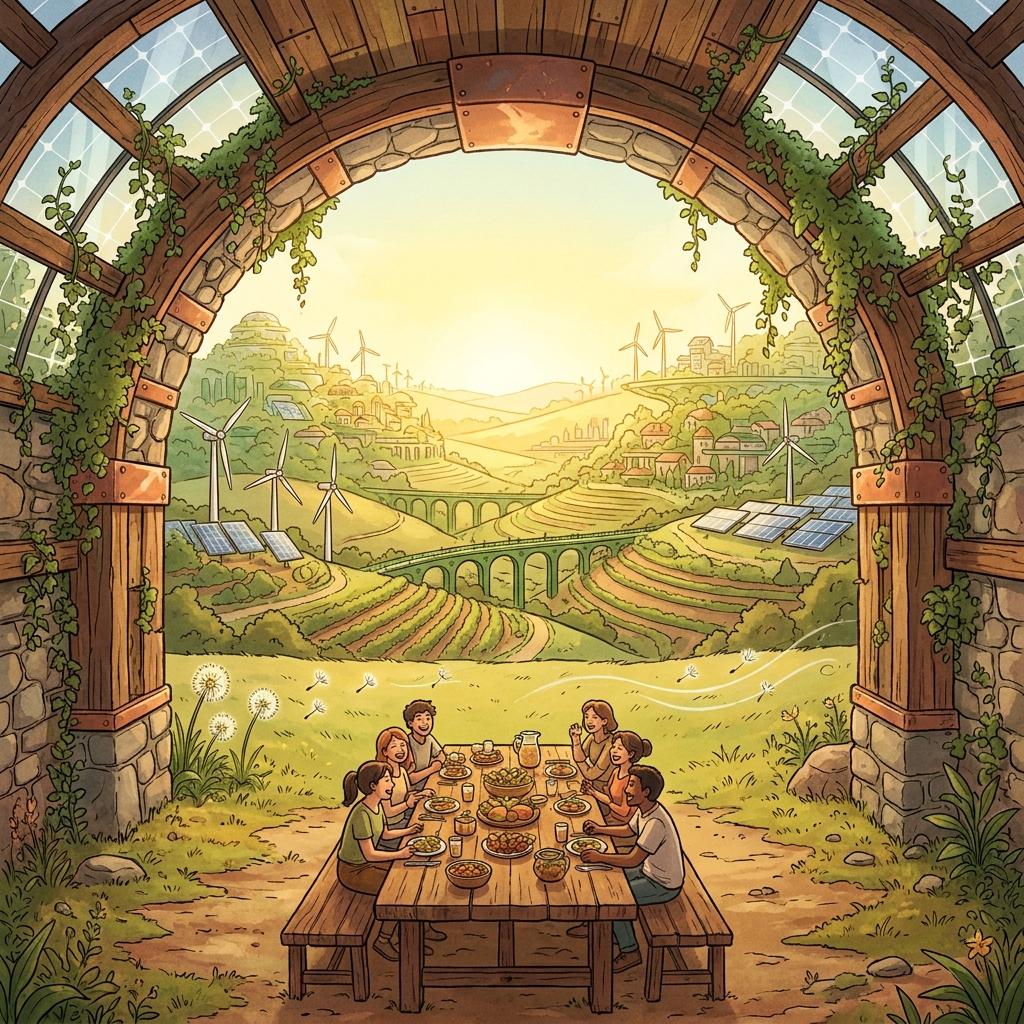
James shared the Revillage Earth project hub [tag="github"], a living reference point housing past meeting summaries, action items, aesthetic direction notes, color references, and the evolving site brief (21:41). He noted this hub is a current-form version of a larger app with logins and richer functionality in development — but functional now for shared reference. The AI-generated images synthesized from meeting transcripts drew genuine appreciation, particularly one that closely echoed the Christopher Alexander pattern language imagery discussed in a prior session without having seen it.
The hub surfaces a working two-word aesthetic anchor — "grounded solarpunk" — which resonated with the team as directionally accurate, even if the specific language of the mission brief still needs a human pass (28:27).
---
The bulk of the session centered on refining Revillage Earth's mission language, working from a draft that James had prepared and then iterating live with [tag="claude"] based on real-time conversation (46:46). The draft organized the mission around several core convictions — a structure the team responded to positively both for internal orientation and as potential website pillars with icons.
Tori introduced the most significant addendum: the current language carries sturdiness and clarity but needs a stronger current of joyfulness running through it (39:00). She described what she's experienced of the project as genuinely sweet and accessible — "simple human technologies" like stone soup, shared soil, a long table — and felt this lightness wasn't yet fully present in the text. The team loved the resulting language Claude generated around this: "Village is rooted in a simple conviction. Transformation doesn't require austerity. It lives through joy."
Matt added a companion thread: beyond joy, the work is about remembering interbeing while holding individual sovereignty — new and ancient ways of knowing that don't diminish the freedoms of modernity but deepen them (44:20). He described the organizing insight he's been sharing with people lately: how we organize space and how we organize people either creates or inhibits conditions for liberation and coherence. This found its way into the "New and Ancient Coherence" conviction in the revised draft.
The six convictions that emerged from the session as structural candidates for the site:
Tori proposed a pairing she loved: "Joyful by nature, participatory by design" — which the team embraced as a possible through-line (01:00:30). Matt flagged listening as an underrepresented theme, particularly within the "Rooted in Place" conviction, pointing to how deeply the whole project's future depends on genuine responsiveness rather than projection (01:01:00).
On the question of scalability language — whether to articulate Revillage as a model or template for other communities — Matt offered a reframe: the work is more like dandelion seeds catching the wind than an exported system (52:51). It goes to seed naturally; adaptation is the point. James suggested "adopt and adapt" as a nice play on words for how other communities might relate to what's being built (53:28). The team aligned on plural models rather than a singular framework — more inspiring synthesizer than replicable playbook (01:21:42).
---
James walked through a full site prototype built in Webflow [tag="webflow"] with draft content organized around: Home, Our Work, Great and Station, Get Involved, About, and Donate (24:00). The prototype reflects the current state of thinking rather than finalized design, and James will convert this into a Google Doc so the team can directly edit content, add image references, and layer in aesthetic direction notes alongside the live prototype view (29:12).
Key structural conversations:
The hero section features a portal/doorway shape that Matt flagged as compelling — evoking the pattern language imagery from an earlier session (01:04:35). The first section after the hero is designed to help visitors quickly orient: why are they here, what do they want, and what's the depth they're looking for. The team discussed whether a three-horizons framing (now, transitioning, transformative) could be a smart visual device for gesturing toward future projects without overpromising or bypassing community input (01:11:05). Matt referenced Naia Trust's investments page as a precedent worth exploring for this kind of horizon-based disclosure.
James visualized it as a three-dimensional horizon: the café right here, the town square a bit further, and then shapes on the horizon still coming into form. This resonated strongly with the team as a way to invite curiosity without locking in specifics (01:10:54). Tori added the feeling she wanted to cultivate: "wonder worth the wander" — people feeling invited to take the walk as things unfold (01:09:14).
The team discussed how to present future projects — housing, farming, wholesale processing, sauna club — with appropriate care (01:06:14). Matt noted that the original pitch deck approach of sharing future-facing content did attract the right people, but the team has been reconsidering how much to surface upfront before the community has had a chance to weigh in. The balance: keeping the door open for solarpunk philanthropists to find their rabbit hole while not triggering resistance on sensitive projects (like higher-density housing) before the context is right.
The layered model — core stewards (dozens), co-creators and volunteers (hundreds), event participants and local commerce (thousands) — was discussed as an internal orientation tool more than a publicly-facing framework (01:14:22). The team agreed that even people in the outermost ring should feel genuine intimacy and invitation when they come to the site, not a sense of being sorted into a tier (01:15:05).
[technology="Community Facilitation Tools"]
James described a sliding scale contribution interface built in Webflow [tag="webflow"] using Stripe [tag="stripe"] for processing — allowing visitors to drag a slider and choose an amount, paid once, monthly, or annually (01:17:15). The team liked framing this page as "Contribute" or "Support" rather than strictly "Donate," since it can encompass donations, investment conversations, gifts of land or assets, legacy bequests, and time (01:18:02).
For events, James recommended linking to existing platforms like Eventbrite or Partiful to start, with the option to build a custom event CMS later (01:23:55). The Get Involved page would surface: attending events, volunteering or co-creating, and deeper commitment pathways — with Matt noting that volunteering also deserves prominent placement (01:18:11).
The About page framing — place-based, person-present, patient — resonated as an orientation, with the team noting that some of the AI meta-commentary in the draft could come out. The partners section was flagged as a meaningful opportunity to show both local Sonoma County relationships (farms, people, projects) and global organizational connections that signal the project's broader significance to funders and investors (01:25:44).
---
The session closed with a genuine conversation about the role of AI in this process. James reflected on using [tag="claude"] to tune into the frequency of the project — not replacing the human creative voice, but amplifying it and helping the team see the organization more deeply (01:30:42). He shared his blog post on writing with AI, which addresses common AI writing patterns (em dashes, "this isn't X, but Y" constructions) that flatten voice, and offered to share it with the team as a filter for content refinement (56:24).
Matt reflected that IRIS [tag="iris"] — which James revealed stands for Intuitive, Relational, and Intersubjective — names something he's beginning to see as one of the more optimistic framings of what AI can actually support: genuine intersubjectivity, when used consciously (01:33:14).
James shared his artist statement on "the place between us" and a broader initiative he's exploring: a contingency of creators working with AI from different perspectives to map a collective understanding of what's actually happening in the world — what's uniquely human, what's shifting, and how to co-create new narratives (01:35:00). Tori reflected that the shift from knowledge holder to wisdom holder as the locus of value feels like exactly what this project is also modeling (01:37:50).
James also mentioned the possibility of Revillage eventually building a resource library — tools, case studies, service providers, templates — that could be both human-accessible and model-trainable, so that AI agents helping people design communities or think through regenerative projects could resource Revillage's work well (01:22:21).
[technology="Collaboration Management Tools"]
---
James Redenbaugh
Matt Jorgensen
Tori Immel
The session opened with a focused review of the Great and Station logo, iterating on hill shapes, shadow treatments, and text framing. The team landed on a version with more hills, connected at the top, and a contained bottom framing that complements the typography beautifully (09:00). Both Matt and Tori responded strongly to the shaded hill treatment on dark backgrounds, and the oval and rectangle lockups were confirmed as the primary formats.
The question of an Instagram-optimized lockup came up given that Revillage's Instagram launched the same morning (10:16). Rather than a full circular badge, the team leaned toward either cropping the rectangle into a square or using just the icon — though James will provide a couple of versions to test in context. Key refinements still to land: repositioning the mountains slightly to the right for better centering, and confirming color directions once the broader brand DNA is locked later in the month (17:33).
James noted that all logo assets will be exported as SVGs, PNGs, and AI files — including the inverted version with orange background and texture — so the team can begin deploying immediately (14:27).
[technology="Parametric Geometric Interfaces"]
---
James shared the Revillage Earth project hub [tag="github"], a living reference point housing past meeting summaries, action items, aesthetic direction notes, color references, and the evolving site brief (21:41). He noted this hub is a current-form version of a larger app with logins and richer functionality in development — but functional now for shared reference. The AI-generated images synthesized from meeting transcripts drew genuine appreciation, particularly one that closely echoed the Christopher Alexander pattern language imagery discussed in a prior session without having seen it.
The hub surfaces a working two-word aesthetic anchor — "grounded solarpunk" — which resonated with the team as directionally accurate, even if the specific language of the mission brief still needs a human pass (28:27).
---
The bulk of the session centered on refining Revillage Earth's mission language, working from a draft that James had prepared and then iterating live with [tag="claude"] based on real-time conversation (46:46). The draft organized the mission around several core convictions — a structure the team responded to positively both for internal orientation and as potential website pillars with icons.
Tori introduced the most significant addendum: the current language carries sturdiness and clarity but needs a stronger current of joyfulness running through it (39:00). She described what she's experienced of the project as genuinely sweet and accessible — "simple human technologies" like stone soup, shared soil, a long table — and felt this lightness wasn't yet fully present in the text. The team loved the resulting language Claude generated around this: "Village is rooted in a simple conviction. Transformation doesn't require austerity. It lives through joy."
Matt added a companion thread: beyond joy, the work is about remembering interbeing while holding individual sovereignty — new and ancient ways of knowing that don't diminish the freedoms of modernity but deepen them (44:20). He described the organizing insight he's been sharing with people lately: how we organize space and how we organize people either creates or inhibits conditions for liberation and coherence. This found its way into the "New and Ancient Coherence" conviction in the revised draft.
The six convictions that emerged from the session as structural candidates for the site:
Tori proposed a pairing she loved: "Joyful by nature, participatory by design" — which the team embraced as a possible through-line (01:00:30). Matt flagged listening as an underrepresented theme, particularly within the "Rooted in Place" conviction, pointing to how deeply the whole project's future depends on genuine responsiveness rather than projection (01:01:00).
On the question of scalability language — whether to articulate Revillage as a model or template for other communities — Matt offered a reframe: the work is more like dandelion seeds catching the wind than an exported system (52:51). It goes to seed naturally; adaptation is the point. James suggested "adopt and adapt" as a nice play on words for how other communities might relate to what's being built (53:28). The team aligned on plural models rather than a singular framework — more inspiring synthesizer than replicable playbook (01:21:42).
---
James walked through a full site prototype built in Webflow [tag="webflow"] with draft content organized around: Home, Our Work, Great and Station, Get Involved, About, and Donate (24:00). The prototype reflects the current state of thinking rather than finalized design, and James will convert this into a Google Doc so the team can directly edit content, add image references, and layer in aesthetic direction notes alongside the live prototype view (29:12).
Key structural conversations:
The hero section features a portal/doorway shape that Matt flagged as compelling — evoking the pattern language imagery from an earlier session (01:04:35). The first section after the hero is designed to help visitors quickly orient: why are they here, what do they want, and what's the depth they're looking for. The team discussed whether a three-horizons framing (now, transitioning, transformative) could be a smart visual device for gesturing toward future projects without overpromising or bypassing community input (01:11:05). Matt referenced Naia Trust's investments page as a precedent worth exploring for this kind of horizon-based disclosure.
James visualized it as a three-dimensional horizon: the café right here, the town square a bit further, and then shapes on the horizon still coming into form. This resonated strongly with the team as a way to invite curiosity without locking in specifics (01:10:54). Tori added the feeling she wanted to cultivate: "wonder worth the wander" — people feeling invited to take the walk as things unfold (01:09:14).
The team discussed how to present future projects — housing, farming, wholesale processing, sauna club — with appropriate care (01:06:14). Matt noted that the original pitch deck approach of sharing future-facing content did attract the right people, but the team has been reconsidering how much to surface upfront before the community has had a chance to weigh in. The balance: keeping the door open for solarpunk philanthropists to find their rabbit hole while not triggering resistance on sensitive projects (like higher-density housing) before the context is right.
The layered model — core stewards (dozens), co-creators and volunteers (hundreds), event participants and local commerce (thousands) — was discussed as an internal orientation tool more than a publicly-facing framework (01:14:22). The team agreed that even people in the outermost ring should feel genuine intimacy and invitation when they come to the site, not a sense of being sorted into a tier (01:15:05).
[technology="Community Facilitation Tools"]
James described a sliding scale contribution interface built in Webflow [tag="webflow"] using Stripe [tag="stripe"] for processing — allowing visitors to drag a slider and choose an amount, paid once, monthly, or annually (01:17:15). The team liked framing this page as "Contribute" or "Support" rather than strictly "Donate," since it can encompass donations, investment conversations, gifts of land or assets, legacy bequests, and time (01:18:02).
For events, James recommended linking to existing platforms like Eventbrite or Partiful to start, with the option to build a custom event CMS later (01:23:55). The Get Involved page would surface: attending events, volunteering or co-creating, and deeper commitment pathways — with Matt noting that volunteering also deserves prominent placement (01:18:11).
The About page framing — place-based, person-present, patient — resonated as an orientation, with the team noting that some of the AI meta-commentary in the draft could come out. The partners section was flagged as a meaningful opportunity to show both local Sonoma County relationships (farms, people, projects) and global organizational connections that signal the project's broader significance to funders and investors (01:25:44).
---
The session closed with a genuine conversation about the role of AI in this process. James reflected on using [tag="claude"] to tune into the frequency of the project — not replacing the human creative voice, but amplifying it and helping the team see the organization more deeply (01:30:42). He shared his blog post on writing with AI, which addresses common AI writing patterns (em dashes, "this isn't X, but Y" constructions) that flatten voice, and offered to share it with the team as a filter for content refinement (56:24).
Matt reflected that IRIS [tag="iris"] — which James revealed stands for Intuitive, Relational, and Intersubjective — names something he's beginning to see as one of the more optimistic framings of what AI can actually support: genuine intersubjectivity, when used consciously (01:33:14).
James shared his artist statement on "the place between us" and a broader initiative he's exploring: a contingency of creators working with AI from different perspectives to map a collective understanding of what's actually happening in the world — what's uniquely human, what's shifting, and how to co-create new narratives (01:35:00). Tori reflected that the shift from knowledge holder to wisdom holder as the locus of value feels like exactly what this project is also modeling (01:37:50).
James also mentioned the possibility of Revillage eventually building a resource library — tools, case studies, service providers, templates — that could be both human-accessible and model-trainable, so that AI agents helping people design communities or think through regenerative projects could resource Revillage's work well (01:22:21).
[technology="Collaboration Management Tools"]
---
James Redenbaugh
Matt Jorgensen
Tori Immel
Finalize Great and Station logo: reposition mountains slightly right and export all lockups (SVG, PNG, AI files) including inverted/texture version and Instagram variants
Finalize the Great and Station logo by repositioning mountains slightly to the right for better centering, then export all lockups as SVG, PNG, and AI files — including the inverted version with orange background and texture, and a couple of Instagram-optimized variants (cropped square and icon-only) for testing in context. Referenced at (17:33) and (14:27).
Revise mission brief to integrate session feedback and convert full site prototype content into a Google Doc for collaborative editing
Take another pass at the mission brief to integrate session feedback — particularly around joyfulness, interbeing, listening, and the six core convictions structure. Then convert the full Webflow site prototype content into a Google Doc so Matt and Tori can directly edit copy, add image references, and layer in aesthetic direction notes. Referenced at (01:29:00) and (29:12).
Share Revillage Earth project hub link with Matt and Tori for async review
Share the Revillage Earth project hub link with Matt and Tori so they can review past meeting summaries, action items, aesthetic direction notes, color references, and the evolving site brief asynchronously. Referenced at (21:41).
Share blog post on writing with AI with Matt and Tori as a content refinement resource
Share James's blog post on writing with AI, which addresses common AI writing patterns (em dashes, 'this isn't X, but Y' constructions) that flatten voice, as a filter for refining the mission brief and website content. Referenced at (56:24).
Review project hub and mission brief and provide language edits on key convictions, particularly around listening and interbeing
Review the project hub and revised mission brief once shared by James; provide language edits and reframing on key convictions — particularly around listening as an underrepresented theme within 'Rooted in Place' and the interbeing/sovereignty framing in 'New and Ancient Coherence.' Referenced at (27:00) and (01:01:00).
Discuss with Tori how to frame future project pipeline on the website, balancing transparency with community readiness
Consider and discuss with Tori how to sequence flagship project disclosure (housing, farming, wholesale processing, sauna club) on the website — balancing openness for solarpunk philanthropists finding their rabbit hole with not triggering resistance on sensitive projects before community context is established. Three-horizons framing discussed as a potential device. Referenced at (01:09:14) and (01:06:14).
Review Google Doc prototype content once shared and add aesthetic notes, image references, and mission language refinements around joy and participatory culture
Once James converts the site prototype into a Google Doc, Tori to review and edit: add aesthetic direction notes, image references, and refine mission language to ensure joyfulness and participatory culture are strongly represented — including the 'simple human technologies' framing and 'joyful by nature, participatory by design' through-line. Referenced at (01:29:00) and (39:00).
Weigh in on how to sequence flagship project disclosure and what content is ready to surface publicly on the website
Tori to weigh in on how much of the future project pipeline is ready to surface publicly — particularly around projects that may trigger resistance before community context is set — and help develop the 'wonder worth the wander' feeling of the site's progressive disclosure approach. Referenced at (01:10:05) and (01:09:14).
Finalize Grayton Station botanical logo mark and comprehensive brand identity system. Square logo version with finer leaf linework and updated mountain fill confirmed as primary direction (11:43). Team needs PNG and SVG exports across all color variants except sage (which is still being workshopped), with versions both with and without paper texture overlay (04:48). Isolated icon exports and star favicon asset required (13:24).
Horizontal monument sign for physical site needs refinement (14:18) - rebalance proportions to make 'Coffee Culture Kitchen' more prominent for distance legibility (15:29). James prefers oval treatment over literal rotation of vertical lockup, with thinner and more rounded linework for signage application (19:21). Sign builder quotes being sourced by Nika (17:17).
Typography system finalized: Primary typeface I am Fel DW Pika (Google Font) works for both headlines and body copy (05:07). Secondary font pairings for menus and supporting assets: Baskerville (versatile serif), Montserrat (modern sans-serif, Tori's favorite), Open Sans or Inter (clean readable alternatives).
Comprehensive brand color palette: Terracotta confirmed as primary brand color at hex #B55633 (10:07) - consistent since early firehouse heritage conversations, represents bridge between Earth and human. Paired with oat milk as standard companion and black as grounding neutral. Blues and yellows available as seasonal/contextual accents. Concept of limited-edition colorways for future merchandise.
Distinctive visual language and brand guidelines covering: curvilinear/flowing forms, hand-feeling imperfection, earth tones with less stark contrast, geodesic/organic architecture references, earth-from-above imagery, cultural glyphs and ancient markings integration, fractal but grounded (not digitally trippy) aesthetic. Working aesthetic anchor: 'grounded solarpunk'. Portal/doorway shapes emerging as compelling visual device.
Guidelines must address multi-generationally aspirational positioning while maintaining tangible rooted-in-now expression - speaking to spectrum from local community members to solarpunk funders. Avoiding spiritual bypass/Mexico City boutique hotel aesthetic in favor of lived-in, rooted feeling.
Using hand-drawn sketching to develop visual and verbal ideas, distilling brand ecology into early website concepts. Logo finalization critical for sign fabrication (wooden form with vector projection, jigsaw cut or CNC approach). Complete brand purpose questionnaire analysis to extract alignment threads. FigJam board with website precedents, mood board images, and inspiration informing direction.
Design and build a new Webflow website for Revillage Foundation to replace existing Squarespace site. Inspired by Shorefast model with clean structural clarity combined with The Ecology Center's vibrancy and approachability. Building a versatile backbone that can support connected but distinct sub-sites over time - an ecology of brands approach.
Core page architecture restructured (25:11) to center dual-entity clarity: Foundation and Development pulled up to top-line navigation as distinct pages, Mission and About consolidated into single About page, dedicated Projects page showcasing flagship initiatives like Grayton Town Square and cafe. Homepage serves two primary user flows: (1) action-oriented visitors arriving via QR codes who need quick navigation to specific destinations, and (2) inspired newcomers with no context who need enough signal about the larger vision to feel drawn deeper.
Homepage features portal/doorway shape hero section evoking Christopher Alexander pattern language. Terracotta color confirmed at hex #B55633 (10:07) - represents bridge between Earth and human, ties to Grayton Station, provides warmth and hand-of-maker texture feeling. First section after hero helps visitors orient: why are they here, what do they want, what depth are they looking for.
Watershed topography illustration identified as one of three critical signature graphics (36:46) - will be expanded to include subtle human infrastructure elements layering human activity into ecological reading. Three-dimensional horizon visualization to show layered timeline: café (present), town square (near future), future projects as shapes on horizon. Foundation × Development relationship diagram makes business/nonprofit relationship instantly legible. Progressive disclosure approach inspired by Naia Trust investments page precedent.
Projects page uses flexible tile-based grid (44:00) where some tiles link to internal subpages, some link to standalone project sites (e.g., Grayton Station), some are static coming-soon placeholders. Tile sizes can vary within grid to give landmark projects more real estate.
Rounded corner aesthetic across cards affirmed (37:20) - professional but friendly, good nervous system feeling. Light background color accents on cards to help text pop while preserving soft, image-forward feel. Mission language organized around six core convictions as potential website pillars with icons: (1) Joyful by Nature, (2) Rooted in Place, (3) Layered by Design, (4) Tangible Before Theoretical, (5) Bridging Worlds, (6) New and Ancient Coherence. Key through-line: 'Joyful by nature, participatory by design.'
Design approach shifted from philosophical manifesto to tangible-first - lead with visible reality of work (cafe, town square, events) and let deeper philosophy emerge through exploration. Visual language: terracotta primary brand color (#B55633), oat milk companion, black grounding neutral, blues/yellows as seasonal accents. Portal/threshold framing devices, curvilinear patterns, earth-from-above imagery, hand-feeling imperfection aesthetic. Integrating geodesic/organic architecture references and cultural glyphs - grounded solarpunk aesthetic.
Typography: Primary typeface I am Fel DW Pika (Google Font) for headlines and body (05:07). Secondary pairings: Baskerville, Montserrat, Open Sans, or Inter for menus and supporting assets.
Future projects (housing, farming, wholesale processing, sauna club) presented with progressive disclosure - balancing transparency for solarpunk philanthropists while respecting community input process. Partner section shows both local Sonoma County relationships and global organizational connections. Bilingual accessibility through Webflow Locales feature.
Donate/Contribute/Support page features sliding scale contribution interface with Stripe integration - drag slider to choose amount, paid once/monthly/annually (18:43). Page encompasses donations, investment conversations, gifts of land/assets, legacy bequests, and volunteering time. Slider shows what each tier enables. Integration with GiveButter for foreseeable future, including upcoming Friends of Grayton Public Spaces monthly-giving campaign.
Get Involved surfaces: attending events, volunteering/co-creating, deeper commitment pathways. Events linked to existing platforms (Eventbrite/Partiful) initially, with option for custom event CMS later. Participatory-by-design meta-treatment being added - small sticky-note function inviting visitors to share skills, giveaways, or things that would light them up to offer in service of community (22:30).
Process shift (28:32): Moving into Webflow build earlier rather than perfecting copy in Google Docs first. Team will workshop copy directly in Webflow, leaving comments on design elements needing adjustment. This allows testing sentence length, rhythm, and visual fit against live site rather than switching between docs and prototype.
Design philosophy guided by Christopher Alexander's pattern language (13:28) - lean into generosity, move away from pressured CTAs, create entryways and approaches that invite landing, honestly display who team is and what's alive. Also weaving in Fernando Flores's action language (45:40) - designing for deeper, slower actions (sitting with, witnessing, communing, transforming) beyond typical click/scroll/share patterns. Measuring against Alexander's 'quality without a name' as design principle (39:50).
Timeline pressure driven by crowdfund launch this week and community nonprofit fundraising festival in two weeks (34:00). Recent community town hall surfaced questions about who Revillage is and how moving parts relate - making basic site (especially homepage and foundation/development pages) genuinely time-sensitive. Target launch: May 27th, before James departs for Portugal.
Design and develop participation pathways and community listening infrastructure for Revillage website. Create intake system where community members can share what makes them most alive, their gifts, and how they want to contribute. Build smart matching capability using AI to connect volunteers to opportunities behind the scenes based on their expressed interests and capacities.
Explore interfaces for submitting dreams and ideas with collective visualization - potentially using generative collage, honeycomb patterns, or other organic forms that reflect the participatory place-making ethos. Core philosophical framing: moving from cultural individualism back into choiceful relationship - rebuilding conditions for genuine community, belonging, interdependence, and place-based connection. System should embody the vision of 'joyfully remembering our interdependence with each other and the living earth' where joy is primary, remembering (not inventing) is the mode, and human-to-human and human-to-place relationships are co-equal.
Consider physical touchpoint (tablet in shipping container at Town Square or Grayton Station) for non-digitally native community members to ensure broad accessibility. Potentially refresh and digitize 2023 community design survey data (150 resident responses) as foundation for understanding existing community voice.
System serves as ongoing listening device for the village, making participation invitations feel special and matched to individual gifts rather than generic volunteer asks. Supports true participatory place-making where many people's hands are genuinely on the work - a barn-raising ethos where the project couldn't have happened any other way. Long-term hope is that two generations from now, people won't leave because the fabric was built by the people who belonged to it.
Listening identified as underrepresented theme in current mission language - this system embodies that commitment to genuine responsiveness rather than projection. Tied to 'Rooted in Place' conviction and the three-layered engagement model: core stewards (dozens), co-creators/volunteers (hundreds), event participants/local commerce (thousands). Even outermost ring should feel genuine intimacy and invitation, not a sense of being sorted into tiers.
Refine and finalize mission articulation and core website content through collaborative editing process. Working from AI-generated draft organized around six core convictions, refining with human voice and team input to balance clarity with joyfulness, sturdiness with accessibility.
Six conviction framework serving as potential website pillars: (1) Joyful by Nature - transformation lives through simple human technologies and pleasure of showing up, (2) Rooted in Place (with listening theme) - beginning with what's real and present, asking what specific place calls for, (3) Layered by Design - meeting people where they are across levels of engagement, (4) Tangible Before Theoretical - building real things: gathering spaces, food systems, rituals of easy togetherness, (5) Bridging Worlds - holding entrepreneurial rigor alongside activist heart, financial clarity alongside spiritual depth, (6) New and Ancient Coherence - drawing on emerging and ancestral ways of knowing; genuine interbeing deepens rather than diminishes sovereignty.
Key through-line identified: 'Joyful by nature, participatory by design.' Mission language must carry sturdiness and clarity while also conveying the genuine sweetness and accessibility of the work - simple human technologies like stone soup, shared soil, long table. Avoiding spiritual bypass while honoring depth. Balance between transformation and joy, remembering interbeing while holding individual sovereignty.
Framing shifted to household → village → watershed holon concept (11:23) rather than asking visitors to see themselves as "one of a thousand" - articulating the fractal/holon more naturally.
Scalability framing: not exported model or template but dandelion seeds catching the wind - plural models, inspiring synthesizer rather than replicable playbook. 'Adopt and adapt' rather than franchise approach.
Content development workflow: full site prototype converted to Google Doc for collaborative editing, allowing Matt and Tori to directly refine language, add image references, and layer aesthetic direction notes. Matt and Tori to complete copy doc by end-of-day Monday (07:51). AI (Claude) being used as co-creative tool to tune into frequency of project and help team see organization more deeply, with human editing pass to remove AI patterns (em dashes, 'this isn't X but Y' constructions) that flatten voice.
Gifted dimension currently underbuilt (39:50) - need to articulate how gift and reciprocity have driven the project. Copy line 'a watershed remembering itself' (32:00) connects ecological stewardship arc with near-term focus on hands, faces, and hearts showing up in village.
Scope includes refining: About page language (place-based, person-present, patient orientation), partner section framing, progressive disclosure language for future projects, Get Involved/Contribute page content, and overall narrative arc across site.
Explore development of resource library for Revillage - tools, case studies, service providers, templates, and knowledge artifacts that support regenerative community building. Library would serve dual purpose: human-accessible resource for practitioners and communities exploring similar work, and model-trainable dataset so AI agents helping people design communities or think through regenerative projects could resource Revillage's work effectively.
Potential to position Revillage as knowledge holder and wisdom holder - not just doing the work but documenting and sharing learnings in ways that support broader movement. Aligns with dandelion seed philosophy: work goes to seed naturally, adaptation is the point, plural models rather than singular framework.
Library could include: design patterns and case studies from Revillage implementation, service provider directory (architects, permaculture designers, community organizers working in regenerative space), template documents and frameworks that can be adopted and adapted, research and precedent studies, economic models and financial structures for community-based development.
Consideration for how this intersects with broader AI and creator contingency work exploring what's uniquely human, what's shifting, and how to co-create new narratives. Potential for Revillage to be part of mapping collective understanding of regenerative community building in the age of AI assistance.
Timeline flexible - this is future-facing work that emerges after core website and systems are established. Could grow organically from documentation practices already in development.
00:00:00
James Redenbaugh: You. This meeting is being recorded. How are you doing?
00:00:07
Tori Immel: I'm well, yeah. Hanging in. It's feeling like Friday energy. Interestingly.
00:00:15
James Redenbaugh: Tuesday energy to me.
00:00:18
Tori Immel: We've got a bunch of events this weekend, so maybe that's part of it.
00:00:21
James Redenbaugh: Oh, nice. Cool.
00:00:24
Tori Immel: Yeah. Matt's cruising over. So again, James, I just made our Instagram this morning and we already got some shots back from a photo shoot we did last night. So I'm like, oh, can't wait to get the gray and station logo up there and get all recognizable. So stick. Yeah.
00:01:07
James Redenbaugh: Exciting.
00:01:12
Tori Immel: Did you have a nice little. Were you on vacation or.
00:01:15
James Redenbaugh: Yeah, little vacation to western eastern Tennessee. Oh yeah.
00:01:22
Tori Immel: For the play.
00:01:23
James Redenbaugh: The play. And Smoky Mountains. It's a nice little trip.
00:01:29
Tori Immel: Love. Sounds beautiful.
00:01:32
James Redenbaugh: Yeah. I'd never really spent time in that area, so it was neat to see.
00:01:38
Tori Immel: Yeah, that's pretty down in those zones. Done. A little Kentucky, a little Tennessee, a little Oklahoma and a little North Carolina. Yeah.
00:01:51
James Redenbaugh: Yeah.
00:01:51
Tori Immel: I used to live in Asheville, so it's really like Asheville. That place is moving.
00:02:00
James Redenbaugh: Yeah. Definitely a little too much these days.
00:02:05
Tori Immel: Yeah. Felt like it was arcing towards that, but I do feel like it. You know, maybe it's starting to push out more of the artists, but probably when you were there it was like that good, good creativity, heartbeat and grunginess and like that good time zone.
00:02:23
James Redenbaugh: Yeah,.
00:02:29
Tori Immel: Yeah, exactly. Let me just give it a quick call.
00:02:33
James Redenbaugh: Sure.
00:02:33
Tori Immel: I painted it. Let's see one.
00:04:26
James Redenbaugh: Here we go.
00:04:27
Tori Immel: Okay. Hey.
00:04:36
Matt Jorgensen: So sorry.
00:04:37
James Redenbaugh: Hey, Matt. No worries.
00:04:41
Matt Jorgensen: Having a session with my spiritual teacher and lost track of time.
00:04:47
James Redenbaugh: Wonderful. That's a good reason. Time doesn't exist anyway.
00:04:54
Matt Jorgensen: Yeah, right, right.
00:04:56
James Redenbaugh: There's a spiritual teaching for you.
00:05:02
Matt Jorgensen: Thanks for your patience.
00:05:04
James Redenbaugh: I'm curious to know who your teacher is.
00:05:08
Matt Jorgensen: Chris McKenna.
00:05:11
James Redenbaugh: I've never heard of him or her.
00:05:14
Matt Jorgensen: Yeah. Let me send you a link.
00:05:24
James Redenbaugh: Yeah.
00:05:25
Matt Jorgensen: Not, not. Not really on the radar teacher, which is great.
00:05:32
James Redenbaugh: Yeah. Those are the best ones. Yeah.
00:05:36
Matt Jorgensen: I'm afraid he's gonna get on the radar because he's going on sabbatical soon to do some writing.
00:05:46
James Redenbaugh: Cool. Wonderful.
00:05:56
Matt Jorgensen: Yeah, yeah. Very multi lineage teacher. Probably. Probably enjoy him.
00:06:11
James Redenbaugh: Well, great. Here we are. Good to be with you. Here we are.
00:06:15
Matt Jorgensen: You too.
00:06:18
James Redenbaugh: Should we start with the Great and Station logo? Just jump into that. Get this.
00:06:26
Matt Jorgensen: Sure. Yeah. Thank you.
00:06:28
James Redenbaugh: Polished up so. Look at this. I wanted Munia to do this, but she's been on a little vacation also, so I just did it myself. And we can tweak this as needed. But yeah, here's a version with Cool. With some More hills. They might be a little too lumpy. I don't know. Wanted to give a little texture there.
00:07:05
Matt Jorgensen: Yeah.
00:07:07
James Redenbaugh: But we can play with it right here until it's just. Just right.
00:07:12
Matt Jorgensen: Yeah. I think I. I think I like it better with more hills. What do you think, Tori?
00:07:19
Tori Immel: I think I like it better with more hills and kind of curious about connecting that top hill.
00:07:26
Matt Jorgensen: Yeah. That kind of bug. That kind of bugs me.
00:07:36
Tori Immel: Wow, look at that. Just like that.
00:07:51
Matt Jorgensen: Yeah, I dig it.
00:07:53
Tori Immel: Me too.
00:07:56
James Redenbaugh: Cool. And then I'm also curious. What if.
00:08:11
Matt Jorgensen: Right. If you could get one in relief or shadow.
00:08:20
James Redenbaugh: I was just gonna do. Do we like that. To extend all the way there?
00:08:49
Matt Jorgensen: Could you maybe zoom out and also do an AB version of that?
00:08:57
James Redenbaugh: Yeah.
00:09:16
Matt Jorgensen: So sick.
00:09:33
Tori Immel: I like it with the bottom contained, I think.
00:09:41
Matt Jorgensen: Yeah. Yeah, I do.
00:09:57
James Redenbaugh: Yeah. I like what it does to the. To the text.
00:10:03
Matt Jorgensen: Also frames that a little bit. Bam. Let's put it on a side.
00:10:16
Tori Immel: Seriously. I was just telling James too, that our Instagram is live, so I'm excited to see like a circular lockup sorts. So beautiful.
00:10:28
James Redenbaugh: Great.
00:10:30
Matt Jorgensen: Yeah.
00:10:31
James Redenbaugh: So the.
00:10:34
Matt Jorgensen: We've got the. We've got the oval. We've got the rectangle that we love. You could probably use just the like, middle of the rectangle that's a square. As like a. An Instagram logo or something. But did we have a. Did we talk about a vision for a. A circular version?
00:11:07
James Redenbaugh: We did briefly, in theory. I think that we should do just.
00:11:15
Matt Jorgensen: Or just like just pulling out the. The icon. The icons. Because it doesn't need to. Doesn't need to say great station.
00:11:24
James Redenbaugh: Right.
00:11:25
Matt Jorgensen: Tori?
00:11:28
Tori Immel: I think it just depends what we. What we want. Trying to remember, like, what most brands do. I feel like some brands just take like the GS. Some brands just do. Just do typography. I see actually most brands, I feel like, do more typography than.
00:12:04
Matt Jorgensen: I. E. Like, it would just say great. And station coffee culture kitchen.
00:12:10
Tori Immel: Yeah.
00:12:11
James Redenbaugh: Maybe it's split or the logo. I don't want to see what Starbucks does, but they. They just have their logo. Pete's. I don't know how to spell Pete's. Peace doesn't. Oh, yeah. They just have their logo, I think, just. Not that version, but this version.
00:12:54
Tori Immel: It's pretty mixed bag for what I'm seeing. Some do just the iconography, some do just the typography. Some have a circular lockup that. This bowl.
00:13:43
Matt Jorgensen: I like just that.
00:13:51
Tori Immel: I think that's beautiful.
00:13:54
James Redenbaugh: Mm. I'll give you a couple versions to try. One with the. Circle and one without. And you can see how they look on the gram.
00:14:15
Matt Jorgensen: Sweet.
00:14:21
James Redenbaugh: Yeah. Cool.
00:14:27
Matt Jorgensen: This is all amazing. Thank you so much, James. And yeah, could. Will you be able to just like export all six of these as or whatever? I guess there's a couple that are getting Next, but all four of them as both like PNGs and SVGs or whatever. AI files.
00:14:56
James Redenbaugh: Yeah, sure.
00:15:01
Matt Jorgensen: Thank you so much. Because yeah, we can always. We can always kind of like get. Get clearer on as. As. As we start using these, we can always get clear on like, are there any. Are there any things that we want to request in terms of specific iterations or lockups or you know, getting. Getting Mona involved in something again? But just to me, this feels like a super rad, super solid place to be for where we are right now. And I feel stoked to put it on a wood sign.
00:15:49
James Redenbaugh: Great. Awesome. It's gonna look good on wood.
00:15:55
Matt Jorgensen: Yeah. I love like those examples that you did. Those mocks were really compelling, I thought.
00:16:06
James Redenbaugh: Awesome.
00:16:08
Matt Jorgensen: Yeah, I, I personally, I like both of those, but I do like the shaded. The shaded hills when you have the dark background.
00:16:22
James Redenbaugh: This one?
00:16:23
Matt Jorgensen: Yeah, I do. Yeah.
00:16:25
James Redenbaugh: Cool.
00:16:26
Tori Immel: Me too.
00:16:29
James Redenbaugh: Great. Do we think. Yeah.
00:16:47
Tori Immel: What was your question?
00:16:52
James Redenbaugh: Do we think that this should move over a little bit? I see what's happening. That's not quite right. But do we like the positioning of these mountains or do we want them to move over to the right a little bit?
00:17:33
Tori Immel: Yeah, I think to the right. You're right. Get a little more centered up.
00:17:40
James Redenbaugh: Cool. I will tweak that after the call. And of course we can always, you know, modify this later. We need to. And this is like a secondary version, but I'll get those SVGs over to you guys as well as the inverted version of this with the orange background and the texture. So you can start using those right away.
00:18:17
Tori Immel: So exciting.
00:18:19
James Redenbaugh: Yay.
00:18:21
Tori Immel: Yay.
00:18:25
Matt Jorgensen: Yeah. Really, really so generous of you. And I know this was mostly your time, but obviously just send us the bill for Mona whenever you get a chance.
00:18:40
James Redenbaugh: I shall.
00:18:43
Tori Immel: So, so grateful. So excited. I can't believe like from where we started to just how iterative and creative. And it's amazing like how you guys just are like circling and getting closer and closer and yeah, really beautiful process I think too the kind of the last pieces that we still want to. This is like kind of like giving know version one pieces, but we've still been talking about like full brand kit colors and still need a little bit of time as a team just to like get closer to. To all of those as we get a Little deeper into like our full marketing brand DNA later this month. So is it pretty easy to like flip in new colors if we want to switch those out as we lock that?
00:19:34
James Redenbaugh: Yeah, totally. Okay.
00:19:36
Tori Immel: Awesome.
00:19:38
James Redenbaugh: Cool. Cool.
00:19:41
Tori Immel: This is so beautiful. I can't wait to put this everywhere. Awesome.
00:19:45
James Redenbaugh: Awesome. Wonderful. Should we shift gears into re villaging the Earth?
00:19:56
Tori Immel: Yes, yes, please.
00:19:59
James Redenbaugh: Great.
00:19:59
Matt Jorgensen: This part of revillaging the Earth.
00:20:01
James Redenbaugh: Yeah, definitely. I'm going to record this to video as well. Great. In case we want to look back. So I'm. Where to start. So first of all, I'll kind of high level what I want to get into with you guys today and see where we're at. I've got this project hub I can share with you guys. Based on our conversations. Also I'll share this with you guys another product where you got multiple project hubs but this will be helpful for you guys if you want to just review our past meetings and see the, the notes and the summary and action items and things here. And you can update tasks if you want. These little quick tasks just to have record of all our calls. They'll. They'll always be here on this page.
00:21:41
Matt Jorgensen: It's such a, that's, it's such a stunning interface you've built here. It's so cool.
00:21:48
James Redenbaugh: Thanks. Yeah, I'm actually redesigning this whole thing as an app with like logins and stuff like that, but this works for now. I love the images that the system generates from the meetings. They're always like pretty spot on and interesting. Like this is a great interpretation of the Christopher Alexander image we were looking at.
00:22:18
Matt Jorgensen: Totally.
00:22:21
James Redenbaugh: Even though the AI didn't see anything that we were looking at it.
00:22:26
Matt Jorgensen: Yeah.
00:22:27
James Redenbaugh: Gleaned this from the conversation and it's like, oh yeah, this is great.
00:22:31
Tori Immel: Incredibles.
00:22:32
Matt Jorgensen: What, what image generator are you using?
00:22:37
James Redenbaugh: Gemini.
00:22:39
Matt Jorgensen: Yeah.
00:22:40
James Redenbaugh: Yeah. Cool. And then so we have this project hub which is just for you guys living on my GitHub. And this brief will evolve, but basically kind of consolidating different things that we've talked about on our calls. Looking at colors, starting to highlight pages that we want the site to have, you know, organize things, aesthetic direction. You know, if, if I were to put it into two words right now, maybe it would be grounded. Solarpunk we can talk about if that's, that's valid or not or that includes everything or not. Yeah. Frequencies, tags, conversing on notes about logo and sign, site architecture, photography, vision. These are just some action items from the last session. But most importantly up here, articulation of the. Of the mission based on our conversations and your brain guidelines and everything. This can evolve too. And right now there's not an easy way for you guys to like edit this but you know, feel free to to browse it, sit with the language and send me updated versions that that feel better. Not that this is going on the site necessarily but it's just helpful to orient revillage I want to say Revillage Earth I don't know is building a living prototype for how a specific watershed community can relocalize economically and culturally so that belonging, affordability and relationship to place become real again and so other communities have a template to adapt again. You know just meant to help us orient to the overall mission of the if the project and I'll just read this and then I'd love to get your your takes the feeling we want visitors to walk away with not being alone. I am not alone therefore I have a power, freedom and responsibility through relationship maybe to like to co create community or future villages together something like that tangible place making not abstraction place making flagship Simonic county affordability you know farmers layered community model concentric rings systems level experimentation grounded sandbox system level acupuncture points tethered to real people, real projects, hopes, fears, budgets, etc. Bridge Between Worlds connecting logical financial entrepreneurial thinking with activists and spiritual communities Town square Creighton Station as a flagship sub projects so I want to dig into this with you guys a bit but first I'll just show you high level we can go through this as well where I've prototyped the whole site with draft content so home page our work a page for Grayton Station specifically Need some more hills in there get involved page about donate a lot of placeholder images and placeholder content and you know nothing is pinned down but thought it would be helpful to have this the starting place to see things in context and think about things and I can convert this into a Google Doc as well organized in the same structure so that you guys can work with the content, add your own stuff add notes and stuff like that easily. So yeah I thought we could start with the the brief and this mission and then see where that takes us so high high level thoughts off the bat.
00:27:43
Matt Jorgensen: You're a wizard.
00:27:44
Tori Immel: Literally I'm like how did you do this so fast? Oh my gosh so casual you're like anyways let's talk like what we know.
00:27:56
James Redenbaugh: I was feeling like I should I should have done more than so time time stress I actually wanted to do more but glad glad it feels Like a lot.
00:28:15
Matt Jorgensen: Yeah, I mean, I would say probably a lot to sit with and do.
00:28:25
James Redenbaugh: On.
00:28:27
Matt Jorgensen: Actual languaging, but energetically, pretty spot on. You know, I haven't quite digested how comprehensive it is, and I know, at least for me, there's a bunch of words I'd want to change here and, like the mission articulation and like, main sub bullets, but none of it's off energetically, so that feels really good. And yeah, grounded solar punk. It's like a pretty good two words.
00:29:08
James Redenbaugh: Great. Awesome.
00:29:12
Matt Jorgensen: Yeah.
00:29:12
James Redenbaugh: Like I said, after this call, I can bring all this content into a Google Doc and then it could be helpful to just have it. Have this in the doc up at the same time so you can see things in context as you go through the text and decide, like, we don't need this section, we don't need this page, or we want this page in this section. And then also editing or. Or rewriting the content and adding links to images and stuff like that, if you have them, as well as feelings about. I'll have a page in there for feelings about aesthetic and design direction, what's already working, what we need to bring in. You know, there's. There's not a lot of design to this yet, other than basic, you know, order of information, structures, spacing. But how do we want to play with images? Are. Are we happy with the structured horizontal sections, or do we want to get more creative? You know, we. We don't want to reinvent the wheel, and we. And we don't have the budget to, you know, reinvent the wheel anyway. But I definitely, I want it to feel like a unique representation of this very unique project. So excited to. To get into that also. And while I'm yapping, before we go bigger into mission, I also just want to show you this one image that Gemini generated based on some dialogue I was having with that and sharing about the mission and the content of our last meeting. Taking inspiration from Christopher Alexander's pattern language, but bringing it into the context of this project. Starting to draft some diagrams that we could evolve to communicate visually about what we're talking about, which is perhaps just as important as the language. And I think we're going to want at least one cool diagram or illustration on the homepage to articulate the bigger vision. And so in my mind, these are some starting places for that. So.
00:32:23
Matt Jorgensen: You want responses on. On these now I. I have a couple.
00:32:28
James Redenbaugh: Or.
00:32:28
Matt Jorgensen: Or not.
00:32:30
James Redenbaugh: Yeah, why don't we. Yeah, I'd love to hear them.
00:32:37
Matt Jorgensen: I'm. I'm drawn to the middle. Right. One the most.
00:32:42
James Redenbaugh: And.
00:32:55
Matt Jorgensen: Yeah, there's, there's. There's aspects of. I would say I'm. I'm not particularly drawn to the. The other ones on the right, but of the ones on the left, I think all of them communicate some interesting aspects of the information.
00:33:26
Tori Immel: And,.
00:33:41
Matt Jorgensen: Yeah, I guess I don't really have that much more immediately.
00:33:48
James Redenbaugh: Cool.
00:33:50
Tori Immel: I'm feeling like the two centers are the ones I'm visually most drawn to. And just over this mop. I really like the idea of helping people via visuals, like, understand the complexity of the whole ecosystem or at least get, like, a feeling of all of the different nodes that our work eventually will continue to weave and bridge and create communication threads between. So, yeah, I think the sense I'm getting from these is, you know, they have different intentions right now, like, watershed coherence, Mandela and proportion hubs. But yeah, maybe it would be interesting, like, for us to have, like, a seed idea of, like, what is on the homepage. Like, the most important thing that we feel like is so far been.
00:34:52
James Redenbaugh: The.
00:34:52
Tori Immel: Trickiest for people to, like, wrap their arms around thinner work or. I don't know, maybe it's also more artistically LED and, like, emergence within it.
00:35:01
James Redenbaugh: But,.
00:35:04
Tori Immel: Yeah, stylistically, I think I'm center right. Probably also a cool mix of, like, there's motion, there's direction, there's interactivity for the mind, but then also the other side of the brain can kind of relax into the movement and topography. Yeah.
00:35:26
James Redenbaugh: Great. Awesome.
00:35:31
Matt Jorgensen: There's the middle left or, sorry, the bottom left and the middle right. I do think, to me, both communicate the most about what's actually happening. And yeah, I think I agree with Tori on the middle to being the most visually appealing, But I think these, these kind of, like, little connected. Connected nodes are definitely. That is just. That is just like, what's happening. It's okay. I guess it's always what's happening, but we're nurturing it in particular.
00:36:20
James Redenbaugh: Cool. Awesome. Yeah, I really like the geometry of this grid. It's very oriented to the cardinal directions, but it's not so orthogonal and Euclidean. And I like the overlay of this. This ordered but dynamic grid on top of. Yes. The landscape and the river and. Yeah, there's a lot there. Yeah,.
00:37:04
Matt Jorgensen: Yeah, I, I, It's. Yeah, the human. The human glyphs, the human imprint, the human mind kind of in. In relationship to everything else that's more ecologically attuned.
00:37:30
James Redenbaugh: I don't know. Great. Awesome. Well, let's go back to our mission here. And. Coming back to this text, I'm curious. How, how this resonates as an articulation of what might be missing at this point. What's left out that's important?
00:39:12
Tori Immel: I mean, you hit all of so many of the points that we discussed and brought in and layered in our last conversations and super grateful for it. I feel like it's got like a. The way the words are like hanging right now has like a sturdiness to me. Like, it's, it's approachable and neutral and so pretty vibrant in the, like, this is what it is. And like, it's also cute to like see self in that perhaps for me checks out. The one thing I, I would bring forward is just the, the feeling of like, joyfulness, like how to, how to give people that sense that like, this isn't like a slog. You know, I think sometimes there's like a, you know, certain words that bring people into like, transformation culturally that feel a little bit like, oh, it's so far away. Or like, you know, there's so much work and relationality to pick up and carry around on a, in a backpack. And like some experiences I've had within this project so far just like, really pinch me at how joyful it can be and how sweet and how like, like really simple human technologies are available to us of like stone soup or picking up a shovel and you know, sweating next to a neighbor, like, like a hot summer day. Yeah, that would be my. So I'd say it's like where you, you just bring a pot and then everyone brings like, you know, one person brings a couple sweet potatoes, someone has like some chard from their garden. Everyone just kind of tosses stuff into the pot and it just kind of, if you get there early, you might get one kind of soup and if you get there late, it's going to look a little bit different.
00:41:11
Matt Jorgensen: And we've actually done it. Sometimes like someone makes a really good broth and it's pretty, pretty doable to just put random stuff in it.
00:41:25
Tori Immel: Yeah. So that would be a plus one is like joyful. In mission articulation. I also wonder about how we're orienting towards bringing the, like, the scalability of this work directly into a mission in such like an articulated way. Or if that's kind of down a couple clicks feeling.
00:42:02
James Redenbaugh: Yeah. So this isn't necessarily homepage content. So it's the scalability score to the mission. You want to include it in here and then decide on the, the how the story is told told, you know, what, which Aspects are we bringing forward and which aspects are. Are later in the. How about for you, Matt?
00:42:56
Matt Jorgensen: It feels pretty complete with Tori's addendum on the, on the joy piece. Yeah, I mean I think it's, it's kind of. Between and betwixt a lot of this, you know, but it's like the, the I am not alone, therefore I have power, freedom, responsibility through relationship. I think.
00:43:36
James Redenbaugh: The.
00:43:39
Matt Jorgensen: Just new and ancient ways of knowing, you know, are really what we're talking about and the coherence that that can bring to the individual's relationship to themselves within a collective. And the thing I'm always kind of coming back to as a, as a philosophical piece is like as. As moderns, you know, continuing to inhabit the, the freedom and self sovereignty of the modern age while remembering this felt sense of inter being and the knowing that's possible from there. So I think a lot of that is already kind of here, but that would probably be in addition to plus one ing on joy, which is really a felt sense of following, aliveness and alignment. I think the other side of that is this kind of re choosing of, of or remembering really of inter being amidst ongoing, you know, freedom and self sovereignty. And the thing I've found myself saying over the last few days to people just in terms of what my interest with all of this is, is, you know, basically the sense that how we organize space and how we organize people kind of creates or inhibits the conditions for liberation and coherence. And so just sort of this excitement about integrative spaces, real life spaces that hold, hold that container for us to rise to the occasion of our own individual and collective evolution. So yeah, I don't know. I'm not in the way. I'm taking this in right now. I'm having trouble pointing to too much specificity, but maybe those words are additive.
00:46:19
James Redenbaugh: Awesome, awesome, awesome. Let me try something real quick.
00:46:46
Matt Jorgensen: Is your AI gonna real time reconfigure this thing?
00:46:50
James Redenbaugh: Yes.
00:46:52
Matt Jorgensen: Yeah.
00:46:55
James Redenbaugh: So cool. All right, let's let that cook for a minute. Yeah, there's a lot, a lot there. I'm sensing a few patterns between the simplicity of joy and connection and community and you know, digging and cooking and. Playing Minecraft with my cousins. Caps time and it's just like such a fun game, such a cool world to like. Yeah, you know, I'm going to just dig and find some materials and you know, build some stuff. There's like a bit of that left less blocky but you know, the joy of creating and simplicity of a potluck. And you know, what it would be like to just bring some ingredients together and be together. And then the complexity of being in our world and interbeing with each other and being in this time and having the privilege of remembering ancient times and creating physical and systemic conditions for evolution and reconnection and awakening and transcending and including the individual. And that individual collective is another polarity here between me finding my role in this world and space for myself and family and recognizing it's all a part of something greater. And there are. Living beings that are not singular, but communities and even counties are beings with heartbeats and circulatory systems and you know, and nervous systems and other things that we're just beginning to understand together and, and much more as possible. And in that world there is opportunity for new kinds of growth, new kinds of investment, new kinds of development, new kinds of projects that measure new kinds of returns. And. Yeah, it's like a whole world in my mind. I keep coming back to the Minecraft metaphor because it's like it's such a simple game in its essence, but so much is possible. Like people have built computers in Minecraft out of, out of these simple materials that can run Minecraft. In Minecraft. It's like it started with this simple set of tools and then this whole world gets, gets created. And I kind of, I feel something like that here where there's perhaps simple sets of tools and context and example projects that actually open a whole world of possibility not only for Sonoma county, but also also the world.
00:51:01
Matt Jorgensen: Beautiful. I've never with Minecraft, but the. I, I took in the energy of it and I love it.
00:51:11
James Redenbaugh: You know, let's, let's get in there. It's gonna start, let's start hosting meetings in Minecraft. I just wish it wasn't so orthogonal, you know, so it's all these right angles. I want it to be more of a Voronoi situation. So here's a new version of this based on what we were just talking about, the mission and the notes I took. And also I was, I had to bring back in some things that didn't end up on the, on this articulation. So let's just look at this real quick. It's also made it a page in the, in the prototype, which is helpful. Relocalizing economy, culture and belonging. Revillage exists to build a living model of place based community in the Green Valley watershed. One that other regions can learn from and adapt. This still sounds a little bit, feels a little off to me. Like I Don't know what that, what that means and the bad.
00:52:31
Matt Jorgensen: Yeah, but there, I mean, that is kind of in some ways the spirit of it. It's like adaptive templates that are just these little points of inspiration that don't really get necessarily exported in any sort of way.
00:52:48
James Redenbaugh: But.
00:52:51
Matt Jorgensen: Yeah, are just. Are just adaptive inspirations, you know, that, that, that can. That can float on the wind, you know, like dandelion seeds. That's probably like the. That's probably like the image, you know, that comes to mind for what we mean by modeling. You know, it's like something going to seed and just. It's already. It's. It's flowering enough that then it goes to seed and just catches the wind and who knows?
00:53:28
James Redenbaugh: Yes. Yeah. I feel like it should either say adapt to their needs or even adopt and adapt to have a nice little play on words because obviously they're learning from it, but we also want them to adopt it. And it's not just adoption. It's adaption to their needs, but we can sit with it all.
00:54:04
Tori Immel: Yeah.
00:54:08
James Redenbaugh: And then it gets a little more grounded, which is good. Operating through a dual foundation and development structure, Revillage brings philanthropic and investment capital towards a shared mission. Creating the conditions for people to thrive in relationship to each other, to land, to watershed, and to the local systems that sustain daily life. Beautiful how we work. Six convictions that shape everything. And these are whichever ones we end up with. Could make for good icons, but I think it'd be helpful to have these kind of like. We can call them values or convictions or whatever. But this is cool. Joyful by nature in there now. Village is rooted in a simple conviction. Transformation doesn't require austerity. It lives through joy. The work runs on simple human technologies. Neighbors cooking together hands and shared soil. Children understood a long table and an open door. These aren't amenities layered on top of the real work. They are the work community itself is the practice and the pleasure of showing up for each other. It's the engine that supports, sustains it. Cute.
00:55:31
Matt Jorgensen: Yeah, very. It's even. Tori and I are always deleting those. Those long hyphens because AI uses them so much.
00:55:41
James Redenbaugh: Yeah. Yeah.
00:55:44
Matt Jorgensen: But they're also. It's kind of annoys me because I. I always used to use hyphens in the same way in my writing and now I just feel like it's been taken and I can't anymore because it looks like an AI tool.
00:55:59
James Redenbaugh: I know we can reinvent new things. I actually wrote a. Well, I co wrote with Nai a blog post about writing with AI.
00:56:24
Tori Immel: Your Minecraft computer. Understood.
00:56:26
James Redenbaugh: Yeah, and it gets into EM dashes and all these other like tropes that tend to come up in the patterns of AI generated content. And often I'll share this this article with AI before I have a generate content, but I didn't hear wow. And it's meant to be a starting place anyway. But I can share this?
00:56:52
Matt Jorgensen: Yeah, please.
00:56:52
James Redenbaugh: Also, it's interesting I get into like Marshall McClellan and stuff as well, Although that image is missing. Anyway, Rooted in place we begin with what's real and present in Greatton and Greater Sonoma County. The soil, the water. People. People already here. Every project responds to what this specific place is calling for, while staying connected to broader movements in bioregional thinking, regenerative economics, and collective liberation.
00:57:34
Matt Jorgensen: Also pretty good.
00:57:36
James Redenbaugh: Also what? Pretty good. Cool. Layered by design, the community model meets people where they are. A committed core of dozens stewards the deep work. Hundreds engages, volunteers and co creators. Thousands experience the village through events, local commerce and cultural programming. Clear pathways let people plug in at the depth that fits their life. I don't know if this needs to be articulated as a conviction, but it's helpful to have there now. Yeah. Tangible before theoretical we build real things, gather spaces, gathering spaces, local businesses, food systems, infrastructure. Rituals of easy togetherness. This makes belonging, affordability and interdependence feel normal rather than inspirational. Systems level thinking stays grounded in the daily lives, budgets and hopes of real people in real places. That's cool. Bridging worlds the work holds entrepreneurial rigor alongside activist heart, financial clarity alongside spiritual depth. Revillage creates coherent spaces where inner transformation and outer structure building reinforce each other without compromising either. New and ancient coherence. We draw on both emerging and ancestral ways of knowledge, recognizing that the coherence available through genuine inter being doesn't diminish individual sovereignty, but deepens it. We live in a significant time. The felt sense of connection to place, to each other, to the living systems we're a part of opens a kind of knowing that isolation cannot access. Re village builds the real life spaces and containers where individuals and communities can rise to the occasion of this moment not as ideology, but as lived experience grounded in watershed held by relationship. Cool. If I were going to build this site today, I would put these 41234 or 1245 as for like pillars with icons or little images. And then I this could be its own section with a cool graphic like there's a lot. There's a lot in here that could be neat to explore.
01:00:30
Tori Immel: I'm remembering too participatory, like for number one. I kind of love the like joyful by nature, participatory by design. Kind of just like fits with what's in there right now.
01:00:44
James Redenbaugh: Yeah, yeah. Participatory is a great or. And there's a whole participatory design movement in the world right now.
01:01:00
Matt Jorgensen: I think another theme to add on to number two is just the theme of listening, you know? And number two, I can't see it anymore. But it says something about like asking what. What wants to happen in. In a given place. And I think that's. That's sort of. To me, that's if we. If we're starting to mold things that are kind of our values or pillars, That's. That's a. That's an important one to me. That probably comes most through that rooted in place subtext.
01:01:46
James Redenbaugh: Awesome. Great. And then we have this aim. Not something precious or exclusive, something approachable and alive. That's another AI ism where it often has this.
01:02:06
Matt Jorgensen: Yeah. Not this. Than that. Yeah, yeah, I've noticed that one a lot.
01:02:11
James Redenbaugh: I. I can't stand it.
01:02:13
Matt Jorgensen: Yeah.
01:02:14
James Redenbaugh: So you see.
01:02:15
Matt Jorgensen: You see it everywhere lately, huh? And. Yeah, in like people's. In people's invitations and flyers and stuff like, this isn't just another event. This is an invitation into the real you.
01:02:34
James Redenbaugh: Yeah, it's. It's annoying. And I. I hear these things too in a lot of YouTube videos where I can tell that the person obviously generated their script and then they're reading it and it's even more noticeable, I think, when speaking because there's also this. This rhythm. Like the sentences tend to have a certain length and anyway, it's a. It's a good starting place. And then we can add our own human creativity to it and. Yeah. And adapt appropriately. An economic and biocultural zone that nurtures both individual and collective liberation and reminds us with. With warmth that we're looking. What we're looking for is already here in each other.
01:03:34
Matt Jorgensen: I kind of love that actually.
01:03:36
James Redenbaugh: Yeah.
01:03:39
Tori Immel: Definitely the second half.
01:03:41
James Redenbaugh: Yeah.
01:03:42
Tori Immel: But all of it's pretty nice together.
01:03:47
James Redenbaugh: Very cool.
01:03:52
Tori Immel: Sweet.
01:03:56
James Redenbaugh: Let's look real quick at the mock up and then I'll let you guys go and let you guys take your own time with. With this to sit with it and play with the content. The other pages on here for first of all, the homepage. Nice simple hero section. Lame graphic, but cool placeholder.
01:04:34
Matt Jorgensen: And does have.
01:04:35
Tori Immel: That.
01:04:35
Matt Jorgensen: Does have that kind of like portal doorway shape that I am digging. So if it becomes more and created less relevant, I think it's a nice, it's cool to feel like you're looking through that doorway and that pattern language image that we looked at.
01:04:58
James Redenbaugh: Yeah, yeah, I like the shape and the intention there. And then first section we could think about if this is the thing we want to lead with but helps users orient to, you know, why are they here, what do they want? Find the depth, bigger picture or something specific. And we could think about where those should go. Flagship projects, brief intro into these different things. They can link to their own pages if they exist or a section of another page like this one does. So think about what, you know, what projects can we start to talk about now besides the cafe? The layer and just, just on that,.
01:06:14
Matt Jorgensen: One of the questions that we're holding is what the appropriate way to gesture towards the future is. Because there's, there really is a lot in the pipeline that's like, you know, maybe not even that far away from manifestation from housing to farming to wholesale processing to sauna club, you know, all these things. And it felt in a way like. Well, I'll just say for me what's one of the things that's been interesting is the first version of the website and that like really linked to a pitch deck that shared a lot of that stuff on some level felt like maybe over sharing. But also people have kind of been drawn in through that in a way that's been quite useful. Like the, the right people have seen some of the, the, the more futuristic or future facing stuff and really been lit up by it. So I think that's just in terms of how we expose flagship projects. I kind of love this in a way like the station and the town square are so much in the now and tangible. And then there's one more tab that's basically everything that's coming down the pike and that might be a nice way to do it. And I don't know, I've kind of gone back and forth a little bit. I think Tori and I talked about showing less of a hand this time around of future stuff in part so that as things manifest we can kind of with the community metabolize the energy of them. For example, housing is controversial, you know, in different in the way that we're likely to do it of like higher density infill within a residential neighborhoods. And what's the right balance for us of potentially alienating or getting people's hackles up before we're ready to kind of meet them in the right context versus the things that we've talked about and for example, being a place where the solar punk philanthropists can kind of find the rabbit hole that lights them up and indicates that this is something quite a bit bigger than a cafe.
01:09:10
James Redenbaugh: Yep. Awesome. Great.
01:09:14
Tori Immel: I think what that's like courting for me too is just like the nested holes within listening like that all of that could happen and none of that could happen if we're listening well and truly. So yeah, I kind of wonder if there's like some cool Jane of philosophy and you know, introducing people to the foundation and well, really to revillage development whether or not in relation to the nonprofit's work in like a, like taking people into this like a wonder worth the wander kind of feeling of like it might look like all these things and you know, take the walk with us as we find out.
01:10:05
Matt Jorgensen: Mm, I love that.
01:10:08
James Redenbaugh: Cool. I could even. Maybe it's just a background image in this section, but I'm seeing it as this horizon in three dimensions where there's things like right here, like the cafe's right here, you know, and the town square is a little further away. And then on the horizon they're like all these cool things I can start to see popping up that were. That we're moving to and it's like pathways to that. So.
01:10:54
Matt Jorgensen: Yeah, that's a really cool. Both of what you're saying, I think could be a really neat unlock.
01:11:04
James Redenbaugh: For.
01:11:05
Matt Jorgensen: Sharing without it feeling like we're telling people what the future is going to be without them having a chance to weigh in on it. So I really, I love that it makes me think of the like three horizons thing too, you know, just like triaging what's most critical in the now transitioning bigger systems and. And then like really transformative models for things. And yeah, I think there's probably really cool philosophical or. Or representational, you know, imaging ways to do some of that. NIA Trust is, you know, does a neat job of articulating that with their own projects and investments.
01:12:08
James Redenbaugh: This. These people that.
01:12:12
Matt Jorgensen: Yeah.
01:12:13
James Redenbaugh: And then.
01:12:15
Matt Jorgensen: And then if you go to their investments, they talk about the investments page. They talk about the like the three horizons of the work that they're investing in and.
01:12:28
James Redenbaugh: Cool site. This is great. Framer thought so.
01:12:47
Matt Jorgensen: This is a group that I would like to invest in us.
01:12:53
James Redenbaugh: Nice.
01:12:55
Tori Immel: So many projects. Wow.
01:12:57
Matt Jorgensen: Yeah. And so many projects that we have like relationships too.
01:13:01
Tori Immel: Oh my God. Wolf is on here too. How funny. Yeah.
01:13:05
James Redenbaugh: Wow.
01:13:07
Tori Immel: Cool.
01:13:09
James Redenbaugh: You guys will be a shoe in when. When your site is.
01:13:15
Tori Immel: Yeah, yeah.
01:13:16
Matt Jorgensen: You know, actually I think Spencer tried to introduce us to them because he met one of them and I think they looked at something and they were like, basically like this is. This, this work is too local for us kind of thing. So I think that's, I think that's part of the interest and the tension. Yeah.
01:13:42
James Redenbaugh: Cool. This is kind of a cool site. Different. Neat. It'll be cool to explore some of those other sites as precedence. This one's a WordPress site. Pretty unique for a WordPress site. Anyway, Then we have the layered model. I don't know if we need to actually articulate about this on the website or if it's just kind of for internally thinking about how people engage.
01:14:22
Matt Jorgensen: Yeah. In a way it's like part of what explains the. If we do end up having like quick links somewhere on that first page where it's giving people like accelerated pathways to finding the content they want, those are kind of what are going to inform that. Like if you're one of the thousands, there's relevance, which is mostly at a certain level. If you're one of the hundreds. Different level setting.
01:14:53
James Redenbaugh: Yeah. But people probably aren't going to come here and identify like I'll be hundreds.
01:14:58
Matt Jorgensen: Yeah. Totally part of the crowd for sure. Trying to blend into the crowd.
01:15:05
James Redenbaugh: Yeah. I'm very much in the background of this project. I'm not alone. Therefore I have power, freedom, responsibility through relationship. Yeah. I think everybody, even people in the thousands, should feel a kind of intimacy when they come here. Like they're invited to everything. And if they can't come to Sonoma county and you know, join an event, they're invited to stay, you know, stay connected and, and invite this into their own life and their own community.
01:15:44
Matt Jorgensen: Yes.
01:15:45
James Redenbaugh: We want them to feel that human touch. Support the work. A model other places can adapt. Starts with this one. Getting built. Your support helps Greaten Station and its donors teach, keeps town square gatherings running and funding the research that makes a replicatable template so you guys can think about how you want to articulate a donation model and how people can contribute in small and large ways. So maybe there's a, You know, even a monthly contribution, something like that. Of course those things can evolve over time. We've built sliding scale payment options where you can literally like drag a slider and pay that amount, you know, at once or monthly or annually, which is kind of neat.
01:17:15
Matt Jorgensen: That's really neat.
01:17:16
James Redenbaugh: Who do you.
01:17:16
Matt Jorgensen: Do you embed a particular processing partner.
01:17:20
James Redenbaugh: In general, Stripe works really well for that. Also. We got it to work with PayPal. Except subscriptions are harder with PayPal. But we just built those interfaces right into Webflow. And then there's other platforms that can be embedded that are good for managing campaigns and donor relations and stuff like that. But I think that this is cool to have on the donate page and maybe we call it like a contribute page or something. You can think about that. Support page.
01:18:02
Matt Jorgensen: Yeah.
01:18:03
James Redenbaugh: Because you can talk about donating, but you can also talk about investing.
01:18:11
Matt Jorgensen: And is this the place that we want that like volunteering wink out to also live?
01:18:18
James Redenbaugh: You know, I think get involved.
01:18:21
Tori Immel: Yeah,.
01:18:24
Matt Jorgensen: Yeah. There's also getting.
01:18:30
James Redenbaugh: Yeah. Gifts of land, assets or time. Somebody just gave you a bunch of land.
01:18:44
Tori Immel: Legacy bequeathments, all those things.
01:18:47
James Redenbaugh: Yeah. I'll bequeath my legacy to you guys.
01:18:57
Matt Jorgensen: You sound broke.
01:19:01
James Redenbaugh: You guys can have it for you. Our work page is sandbox for systems level acupuncture. I could see a cool graphic there that speaks to that.
01:19:23
Matt Jorgensen: Yeah.
01:19:26
James Redenbaugh: Clear little metrics. Intro to great and station would have a nice rendering of that building to come. Town square gatherings. It keeps talking about the gatherings, but we can definitely, you know, talk more about the actual project underway. That's very exciting. And that might want its own page. Also. The foundation and development cult. Nice little Venn diagram there. Dual. Dual spirit. Non binary. Food systems watershed and the farmer you know by name. Greatness sits in Green Valley. So a bit about the place. Bit more about the place and the specialness of the area. Could be a good place for that. And then a bit about how the model becomes something that can replicate. Could be a neat good opportunity to bring in like a world map, maybe even a Dymaxon map to show other villages around the world. Adapting your models. Do we want to talk about the model as something that's same, singular or plural? Is it a model or is it a. More of an ecosystem?
01:21:27
Matt Jorgensen: Yeah, it's like more inspiration even more than model. But models probably would feel. Pluralism feels good, you know.
01:21:38
James Redenbaugh: Cool.
01:21:42
Tori Immel: Yeah, I agree. Most of our playbook more of like a inspiring synthesizer.
01:21:48
James Redenbaugh: Yeah. Eventually you might even have a whole resource library of, you know, tools, service providers, concepts, case studies, templates, testimonials, things like that people can plug into, subscribe to and train their models with. You know, people are using their. Their agents. So it's important to think about what. What are we making available to people, but also what are we making available to models so that when I ask Claude to help me design this village or better design a community or think about a project, it can resource your work. Well,.
01:22:40
Matt Jorgensen: That's really Interesting.
01:22:49
Tori Immel: Like Colin would love that too. That's really cool.
01:22:53
James Redenbaugh: Yeah. Then there's a get involved page you guys can think about what what the get involved and you know what's on get involved and what's on donate or contribute is another good word. But this, this could also be just an events page because I think that's the main one main thing here and we want a nice little event CMS and an easy way for people to. To sign up or get information. So we'll have to think about how that should technically work.
01:23:40
Matt Jorgensen: And how would you think about like RSVPing?
01:23:45
James Redenbaugh: Would.
01:23:45
Matt Jorgensen: Would you think about just having these be links to eventbrite type type thing Eventbrite partiful.
01:23:55
James Redenbaugh: There's others that are easy and I would. I'd recommend something like that to start to make it easy for you guys.
01:24:09
Matt Jorgensen: Yeah.
01:24:10
James Redenbaugh: Down the road we can build a custom system that does whatever you want but for now I think just links to those things. Different ways in none more valid than the other. I don't know about saying that but it's cute. Come to an event volunteer or co create deep commitment. So you know this could be. We don't need to talk so much about pathways by design but I could just say like ways to participate. You know come to an event volunteer or you know what's a deeper way that. That you're inviting people to commit and what's the pathway into that. Partner with us. Great place for partner logos. You know also on a about page they could go there. And. You could also think about local and global partners as well like who's. Who are the. The actual farms and people in Sonoma county that are critically important but also what are the bigger organizations that you're working with globally to show investors like the one you're talking about that it's not just a local thing for Sonoma but you're also working with Iris co creative like globally recognized. Hello. Oh my God.
01:26:06
Tori Immel: And our first legacy donor. Amazing.
01:26:15
James Redenbaugh: Bequeather.
01:26:18
Matt Jorgensen: Our first under 80 bequeather.
01:26:20
Tori Immel: Yeah we're blessed and honored.
01:26:26
James Redenbaugh: So think about that. And then we've got lastly about page place based person present patient a lot of Ps. Dual entity initiative rooted in green Valley watershed of Sonoma county working to rebuild the conditions for genuine community belonging and interdependence. Joyfully remembering our interdependence which is each other and the living earth. Three things we're working. Three things are worth saying about that sentence because each word is load bearing. I don't know about the Meta conversation about the text.
01:27:11
Matt Jorgensen: There's a decent amount of just meta conversation that we can remove from the website.
01:27:19
James Redenbaugh: But it's cool to have this here. I don't know, you know the. The mission stuff is. Is on its own. You know, that could come back in here or whatever those four things are. But you know, or we have a cute little this is vision. You know, it is different from mission. It's more emotional and energetic and these are cute little pieces of it for sure. Cute and heart heart centered each other and the living earth co equal human to human human to place held as a quality equally centered aspects of the world. Remembering joy the core move from cultural and visualism back to choice relationship. I don't. I don't know about that core move there, but. This is cool.
01:28:36
Tori Immel: I'm loving this. I cannot wait to keep diving in and yeah see it all in text and get to put our fingerprints on it. James, thank you so much. This is like such a treat to go through and wander around and I feel like I'm in like a. Like a botanical garden of like. Yeah, like a utopian botanical garden. Just looking at plants and reading signposts and it's joyous.
01:29:06
James Redenbaugh: But it's not a utopia. It's a hamlet. Quietly thriving. I was just going to say in is also a utopia. I'm a big buck Mr. Fuller fan and he talk about utopia or oblivion and I feel like these are the two choices we have and the real UTOP utopia is a quiet thriving hamlet. Like what better than that. But yeah, we want to take out the AI fingerprints put in our own and share authentically about what's. What's here. So yeah, I hope the structure works well. I think I'll take another quick pass at this just to integrate some of what we've talked about on the call and then copy the content into a Google Doc so that you guys can put your hands on it and then we'll create another version of that once. Once you feel good about that doc.
01:30:13
Tori Immel: Sounds really perfect.
01:30:17
James Redenbaugh: Cool.
01:30:18
Tori Immel: Thank you, thank you, thank you.
01:30:20
Matt Jorgensen: Yeah, this is really epic. I feel inspired. This is kind of funny, but yeah, I often say like a big piece of our work is just helping the community see itself more deeply. And I really appreciate that you're doing that with this process with our organization. It's really powerful.
01:30:42
James Redenbaugh: Awesome. Great. It's cool. We already had participatory right there. Place making right here. We also already had Joyful, which is. Is cool. It's. It's all in here. It's like there's a, a frequency of this project that we're tuning into and Claude's tuning into it as. As well appreciate Claude's assistance on this. So yeah, I'll send this link to you guys right now so you can check it out and then when that doc is ready, probably tomorrow, I'll send that over and you can get to work on it.
01:31:38
Tori Immel: Sounds perfect.
01:31:41
Matt Jorgensen: So epic. This is so epic. I can't. I'm really stunned by your process. I don't. I don't know, maybe you know better than I do. I don't feel like very many people have, have the capacity to run a process like this. I mean the logo design was one thing, but we're. This is just like a supercharged version of that. It's really epic. So impressed.
01:32:07
James Redenbaugh: Awesome.
01:32:08
Tori Immel: I think it subverts a lot too of like, you know, some design experiences, whether across like graphic or web or even creative partnerships where it's like words and then it's like here it is. And then there's less of that. Like, okay, like you're actually in there. Both of your processes have been very like co creative and emergent in the sense that I think it's like not saying like inviting us, like widen our experiencing and thinking and being in the outside looking in of this brand and division. So very potent.
01:32:47
James Redenbaugh: Awesome.
01:32:48
Matt Jorgensen: It's almost like an iris.
01:32:50
James Redenbaugh: It's almost like an iris co creative process. Yeah. And iris, I think I've mentioned this stands for intuitive, relational and intersubjective.
01:33:01
Matt Jorgensen: No, you didn't. Tell me you didn't say that.
01:33:04
James Redenbaugh: Yeah. Love it. Love it. In my mind holding that intention yields what we're talking about.
01:33:13
Matt Jorgensen: Yeah.
01:33:14
James Redenbaugh: Yeah. And that's what, you know, it's evolved slowly over 15 years, but that was kind of the intention from the, from the beginning and AI has just like really accelerated it and amplified things a lot.
01:33:34
Matt Jorgensen: Yeah. I want to have a philosophical chat with you about that at some point, but it actually gives me a different lens, a different lens on my optimism for AI, you know, as, as. As a tool for. I mean inter being really the intersubjective piece of your. And the intuitive. I mean it's all of those, all those things if, if used well. So yeah, thanks for that.
01:34:06
James Redenbaugh: Yeah. Check out my artist statement on the place between us. Have I shown you this?
01:34:19
Matt Jorgensen: No.
01:34:21
James Redenbaugh: I don't know why.
01:34:23
Matt Jorgensen: This is beautiful.
01:34:26
James Redenbaugh: The points aren't showing up. That's where supposed to have all of these artists and musicians and zero creators. Oh no. But I made this for A magazine a few weeks ago and I'm writing a lot about the intersubjective nature of reality and how AI can give us a. A deeper experience of that if we co create with it consciously because it's. It's a mirror of ourselves and it's. And it's limited by the nature of its technology but also the nature of its training. These models are so advanced. But even the latest Claude opus powerful model, its training data goes up until April of 2024 and that's like 10 years ago. You know, so much has happened since then and it can go and research and get caught up like what's happened in the world, but it's not, you know, it's inherently coming from the past and looking at the past and it's not able to really tune into the future or the present. And so I've been thinking about starting a little contingency of creators, people, beings, minds that are looking at reality from different perspectives. Working with AIs in different ways to start to map a collective sense of what it. You know, what's actually happening in our world as individuals, as collectives. How are things changing? How can we use these tools to deepen our understanding of that what. What's uniquely human, you know, and, and not going to be replaced by these tools. And how can we have a shared, you know, continue to co create new narratives about what our world actually is and where it's going. So more on that as it. As it emerges.
01:37:15
Tori Immel: I'm inspired by that. I so fun. It's like flipping through a magazine of like now. And also I saw a subthread of like the arc of AI replacing used to be so valuable to be like a knowledge holder and now the value of being a wisdom holder feel just even the inquiry of this project is wise like a. Yeah an offering in it that feels really potent. Thanks for sharing that. Very human of many layers.
01:37:50
James Redenbaugh: Very cool. Well, I'll let you guys go and I'll be in touch and talk to you soon.
01:37:57
Tori Immel: Thank you, James.
01:37:59
James Redenbaugh: Thank you.
01:38:00
Matt Jorgensen: Have a great rest of your day.
01:38:02
James Redenbaugh: Take care. Ciao.







.svg%20(1).png)


.png)