

Matt opened with the timeliness pressure driving the website launch (02:35). A recent town hall drew roughly 100 community members, and the soft launch of the Grayton Station crowdfund is beginning today via QR codes and printed logos, with a public push and press planned around May 13th. As more curious, arm's-length observers begin engaging in late May, the website needs to crisply articulate how the various entities — the business, the town square, the place-based public council, and the foundation — relate to each other. Rather than relying on words and diagrams in conversation, the team wants to point people to revillageearth.org/our-work for clarity.
Matt and Tori expressed deep appreciation for James's creative output and capacity to weave heart into the work, noting how the Figma explorations and prototype are inspiring fresh articulations of what Revillage is doing.
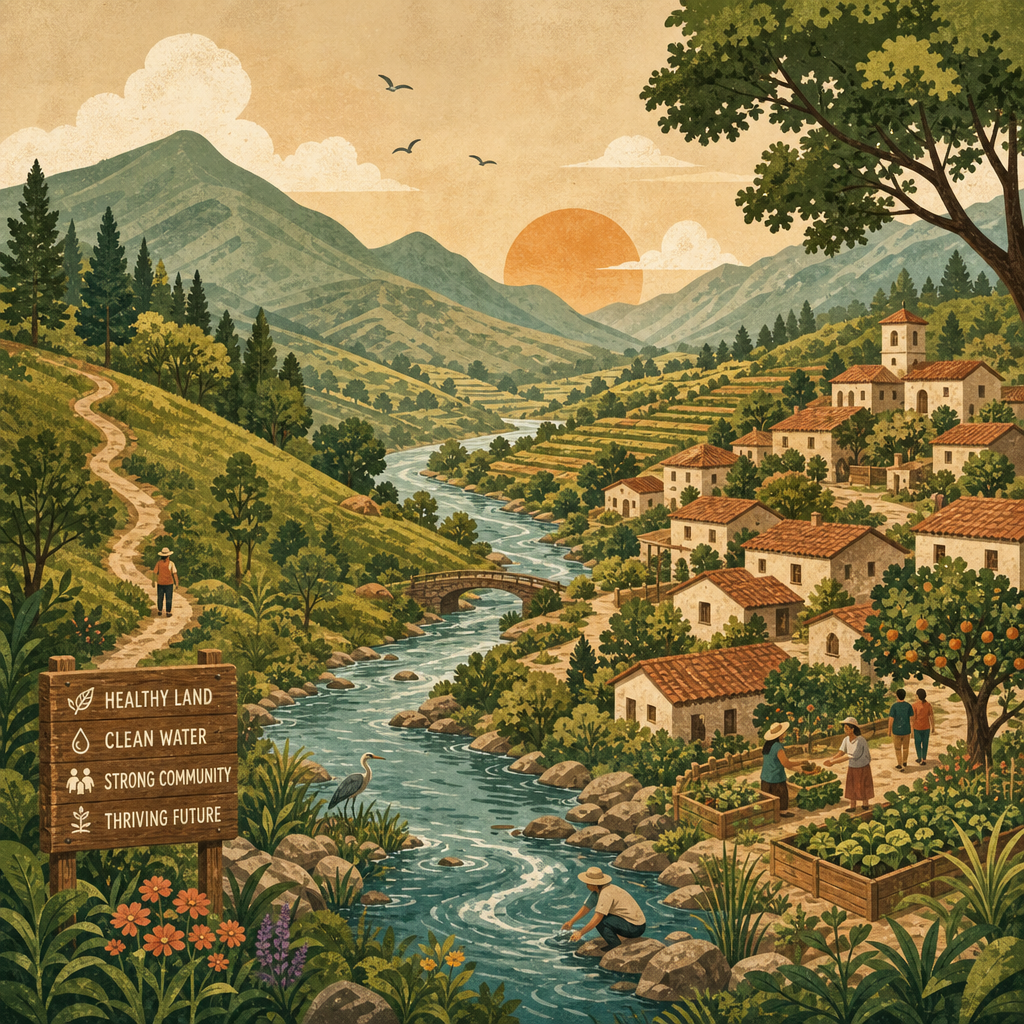
The watershed topo graphic created with Munya landed strongly with both Matt and Tori (06:00). Matt noted it feels like a "best of synthesis" of earlier inspiration, with one consideration: it leans 100% ecologically forward, where some prior references included nodes of human activity layered into the topography. Munya offered to expand the illustration with houses or human infrastructure elements if desired.
Tori connected the visual to the copy line "a watershed remembering itself" (32:00), noting the deep ecological stewardship arc paired with near-term focus on the hands, faces, and hearts showing up in the village. The team agreed Munya's expansion to include subtle human elements would help bridge those scales.
The "pick your scale" pathway visual (thousands, hundreds, dozens) prompted reflection on the fractal/Holon concept Revillage uses frequently (11:23). Rather than asking visitors to see themselves as "one of a thousand," the team aligned on reframing it as household → village → watershed — articulating the holon more naturally.
Between three hero variations, both Matt and Tori gravitated toward the terracotta option (33:48). Matt noted terracotta "represents that bridge between Earth and human" and ties nicely to Grayton Station. Tori appreciated its character, warmth, and the subtle texture suggesting soil and seashell erosion — hand of the maker. The greenest variant felt like it "tripled down" on the ecological reading already present elsewhere.
The team affirmed the rounded corner aesthetic across cards, with Matt describing it as "professional but very friendly" and a "nice nervous system feeling" compared to most websites (37:20). Light background color accents on cards were welcomed to help text pop while preserving the soft, image-forward feel.
James walked through how Christopher Alexander's pattern language is shaping the prototype's structure and intent more than its visual surface (13:28). The philosophy guiding the site:
Matt shared how Alexander's "quality without a name" has made a strong impression on his own work, and was moved to see it embedded as a measurable design principle for the site (39:50). He flagged that the "gifted" dimension is currently underbuilt and wants to figure out how to articulate it well, since gift and reciprocity have driven the project so far.
James also shared that he's weaving in Fernando Flores's action language alongside Alexander's pattern language (45:40) — asking what deeper, slower actions (sitting with, witnessing, communing, transforming) the UI can consciously design for, beyond the typical click/scroll/share patterns.
A new Field Notes page emerged as a way to keep the site alive without requiring blog-level commitment (15:00). Short, ~120-character updates from any team member — an event, a thought, a neighbor's idea — would surface what's currently engaged. Tori loved the format's lightness and proposed a parallel input channel where community members could contribute observations via a simple form feeding Airtable [tag="airtable"].
[technology="Community Facilitation Tools"]
The "pick your scale" contribution slider — showing what each tier enables — drew strong enthusiasm (18:43). The team is continuing with GiveButter for the foreseeable future, including an upcoming monthly-giving campaign called Friends of Grayton Public Spaces. Matt and Tori want to think through how the slider relates to specific campaign articulations (e.g., split allocations between programming and site maintenance).
James proposed automating GiveButter total updates via its API, or scheduling a daily Claude [tag="claude"] bot to refresh figures across the site (21:06).
[technology="Communication Automations"]
Tori appreciated how volunteering, events, and gatherings stack together on this page (21:50), and invited a participatory-by-design meta-treatment — perhaps a small sticky-note function inviting visitors to share skills, giveaways, or things that would light them up to offer in service of community. Matt agreed this addition would round out the page meaningfully, with the open question of how that input gets ingested.
Tori shared that the team is working with a photographer for Grayton Station's social channels and may expand that engagement, plus capture live community shots at an upcoming event (24:12). James affirmed every prototype placeholder can become a photograph or illustration, with some serving as background section treatments. A mix of genuine community imagery and stock is acceptable — the priority is avoiding a "stocky" feel.
James outlined the path forward (25:33):
The intent is to keep the process lean given budget and timeline constraints.
James shared his digital pattern language infographic — a work-in-progress that pairs Alexander's traditional patterns with digital translations and includes anti-patterns (memory disenfranchisement, fake activity indicators, roach motel UX), which Matt found especially powerful: "the shadow teaches the light" (45:06). 📄
James envisions this becoming a collaborative wiki updating Alexander's patterns and anti-patterns for the modern world, and invited Matt, Tori, and Spencer into that conversation. Matt — who was first introduced to Alexander by Spencer years ago — offered to be of service however helpful, noting this body of work is a major thread in what he's channeling these days.
James walked through his current research mode using Obsidian as a notes manager paired with Claude [tag="claude"] (48:57). By sharing folders directly with Claude, he can have the model research thinkers, generate interlinked files, and reference accumulated knowledge across blog posts and creative work — building persistent memory rather than relying on session threads. Switching models later remains easy because the brain lives on the local hard drive.
Matt expressed strong interest in porting from his current ChatGPT-based stack ("6 to 12 months into tech debt") to Claude + Obsidian, and would pay for that as a service (52:35). James floated training an AI or building a small course to support that transition. Tori echoed wanting to play with the same stack, especially as an alternative to questionnaire-driven AI branding tools that miss the felt, generative quality of the work.
The conversation closed with reflection on Anthropic's more ethical posture and the broader pressures of the AI race (55:04).
Matt Jorgensen
Tori Immel
James Redenbaugh
Matt opened with the timeliness pressure driving the website launch (02:35). A recent town hall drew roughly 100 community members, and the soft launch of the Grayton Station crowdfund is beginning today via QR codes and printed logos, with a public push and press planned around May 13th. As more curious, arm's-length observers begin engaging in late May, the website needs to crisply articulate how the various entities — the business, the town square, the place-based public council, and the foundation — relate to each other. Rather than relying on words and diagrams in conversation, the team wants to point people to revillageearth.org/our-work for clarity.
Matt and Tori expressed deep appreciation for James's creative output and capacity to weave heart into the work, noting how the Figma explorations and prototype are inspiring fresh articulations of what Revillage is doing.
The watershed topo graphic created with Munya landed strongly with both Matt and Tori (06:00). Matt noted it feels like a "best of synthesis" of earlier inspiration, with one consideration: it leans 100% ecologically forward, where some prior references included nodes of human activity layered into the topography. Munya offered to expand the illustration with houses or human infrastructure elements if desired.
Tori connected the visual to the copy line "a watershed remembering itself" (32:00), noting the deep ecological stewardship arc paired with near-term focus on the hands, faces, and hearts showing up in the village. The team agreed Munya's expansion to include subtle human elements would help bridge those scales.
The "pick your scale" pathway visual (thousands, hundreds, dozens) prompted reflection on the fractal/Holon concept Revillage uses frequently (11:23). Rather than asking visitors to see themselves as "one of a thousand," the team aligned on reframing it as household → village → watershed — articulating the holon more naturally.
Between three hero variations, both Matt and Tori gravitated toward the terracotta option (33:48). Matt noted terracotta "represents that bridge between Earth and human" and ties nicely to Grayton Station. Tori appreciated its character, warmth, and the subtle texture suggesting soil and seashell erosion — hand of the maker. The greenest variant felt like it "tripled down" on the ecological reading already present elsewhere.
The team affirmed the rounded corner aesthetic across cards, with Matt describing it as "professional but very friendly" and a "nice nervous system feeling" compared to most websites (37:20). Light background color accents on cards were welcomed to help text pop while preserving the soft, image-forward feel.
James walked through how Christopher Alexander's pattern language is shaping the prototype's structure and intent more than its visual surface (13:28). The philosophy guiding the site:
Matt shared how Alexander's "quality without a name" has made a strong impression on his own work, and was moved to see it embedded as a measurable design principle for the site (39:50). He flagged that the "gifted" dimension is currently underbuilt and wants to figure out how to articulate it well, since gift and reciprocity have driven the project so far.
James also shared that he's weaving in Fernando Flores's action language alongside Alexander's pattern language (45:40) — asking what deeper, slower actions (sitting with, witnessing, communing, transforming) the UI can consciously design for, beyond the typical click/scroll/share patterns.
A new Field Notes page emerged as a way to keep the site alive without requiring blog-level commitment (15:00). Short, ~120-character updates from any team member — an event, a thought, a neighbor's idea — would surface what's currently engaged. Tori loved the format's lightness and proposed a parallel input channel where community members could contribute observations via a simple form feeding Airtable [tag="airtable"].
[technology="Community Facilitation Tools"]
The "pick your scale" contribution slider — showing what each tier enables — drew strong enthusiasm (18:43). The team is continuing with GiveButter for the foreseeable future, including an upcoming monthly-giving campaign called Friends of Grayton Public Spaces. Matt and Tori want to think through how the slider relates to specific campaign articulations (e.g., split allocations between programming and site maintenance).
James proposed automating GiveButter total updates via its API, or scheduling a daily Claude [tag="claude"] bot to refresh figures across the site (21:06).
[technology="Communication Automations"]
Tori appreciated how volunteering, events, and gatherings stack together on this page (21:50), and invited a participatory-by-design meta-treatment — perhaps a small sticky-note function inviting visitors to share skills, giveaways, or things that would light them up to offer in service of community. Matt agreed this addition would round out the page meaningfully, with the open question of how that input gets ingested.
Tori shared that the team is working with a photographer for Grayton Station's social channels and may expand that engagement, plus capture live community shots at an upcoming event (24:12). James affirmed every prototype placeholder can become a photograph or illustration, with some serving as background section treatments. A mix of genuine community imagery and stock is acceptable — the priority is avoiding a "stocky" feel.
James outlined the path forward (25:33):
The intent is to keep the process lean given budget and timeline constraints.
James shared his digital pattern language infographic — a work-in-progress that pairs Alexander's traditional patterns with digital translations and includes anti-patterns (memory disenfranchisement, fake activity indicators, roach motel UX), which Matt found especially powerful: "the shadow teaches the light" (45:06). 📄
James envisions this becoming a collaborative wiki updating Alexander's patterns and anti-patterns for the modern world, and invited Matt, Tori, and Spencer into that conversation. Matt — who was first introduced to Alexander by Spencer years ago — offered to be of service however helpful, noting this body of work is a major thread in what he's channeling these days.
James walked through his current research mode using Obsidian as a notes manager paired with Claude [tag="claude"] (48:57). By sharing folders directly with Claude, he can have the model research thinkers, generate interlinked files, and reference accumulated knowledge across blog posts and creative work — building persistent memory rather than relying on session threads. Switching models later remains easy because the brain lives on the local hard drive.
Matt expressed strong interest in porting from his current ChatGPT-based stack ("6 to 12 months into tech debt") to Claude + Obsidian, and would pay for that as a service (52:35). James floated training an AI or building a small course to support that transition. Tori echoed wanting to play with the same stack, especially as an alternative to questionnaire-driven AI branding tools that miss the felt, generative quality of the work.
The conversation closed with reflection on Anthropic's more ethical posture and the broader pressures of the AI race (55:04).
Matt Jorgensen
Tori Immel
James Redenbaugh
Review and comment on website copy doc and prototype by end-of-day Monday
Matt to review and comment on the website copy doc and prototype by end-of-day Monday. Referenced at (07:51).
Add ideas for participatory 'share what's alive for you' feature on Get Involved page
Matt to add ideas for the participatory sticky-note-style feature on the Get Involved page where visitors can share skills, giveaways, or things that would light them up to offer. Referenced at (23:00).
Sit down with Tori to align donation slider with specific campaign articulations including Friends of Grayton split allocations
Matt and Tori to align on how the donation slider on the website relates to specific campaign articulations, e.g., split allocations between programming and site maintenance for Friends of Grayton Public Spaces. Referenced at (20:30).
Explore porting from ChatGPT stack to Claude + Obsidian workflow
Matt expressed strong interest in migrating from current ChatGPT-based stack to Claude + Obsidian workflow and would pay for that as a service. Referenced at (52:35).
Lead development and refinement of website copy doc by end-of-day Monday
Tori to lead development and refinement of the website copy doc by end-of-day Monday. Referenced at (08:01).
Coordinate photography for upcoming community event with shot list aligned to website needs
Tori to coordinate with the photographer working on Grayton Station social channels to capture live community shots at an upcoming event, aligned to website needs. Referenced at (24:12).
Plant participatory-by-design seed into Get Involved page copy and design notes
Tori to incorporate participatory-by-design framing into the Get Involved page copy and design notes, including the sticky-note-style community input concept. Referenced at (22:30).
Download Obsidian and begin experimenting with Claude + Obsidian AI research workflow
Tori to download Obsidian and begin experimenting with the Claude + Obsidian AI research workflow as an alternative to questionnaire-driven AI branding tools. Referenced at (53:30).
Produce final prototype wireframe with image and asset notes once copy is locked
James to produce the final prototype serving as the wireframe, with image and asset notes, once copy doc is completed by Matt and Tori. This serves as the basis before moving into Webflow build. Referenced at (27:00).
Coordinate with Munya on expanding watershed illustration to include subtle human infrastructure elements
James to coordinate with Munya (Moenja Schijven) on expanding the watershed topo illustration to include subtle human infrastructure elements such as houses, to bridge the ecological and human scales. Referenced at (31:13).
Explore GiveButter API integration or scheduled Claude bot to keep fundraising totals current on website
James to explore automating GiveButter donation total updates via its API or a scheduled Claude bot to refresh fundraising figures across the site automatically. Referenced at (21:06).
Share digital pattern language infographic links and invite Matt, Tori, and Spencer into the collaborative project
James to share the digital pattern language infographic links with Matt, Tori, and Spencer and continue inviting them into the collaborative wiki project updating Alexander's patterns and anti-patterns for the modern digital world. Referenced at (40:57).
Consider building short course or AI agent to help others port AI stacks to Claude + Obsidian
James to consider building a short training course or AI agent to help individuals and organizations migrate from ChatGPT-based workflows to Claude + Obsidian stack, given Matt's expressed interest in paying for this as a service. Referenced at (53:00).
Design and build a new Webflow website for Revillage Foundation to replace existing Squarespace site. Inspired by Shorefast model with clean structural clarity combined with The Ecology Center's vibrancy and approachability. Building a versatile backbone that can support connected but distinct sub-sites over time - an ecology of brands approach.
Core page architecture restructured (25:11) to center dual-entity clarity: Foundation and Development pulled up to top-line navigation as distinct pages, Mission and About consolidated into single About page, dedicated Projects page showcasing flagship initiatives like Grayton Town Square and cafe. Homepage serves two primary user flows: (1) action-oriented visitors arriving via QR codes who need quick navigation to specific destinations, and (2) inspired newcomers with no context who need enough signal about the larger vision to feel drawn deeper.
Homepage features portal/doorway shape hero section evoking Christopher Alexander pattern language. Terracotta color confirmed at hex #B55633 (10:07) - represents bridge between Earth and human, ties to Grayton Station, provides warmth and hand-of-maker texture feeling. First section after hero helps visitors orient: why are they here, what do they want, what depth are they looking for.
Watershed topography illustration identified as one of three critical signature graphics (36:46) - will be expanded to include subtle human infrastructure elements layering human activity into ecological reading. Three-dimensional horizon visualization to show layered timeline: café (present), town square (near future), future projects as shapes on horizon. Foundation × Development relationship diagram makes business/nonprofit relationship instantly legible. Progressive disclosure approach inspired by Naia Trust investments page precedent.
Projects page uses flexible tile-based grid (44:00) where some tiles link to internal subpages, some link to standalone project sites (e.g., Grayton Station), some are static coming-soon placeholders. Tile sizes can vary within grid to give landmark projects more real estate.
Rounded corner aesthetic across cards affirmed (37:20) - professional but friendly, good nervous system feeling. Light background color accents on cards to help text pop while preserving soft, image-forward feel. Mission language organized around six core convictions as potential website pillars with icons: (1) Joyful by Nature, (2) Rooted in Place, (3) Layered by Design, (4) Tangible Before Theoretical, (5) Bridging Worlds, (6) New and Ancient Coherence. Key through-line: 'Joyful by nature, participatory by design.'
Design approach shifted from philosophical manifesto to tangible-first - lead with visible reality of work (cafe, town square, events) and let deeper philosophy emerge through exploration. Visual language: terracotta primary brand color (#B55633), oat milk companion, black grounding neutral, blues/yellows as seasonal accents. Portal/threshold framing devices, curvilinear patterns, earth-from-above imagery, hand-feeling imperfection aesthetic. Integrating geodesic/organic architecture references and cultural glyphs - grounded solarpunk aesthetic.
Typography: Primary typeface I am Fel DW Pika (Google Font) for headlines and body (05:07). Secondary pairings: Baskerville, Montserrat, Open Sans, or Inter for menus and supporting assets.
Future projects (housing, farming, wholesale processing, sauna club) presented with progressive disclosure - balancing transparency for solarpunk philanthropists while respecting community input process. Partner section shows both local Sonoma County relationships and global organizational connections. Bilingual accessibility through Webflow Locales feature.
Donate/Contribute/Support page features sliding scale contribution interface with Stripe integration - drag slider to choose amount, paid once/monthly/annually (18:43). Page encompasses donations, investment conversations, gifts of land/assets, legacy bequests, and volunteering time. Slider shows what each tier enables. Integration with GiveButter for foreseeable future, including upcoming Friends of Grayton Public Spaces monthly-giving campaign.
Get Involved surfaces: attending events, volunteering/co-creating, deeper commitment pathways. Events linked to existing platforms (Eventbrite/Partiful) initially, with option for custom event CMS later. Participatory-by-design meta-treatment being added - small sticky-note function inviting visitors to share skills, giveaways, or things that would light them up to offer in service of community (22:30).
Process shift (28:32): Moving into Webflow build earlier rather than perfecting copy in Google Docs first. Team will workshop copy directly in Webflow, leaving comments on design elements needing adjustment. This allows testing sentence length, rhythm, and visual fit against live site rather than switching between docs and prototype.
Design philosophy guided by Christopher Alexander's pattern language (13:28) - lean into generosity, move away from pressured CTAs, create entryways and approaches that invite landing, honestly display who team is and what's alive. Also weaving in Fernando Flores's action language (45:40) - designing for deeper, slower actions (sitting with, witnessing, communing, transforming) beyond typical click/scroll/share patterns. Measuring against Alexander's 'quality without a name' as design principle (39:50).
Timeline pressure driven by crowdfund launch this week and community nonprofit fundraising festival in two weeks (34:00). Recent community town hall surfaced questions about who Revillage is and how moving parts relate - making basic site (especially homepage and foundation/development pages) genuinely time-sensitive. Target launch: May 27th, before James departs for Portugal.
Finalize Grayton Station botanical logo mark and comprehensive brand identity system. Square logo version with finer leaf linework and updated mountain fill confirmed as primary direction (11:43). Team needs PNG and SVG exports across all color variants except sage (which is still being workshopped), with versions both with and without paper texture overlay (04:48). Isolated icon exports and star favicon asset required (13:24).
Horizontal monument sign for physical site needs refinement (14:18) - rebalance proportions to make 'Coffee Culture Kitchen' more prominent for distance legibility (15:29). James prefers oval treatment over literal rotation of vertical lockup, with thinner and more rounded linework for signage application (19:21). Sign builder quotes being sourced by Nika (17:17).
Typography system finalized: Primary typeface I am Fel DW Pika (Google Font) works for both headlines and body copy (05:07). Secondary font pairings for menus and supporting assets: Baskerville (versatile serif), Montserrat (modern sans-serif, Tori's favorite), Open Sans or Inter (clean readable alternatives).
Comprehensive brand color palette: Terracotta confirmed as primary brand color at hex #B55633 (10:07) - consistent since early firehouse heritage conversations, represents bridge between Earth and human. Paired with oat milk as standard companion and black as grounding neutral. Blues and yellows available as seasonal/contextual accents. Concept of limited-edition colorways for future merchandise.
Distinctive visual language and brand guidelines covering: curvilinear/flowing forms, hand-feeling imperfection, earth tones with less stark contrast, geodesic/organic architecture references, earth-from-above imagery, cultural glyphs and ancient markings integration, fractal but grounded (not digitally trippy) aesthetic. Working aesthetic anchor: 'grounded solarpunk'. Portal/doorway shapes emerging as compelling visual device.
Guidelines must address multi-generationally aspirational positioning while maintaining tangible rooted-in-now expression - speaking to spectrum from local community members to solarpunk funders. Avoiding spiritual bypass/Mexico City boutique hotel aesthetic in favor of lived-in, rooted feeling.
Using hand-drawn sketching to develop visual and verbal ideas, distilling brand ecology into early website concepts. Logo finalization critical for sign fabrication (wooden form with vector projection, jigsaw cut or CNC approach). Complete brand purpose questionnaire analysis to extract alignment threads. FigJam board with website precedents, mood board images, and inspiration informing direction.
Commission professional photography to support new website launch. Current photography library reflects earlier, scrappier season of project and may not carry the polished new site effectively. Develop comprehensive shot list based on emerging site architecture and design direction.
Explore extracting high-quality stills from existing professional video content with help from videographers Spencer and Nico - though raw YouTube exports won't meet quality standards. Assessment needed: what exists and can be repurposed versus what needs fresh commissioning.
Shot list should reflect finalized aesthetic vocabulary: hand-feeling imperfection, earth tones, imagery of earth and people in relationship, cultural and place markings, lived-in and rooted feeling. Priority on showing the tangible reality of the work - the cafe, town square, events, community in action - rather than aspirational or overly polished aesthetic. Balance budget considerations between commissioning now versus later phases.
Refine and finalize mission articulation and core website content through collaborative editing process. Working from AI-generated draft organized around six core convictions, refining with human voice and team input to balance clarity with joyfulness, sturdiness with accessibility.
Six conviction framework serving as potential website pillars: (1) Joyful by Nature - transformation lives through simple human technologies and pleasure of showing up, (2) Rooted in Place (with listening theme) - beginning with what's real and present, asking what specific place calls for, (3) Layered by Design - meeting people where they are across levels of engagement, (4) Tangible Before Theoretical - building real things: gathering spaces, food systems, rituals of easy togetherness, (5) Bridging Worlds - holding entrepreneurial rigor alongside activist heart, financial clarity alongside spiritual depth, (6) New and Ancient Coherence - drawing on emerging and ancestral ways of knowing; genuine interbeing deepens rather than diminishes sovereignty.
Key through-line identified: 'Joyful by nature, participatory by design.' Mission language must carry sturdiness and clarity while also conveying the genuine sweetness and accessibility of the work - simple human technologies like stone soup, shared soil, long table. Avoiding spiritual bypass while honoring depth. Balance between transformation and joy, remembering interbeing while holding individual sovereignty.
Framing shifted to household → village → watershed holon concept (11:23) rather than asking visitors to see themselves as "one of a thousand" - articulating the fractal/holon more naturally.
Scalability framing: not exported model or template but dandelion seeds catching the wind - plural models, inspiring synthesizer rather than replicable playbook. 'Adopt and adapt' rather than franchise approach.
Content development workflow: full site prototype converted to Google Doc for collaborative editing, allowing Matt and Tori to directly refine language, add image references, and layer aesthetic direction notes. Matt and Tori to complete copy doc by end-of-day Monday (07:51). AI (Claude) being used as co-creative tool to tune into frequency of project and help team see organization more deeply, with human editing pass to remove AI patterns (em dashes, 'this isn't X but Y' constructions) that flatten voice.
Gifted dimension currently underbuilt (39:50) - need to articulate how gift and reciprocity have driven the project. Copy line 'a watershed remembering itself' (32:00) connects ecological stewardship arc with near-term focus on hands, faces, and hearts showing up in village.
Scope includes refining: About page language (place-based, person-present, patient orientation), partner section framing, progressive disclosure language for future projects, Get Involved/Contribute page content, and overall narrative arc across site.
Design and develop participation pathways and community listening infrastructure for Revillage website. Create intake system where community members can share what makes them most alive, their gifts, and how they want to contribute. Build smart matching capability using AI to connect volunteers to opportunities behind the scenes based on their expressed interests and capacities.
Explore interfaces for submitting dreams and ideas with collective visualization - potentially using generative collage, honeycomb patterns, or other organic forms that reflect the participatory place-making ethos. Core philosophical framing: moving from cultural individualism back into choiceful relationship - rebuilding conditions for genuine community, belonging, interdependence, and place-based connection. System should embody the vision of 'joyfully remembering our interdependence with each other and the living earth' where joy is primary, remembering (not inventing) is the mode, and human-to-human and human-to-place relationships are co-equal.
Consider physical touchpoint (tablet in shipping container at Town Square or Grayton Station) for non-digitally native community members to ensure broad accessibility. Potentially refresh and digitize 2023 community design survey data (150 resident responses) as foundation for understanding existing community voice.
System serves as ongoing listening device for the village, making participation invitations feel special and matched to individual gifts rather than generic volunteer asks. Supports true participatory place-making where many people's hands are genuinely on the work - a barn-raising ethos where the project couldn't have happened any other way. Long-term hope is that two generations from now, people won't leave because the fabric was built by the people who belonged to it.
Listening identified as underrepresented theme in current mission language - this system embodies that commitment to genuine responsiveness rather than projection. Tied to 'Rooted in Place' conviction and the three-layered engagement model: core stewards (dozens), co-creators/volunteers (hundreds), event participants/local commerce (thousands). Even outermost ring should feel genuine intimacy and invitation, not a sense of being sorted into tiers.
Develop lightweight Field Notes page and content system to keep website alive without requiring blog-level commitment (15:00). Short, ~120-character updates from any team member - an event, a thought, a neighbor's idea - would surface what's currently engaged. Format's lightness allows casual community voice sharing.
Parallel input channel where community members can contribute observations via simple form feeding Airtable (15:00). Creates participatory documentation stream showing what's alive in the village week to week. Alternative to traditional blog that feels more accessible and authentic to team's workflow.
Supports Christopher Alexander's pattern language principle of making the site alive and generous - showing honest reality of where team is at and what's engaged rather than curated marketing content (13:28). Ties to broader participatory-by-design ethos and community listening infrastructure.
Implementation through Webflow CMS collection synced with Airtable via Whalesync. Simple form interface for both team and community submissions. Potential for AI moderation or curation support using Claude to maintain quality while keeping submission barrier low.
Develop training course or AI agent to help individuals and organizations migrate from ChatGPT-based workflows to Claude + Obsidian stack (52:35, 53:00). James demonstrated research mode using Obsidian as notes manager paired with Claude - sharing folders directly with AI model to build persistent memory and interlinked knowledge base rather than relying on session threads (48:57).
Matt expressed strong interest in porting from current ChatGPT stack (described as '6 to 12 months into tech debt') to Claude + Obsidian, and would pay for this as a service (52:35). Tori also interested in experimenting with same stack, especially as alternative to questionnaire-driven AI branding tools that miss felt, generative quality of the work (53:30).
Potential deliverables: short course walking through migration process, template Obsidian vault structure, AI agent that helps with setup and knowledge transfer, documentation of best practices James has developed. Could serve broader market of practitioners wanting more ethical AI stack (Anthropic vs OpenAI) with better knowledge persistence and local control.
Represents potential service offering for Iris Cocreative beyond one-off client request. Ties to larger questions about AI tooling for consciousness-focused work and maintaining human agency while leveraging AI assistance. Conversation included reflection on Anthropic's more ethical posture and broader pressures of AI race (55:04).
Matt and Tori immediate clients for this work, but scalable to other purpose-driven organizations in Iris network.
00:00:01
Matt Jorgensen: This meeting is being recorded.
00:00:16
James Redenbaugh: Hi Tori. James, can you hear me? Yeah. Hey,.
00:00:26
Matt Jorgensen: I'll be home in five minutes. Thanks for the flexibility.
00:00:31
James Redenbaugh: No problem.
00:00:32
Matt Jorgensen: How's your day and week going?
00:00:36
James Redenbaugh: Pretty good. It's been a long one.
00:00:40
Matt Jorgensen: Yeah, same here. It's something this time of year. You know, my wife works in schools and they call it the hundred days of May and so we're on day one of it. But just this, this April, May time is, you know, I think it's full for every, every living being.
00:01:04
Tori Immel: Yeah, it's been alive in your week, James.
00:01:09
James Redenbaugh: Are you in a cafe?
00:01:11
Tori Immel: Yeah. Can you hear me okay?
00:01:13
James Redenbaugh: Yeah, yeah.
00:01:14
Matt Jorgensen: You might just mute when you're not talking.
00:01:16
Tori Immel: Yeah, happy too. I was just asking what's been alive for your week, James.
00:01:22
James Redenbaugh: Been getting into some pottery. Taking pottery class with my wife. Other than that I've been at the computer pretty much trying to finishing up a woodworking project too I guess. But lots of, lots of AI stuff. Lots of computer tasks this week. Looking forward to maybe getting out into nature this weekend.
00:01:52
Tori Immel: Yeah, that does sound glorious. That's awesome.
00:01:57
James Redenbaugh: How about for you?
00:02:03
Tori Immel: I feel like I've really been seeing the trees this week, all the redwoods on my lantern looming a lot. Just been jumping in the sauna and tons of laptop time as well. We did host a super sweet town hall on Wednesday night though and had probably like 100 folks from the community and beyond come out. Yeah, that was really just heart filling and amazing to see how engaged folks are.
00:02:32
James Redenbaugh: Yeah, awesome.
00:02:35
Matt Jorgensen: And it, and it elevated the timeliness for us to get our new website live with a clear articulation of, you know, what's current, what we're up to and how the various entities relate to each other. Because the vast majority of people are just super stoked this stuff's happening but there are some skeptics that are like wait, so you have a business and how's it related to the town square and the place public council and how's it related to the foundation and who's on the boards and you know, it's like you can use words and to a certain extent diagrams in those circumstances but you know, the easiest thing would just be yeah, look, go to everyvillage earth our work and it's all going to be crystal clear, you know. And so I was feeling very exciting and timely and we're just today actually entering into soft launch on our crowdfund for Grayton Station. And so put out some QR codes early, early morning this morning referring people to the we funder page and actually like sharing our logo in printed form for the first time. And so we'll launch that publicly hopefully along with some press and such on May 13th or thereabouts. And so regardless of whether or not the website is done by. Exactly. Then we're expecting the latter half of May to start to just have a lot more eyeballs as we kind of push that out there. And there's a lot more curious, maybe slightly arm's length people trying to figure out who we are and what we're up to. So, yeah, I think we're right on time with all of it. And Tori and I are just kind of stunned and grateful and inspired by your capacity for creativity and, and output wrapped in some heart. You know, it's. It's just incredible to see the fig, the figma and, and the way you work. And I think it's going to inspire for us new and crisp articulations of what we're doing. Great.
00:05:05
James Redenbaugh: Glad to hear. Thanks so much.
00:05:10
Matt Jorgensen: I also love that. I love your. I haven't gone down the rabbit hole of your rabbit hole on pattern language, but I love, I love, I kind of just love people that can't help themselves with rabbit holes. I know that can be a blessing and a curse and I share it. But it's like, I really, I love that you just get inspired by stuff and you like, look, look up six hours later probably and are like, oh, wow, I really got down into Alice in Wonderland here.
00:05:39
James Redenbaugh: Yeah.
00:05:40
Matt Jorgensen: Yeah.
00:05:41
James Redenbaugh: Now I feel like I have to create this whole collaborative website around digital pattern language.
00:05:49
Tori Immel: Yes. I cannot wait to deep dive on that.
00:05:52
Matt Jorgensen: I feel like the burdens of genius.
00:05:55
Tori Immel: The Edge effect. So good.
00:05:59
James Redenbaugh: I can't believe I haven't done it before. Yeah, a lot of fun stuff is, is coming out of it and it just makes so much sense. Like, oh yeah, duh, why haven't I.
00:06:12
Matt Jorgensen: This way Totally makes so much sense. Yeah.
00:06:15
James Redenbaugh: Yeah. So what do you guys think of the prototype? You know, also with. With that involved, I feel like that helped me take it to a next level and introduce some new elements. And I'm curious if you've had time to go through it and see the copy doc, maybe work on it. How are things going there?
00:06:42
Matt Jorgensen: Have not worked on copydoc and planning to over the weekend and really by end of day Monday, I think we're hoping to both have had some time with it and have looked both at the prototype and the figjam, which seems. Seems like you've only partially integrated some of the figjam creative into the prototype unless you updated it in the last day or two. Or day or day. But from what I saw, and I'll have it open in another couple minutes. I'm incredibly amped and really loving the. The visual language and that watershed topo graphic that you and maybe Mona have worked on and yeah, I'm just like, I'm feeling really inspired and stoked.
00:07:51
James Redenbaugh: Great. Awesome.
00:07:55
Tori Immel: Yeah, I think similarly, I think just enjoying the process of.
00:08:01
Matt Jorgensen: Yeah.
00:08:01
Tori Immel: Like the map, the Mac making capacity and then also like the. The meme language. Like it really is bringing it to life for me with the visuals certainly on the, on the Figma board, but also just in relationship on the website. Yeah, I'm really excited to get into copy and put our fingers on that and then, you know, see what comes out the other side once it's all kind of layered in. Yeah. And I feel like I was also noticing that there's been some, some pretty awesome work over on the actual RE village. Like over in frame two. Let me see if I can click on the Figma just with the RE Village logo itself. It's cool to see it in these beautiful aligned colors and I'm actually digging the typography switch up as well. So. Kind of curious. Yeah. Matt, when you get to your computer, how that's landing. We actually haven't talked about that. But I think one thing that was coming up for me in this process was. Yeah. Just looking at the logo that we have now and like how to find some like blended cohesion with maybe keeping some of the spirit of that. So that was really exciting to see. Thank you.
00:09:23
James Redenbaugh: Yeah, I think the logo has a lot, a lot going for it and we can find some better uses, better ways to use it. I really like it without the white background on the hands when it's just two colors and the negative space becomes transparent. I think it's working well on these, on these mock ups. Fun to see it in different colors also.
00:10:04
Tori Immel: Okay. No, go for it.
00:10:08
James Redenbaugh: I was just going to clarify, Matt, you mentioned the FigJam board.
00:10:19
Matt Jorgensen: Yeah.
00:10:19
James Redenbaugh: But we don't have a FigJam for this project or Figma.
00:10:25
Matt Jorgensen: Yeah, yeah, Figma.
00:10:26
James Redenbaugh: We just have this Figma board.
00:10:28
Matt Jorgensen: Yeah. Cool.
00:10:30
James Redenbaugh: I just want to make sure I'm not. You guys haven't put something for this project on a FigJam board that I'm not seeing?
00:10:37
Matt Jorgensen: No.
00:10:37
James Redenbaugh: Okay, great.
00:10:39
Matt Jorgensen: Let me.
00:10:41
Tori Immel: The. The one thing was seen as this kind of zone. I don't know if I can click in, but the pathways at different depths, thousands, hundreds, dozens. I'M digging the visuals on that, like, very, very much so. And I'm kind of curious how we can layer in a concept there. Yeah, I think I can't. I was having a memory that when we chatted, the first turn on this, that we were, like, feeling slightly less resonant with, like, trying to help folks, like, stack into, like, seeing themselves as like, one of a thousand. So didn't know if that was, like, a placeholder here. We can do some creative thinking around that and, you know, if it is resonating now or we want to switch up.
00:11:23
Matt Jorgensen: I think it's a cool visual and I wonder, like, about just different ways we could articulate it. Like, I think the spirit of it is the fractal concept that we. That we use a lot or the Holon concept. And so maybe it's actually looking at, like. I don't know how explicitly we want to label it, but I see, like, you know, household, village, watershed. You know, there's a bunch of different ways we could articulate the Holon, and I think that that is an important part of what we're representing.
00:11:56
James Redenbaugh: Yeah, I had the same thought. It ended up in the prototype, even.
00:12:00
Matt Jorgensen: Though.
00:12:03
James Redenbaugh: I thought it was more of an internal framing. And then Munia ended up making this diagram. But then seeing it, I thought, like, oh, this could be cool to represent something, but not this.
00:12:17
Tori Immel: Love it. Same brain. Perfect. So where does this in living in your process, James? Like, and kind of jumping on and chatting through just like, you know, loving it. And then, like, are you wanting to do, you know, like, more visuals or. I'd kind of be curious as, like, a second question to that is, like, where the Christopher Alexander pieces, like, where you're kind of, like, tracking that within some of these visuals just so I could fill your artism and beauty in that.
00:12:56
James Redenbaugh: Yeah, yeah. So in here, we're mainly playing with what a style can look like, you know, and it's just iterations on the homepage and these different sections, the Christopher Alexander stuff. More came into play in the prototype of the whole site and how I'm thinking about that. I'm going to share that screen real quick.
00:13:28
Matt Jorgensen: My video is kind of fritzing out.
00:13:37
James Redenbaugh: And then. So we'll use FIGMA to kind of hone in on the style and imagery, but we won't mock up all the pages there. And we'll use this prototype to see the whole of the site and the different sections and what they're doing. The work around Christopher Alexander is largely about the structure and the purpose of the site and what we're asking people to do, it's less about the, the visuals or at least I just haven't, haven't thought about that yet. It's more about the philosophy of how we want to engage people. So like, I think it's, I think it would be advantageous to, to lean into like generosity. What, what can we give away? How can we make that transparent and lean away from like pressured calls to action or you know, inducing any kind of emotion to get people to take the action. We want more inviting. Creating an entryway, creating an approach, creating space for people to land and just like honestly displaying who you guys are, where you're at, what you're working on, what's alive. One idea that came up is this Fields Notes page, which is a new concept which would kind of be like a simple, you know, it's not even quite a blog and it's not a Twitter feed because, because it's not connected to Twitter. But it could be a way for anybody on the team to share a simple update. We had a little event, we had a thought, we had an idea, A neighbor shared this concept. Something is alive and happening and this isn't an idea that we thought of months ago and then forgot to revisit, but it's something that's engaged every day. Not that you have to post something every day, but if once a week like a new field note pops up, it just brings some, some life to the site.
00:16:16
Tori Immel: Can I jump in with you here on this one and just say I love this so much. I think it's so amazing and I've been feeling like as we've been dipping a little bit into like newsletter pieces, like just wanting to be really mindful of current, you know, capacity and not like over committing to like biweekly emails and seeing like most of these being like 120 character count with a two word like thing. I was like, I could do that. We could have a Slack channel and we could just pop them in there. And also curious to if you've done this with other organizations or played around with this. Personally, I put in the, the Google Copy Doc, like it could be amazing to have like a sub vein or not a sub but like a parallel vein of like a, you know, an airtable Google form essentially where community members could also be like in their observance of the rhythm of the, of the space and community itself unfolding. So thank you for this. This was like, I was like elated to read this and just understand the format and also just really incredibly beautiful writing.
00:17:20
James Redenbaugh: It's like awesome. That was another idea actually of how can we harvest input on the website either to feed something like this and. Or to gather data on the community and what they want to see and what's important to them. So it, you know, it can be a simple form and it can populate an airtable or something like that and then that. That could become any number of things moving forward. But definitely, I think that's one simple way that people can get involved is just sharing something like that so you can think about that and then on the contribute. That's really cool. We have this pick your scale slider and so beautiful. Yeah, it'll tell you like what your contribution can do.
00:18:43
Tori Immel: That is so amazing. Yes.
00:18:46
James Redenbaugh: So, yeah, I thought that was pretty neat.
00:18:51
Tori Immel: Wow. Oh, I'm excited about this. That's amazing. That's for monthly too. This is incredible. Yes, I'm excited to dream into that. I've never seen a website that's done that.
00:19:06
Matt Jorgensen: Wow, that is so sick.
00:19:10
James Redenbaugh: Thanks.
00:19:13
Matt Jorgensen: Yeah, that's just incredible. I really love that.
00:19:19
James Redenbaugh: Great.
00:19:25
Matt Jorgensen: Oh, that's. That's neat. You pulled it in and is that you're like able to live scrape, Give Butter.
00:19:38
James Redenbaugh: I haven't figured out how to do that yet. Right now it's just static.
00:19:43
Matt Jorgensen: Yeah.
00:19:43
James Redenbaugh: But maybe we could do that.
00:19:49
Matt Jorgensen: Yeah. It's not hugely critical necessarily, but it would be cool. And we are going to keep. We are going to keep using Give Butter I think for the foreseeable future for different. Like we're about to start a new campaign that's more around monthly giving that's probably going to be called like Friends of Great in public spaces where we try to get people that are more so in like a booster club type of thing. But yeah, it doesn't necessarily need to. I think we need to sit down a little bit and think about how for example, that slider wants to relate to a campaign articulation of things. And that campaign will be sort of going to probably a shared fund between us and the town or like half of it is allocated for our work, the programming and half of it's allocated for site maintenance and stuff. And so yeah, we just have to. There's. There's a lot of moving parts, but these different views of it are really inspired and I think will. Will get people feeling differently about engaging.
00:21:06
James Redenbaugh: Yeah. Cool. If gitbutter probably has an API we could use to automate this, but we could also schedule a Claude bot once a day to update this and other ones that you have Going. So that'll. Because that would be cool to see here.
00:21:40
Matt Jorgensen: Yeah.
00:21:47
Tori Immel: So I was. I was really admiring the get involved page too. I feel like I really enjoy kind of like the. The stacking function of like volunteering being right next to all of the events and gatherings. Right now we have it as like a calendar and then, you know, it's kind of just like living more in. In our newsletter communications of how people can participate and get involved.
00:22:14
James Redenbaugh: Yeah.
00:22:15
Tori Immel: So I think this is something like as I really kind of like get into the copy and you know, I'm taking in the deep inspiration and like interactivity of the website as a whole. And Matt, just kind of inviting you and James, given your genius and just wherewithal within all of these spaces. One thing I think I'm really curious is just to bring in that participatory by design. How do we model it on this page in a really meta way, even if it's small and maybe not as designed out like what we were talking about of the putting a sticky note essentially on the whiteboard of this page and that being a different design process with you. But yeah, just curious to plant that seed with. With both of you and myself.
00:23:05
Matt Jorgensen: I mean the what James was just hovering over. I feel like with the addition of sort of like one little almost sticky boarding function, it would feel to me very like it already feel that it feels participatory by design. Looking at it in this articulation of like, oh, there's all these different things that are just that being done by the village. But that addition of like the invitation to just share what's alive for you, even if it doesn't fit in here, I think would round it out a little bit and we could figure out how we ingest that information of just like people sharing their own skills or giveaways or you know, the things that would light them up to. To do in service of community, you know.
00:23:57
James Redenbaugh: Yeah. Think about it and add your ideas in that.
00:24:06
Matt Jorgensen: Yeah, yeah.
00:24:08
James Redenbaugh: In that copy. Duck.
00:24:10
Matt Jorgensen: Yeah.
00:24:12
Tori Immel: Amazing. James, I'm wondering if you could walk us through like kind of the visual mix or like the next fork in the road point after we make it through copy. Just thinking about like photography. We're working with an amazing photographer for the social side of the house, but seems like we could work with her in an expanded way to pull over.
00:24:37
Matt Jorgensen: Great. And stations specifically.
00:24:40
Tori Immel: Exactly. But also I think we're going to get a photographer for this upcoming event and have some like, kind of like live action community shots.
00:24:48
James Redenbaugh: Nice.
00:24:49
Tori Immel: Yeah. So, you know, there's going to be opportunities within the next month to kind of like bring in, I don't know what it's called B roll, but not like stock photos. And really kind of like with live community events and coffee shop service, think about shot list and what we really want to be approaching. So just kind of curious like if there's a way maybe in the copy doc. It seems like in the prototype website right now that, you know, like in that volunteer with us it says hands raised, work shared. Like how do you typically think through like the mix of illustrations and you know, if we want to take that into the pattern language world compared with photography.
00:25:33
James Redenbaugh: Yeah, I think that we could definitely use photos on every page here. Everything in the prototype that's a placeholder can become an image, a photograph or an illustration. And we can also have some that are. In the background on sections. I think we want to see what, get what can get generated and, and play with that. But generally. So next steps, once you guys have the copy doc in a place that feels really good, we'll do a final prototype which will serve as the, basically the wireframe for the website. So we know all what, what we're building and we can put notes into there, what photos we might put where or what we might want photos for. And then at the same time we want to get this to a point where we feel really good on the style decisions. So for example, saying like, yeah, let's go with this kind of these, these fonts feel good, the color, the background treatment, the illustrative quality. And we like these kind of cutouts pictures here or we want to go with something simpler like that. And then we'll put the two together when we build it out in webflow to bring everything together. So we won't fully design it out here. We'll just kind of jump into webflow with our prototype and our, our style because there'll be a lot of similar elements across the site and but different content, different images. So yeah, that's basically it. Trying to make it not too complex and complicated as we, as we do it because we want to do it soon and we don't have a large budget and. These. I think it would be good on the final site. Probably. Probably. I mean it'd be awesome if every image on there is of you guys. But I think it's totally fine if it's a mix as well of some stock and some, some genuine images. Like this one here could be you guys, you know, could be some folks in Greaton. Who knows doesn't feel too stocky.
00:29:05
Matt Jorgensen: Yeah.
00:29:08
James Redenbaugh: How do we feel about this illustration, by the way, of the watershed?
00:29:15
Matt Jorgensen: I super love it. I think it's really beautiful. I was actually just. I was actually just looking up an actual topo of the Green Valley, and I don't.
00:29:30
Tori Immel: I don't.
00:29:31
Matt Jorgensen: I. I didn't suppose you. You did this based on anything in actual topo map. And I was just. I was just thinking about that element of it. Like, I don't think most people will really think about it. That specifically. That was the only thing that came up for me. For people that are, like, oriented in that way where they're like, where is that? You know, that's. But I think it's really. I think it's really beautiful.
00:30:00
James Redenbaugh: And.
00:30:03
Matt Jorgensen: I was going back to a bunch of the inspiration stuff that we went through the other day, and I feel like this feels like a best of synthesis of some of it to me with, you know, I think maybe a little. The only. The only other thing that comes up for me is it's obviously like 100% ecologically forward versus some of the other stuff that we had played with or looked at was kind of like topo in relationship to nodes of human activity that were, you know, in different, like, little points or of light or different things like that. But I don't know. I'm just kind of. I'm just kind of riffing on things that come up for me and looking at it. It's definitely like, has that feeling of like you're interacting with an ecologically oriented organization, which isn't necessarily wrong. At a deep. At a deep we are nature level.
00:31:13
James Redenbaugh: Mm. Yeah. Munya had shared. If you guys like this, she could create a larger one with more details and add in even little houses or things that look like human infrastructure on the territory.
00:31:37
Matt Jorgensen: What do you think, Dory?
00:31:40
Tori Immel: It feels similarly. I think also there's a piece of this that, like the. I really love the copy. Like a watershed remembering itself. And then that paired with the fully ecological. There's something that. Yeah, I think feeling a little bit of that similarity of, like, for the banner, like, homepage. Like, do people get a sense of how that's something that we're arcing into? Because I think increasingly I'm finding that there's deep ecological stewardship happening, and a lot of that will come through partnership. And in the near term, this work is so focused on the hands and the faces and the hearts that are showing up in the village. So, yeah, I think it does a lot of things. It's kind of like a showing that North Star, and really there's nothing more common ground than the ground that nourishes us and we all live on. Yeah. So some deep threads that really resonate here. And as far as the visual illustration goes itself, I love it. Like, it feels so alive. There's like this real movement. Like, it's like you're both traveling upwards and, like, downwards with the flow of water. So I'm super digging it. I love the idea of Monya, if she is open to bringing some, like, you know, homes or pieces that kind of signify, like, the human interaction with the natural world. And I think maybe that's something as Matt and I get into the copy further, like, maybe there's a way to play with where this illustration lives or, like, which copy we want standing right next to it so that it kind of evokes a balance between all the things.
00:33:25
James Redenbaugh: Co. I'm curious if there's a quick take between these three heroes, if one of these feels more resonant off the bat.
00:33:48
Matt Jorgensen: Hero being which part?
00:33:50
James Redenbaugh: The top.
00:34:02
Matt Jorgensen: Yeah, I, I, I dig the terracotta. I think it's, I think it's the right color, like, core color for us. And I like the, the kind of, like, little tie with the Grayton station. But also I feel like terracotta kind of represents that bridge between Earth and human, you know, like, pretty nicely. So that feels good. And I don't know, I'm like, maybe slightly oriented towards the middle one, like the oat milk kind of slightly, slightly less bold color. But I don't, I don't have a super strong intuition necessarily there.
00:35:03
Tori Immel: I like the terracotta. It's gorgeous. I feel like it's nice yellow color right off the bat for folks too. It's like van art oriented. Then I can also get down and set it in the omil. There's like, some flecks in it. Oh, that's fun. It's like bmix. That's cool. The coarse green one on the far left. Can you zoom in on that one a little bit with the texture on it?
00:35:32
James Redenbaugh: Yeah.
00:35:33
Tori Immel: Sweet. Love it. Texture's super cool. I think, given what we were just talking about with the ecological and the green kind of like triples down a little bit on that for me in some way. Yeah. Like this, like, Earth forest. Yeah. So I think I'm drawn to the other two because it feels a bit bringing it back into, like, a more neutral zone. But yeah, I think my first choice would be terracotta. And if you Go back to the oat milk. I do like the. Seems like we'll probably get the wire. You hear circles or something similar image wise on the next banner. You're just saying this very top one. Yeah. Cool.
00:36:12
James Redenbaugh: Yeah.
00:36:14
Tori Immel: Yeah, I'm open. I think the terracotta has a lot of character. That texture in there isn't overwhelming. And it feels like hand of the maker is somehow like in that like whether you know it's soil and kind of like seashell erosion in there probably or just like kind of like it.
00:36:40
James Redenbaugh: Great. And do we think we like the, the rounded corners aesthetic? The way these cards are feeling in general?
00:36:55
Tori Immel: What would alternatives be?
00:36:59
James Redenbaugh: Sharp corners, you know, like this. We could instead of containing things have cards that feel more like that. We give these more of their own color as well.
00:37:20
Matt Jorgensen: I really, I, I really like the, the soft feel so far of the whole site. It just feels like, feels professional but very friendly which I'm really digging so I could go for some like sharp edges if, if others have an aesthetic preference towards it. But the overall like crispness with, with a roundedness just feels so to me it's, it's like a, a nice nervous system feeling compared to a lot of websites.
00:37:58
Tori Immel: Totally agree. I'm always on vistaprint trying to get on those rounded corner. Four by sixes but out of budget. Yeah. I love the rounded. I do. I would. It could be kind of cool to see some background colors on that so the text pops a bit. Yeah. But I like it as is too. It feels very like visual image forward and that's reading really, really well as well.
00:38:24
James Redenbaugh: Cool. Yeah.
00:38:27
Matt Jorgensen: That's kind of nice. Yeah. A little, some sort of accent to the cards. Yeah. James. I think this. I, I feel super, super amped and I feel, I feel conscious that we, we, we kind of wanted to come in and just get a little bit of a level set on where we were in the process and, and if there's anything you know, you really needed from us other than copy. But it feels like we should just get in here and like comment up on things that we really like particularly and, and work on the work on the Google Doc and it feel, I mean to me it actually feels like we're close on like so much of it even, even, even to the extent of like things that we'd been kicking the can on like writing our values on like Jesus. This like AI plus James Articulation of our values is like definitely more than halfway there which is just. Yeah, it's really incredible and I totally hadn't Looked into your pattern language brief, and I just feel so inspired that you pulled in the whole quality without a name like Metric. I mean, it's definitely been such a. That idea and articulation from his work had such a strong. Made such a strong impression on me. And I think it's just so beautiful to look at how a website can do that and then to actually be trying to measure against it. It's like such a cool thing to come back to as we go through this process. And, you know, if. If the one area that we're currently under built is gifted, I feel like that's also probably at the very deepest level, something that we want to figure out how to articulate in a good way so that the whole thing can continue to run on that flow of gift and reciprocity which has really driven it so much so far as a project.
00:40:57
James Redenbaugh: Awesome. Yeah, I'll put these in here for you to explore as well. This is the traditional Alexander's quality, and then this is the digitized.
00:41:14
Matt Jorgensen: Yeah, cool.
00:41:16
James Redenbaugh: Work in progress. Simplified, obviously. Yeah. But I kind of put all my explorations into one big infographic here.
00:41:30
Matt Jorgensen: Oh, my God.
00:41:32
James Redenbaugh: Oh, cool. And there's a lot of other. Yeah, I'm bringing into it also.
00:41:41
Matt Jorgensen: Yeah, a lot of the greats. Old white guys.
00:41:48
James Redenbaugh: Yeah.
00:41:51
Matt Jorgensen: But also you got indigenous down there.
00:41:55
Tori Immel: Yeah, no, no.
00:41:58
James Redenbaugh: Yeah. But yeah, I. I feel like it wants to be a site and would be dope to get you guys involved in that and Spencer and.
00:42:12
Matt Jorgensen: Oh my God, so dope. However. However we can. I'll speak for myself, however, I could be of service to you launching that. I'd be really, be really thrilled because this, this body of work is definitely a big piece of what I feel like I'm channeling these days. And it's very much a ongoing learning journey and it would be fun. I think articulating it in different contexts like the digital would just deepen my own understanding and creative process around it.
00:42:54
James Redenbaugh: Awesome. And yet it seems like there could be a need for more articulation and expression of. Of the concepts, you know, pertaining to what they're meant for in physical space as well. Obviously there's. There's the books and some people have done some interesting things with it, but I haven't found like a cool collaborative wiki of all the no patterns and anti patterns updated for our modern world.
00:43:34
Matt Jorgensen: Yeah, totally. You know, Spencer was the first person to turn me on to Christopher Alexander.
00:43:45
James Redenbaugh: Oh, awesome. Yeah,.
00:43:49
Matt Jorgensen: It all comes back around.
00:43:52
Tori Immel: Yeah, I'm appreciating this. I'm Definitely new to it, but I feel like this is a book I'm going to pull down. When you just said that, James, of like sparking it into physical space. There's like the architecture and the digital frames like we're seeing. But this is such a fun. I mean, beyond fun. It's like deeply meaningful and you know, outside of design and how people hold the technology of living, like how could it actually come into physical form like in the spaces that all of us are touching? Yeah. Thank you so much for this. I mean, I. I feel like I'm learning so much as we're at the beginning of our branding journey in so many ways and to bring in this kind of like creative nuance and deeply informed by AI and what feels like a generative, like almost like loving quality to allow it to be like benevolent and whole generating.
00:44:52
James Redenbaugh: Yeah, yeah.
00:44:54
Tori Immel: That's refreshing.
00:44:56
James Redenbaugh: It. It came up with this whole.
00:45:00
Matt Jorgensen: I was gonna say I've never seen the anti patterns that. That was new.
00:45:06
James Redenbaugh: Yeah, I guess so. Yeah. I haven't seen that.
00:45:09
Matt Jorgensen: The shadow teaches the light. Dang,.
00:45:14
James Redenbaugh: It's so cool. It's like totally like memory disenfranchisement.
00:45:20
Matt Jorgensen: If that ain't at the.
00:45:22
James Redenbaugh: Yeah, yeah. Fake activity indicators.
00:45:26
Matt Jorgensen: It gives me chills. Yeah. Actually.
00:45:32
Tori Immel: Roach motel. As far as we can get from a roach motel.
00:45:35
Matt Jorgensen: Yeah, Easy in, hard out.
00:45:40
James Redenbaugh: Uhhuh. I was just gonna say. And then I'm also bringing in like I grew up, my mom was very into Christopher Alexander and we always had his books around and he had a pattern language, obviously. And then we also grew up with this guy named Fernando Flores who was a teacher. Both my parents and my dad taught with him and he has this action language and wrote a lot about coordination and collaboration and management and ontology. And so that's like informed my life and work as well. And I'm starting to kind of combine the two.
00:46:29
Matt Jorgensen: Yeah.
00:46:30
James Redenbaugh: And look at like what, what actions do we want to design for? Consciously. Yeah. Because so much of UI design is like just getting people to sign up or click something or scroll or share or react, but so much more is possible. There's so many layers of deeper actions that we can consciously design for and slower actions like sitting with, you know, and just witnessing.
00:47:02
Matt Jorgensen: Right, right.
00:47:04
James Redenbaugh: And that can lead to, you know, purposeful action like transformation and awakening, communing things like that. So it feels like there's so much to discover, you know, there's so much to. To co create and learn about how we build digitally and physically and also how those realms can interact and inform each other. So happy to invite you guys to this conversation and see what emerges up to.
00:47:46
Matt Jorgensen: So sick.
00:47:48
James Redenbaugh: Yeah.
00:47:49
Tori Immel: Also just echoing if there's any way that I can support as that continues to roll. Keep me tuned.
00:47:55
James Redenbaugh: Awesome.
00:47:56
Tori Immel: We just. I just had a. A great chat with the woman that I was mentioning who's supporting with social and stuff, and she was getting me teamed up to like, AI forward, like branding, basically, like getting led through a questionnaire. And I feel like taking this piece of pattern language and like, you know, the pieces and the action and the generative, like the like felt quality, essence and like, how do people exit a website and move into the real world and like, be and interact and like, feel is something that I. I'm just really appreciating this conversation compared to, like, that, which is like, give it some writing prompts and have it generate, you know, Instagram captions. And like, there's so much unseen in that 2D of the screen and how we interact with it. So I feel like there's a real aliveness and even bringing that to that thing that feels meaningful given that, you know, there will be content and how do we mindfully play with it. So thank you.
00:48:57
James Redenbaugh: Yeah, sure. Also, happy to share with you guys my main mode of research these days in case it's inspiring and helpful. Do you guys know the app Obsidian? So it's kind of like Notion. It's a notes manager app, basically. And my Obsidian isn't loading right now for some reason. Otherwise I'd share it with you, but I guess I'll just share it. Oh, no, here it is. Okay. It's basically just a simple way to organize text, but there's all kinds of plugins and things that you can add into it. And then it also will show you, like, your connections between things, which is really. Yeah, but it pairs very well with AI because I can share this whole folder with Claude or a particular folder and I can say, like, research these eight thinkers and summarize their work on these perspectives and create a file for each one and interlink it and compare it to the other research that's already in this directory. And then my AI can reference any of these things in anything I'm creating. So if I'm creating a blog post, I won't just start a fresh cloud or rely on its memory and say, hey, I'm thinking about making a blog post about this. I'll say, like, let's write together about this and here's the different kind of wells of information that we can pull from and we want it to build on each other. And so it's. It can use its research and my writing and this co creation of new content that builds over time. And I just highly recommend it as a, as a means of working with LLMs over just relying on the. The different sessions and conversation threads because it feels like something can be.
00:51:37
Matt Jorgensen: Really.
00:51:37
James Redenbaugh: Built over time and persist and if I want to switch models, if I don't, if I like something else more than Claude at some point or want to work entirely locally for some reason I still have all the memory and the brain living on my hard drive.
00:51:56
Matt Jorgensen: I think that could be really, really beneficial for the way that I work. And honestly, I. I've got. I feel like I have a little. Just been like running so fast on the projects that I feel like I'm like 6 to 12 months and into tech. Tech debt on my AI stack because I just like got. I just like chose GPT like two years ago and then set up all these like custom GPTs and folders and like it works really well. And I just haven't had the like two days to like port to Claude plus.
00:52:35
James Redenbaugh: Oh, you're muted now.
00:52:40
Matt Jorgensen: Yeah, I would really like to do it.
00:52:43
James Redenbaugh: Cool.
00:52:44
Matt Jorgensen: Yeah. To the, to the extent that you trained one of your team members to offer that as a service, I would pay for it.
00:52:56
James Redenbaugh: Right. Maybe I'll train an AI to do that or make a little course on it.
00:53:05
Tori Immel: So amazing. Yeah. There's so much with this. Don was just showing me too, like how you can create interactivity so polls and can basically do full client outreach. There's so many ways beyond what you are going to generate, like how you can ask it to like go out into the webs and like bring people forward. Yeah. And hyper local and global scales and context. I think that's. Yeah. It's such a unique moment that we're in and I also feel kind of similarly like I'd love a tech stack like this and. Let's play with it. I'm definitely going to download this Obsidian. Thank you.
00:53:41
James Redenbaugh: Yeah, check it out. You can have Cloud 2, like build a directory of potential leads, potential investors, potential contacts or partners or anything like that that you need.
00:53:55
Matt Jorgensen: Yeah, it's. It's interesting. It feels like in the last 12 months Claude has invested a lot more in and kind of like the middle layer of professional services and like agent work, like the whole cowork and cloud code and everything and like really diverged from ChatGPT, which seemed to kind of like double down on very simple, like retailer consumer facing and then like pretty deep like API based integration at larger scale. At least that's my feeling is that there's like this missing middle that Claude is Now like crushing ChatGPT yet.
00:54:46
James Redenbaugh: Yeah, just in the last like week, Chat GPT is starting to catch up with codex and their 5.5 model. But I, I'm so invested in Claude and I like them a lot more as a company.
00:55:04
Matt Jorgensen: Yeah, they're, they're more ethical company, it feels like.
00:55:08
James Redenbaugh: Yeah. And they actually have a more powerful model that's more powerful than the latest GPT model, which is more powerful than Anthropics released models. But they won't release their most powerful model because it's too powerful and it could just hack anything and creating all these security vulnerabilities. So.
00:55:37
Matt Jorgensen: It's a really, it's a really wild, it's a really wild time. I have a friend that is actually like, he's the, he's the ethics research lead at, at Anthropic and He was on 60 Minutes last month or a couple months ago talking about it and it's tough, it's tough for them to make those decisions, to hold things back when others aren't and so much pressure, you know.
00:56:12
James Redenbaugh: Yeah.
00:56:13
Matt Jorgensen: To keep raising billions of dollars to have the compute and then also somehow key to the pressure to, you know, outgun.
00:56:25
James Redenbaugh: Totally. Anywho,.
00:56:28
Matt Jorgensen: I'm gonna go change a diaper.
00:56:34
James Redenbaugh: Cool. I, I think we're, we're good for today. Yeah, yeah, yeah.
00:56:40
Matt Jorgensen: Very, very much so. I'm like, yeah, we're, we're definitely behind on our, our part of the work now, but thanks for bringing us up to speed on where we are in the process and really just inspired working with you.
00:56:57
James Redenbaugh: So awesome.
00:56:58
Matt Jorgensen: Thank you.
00:56:59
James Redenbaugh: No problem.
00:57:01
Tori Immel: Thank you so much, James.
00:57:03
James Redenbaugh: My pleasure. Well, enjoy the diaper and have a great weekend.
00:57:08
Tori Immel: Enjoy your nature time. Cheers. Bye.
00:57:14
James Redenbaugh: Bye. Great weekend.







.svg%20(1).png)


.png)