

James and Ashle met to align on operational priorities ahead of James's departure for the Hollow Movement activation event in Portugal followed by his honeymoon. The conversation centered on establishing a workable interim project management system, reviewing the ambitious Iris OS vision document, and ensuring Ashle has the access and context needed to support the studio during James's absence (14:15).
A follow-up meeting was scheduled for Tuesday, May 26th to finalize all access, handoffs, and outstanding items before James leaves on the 27th. Ashle emphasized that James should genuinely disconnect during his honeymoon and only be contacted for true emergencies (16:00).
James shared his Iris OS document — a high-level vision for an integrated system that would serve as the studio's "brain and body." The document articulates how IRIS [tag="iris"] processes, projects, and team coordination could be unified into a coherent operational layer with explicit containers for engagements, meetings, milestones, and assets.
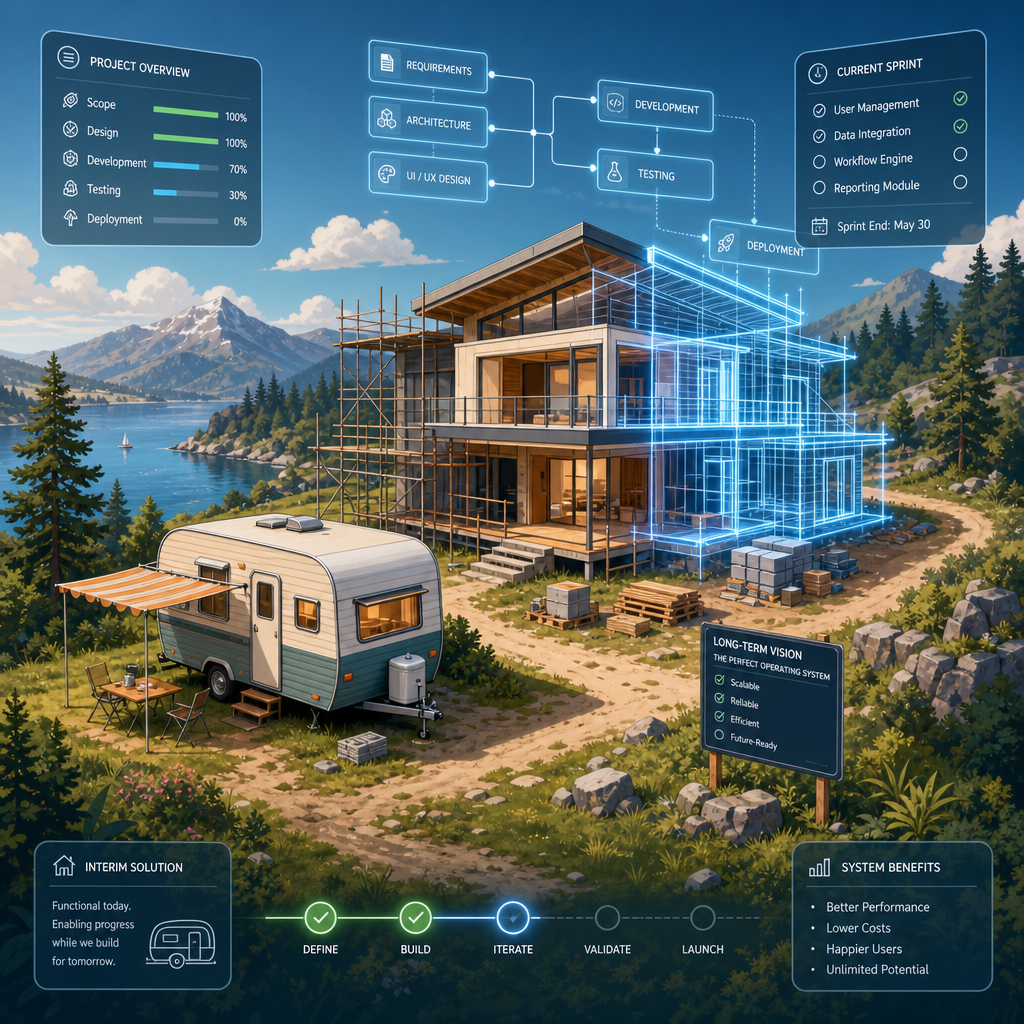
Ashle reframed the strategy with a useful metaphor that resonated: the Iris OS is the dream house being built on beautiful property, while ClickUp is the caravan we live in during construction (01:01:36). The caravan is uncomfortable and imperfect, but it gives the team running water and essentials — and it's a learning opportunity to discover what's truly necessary in the dream house.
Key principles emerging from the discussion:
[technology="Collaboration Management Tools"]
Rather than treating Iris OS as purely long-term, Ashle suggested expanding Phase One to incorporate the boring-but-necessary administrative essentials alongside James's foundational vision elements. This way both tracks move forward together and the foundation supports the eventual full system (35:03). Ashle will add comments and track changes to the document with suggested additions.
The team agreed to reactivate ClickUp as the interim project management tool while Iris OS is being built. James acknowledged ClickUp's limitations — it's task-oriented rather than asset-oriented, and feels like "building with Legos when we need something built from steel" (01:01:00) — but it's functional and the team is partially familiar with it.
Practical decisions:
James clarified his note about tracking "at scales rather than task level" — he meant forecasting effort scale per engagement per month (a 10K website might scale up for two months then have a long tail). Ashle recommended doing both initially: detailed task tracking to validate pricing bands and create templates, plus monthly scale forecasting for capacity planning. James likely undercharges relative to actual hours worked, and time tracking will surface this gap (39:50).
James walked Ashle through the current Airtable [tag="airtable"] CRM connected to the Webflow [tag="webflow"] engagement interface at iriscocreative.com/engagements. The system organizes leads, active projects, retainer clients, and hosting/maintenance subscriptions with status tracking.
A significant operational gap emerged: James doesn't currently know whether the hosting and maintenance business is profitable (51:54). The model originated when the studio hosted WordPress sites on shared infrastructure, allowing margin through aggregated subscriptions. With prices increasing across services every six months and records not consistently updated, profitability is unclear.
Ashle will:
[technology="CRM System Templates"]
James demoed the n8n [tag="n8n"] automation that powers the meeting artifact system, which Ashle praised as significantly better than typical AI summaries. The workflow:
James noted that migrating from Airtable to Supabase [tag="supabase"] would simplify much of this and improve reliability — most workflow breakdowns trace back to Airtable quirks (01:30:15).
[technology="Communication Automations"]
Ashle tested the Hollow Movement profile creation flow and surfaced several findings:
When Ashle left the purpose field as "test," the system auto-generated an oddly specific mission statement about "building collaborative networks of land stewardship, marine biologists and community organizers along the Portuguese Atlantic coast" (01:42:02). James couldn't identify where this came from — there shouldn't be a generator populating that field. Needs investigation.
Ashle flagged that James should secure a Data Processing Agreement (DPA) with Anthropic since user data flows through the Claude [tag="claude"] API. The form is straightforward to complete online but legally important, especially given international users and GDPR's right-to-be-forgotten requirements. Related: the app needs a "delete my profile" option on the account page so users can self-serve removal rather than contacting James directly (01:33:32).
Ashle got stuck on the purpose question — only ~7% of people have a clear sense of their purpose, so this is common friction. James proposed adding a purpose assessment alongside the existing assessment to help users surface this answer rather than facing a blank prompt.
Ashle will conduct cross-device and browser testing focused on mobile responsiveness, which James noted is currently neglected.
[technology="Assessment Systems"]
James openly acknowledged being the "designated bottleneck" and noticed his own internal resistance to systematizing — there's a part of him that finds it easier to just do things himself rather than explain or delegate (01:02:35). Ashle reflected back the "hit by a bus" principle from a former boss: the goal isn't to remove James's ability to work directly, but to ensure others can step in when needed — whether for honeymoons, future babies, or just capacity overflow (01:03:34). James wants to move out of constant triage mode and toward a system he could genuinely step away from.
James Redenbaugh
Ashle Bailey-Gilreath
James and Ashle met to align on operational priorities ahead of James's departure for the Hollow Movement activation event in Portugal followed by his honeymoon. The conversation centered on establishing a workable interim project management system, reviewing the ambitious Iris OS vision document, and ensuring Ashle has the access and context needed to support the studio during James's absence (14:15).
A follow-up meeting was scheduled for Tuesday, May 26th to finalize all access, handoffs, and outstanding items before James leaves on the 27th. Ashle emphasized that James should genuinely disconnect during his honeymoon and only be contacted for true emergencies (16:00).
James shared his Iris OS document — a high-level vision for an integrated system that would serve as the studio's "brain and body." The document articulates how IRIS [tag="iris"] processes, projects, and team coordination could be unified into a coherent operational layer with explicit containers for engagements, meetings, milestones, and assets.
Ashle reframed the strategy with a useful metaphor that resonated: the Iris OS is the dream house being built on beautiful property, while ClickUp is the caravan we live in during construction (01:01:36). The caravan is uncomfortable and imperfect, but it gives the team running water and essentials — and it's a learning opportunity to discover what's truly necessary in the dream house.
Key principles emerging from the discussion:
[technology="Collaboration Management Tools"]
Rather than treating Iris OS as purely long-term, Ashle suggested expanding Phase One to incorporate the boring-but-necessary administrative essentials alongside James's foundational vision elements. This way both tracks move forward together and the foundation supports the eventual full system (35:03). Ashle will add comments and track changes to the document with suggested additions.
The team agreed to reactivate ClickUp as the interim project management tool while Iris OS is being built. James acknowledged ClickUp's limitations — it's task-oriented rather than asset-oriented, and feels like "building with Legos when we need something built from steel" (01:01:00) — but it's functional and the team is partially familiar with it.
Practical decisions:
James clarified his note about tracking "at scales rather than task level" — he meant forecasting effort scale per engagement per month (a 10K website might scale up for two months then have a long tail). Ashle recommended doing both initially: detailed task tracking to validate pricing bands and create templates, plus monthly scale forecasting for capacity planning. James likely undercharges relative to actual hours worked, and time tracking will surface this gap (39:50).
James walked Ashle through the current Airtable [tag="airtable"] CRM connected to the Webflow [tag="webflow"] engagement interface at iriscocreative.com/engagements. The system organizes leads, active projects, retainer clients, and hosting/maintenance subscriptions with status tracking.
A significant operational gap emerged: James doesn't currently know whether the hosting and maintenance business is profitable (51:54). The model originated when the studio hosted WordPress sites on shared infrastructure, allowing margin through aggregated subscriptions. With prices increasing across services every six months and records not consistently updated, profitability is unclear.
Ashle will:
[technology="CRM System Templates"]
James demoed the n8n [tag="n8n"] automation that powers the meeting artifact system, which Ashle praised as significantly better than typical AI summaries. The workflow:
James noted that migrating from Airtable to Supabase [tag="supabase"] would simplify much of this and improve reliability — most workflow breakdowns trace back to Airtable quirks (01:30:15).
[technology="Communication Automations"]
Ashle tested the Hollow Movement profile creation flow and surfaced several findings:
When Ashle left the purpose field as "test," the system auto-generated an oddly specific mission statement about "building collaborative networks of land stewardship, marine biologists and community organizers along the Portuguese Atlantic coast" (01:42:02). James couldn't identify where this came from — there shouldn't be a generator populating that field. Needs investigation.
Ashle flagged that James should secure a Data Processing Agreement (DPA) with Anthropic since user data flows through the Claude [tag="claude"] API. The form is straightforward to complete online but legally important, especially given international users and GDPR's right-to-be-forgotten requirements. Related: the app needs a "delete my profile" option on the account page so users can self-serve removal rather than contacting James directly (01:33:32).
Ashle got stuck on the purpose question — only ~7% of people have a clear sense of their purpose, so this is common friction. James proposed adding a purpose assessment alongside the existing assessment to help users surface this answer rather than facing a blank prompt.
Ashle will conduct cross-device and browser testing focused on mobile responsiveness, which James noted is currently neglected.
[technology="Assessment Systems"]
James openly acknowledged being the "designated bottleneck" and noticed his own internal resistance to systematizing — there's a part of him that finds it easier to just do things himself rather than explain or delegate (01:02:35). Ashle reflected back the "hit by a bus" principle from a former boss: the goal isn't to remove James's ability to work directly, but to ensure others can step in when needed — whether for honeymoons, future babies, or just capacity overflow (01:03:34). James wants to move out of constant triage mode and toward a system he could genuinely step away from.
James Redenbaugh
Ashle Bailey-Gilreath
Reactivate ClickUp account and add Ashle as team member
James to reactivate the existing ClickUp account (archiving old material as needed) and add Ashle as a team member. Referenced at 01:10:28. ClickUp messaging features may replace Slack for internal communication.
Send outstanding invoices and copy Ashle on communications
James to send currently outstanding invoices and copy Ashle so she can learn the invoicing process and provide support during his absence. Referenced at 01:26:28.
Provide Ashle access to Bonsai for invoicing during James's absence
James to grant Ashle access to Bonsai so she can manage invoicing workflows while James is traveling and on his honeymoon. Referenced at 01:21:58.
Update hosting and maintenance pricing and cost records for profitability assessment
James to update hosting and maintenance pricing and cost records so Ashle can cross-reference against actual expenses and assess profitability. Referenced at 53:10.
Share contractor contract template and client contract with Ashle for review
James to share both the existing client contract and any contractor contract template with Ashle for review and feedback on completeness and tone. Referenced at 01:24:23.
Top up Anthropic API credits to restore Hollow Movement profile generation
James to top up Anthropic API credits so that Hollow Movement profile generation is restored and Ashle can complete cross-device and mobile testing. Referenced at 01:35:04.
Investigate and fix phantom purpose auto-generation bug in Hollow Movement user profiles
James to investigate the bug where leaving the purpose field as 'test' causes an oddly specific auto-generated mission statement to populate (e.g., about Portuguese Atlantic coast land stewardship). Source of generation is unknown. Referenced at 01:41:39 and 01:42:02.
Connect Ashle with Munia, Sean, and Yvonne for onboarding and context
James to introduce Ashle to Munia (Moenja), Sean, and Yvonne so she can coordinate with them during James's absence and gather context for PM system design. Referenced at 01:12:02.
Revise Iris OS document language around scale versus task tracking distinction
James to revise the Iris OS document to clarify that 'tracking at scales' means forecasting effort scale per engagement per month rather than avoiding task-level tracking. Referenced at 38:43.
Mock up visual prototype of the Iris OS interface
James to create a visual interface prototype of the Iris OS vision to make the concept more tangible for the team. Referenced at 01:23:10.
Schedule follow-up meeting with Ashle for Tuesday May 26th blocked for two hours
Ashle to set up the next meeting for Tuesday May 26th at the same time, blocked for two hours, to finalize all access, handoffs, and outstanding items before James leaves on the 27th. Referenced at 18:27.
Review Iris OS document and add track-changes comments expanding Phase One scope
Ashle to review the Iris OS vision document and add track-changes comments suggesting additions to expand Phase One to incorporate administrative essentials alongside James's foundational vision elements. Referenced at 23:01 and 35:03.
Familiarize with current ClickUp features and sketch interim PM layout
Ashle to familiarize herself with new ClickUp features and sketch a proposed layout for the interim PM system based on conversations with team members. Referenced at 41:52.
Reach out to Munia and Sean during James's absence to inform PM system design
Ashle to reach out to Munia and Sean while James is traveling to gather their input and context to inform the ClickUp PM system design. Referenced at 01:11:37.
Cross-reference card statements against services list to determine hosting profitability
Ashle to cross-reference business card and debit card statements against the services list to determine actual costs and assess hosting business profitability. Should also identify shared expenses (e.g., $200/month Claude plan, iStock credits) that should be built into project estimates. Referenced at 54:04.
Coordinate hosting price updates and clarify billing structure for maintenance clients
Ashle to coordinate updating hosting pricing and prepare a clarified billing structure to support invoicing workflows via Bonsai. Referenced at 49:42.
Conduct cross-device and mobile browser testing of Hollow Movement app once API credits restored
Ashle to conduct cross-device and browser testing of the Hollow Movement app with focus on mobile responsiveness once Anthropic API credits are topped up by James. Referenced at 01:39:47.
Research and advise on Data Processing Agreement with Anthropic for GDPR compliance
Ashle to research the Data Processing Agreement process with Anthropic given that user data flows through the Claude API for Hollow Movement. Form is straightforward to complete online but legally important for GDPR compliance and right-to-be-forgotten requirements. Referenced at 01:36:10.
Add new clients to Airtable CRM as they come in during James's absence
Ashle to maintain the Airtable CRM by adding new client records as leads and active projects come in while James is traveling. Referenced at 01:14:40.
Review client contract and prepare contractor contract feedback for James
Ashle to review the client contract James shares and provide feedback on completeness and tone, and review the contractor contract template. Referenced at 01:24:39.
Add delete-my-profile option to Hollow Movement account page for GDPR self-service removal
James to add a 'delete my profile' option on the Hollow Movement account page so users can self-serve profile removal rather than contacting James directly, satisfying GDPR right-to-be-forgotten requirements. Referenced at 01:33:32.
Design purpose assessment to help Hollow Movement users surface their purpose answer
James to design a purpose assessment alongside the existing assessment to help users surface their purpose rather than facing a blank prompt. Only ~7% of people have a clear sense of purpose so this is common friction in the onboarding flow. Referenced at approximately 01:44:00 during purpose field UX discussion.
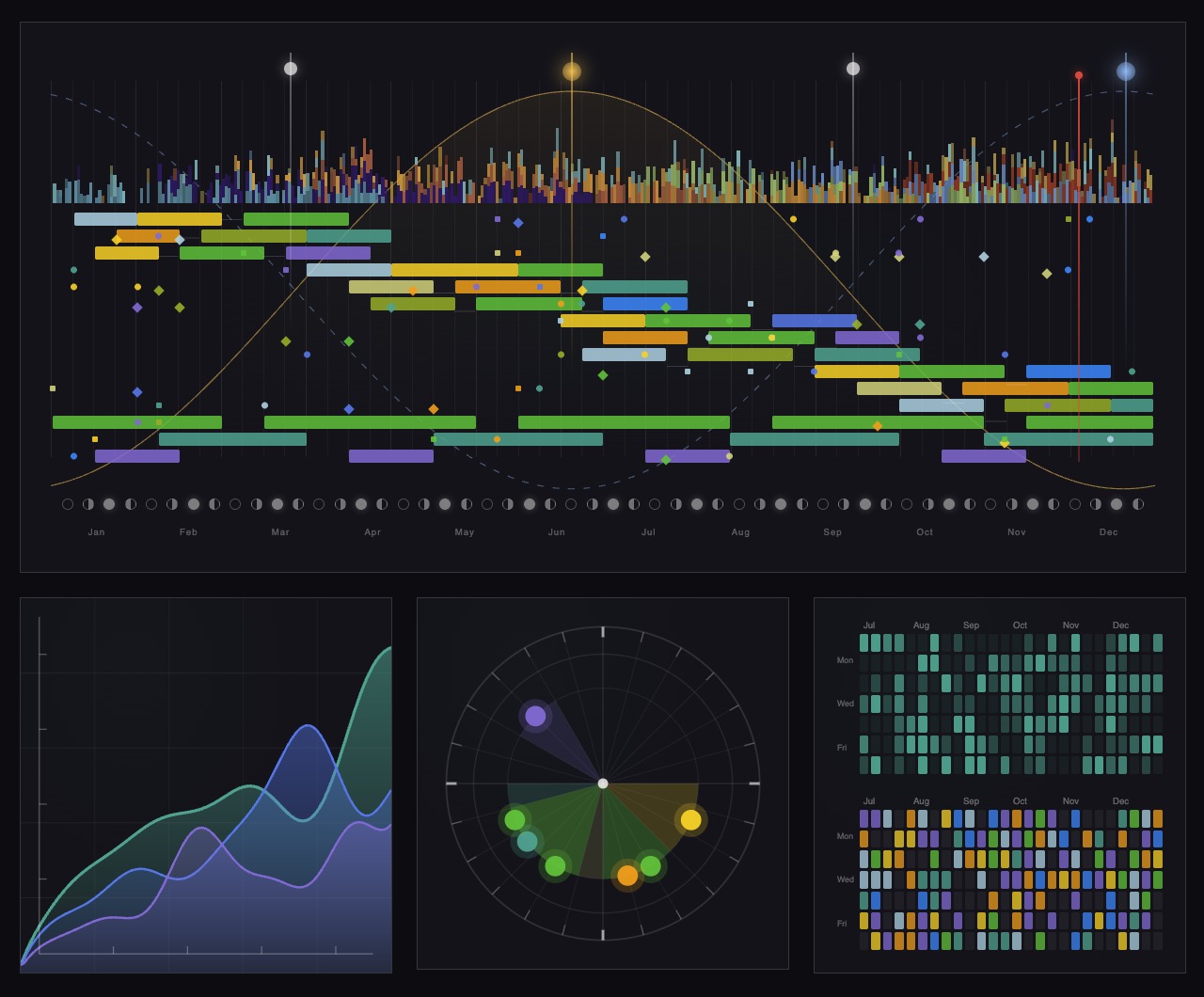
Custom project management system built from the ground up to support collaborative energies of projects. Features dynamic timeline visualization from past meetings, automated meeting artifact creation with summaries and action items, live editing capabilities, and organization by project phases. Single CMS collection architecture circumventing Webflow's nested collection limitations with JavaScript-powered status-based color coding, urgency indicators, and project timeline visualization. Real-time webhook integration enabling front-end CMS item creation without authentication. Designed to be more engaging and supportive than existing stale project management tools. Currently evaluating React architecture as alternative to Webflow-based approach given extensive custom JavaScript requirements - considering whether Webflow serves primarily as UI generator or if full React app would provide better integration. Decision made at 58:30-1:00:00 to park further development for ~6 months and identify simpler near-term plateau that team can actually use, while maintaining existing data structures (engagements, clients, meeting artifacts, initiatives, tasks). NEW DEVELOPMENTS: James prototyping 'James Today' personal workflow tool as interim solution - combines day/week views, time tracking, project urgency sorting, daylight visualization for team time zones, and Vedic astrology context (01:41:12). Key design principles: unified temporal views, quantitative and qualitative time awareness, drag-and-drop scheduling with auto-status updates, data capture for Claude retrospective analysis. Vision evolved to include dashboard representing engagements as organism showing energetic and temporal space each project holds (01:53:30), enabling forecasting, retrospective analysis, and team visibility. Move from request-only to offer-based model where team members can proactively propose involvement (01:55:37). STRATEGIC SHIFT: May 2026 - Decision to reactivate ClickUp as interim PM system while Iris OS vision continues development. Using 'caravan during house construction' metaphor (01:01:36) - ClickUp provides functional base while learning what's essential for dream system. Iris OS vision document shared with Ashle, expanding Phase One to incorporate administrative essentials alongside foundational vision elements (35:03). Core design principle clarified: base unit should be the asset (what we're building), not the task, with tasks serving milestones that serve assets. Client-facing should be simple with important assets surfacing; internal should provide journey map with clear stages. Meeting artifacts to be defined upfront per project. James acknowledged being 'designated bottleneck' with resistance to systematizing (01:02:35), goal is moving from triage mode to system he can step away from. JULY 2026 UPDATE: ClickUp now fully synced with custom Collaboration OS app (08:30). Tasks flow bidirectionally on scheduled cadence - ClickUp updates pull into app every 15 minutes, task updates sync back every 30 minutes. Today's focus (07/07/2026) is reworking artifact automation to create posts directly on website and tasks straight into ClickUp, consolidating everything into one place rather than generating separate Airtable artifacts. Strategic design advantage: custom interface enables calmness, spaciousness, and clarity over ClickUp's high information density (10:58). Vision includes simple milestone timeline views helping clients see what they need to do rather than parsing long compiled task lists. App to be published to Vercel for team collaboration. Ashle will be able to log in, update tasks, and comment directly. James merging earlier Iris OS phase one document with current Collaboration OS plan - currently on phase three of app development (29:09). Key question to revisit: what do we lean on the interface for, and what systems need to be strong independent of the technology?
Development of operational infrastructure to support Iris's transition from mission-first to sustainable business model. Includes: project costing and financial projections modeling different engagement types by hours and rates (37:28), hour tracking frameworks that provide data without surveillance burden (43:20), internal procedures and delegation structure to reduce James as bottleneck (06:47), pricing strategy review to improve profit margins while maintaining mission alignment (37:28), scenario planning for different growth paths including freelancer model, scale, nonprofit structure, and funding options (40:50). Exploration of 501(c)(3) nonprofit registration possibility to enable tax-deductible donations and grant access for open-source tools and public goods development. Led by Ashle Bailey-Gilreath who brings 15 years operations and general management experience across financial projections, project management, people management, contracts, and internal procedures primarily in nonprofit sector (13:05). Critical foundation for supporting James's personal timeline including marriage and family planning requiring greater financial stability and breathing room (34:37). NEW DEVELOPMENTS: Pricing calibration focus on tracking real project costs including hidden time costs like email, Claude iteration, and team coordination to establish accurate pricing baseline (01:05:39-01:13:00). Vision for 70% of projects priced sustainably with 30% capacity for passion/sliding-scale work. Investigation of retainer model reframed as 'continued support' structure for post-launch maintenance (29:30-40:36). Target revenue increase to $250K+ to support family planning and studio sustainability (01:28:10). HOSTING PROFITABILITY GAP: Significant discovery that current hosting/maintenance business profitability is unknown (51:54). Model originated with WordPress shared hosting allowing margin through aggregated subscriptions, but with service price increases every six months and inconsistent record updates, actual profitability unclear. Ashle to cross-reference card statements against services list, identify shared expenses (Claude plan, iStock) that should be built into estimates, update pricing and prepare Bonsai invoicing workflows. TRACKING METHODOLOGY: Ashle recommended both detailed task tracking (to validate pricing bands and create templates) AND monthly scale forecasting for capacity planning (39:50). James likely undercharges relative to actual hours - time tracking will surface gap. JULY 2026 UPDATE: Financial workflow handoff actively progressing. James blocking Wednesday and Thursday this week for deep dive on hosting clients, accounting, and Bonsai setup (20:56). Ashle ready to take on contractor invoice management (Sean and others), will input into Bonsai and organize contracts in Google Drive for 1099 filing (24:54). Client invoicing coordination established - James continues sending invoices (Re:Village Earth, Uncommon Partners, Cloud Medical) and copies Ashle to build pattern learning and eventual handoff capability (23:43).
Development of interconnected, reusable platform modules that can be deployed across multiple client sites. Goal is creating an ecosystem where components built for one client (assessments, directories, matching algorithms, LMS) can be rapidly deployed for others with minimal rework (21:45). More ambitiously, envisions profiles and content that travel across client platforms - so a user on Hollow Movement could bring their profile into Pro Social environment or access a course running simultaneously across multiple sites. Uses Webflow as foundation with significant custom code. Hollow Movement app serves as first proof of concept, launching at The Wave event at 01:30. Platform includes: AI-assisted profile generation with auto-generated tags and categories, global directory and map systems, holon (group/organization) profiles with wall-sharing, member-to-member messaging, assessment systems with archetype graphs, intelligent matching with compatibility analysis, sliding-scale membership payments, and planned learning management system. Community naming process proposed at 04:14 to turn naming into collaborative activation moment during launch, letting early users contribute ideas and deepening community ownership. Platform currently at temporary domain, team jokingly calling it 'Jeff' or 'Goeff'. This represents Iris's strategic direction toward productized, scalable solutions while maintaining customization for each client's mission. NEW DEVELOPMENTS: Hollow Movement identified as ideal test case for continued support pricing model with tapering structure (40:36). Similar directory system being designed for Gaia Warriors with upgrades flowing between projects. Codebase organized with replication in mind. James considering dedicating more time to platform evolution with potential for fewer outside projects. App reaching stable beta state by end of week for launch (27:44, 57:44). TESTING & COMPLIANCE: Ashle conducting cross-device and mobile testing with focus on mobile responsiveness (01:39:47). Bug discovered: phantom auto-generated purpose text appearing in profiles when field left as 'test' - needs investigation (01:42:02). GDPR compliance gap identified: need Data Processing Agreement with Anthropic and 'delete my profile' self-service option on account page (01:33:32, 01:36:10). Purpose field UX friction noted - only ~7% of people have clear purpose, proposal to add purpose assessment alongside existing assessment. API credits need top-up to restore profile generation (01:35:04). JUNE 2026 UPDATE: Holos app now has hundreds of active users post-Wave launch with strong positive feedback from Monday team meeting. Core features stabilized including profiles, holons, messaging, and assessments. ClickUp task organization implemented across domains: bug tracking, messaging, privacy & analytics, design system migration, staging & deployment. Privacy infrastructure being strengthened with user-controlled map visibility settings at column-movement.net (20:11). AGENTIC VISION: Platform evolving toward intelligent matchmaking and agentic toolsets - users should be able to query network with questions like 'I'm exploring this domain, who should I talk to?' or 'What blind spots might our holon have?' (50:23). Requires privacy-preserving architecture using sub-agents and intelligent layers rather than exposing all user data to models. Long-term vision includes MCP server exposure so users' personal agents can query Holos database with privacy-aware modes. Design philosophy: build for future agent-to-agent collaboration on behalf of humans in addition to human users. Next major build area: online learning, courses, and resource library creation to give users reason to return regularly and round out platform. JULY 2026 UPDATE: Native iPhone app development progressing - Iván has real native iOS demo working, meaningful step beyond web app version (21:19). Opens real app-building capacity for IRIS Cocreative. Ashle's multi-device household (Mac, PC, Android, iPad) available as natural testing ground (35:55). User pattern noted: older male academics in their orbit often browse on iPads - worth remembering for responsive testing.
Reactivation and configuration of ClickUp as interim project management system while Iris OS vision develops. Serves as 'caravan during house construction' (01:01:36) - functional workspace that enables learning what's essential for future dream system. Implementation includes: reactivating existing ClickUp account rather than fresh start, archiving old material as needed, configuring asset-oriented structure where tasks serve milestones that serve assets, establishing both detailed task tracking (for pricing validation and templates) and monthly scale forecasting (for capacity planning per 39:50), setting up Claude integration to enable export from Airtable directly into ClickUp, evaluating ClickUp messaging features as potential Slack replacement, and creating layouts based on team member input. Ashle to familiarize with current ClickUp features and sketch PM layout after consulting with Munia and Sean (01:11:37, 41:52). System should support client-facing simplicity with important assets surfacing while giving internal team journey maps with clear stages. Foundation for managing studio work during James's honeymoon and reducing him as bottleneck. Target completion before James leaves May 27th. JULY 2026 UPDATE: ClickUp now operational and actively used by team. Bidirectional sync established with Collaboration OS app - ClickUp updates pull into app every 15 minutes, task updates sync back every 30 minutes (08:30). Task organization conventions finalized: grouped by domain (accounting, operations, admin), client invoices structured as tasks with subtasks, due dates aligned to workflow blocks (Thursday for accounting), priority flags for urgent items (26:41). Ashle actively restructuring task organization to match James's cognitive preferences. System successfully supporting financial handoff and operational coordination. Integration with custom app working as designed.
Comprehensive analysis and remediation of hosting and maintenance services profitability gap identified at 51:54. Current state: unclear whether hosting business is profitable due to service price increases every six months and inconsistent record updates. Original model based on WordPress shared hosting with margin through aggregated subscriptions no longer matches reality. Scope includes: cross-referencing business card/debit card statements against services list in Airtable CRM to determine actual costs, identifying shared expenses that span clients (Claude $200/month plan, iStock credits, etc.) that should be built into project estimates rather than absorbed, updating hosting pricing to reflect actual costs with appropriate margin, preparing updated invoicing workflows via Bonsai, documenting services architecture for future reference, and establishing process for regular pricing review as vendor costs change. Led by Ashle with James support for technical context. Critical for understanding true studio profitability and ensuring hosting services contribute positively rather than drain resources. Connects to broader financial operations work but distinct workstream with clear deliverable.
Setup and configuration of access infrastructure for Ashle and future team members to support distributed studio operations. Immediate scope includes: Gmail account creation on Iris domain for ecosystem integration (17:47), Slack workspace configuration with automation integrations for meeting summaries, proposal notifications, and team coordination (20:12), Airtable access provisioning via shared login for CRM and project data, Google Drive access through Gmail accounts for documents and assets, Bonsai access for invoicing support during James's absence and ongoing (01:21:58), ClickUp access for interim PM system. Establishes communication norms: Slack for internal team coordination, WhatsApp/email for client communication, asynchronous-first approach respecting distributed time zones. Foundation for scaling team collaboration without adding significant tool costs. Priority access setup for Ashle before James's May 27th departure, then systematic onboarding for Munia, Sean, and Yvonne. Includes documentation of access protocols and onboarding workflows for future team members.
Implementation of GDPR compliance requirements for platform work involving user data processing through AI services. Identified gap at 01:33:32 and 01:36:10: need Data Processing Agreement with Anthropic since user data flows through Claude API for profile generation, assessment analysis, and matching algorithms. Scope includes: securing DPA with Anthropic (straightforward online form), implementing self-service 'delete my profile' functionality on account pages so users can exercise right-to-be-forgotten without contacting support, reviewing data retention policies across platform implementations, documenting data processing flows for transparency, and creating privacy policy language that accurately reflects AI processing. Critical for Hollow Movement app with international users subject to GDPR, but applies to all platform work including future client implementations. Ashle to research and advise on DPA process and compliance requirements given ops background. Affects all platform modules that process user data through external AI services.
00:04:40
James Redenbaugh: It.
00:05:33
Ashle Bailey-Gilreath: James.
00:05:36
James Redenbaugh: Hi. Ashley.
00:05:37
Ashle Bailey-Gilreath: How are you?
00:05:40
James Redenbaugh: I'm good. How are you doing?
00:05:42
Ashle Bailey-Gilreath: Doing okay. Very moving this morning. So I'm in our new house, and it's Paige. We're having painters come this weekend, but it's. It's like one of those houses where they just, like, gut everything and. And they turn it into, like a. A soulless box. But it was. It's in our. It's in the village we live in. We really like it here, so we figured it's fine to ran at least for a year. But we're going to paint some of the rooms because it's tricky when they're. When it's all beige everywhere.
00:06:26
James Redenbaugh: So what colors are you gonna paint? Do you know?
00:06:29
Ashle Bailey-Gilreath: I do. Yeah. So the living room and the bedroom are gonna be, like, a dark blue color. It's a farrow and ball color called stiff keep blue. And my office is also faron ball. It's called the Knimes. It's like a really wonderful blue green with, like, a gray undertone. And an Adam's office will be black. So it's a pheromone ball color is railing. So it's actually like a really deep charcoal. So it's not just so it looks more like coal, but. Yeah. So that's it for now. Might paint more rooms. But it was. It was. That was enough at least to make it feel. Break it up a little bit. And that feels just so.
00:07:23
James Redenbaugh: Cool. And what is your. What is your village? You. Where you guys are in?
00:07:30
Ashle Bailey-Gilreath: So we're in Northern Ireland, so we live in a village called Kellogg. So. K I L L O U G H and it's like 700 people. It's about. In 45 minutes to an hour away from the city and about two hours. Hour. And. Yeah, about two hours to Dublin. So it's pretty decent. But we're right on. On the Irish Sea. So, like, our house here is about as close as you can get. I might show you all the window, actually. Can you see that?
00:08:11
James Redenbaugh: Oh, wow.
00:08:13
Ashle Bailey-Gilreath: Yeah. So it's Irish Sea, so. Right. The body water. Right. Yeah. Yeah. We're like. I could throw a stone to it. So. So, yeah, that's. It's a selling point of this box house. It's a really good location. But, yeah. So it's called Killoc, and it's a weird little place, but we've been here for three years, and we've kind of gotten used to, like, all the quirks, and it's great. It's just. Everybody's got a story like when we tell people we're moving into this house, they have no idea what I mean when I say like the house number. But if I tell them it's the house that Paul was building when he died, everyone knows what that means. And Paul died by being crushed by his electric gate.
00:09:04
James Redenbaugh: Oh, my God.
00:09:05
Ashle Bailey-Gilreath: Yeah, it was terrible. Everybody liked Paul. So. Yeah, we live in the house that Paul was renovating. A crush.
00:09:16
James Redenbaugh: Was it this. Was it at your house?
00:09:18
Ashle Bailey-Gilreath: No, no, no, no. He lives like, he lives up, up the road, like around the lock area. And so he lived in like a. Like a fancier house with one of those electric iron gates. And he was coming home one night from the pub and I have no idea, but it was a terrible accident. He got crushed by.
00:09:38
James Redenbaugh: Oh my goodness.
00:09:39
Ashle Bailey-Gilreath: So it's stuff like that in the village that's like. Yeah.
00:09:44
James Redenbaugh: So that's sweet.
00:09:46
Ashle Bailey-Gilreath: Yeah. But it's nice. It's a nice little place. It's a weird little place, but I like that. How was your wedding?
00:09:55
James Redenbaugh: Such a.
00:09:57
Ashle Bailey-Gilreath: It's great. It's place. It is. And the people are great. They're really friend. They are really friendly and they're super down to earth. So. Yeah, it's really nice.
00:10:11
James Redenbaugh: My wedding was so boring. It was the most. I mean, Could have been worse, but it was really weird. The ceremony was eight minutes long. So it's like, how are you? How are you bored at a wedding where the ceremony is eight minutes long? At least it wasn't like a five hour Catholic ceremony. Yeah, but I don't know, it was weird. It was like a beautiful spring day in Richmond.
00:10:46
Ashle Bailey-Gilreath: Yeah, but the great location at least.
00:10:49
James Redenbaugh: But the venue was like a brewery slash pizza oven place. And it was in like the back. Back room. Like the ceremony was in this windowless room full of barrels.
00:11:05
Ashle Bailey-Gilreath: Okay.
00:11:06
James Redenbaugh: And then the reception was in like this room that had two skylights and. Wow. And that's it. And I was like, okay, I guess this is. This is what we're doing.
00:11:19
Ashle Bailey-Gilreath: Did you get an opportunity to like at least explore. Did you two get to go and explore Richmond or the area or anything? Or did you just come in for the wedding and then leave?
00:11:30
James Redenbaugh: We came in and we were helping Emily's mom with stuff at her house and we got to do a few things and see family and.
00:11:39
Ashle Bailey-Gilreath: Okay.
00:11:40
James Redenbaugh: And friends, but you know. Yeah. It's just was funny.
00:11:45
Ashle Bailey-Gilreath: Oh, so was it? It was a family member wedding then.
00:11:48
James Redenbaugh: It wasn't like it was Emily's stepsister.
00:11:51
Ashle Bailey-Gilreath: Okay, okay, okay, okay. That makes more sense. Yeah, I Would expect that you two would have friends that would be more thoughtful about.
00:12:01
James Redenbaugh: Yeah.
00:12:02
Ashle Bailey-Gilreath: So I understand now that it's kind of like the obligatory family thing. And then. Well, new experience.
00:12:11
James Redenbaugh: Yep. Yep. Yeah. And now we leave in seven days. I can't believe it. Getting ready to go on this trip. And yeah, I would like your. I looked over your agenda. I didn't have any notes, but happy to talk about whatever.
00:12:42
Ashle Bailey-Gilreath: Okay. Does that. Is that helpful for you? The agendas?
00:12:46
James Redenbaugh: Yeah, definitely.
00:12:49
Ashle Bailey-Gilreath: I didn't know if. I just realized I had misnumbered some things, but I didn't know if it was like, too rigid. I feel like once we get in conversation, it doesn't feel rigid, but it's more me just putting down onto paper stuff that I don't want to forget while we are talking. We don't actually have to flow in this exact order or anything. It's mainly just so it helps me. But I didn't know if it helped you.
00:13:16
James Redenbaugh: Yeah.
00:13:18
Ashle Bailey-Gilreath: Okay. I think I. So 1. Thanks so much for access to stuff. I didn't. And then I'll ask about other access and things. But I just wanted to check in with you. Like, where are you at this week? Like, how's Hollow Movement going? And then you had a bunch of other projects because you said you were a little bit overwhelmed the last time we talked. And like, what's most on your mind before you head out? And is there anything that I can help with? And then also I just wanted to ask really quickly if you wanted to have another meeting before you leave or if you want to try to get everything settled during this one just so we can. I can be mindful of your schedule.
00:14:15
James Redenbaugh: Yeah, I think it'd probably be helpful to meet again before we go, especially because I feel. Not on top of all the projects right now. I feel very on top of Hollow Movement.
00:14:42
Ashle Bailey-Gilreath: Okay.
00:14:43
James Redenbaugh: But I've been kind of defaulting to working on Hollow Movement and putting off other projects, and there's nothing like, Crazy urgent. But now, like, this next week, I feel like, okay, I need to bring some love to these other projects, get them locked away, because Hollow Movement is actually in a good place. There's a few things that I can keep working on in preparation for the. For the event, but I've just been kind of pouring myself into getting. Getting the app working, getting some new features online and, and prototyping some stuff for that. So it'd be good to check in before. Before the conference. And then I. I hope that I can. Of course I'll be reachable and staff on honeymoon. And we're planning to have a couple days.
00:15:53
Ashle Bailey-Gilreath: Oh, it's your honeymoon?
00:15:55
James Redenbaugh: Yeah.
00:15:56
Ashle Bailey-Gilreath: Oh, yeah. No, you shouldn't work. Don't work.
00:16:00
James Redenbaugh: That's.
00:16:01
Ashle Bailey-Gilreath: I thought it was just a trip that you planned to just happen to work out where you'd be like hopping over countries. No, James, don't work. Don't. Let's fit. Let's get stuff settled so I can take care of. So don't work on your honeymoon. That's crazy.
00:16:15
James Redenbaugh: Okay. Okay.
00:16:16
Ashle Bailey-Gilreath: Yeah, don't do that. No, no, no, don't do that. Yeah, let's. Let's. Let's find. Let's have another meeting before you go and then you guys. Yeah, no, don't work. I thought it was just. You just. You just happened to schedule a trip right around the same time that the wave was. And it was just working out. I had no idea it was your honeymoon, so.
00:16:34
James Redenbaugh: No, yeah, no, we.
00:16:36
Ashle Bailey-Gilreath: No, don't. Don't do that.
00:16:38
James Redenbaugh: Fine. Are finally doing a honeymoo.
00:16:41
Ashle Bailey-Gilreath: Okay, good.
00:16:42
James Redenbaugh: I'm getting married in September.
00:16:44
Ashle Bailey-Gilreath: Hey. That's our honeymoon. Was. We moved here, so it's just been like 12 years.
00:16:52
James Redenbaugh: That's the way to do it.
00:16:54
Ashle Bailey-Gilreath: Yeah.
00:16:57
James Redenbaugh: That's awesome. Well, don't. You shouldn't work either.
00:16:59
Ashle Bailey-Gilreath: I know, I know. I should really. Should be more mindful of my time management. I should decline meetings for that. I'm sorry.
00:17:12
James Redenbaugh: Instead of out of office just indefinitely.
00:17:14
Ashle Bailey-Gilreath: Yeah. So when do you leave to go to Portugal?
00:17:22
James Redenbaugh: So we leave on Wednesday and then. But then the honeymoon doesn't start until June 2nd or something.
00:17:33
Ashle Bailey-Gilreath: Okay, but you're at the activation day. Wait, no, you. But the activation day is the first, so it's like you're. You do the. You do like your thing, like the biggest part of it, and then you go on your honeymoon. So we should meet before you leave.
00:17:51
James Redenbaugh: Yes. Yeah, I think so. Yeah. So, yeah, we leave on the 27th. We'll have the 28th to kind of settle in there.
00:18:03
Ashle Bailey-Gilreath: Well, do you want to meet on the 26th at the same. Around the same time as.
00:18:09
James Redenbaugh: Sure.
00:18:10
Ashle Bailey-Gilreath: Today that be.
00:18:12
James Redenbaugh: Yeah, let's do it.
00:18:13
Ashle Bailey-Gilreath: Or we can meet on Monday. I'm. It's a holiday in the States and a holiday here, so I'm totally free on Monday. It's up.
00:18:25
James Redenbaugh: Let's do Tuesday.
00:18:27
Ashle Bailey-Gilreath: Okay. I'll set it for same time. Is that okay? Same time as today?
00:18:31
James Redenbaugh: Yeah.
00:18:31
Ashle Bailey-Gilreath: Okay.
00:18:32
James Redenbaugh: Yep.
00:18:33
Ashle Bailey-Gilreath: I'll block out two hours just to be safe, and we'll get totally sorted, organized, and then you can go and Enjoy yourself. And only if I contact you is it because it's like I genuinely need something that can't wait.
00:18:48
James Redenbaugh: Cool.
00:18:48
Ashle Bailey-Gilreath: So. But as I always remind our. My colleagues at Pro Social, we are not an emergency room or you know, like, so it's okay. Stuff can wait. It doesn't feel like it, but stuff can.
00:19:04
James Redenbaugh: So thank you, that's very helpful. But I will. I am planning on working on the 28th, probably mostly on the. On just like last minute Hollow Movement stuff. Okay. And then the second as well. We'll have all day on the second and then we fly to Azores on the third, actually.
00:19:33
Ashle Bailey-Gilreath: Okay.
00:19:36
James Redenbaugh: So I'll be doing some things then.
00:19:40
Ashle Bailey-Gilreath: Okay, well, we can use those times for like if I'm finding I need to. To get me access or something. You can like time block and it won't. We can talk Like I'm open on those days, I think. Pretty, pretty open. And yeah, like the 28th, I'm. As of right now, I have no me nothing scheduled. And the second I am. Well, you'll be in my time zone. So. So. And on the second I just. I usually have meetings my time between 2 and like 3:30, but otherwise we can meet before then or after then if you find that it would be easier to talk. But otherwise we'll see if we can knock everything out on our next meeting. And then this way, just in case I need something from you, you kind of time block, it just gets, you know, check stuff off for me and then, and then I'll be good and I can take care of stuff while you're away.
00:20:50
James Redenbaugh: Cool, great. We can play by ear. Unlikely to find a bunch of potential future clients at. At the Hollow Movement. And, and so I might want to connect them with you since I'll be going offline.
00:21:19
Ashle Bailey-Gilreath: Yeah.
00:21:20
James Redenbaugh: If they want to find out more about what, what we're doing or schedule a call or talk to somebody else in Iris immediately after the wave as.
00:21:38
Ashle Bailey-Gilreath: They're like, can we work on something over the next week? On like what that. Like what a onboarding? Like what that looks like for me to do. So, like what I can send them and if there's a way for me to access your calendar or send that to them. I mean, I think it's just the link that you have, but just so I can have that ready.
00:22:00
James Redenbaugh: Yeah. Yeah, definitely. And I have a few different links depending on how much time they need. So. Yeah. And. This might be a good time to talk about the Iris OS doc that I shared with you. Did you have a chance to check that out.
00:22:28
Ashle Bailey-Gilreath: I did. I did. Cool.
00:22:33
James Redenbaugh: And I'm curious your thoughts on that because this system would include ideally all that onboarding stuff and everything, like making really explicit what we do when we start a new project and service agreements and initial meetings and things like that.
00:23:01
Ashle Bailey-Gilreath: Is this. Whenever you were saying that you were having some like, epiphanies about what you sort of wanted to structure with the PM system and stuff, is it like, was it from this that you started to think about those things?
00:23:23
James Redenbaugh: Yes, yes. This is kind of like a, an over articulation of the, the simpler ideas I was having and I was actually just sketching, sketching it in pencil. And. And then this doc is probably complicating it and then we can come back into simplicity on it. But I'm curious overall impressions and thoughts on the doc as it is.
00:24:12
Ashle Bailey-Gilreath: I. So it, it was a lot. And by that I don't mean like it was a lot to read or digest or anything, but it was, it's, it's a lot more high level, like big picture, even though there's a lot of detail in it then. And so I think one of the things that I wanted to ask you about was how do you want to go? I think that we, whenever you sent this, are you like. I'm trying to figure out sort of our immediate focus, so getting some sort of PM system set up just to be able to do stuff and be efficient. And then there's this here. And so I just want to. Are you framing this as like a long term goal or is this something that you want to immediately start to like, lay the train tracks down, like with your metaphor that you had?
00:25:08
James Redenbaugh: Yeah, I want to. Both, I think that. And I want to discuss this with you and see what's, what's going to be the best option. It's. It's not realistic to get this up before, before I leave on this trip. And I think we want to bring more clarity to the system that we have or the, the projects that we have and the processes that are already underway. And I want to start to think about. This kind of system right away because I think it's integral to. Iris actually working, moving forward into the future. I feel like we need a brain essentially and a, and a body and, and this is kind of encompassing a lot of, a lot of things that I felt like we've needed for a long time. And I feel like I'm finally seeing how to, how to put them together and also how to technically build them. Like, I couldn't Build a system like this six months ago, or it would take me six months to do it. And now I feel like a lot of, you know, if I had two dedicated days to just spend on this, I could have a prototype with a lot of the major features of what's. Of what's here. So that's kind of how I'm thinking about it. I want to just kind of language and. Create containers for how to. How to think about projects and our processes and how the different kind of organs of IRIS fit together in, in an organism.
00:28:07
Ashle Bailey-Gilreath: Okay.
00:28:10
James Redenbaugh: And if we could make. Make certain process things really explicit in a software layer, I feel like it could be ten times easier to, to manage projects, to take on new projects, to have different kinds of projects happening concurrently. And it's, it's definitely still going to be worth, you know, or we still need to discuss how, how are we pricing things, how are we sizing things, what size projects are we targeting, what are we saying no to things like that.
00:29:01
Ashle Bailey-Gilreath: Okay, yeah, I think that sounds good. I think like, I didn't go through the document and make comments and stuff. I can. I wanted to foresee what you wanted me to do with it. I like, I like the metaphor that you had about the body. I kind of viewed this more as almost like building the nervous system before we have the body. And so that's part of the. So like reliable project management. It doesn't have to be what the end system will look like, but just that we have, like, we know exactly what the working parts are that we need to track and that that is working for the whole studio, the whole team. And then that can be adapted to the OS and like invoicing and like onboarding and all of that. And so like, you've mentioned that in the spine part. So I think that was the main thing. I just, like, this is really cool and it's very ambitious. I just wanted to make sure that we still get that groundwork put in place so that you can spend time on this. Do you know what I mean? And then, but. And like not end up in the same place where you sort of did last year, where you had this like, really incredible vision. But then like, the really annoying but necessary, like, administrative and operational stuff is overlooked. And then, and then you're like, should I put everything and go work at a. I want you to get there again. So I think, like, I really like it. I just wanted to make sure I understood the context of it. I don't. I mean, I have no feedback on switching from Webflow or anything. I don't, I don't. I did. I was curious how that might affect, like, your existing clients that are all on webflow, if that mattered, if your OS is somewhere else and I'm, I'm assuming, would you move away from webflow entirely for new projects?
00:31:18
James Redenbaugh: No. I mean, I think we'll continue to build webflow websites for people.
00:31:23
Ashle Bailey-Gilreath: Okay. Okay. I just wasn't sure how much it's.
00:31:27
James Redenbaugh: Just our, our own site and where clients access their project info. Right now it's. And I don't even have good analytics on how many people actually are, are using the, the project system we built into our webflow site. But the sense I get is that clients aren't spending a lot of time in there, like reviewing meeting artifacts or updating checklists or, or looking at the engagement page. And I. Part of that is because clients just have their own thing and maybe they don't. Maybe it doesn't need to be so much for them. Like, it's important for them to have their, their view in their space and access to the things we want them to have access to. But I think the other part of it is that it's just like, it's just links, there's no login, and it's probably overly complicated for them to go there and see all these parts. And so I want them to have a really simple experience and access to the important things and, and for the most important things, like assets, for those to just rise to the surface and, and be right there. And then for us internally and as a team and, and for each team member to have a tool that can really guide the process. So in any project, we can really see ourselves on a map and at a point in time and like on a journey with steps and stages and not just, you know, a line in a, in a timeline and a vague sense of what needs to happen when. But if we up front really define these clear milestones and pieces that we need to get to, and that's built into the meeting artifact system. So before we even have the meeting, we can see all the meetings that we're going to have for a project. And of course we can make extra ones if we need it, then I think the journeys can go a lot smoother and it'll be easier to delegate and bring people in at the right time and make sure that they have the context and the assets and the access that they need to do that.
00:35:03
Ashle Bailey-Gilreath: Okay. Yeah, I like that. I think I would suggest, and I'll give it some thought and I can make track changes or comments, but I think we would. We could build out phase one a little bit more to incorporate what you have, and then also some of the outstanding boring things that we need internally. And so I think that will kind of help us do two things, like get on the path to start building the foundation for the OS and also addressing some of the concerns that you have. And that's why I'm here. So I think we can build it into phase one because it would. It'll overlap a lot.
00:35:39
James Redenbaugh: Yeah, a whole lot. Yeah.
00:35:41
Ashle Bailey-Gilreath: So I think, like, building that out a little bit makes sense. And it'll. I would still recommend, like, a stepwise approach to your PM tool. I still think maybe ClickUp is the way to go for right now. Just for right now. And, like, while we build maybe phase one, and then we can look at what phase two looks like, and then just so there's something somewhere and people get in the rhythm of using it. And then it also is just really helpful to figure out, like, what's working, what isn't, so that you have, like, a use case for when you move forward in your os. So I can add in some of my suggestions to sort of add to phase one so we can address some of the other things that we've talked about before. And then one of the questions I had, it's in your section 8, your open questions, the time and money. What do you mean when you say track at scales rather than task level? So you have tracked in a monthly rhythm and maybe you didn't mean this. Maybe your Claude or whoever you use decided this is. You should do this. I didn't know if this was part of your original sketch, but I didn't know what. What did you mean by that when you say it? Because I haven't seen that phrase used very much in this kind of world.
00:37:18
James Redenbaugh: Yeah. So this is actually what we related to what we were talking about in our last meeting, where we track and forecast the scale of a given engagement for a given month. So if we're starting a new project, it's a 10k website, maybe the scales here this month, and then, you know, maybe we'll do twice as much effort for the next two months. And then it might have this long tail where we're still supporting and dedicating some time, but it's not nearly that. So that's what I'm talking about there.
00:38:06
Ashle Bailey-Gilreath: Okay. Okay. Okay. Okay.
00:38:07
James Redenbaugh: Okay.
00:38:08
Ashle Bailey-Gilreath: I would recommend, just at the very beginning, we do both only because the task level will just be helpful for me to make sure that I can create sort of templates for you and we can double check like are you actually pricing these things within the correct band? And then from there it's just internal. That's it. But then yes, then I, yes, totally agree about the scaling per month so that you can see what your time looks like and you can see how you can fit in new projects to things or be a human and go on a honeymoon and stuff like that. So.
00:38:42
James Redenbaugh: Yeah.
00:38:42
Ashle Bailey-Gilreath: Yeah. Okay, great.
00:38:43
James Redenbaugh: Yeah, yeah, no, that's, that's confusing and I need to revise this.
00:38:50
Ashle Bailey-Gilreath: That's why I just. But it makes sense. Since we talked about it. That makes perfect sense.
00:38:56
James Redenbaugh: We definitely still want to track tasks.
00:39:00
Ashle Bailey-Gilreath: But I mean one, you depend. Well, depends on how you move forward with your team. But in order to pay them if they're working hourly, we've got to track it anyways. But it would be helpful just to track a few different types of projects just so we can kind of have that internal information. So you know, if you're undercharging, I think the main thing is going to be tracking your time because I think that's going to be the biggest gap or discrepancy in receiving the right amount of financial like reward based on your time. I think you probably work in more than you are getting paid.
00:39:50
James Redenbaugh: Oh yeah, yeah. So. Yeah, yeah, that'll be good.
00:40:02
Ashle Bailey-Gilreath: But yeah, I like this frame. I think it's super ambitious. So I mean I wouldn't expect anything less. I just would like to maybe build out what phase one looks like just a little bit more so we can weave in some of the things that we're talking about into what that is and then we kind of solve the same things in parallel.
00:40:22
James Redenbaugh: Yeah.
00:40:22
Ashle Bailey-Gilreath: Then you have a really good foundation.
00:40:25
James Redenbaugh: Yeah.
00:40:26
Ashle Bailey-Gilreath: To keep going.
00:40:27
James Redenbaugh: Yeah. I think it'll be good to. Return to ClickUp in, in the meantime and, and maybe what'll make the most sense is to have like. To use ClickUp for tasks and planning and coordination stuff and have, you know, maybe what we need is more a way to organize the high level access and assets for clients like a client portal. But we still use ClickUp as a, as a PM tool and ClickUp has added a ton of features. We could, you know, we could also not use Slack because it's like everything that Slack does is in, is in ClickUp now.
00:41:38
Ashle Bailey-Gilreath: Okay, interesting. Would you be able to give me access to ClickUp just so I can not. Because I know you haven't been on there in a year just so I can get familiar with like some of the new features.
00:41:52
James Redenbaugh: Yeah.
00:41:53
Ashle Bailey-Gilreath: Definitely not to audit or anything like the records that you have in there. Yeah, no, I only used ClickUp. I mean well, I used it with you and Yvonne whenever you guys doing our site. But then we used it internally for a little while or sort of admin project things. But it's been two years maybe so I'm sure there's loads of other features.
00:42:21
James Redenbaugh: Yeah. Why did.
00:42:25
Ashle Bailey-Gilreath: I've got two. I've got surround sound.
00:42:29
James Redenbaugh: Yeah. So I'm. It's only on my Mac right now. I need to.
00:42:37
Ashle Bailey-Gilreath: Okay.
00:42:38
James Redenbaugh: Get Click up on my PC. I just wanted to share my screen over here so we could look together what's in here? But I wanted to ask. You guys started using ClickUp and then ultimately didn't. It didn't work for you or you switched to something else?
00:43:06
Ashle Bailey-Gilreath: We. Well then we. Then we created this really overly complicated thing in airtable and. But ClickUp was just. It was just for two other sort of administrative administrators that we had. It was mainly just me working with them on it for admin type tasks because they were so spread out. One was in Australia and then the other one was in Rhode island and then there was me. And so it was the. Just the easiest way to kind of like during our non overlapping time zone times to mark certain things as like whenever you get to your desk, this is Virginia, stuff like that. But then we didn't have as big of a gap because the lady who was helping us in Australia, she went on to another job and. And then oddly enough the Juliet who was working, she was based in Rhode Island. She actually is going. She's doing a master's degree in Belfast. So now we're on the exact. I mean she's 45 minutes away from me now. So. So we just didn't use it because it was just a lot easier to send a quick message on Slack.
00:44:26
James Redenbaugh: Yeah.
00:44:27
Ashle Bailey-Gilreath: But it was really helpful when we did have that disparity and your team has that. So it wasn't that we. And then for our entire team there was a big discussion and everybody wanted to. Wanted something slightly different and so Sage went a little bit crazy and built this like super complicated thing in airtable. But then like half our team wouldn't use it because they were really intimidated by airtable. So anyways. But I did find ClickUp much more intuitive than airtable for project based tasks, those things. But I have. It's been a couple of years so I don't know what other features because there wasn't really like a chat type feature or anything in there?
00:45:21
James Redenbaugh: Yeah, yeah. They, they've added a ton and there's a lot of AI stuff in here now I need to explore it and I think. We would probably over complicate things. So here's our CRM. Obviously that hasn't been updated in a while, but is it.
00:45:59
Ashle Bailey-Gilreath: Well, what you sent me an airtable that felt like sort of a CRM as well.
00:46:04
James Redenbaugh: Yes. Okay. Yeah. So that's air table. So it's connected to our webflow.
00:46:11
Ashle Bailey-Gilreath: Okay.
00:46:13
James Redenbaugh: Interface and so that's the most up to date.
00:46:16
Ashle Bailey-Gilreath: Okay.
00:46:16
James Redenbaugh: CRM. And, and just looking at how we set this up so we have, you know, leads and then active leads and then scheduled projects underway, paused retainer clients, Maintenance and hosting. I think I just mentioned a few here if they needed action. And, and then we had cold incomplete done integrated down here and then I know that we also have our full hosting and maintenance list at this time. All of these needed attention. I hope they got it.
00:47:26
Ashle Bailey-Gilreath: And if people needed things. Whereas was it just you they reach out to or would they reach out to anyone else?
00:47:36
James Redenbaugh: It depends. We had Rob who was helping a lot with WordPress stuff for a while. He got a full time job and so a lot of clients were working directly with Rob. And if it's like a little thing from an old client, it's usually me because there's some context that I have and. Or it's like, I think a lot of the attention needed here is like looking at their subscription or sending them an invoice or something like that. And I was the only person tracking that. But I, I did put into here and, and this is where. There's nowhere that has more better information about all our hosting clients than right here. And so I have the, the hosting subscription, the subscription status. Like some of them have manual build billing, some of them have yearly. Some of them have monthly subscription or automatic yearly subscription and they're different amounts and I have the start date and.
00:49:17
Ashle Bailey-Gilreath: Probably need to be updated just because most. I mean it feels like everything increases its price like every six months now.
00:49:26
James Redenbaugh: Yeah, I haven't. Yeah, they probably do. Most. Yeah, it's like I need to work.
00:49:42
Ashle Bailey-Gilreath: On that if I can figure.
00:49:46
James Redenbaugh: Yeah.
00:49:47
Ashle Bailey-Gilreath: But I can work on that like while you're away when I have extra time.
00:49:51
James Redenbaugh: Mm. And I'm sure you'll have. Lots of questions that don't have easy answers and, and I don't need you to go, you know, down a bunch of rabbit holes to, to figure things out if it's not clear, but I do, I think it, I think you can definitely help me get this to a solid point because it's like lots of little amounts that, That add up for sure. And it's.
00:50:41
Ashle Bailey-Gilreath: Is there like, what is the benefit? Is the benefit. So the benefit for the client is they don't have to think about hosting at all. And then they potentially get a little bit of a lower rate because you, because you've gotten. Okay, is there benefit for you doing this?
00:51:05
James Redenbaugh: It keeps them in our ecosystem. So it started, it made a lot more sense when we were hosting WordPress clients because we have. And we still are. I mean most, probably most of these are still WordPress things. And that makes more sense because we have our big server that we can have a lot of sites on and we have big subscriptions for things that we use across sites and so we can pay for those, those bigger things and then save clients money and, and ideally make profit.
00:51:54
Ashle Bailey-Gilreath: Do you know if you're making profit?
00:51:58
James Redenbaugh: No. Right now? I. I don't know. I'm probably not. Okay, probably.
00:52:04
Ashle Bailey-Gilreath: Would you want to know the answer to that? Like, would you want me to, would you want me to figure out like what you're paying and then versus what you're billing and see if there's.
00:52:16
James Redenbaugh: Yeah, yeah, that would be good to know.
00:52:20
Ashle Bailey-Gilreath: Would Bonsai show me what you're paying or would I just need to access all of these?
00:52:28
James Redenbaugh: No, I need to, I need to update things and do I have, Did I track that in here? I'm not sure. Somewhere I have all our different expenses.
00:53:10
Ashle Bailey-Gilreath: Are they updated?
00:53:12
James Redenbaugh: No.
00:53:13
Ashle Bailey-Gilreath: Okay, well, I mean it's still a really good list of services and platforms that you're paying for. I. And then I can see if I could figure out how to.
00:53:27
James Redenbaugh: Yeah, they were updated at, at some point and I can go through and you know, if I spent an hour looking at things, I could get it up to date.
00:53:41
Ashle Bailey-Gilreath: I mean, I'm just trying to find ways to make it so you don't have to do this kind of admin stuff. Like do you use the same credit card for all of these? Like do you, do you have a studio credit card? So like a statement would show how much it is.
00:54:04
James Redenbaugh: We do have a studio. Well, we have a, a debit card for the studio,.
00:54:14
Ashle Bailey-Gilreath: Maybe the state what you're paying. And then I can just cross reference from the statement because then you could just give me a statement and I guess maybe some things are annual.
00:54:27
James Redenbaugh: Yeah, some things are annual, some things are monthly. And. There's. I'm just thinking there's two different car, there's two different business cards. Some things are probably on my personal card.
00:54:57
Ashle Bailey-Gilreath: And I'm sure your taxes are a joy.
00:55:02
James Redenbaugh: Yeah. Yeah. And I can look at my taxes for last year also, since those are all organized. But this is. All the different. Yeah. I need to look at things. We can also track the things that we're not.
00:55:29
Ashle Bailey-Gilreath: Yeah.
00:55:32
James Redenbaugh: Charging the client for. Like I'm. I'm paying right now 200 bucks a month for the highest quad plan because I've been using that a lot. I've been paying for istock credits. I need to use them and then cancel that. So like that gets used across projects. And we're not like invoicing clients for that necessarily anyway. There's lots of. Lots of little things that, like I said, don't. Don't represent a major source of income. But it would be good to be concerned profit here.
00:56:24
Ashle Bailey-Gilreath: Yeah. And I guess just like weighing. Just like that. Not that you need to make a decision like immediately, but weighing like, is this type of stuff, like these little things, something that is. Does it take up more time and resources and stuff for you then how you could better show up for clients?
00:56:48
James Redenbaugh: Yeah.
00:56:49
Ashle Bailey-Gilreath: And. And then also tracking things that clients aren't paying for or just making sure that we have the updated numbers for stuff. We can just build that into that kind of estimated quote. Just make sure that everything that you're. Whatever you're charging is going to cover stuff. So making you like. So making sure that you're $200 a month or whatever. It's. It's getting covered because you're using it across and stuff like that. So like the little incidental stuff that is looked over, just build it in so that, you know.
00:57:29
James Redenbaugh: Yeah, that'd be good. I will give you access to. Click up here and.
00:57:41
Ashle Bailey-Gilreath: Okay.
00:57:44
James Redenbaugh: I almost want to start fresh. I mean, we have so much in here. We should probably keep this account and maybe create a new space. I'm seeing it. We were using it like a year ago. It hasn't been.
00:58:04
Ashle Bailey-Gilreath: We checked for.
00:58:07
James Redenbaugh: Yeah, we used it.
00:58:09
Ashle Bailey-Gilreath: But then. Yeah, it was all right for tracking.
00:58:15
James Redenbaugh: Yeah. What I don't love about it is it's so task oriented and I feel like the. The system that I really want to have has tasks built into the. The DNA of it. But it's like the task is not the base unit of things. I think the base unit should be either like scale or meeting or milestone or asset. Probably asset. Like what are we actually building? So like, I Could look at any project here, like seven group, and it's. We have this list of tasks, you know, organized by different statuses. It looks like we got everything done on this project. That's great, but it tells me nothing about what were we actually building. What are the pieces of the project, where's the website, where's the brand, what's the status of those, those four or five important things. And then all the tasks should be in service to those bigger things. And in an intelligent system that we could build, the tasks that we see on a given day on my to do list or after a meeting would all be interconnected with those bigger things. So if we complete the brand guidelines, for example, we send those to the client, then automatically the tasks connected to that could get updated.
01:00:35
Ashle Bailey-Gilreath: Yeah, so I guess you're looking at. Not like. So you have the base unit as an asset, but then you have milestones within it that your tasks are linked to. So when that milestone is complete, those are done, but it has to connect back to the asset.
01:00:50
James Redenbaugh: Yeah, yeah. And, and ClickUp now has like, you know, I could create different views. It has lots of cool things. We can set milestones in here. We can make mind maps, there's a whiteboard. We can do custom dashboards and Gantt charts and all kinds of stuff. But it's like, it's like building with Legos. You know, we can build lots of cool stuff with Legos, but what we actually need is, is like an earthen house or something out of steel or I don't know the metaphor.
01:01:36
Ashle Bailey-Gilreath: Or I guess sort of like if you were, if you had brought, bought like really beautiful property and you were going to build your dream home on it, but you're going to live in this like, caravan while it's being built right now. Like water, I guess, while you build your dream house. Os, what are the essential things you need in your caravan? So, like running water, hopefully, and stuff like that. And so I think those are the things that I'm focused on right now just so we can get those that little bit taken care of for you because it'll free up so much more time and like mental space for you to dedicate to the bigger thing.
01:02:19
James Redenbaugh: Yeah.
01:02:21
Ashle Bailey-Gilreath: But if you want to make a new hiccup account, that's fine. And then I can always reference the other one as just archival information. We could pull over whatever you want to. I decided so whatever you want to.
01:02:35
James Redenbaugh: Do there, we can use this. You know, we can always archive stuff and, okay, delete things. But this has statuses and context and I'm sure all sorts of things that I'm forgetting as well. And you know, I think honestly, As the bottleneck, as the designated bottleneck in, in the company, I know a new system will be great and is needed and you know, there's so much that I. I know I can just manage better myself. Yeah. And it's so much easier for me to do that. Just being in conversation and having somebody else in the.
01:03:29
Ashle Bailey-Gilreath: Yeah.
01:03:30
James Redenbaugh: In the space with me.
01:03:32
Ashle Bailey-Gilreath: Yeah. No, I mean, I totally get it because I'm the same way. I will, if I will take on a hundred things because I think, well, I can just get done faster and having to explain it or whatever. But one of the things that one of my old bosses, a non profit I worked at but a long time ago, sad. And it like stuck with me for a long time. But what if I got hit by a bus? So like then that means no one else can help because they don't know where it is. So not saying you're hit by a bus, but what if you need to take time off because you guys have babies or do you know what I mean? So even though it is so much easier for you to just do it, it's so much faster. It feels like it's more gratifying, you know, it's just all those things. How can we set it up to where you can still just do it if you want to, but if you can't, then yeah. Or if you just don't want to, if you just are at capacity. Like, how can we set it up so that other people can help you and know how to help, but you can still totally be James. We just have this backup thing, you know what I mean? Like you can still, you can still do work the way that you do, but it's like, it's the what ifs. Like what if something was to happen? Or what if you really need time off or whatever? Like, how do we get it set up so that other people can help and step up?
01:05:05
James Redenbaugh: Yeah. Yep, exactly. I think I even have some, some internal resistance to being better at like. Like if I was really great at being on top of everything all the time, I could keep moving the whole thing along, but you would be like relatively fine, human.
01:05:39
Ashle Bailey-Gilreath: Like we can't be on top of everything all the time. I want to be this way too. I want to be able to like control everything. Like, this move is driving me crazy because I thought I'd have the whole new house set up perfect. Rooms painted. We just move Right in like. It's like an Airbnb. That's not happening. We're going to sleep on a mattress on the floor tonight. I don't have any blinds and the sun rises at 5:00am and. And so, like, I'm having to figure out, like, okay, I gotta let go of some control. Because, like, as much as I tried to get everything, like, everything exactly the way it needed to be, because that's just my personality. Stuff happens. And. And it's all. It's okay. But at least we bought a mattress. So, like, at least we have it over here. And, like, at least we can, you know, like these little things. At least we figured out why the hot water wasn't working today. And so, like, I. I totally get it, but, like, we are just human and stuff happens like, that we can't control. And I don't think you should beat yourself up or anything about, like. Because you're not on top of everything. Because that would be crazy. Like, that would be nuts. You have no social or, like, emotional life because you would just be sat there, like, working all the time. And.
01:07:02
James Redenbaugh: Yeah, that's.
01:07:03
Ashle Bailey-Gilreath: You miss out on some pretty important stuff.
01:07:05
James Redenbaugh: Yeah, no, I'm saying I think. I am. Like, There's things that I. I mean, there's a lot I can improve about my own workflow and should. And sometimes I see that I'm like, shackling myself further to iris, and that's not what I want to do. I want to have that. That brain body that I could walk away from for the benefit of me and for the benefit of irises as well. And. Too often I'm just in a. In a triage situation, which is ultimately very inefficient to see. Like, okay, you know what. What needs to get done here? What do I need to do to make it happen? And I want to get away from that.
01:08:30
Ashle Bailey-Gilreath: Okay, we can do it. It will be imperfect at first because I think we might have to use ClickUp. You don't like it, but. But no, that. It's just like, it's. You're just. You're living in the caravan while you're watching, like, your dream house be built.
01:08:47
James Redenbaugh: Yeah, that's a good metaphor.
01:08:49
Ashle Bailey-Gilreath: So, like, the caravan is very uncomfortable, but it's not permanent at all. And we could still build this, like, beautiful OS that you have in mind while also hanging out in the caravan for right now. And at least we have our essentials. And it'll be a really good learning experience because you had to live in a caravan for six Months and you learned like, what's really essential, what stuff you really need and then what stuff that actually wasn't totally necessary, but it's nice to have.
01:09:25
James Redenbaugh: And you can go and sit on different parts of the site, you know, and move your caravan and see like, where does the sun rise.
01:09:32
Ashle Bailey-Gilreath: Yeah, yeah.
01:09:33
James Redenbaugh: And you know, move the porta potty around.
01:09:37
Ashle Bailey-Gilreath: Yeah.
01:09:37
James Redenbaugh: To find the best.
01:09:38
Ashle Bailey-Gilreath: And it might, you know, and it might change within reason, like your ultimate building plans. But yeah, sometimes it's good to hang out in a caravan for six months. So.
01:09:51
James Redenbaugh: Cool. And Claude can connect to ClickUp now as well. So we can, we can have quad help out there and even, you know, export stuff from Airtable right into ClickUp.
01:10:10
Ashle Bailey-Gilreath: Oh, nice.
01:10:11
James Redenbaugh: So we don't need to start from scratch, really.
01:10:17
Ashle Bailey-Gilreath: Okay. So do you want to keep using the account that you have or are you going to make a new one?
01:10:28
James Redenbaugh: Yeah, no, we can keep this one. Oh, I need to reactivate it because I haven't been paying for it. And then I'll add you.
01:10:35
Ashle Bailey-Gilreath: Okay.
01:10:36
James Redenbaugh: And bring in there.
01:10:38
Ashle Bailey-Gilreath: Okay, that sounds good. Yeah. I think like the question I had written on the agenda, like, what does the team need to function reliably for the next six months while you're building? I think it's that my question was basically like, what are. What do we need in the caravan? And so I'm glad that that metaphor came because it helps a little bit.
01:11:04
James Redenbaugh: Yeah. Cool. And I was going to add you to Slack, but I feel like maybe we should just use the messaging in ClickUp if we're going to use that. Because right now, honestly, I'm using Slack to talk to you and Munia and I'm sure Munya would be happy using something else. And.
01:11:37
Ashle Bailey-Gilreath: Did you want me while you're away to connect with. Well, you said Munia, but is there anyone else on the team just so I can kind of see like what are their needs so that we can build something or not build, but at least set up ClickUp in a way that. So people are actually going to use it.
01:12:02
James Redenbaugh: Yeah, yeah, definitely. Munia and Sean are the main people right now.
01:12:09
Ashle Bailey-Gilreath: Okay.
01:12:09
James Redenbaugh: Also Yvonne. Yvonne is great. I'd love to find more ways to integrate him, but his specialty is like very back end code, so he's working on the Hollow Movement stuff, but most of our clients don't need the kind of things that he does. And so Munia and Sean are like our, our bread and butter right now, even though Sean's mainly work on. On Hollow Movement as well. So yeah, I'LL definitely connect you with them. Mun is excited. I was messaging her about it already. And. Yeah, yeah, what else else is on our agenda?
01:13:20
Ashle Bailey-Gilreath: Okay, so I don't need access to Slack. I'll get rid of that. We went through. Do you need to orient me an Airtable or is it mainly just that year for now at least. I guess I'm trying to think of, well, I mean we'll meet again before you go but I'm just trying to think of like what to do over a three week period and one thing I'd like to do is be able to sketch up and think about like click up in the layout based on my conversations with your other team members. Then run that and when you get back kind of have like a, a whole kind of skeleton of what that might look like and get your feedback on it. And so I didn't know if, if air like serums obviously that's super helpful but I didn't know if there's anything else within your air table that I would need to know or see. Is there anything that you want me to do with an air table? Like what, what do you. Where is your main CRM? Is it airtable? Like so if you get some potential clients and stuff and you send them my way, where would you like me to register that information?
01:14:40
James Redenbaugh: Yeah, great question. Airtable is our main CRM. People has all our people and they're all either clients or team members. Or undefined it looks like. And anyone I have a meeting with is automatically added in here. So there's a lot of duplicates. Okay. Talent. And whenever I create an artifact, I make sure that the person I had a meeting with has profile in people with some basic information so that they show up in the meeting artifact. So here's the meeting I had with Jan and Zachary and they're then going to be connected to the client and we have an engagement. So the engagements are connected to the people and the client. So we can see on the engagement here I have, I have actually the client should show up there. So that's not connected. And I've added Yvonne and Munia. Even though this is the Yvonne that's not working with us. I set this up a while back but it gives a. A nice simple timeline over here organizes all the action items from the different meetings, has these primary initiatives. We'll probably add a couple more as we're going on, but all of this information is going to be what's in here as well. So.
01:17:08
Ashle Bailey-Gilreath: Okay.
01:17:10
James Redenbaugh: It's just a nicer view of it. So if I open this up, I can see all of that information. So if it's helpful to like wrap your head around a project, these pages will be better or review an artifact. And if you. While I'm gone, if you have a meeting with a client, we can record it on Fireflies and then make these artifacts after. I don't expect you to make them. Even though it's pretty automated, there's like little idiosyncrasies where it's. Especially with a new client that's not fully set up, it's just a little tricky.
01:18:07
Ashle Bailey-Gilreath: Okay.
01:18:11
James Redenbaugh: But yeah, you can see all the engagements here at iris co creative.com engagements and the password is just 1, 2, 3, 4. And then you can collapse the. The idea and planning ones. And I can actually see the pro social market economy is still in planning but that's underway. So I can set that to underway. And I usually add the clients to the quick team as well. So I can add Yan and Zachary. And I'll remove iodine. And I have this notes and urgencies which are just like my notes of like what's the most urgent thing there? I don't need to follow up with Yan right now. So I'll delete that and then it doesn't happen right away. But that was pretty fast. So now we can see the Qlik team is updated here.
01:19:32
Ashle Bailey-Gilreath: Okay.
01:19:34
James Redenbaugh: And the status hasn't updated yet, but it will end up over here and underway.
01:19:45
Ashle Bailey-Gilreath: So when you said a minute ago if I have any meetings with clients, I'm happy to do that. But I think maybe one of the things that would be really helpful for our next meeting is just I just want to feel as prepared as possible to be able to provide them with that information. And I don't want to misrepresent anything. So maybe for our next meeting we can run through those things. I'm sure a lot of people will want to just wait till you're back. But if they. If they can or don't want to, then I'm very happy. So I told them that's fine. I can add them in as they come in into air table. And I think I'm mainly trying to get. So for between now and our meeting next week, I'll look through ClickUp and just kind of or myself. Do you think that you might be able to look at the posting like invoices and stuff? Because I'm happy to reach out to people. I just want to. Unfortunately I think it lives in your head or in your records and I can do all of that part by reaching out if you're able to spend time on that. Or is. Does that feel like. Is that adding to your pile of projects that you've got, you're trying to take care of in the next week?
01:21:36
James Redenbaugh: It is, but it would feel really good to have that to at least make progress in that domain. So, yeah, I think as we. We get back into ClickUp, I. I'll try my best to make time.
01:21:58
Ashle Bailey-Gilreath: Okay. I know the amounts need to be updated because I don't know. And then also, if you want me to reach out and do invoicing, I'll need access to Bonsai so that I can invoice them. And, and then not next week, but while you're away, I will reach out to Nunia and Sean and talk about things and help the clients sketch something out for the PM system for our caravan. And before this next week, do you want me to just spend time looking at, obviously whatever you send me over email and then kind of looking at ClickUp and everything and then also at your document. Do you want me to make any comments or anything like that to the OS document that you put together? Maybe at least some of the comments I have around implementing some other stuff into the phase one.
01:23:10
James Redenbaugh: Yeah, that'd be helpful. And it's, you know, it's a first draft right now. I'm gonna keep revising it. Sorry, someone's calling me. And. Yeah, and I, I also want to mock up a quick working version of the interface that I'm thinking about because I think it'll make more sense to see. To see it instead of a bunch of words. Right now it's just like a messy sketch that looks more complicated. But. Yeah, I think there's a, A vision of it that I want to just like, make visual.
01:24:23
Ashle Bailey-Gilreath: Okay. Is there other stuff that you had in mind that you wanted me to help with? Like, do you need help with anything? Because I know you have a bunch of projects you want to make some progress on over the next week. Is there anything I can help with.
01:24:40
James Redenbaugh: The, the contractor contract template? And if you want to have a look at our client contract, would love your. Your take on that. It's like, is more needed. Should we change anything? Is it too much? And yeah, that will definitely be helpful.
01:25:06
Ashle Bailey-Gilreath: Okay.
01:25:11
James Redenbaugh: And. And, you know, otherwise, I think, yeah, continuing to orient here and envision with me greater order and whatever you see fit along those, along those lines, whether it's like research or whatever.
01:25:35
Ashle Bailey-Gilreath: Okay, I'd say go for it. Okay. Is there anything Else. That you wanted to talk about? We had blocked out time that I didn't know. Are you. Are there any other. Are you feeling. Or is there, like, stuff on your mind that you feel, like, uncertain about? Or is there. Do you want to brainstorm anything with the OS document, or do you want to. I hate this phrase, but do you want to buy back some of your time to work on other things? That's always great when there's meetings. There's five minutes left, and they're like, oh, we're gonna give you back some of your time. Well, thank you so much.
01:26:24
James Redenbaugh: Yeah.
01:26:25
Ashle Bailey-Gilreath: Yeah.
01:26:25
James Redenbaugh: Pretty dumb.
01:26:27
Ashle Bailey-Gilreath: Yeah.
01:26:28
James Redenbaugh: Yeah. I think. I think that's probably going to be good today. I should. I should really do some invoices right now. And then I can copy you on those. Okay. Get those.
01:26:47
Ashle Bailey-Gilreath: Oh, and then. Bon.
01:26:48
James Redenbaugh: Get those out.
01:26:51
Ashle Bailey-Gilreath: I know that your artifact creates these things, but I'm so used to typing notes. It's helpful for me.
01:26:57
James Redenbaugh: Yeah, it's good. Yeah. Whatever you need to do.
01:26:59
Ashle Bailey-Gilreath: Okay. But I know that you have another way that you keep this information. And then your artifacts are really helpful. I didn't know that you had to do a couple of things to get them to generate, but I. I think they're. I love them. They're great. They're much better than, like, other AI summaries.
01:27:20
James Redenbaugh: Awesome.
01:27:21
Ashle Bailey-Gilreath: And I like the visuals, and I loved the, like, the tactile. Like, I can actually check off stuff, and it's cool. Like, I really like it. It's really neat, and I like the summaries, and I love the minute and second, like, tagging about where this was so that you can be like, oh, yeah. And then you can go look at. Just listen to just that section, and you don't actually have to go up, but then you have the recording. So you've done a. It's really cool what you've made. I really like it a lot. Lot.
01:27:52
James Redenbaugh: Thanks. Thanks. Right now, this is the automation that creates it.
01:28:01
Ashle Bailey-Gilreath: Oh, okay.
01:28:01
James Redenbaugh: It can. It can be simplified, but basically it takes the. The transcript. I just identify, like, which. Which meeting it was. You know, often this is all I have to do is pull up the last meeting. So this meeting had a ton of people. And then. And then I go to the end, and I click run it, and it will go and find the people in the meeting, get the client, get the engagement, get any past artifacts, if they exist, and then get the full summary that Fireflies creates, Get the transcript, format all of those things into a clean prompt, and then it feeds everything into A detailed prompt with context from Iris into Claude to create that summary. And then that gets formatted with custom code. And then it will get the initiatives and then pick what initiatives are related to that meeting. And then it generates the image using Nano Banana and uploads that into Google Drive because needs to be hosted somewhere for it to then end up on Airtable. And then this creates the record in Airtable. And then this whole part of it is just the task creation. So then it's running through other things. It's looking at all existing tasks related to that project and existing initiatives. And then this agent sees what initiatives need to get updated or created. Those are the higher order things. And then this agent finally looks at all of that and creates tasks given that context.
01:30:15
Ashle Bailey-Gilreath: That's super cool.
01:30:18
James Redenbaugh: Just so you could see what's happening in the, in the back end. And if we had the system living in Supabase instead of Airtable, a lot of this could be, could be simpler and it would be easier to make it fully automatic because a lot of the things, if the workflow doesn't run and I need to fix something, it's usually some breakdown with Airtable.
01:30:56
Ashle Bailey-Gilreath: Okay.
01:30:56
James Redenbaugh: And that doesn't happen as much with Supabase for whatever reason.
01:31:02
Ashle Bailey-Gilreath: Interesting. That's pretty cool. I feel like you have, like there's a, like a slogan, like it could be simplified. Might be something that you say pretty often.
01:31:15
James Redenbaugh: Yeah.
01:31:16
Ashle Bailey-Gilreath: Gets the job done. That's really neat.
01:31:23
James Redenbaugh: In case you're curious, for the. We build similar things into apps. So for the Hollows app, this was the workflow that we were using to do the profile creation. So people would fill out a form, it would find their existing profile and then run all these different things to create their profile. Lots of different agents and finding context and inserting things. And then we've simplified it to have these multiple steps. And so the first one actually doesn't use NAD at all. It uses. Even though it uses an agent to find just the coordinates of your location, it's all running on the app itself with custom code. And then the other parts of the profile creation. Did you, did you fully complete your profile, by the way?
01:32:40
Ashle Bailey-Gilreath: I got stuck on my purpose. I felt nervous about what to write there. So I can just write test or something if you want, and then I could do it.
01:32:53
James Redenbaugh: Yeah, you can, yeah. What? I mean, whatever.
01:32:58
Ashle Bailey-Gilreath: It's generating my tagline and banner. Yeah, I got stuck on that and I was like, I don't, I don't know if I'm in the right headspace. So I wrote test and now it's generating it. But yeah, I got stuck there.
01:33:11
James Redenbaugh: Yeah, it's a big. It's a big question.
01:33:14
Ashle Bailey-Gilreath: It is a big question. I wasn't ready for that. And I was like, oh, no, I'll fix it before you end up like. Like showing this. So it's a little bit better. But. But yep. So it's generating. It's taking a second.
01:33:32
James Redenbaugh: Cool. So I can see.
01:33:34
Ashle Bailey-Gilreath: Actually, question about is, what if people want their profiles removed? Like, do they have to contact you?
01:33:47
James Redenbaugh: Good question. We will. We'll add that to the account page.
01:33:50
Ashle Bailey-Gilreath: Okay.
01:33:52
James Redenbaugh: Like, delete my profile. Delete my.
01:33:55
Ashle Bailey-Gilreath: Okay.
01:33:59
James Redenbaugh: My thing that's not there yet. Yeah, that's easy to add.
01:34:03
Ashle Bailey-Gilreath: Okay. I was just wondering. So one of the things that I had to do, a deep dive into is like, data privacy and like GDPR and all that kind of stuff. And even the United States doesn't participate in GDPR technically. Like, they. It's international, like the people that are going to be using this. And so I know a little bit too much about, like the legality around data privacy and all of that and the right to be forgotten and stuff with gdpr. And so it's always just so helpful to be able to let them do it themselves because it saves time for you to. So I just don't know if it was a feature you were going to consider doing.
01:34:52
James Redenbaugh: Yeah, definitely, definitely. And the backend setup to handle that.
01:34:59
Ashle Bailey-Gilreath: Okay.
01:35:00
James Redenbaugh: Yeah.
01:35:01
Ashle Bailey-Gilreath: And I'm glad you had its way.
01:35:04
James Redenbaugh: I'm glad I had you test it, because I see I need to add credit to my Anthropic account.
01:35:10
Ashle Bailey-Gilreath: Okay. Okay.
01:35:11
James Redenbaugh: Because this doesn't use my $200 a month plan, unfortunately, it uses the API. That's a whole other thing. So I've got to add money in there.
01:35:22
Ashle Bailey-Gilreath: Oh, do you have. Do you have. Does that mean Xanthropic is running your data? There's the thing that's good to have on record. I don't. Let me. I'm trying to find the exact language for it.
01:36:08
James Redenbaugh: Mm.
01:36:10
Ashle Bailey-Gilreath: A data processing agreement with Anthropic. It's really easy to get, but you probably should have that. Okay, but that's. What. If that's what it's called, I can.
01:36:24
James Redenbaugh: What does that mean?
01:36:25
Ashle Bailey-Gilreath: It's like if you're. If data is being sent to their API and it needs to just establish some site, establish like a priority. It's just like. I mean, even though it's not sensitive information that you're gathering, it's really easy because they people. Because Anthropic knows that people are using. Sending so much data to it. It's literally like just something. You fill it online and then it just says like, you know and they know and that's it. So it might be something to just have eventually.
01:37:00
James Redenbaugh: Cool. Yeah. If you could look into that, that'd be great.
01:37:03
Ashle Bailey-Gilreath: Yeah, yeah. Stuff like that, that I like. It's stuff like that. Like, it's. It's really boring and. And it's not, you know, it's not very fun, but it's that kind of stuff that I'm always trying to keep an eye out for.
01:37:20
James Redenbaugh: Yeah, most.
01:37:22
Ashle Bailey-Gilreath: Yeah, it's easy enough to get.
01:37:26
James Redenbaugh: Most of what we send to Claude is stripped of any personal information. So here I can see this. Like, your task is to create a prompt for an image generation model. And then it. It takes your bio, your purpose, your company and your role. If you specified that, and I guess you know, somebody could identify you that from that. Perhaps. But it doesn't include like your name or email address or any of that.
01:38:02
Ashle Bailey-Gilreath: Okay, cool.
01:38:04
James Redenbaugh: But you didn't input anything, so your banner would probably be pretty generic.
01:38:12
Ashle Bailey-Gilreath: Yeah, yeah, yeah. You wouldn't get a good image though.
01:38:17
James Redenbaugh: So, you know, just put something. Copy your LinkedIn profile or something, see what it does.
01:38:24
Ashle Bailey-Gilreath: Well, I did put a b. I did put a bio. It's just not. I'm not. I have a.
01:38:31
James Redenbaugh: You did put a bio in there and it didn't.
01:38:33
Ashle Bailey-Gilreath: Yeah, I just didn't put the purpose. So I just wrote the word test.
01:38:38
James Redenbaugh: Oh, maybe. Maybe that was somebody else testing it.
01:38:47
Ashle Bailey-Gilreath: Yeah, the bio is easy enough. I just copied it from somewhere else, but. Want me to try again?
01:39:03
James Redenbaugh: That's okay. I. I'll top up the credits and then I'll have you. Yeah. Have you tested again?
01:39:17
Ashle Bailey-Gilreath: If you need me to test anything else about it, I can. You want me to test it on like different devices? So I work on a Mac and then we have an iPad. We use Google Pixel phones, but my husband has PCs, so. Or I don't know if that. But we can also test different browsers. I don't know if you're at that stage.
01:39:47
James Redenbaugh: Yeah, Poke around. Honestly, the mobile version is pretty neglected right now, so if you could find issues on. On mobile, that'd be helpful.
01:39:55
Ashle Bailey-Gilreath: Okay.
01:39:58
James Redenbaugh: And take the assessment. That should be easier than your purpose because it's really simple questions. You just slide back and forth.
01:40:11
Ashle Bailey-Gilreath: Okay.
01:40:14
James Redenbaugh: We'll add more assessments over time. We'll probably add a purpose assessment too to help people with that question. Because that's feedback that we get a lot as well. Like, oh, how do I, how do I identify my purpose? Yeah, and we can give more context. Like you can always change it later. It's because most people only like 17% or 7% of the population, like has a sense of their purpose. Something like that. So it's, it's not, it's not going to be common that people will have an easy time answering that question. But yeah, check it out. Check out our new messaging app.
01:41:12
Ashle Bailey-Gilreath: So I was able to go into my profile and edit. So it looks like my title and company wasn't there. And it looks like it gave me a purpose. It looks like that I'm interested in building collaborative networks of land stewardship, marine biologists and community organizers along the Portuguese Atlantic coast.
01:41:38
James Redenbaugh: Hmm.
01:41:39
Ashle Bailey-Gilreath: I don't know where that came from.
01:41:42
James Redenbaugh: Okay, I need to look into stuff.
01:41:44
Ashle Bailey-Gilreath: Okay, that's funny. The domains and the tags I did select and then for some reason I'm not sure why, but the title and organization wasn't showing up. But like my location's there, so that's updated. But yeah, it gave me.
01:42:02
James Redenbaugh: I can't. I can't wait to hear about your network of land stewards. That sounds so cool.
01:42:09
Ashle Bailey-Gilreath: That's a really. Who, who wrote this?
01:42:13
James Redenbaugh: I have no. Honestly, I have no idea where this is coming from. There shouldn't even be something that generates this field. So that's great. Something. There's a ghost in the machine. I gotta figure.
01:42:29
Ashle Bailey-Gilreath: So they have lofty ambitions.
01:42:32
James Redenbaugh: Yeah, weird.
01:42:36
Ashle Bailey-Gilreath: Ecosystem health and community resilience. Lost 12 bio regions.
01:42:42
James Redenbaugh: And that just showed up like just now.
01:42:44
Ashle Bailey-Gilreath: Yeah, no, I just went to here. But yeah, I just went to my profile to see what was going on. Complete your steps. So complete your profile. And I clicked that took me to my. Oh wait, no, it's got me some. Somewhere else. I had said my profile but now it's got me into the. Tell us about yourself. Oh wow. What a prompt. In this life I show up as. Who came up with the prompts?
01:43:24
James Redenbaugh: Mostly me.
01:43:25
Ashle Bailey-Gilreath: Okay. Okay. Well for now I'm going to be a marine biologist. And then what drives you? And then it's got the. And then it already has this filled in. Building a collaborative network of land. I'll leave it. I'm going to hit continue. And then it's got my organization. I'll add in pro social website.
01:43:54
James Redenbaugh: Well, it's not going to work right now because I need to add credit in the interoperable account.
01:44:00
Ashle Bailey-Gilreath: Here's what we made. Edit your so. Okay, so now I'm. Here's what we made. Edit your tagline and regenerator, upload your banner until it feels right. So I won't be able to. Yes. So I can hit save and finish though. And my profile says complete. I've got a website and I'm still a marine biologist, so that's really.
01:44:36
James Redenbaugh: Yeah, I. I'll let you know as soon as I get the workflow running.
01:44:43
Ashle Bailey-Gilreath: Okay. Okay.
01:44:44
James Redenbaugh: Assessment shouldn't work.
01:44:46
Ashle Bailey-Gilreath: Okay, I'll do this. This. That's pretty cool. That's hilarious.
01:44:53
James Redenbaugh: Yeah, there must be some default thing that is. That's built in there that it's defaulting to or. So anyway, I'm gonna hop into.
01:45:03
Ashle Bailey-Gilreath: Well if you didn't write it though, some like Claude's really into it's really got a mission statement going.
01:45:12
James Redenbaugh: Yeah.
01:45:13
Ashle Bailey-Gilreath: Portuguese Atlantic.
01:45:16
James Redenbaugh: I don't know.
01:45:17
Ashle Bailey-Gilreath: Is not. Yeah, that is. Nevermind. That is possible. Okay. Anyways. Well, yeah, I'll do the assessment. I'll let you know and I'll test it out on mobile and stuff and let me know when you want me to test anything out or. Okay, do some kind of a banner.
01:45:37
James Redenbaugh: All right, cool.
01:45:39
Ashle Bailey-Gilreath: Okay, thanks so much, James. If you need anything in the meantime, just send me stuff and just let me know when you're you giving me access to things and I'll work on this other stuff for you and I've set up a meeting for next week.
01:45:50
James Redenbaugh: Great. Thank you, Ashley.
01:45:52
Ashle Bailey-Gilreath: Appreciate it, James.
01:45:53
James Redenbaugh: I'll talk to you soon. Ciao.
01:45:55
Ashle Bailey-Gilreath: Okay.







.svg%20(1).png)


.png)