

The session opened with James framing the goal: to find a shared aesthetic language for Gaia Warriors — not just personal preference, but a set of core visual ingredients that would carry the right frequency for the project (03:26). Rather than working through one category at a time, the pair moved fluidly between fonts, graphics, color, pattern, and spatial reference, letting responses emerge intuitively.
Tess quickly oriented the aesthetic direction: away from anything that reads too corporate or rainbow-heavy, and toward elegance, fine lines, gold tones, and natural textures (21:06). The left-leaning serif exploration was immediately preferred over anything reminiscent of Gaia TV's branding — important distinction for the project's visual identity (13:15).
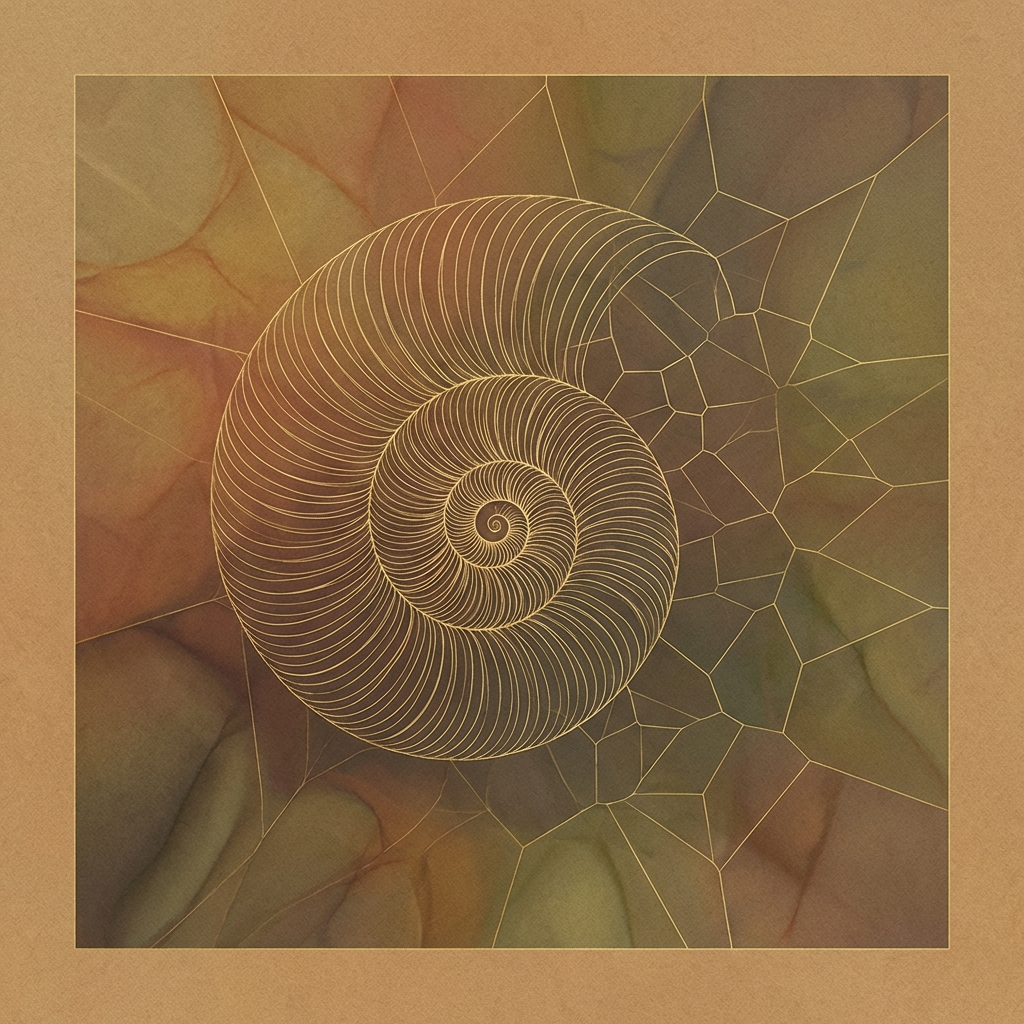
Scrolling through James's Pinterest together surfaced the clearest signals of the session. Reishi mushrooms, ammonite spirals, Voronoi cellular patterns, wood grain, leaf membranes, coral structures — all landed as immediate resonances for Tess (26:41). The aesthetic that emerged isn't hand-drawn, but feeling handmade — elegant, precise lines with an organic soul.
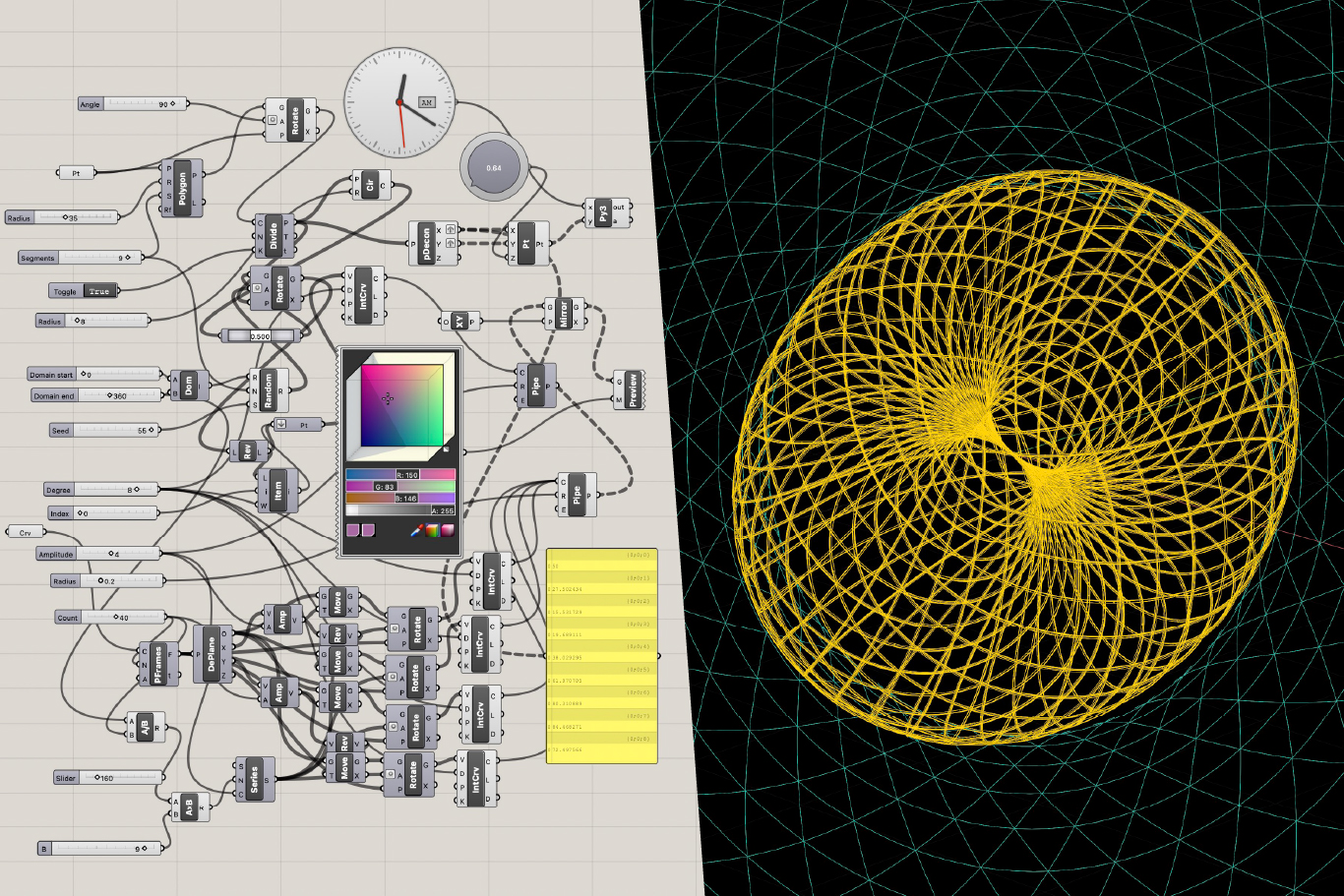
Spirals emerged as a central symbolic anchor. Tess described them as the visual language of source itself — the toroidal field, everything spiraling in and out (29:42). James noted the etymology of the word universe — "the one spinningness" — which deepened the conversation. The Voronoi pattern (found in cell structures, microscopic nature) also drew strong enthusiasm, and James noted its appeal as something that can be generated mathematically (27:46).
Key aesthetic preferences confirmed:
James confirmed the direction: no flat solid colors on the website. Instead, subtle textures will be used everywhere — a philosophy modeled on his own studio's work and a Berlin consultancy site he referenced where a touch of sacred geometry elevated an otherwise minimal design (38:55).
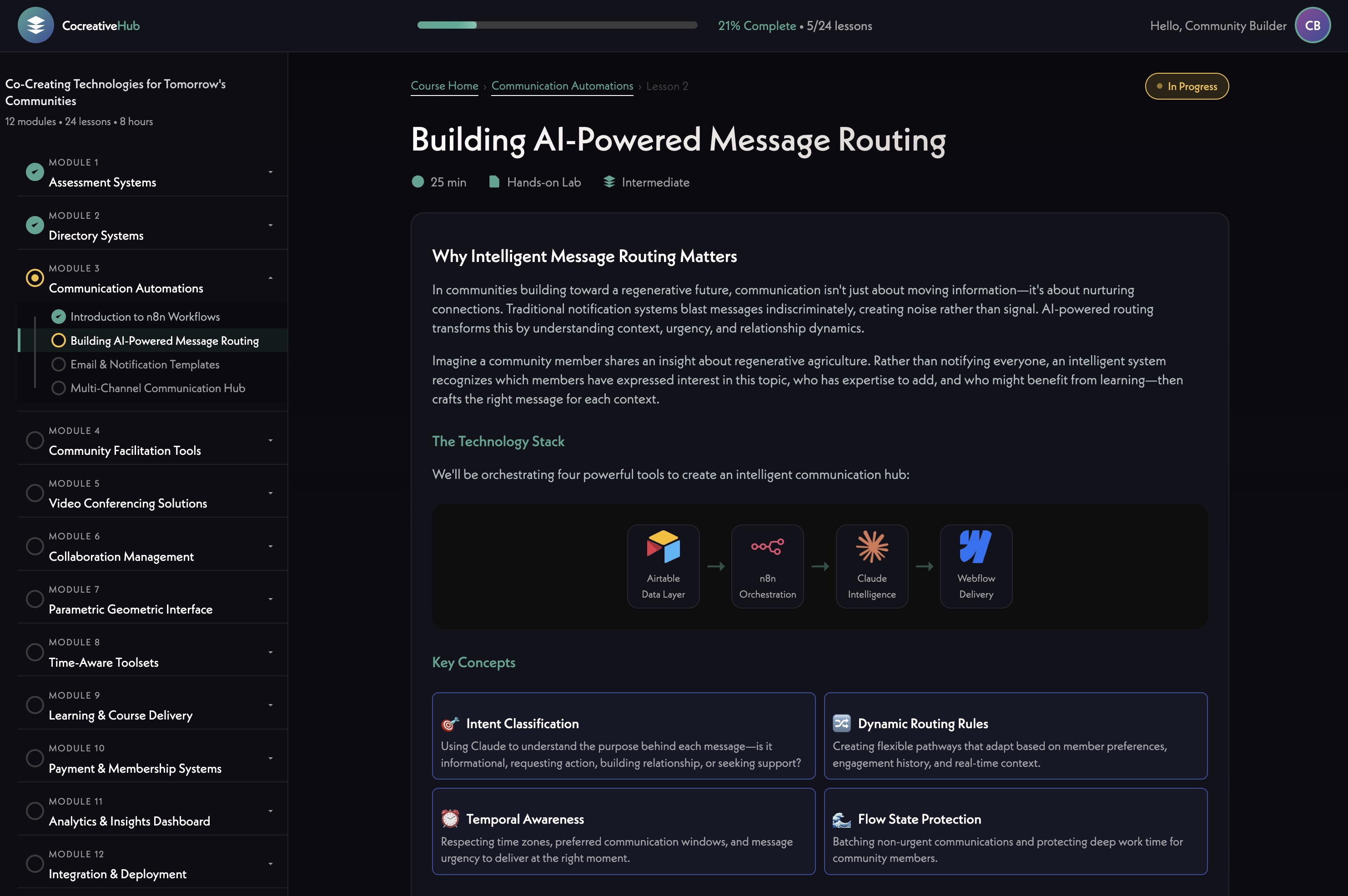
[technology="Parametric Geometric Interfaces"]
Spatial references were explored as metaphor for the site's structural feeling. Tess gravitated toward curved, organic, flowy forms — bamboo structures, rounded homes, anything opposite to the standard rectangular box (44:54). Gaudí's Sagrada Família was a shared point of reverence, and Frank Lloyd Wright was introduced as a useful bridge figure: someone who honored organic, curvilinear forms while accepting that practical structure requires some straight lines (46:21).
James drew the parallel directly to web design — the most expressive site still lives inside a rectangular browser or phone screen. The goal is to find the balance between organic forms and necessary straight lines, letting nature breathe within the constraints of the medium (47:03).
M.C. Escher was mentioned as a related reference for his psychogeometric sensibility, though James noted some of his work tilts darker (49:53).
Both James and Tess acknowledged a shared tendency toward richness — Tess describing herself as an "over the top, cram in as much art as you can" person, and James affirming there's genuine space in the current zeitgeist for a more maximal aesthetic (51:49). The guiding principle: the visual richness serves as rich soil — a permaculture frame — where the real stars are the people and offerings on the platform. The design frames them, it doesn't compete with them.
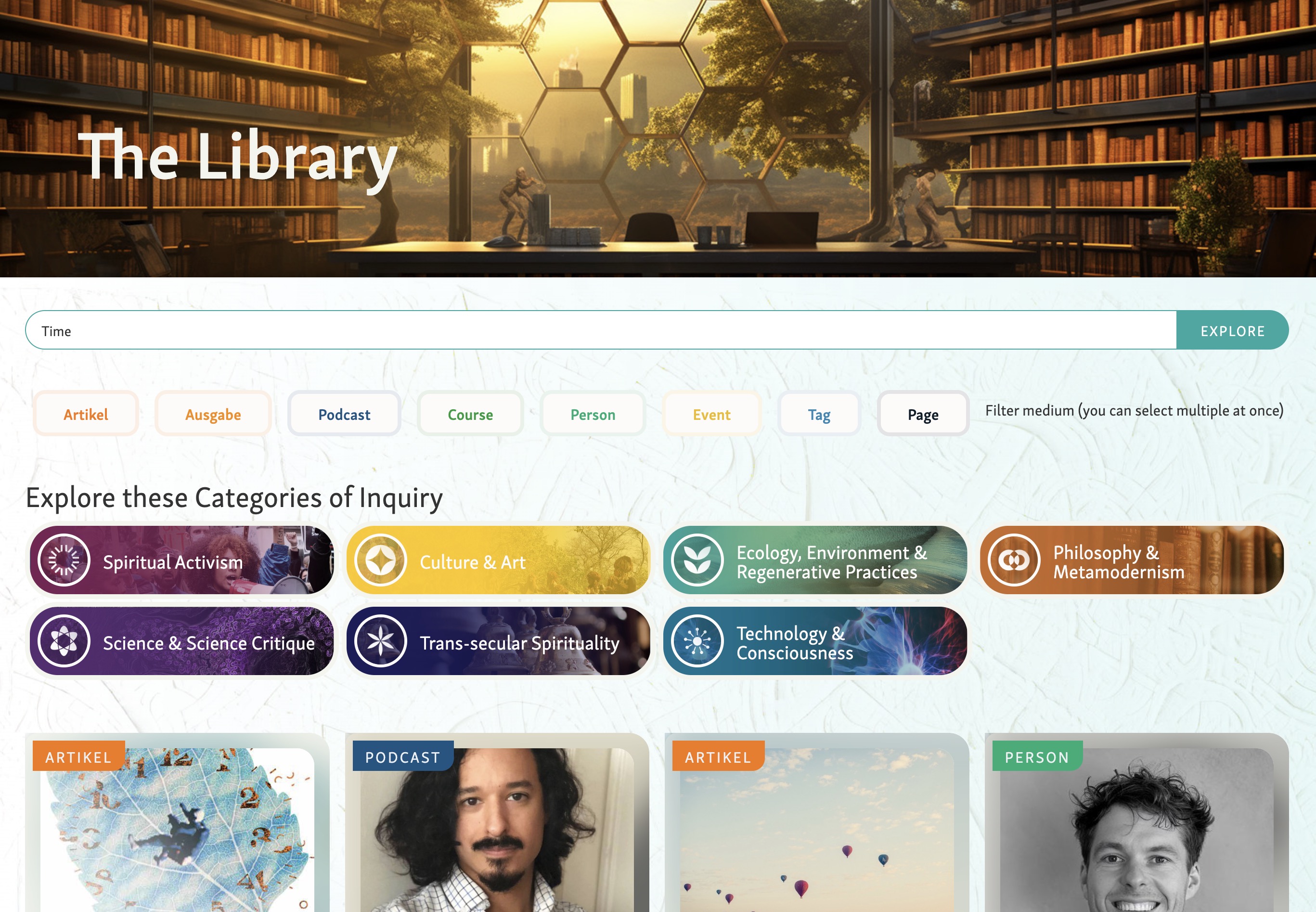
James shared reference examples from his portfolio — nature-filled geometric shapes used as containers for photographs, a honeycomb magazine layout, team portraits placed inside pentagons — all demonstrating how breaking the grid slightly can make everything feel alive without becoming overwhelming (41:29).
James walked Tess through a feature he's actively building: after filling out a profile, the platform automatically generates a custom banner image based on the user's information — no design work required from the user, but still unique to them (56:58). This could translate directly to Gaia Warriors.
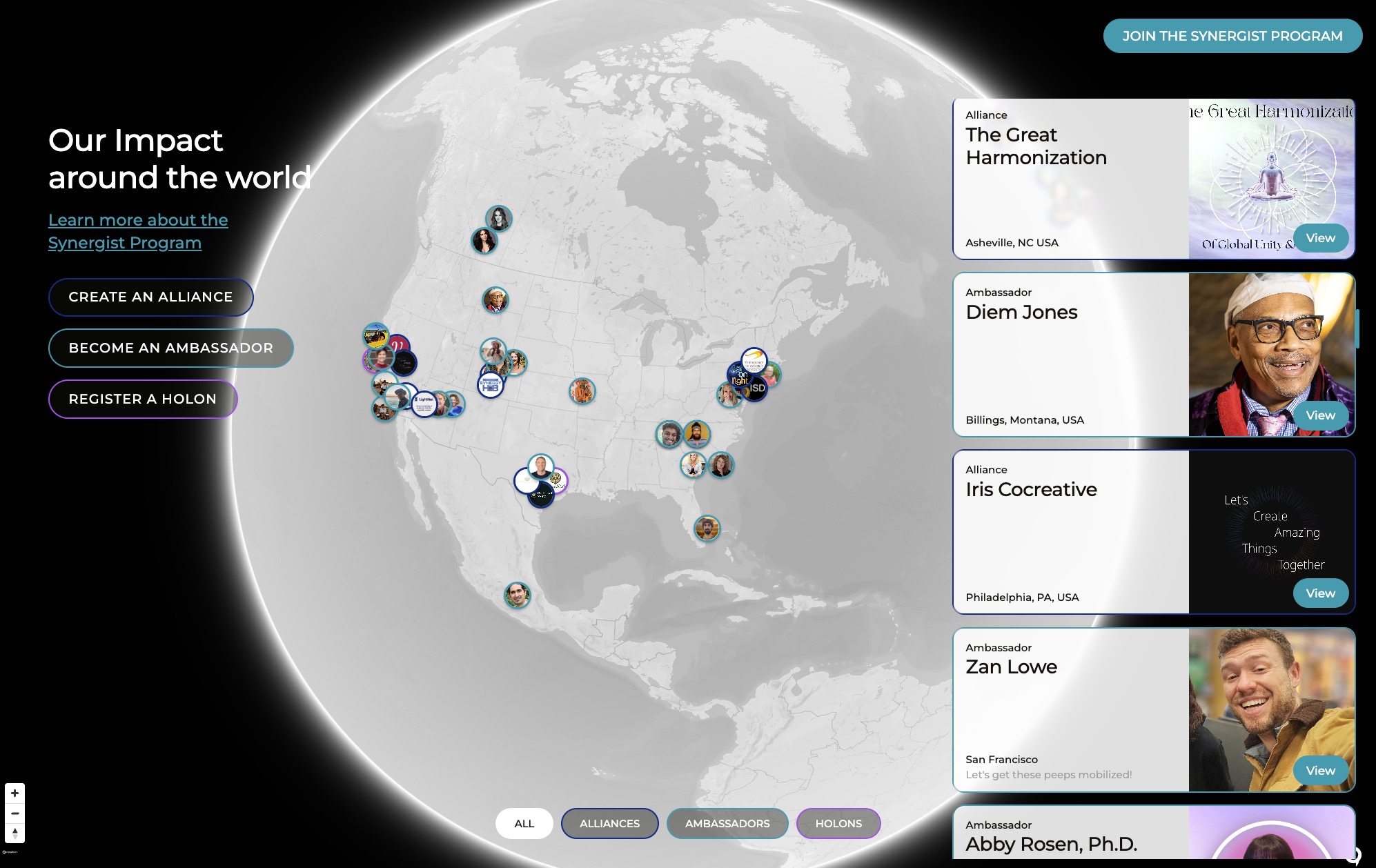
The honeycomb directory concept was also shared — a view where profile images are replaced by auto-generated artwork that fits within a visual ecology. Zooming into a region like Asheville would reveal a constellation of bubbles, each unique to a person but visually cohesive as a whole (58:00). This offers multiple ways to browse the community without defaulting to a boring grid.
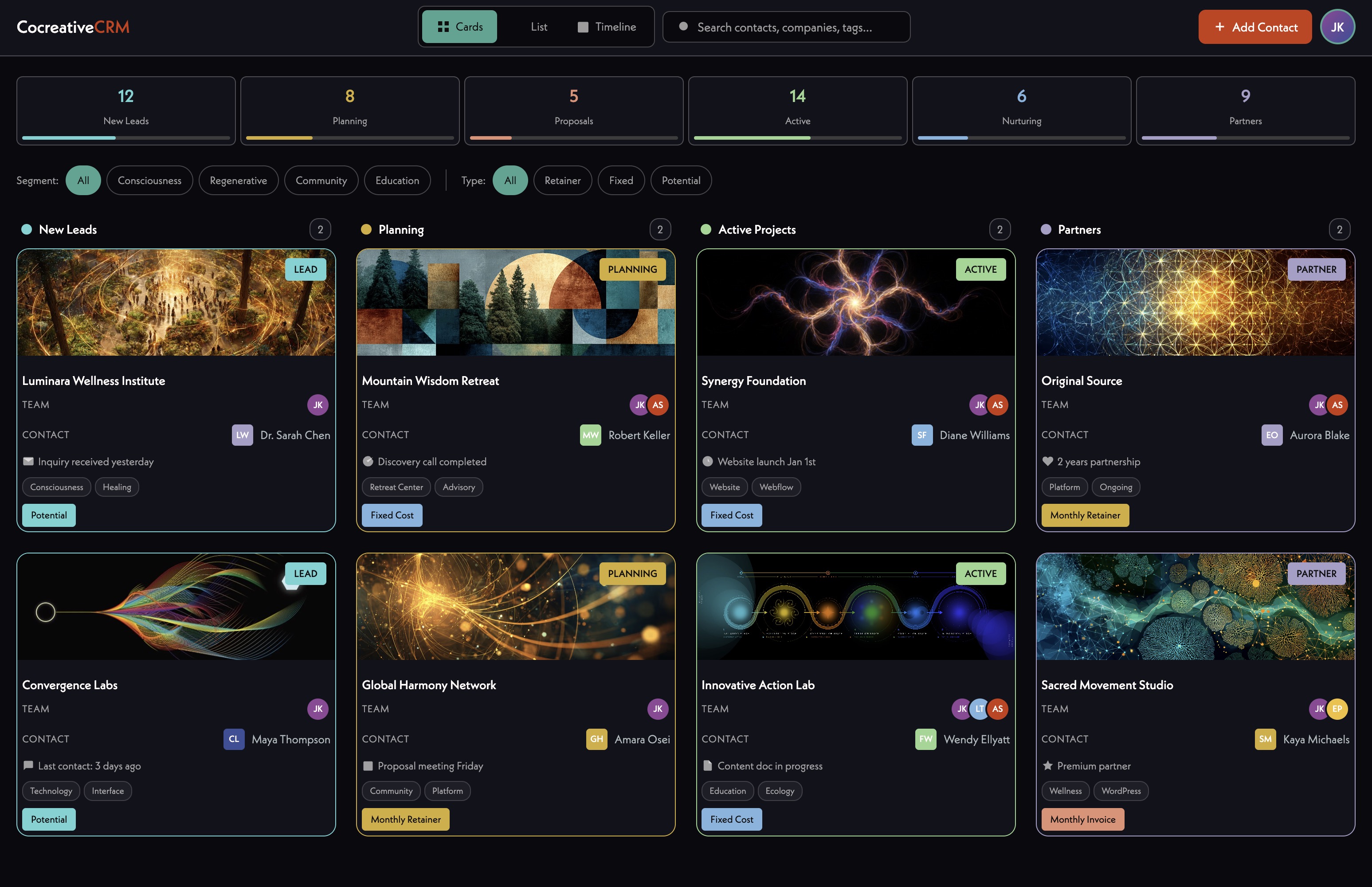
[technology="Directory Systems"]
[technology="Community Facilitation Tools"]
A key conceptual framework crystallized during the session (01:02:26):
These two axes exist symbiotically — the platform anchors people locally while ensuring those nodes are learning from and feeding each other globally. James drew a parallel to how he's building the Hollow Movement app, noting that cross-pollination between platforms is part of the vision — a course could run simultaneously across Gaia Warriors and Hollow Movement with shared participants (01:15:23).
[technology="Online Learning Platforms"]
[technology="Intelligent Matching Algorithms"]
Tess shared her vision for community-driven fundraising — collectively voting on which projects receive funding, with full transparency on where money goes and what it accomplishes (01:09:16). She described a personal experience funding a well in Kenya, filming the ceremony of the Samburu tribe receiving water, and sharing that footage with donors — calling out that the missing piece in most fundraising is the felt experience of impact.
Incentive models were explored: rewarding members who amplify each other's work (sharing social media, donating time to a fellow member's project) with tangible returns like retreat access or community recognition. James connected this to broader infrastructure he's building around impact tracking, contribution logging, and eventually blockchain-based systems that could automate fair distribution of shared revenue (01:06:00).
Purpose Earth — a nonprofit connected to the Hollow Movement — was shared as a live reference, having distributed nearly $600,000 in grants through a transparent, map-based model (01:13:10). 🔗 James flagged this as an example of what localized, direct-impact funding can look like at scale.
[technology="Collaboration Management Tools"]
James proposed that Tess start an Airtable [tag="airtable"] account immediately to begin organizing profiles and contacts, starting with Nevada City and Grass Valley as the baseline dataset (01:18:41). James will build out the table structure and record a Loom walkthrough so Tess can begin inputting data efficiently.
He also showed how Claude [tag="claude"] can be connected to Airtable [tag="airtable"] to eliminate manual data entry — passing an existing spreadsheet or Google Doc to Claude and having it map and populate fields automatically, as well as conduct research to fill in missing details like website descriptions or category tags (01:19:40). Tess confirmed she already has experience using Claude [tag="claude"] for structured data work — she's been building an index of all indigenous tribes of the world (~6,000+ entries) and found Claude [tag="claude"] significantly more reliable than other AI tools for this kind of research (01:20:24).
[technology="CRM System Templates"]
[technology="Communication Automations"]
James flagged the need for a shared Google Doc with multiple tabs — one per page of the website — to map out what content will be needed, what needs to be written, and what's already available (01:17:30). This will become the content coordination hub going into design.
Tess shared exciting plans for a physical Gaia Warriors launch event — a three-day gathering on the land of the local Sayakumi/Maidu tribe near Nevada City, tentatively aimed for just before the summer solstice in June (01:23:18). The Kogi from Colombia have been invited to attend — a tribe that famously chose isolation from the modern world until very recently, and who Tess and James both hold in deep respect (01:22:58).
The event structure would include:
Tess's long-term vision is to replicate this model in each town, using the events to activate the directory locally and let people meet each other in person before or alongside the digital platform (01:24:13).
James mentioned making laser-cut wooden stickers — a callback to a beloved piece of merch from his earlier Montaya project, where people held onto the mandala stickers for years without even wanting to stick them to anything (01:24:50).
The session closed on themes that feel central to the Gaia Warriors ethos. The platform's visual language and community model both reflect the same underlying polarity:
James shared context from his earlier project Montaya — a platform built around the idea that "there are many paths up the same mountain, and many mountains" — and how the people at the peaks of their respective disciplines recognize each other across traditions, cultures, and geography. The same spirit is alive in Gaia Warriors (01:26:30).
Both reflected on the importance of community safeguarding — having seen spiritual communities become extractive or cultish — and agreed that reputation systems, easy reporting tools, and proactive vetting will need to be built into the platform thoughtfully (01:27:20).
Designer Munia — James's long-time collaborator of eight years — will be brought into the process next, beginning work on color palettes, typography, and early homepage compositions (01:16:28).
---
James Redenbaugh
Tess (Gaia Warriors)
The session opened with James framing the goal: to find a shared aesthetic language for Gaia Warriors — not just personal preference, but a set of core visual ingredients that would carry the right frequency for the project (03:26). Rather than working through one category at a time, the pair moved fluidly between fonts, graphics, color, pattern, and spatial reference, letting responses emerge intuitively.
Tess quickly oriented the aesthetic direction: away from anything that reads too corporate or rainbow-heavy, and toward elegance, fine lines, gold tones, and natural textures (21:06). The left-leaning serif exploration was immediately preferred over anything reminiscent of Gaia TV's branding — important distinction for the project's visual identity (13:15).
Scrolling through James's Pinterest together surfaced the clearest signals of the session. Reishi mushrooms, ammonite spirals, Voronoi cellular patterns, wood grain, leaf membranes, coral structures — all landed as immediate resonances for Tess (26:41). The aesthetic that emerged isn't hand-drawn, but feeling handmade — elegant, precise lines with an organic soul.
Spirals emerged as a central symbolic anchor. Tess described them as the visual language of source itself — the toroidal field, everything spiraling in and out (29:42). James noted the etymology of the word universe — "the one spinningness" — which deepened the conversation. The Voronoi pattern (found in cell structures, microscopic nature) also drew strong enthusiasm, and James noted its appeal as something that can be generated mathematically (27:46).
Key aesthetic preferences confirmed:
James confirmed the direction: no flat solid colors on the website. Instead, subtle textures will be used everywhere — a philosophy modeled on his own studio's work and a Berlin consultancy site he referenced where a touch of sacred geometry elevated an otherwise minimal design (38:55).
[technology="Parametric Geometric Interfaces"]
Spatial references were explored as metaphor for the site's structural feeling. Tess gravitated toward curved, organic, flowy forms — bamboo structures, rounded homes, anything opposite to the standard rectangular box (44:54). Gaudí's Sagrada Família was a shared point of reverence, and Frank Lloyd Wright was introduced as a useful bridge figure: someone who honored organic, curvilinear forms while accepting that practical structure requires some straight lines (46:21).
James drew the parallel directly to web design — the most expressive site still lives inside a rectangular browser or phone screen. The goal is to find the balance between organic forms and necessary straight lines, letting nature breathe within the constraints of the medium (47:03).
M.C. Escher was mentioned as a related reference for his psychogeometric sensibility, though James noted some of his work tilts darker (49:53).
Both James and Tess acknowledged a shared tendency toward richness — Tess describing herself as an "over the top, cram in as much art as you can" person, and James affirming there's genuine space in the current zeitgeist for a more maximal aesthetic (51:49). The guiding principle: the visual richness serves as rich soil — a permaculture frame — where the real stars are the people and offerings on the platform. The design frames them, it doesn't compete with them.
James shared reference examples from his portfolio — nature-filled geometric shapes used as containers for photographs, a honeycomb magazine layout, team portraits placed inside pentagons — all demonstrating how breaking the grid slightly can make everything feel alive without becoming overwhelming (41:29).
James walked Tess through a feature he's actively building: after filling out a profile, the platform automatically generates a custom banner image based on the user's information — no design work required from the user, but still unique to them (56:58). This could translate directly to Gaia Warriors.
The honeycomb directory concept was also shared — a view where profile images are replaced by auto-generated artwork that fits within a visual ecology. Zooming into a region like Asheville would reveal a constellation of bubbles, each unique to a person but visually cohesive as a whole (58:00). This offers multiple ways to browse the community without defaulting to a boring grid.
[technology="Directory Systems"]
[technology="Community Facilitation Tools"]
A key conceptual framework crystallized during the session (01:02:26):
These two axes exist symbiotically — the platform anchors people locally while ensuring those nodes are learning from and feeding each other globally. James drew a parallel to how he's building the Hollow Movement app, noting that cross-pollination between platforms is part of the vision — a course could run simultaneously across Gaia Warriors and Hollow Movement with shared participants (01:15:23).
[technology="Online Learning Platforms"]
[technology="Intelligent Matching Algorithms"]
Tess shared her vision for community-driven fundraising — collectively voting on which projects receive funding, with full transparency on where money goes and what it accomplishes (01:09:16). She described a personal experience funding a well in Kenya, filming the ceremony of the Samburu tribe receiving water, and sharing that footage with donors — calling out that the missing piece in most fundraising is the felt experience of impact.
Incentive models were explored: rewarding members who amplify each other's work (sharing social media, donating time to a fellow member's project) with tangible returns like retreat access or community recognition. James connected this to broader infrastructure he's building around impact tracking, contribution logging, and eventually blockchain-based systems that could automate fair distribution of shared revenue (01:06:00).
Purpose Earth — a nonprofit connected to the Hollow Movement — was shared as a live reference, having distributed nearly $600,000 in grants through a transparent, map-based model (01:13:10). 🔗 James flagged this as an example of what localized, direct-impact funding can look like at scale.
[technology="Collaboration Management Tools"]
James proposed that Tess start an Airtable [tag="airtable"] account immediately to begin organizing profiles and contacts, starting with Nevada City and Grass Valley as the baseline dataset (01:18:41). James will build out the table structure and record a Loom walkthrough so Tess can begin inputting data efficiently.
He also showed how Claude [tag="claude"] can be connected to Airtable [tag="airtable"] to eliminate manual data entry — passing an existing spreadsheet or Google Doc to Claude and having it map and populate fields automatically, as well as conduct research to fill in missing details like website descriptions or category tags (01:19:40). Tess confirmed she already has experience using Claude [tag="claude"] for structured data work — she's been building an index of all indigenous tribes of the world (~6,000+ entries) and found Claude [tag="claude"] significantly more reliable than other AI tools for this kind of research (01:20:24).
[technology="CRM System Templates"]
[technology="Communication Automations"]
James flagged the need for a shared Google Doc with multiple tabs — one per page of the website — to map out what content will be needed, what needs to be written, and what's already available (01:17:30). This will become the content coordination hub going into design.
Tess shared exciting plans for a physical Gaia Warriors launch event — a three-day gathering on the land of the local Sayakumi/Maidu tribe near Nevada City, tentatively aimed for just before the summer solstice in June (01:23:18). The Kogi from Colombia have been invited to attend — a tribe that famously chose isolation from the modern world until very recently, and who Tess and James both hold in deep respect (01:22:58).
The event structure would include:
Tess's long-term vision is to replicate this model in each town, using the events to activate the directory locally and let people meet each other in person before or alongside the digital platform (01:24:13).
James mentioned making laser-cut wooden stickers — a callback to a beloved piece of merch from his earlier Montaya project, where people held onto the mandala stickers for years without even wanting to stick them to anything (01:24:50).
The session closed on themes that feel central to the Gaia Warriors ethos. The platform's visual language and community model both reflect the same underlying polarity:
James shared context from his earlier project Montaya — a platform built around the idea that "there are many paths up the same mountain, and many mountains" — and how the people at the peaks of their respective disciplines recognize each other across traditions, cultures, and geography. The same spirit is alive in Gaia Warriors (01:26:30).
Both reflected on the importance of community safeguarding — having seen spiritual communities become extractive or cultish — and agreed that reputation systems, easy reporting tools, and proactive vetting will need to be built into the platform thoughtfully (01:27:20).
Designer Munia — James's long-time collaborator of eight years — will be brought into the process next, beginning work on color palettes, typography, and early homepage compositions (01:16:28).
---
James Redenbaugh
Tess (Gaia Warriors)
Brief designer Munia with session context and begin color palette and typography exploration
Brief long-time collaborator Munia with context from this vision session and get her started on color palettes, typography, and early homepage compositions for Gaia Warriors. Referenced at 01:16:28.
Set up shared Google Doc with tabbed structure for each website page
Create shared Google Doc with one tab per website page to map out content needs, what needs to be written, and what is already available. This becomes the content coordination hub going into design. Walk Tess through content needs. Referenced at 01:17:30.
Build out Airtable table structure for community CRM and record Loom walkthrough for Tess
Build out Airtable table structure for the community CRM starting with Nevada City and Grass Valley as baseline dataset. Record a Loom walkthrough so Tess can begin inputting data efficiently. Referenced at 01:18:43.
Demonstrate how to connect Claude to Airtable for automated data import and research
Show Tess how to connect Claude to Airtable for automated data import and research — passing existing spreadsheets or Google Docs to Claude to map and populate fields automatically, as well as conduct research to fill in missing details like website descriptions or category tags. Referenced at 01:19:40.
Source nature-based stock video and photography using available iStock credits
Use approximately 41 available iStock credits to source relevant stock video and photography aligned with the aesthetic direction identified in this session — organic forms, spirals, natural textures, Voronoi patterns, nature photography. Referenced at 39:44.
Schedule follow-up vision and design session for approximately next Friday
Schedule next follow-up session for approximately the coming Friday to continue design and vision work. Referenced at 01:31:45.
Create Airtable account and share login credentials with James
Create an Airtable account and share login credentials with James so he can build out the table structure for the community CRM. Referenced at 01:18:41.
Begin compiling Nevada City and Grass Valley contact and profile data for directory baseline
March 25, 2026
Begin compiling Nevada City and Grass Valley contact and profile data as the baseline dataset for the community directory. This is the first geographic node of the directory. Referenced at 01:19:13.
Use Claude to structure and import existing data into Airtable for directory
Use Claude to assist with structuring and importing existing contact and profile data into Airtable for the directory, leveraging Claude's ability to map fields, populate entries, and conduct research to fill in missing details. Referenced at 01:20:24.
Coordinate logistics for June launch event on Sayakumi Maidu land
Coordinate logistics for the three-day physical Gaia Warriors launch event on the land of the local Sayakumi/Maidu tribe near Nevada City, tentatively just before the summer solstice in June. Confirm dates, Kogi participation, local panelists from organizations like Geoship, and structure for Gaia Warriors Day and indigenous ceremony components. Referenced at 01:23:18.
Continue building indigenous tribes index and explore how tribe profiles could be represented on website
Continue building the index of all indigenous tribes of the world (~6,000+ entries using Claude) and explore how tribe profiles and elder interviews could be represented on the Gaia Warriors website. Referenced at 01:21:15.
Browse iStock for nature-based video content aligned with aesthetic direction from session
Browse iStock for nature-based video content that aligns with the aesthetic direction identified in this session — spirals, organic forms, reishi mushrooms, ammonites, Voronoi patterns, water, stone, natural textures with gold and warm earth tones. Referenced at 39:44.
Complete brand identity and website design for Gaia Warriors platform. Design will embody coherence principles through proportions, colors, and interface choices that create 'a new kind of collective nervous system.' Core design principles established: resonance as primary quality, organic/non-rectangular geometry pushing against screen limitations, nature-inspired architecture (adobe, cob, bamboo, hemp) informing digital aesthetics, real Earth photography rather than AI-generated imagery. Logo symbolism deeply explored: masculine-feminine balance, four elements integration, torchbearer and nurturer archetypes, wings representing integration of both energies.
Visual aesthetic direction now clearly defined: Fine lines over thick/hand-drawn, gold tones and warm earth textures, ombré and tonal variation within single color families (no flat solid colors), elegant precision with organic soul. Spirals emerged as central symbolic anchor - toroidal field, universe as 'one spinningness', ammonite forms. Voronoi patterns (cellular structures) also resonant. Nature textures: reishi mushrooms, wood grain, leaf membranes, coral structures, rippling water, stone arches.
Architectural references: Gaudí's Sagrada Família, Frank Lloyd Wright's organic curvilinear forms balanced with practical structure - metaphor for web design within rectangular browser constraints. Maximal aesthetic with intention - rich soil permaculture frame where people and offerings are the stars. Breaking the grid slightly to make everything feel alive.
Shared Google folder populated with color palettes, logo files, brand references, nature videos, gold frames. Designer Munia being brought in next to begin color palette, typography, and homepage compositions. iStock credits (41 available) to be used for nature-based stock video and photography aligned with established aesthetic.
Build searchable member directory to help Gaia Warriors members find and connect with each other. Directory is central to launch vision and serves as the heart of the discovery layer. System supports geographic discovery, category filtering, and profile clustering for dense areas. Core features: MapBox integration with auto-calculated coordinates from location entries, profile clustering creating visual polygons for nearby users rather than overwhelming pin stacks, quick profile creation with low friction, tag interface with curated list plus custom options. Directory will surface healers, organic farms, organic restaurants (organic/farm-to-table/ethically sourced only), nonprofits, events, ceremonies, retreats, sovereignty-related services, artists, and musicians for each featured location. Artists and musicians being added as new category (12:25) — recognizing that choosing the artist's path in this world is itself an act of courage. Potential integration with Awakening World database as resource for global artist directory (13:25). Launch strategy: Start with curated US spiritual hubs (Sedona, Mount Shasta, Asheville) with visible roadmap for future towns. Gaia Warriors actively expanding town by town with ambition for global coverage (04:33). Users can propose and vote on which cities get added next. Long-term vision is fully global, organized by bioregion rather than national borders, with regional ambassadors managing each area. Technical implementation: Airtable-to-Webflow sync with draft/publish status trigger field (05:29). Allows staging large batches of entries before selective publishing. AI-assisted research workflow validated for population (Claude integration operational). Design direction established: Deep green background with light-on-dark aesthetic. Will incorporate more collage elements and Earth imagery as design matures. Built on Airtable relational database with Webflow front-end and MapBox geographic visualization. Infrastructure already prototyped in parallel platform project (Holos).
Develop Mystery School component featuring courses from Tess and guest teachers on somatic healing, indigenous wisdom, nervous system regulation, and embodiment practices. Platform needs to support flexible business models including membership access and revenue sharing.
Paid tier of platform unlocks deep educational programming where line between teacher and student stays deliberately blurry — everyone is both. Structure encourages participants to share their own codes and breakthroughs alongside formal curriculum. Initial launch will feature Tess's course with different guest teachers in modules.
Cross-pollination framework: Courses could run simultaneously across Gaia Warriors and Hollow Movement with shared participants (01:15:23). This supports horizontal axis of platform - non-local learning where village builders in different regions learn from and feed each other.
Long-term vision: Learning happens through self-paced exploration, community engagement, and right content at right time — transformative learning journeys that respond to learner needs rather than rigid structures.
Build community facilitation features including community challenges, experience sharing spaces, voting systems, and tools for collaborative project creation. Community challenges: Weekly or recurring prompts (e.g., 'do one random act of kindness this week', 'build an earth altar') where users post participation and inspire each other. Available in free tier. Voting on projects and initiatives: Users have tangible sense that engagement creates real-world impact. Free tier feature. Connected to transparent fundraising system where community votes on which projects receive funding. Incentive models being explored: Rewarding members who amplify each other's work (sharing social media, donating time to fellow member's project) with tangible returns like retreat access or community recognition. Token system potentially partnering with existing platforms like Seeds rather than building from scratch (40:25). Collaborative project management: Eventually users who meet on platform and take on project together should manage collaboration entirely within platform without migrating to external tools. Custom project management tool demonstrated in parallel platform — team members use existing profiles to access admin features, manage tasks, update statuses, add copy, view timeline. Vision is same capabilities in Gaia Warriors. Messaging and posting functionality already prototyped in Holos platform. Features demonstrated include: direct messaging, group chats, holon (group) creation with message walls, image sharing, topic threads, shared resources. Forum-style posting for mission photo shares and event mentions confirmed as core feature. @mentioning capability for linking events and content within community discussions. Core design principle: Successful technology gets out of the way of human connection (17:23). Technology should amplify fiber-optic connections between humans as sources of light and creativity, not dampen them or create illusion of connection while actually isolating. Platform must translate online community into in-person interaction (19:45).
Build unique transparent fundraising system where community votes on fund allocation, corporations receive tax benefits, and progress is documented through video updates showing real impact. System addresses nonprofit corruption concerns by creating radical transparency and community direction of resources.
Tess vision (01:09:16): Full transparency on where money goes and what it accomplishes - the missing piece in most fundraising is the felt experience of impact. Example shared: funding a well in Kenya, filming ceremony of Samburu tribe receiving water, sharing footage with donors.
Purpose Earth nonprofit (connected to Hollow Movement) referenced as live model - distributed nearly $600,000 in grants through transparent, map-based system (01:13:10). This demonstrates what localized, direct-impact funding can look like at scale.
Integration with community contribution tracking: Members who amplify each other's work could earn community recognition or tangible benefits. Impact tracking and contribution logging could eventually automate fair distribution through blockchain-based systems.
Build custom membership system with multi-tier access (including sliding scale and 'pay what you want' options), subscription management through Stripe, and secure authentication. System must support flexible pricing models to ensure platform remains inclusive while sustaining teachers and operations.
Two-tier model: Free tier includes community challenges (weekly prompts like 'do one random act of kindness'), community voting on projects and initiatives, and basic engagement features. Paid tier unlocks Mystery School content with teachers, healing modalities, and guided learning journeys where line between teacher and student stays deliberately blurry.
User profiles created quickly with questions about identity, seeking, offering, location, and work domains. Tag interface for self-categorization. Profile includes auto-generated banner images created by AI reading user's profile content (56:58). User immediately lands in directory context after profile creation to see themselves as part of the network.
Platform designed to feel transparently in-process at launch — foundation being laid, invitation to be creator not consumer. Community safeguarding built in thoughtfully: reputation systems, easy reporting tools, proactive vetting to prevent extractive or cultish dynamics (01:27:20).
Membership features demonstrated in Holos prototype (12:30): Mini profiles opening from directory cards with expansion to full profile pages, member-only access to holons/groups, RSVP visibility for events showing which community members are attending (20:25), filtering events by Gaia Warriors member attendance.
Coordinate September 2026 launch campaign centered on physical Gaia Warriors launch event, including finalization of launch video (90-120 min featuring teachers), personal heartfelt outreach across three continents, ambassador recruitment, and activation messaging. Timeline revised to September launch (01:39). Payment cadence: installment now, end of July, end of August. Physical launch event: Three-day gathering on Sayakumi/Maidu tribal land near Nevada City, tentatively just before summer solstice in June. Kogi tribe from Colombia invited to attend. Event structure: (1) Gaia Warriors Day with local panelists from organizations like Geoship sharing projects, (2) Indigenous ceremony and presence from Kogi and Sayakumi, (3) Activation of local directory giving featured community members visibility and promotion. Long-term vision: Replicate this event model in each town - use gatherings to activate directory locally and let people meet in person before/alongside digital platform. Laser-cut wooden stickers with QR codes being made as beloved merch callback to Montaya project (22:40). Physical artifacts explored as portals to platform (22:00): Pins or buttons signaling membership and creating recognition between Warriors in the wild, premium tiered artifacts for ambassadors (e.g., 3D-printed metal Merkaba with cuboctahedral geometry), QR codes embedded as bridges from physical to digital. Tomorrowland metaphor: pin as both membership marker and literal transporter to higher-vibration shared space (25:08). Launch strategy: Pilot with curated US spiritual hubs (Sedona, Mount Shasta, Asheville) featuring healers, organic farms, organic restaurants, nonprofits, events, ceremonies, retreats, sovereignty services, artists, musicians. Regional ambassadors or small teams will eventually manage each bioregion. Campaign creates sense of movement activation — people showing up for a mission to change the world. Transparent about beta/in-process status while demonstrating functional foundation ready for creative co-creation.
Build full Webflow website incorporating brand design, portal onboarding experience, directory system, profile creation flows, and community features. Website functions as threshold and activation point — not just information delivery. Key components: Portal/threshold onboarding with initiatory 'yes' moment, puzzle piece composition showing empty space as call to action, time-manipulated nature videos evoking emotional resonance, ornate decorative elements throughout, sacred geometry integration, smooth animations creating sense of living world rather than static pages. Visual implementation: Fine-lined spirals, Voronoi patterns, gold tones, ombré color variations, subtle textures everywhere (no flat solid colors). Nature-based stock photography and video from iStock library. Architectural metaphor of organic forms within rectangular browser constraints - like Frank Lloyd Wright's balance of curves and structure. AI philosophy statement to be added to site (10:21): No AI used for content or art — everything human-made and organic. AI reserved for research acceleration only. Marketing angle: In age of increasing AI prevalence, how do we remember and celebrate our humanness? Use AI to handle administrative layers so humans spend more time with healers, in community, making art, growing food, learning together (11:30). Technical implementation: Webflow CMS, Airtable backend via Whalesync with draft/publish status trigger (05:29), MapBox for geographic features, Stripe for payments, custom JavaScript for interactions including auto-generated profile banners and honeycomb directory views. Infrastructure already prototyped in parallel platform build (Holos). Design principle guiding all features: Successful technology gets out of the way of human connection (17:23). Humans are sources of light and creativity; technology should amplify those fiber-optic connections, not dampen them. Content coordination: Shared Google Doc with tabbed structure for each website page mapping what content is needed, what needs writing, and what's already available. Target launch September 2026 (01:39). MVP scope to be defined next week (44:17) to clarify what must launch versus what can follow.
Research and plan for data sovereignty, backup systems, and migration capabilities to ensure Gaia Warriors can survive potential Internet disruptions or platform shutdowns. Explore open source alternatives to current cloud stack (Airtable, Webflow) that can run on local servers or private infrastructure. Design distributed backup strategy with data stored on hard drives at multiple geographic nodes. Ensure platform can participate in meshwork systems if global networks fail.
Philosophy: 'hope for the best, prepare for the worst' — leverage cloud tools now while maintaining migration capability. Airtable will serve as lightweight CRM in near term for managing ambassador relationships and community tracking, with plan for eventual in-platform management. Airtable account setup (01:18:41) is first step - Tess creating account, James building table structure and recording Loom walkthrough.
Claude integration with Airtable for automated data import and research (01:19:40). Tess already experienced using Claude for structured data - building index of all indigenous tribes of the world (~6,000+ entries) and found Claude significantly more reliable than other AI tools for this research (01:20:24). This workflow directly applicable to populating community directory.
Preliminary research into local hosting, self-hosted AI, and CSV export/import workflows. Long-term vision includes possibility of distributed nodes and local meshwork systems aligned with bioregional organization structure.
Establish content coordination infrastructure and begin populating website content, community directory, and knowledge base. Central hub is shared Google Doc with tabbed structure - one tab per website page - mapping what content is needed, what needs writing, and what's already available. Airtable CRM setup for community directory: James built table structure and recorded Loom walkthrough for Tess. Gaia Warriors actively expanding directory town by town with ambitions for global coverage (04:33). Claude integration now fully demonstrated and operational for automated data import - passing existing spreadsheets/Google Docs to Claude to map and populate fields automatically, plus conduct research to fill missing details. Airtable-to-Webflow sync enhanced with draft/publish status trigger field (05:29). Allows staging large batches of entries and selectively publishing when ready. System will evolve over time but sync behavior remains consistent. AI philosophy for content creation (10:21): No AI used for content or art — everything human-made and organic. AI reserved strictly for research acceleration and administrative tasks so humans can spend more time in community, making art, growing food, learning together (11:30). New directory categories being added: Artists and musicians alongside healers, permaculturists, earth stewards, and farmers (12:25). Awakening World database shared as resource for global artist directory content (13:25). Workflow validated through live demonstration: Healers and organic restaurants in Nevada City successfully populated with addresses, websites, Instagram handles, and AI-generated descriptions confirmed by Gaia as publication-quality. Image workflow established: logos via screenshot from websites/Instagram, banner images via Google Maps business listings which frequently have higher-quality photography. Tess bringing proven workflow from indigenous tribes index project (~6,000+ entries built using Claude) - Claude significantly more reliable than other AI tools for structured research. This same methodology applies to populating healer profiles, organization descriptions, and event details. iStock library credits (41 available) being used to source nature-based stock video and photography aligned with established aesthetic direction - reishi mushrooms, spirals, wood grain, rippling water, stone arches, membranes. Content types being coordinated: Website page copy, member/organization profiles for directory, indigenous tribe profiles and elder interviews, launch event details, brand story and mission statements. New team support becoming available: project manager being interviewed, Lauren returning to help with research and image sourcing.
00:00:07
Gaia Warriors: This meeting is being recorded.
00:00:45
James Redenbaugh: Hi, Tess.
00:00:46
Gaia Warriors: Hi, James.
00:00:48
James Redenbaugh: How you doing?
00:00:51
Gaia Warriors: Good, and you?
00:00:53
James Redenbaugh: Good, I'm doing good.
00:00:57
Gaia Warriors: That's nice.
00:00:59
James Redenbaugh: Yeah.
00:01:02
Gaia Warriors: Beautiful day out here in California.
00:01:05
James Redenbaugh: Oh good. It's just starting to feel like spring a little bit over here and I'm very glad about that.
00:01:12
Gaia Warriors: Oh really? Yeah, it's been like full on spring after that snowstorm.
00:01:20
James Redenbaugh: Cool.
00:01:21
Gaia Warriors: Yeah.
00:01:30
James Redenbaugh: You're in Grass Valley, right, or Nevada City.
00:01:36
Gaia Warriors: Nevada City. Well, they're like five minutes from each other, so it's pretty much the same area.
00:01:43
James Redenbaugh: A friend of mine I realized is starting an art gallery in. I'm not sure if it's Nevada City or Grass Valley, but one of them.
00:01:50
Gaia Warriors: Oh, cool. I'd like to check that out.
00:01:54
James Redenbaugh: Yeah, I'll figure out the name of. Looks really cool. She's an awesome person. She was actually my. The partner that I moved out to California with and 2012 and now she's married and building this gallery with her husband. It looks really cool.
00:02:17
Gaia Warriors: Wow. Is it gonna just be like, what kind of art? Like paintings and stuff?
00:02:22
James Redenbaugh: I think all kinds of stuff. They're pretty alternative conscious people, so I don't know, they'll probably do cool events and things.
00:02:34
Gaia Warriors: Yeah, it's very. We have lived in a very artistic town, that's for sure. There's a lot of like art. Art towns and events and.
00:02:45
James Redenbaugh: Ah, awesome.
00:02:50
Gaia Warriors: Okay, 30 minute drive. It's. Sorry, I just have to finish this text real quick about where.
00:03:01
James Redenbaugh: Yeah, no problem.
00:03:02
Gaia Warriors: 30 minute drive. Hey dad.
00:03:26
James Redenbaugh: Cool. So the main purpose of the call today is to align on colors, feelings, aesthetic imagery, texture, pattern. And I pulled some things together, but I thought we could do some exercises together to look at some, some different contrasty things and, and see where our, our sensibilities align around this project. So we'll look at some, at some visuals and some imagery and I'm very curious. Your tastes. And of course taste is very subjective and it's not like personal taste is not the most important thing when it comes to branding a project like this. Yeah, you know, it's not. I want, I want you to find it like beautiful and awesome and like it represents everything that you're doing, but it's also not necessarily a reflection of your personal taste and, and what you enjoy the most. But you know, that said, your personal preferences are really important and they tell me a lot about the, the kind of frequency of the project and it's also an opportunity for me to sense and like correct and in tune my own senses to see what, you know, what do I feel would Work for this and see if you agree and things like that. So.
00:05:24
Gaia Warriors: Sounds good.
00:05:25
James Redenbaugh: Great. And yeah, you already shared some stuff and of course you'll have more opportunity to share more things and you know, the things that you see today might inspire you to go find other stuff and that's always welcome, including if you want to go to like a library or a botanical garden or a, you know, a crystal shop for inspiration and take pictures and things like that, that's more than welcome.
00:05:59
Gaia Warriors: Cool. That's a good idea to do that.
00:06:02
James Redenbaugh: Yeah. So, and then also I'll say a goal in general of mine is to. Find together a core set of ingredients that we'll use to make the visual language. And the visual language is kind of like a core set of like it's ingredients that we'll use to make the website. But the kind of meta ingredients are things like, you know, the interplay between Gaia and Warrior is definitely one of them. That's obviously going to be a major theme in this website. So we'll explore like what is the Gaia energy aesthetically and what is the Warrior energy aesthetically and how can they dance together in different ways. So I'm sure that's going to be one. But then there also might be other ones. You know, for example, five elements is a common one, or four elements, or maybe there's three elements that we identify, or six elements. You know, I don't want to assume what those are. I want to create a space for us to, to find them and then we'll play with them on the site and use them to kind of permeate everything. So for example, maybe. Well, I'm sure connection is really important on the website, connecting people. And then. So when we're talking about connection or when a page has a connective function, what kind of symbolism or imagery are we using to talk about connection or connectivity? And then we can develop a kind of shorthand for that, that kind of thing. So we'll see what, what emerges. I want to keep it loose and keep it open. But before we jump into that, any, any ideas that you want to share? Anything that's been alive for you since our last call. Any, any developments?
00:08:22
Gaia Warriors: I did like a four hour brain spotting yesterday. That was pretty powerful.
00:08:27
James Redenbaugh: Whoa. What's that?
00:08:30
Gaia Warriors: It's, it's an ancient med. Actually, I think it's. I don't know if it's how old it is actually. I don't know why I said ancient, but it's a modality where they take like a, a pointer and they put it across your eyes. And well, you set an intention first about what you want to. Anything that you want to work on, like a trigger in your life. And then she puts the pointer across your across. And then she says, does it feel more heavy on this side or this side? And then you choose a side. And then she takes the pointer and she moves it across like your eye frame. And then when your yuck. Your eye will kind of like flicker, then she knows that's a spot. Because your eyes are connected to the part of your brain where trauma is stored in your subconscious. And so when you're working on a particular theme, when you hold the pointer there, that that part of the trauma, what's linked to that trigger or linked to that theme will start playing out and you'll start seeing like, memories come out which are like either past life or current life that are related to that specific thing. And then your body gets a chance to have it to be witnessed and experienced and cleared out. So that can be cleared out through crying or like shaking. Your bodies can shake or. Yeah, just things like that. But yeah, it's very, very, very powerful. So I'm basically doing a lot of like, research on different types of shadow work and modalities and using myself as the guinea pig and seeing what works and what doesn't work because that's going to be part of the educational content that's going to be as part of the Guy warriors like curriculum. Bless you.
00:10:24
James Redenbaugh: Awesome. That's great. It's funny because what I felt called to do today isn't exactly something that I've done before, but I wanna. I'll show you in a sec. But I wanna just take two different things. We'll do a bunch of different sets and I wanna get your gauge between them to see like, is it more this one or more that one? Sounds pretty similar to that.
00:10:53
Gaia Warriors: Yeah,
00:10:55
James Redenbaugh: that same kind of thing.
00:10:57
Gaia Warriors: Yeah. Yeah.
00:10:59
James Redenbaugh: So, and I'll. I'll bring different. Different. You'll see different things in according to where we go. Great, let's start. And we'll kind of go between fonts and colors and symbols and patterns instead of focusing on one thing and then another.
00:11:30
Gaia Warriors: Okay.
00:11:33
James Redenbaugh: And some of the images you'll see will have. All of the above. So I'm going to share this screen here. Are you seeing this? Is this big enough yet? Cool. So when we look at different things, you wrote warriors warriors. There. Is that right? Is it three Rs?
00:12:18
Gaia Warriors: Yeah, three hours.
00:12:20
James Redenbaugh: Cool. So yeah, when we look at these things, it's not only about, like, which one are you more drawn to? But also what. What kind of qualities do they invoke in you or are you not drawn to either? But I'm mostly. We're going to start with things that are more on a spectrum. So looking at these two, just the word Gaia.
00:12:55
Gaia Warriors: Yeah.
00:12:58
James Redenbaugh: Of these, which are you more drawn to?
00:13:02
Gaia Warriors: The left More.
00:13:04
James Redenbaugh: The left. Like very much more the left.
00:13:08
Gaia Warriors: Yeah, yeah, yeah. The other one looks too similar to Gaia tv.
00:13:15
James Redenbaugh: Oh, yeah. Let's find a nice green dot here. Put it in the background. Yeah. We don't want to be Gaia tv. Cool. And not all of these will say Gaia and that's okay. Then we have this one. And this one. Which of these fonts feels more resonant?
00:14:24
Gaia Warriors: I like the bottom right corner looks pretty cool.
00:14:30
James Redenbaugh: Cool.
00:14:31
Gaia Warriors: Probably the two opposite corners
00:14:36
James Redenbaugh: and the. Both the. Do you also like the color and the quality of light in here?
00:14:50
Gaia Warriors: Yeah.
00:14:52
James Redenbaugh: Cool. And what don't you like about this over here?
00:15:00
Gaia Warriors: It's kind of clunky.
00:15:06
James Redenbaugh: Kind of sticky too.
00:15:08
Gaia Warriors: Yeah. The other ones look just cleaner and. Yeah.
00:15:14
James Redenbaugh: Cool. Now let's hop over to a graphic. We've got this lady over here. And then something more golden. I'm not as fast on my PC as I'm used to being on my Mac. How about these graphics? This one on the left, more hand drawn, high contrast. On the right, more golden. Fine line, textured.
00:16:16
Gaia Warriors: I definitely like the. The fine line and the gold better, but I like the fact that there's a little. It looks like the woman there is holding, like she's. She's using her intention to create a sun. We could use if we could put that little chick under that sun.
00:16:40
James Redenbaugh: Cool. So you like the kind of feminine.
00:16:45
Gaia Warriors: This is all about empowering. So, you know, I like the idea of, like. People feeling like they are co creators and magicians in the world.
00:16:59
James Redenbaugh: Cool. Looking at just the symbol, do you like the asymmetry or there. Are there things that you like about the asymmetry here or do you feel more drawn to the symmetry of this circle?
00:17:17
Gaia Warriors: Good question. I mean, I don't mind asymmetry or symmetry. I just. I like the. The fine lines and the gold just look more beautiful to me. Not so much. I don't. Things can be asymmetrical and symmetrical and still be beautiful, you know?
00:17:39
James Redenbaugh: Yeah. Cool. Good.
00:17:43
Gaia Warriors: Thanks for asking.
00:17:47
James Redenbaugh: I'm gonna bring in a couple more. There's some more lines. It's kind of trippy. Oops. I keep pushing the wrong button
00:18:14
Gaia Warriors: like that. Ooh, like that Too.
00:18:29
James Redenbaugh: Yeah. So between these two, what feels more resonant?
00:18:35
Gaia Warriors: I mean, they're both so beautiful, but the one on the bottom right is. Yeah. Very, very beautiful to me. Very exquisite.
00:18:42
James Redenbaugh: Special. Yeah. I like the balance of symmetry and asymmetry over here.
00:18:51
Gaia Warriors: Yeah,
00:18:54
James Redenbaugh: I really like this texture as well.
00:18:58
Gaia Warriors: Yeah, Yeah, I did.
00:19:01
James Redenbaugh: Somebody just rung my. My doorbell. Go grab that real quick.
00:19:05
Gaia Warriors: Of course. Of course.
00:19:06
James Redenbaugh: One sec. It. All right. Just a package now. Magic mind. Cool. Let's see. What else do we want to bring in here? Now this one's going to be a little different. How about between these two images,
00:20:57
Gaia Warriors: the one on the right?
00:20:59
James Redenbaugh: Oh, yeah. And why is that?
00:21:06
Gaia Warriors: I'm just not a fan of too many, like, rainbowy type colors. I prefer, like, most, like, simplicity, like, not doing too, like, too many colors. Just, like, that one just looks way more beautiful to me.
00:21:22
James Redenbaugh: Cool, elegant nature.
00:21:25
Gaia Warriors: Yeah, totally.
00:21:27
James Redenbaugh: Yeah. I like the sun in there.
00:21:31
Gaia Warriors: Yeah. But, yeah, that's definitely, like, a theme on the art is, like. Is elegance, I think, is really something that I'd be hoping to aim for.
00:21:47
James Redenbaugh: Cool. How about. And this one you might not like either, but I just want to test.
00:22:01
Gaia Warriors: I mean, I like spirals a lot. I love spirals.
00:22:07
James Redenbaugh: Is this too much color, or are they kind of elegant there?
00:22:11
Gaia Warriors: Yeah, I think that's pretty beautiful, actually. Oh, it's a hard one. Yeah. I'm gonna have to choose the flower of life. Earth.
00:22:38
James Redenbaugh: Cool. I'll put it more. More towards the center, though. Yeah. I think things like this could work well as, like, editorial artwork or the COVID of a course or something like that, as opposed to, like, a background image or something, because we don't. We don't want to distract people too much. Yeah. Cool. Okay, then let's look at some color palettes. Actually. Let's do this one first.
00:23:31
Gaia Warriors: It.
00:24:00
James Redenbaugh: Oops. It's on these.
00:24:24
Gaia Warriors: Interesting. So I do. I really do like the thin lines because that does have a more elegant look to it. Yeah. The other one is just more, like, fascinating, but. Yeah, overall, the one on the right's way more fun to look at, but I do love the elegant lines on the left.
00:25:02
James Redenbaugh: Yeah. I really like the grasses here.
00:25:11
Gaia Warriors: Yeah, I do. Yeah. Can see that that well. Yeah, I like that too.
00:25:15
James Redenbaugh: Mm.
00:25:17
Gaia Warriors: Yes. I'd choose to be the one on the right. More.
00:25:21
James Redenbaugh: Cool. I want to share my whole Pinterest here.
00:25:34
Gaia Warriors: I want to see your Pinterest. Never really know Pinterest that much.
00:25:40
James Redenbaugh: I like Pinterest.
00:25:44
Gaia Warriors: It's just art and pictures and. No, you have to read anything.
00:25:48
James Redenbaugh: Exact yeah. So I wonder if anything jumps out at you here. How do you like this race team, for example?
00:26:07
Gaia Warriors: I. Oh, yeah. Those are so beautiful. Oh, my God. And I love. Yes. Oh, my God. Those Reishis are so beautiful. Those Reishis there that you just passed over. Oh, my God.
00:26:18
James Redenbaugh: Which ones?
00:26:19
Gaia Warriors: The ones.
00:26:21
James Redenbaugh: Yeah.
00:26:21
Gaia Warriors: Oof.
00:26:22
James Redenbaugh: Yeah.
00:26:25
Gaia Warriors: I love this green thing there. Whatever that is.
00:26:28
James Redenbaugh: This ripple?
00:26:29
Gaia Warriors: No, the one above it.
00:26:31
James Redenbaugh: This up here or this.
00:26:33
Gaia Warriors: That one? Yeah.
00:26:34
James Redenbaugh: Yeah, it's beautiful. Cool. Let's look at that in a second.
00:26:41
Gaia Warriors: Oh, I love that. Oh, my God. These are so good. I love. Oh, my God. I love the spiral. The ammonite type spirals. They're so beautiful.
00:26:53
James Redenbaugh: These guys.
00:26:54
Gaia Warriors: Yeah.
00:26:55
James Redenbaugh: Great.
00:26:57
Gaia Warriors: And this is that spiral on water, but underneath it, vortex or something.
00:27:04
James Redenbaugh: It is like a spiraling ripple.
00:27:06
Gaia Warriors: Yeah, I like that one too. Yeah, I love that. The one next to the spiral on the right.
00:27:15
James Redenbaugh: This one? This one?
00:27:16
Gaia Warriors: Yeah.
00:27:19
James Redenbaugh: I really like the colors here.
00:27:24
Gaia Warriors: Yeah. Yeah. That's cool.
00:27:27
James Redenbaugh: That's a nice palette.
00:27:30
Gaia Warriors: It's a super nice. Yeah.
00:27:33
James Redenbaugh: Yeah. This. Yeah. How do you feel about these Voronoi patterns?
00:27:40
Gaia Warriors: Oh, they're so cool.
00:27:45
James Redenbaugh: Awesome.
00:27:46
Gaia Warriors: Yeah.
00:27:46
James Redenbaugh: I'm a big fan of the Voronoi. It's this pattern. It's. That's found in, like, cells, and this is a little. Slightly different kind of Lee pattern, but it's. Yeah. It's like you see it everywhere in nature, especially on microscopic levels. Here's a really simple version of it. Cool.
00:28:18
Gaia Warriors: Yeah, man. Nature's the best artist.
00:28:21
James Redenbaugh: Mm. And it's, like, mathematical, too, so it's fun to make out of math bubbles.
00:28:34
Gaia Warriors: Wow. So you just click on one picture, and a whole bunch of similar ones come up.
00:28:38
James Redenbaugh: Yeah. You can get lost in here forever. It's crazy and cool. You know, I've been using it for years, so it gets to know me and what I like, and
00:28:53
Gaia Warriors: that's awesome.
00:28:55
James Redenbaugh: Yeah. So I feel like our aesthetic is less. Less hand drawn, but maybe feeling handmade, like, more elegant lines. Where's that one that we were looking at? This guy. Let's make sure we save that in here. Elegant lines.
00:29:25
Gaia Warriors: Yeah. I mean, that's just so beautiful to me.
00:29:28
James Redenbaugh: Awesome textures. You showed a lot of gold.
00:29:33
Gaia Warriors: Yeah. And that texture is awesome.
00:29:37
James Redenbaugh: And tell me about the spiral. What do you love about spirals?
00:29:42
Gaia Warriors: To me, it's just. It's. It's. It's. It's what the universe is. It's like everything is spiraling in and spiraling out. It's like when I go. When I think of source or the universe. That's what I think of it in terms of. And I just think that. That it's that toroidal field, that spiral that's just like the essence of everything. I don't know.
00:30:10
James Redenbaugh: Do you know what universe means? You know the etymology of the word? It means the one spinningness.
00:30:19
Gaia Warriors: Oh, really?
00:30:21
James Redenbaugh: Yeah. Universe versus.
00:30:24
Gaia Warriors: I like that spiral underneath the spinning.
00:30:28
James Redenbaugh: This one here?
00:30:29
Gaia Warriors: Yeah. Yeah. I didn't know that. So it means that the universe is. Is spinning itself. Say that again.
00:30:42
James Redenbaugh: The one spinningness.
00:30:44
Gaia Warriors: The one spinningness. Oh, that toroidal one's really cool there.
00:30:50
James Redenbaugh: This one?
00:30:51
Gaia Warriors: No.
00:30:52
James Redenbaugh: Or this one?
00:30:53
Gaia Warriors: Oh, my God. They're all cool. But I was. Yeah, the one you're on now. Yeah.
00:30:57
James Redenbaugh: Yeah. I gotta make some toroidal art today for this magazine.
00:31:08
Gaia Warriors: Cool. Yeah, it's epic.
00:31:15
James Redenbaugh: How about things like this? What does this do for you?
00:31:22
Gaia Warriors: Yeah, I mean, I think it's beautiful. I still think that's really beautiful. It's. I like the. Yeah, that. The feeling of someone. That someone's, like, drew it.
00:31:42
James Redenbaugh: How about this one?
00:31:44
Gaia Warriors: Yeah, I like it.
00:31:48
James Redenbaugh: Like, so. Like, so kind of coming back here.
00:31:56
Gaia Warriors: Where was that first page that you showed me? I like that green branch thing over there.
00:32:05
James Redenbaugh: What? What were we looking at? That. Oh, it was the Reishi. This one?
00:32:14
Gaia Warriors: Yeah. I really like that one next to the ammonite.
00:32:19
James Redenbaugh: This one?
00:32:19
Gaia Warriors: Yeah. Yes. That one's really cool.
00:32:23
James Redenbaugh: Oh.
00:32:25
Gaia Warriors: Oh, look at all of those. Oh, my God.
00:32:28
James Redenbaugh: Yeah.
00:32:29
Gaia Warriors: Yeah, it's beautiful. I think, like, a lot of, like, rock in arches and, you know, down there in Utah looks like that.
00:32:43
James Redenbaugh: Yeah, This.
00:32:51
Gaia Warriors: Yeah, that's is beautiful.
00:32:55
James Redenbaugh: I love a wood texture.
00:32:57
Gaia Warriors: Oh, my God. Me too. Oh, my God. All of this is beautiful.
00:33:05
James Redenbaugh: Hi, my little. My little girl. Yeah.
00:33:14
Gaia Warriors: Is this just all, like, wood? Different colors of wood laid on each other? Huh?
00:33:18
James Redenbaugh: This is stained wood. These is. This is paper over here. This is like, felt. It looks like or something.
00:33:29
Gaia Warriors: Oh, my God. I really like the ombre look, you know, like when it's different variations of the same color but in different shades, and they're really beautiful. Yeah.
00:33:44
James Redenbaugh: I want to show you my wedding cake real quick.
00:33:47
Gaia Warriors: Your wedding cake? Wow.
00:33:50
James Redenbaugh: I made a funky website for our wedding. Oh, we like lots of colors. Oh, yeah.
00:33:59
Gaia Warriors: Our. Wow. Such beautiful pictures.
00:34:01
James Redenbaugh: Our invitation had a lot of layers and.
00:34:05
Gaia Warriors: Wow. Oh, my God. That's such a beautiful invitation.
00:34:09
James Redenbaugh: Thank you.
00:34:10
Gaia Warriors: Oh, I love that.
00:34:13
James Redenbaugh: Oh, speaking of wood textures, I made this, our wedding arch, out of 16 different kinds of wood from around the world.
00:34:23
Gaia Warriors: Oh, my gosh.
00:34:25
James Redenbaugh: These aren't stained. They're just Natural woods that are natural.
00:34:29
Gaia Warriors: What? That's like, naturally red and orange like that?
00:34:33
James Redenbaugh: Yeah.
00:34:34
Gaia Warriors: Wow.
00:34:36
James Redenbaugh: My cat's walking on my keyboard. But our cake. Let me see if we can find it. There we go. Yeah. We had these, like, purple mountain ombre bleeding into.
00:34:53
Gaia Warriors: Oh, my gosh. That is such an elaborate cake. How do you eat that?
00:34:58
James Redenbaugh: I know. We still have some of it with this pattern on top. The cake lady liked me or not because I. I was, like, very specific about what we wanted. I even gave her this pattern.
00:35:15
Gaia Warriors: Those are very powerful shapes. Those shapes are really powerful.
00:35:18
James Redenbaugh: Yeah. I 3D printed them out of gold.
00:35:21
Gaia Warriors: That's awesome. Wow. Out of real gold, huh? Whoa.
00:35:30
James Redenbaugh: Yeah. Anyway, fancy show and tell.
00:35:36
Gaia Warriors: That's really cool. I'm, like, super impressed.
00:35:39
James Redenbaugh: Oh, thanks.
00:35:41
Gaia Warriors: Yeah. Very magical.
00:35:44
James Redenbaugh: It was a magic day. It really came together in these wonderful ways. We couldn't have done it without our. Without our community. It was great. People flew in and helped us. Finishing. Finish everything and build this portal and get all the flowers ready. And it was awesome to feel so supported.
00:36:09
Gaia Warriors: That's awesome.
00:36:11
James Redenbaugh: Takes a village and everything does. Everything we're doing does.
00:36:16
Gaia Warriors: Yeah. Go back. Can you go back real quick?
00:36:21
James Redenbaugh: Yeah, yeah.
00:36:22
Gaia Warriors: Sorry. I just. Something caught my eye. Oh, my God. There's so many cool things everywhere. I think it was when you picked. When you clicked on that. The layering thing.
00:36:52
James Redenbaugh: Which one? This one?
00:36:54
Gaia Warriors: Yeah. Was it here? Whoa. Is that. What. Is that where you. Are you. The thing underneath your piece? Oh, my God. Yes. This is so nice.
00:37:06
James Redenbaugh: Like, so many patterns.
00:37:08
Gaia Warriors: And the membrane, I love, like, the mem. Like, you. Like the membranes of the leaves and the coral. Oh, my God.
00:37:15
James Redenbaugh: Yes.
00:37:17
Gaia Warriors: That is so beautiful. All the shapes of nature. Yeah. Can you save this big one here?
00:37:24
James Redenbaugh: Yeah. Willow, don't drink that. She keeps drinking my cereal milk. That's not good for you.
00:37:35
Gaia Warriors: Oh, my God. I think that is so awesome to just use these beautiful natural shapes of the earth.
00:37:42
James Redenbaugh: Yeah.
00:37:43
Gaia Warriors: Like that ripple of the water with the stone. That person's finger on the thing. Like, this whole page is just, like, amazing. That is so cool. Oh, my God. That is so cool.
00:37:55
James Redenbaugh: I feel like we're not going to have any solid colors on the website. Like, I don't want it to be overwhelming and overstimulating, but we can find subtle ways to use textures and things instead of just, like, boring, solid colors.
00:38:13
Gaia Warriors: Yeah, totally. And I think we just stick to. I guess nature kind of uses a lot of colors, but.
00:38:24
James Redenbaugh: But, like. I mean, I do it on my website. On my website all the time. At least on this one, we use a lot of watercolor, but I'll go to.
00:38:39
Gaia Warriors: So cute that you did that.
00:38:42
James Redenbaugh: This is a good example, actually. So, like, these could be solid colored things, right? They each have a texture to them, but they're still colored. But it's not just a boring one. Plain, solid color.
00:38:57
Gaia Warriors: Yeah, I like that. That. Oh, that's so pretty. That. Whatever. What's. What? Yeah, that. Whoa, that's awesome.
00:39:04
James Redenbaugh: Yeah, it's like the. Some beautiful coast somewhere where, like, the river meets the sea.
00:39:13
Gaia Warriors: Oh, my God. Yes. That's so cool because you're making like a shape. It looks like an elegant shape, but you're putting nature cut.
00:39:20
James Redenbaugh: Oh, yes, exactly.
00:39:21
Gaia Warriors: This is stunning. Oh, my God.
00:39:23
James Redenbaugh: Oh, great. Yeah. I love. You love. I love that you love that we built this site, like, years ago. And then in the footer, we have a video of the earth down here in the background just because.
00:39:35
Gaia Warriors: Oh, so cool. I love it.
00:39:39
James Redenbaugh: Why not?
00:39:41
Gaia Warriors: I'm so happy that you did that.
00:39:44
James Redenbaugh: Oh, by the way, I have like $600 of I stock credits I should use. I have to use this month. So feel free to peruse iStock photos and share things, especially videos, because we get more for the money if we use the credits on video.
00:40:09
Gaia Warriors: Okay.
00:40:12
James Redenbaugh: So feel free.
00:40:15
Gaia Warriors: With iStock, you don't have to get permission. You can use whatever's on there. Huh.
00:40:20
James Redenbaugh: Well, I have credits, so I have 41 credits I gotta use up. So we can use some of those and then. Yeah, then we can do whatever we want with those.
00:40:30
Gaia Warriors: That's what I mean. Yeah. Once you've got the credit to get it, you can do what you want with it.
00:40:35
James Redenbaugh: Exactly.
00:40:37
Gaia Warriors: That's cool.
00:40:42
James Redenbaugh: And you know, like, we can overuse images and we can overuse video. We. We don't want to get overboard, but in key ways, it can really take the website to the next level. I think Evolved World is a good example. This is another good example too. So this. This has a lot of solid color.
00:41:05
Gaia Warriors: Very good.
00:41:06
James Redenbaugh: Yeah. Isn't that great?
00:41:07
Gaia Warriors: It's a great name.
00:41:09
James Redenbaugh: And these guys are like a very professional consultancy in. In Berlin. But we put some nature in this geometry here, and I feel like it just takes everything to the next level.
00:41:23
Gaia Warriors: Yeah, yeah, yeah, totally. I love that.
00:41:29
James Redenbaugh: And then on the about page, I was stoked they let me do this. They let me put them in this pentagon.
00:41:38
Gaia Warriors: Cool.
00:41:40
James Redenbaugh: So you can like.
00:41:41
Gaia Warriors: That's so awesome. It's so different to like just a normal standard. That's awesome. I like that a lot.
00:41:49
James Redenbaugh: Yeah. I love finding ways to just break out of the box a little bit.
00:41:54
Gaia Warriors: Yeah, that's. That's super cool.
00:41:58
James Redenbaugh: Get people out of the way. Cool. I feel like I'm getting a good sense of what excites you, which is really helpful. Oh, look at all these spirals.
00:42:11
Gaia Warriors: Oh, my God. That is so cool. Wow.
00:42:19
James Redenbaugh: I feel like I can get high on just looking at spirals.
00:42:22
Gaia Warriors: Oh, my God.
00:42:22
James Redenbaugh: I know.
00:42:23
Gaia Warriors: Me too. So good.
00:42:29
James Redenbaugh: My wife and I are going to try to have a baby soon, so I'm, like, abstaining from all substances for months in preparation. And.
00:42:41
Gaia Warriors: Wow.
00:42:43
James Redenbaugh: It's. I'm somebody who likes occasional weed. I really love mushrooms. I could do mushrooms, but it's just hard to make time for that. But I'm finding it. It's nice to have this sobriety fully for this time because I find that I can still achieve the same states through different means, through, like, art and meditation and life and creation.
00:43:16
Gaia Warriors: Yeah. I mean, that's the goal, right?
00:43:19
James Redenbaugh: Yeah, exactly.
00:43:23
Gaia Warriors: I get the most high when I'm doing my mission.
00:43:26
James Redenbaugh: Yeah.
00:43:27
Gaia Warriors: Doing something that's in alignment with my soul. I'm just, like, totally.
00:43:32
James Redenbaugh: Me, too. What did I want to show you? Oh, yeah. I want to look at spaces with you to get a sense of the architecture you'd be drawn to. Even though we're not creating architecture yet, I hope we do make some temples one day. But as a metaphor.
00:43:59
Gaia Warriors: Oh, my gosh.
00:44:01
James Redenbaugh: I'm curious, like, what kind of spaces you're most drawn to?
00:44:07
Gaia Warriors: Whoa. Holy shit.
00:44:12
James Redenbaugh: Yeah, these are pretty cool.
00:44:15
Gaia Warriors: I definitely, like. Oh, my gosh. Giving me too many options here, James.
00:44:23
James Redenbaugh: Sorry.
00:44:25
Gaia Warriors: No, I'm joking. It's great. It's so cool. I mean, that one's really cool. The one you have in the middle right now.
00:44:35
James Redenbaugh: This one here?
00:44:36
Gaia Warriors: Yeah. Yeah, that one's really cool.
00:44:40
James Redenbaugh: Yeah. That looks like Bali.
00:44:43
Gaia Warriors: Oh, my God. I love bamboo so much. That one there is really cool there. Oh, my God. They look like mushroom houses.
00:44:54
James Redenbaugh: Yeah.
00:44:54
Gaia Warriors: Oh, my God. Yeah. I'm definitely more into curves and round and flowy things. The opposite of what we all live in.
00:45:12
James Redenbaugh: Yeah. As opposed to. Let's see.
00:45:25
Gaia Warriors: Yeah. Oh, my God. Mysteriously.
00:45:32
James Redenbaugh: No. Thank you.
00:45:34
Gaia Warriors: What the hell? Still living in little boxes.
00:45:40
James Redenbaugh: Yeah. How about Frank Lloyd Wright?
00:45:46
Gaia Warriors: I don't know who that is.
00:45:50
James Redenbaugh: He was a hugely influential modernist architect. Like, a hundred years ago, he did the Guggenheim in New York City. I love this building. Look at that roof.
00:46:10
Gaia Warriors: W.
00:46:13
James Redenbaugh: And this was, like, a hundred years ago.
00:46:16
Gaia Warriors: Wow.
00:46:21
James Redenbaugh: And what I like about Frank is he. He makes these very beautiful organic curvilinear spaces. But he also uses straight lines because, you know, practically when. When building, we do. We need some straight lines. I would love for everything to just be like a mushroom, but. On the web as well. We can make the most wild out there website, but it's always going to be viewed on a square browser or a rectangular phone.
00:46:59
Gaia Warriors: That's true.
00:47:03
James Redenbaugh: So we'll have to find a balance of organic forms and straight lines in the right.
00:47:11
Gaia Warriors: What do you think of Gaudi's stuff?
00:47:16
James Redenbaugh: He's cool.
00:47:17
Gaia Warriors: Like, his stuff, too. When I went to Spain, I was like, whoa.
00:47:24
James Redenbaugh: Yeah. I feel like this. I. This is. We don't want to go to Expedia. Get me out of there. I like him a lot. Yeah. These archers.
00:47:51
Gaia Warriors: Yeah. And there's cathedrals that he's got in Barcelona are just like. What the.
00:48:03
James Redenbaugh: What is it called?
00:48:03
Gaia Warriors: The sa familia sagrada.
00:48:07
James Redenbaugh: Yeah, They just finished it, I think, like.
00:48:17
Gaia Warriors: Oh, really?
00:48:18
James Redenbaugh: A week ago.
00:48:19
Gaia Warriors: Oh, wow. Oh, my gosh. Whoa. That's a trip.
00:48:32
James Redenbaugh: Crazy. It's. Yeah. He was definitely an alien.
00:48:43
Gaia Warriors: Whoa. Oh, my gosh. Oh, my gosh.
00:48:47
James Redenbaugh: Yeah, there's no way. He was just.
00:48:49
Gaia Warriors: What a thing to. Yeah, totally. Wow.
00:49:00
James Redenbaugh: Here is.
00:49:01
Gaia Warriors: Whoa. Oh, my gosh.
00:49:03
James Redenbaugh: What will.
00:49:08
Gaia Warriors: That's very cool.
00:49:10
James Redenbaugh: Cool.
00:49:14
Gaia Warriors: Very ornate.
00:49:19
James Redenbaugh: His work reminds me a lot of Eschers as well, where Escher was a graphic artist. I'm sure you've seen these kind of things.
00:49:39
Gaia Warriors: Kind of. I don't think I've seen. Actually don't know if I've seen this before. Wow. It's trippy.
00:49:48
James Redenbaugh: Yeah. He was really into psycho geometry as well.
00:49:53
Gaia Warriors: Yeah.
00:49:54
James Redenbaugh: Way back in the day.
00:49:55
Gaia Warriors: Wow.
00:49:57
James Redenbaugh: Some of his stuff is, like, kind of dark, though. Cool, cool, cool. So. I don't want to trip out too much on those images, but.
00:50:21
Gaia Warriors: Kitty cat's so cute.
00:50:23
James Redenbaugh: No, she. This is the one that loves the most attention of the three. She needs the attention. Hi, baby. Yes, I'm here. So I'm just so excited to start playing with stuff and looking at things with you. I have an intuitive sense looking at things come together, an intuitive sense of an aesthetic that can start to form and. It definitely has the potential of be being like, too rich, like too sweet with too much going on and so. And that's. Okay. That's a good thing to have at this stage because then we can always pair back.
00:51:21
Gaia Warriors: Yeah. And I'm probably going to need your help with that because I am a little bit like. I am like, as. I'm a kind of over the top person, like, cram in as much art in one space as you can. And I know some people come and they're like, could be overwhelmed with how much I've got going on, but other people really like it. So it's be good to find a balance, you know, the middle ground.
00:51:49
James Redenbaugh: Yeah. And I think it's. There's space in the zeitgeist for a more maximal aesthetic these days. Like, I'm. I'm pro decoration and articulation and expression and play. We don't need to restrict ourselves. No, do not knock over these things and put them up there so you can't reach them, but you still do. Hi. Hey, baby. Because the main thing that we want to draw people's attention to are the other people on the platforms and offerings. And, you know, we mainly want to make a. A framing for that. But the frame, it's like. I know, kind of like a permaculture garden. We want to provide a really rich soil for the plants to come in and be together and create a kind of spiraling harmony for other ingredients to just come in and join and we can encourage. Stop it, baby. Do I have to put you outside and close the door? I'm sorry. I love you.
00:53:33
Gaia Warriors: A little cheeky cat.
00:53:35
James Redenbaugh: Well, cheeky cat.
00:53:36
Gaia Warriors: Mischievous.
00:53:37
James Redenbaugh: Oh, my blanket has lots of cool patterns too.
00:53:41
Gaia Warriors: Oh, wow. Check that out.
00:53:43
James Redenbaugh: Yeah.
00:53:47
Gaia Warriors: You're like me. I'm like, if I'm gonna get a blanket, it has to be the most beautiful, artistic blanket ever. Yeah, I'm not gonna get a plain one. No,
00:53:57
James Redenbaugh: exactly.
00:53:57
Gaia Warriors: Because beauty, I think beauty raises your vibration. When you're looking at beauty and art, it makes you feel better. So why not have it everywhere you go and look?
00:54:07
James Redenbaugh: Yeah. And we'll be thinking about what kinds of things we want people to share when they create their profiles. And we don't need to limit them to one profile Image. Like, remember MySpace, when we got to be so creative with our profiles there, it wasn't just like Facebook profile, banner wall list, grid stuff. It was like, you could change your colors and your background and have, like, music playing. And. Not that we need to do that, but I want it to be not boring. I want it to be. To find ways for. For it to be more unique. And we're going to have more ideas for that than we can implement in the initial launch. But we definitely don't have to limit ourselves to, like, the bare minimum.
00:55:10
Gaia Warriors: MySpace just went out like that. You think they just put. Poured too much money into Facebook, huh?
00:55:16
James Redenbaugh: Yeah, I guess Facebook won out because they. They made it Like a competition to, to have more friends and likes. And they invented the like button and content sharing and MySpace was more about my space. Here's. Here it is. You know, this is for me and you can get to know me through it and. Yeah, like send me a message. But it wasn't like sharing content and gathering likes and finding followers. It was just like. So there wasn't really a revenue model behind it.
00:56:00
Gaia Warriors: Way, way more.
00:56:02
James Redenbaugh: Yeah. And then Facebook realized that they could harvest attention and make gobs of money siphoning attention and then selling people crap. Yeah. Yeah. So I'll show you something I'm working on over here to also get you thinking about what's possible. We're going to push an updated version of this soon. But. Here, after you fill out your profile, the site automatically generates a banner image for you.
00:56:58
Gaia Warriors: Wow.
00:56:59
James Redenbaugh: So you don't even have to go and find one. You can update it yourself if you want. But it like takes your profile information and makes a cool image based on what you shared.
00:57:12
Gaia Warriors: So cool.
00:57:14
James Redenbaugh: Yeah. So we could do a similar thing.
00:57:17
Gaia Warriors: Yeah, I love that. Oh my gosh.
00:57:21
James Redenbaugh: And we could even do like, you know, there's a directory view will have to have where people share their, their picture, their business logo or whatever the profiles for. But then I'm going to show you something over here. I called the magazine Hive. They have a rich magazine and all these articles and they have all this cool art in the magazine. And so I just put it in this honeycomb.
00:57:50
Gaia Warriors: That's so cool. I love that.
00:57:53
James Redenbaugh: And it just like it goes on forever. And we could have multiple ways of viewing the profile where one view like this doesn't use your profile image, but it uses an image that's auto generated to fit with the others. So it's unique to you, but it's also a part of this ecology. So you can see things starting to form and you could zoom into Asheville and just see the bubbles of people and not their profiles, but like just the images that were generated based on what they shared.
00:58:36
Gaia Warriors: Oh my God, that's so cool.
00:58:38
James Redenbaugh: As a fun way to engage.
00:58:40
Gaia Warriors: Yeah, I love that. It's so cool. Every time I speak to you, just like it just keeps getting better and better.
00:58:47
James Redenbaugh: Oh, cool.
00:58:48
Gaia Warriors: And just love your ideas so much.
00:58:51
James Redenbaugh: I feel like I was made for this. Like I've been waiting for this moment in time right now when all these things I've been wanting to build forever are I can suddenly do.
00:59:04
Gaia Warriors: Oh my God. That makes me so happy.
00:59:08
James Redenbaugh: Yeah. And then people like you show up and you're like, I want these things. And I'm like, great.
00:59:14
Gaia Warriors: If I have the.
00:59:17
James Redenbaugh: Yeah. If I didn't know any better, I would think that there's some kind of divine orchestration going on or something like that.
00:59:25
Gaia Warriors: Oh my God. It makes me feel better. I don't have to be hard on myself that I didn't birth this five years ago when I first had the idea.
00:59:32
James Redenbaugh: No,
00:59:35
Gaia Warriors: meant to be now. I was meant to be with you. Was meant to be with these tools and these access that we have with everything.
00:59:42
James Redenbaugh: Totally. I mean, I showed you the Montaya stuff. We were trying to do really similar things five years ago.
00:59:49
Gaia Warriors: And yeah.
00:59:51
James Redenbaugh: Couldn't do it. And I felt bad about that for a long time. But it's everything. Everything really great and worth doing is. Is done in collaboration with the cosmos. And we.
01:00:06
Gaia Warriors: Yep.
01:00:08
James Redenbaugh: We can't take credit for growth too
01:00:10
Gaia Warriors: as well, you know.
01:00:12
James Redenbaugh: Yeah. We have to be ready, we have to be humble, we have to be open.
01:00:19
Gaia Warriors: Yeah. A lot of ego work before we can yield something that's powerful too.
01:00:29
James Redenbaugh: Totally. Yeah. Because it's like you, you know Aladdin. You seen Aladdin? You know, when he goes and gets the genie, the. The magic lamp.
01:00:43
Gaia Warriors: The lamp.
01:00:46
James Redenbaugh: He can't touch any of the treasure along the way or else the whole cave will collapse in. And when you go to do something great and your ego's not in the right place and it like tries to take credit for what's happening or tries to grab the. The treasure, I feel like it just collapses, the whole thing.
01:01:11
Gaia Warriors: A good way to put it. Yeah, it's true.
01:01:13
James Redenbaugh: Yeah. And when you just surrender and like ride the magic carpet, like just let the carpet. Thank you. It all works out.
01:01:26
Gaia Warriors: Yeah. Yeah. It's a good balance of like surrender and also taking inspired action. It's like that beautiful dance between you and the universe.
01:01:39
James Redenbaugh: Yeah. Yeah. That feels like to. Of the ingredients that I was talking about actually were. We have Gaia and we have Warrior.
01:01:58
Gaia Warriors: Exactly. You're right.
01:02:00
James Redenbaugh: We have Surrender and we have inspired action.
01:02:04
Gaia Warriors: Exactly. That's so true. Yeah. The feminine, the action, the masculine, the flow, the Gaia, the structure, the masculine and the. Yeah. It's like. I love that you're putting it like that because I never really thought of it that way before, but it's like so resonant.
01:02:26
James Redenbaugh: And then I think we have another binary of the. The like place based offerings and profiles or the directory basically. And then non local like wisdom and learning journeys.
01:02:51
Gaia Warriors: Right.
01:02:54
James Redenbaugh: And they of course exist symbiotically as well. Where the platform is very focused on helping people find and connect to what's in their backyard, what's right here, who's here, who can I call on? Who can help me with this healing or this project or this issue or what event can I go to that that is talking about like resilience and sovereignty or embodiment, any of these things.
01:03:30
Gaia Warriors: I'm getting ideas. I'm getting ideas.
01:03:34
James Redenbaugh: And then there's also the importance of it being non local and for all of those nodes to be learning from each other. If I'm building a village in Asheville with a group of people, we'll be learning from each other and be learning from other people in Asheville. But how do I plug into the other village builders in the country and around the world that are learning at the same time? And who do you, you know, who has teaching that I need to learn from and, and where do I put the teaching that I have to offer? So it's like those two, two lines like the vertical place based and the horizontal.
01:04:16
Gaia Warriors: Yeah, Learning.
01:04:17
James Redenbaugh: Learning journeys.
01:04:19
Gaia Warriors: Yes. Yeah. Like the vertical is like the, the square that you're standing on, what you're anchoring in and the horizontal is like the community, the global what's around you that you can draw upon. But James, you know what I was just thinking would be really cool is for some of the members that we could like for like when I was saying that you could win prizes, like we could be like we one person we picked, we draw it out of a hat or whatever the fuck we do. But we pick a person that's got a project and then we can call upon everybody and that's around in the membership to like donate time to help that person. And so it'll be like a service, you know, and we'll get to like give ideas or give time so that we ignite everybody's project together. And we also get the reward of being in service and helping somebody else I think to do that. But that would be a really cool thing to add to it. Kind of like the Buntu he. That's what his Ubuntu thing was like that eventually you find a way for the community to be self sustaining with these projects. Everyone donates a few hours of their time to a project that's going to bring in money for the whole town. And then you can eventually quit your own job, only work a few hours a week to the. For the community to thrive. But then you have time to do your own projects and then you all help each other get your own Gift or project out there?
01:05:50
James Redenbaugh: Yeah, I love it.
01:05:54
Gaia Warriors: That's cool.
01:06:00
James Redenbaugh: Yeah, we definitely, Probably not in the next couple months, but definitely this year are developing tools for like, tracking impact and input and contribution. Even for my own, even for the tool that I'm building for iris, for my team, like, I need to see who's doing what and what am I paying them and, you know, what budget do we have to work in and those practical things. But then I also want to take on projects that are, that don't necessarily have the client input at the start, but are like, here's something that we can build together. Can we co own it? Can we track our contributions through it? So at the end, if we put it out into the world and it makes some money, how do we know, like, what to. What to do with that? And I know that there's. It's going to get easier and easier to build intelligent, even blockchain systems into these kind of tools so that those things are tracked, tracked and, and automatic.
01:07:37
Gaia Warriors: That's cool.
01:07:38
James Redenbaugh: And then you can do things and you can raise money for things. Like, I want to plant trees in this town in Mexico, and I want to hire a hundred people in this town to plant trees, and they can get this much money per tree. And so, you know, I can raise some money for that. And the donors know that the trees are actually going to get planted because the people get paid when they take a picture of the tree and it's in a unique. You know, it's actually a tree. It's actually in the right place. You know, it's actually not a copy of the photo. And then the money just goes right into their account immediately. So it's easy for everybody. And then it's like more donors want to give because they can just see, like, oh, I can put $5 in and the tree comes up over here immediately. There's no bureaucracy. There's no like mid. Like, oh, yeah, I'm donating to some NGO that has 500 employees and maybe 5 cents of this dollar will go to a well in Africa. Things like that, that just don't make sense anymore, whether it's like a donation thing or an investment. Like, I have an. I want to invest in this idea to do this thing. What's out there? Who else is there? I don't want to fully fund it myself, but I want to be a piece of it, you know, and maybe I only have a little bit to donate, but why can't I be involved? You know, why do only the super rich get to fund Facebook. In the beginning, you know, why can't be. Why can't everybody.
01:09:11
Gaia Warriors: What? You know, finish. Finish your thought.
01:09:13
James Redenbaugh: But I was just, you know, why can't everybody be involved?
01:09:16
Gaia Warriors: And what were you going to say? Well, that's. That's kind of part of what I want to. With the fundraising. Part of Guy warriors is to have, like, different projects up, and then we kind of vote collectively about where we want. Like, if we raise money, which projects we want it to go to, and then have that transparent, you know, like you said, you show the picture. Like, I want the. That's what's been. That's what's been hijacked with. With nonprofits and fundraising is the transparency key is. Is gone. And so you don't know where the money goes, and there's all that corruption. So I'm really passionate about that. Like, I just raised. I did raise money to put a well in Kenya, and then I got them to film the well going in. And there's all these amazing Samburi tribe people, like, singing and, like, doing this beautiful ceremony around the water that just came into their land. And they're, like, splashing each other with the water. And it was like, just like made my heart so happy to see what my bit of effort and money did and how it changed their lives. And then so I sent that to all the people that donated, and they're like, oh, my God. You know, it's like such a beautiful feeling, and that's what's missing. Like, you don't get to experience the reward part. And I do think it's very important, like you said, to incentivize people. Like, I want people to be rewarded. That's why I'm trying to think of ways of, like, one of the incentives is, you know, if. If you share this person's like, social media, then you can be rewarded by winning a spa at their retreat or whatever. Like, we need. If we incentivize things, then people are more willing to do it because they're helping others, and then they can get rewarded. So I definitely want to explore how we can create more of that. Now. I know if people are doing, like, tokenization and stuff like that, so it'll be cool to team up with more of these people.
01:11:07
James Redenbaugh: Yeah.
01:11:07
Gaia Warriors: Things.
01:11:09
James Redenbaugh: Yeah. Some of my clients are. Are thinking about the same. The same kind of thing. So let's see what wants to emerge there.
01:11:24
Gaia Warriors: Yeah, we need to form more collaborations and more cross polish, pollination and more. That's what I really like. I don't Want to. That's all I want guy woes to do is link up with all the other people that are already doing it. I don't. You know.
01:11:37
James Redenbaugh: Yeah, totally. So, like Hollow Movement that we're building this app for, They also have this. This model they're calling the Engine for Good, which is funding holon groups that are like purpose driven groups that form around a specific action and then they can apply for grant funding and then, you know, demonstrate the impact that they do. And it just kind of goes around and they have. Oh, this is. I think Ivan's working on this right now. It needs to get. Get work done. But they're non profit.
01:12:33
Gaia Warriors: That's cool. I should tell my friend about it.
01:12:35
James Redenbaugh: Yeah.
01:12:36
Gaia Warriors: Working very closely with Kenya.
01:12:40
James Redenbaugh: They've done all these things all around the world. Ton. In Africa, All over the.
01:12:51
Gaia Warriors: This one's called Purpose Earth.
01:12:53
James Redenbaugh: Huh? It's the. It's the nonprofit. It's a nonprofit that's very connected to Hollow Movement. They're their own organization, but we made the site for them a few years ago. It was really fun to.
01:13:10
Gaia Warriors: Oh my gosh. That's so cool. That did such cool. That's such cool.
01:13:13
James Redenbaugh: To make this map. Yeah.
01:13:19
Gaia Warriors: Wow. So those are all the grand recipients.
01:13:22
James Redenbaugh: Yeah. And they're neat. And I feel like it's like just the beginning of this kind of thing, you know?
01:13:32
Gaia Warriors: Cool.
01:13:33
James Redenbaugh: They've done almost $600,000 in grants, but compared to like global NGO budgets, it's nothing.
01:13:44
Gaia Warriors: It is nothing. Yeah.
01:13:45
James Redenbaugh: But it makes so much more sense than these giant. I mean, some things you need to raise a ton of money to. To figure out how do we take carbon out of the air or stuff like that.
01:13:54
Gaia Warriors: Yeah.
01:13:54
James Redenbaugh: But so much else when it comes to social and community stuff, it should stay small, you know, it should stay person to person.
01:14:03
Gaia Warriors: Yeah.
01:14:04
James Redenbaugh: And. And relational and real. So I feel like there's going to be more. More and more of that Beautiful.
01:14:18
Gaia Warriors: Oh my God. That is. That's. That is. What we've missed is the personal aspect. Back connection relations first like that first intimacy between people. Yeah, yeah.
01:14:35
James Redenbaugh: And the way that I'm building the Hollow Movement app and the way that I want to build the app for you would enable like direct cross pollination. So I think it's. It's beautiful and important to have different kinds of expressions of these networks, to not just have one, you know, one app that we all go to as default. But you know, you and. And your people might be involved in something that the Hollow Movement is doing on their platform and it could show up in both places at once.
01:15:20
Gaia Warriors: Definitely.
01:15:23
James Redenbaugh: And you know, even courses could be run over here and over there at the same. At the same time with different people and have these cross pollination.
01:15:33
Gaia Warriors: Yes.
01:15:35
James Redenbaugh: But, you know, and I think that you would, you would love the events that they do. It's really fun. You'd love their community. But it's a different vibe for sure. It's like more baby boomers, kind of older, old hats, less radical, less like deep embodied connection to earth and, and consciousness. So I'm excited about the Gaia warriors app being this really beautiful, rich space that folks will be stoked to have profile hang out in. Yeah,
01:16:20
Gaia Warriors: awesome.
01:16:22
James Redenbaugh: Cool.
01:16:23
Gaia Warriors: Happy with everything. That's everything just feels in alignment. It feels great.
01:16:28
James Redenbaugh: Wonderful. Great. Well, I want to start bringing Munia into the process. One of our designers, she's my favorite designer to work with. We've been working together for like eight years and she has incredible sensibility and graphic creation and deep sensitivity to colors. So I'll share some context with her about the project and get her started on color palette and typography and putting some views together and then we can start to see what these things could actually look like, what a homepage might start to look like, things like that. And at the same time you can be. Well, there's two domains of homework that I'll give you, and one is like content for the website. I'm not sure how much you've thought or what you've done yet so far on that, but we want to create a single Google Doc where we can have multiple tabs for the different pages of the website and then identify what. What content are we going to need for those things? What's going to need to be written? Can we look at that together and talk about it?
01:18:02
Gaia Warriors: Okay.
01:18:04
James Redenbaugh: And then the other thing is, I want to support your. Your CRM efforts and outreach and for gathering initial profiles. And you know, before we even have the website, see, you know, who in. In Grass Valley are we going to put up on there and. And what are the other towns and how do we start connecting them? So I can start a. Actually, you should start an airtable account and then give me the login for that.
01:18:41
Gaia Warriors: Okay.
01:18:43
James Redenbaugh: And then I can build out the structure of the table for you and make a little loom video about.
01:18:50
Gaia Warriors: Yeah, that'd be awesome.
01:18:51
James Redenbaugh: How it works and then you can start inputting, putting stuff in there.
01:18:57
Gaia Warriors: Yeah, yeah, yeah. I definitely want to start with Nevada City, Grass Valley, because I've got quite a lot of that info or data already collected. So it'll be good to use this as, like the, as like a blueprint baseline for all the other ones.
01:19:13
James Redenbaugh: Great, great. I can even show you how to connect Claude to Airtable to have it do things for you. So if you have a database in a Google Doc or a spreadsheet or something, you could share that with Claude and say, here's our airtable, here's the new structure. Can you put what we have into that so that you're not doing a bunch of data entry?
01:19:40
Gaia Warriors: Yeah.
01:19:42
James Redenbaugh: And then you can also have it do research. Like here's, you know, we have a website field for all these websites, but could you go and find a description of what each of these things are? Or can you categorize these things based on category? Things like that. That can make it a lot easier for you.
01:19:59
Gaia Warriors: I did a, an index for the tribes of the world and I used Claude and it was so helpful. And then he just, like, he would give me all of the list and then he'd give it to me in the certain type of text and then I could just like copy it and then insert it in one thing and then it would just go plop, all in perfect order, like. Yes. So, yeah, I have some experience doing that stuff.
01:20:24
James Redenbaugh: All the indigenous tribes of the world.
01:20:27
Gaia Warriors: Yeah, I'm doing an index of all the indigenous tribes of the world.
01:20:30
James Redenbaugh: What?
01:20:32
Gaia Warriors: Yeah.
01:20:33
James Redenbaugh: So cool.
01:20:34
Gaia Warriors: Yeah. And Claude was the best out of all of the AIs that I tried. Well, actually only use Claude and ChatGPT, but Claud is way, way better in the information I was getting from it.
01:20:46
James Redenbaugh: I love Claude. I love Claude so much.
01:20:50
Gaia Warriors: Yeah,
01:20:53
James Redenbaugh: that's so cool. I love that. Yeah. Yeah. I'll. Let's continue the conversation about how to. And if we want to, you know, represent those tribes on. On the website, what that could look like.
01:21:15
Gaia Warriors: Okay. Yeah, that would be cool. Yeah. We're trying to get a testimony in like interview from an elder from each tribe of the world.
01:21:26
James Redenbaugh: Wow.
01:21:28
Gaia Warriors: Yeah, we've done five or six so far still, really, in the beginning.
01:21:33
James Redenbaugh: Oh, cool. How many are there?
01:21:37
Gaia Warriors: Well, when I did the table, it was like 6,000, but I think there's way more. There's a lot of tribes that aren't listed, you know.
01:21:47
James Redenbaugh: Yeah.
01:21:49
Gaia Warriors: Like there's something on Amazon that are just not listed at all.
01:21:55
James Redenbaugh: Why hasn't anyone been doing that? That's.
01:21:59
Gaia Warriors: There is some universities, I think, that have attempted some of this stuff and we're wanting to contact them and collaborate, but. Yeah, it doesn't seem like there Is like a single public record of this that exists.
01:22:16
James Redenbaugh: Cool.
01:22:17
Gaia Warriors: Yeah,
01:22:20
James Redenbaugh: wonderful. Well, I have some connections to some tribes in, in Central America, in Mexico and Guatemala.
01:22:28
Gaia Warriors: Oh, cool.
01:22:31
James Redenbaugh: Some wonderful people down there. Also. This amazing tribe in Colombia. They were basically un. Like they chose to be uncontacted for a long time. They were like, I don't want anything to do with the modern world. We're just going to live in the mountains.
01:22:56
Gaia Warriors: Are they the. Are you talking about the Kogi?
01:22:58
James Redenbaugh: The Kogi? Yeah, yeah, yeah. They're so cool.
01:23:02
Gaia Warriors: Yeah. That's so funny that you mentioned the Kogi because I'm doing a event, like a Gaia warriors physical in person launch event and the Kogi are going to be there.
01:23:12
James Redenbaugh: Oh, wonderful.
01:23:14
Gaia Warriors: Yeah.
01:23:15
James Redenbaugh: When's that?
01:23:18
Gaia Warriors: We wanted to do it on the summer solstice in June, but there's a lot of events on that weekend. So I'm thinking that we should maybe just do it like the week before. But we're still in talks about it. But yeah, I'm very excited. And we're going to do it on our local tribe. They're called the, they're. The English name is the Maidu, but they're actually the Sayakumi tribe. And we're going to. They've got like a big piece of property and they have all these like log, like the traditional log cabins and stuff. And we're going to do like a three day event on their land and then have the Kogi come. And the first day would be like the Gaia Warriors Day and I'd have like, I'm gonna have like a representative from Geoship and just like all the people in this town that are doing cool things, we're gonna have like a sort of panel of Gaia warriors in this town like talking about the project and work that they're doing.
01:24:12
James Redenbaugh: Cool. Awesome.
01:24:13
Gaia Warriors: Yeah. And then I want to eventually do one like a Gaia warriors event in each town. So we activate the directory, we activate a local event where you people get to meet each other and then the, the people that are in that town that are doing the cool things, we give them the promotion that they need
01:24:30
James Redenbaugh: and the support and I love it. Yeah, cool. We got to make cool stickers for people. And I would laser cut them out of wood.
01:24:50
Gaia Warriors: Oh my gosh. Yeah, I love that.
01:24:52
James Redenbaugh: Yeah, we did that for Montaya and we would give them away and people loved it. They still tell me years later they're like, I still have your sticker on my desk. I didn't even want to stick it to Anything, because I loved it so much. And it's like sitting there and it's like this mandala just says Montaya. It's a mountain. Am I wearing. Oh, yeah, I'm still wearing my Montaya shirt.
01:25:15
Gaia Warriors: Oh, wow.
01:25:17
James Redenbaugh: This was our motto. Connect, support and inspire. We got the Chicana symbol.
01:25:23
Gaia Warriors: Nice.
01:25:23
James Redenbaugh: And this was our mandala on the back here. You see it?
01:25:31
Gaia Warriors: Oh, wow. Yeah, I can see it. Yeah. Wow. What is Mandela again?
01:25:41
James Redenbaugh: What is it?
01:25:42
Gaia Warriors: What mean?
01:25:44
James Redenbaugh: It's a word we made up inspired by what just kind of came to us. But it's got the. The Greek word mon, which is unity. One like Monday or mano, and the apali word aya, which is ancient Asian language. A means like the, the complexity of life. And so it was the unity and complexity and, and the logo was the mountaintop or this mountain and the chana on top. Because there's this saying that there's many paths up the same mountain, you know?
01:26:30
Gaia Warriors: Right.
01:26:32
James Redenbaugh: Which is true, but there's also many mountains, realistically on our sphere, not flat earth. And that's okay. That's beautiful because the peaks are connected by the nature of their altitude. So it's like there's many paths and there's many mountains, but also it's, you know, it's one. It's one planet, it's one unity. And the people at the peaks are connected. And so you could be at the peak of music expression or the peak of art or the peak of Buddhism or the peak of Christianity. And you're going to get along with those people. You know, you're going to vibe, you're going to have more in common with them than the people that are just hanging out at the, at the base, even if they're on the other side of the planet. So we wanted to connect, Connect the tribes and connect the seekers and connect the, the creators and the creatives. And. And wasn't the time. Our team was really young and we. The technology was really just like prohibitively expensive to design, to build on the time. And it's. It's so hard to. To vet as well. That's another thing we're going to have to figure out is how can. How can we handle a conscious way to do like community rep, reputation and how do we make it easy for people to like, report even just like bad vibes, you know, but in the worst case, like abuse, like if, if there's a body worker on the platform, it was actually just like shadowy and abusive. Like, how do we find that out as fast as possible? And take them off the platform, things like that. And we were kind of naive in the beginning and we'd go and like stay at these spiritual centers and learn with these yoga teachers and like stay there in exchange for building a website for them. And. And sometimes it would be awesome and great and sometimes we would end up in these situations where we feel like, how, how did we end up here? This is like a cult. And we feel like slaves now. And they have us like shoveling in this barn in this French countryside, you know, and like, oh man, what is happening? Yeah. And all these mistakes that you have to make in your 20s.
01:29:46
Gaia Warriors: Yeah. You have to. And we're kind of like the ics. We're like the frontline system creators and we're kind of just learning as we go along because there is no. We're setting that precedent. So we just, we just have to be gracious with that process and know that it's. We're going to have those mistakes like that. But as long as we're willing to like take the accountability or of being naive. Because I'm also pretty. I've become better. My ex partner helped me, but I used to be very like open door policy and I just want to help everyone and. Yeah. And then I was just like having no life force energy to do anything for myself.
01:30:23
James Redenbaugh: Yeah. Yeah. And I think the, the landscape of the conscious world is pretty different these days. My camera died, but that's okay. Where like the Internet's been around a lot longer and. A lot of things have already been exposed. Like I feel like there's. It's harder to start a cult these days and.
01:31:02
Gaia Warriors: Yeah. It's harder to get away with shit right now than.
01:31:05
James Redenbaugh: Yeah. Yeah. Thankfully.
01:31:09
Gaia Warriors: Yeah.
01:31:11
James Redenbaugh: So anyway, I've got to run. Thank you so much for today.
01:31:18
Gaia Warriors: Thank you so much.
01:31:21
James Redenbaugh: And get you set up in a. In a Google Doc and airtable.
01:31:28
Gaia Warriors: I must create an airtable and then send you the login.
01:31:31
James Redenbaugh: Yes, exactly.
01:31:33
Gaia Warriors: Okay.
01:31:35
James Redenbaugh: And cool. Can't wait to continue the conversation.
01:31:38
Gaia Warriors: Awesome. Do I need to book another session? Like when. When should I book that for? Or do you want to wait for you?
01:31:45
James Redenbaugh: Or maybe around the same time next week? Like next Friday if you're around.
01:31:50
Gaia Warriors: Okay, sounds good.
01:31:53
James Redenbaugh: Great. I'll talk to you soon.
01:31:55
Gaia Warriors: You talk to you soon. Have a beautiful weekend.
01:31:57
James Redenbaugh: You too. Bye.
01:31:58
Gaia Warriors: Bye.








.svg%20(1).png)


.png)