
James and Forest opened with a warm check-in before diving into the substance of C-LAB's brand identity and website vision. James noted his excitement after reading through Forest's branding questionnaire and manifesto (05:00): "The more I read, I was like — yeah, this thing is pretty cool. We need more of this." Forest clarified that the manifesto functions more as a positioning statement — a way of getting clear on what C-LAB stands for and what differentiates it from other offerings in the psychedelic and transformational space (07:09).
---
Forest walked through the layered meaning behind the name, which carries significant weight for how the brand should be expressed visually and verbally (13:23).
The "C" holds multiple simultaneous meanings:
The "Lab" speaks directly to Forest's core pedagogical emphasis: run the experiment and see for yourself (16:10). C-LAB prioritizes direct embodied experience over conceptual faith — the idea that true gnosis is a full-body, full-being understanding, not just an intellectual one. From that place, genuine transmission becomes possible. The lab is also a frame for cultural transformation at scale — experimenting with how individuals and groups can transform consciousness here and now, without requiring decades of practice.
---
A pivotal strategic discussion emerged around separating C-LAB into two legally and experientially distinct entities (44:28).
C-LAB (the primary website and brand) will operate psychedelics-free — or more precisely, psychedelic substances won't be centered or organized around. The work is deeply psycho-catalytic — using breathwork, somatic practices, dialogue, music, movement, and embodied awareness to catalyze consciousness. This framing makes C-LAB accessible to corporations, nonprofits, politicians, and anyone who carries stigma or contraindications around substances.
The Church (a separate, yet clearly related entity) will hold the psychedelic retreat offerings — the medicine ceremonies and guided journeys. Forest envisions a naming strategy where the two entities share obvious visual and linguistic DNA (e.g., a shared tagline like "for the love of life") while remaining legally and experientially distinct (45:28).
James affirmed this direction: "It's not only the legal way to do it — it can work in your favor. It's so exciting to make it approachable yet cosmic, psychedelic yet clean and professional" (47:30). Forest added that psychedelics are simply one tool among many — like meditation, breathwork, or dance — and he doesn't want C-LAB's entire identity organized around them (49:54).
---
Forest outlined the evolving ecosystem of how people move through C-LAB (29:08):
Entry Points:
Deepening Pathways:
C-LAB Local — a model Forest is especially excited about (34:35): rather than flying strangers to Costa Rica, a local organizer assembles a group of eight in their own city, and C-LAB travels to them. When the team leaves, that group has continuity — they can keep meeting in person, deepening relationships with each other and with land. This model is also more resilient as global travel becomes less predictable.
James noted the broader cultural shift this reflects: "The age of personal transformation for the sake of personal transformation is over. The point is to increase our capacity to be high-functioning groups and do things together" (37:48).
Facilitator Training — the pathway Forest is arguably most excited about. He held his first brainstorm with four long-term C-LAB community members the day before this meeting, all of whom requested facilitator training (31:48). Within three years, Forest's vision is to have a fully developed curriculum, at least one or two pilot cohorts completed, and graduates confidently running retreats independently — with the same level of integrity as the core team.
Forest also flagged that phase two or three of the website should include a suite of tools for facilitators: marketing assets, payment processing, online registration, C-LAB-branded design templates, and potentially their own private community spaces — everything they need to run their own offerings under the C-LAB banner (01:03:17).
[technology="Community Facilitation Tools"]
[technology="Custom Membership System"]
[technology="Online Learning Platforms"]
---
James and Forest spent meaningful time on logo exploration and visual direction. Forest shared several reference images and articulated what's working and what isn't (01:07:46).
The current logo feels too faint and pastel — Forest wants richer, more saturated rainbow hues with a seamless gradient blend across the full color spectrum, rather than a segmented or banded treatment (01:08:58). The C-shape itself is intentional as both an open invitation ("you're a part of this") and a visual container for the iris of an eye — pointing to the double meaning of see/C for yourself (01:22:35).
Forest wants the black dot at the center of the C to evoke the initial flaring forth — the cosmogenic moment, the big bang, the great radiance from which all of manifest reality emerges (01:10:21). This isn't decorative — it's metaphysically intentional, pointing to the absolute dimension of reality that underlies all relative expression.
James proposed adding "C LAB" as text below the logomark so the symbol doesn't have to carry the full weight of communicating the name — noting that most people read it as "Lab" without immediately parsing the C (01:23:09). Forest agreed this was the right call.
James also noted a resonance with IRIS Cocreative's [tag="iris"] own logo — "the iris was a Greek god of rainbows, a messenger god going between heaven and earth" (01:24:49) — a beautiful alignment with C-LAB's bridging role between the absolute and relative dimensions of experience.
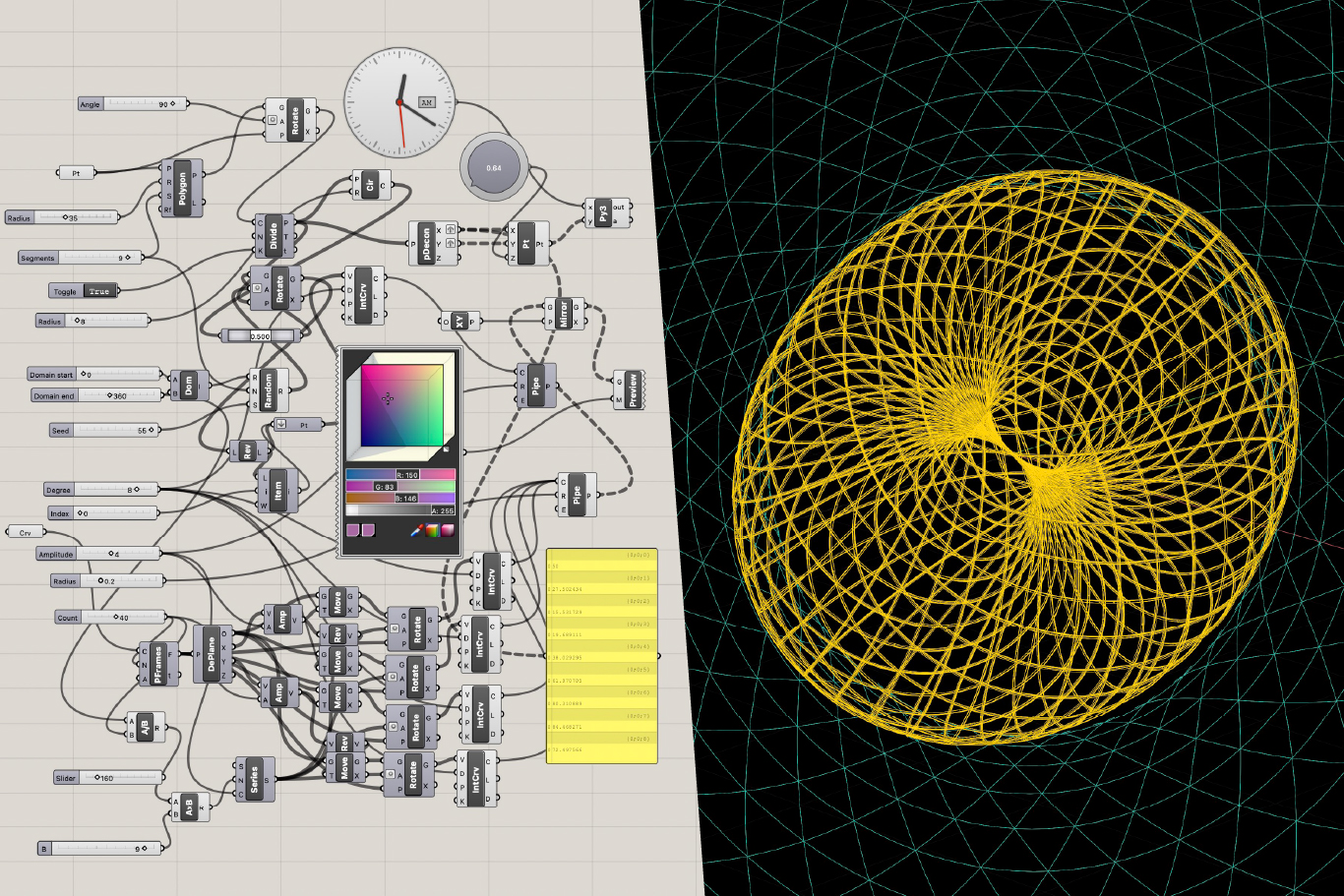
James introduced his use of Grasshopper [tag="grasshopper"] to generate mathematically derived forms — a node-based parametric design language that allows the team to tweak geometric parameters and output evolving forms. This opens the possibility of generating the logo geometry and then reusing those same parameters to produce backgrounds, icons, and other graphic assets with visual consistency (01:26:00).
[technology="Parametric Geometric Interfaces"]
Key geometric explorations discussed:
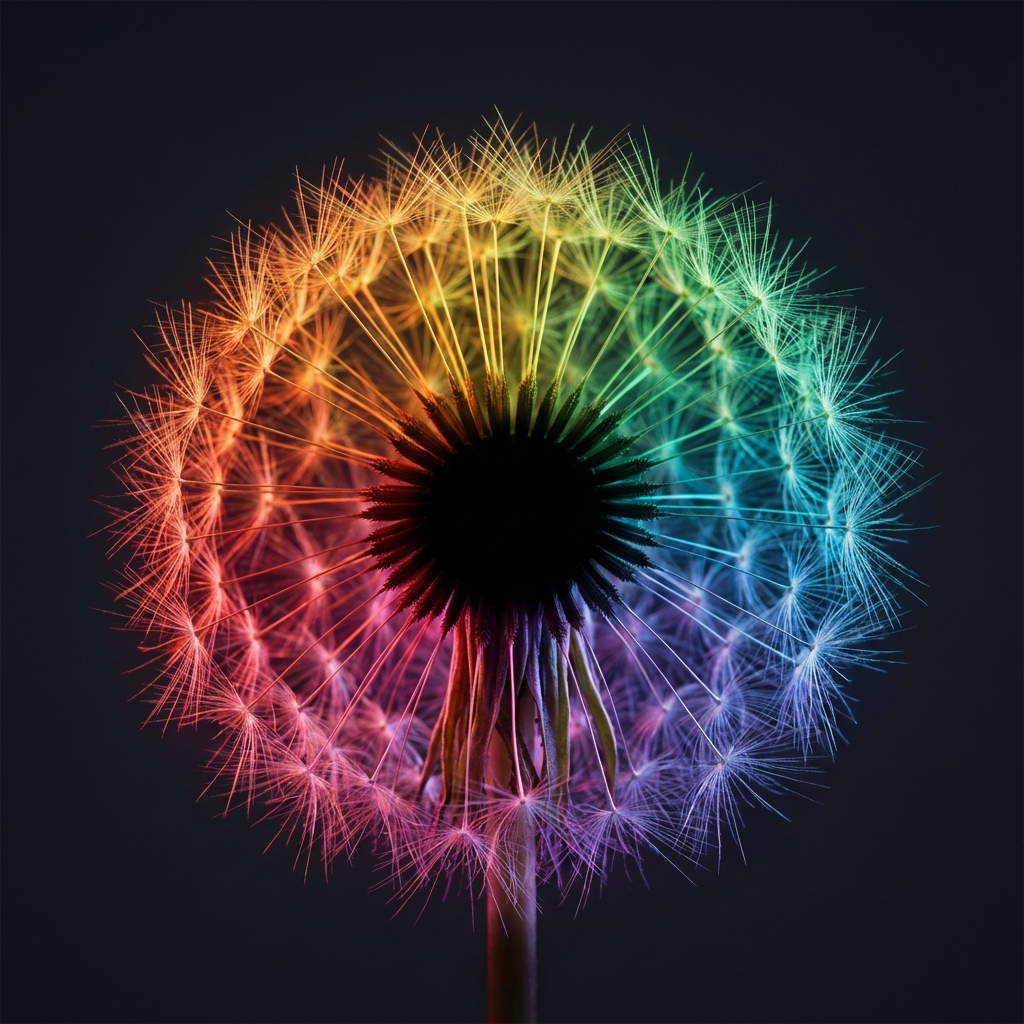
Forest pointed to a micro/macro visual philosophy as a guiding design direction (01:28:13): the idea that transformation begins with seeing differently — zooming all the way in to reveal the hidden miracle in ordinary things (a dandelion as a mandala), and zooming all the way out to reveal cosmic scale. This connects directly to C-LAB's first movement: wonder and gratitude.
Forest expressed interest in simple time-lapse photography — a dandelion slowly opening and going to seed, ending in a mandalic form — as a way of communicating we live in a living universe (01:30:10). James offered access to iStock video credits from an existing plan for exploring premium stock footage for the site (01:30:45).
---
Forest noted that the site architecture is fairly clear in his mind and he could have a rough draft outline ready by early next week, tagged by phase (01:06:02). The full vision is larger than the current budget and timeline allow, so the plan is to map the whole picture and then clearly delineate what falls in phase one, two, and three.
Timeline constraint: Forest has approximately six weeks before becoming unavailable for roughly three months (likely due to the arrival of his baby) (01:33:50). The priority for this window is:
James confirmed this is achievable: "In six weeks we can have a version of your website. We can move quick, iterate the graphics and brand, and give you what you need to start developing your presence" (01:35:35).
James previewed IRIS's internal project management system — built directly into a client website — and plans to create a simplified version for C-LAB with shared task lists, content organization, and a timeline view so both sides stay aligned on what's being built, when, and what's needed from whom (01:36:48).
A shared canvas workspace (Figma, Miro, or similar) will be set up so both James and Forest can work visually together — laying out reference images, design directions, and assets on an infinite canvas rather than a folder structure (01:38:29).
---
Forest gave context on the current C-LAB core team (52:33):
Forest was candid that while Jenny holds the co-founder title for optics, C-LAB is fundamentally his vision and his years of foundational work. He sees its future as bigger than any individual — including himself — and wants the website to reflect that ecology: a space where people can see themselves as potential facilitators, contributors, and community members, not just recipients of Forest's teachings (39:03).
---
Forest
James
James and Forest opened with a warm check-in before diving into the substance of C-LAB's brand identity and website vision. James noted his excitement after reading through Forest's branding questionnaire and manifesto (05:00): "The more I read, I was like — yeah, this thing is pretty cool. We need more of this." Forest clarified that the manifesto functions more as a positioning statement — a way of getting clear on what C-LAB stands for and what differentiates it from other offerings in the psychedelic and transformational space (07:09).
---
Forest walked through the layered meaning behind the name, which carries significant weight for how the brand should be expressed visually and verbally (13:23).
The "C" holds multiple simultaneous meanings:
The "Lab" speaks directly to Forest's core pedagogical emphasis: run the experiment and see for yourself (16:10). C-LAB prioritizes direct embodied experience over conceptual faith — the idea that true gnosis is a full-body, full-being understanding, not just an intellectual one. From that place, genuine transmission becomes possible. The lab is also a frame for cultural transformation at scale — experimenting with how individuals and groups can transform consciousness here and now, without requiring decades of practice.
---
A pivotal strategic discussion emerged around separating C-LAB into two legally and experientially distinct entities (44:28).
C-LAB (the primary website and brand) will operate psychedelics-free — or more precisely, psychedelic substances won't be centered or organized around. The work is deeply psycho-catalytic — using breathwork, somatic practices, dialogue, music, movement, and embodied awareness to catalyze consciousness. This framing makes C-LAB accessible to corporations, nonprofits, politicians, and anyone who carries stigma or contraindications around substances.
The Church (a separate, yet clearly related entity) will hold the psychedelic retreat offerings — the medicine ceremonies and guided journeys. Forest envisions a naming strategy where the two entities share obvious visual and linguistic DNA (e.g., a shared tagline like "for the love of life") while remaining legally and experientially distinct (45:28).
James affirmed this direction: "It's not only the legal way to do it — it can work in your favor. It's so exciting to make it approachable yet cosmic, psychedelic yet clean and professional" (47:30). Forest added that psychedelics are simply one tool among many — like meditation, breathwork, or dance — and he doesn't want C-LAB's entire identity organized around them (49:54).
---
Forest outlined the evolving ecosystem of how people move through C-LAB (29:08):
Entry Points:
Deepening Pathways:
C-LAB Local — a model Forest is especially excited about (34:35): rather than flying strangers to Costa Rica, a local organizer assembles a group of eight in their own city, and C-LAB travels to them. When the team leaves, that group has continuity — they can keep meeting in person, deepening relationships with each other and with land. This model is also more resilient as global travel becomes less predictable.
James noted the broader cultural shift this reflects: "The age of personal transformation for the sake of personal transformation is over. The point is to increase our capacity to be high-functioning groups and do things together" (37:48).
Facilitator Training — the pathway Forest is arguably most excited about. He held his first brainstorm with four long-term C-LAB community members the day before this meeting, all of whom requested facilitator training (31:48). Within three years, Forest's vision is to have a fully developed curriculum, at least one or two pilot cohorts completed, and graduates confidently running retreats independently — with the same level of integrity as the core team.
Forest also flagged that phase two or three of the website should include a suite of tools for facilitators: marketing assets, payment processing, online registration, C-LAB-branded design templates, and potentially their own private community spaces — everything they need to run their own offerings under the C-LAB banner (01:03:17).
[technology="Community Facilitation Tools"]
[technology="Custom Membership System"]
[technology="Online Learning Platforms"]
---
James and Forest spent meaningful time on logo exploration and visual direction. Forest shared several reference images and articulated what's working and what isn't (01:07:46).
The current logo feels too faint and pastel — Forest wants richer, more saturated rainbow hues with a seamless gradient blend across the full color spectrum, rather than a segmented or banded treatment (01:08:58). The C-shape itself is intentional as both an open invitation ("you're a part of this") and a visual container for the iris of an eye — pointing to the double meaning of see/C for yourself (01:22:35).
Forest wants the black dot at the center of the C to evoke the initial flaring forth — the cosmogenic moment, the big bang, the great radiance from which all of manifest reality emerges (01:10:21). This isn't decorative — it's metaphysically intentional, pointing to the absolute dimension of reality that underlies all relative expression.
James proposed adding "C LAB" as text below the logomark so the symbol doesn't have to carry the full weight of communicating the name — noting that most people read it as "Lab" without immediately parsing the C (01:23:09). Forest agreed this was the right call.
James also noted a resonance with IRIS Cocreative's [tag="iris"] own logo — "the iris was a Greek god of rainbows, a messenger god going between heaven and earth" (01:24:49) — a beautiful alignment with C-LAB's bridging role between the absolute and relative dimensions of experience.
James introduced his use of Grasshopper [tag="grasshopper"] to generate mathematically derived forms — a node-based parametric design language that allows the team to tweak geometric parameters and output evolving forms. This opens the possibility of generating the logo geometry and then reusing those same parameters to produce backgrounds, icons, and other graphic assets with visual consistency (01:26:00).
[technology="Parametric Geometric Interfaces"]
Key geometric explorations discussed:
Forest pointed to a micro/macro visual philosophy as a guiding design direction (01:28:13): the idea that transformation begins with seeing differently — zooming all the way in to reveal the hidden miracle in ordinary things (a dandelion as a mandala), and zooming all the way out to reveal cosmic scale. This connects directly to C-LAB's first movement: wonder and gratitude.
Forest expressed interest in simple time-lapse photography — a dandelion slowly opening and going to seed, ending in a mandalic form — as a way of communicating we live in a living universe (01:30:10). James offered access to iStock video credits from an existing plan for exploring premium stock footage for the site (01:30:45).
---
Forest noted that the site architecture is fairly clear in his mind and he could have a rough draft outline ready by early next week, tagged by phase (01:06:02). The full vision is larger than the current budget and timeline allow, so the plan is to map the whole picture and then clearly delineate what falls in phase one, two, and three.
Timeline constraint: Forest has approximately six weeks before becoming unavailable for roughly three months (likely due to the arrival of his baby) (01:33:50). The priority for this window is:
James confirmed this is achievable: "In six weeks we can have a version of your website. We can move quick, iterate the graphics and brand, and give you what you need to start developing your presence" (01:35:35).
James previewed IRIS's internal project management system — built directly into a client website — and plans to create a simplified version for C-LAB with shared task lists, content organization, and a timeline view so both sides stay aligned on what's being built, when, and what's needed from whom (01:36:48).
A shared canvas workspace (Figma, Miro, or similar) will be set up so both James and Forest can work visually together — laying out reference images, design directions, and assets on an infinite canvas rather than a folder structure (01:38:29).
---
Forest gave context on the current C-LAB core team (52:33):
Forest was candid that while Jenny holds the co-founder title for optics, C-LAB is fundamentally his vision and his years of foundational work. He sees its future as bigger than any individual — including himself — and wants the website to reflect that ecology: a space where people can see themselves as potential facilitators, contributors, and community members, not just recipients of Forest's teachings (39:03).
---
Forest
James
Draft website structure outline with pages, content sections, and phase 1/2/3 tags
March 9, 2026
Forest to complete and send a rough draft of the website structure — pages, content sections, and phase 1/2/3 tags — by beginning of next week, ideally drafted during Friday's flight. This will help delineate what falls in phase one, two, and three given the six-week availability window before his baby arrives.
Refine branding questionnaire to sharpen C-LAB messaging and positioning
Continue refining the branding questionnaire to sharpen messaging and positioning. The manifesto currently functions more as a positioning statement — clarifying what C-LAB stands for and what differentiates it in the psychedelic and transformational space.
Gather and send all existing brand assets into shared workspace
Gather and send all existing assets including logo files, reference images, and maps into the shared visual workspace once James sets it up.
Set up shared visual canvas workspace in Figma or Miro for collaborative asset organization and design exploration
Set up a shared visual canvas (Figma or Miro) so both James and Forest can work visually together — laying out reference images, design directions, and assets on an infinite canvas rather than a folder structure.
Build simplified project management workspace for C-LAB with task list, content sections, and timeline view
Build a simplified version of IRIS's internal project management system for C-LAB — with shared task lists, content organization, and a timeline view so both sides stay aligned on what's being built, when, and what's needed from whom. Inspired by IRIS's internal system built directly into a client website.
Begin logo iterations exploring seamless rainbow gradient, toroidal and phylotactic geometry via Grasshopper, eye/iris motif, and mandala/diamond structure in light and dark versions
Begin logo iterations exploring: (1) seamless rainbow gradient with richer, more saturated hues replacing the current pastel/faint treatment, (2) toroidal and phylotactic geometry generated via Grasshopper with reusable parameters for backgrounds and icons, (3) eye/iris motif within the C-shape connecting to the 'see/C for yourself' double meaning, (4) mandala/diamond structure in both light and dark versions using the seamless rainbow gradient. Black dot at center should evoke the initial flaring forth / cosmogenic moment. Include 'C LAB' text below logomark.
Explore iStock video library for micro/macro and living universe footage candidates for website
Use existing iStock video credits to explore premium stock footage for the site. Priority is micro/macro visual philosophy content — e.g., time-lapse of a dandelion slowly opening and going to seed (ending in a mandalic form) — communicating 'we live in a living universe.' This connects to C-LAB's first movement of wonder and gratitude.
Prepare and share a clear six-week delivery timeline aligned with Forest's availability window
Create and share a clear six-week delivery timeline covering: (1) logo design and branding, (2) the two foundational C-LAB maps as simplified line art, and (3) a working version of the website. Forest becomes unavailable for approximately three months after this window due to baby arrival. James confirmed this is achievable: 'In six weeks we can have a version of your website.'
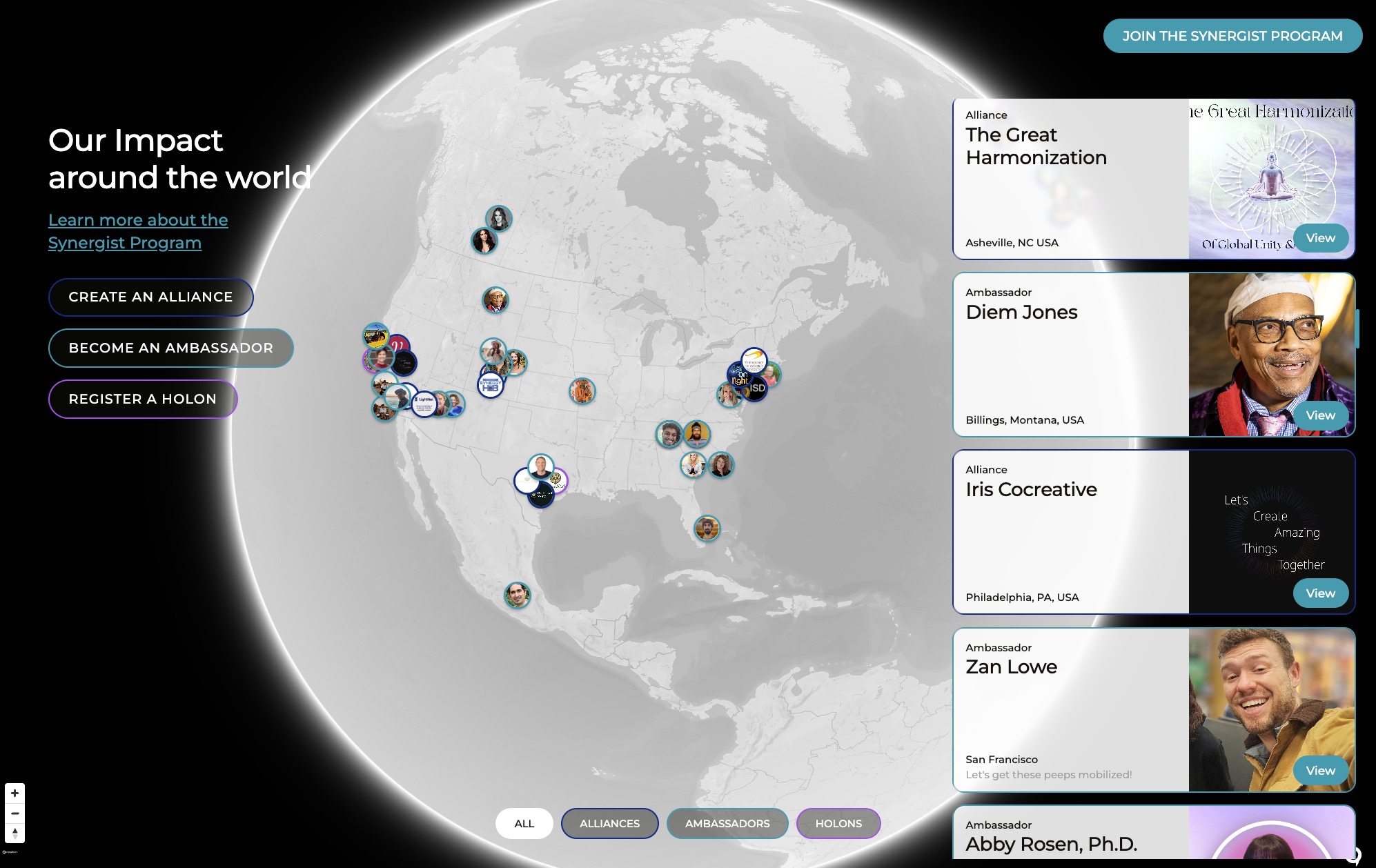
Experiment with 3D globe morphing concept — toroidal form transitioning to sphere/map with layered toggled data points
Develop an evolution of the animated globe concept: a 3D morphing globe that transforms between a toroidal form and a flat map projection while keeping data points intact. Globe should support toggled layers for different community segments — community members, C-LAB local groups, and certified facilitators — each a different color, viewable separately or all at once.
Initial project discovery and planning call to understand C-LAB's vision, requirements, and budget parameters. Covers retreat offerings, future platform needs (LMS, community, membership), AI integration strategy, and phased development approach. Meeting established brand identity, dual entity strategy (C-LAB vs The Church), logo direction with four ingredients approach (mandala, taurus, eye, rainbow), visual identity themes, and six-week delivery timeline before Forest's availability window closes. Confirmed AI-assisted workflow using Claude desktop, Obsidian, GitHub, and Google Workspace integration. Established GitHub + Claude architecture for website development and collaborative content management.
Core website development for C-LAB including retreat program information, one-on-one session scheduling, payment processing integrated with nonprofit structure, and Tally registration system integration. Development approach shifting to GitHub + Claude architecture rather than pure Webflow - design components and style guide in Webflow, export HTML/CSS, host in GitHub repo where Claude acts as content administrator enabling conversational updates and true collaboration. Six-week delivery window before Forest becomes unavailable for three months (first ~3 weeks after baby arrives). Phase 1 priorities: logo design and branding, two foundational C-LAB maps, working website version with lorem ipsum acceptable as placeholder if copy not ready. Focus on beautiful custom design with AI-augmented development and parametric geometric interfaces. Budget range $5,000-8,000 with phased approach. First-draft website to be spun up from content outline document for visual/collaborative review. Design direction confirmed: Typography selection finalized with Montserrat (primary sans serif for headlines and body) and Frances (complementary serif accent) - both Google fonts matching Holo Movement typeface combination. Interactive sections planned: Five Movements map/diagram with rollover breakouts, Three Centers/Circles/Times parallel interactive treatment. Transformation motif established as primary design concept - rainbow mandala as living symbol woven throughout site with animated transitions between contrasting old-world/new-world image pairs (industrial monocropping → permaculture garden, meta-crisis → ecological civilization). Reusable animation widget concept for contrasting image montages throughout site. HTML mockup in GitHub repo accessible to Forest for Claude-assisted iteration. Homepage architecture refined: Hero reframed as bright oasis (fractal of whole site), science section reordered to lead with Watts Connectedness Scale, AI voice patterns removed for natural prose, five movements centered on full 360° mandala (not spiral) with scroll-tied and hover/click interactivity, testimonials section with video + pulled quotes + simple attribution. Offerings section needs clear separation between C-LAB (without psychedelics) and C-LAB + psychedelics via tabs/color coding/grouped sections. Core positioning: curriculum-centric, not psychedelic-centric. Path/journey metaphor throughout site language and graphics.
Future development of online courses (free resource library and paid content), community platform for education and community space, custom membership system, facilitator training program support tools (marketing assets, payment processing, registration, design templates, private community spaces), and advanced integrations. Includes C-LAB Local community mapping with toggled layers (members, local groups, certified facilitators) and 3D morphing globe visualization. This represents phase 2+ development beyond initial website, to be scoped and budgeted separately as C-LAB grows and additional funding becomes available. Community page will feature interactive globe map showing members across the world (39:00) with tiered privacy levels (default low-transparency with opt-in for richer profiles), involvement tiers represented via color (retreat alumni, monthly gathering attendees, facilitators), and potential mycelial-style connections between members as visual metaphor (42:16). Case studies and additional testimonial videos live on this page for deeper exploration.
Comprehensive brand identity development including logo redesign with four core ingredients: mandala (Tibetan black-and-white geometric), taurus (head-on toroidal form via Grasshopper), eye (perception/cosmogenesis with stars in pupil), and rainbow (360-degree circular gradient at CAAB saturation level). Visual identity themes emphasize micro/macro philosophy, wonder and gratitude, living universe concept. Logo explorations include fractal rotation system in Illustrator using diamond and circle shapes, taurus geometry with more segments and smaller center hole, Tibetan mandala as mask testing rainbow-through-white and rainbow-through-black versions, eye effect through darker outer circumference shading and dark central circle. Logo must work on white backgrounds, black backgrounds, and grayscale. Animation potential noted for parametric model structure. Includes time-lapse photography exploration, iStock video research (credits expire April 23rd), and establishing visual language that bridges cosmic and professional aesthetics. Dual entity strategy: C-LAB (psychedelics-free) and The Church (medicine ceremonies) with shared visual DNA but distinct identities. Current iteration focus: Evolved from original C-LAB logo geometry with mosaic technique and inner glow effects. Refining C-shape with subtle triangular angle opening (narrowing toward pupil) to evoke light glare on eye while reading as C. Testing hard-edge vs soft-edge variations (preference for hard edges). Adding subtle dark shading around inner pupil and outer Taurus edge for dimensionality. Exploring gradient/drop shadow on inner thorny crown details. Design must translate well to digital screens, printed apparel, and embroidered hats. Figma collaboration space shared with Forest for direct commenting. Logo direction refined: Two variants reviewed - lattice/grid version with visible connecting lines, and minimalist positive/negative space version with geometry implied. Forest leans toward minimalist for organic feel and better scalability at small sizes (01:14:59). Both can coexist as use-case variants - full lattice for large placements, cleaner version for small applications like favicons. Refinements needed: tighten gaps in minimalist version for clearer C reading, keep rounded corners on geometric shapes. Overall geometry solid and ready for full style guide. Rainbow-colored copy direction nixed (01:20:29) - logo already carries rainbow tones, applying to typography risks over-signaling. Gradient fonts (not full spectrum) still open for exploration.
Set up collaborative project workspace for C-LAB using GitHub repository as primary collaboration platform. GitHub repo will house website code and enable both teams to connect Claude desktop instances for conversational development and content updates. System enables visual/canvas-based collaboration suitable for Forest's working style, with shared access to design assets, task coordination, content organization, and timeline visibility. Replaces initial Figma/Miro canvas concept with GitHub + Claude approach for tighter integration with website development workflow. Enables both teams to stay aligned on what's being built, when, and what's needed from whom during rapid six-week development window.
Current state: GitHub mockup repo created and Forest invited with access. Figma designer space shared with Forest for direct commenting on logo variations. WhatsApp established for real-time weekend collaboration. Forest can connect Claude to repo for direct editing or use URL for reference while drafting in Google Doc.
00:00:00
James Redenbaugh: I. I've switched to a PC and I'm still getting used to how to stay signed into Zoom.
00:00:08
Forest: Yeah. Yeah, no worries.
00:00:11
James Redenbaugh: How are you
00:00:13
Forest: in this moment? I'm feeling pretty good. And overall. Yeah, juggling a lot.
00:00:24
James Redenbaugh: I can imagine.
00:00:26
Forest: Yeah. Yeah. Most of the time, I feel like I'm doing a pretty good job of holding it all. And I noticed it's when I get tired and my energy starts to dip that I start to feel a little. Yeah. That's where I lose perspective on things. But. Yeah. But pretty. Pretty happy with my. My capacity, you know, just like, really feeling the kind of the fruits of 25 years of psychospiritual practice. I'm like, oh, wow, this works. Like, when life gets really hard, it works.
00:01:14
James Redenbaugh: Yeah, that's what it's for.
00:01:17
Forest: That's what it's for. And it's. It's just nice because, like, I think these are the. Especially these are the moments where life kind of holds up a mirror and, like, hey. And to get to kind of see myself and experience. See myself in that mirror and be like, oh, wow. Forest 10 years ago could not have handled this. I don't even think Forest five years ago could handle this. You know, there's something that, even though life is very challenging right now, there's something that feels deeply satisfying about that.
00:01:49
James Redenbaugh: Yeah. Yeah.
00:01:53
Forest: Yeah. How are you doing?
00:01:56
James Redenbaugh: I'm doing well. Yeah. Year of the horse. Lots of threes today. Three, sure. The horse. Yeah,
00:02:10
Forest: Isn't it? It's Fire Horse, right?
00:02:13
James Redenbaugh: Fire Horse. Yeah. I feel good about it. Crazy times in the world. It's really insane what's been happening with AI lately. The latest. The latest breakthroughs and just been spending most of my time understanding it and implementing it, and usually utilizing it new ways and working too much, but enjoying it a lot and. Yeah. Trying to make time for being as well.
00:02:59
Forest: Are you gonna try and join the call tomorrow with Elizabeth?
00:03:06
James Redenbaugh: I thought. I'm joining one today. What's tomorrow?
00:03:12
Forest: Oh, I'm sorry.
00:03:12
James Redenbaugh: Today.
00:03:13
Forest: I, I. Yeah, I'm a little dis. Yes, today. I am planning on going today.
00:03:21
James Redenbaugh: Yeah, I'll be there today.
00:03:24
Forest: Awesome.
00:03:25
James Redenbaugh: My mom's joining as well.
00:03:27
Forest: She is?
00:03:29
James Redenbaugh: Yeah. So my mom will be with me.
00:03:31
Forest: That is super cool. I love that.
00:03:34
James Redenbaugh: Yeah.
00:03:35
Forest: Well, I will see you on call. I'm gonna go for the first part where Elizabeth is there, and then I have to jump.
00:03:42
James Redenbaugh: But yeah, yeah, I'll just be for the first hour and a half. I think there's more later also, but
00:03:51
Forest: I did join an ongoing committed group which has been really juicy.
00:03:56
James Redenbaugh: Oh, awesome. Yeah, wonderful.
00:03:59
Forest: Yeah. They mentioned you in one of our last calls, actually, which was cool.
00:04:03
James Redenbaugh: Oh, cool.
00:04:04
Forest: Yeah, they were introducing the monastery and were talking you up.
00:04:09
James Redenbaugh: Oh, wonderful. Yeah. I wish I had all the time in the world to do all the things with them, because I would say. But yeah, they're great. They're a great bunch. I love supporting their work and I really loved reading your. Your branding questionnaire responses and your manifesto. Cool. Really beautiful. It sounds very. Both familiar, like. I get it. And a lot of curiosities and, and. And a lot of exciting newness in there. I'm really excited to. To get to know more about this and see how we can be a greater service to it. But the more I read, I was like, like, yeah, this thing is. This thing is pretty cool. This is. We need more of this.
00:05:16
Forest: That's nice to hear. Yeah. Appreciate the reflections, especially because I know, you know, I. I have some sense of your portfolio and the kind of clients you've been working with, so you have some perspective and experience with what's happening in the field. So that feels good to hear.
00:05:33
James Redenbaugh: Yeah. I'm going to turn on the. The recording, if that's okay with you. Sure.
00:05:41
Forest: And is there.
00:05:43
James Redenbaugh: This meeting is being recorded.
00:05:45
Forest: I don't need to see this firefly thing. Let me see if I can change the view.
00:05:49
James Redenbaugh: I can hide it.
00:05:50
Forest: Yeah, that's great.
00:05:52
James Redenbaugh: Yeah. Good. Yeah, Wonderful. Well, let's hop into that if you're ready.
00:06:05
Forest: Yeah, absolutely. I'll say the, the branding questionnaire. I did have a little bit of time to go back this morning and do a little editing on our first few questions. I didn't have time to go through everything, but I think the gist of it is there. And the. The manifesto is definitely one of the most. One of my more most recent kind of reflections and writings about caab. So appreciate you taking the time to read that.
00:06:36
James Redenbaugh: Yeah, I really like the manifesto. I'm not a huge fan of manifestos in general, but I'm not.
00:06:44
Forest: I don't even really like the word manifesto. I'm trying to.
00:06:46
James Redenbaugh: I know. Woman. Womanifesto, or.
00:06:52
Forest: It's not a proclamation. Even that word is not quite right. But yeah,
00:07:03
James Redenbaugh: Long before this opening up my Obsidian notes, I guess it's kind
00:07:09
Forest: of like a positioning statement in a way. You know, there's some way that. Just trying to get. And this is very related to the website is like really getting clear on how I want to position calab and how to find the language to make it clear what we are about and what we are not about. You know, like, what differentiates c. Like, who are we? And what actually differentiates CAAB from other psychedelic retreats? As well as what differentiates? Like, it's. It's like a. It's a positioning statement. But this is all part of process of me getting clear on, like, who. What is CAAB and, like, what do we stand for?
00:07:59
James Redenbaugh: Yeah, you know, it's.
00:08:03
Forest: Yeah,
00:08:06
James Redenbaugh: an important piece. The way I like to think about the. The. The challenge of creating a website like this is. I think about it very architecturally. Like, what is the. The space that we're inviting people into? What are the programmatic functions of that space? And. Perhaps less like a physical architecture. Narrative and story and word, of course, is very important. When I walk into a museum, I might be reading the plaques on the walls, but there's not, you know, or an office building. There's not a lot of words that are part of that medium. And. And with a website, you know, language is. Is crucial. But language, too, creates space, creates room for transformation and for connection and for emergence and possibility. And so the. The quest of creating both the visuals and the. And the verbal, in my mind is a very architectural one, spatial one, in that we want to. We want to welcome people into. Into something and then give them tools to stay in that something. And we want people who encounter that something to be able to quickly identify is it for them or is it not? And so that's not about making it attractive. Like, we want to hook everybody, but it's about definitely putting. Putting the best foot forward or more framing the entryway, the view to the village that you're building, so that people walking by on the road, when they look in, they're like, oh, I'm. I'm home. You know, this is. I can find myself here. I can find community here. I can give myself to this. I could not only sign up for this thing now, but I can begin a. A deep and profound relationship with this or even recognize that I've already been in relationship to this before I even knew about it, you know. Yeah. Before I even heard caab. So we want to create space for that depth while also being, of course, clean, clear, professional, somewhat minimal. You know, we don't want it to be too Lake or Boozian, but he's a. He was a architect of one of the modernists. We don't want it to be Mies Vanderohe. He's a very Chicago guy.
00:11:56
Forest: Yeah, I know that reference.
00:11:58
James Redenbaugh: Yeah. More Frank Lloyd Wright. Less mies van der Rohe.
00:12:02
Forest: Okay, okay, fair enough.
00:12:05
James Redenbaugh: But we don't want things that aren't needed in there. And, and so when I, when I, I was reading your, your questions and your manifesto, I felt like I'm trying to. Or a vision of this space started to, to form and the electric potential of it started to. To bubble up for me. And so I have some questions to take us deeper into that, but is there anything that, that you want to share off the top of your head?
00:12:51
Forest: No, I'm just happy to hear that, you know, after reading that or while you were reading it, that there was some. Sounds like some aliveness and creative bubbling. So that's great.
00:13:03
James Redenbaugh: Yeah. I have intuitions about the word lab, but I wanted to ask you more about the, the labness of it. You know, I, I understand C, but could you tell me more about the lab?
00:13:23
Forest: Yeah, let me say a little bit about both, because the C has lots of layers to it.
00:13:27
James Redenbaugh: Yeah, please.
00:13:29
Forest: So the C is both C period, as in it stands for all of these wonderful C words. Consciousness, creativity, collaboration, compassion, catalyze. I mean, I can send you. There's. When I started actually like digging into it, it's amazing how many C words there are that capture the essence of what it means to live an awake life. And then it's kind of evolving more and more into the C standing for like, it's catalytic, you know, like psychedelics are catalytic. But the C is, you know, part of what C lab is really doing is it's catalyzing these essential qualities.
00:14:21
James Redenbaugh: Right?
00:14:21
Forest: It's catalyzing consciousness, it's catalyzing creativity, it's catalyzing community. So there's all these wonderful C words. It also stands for C as in perspective to. So to see things from a new perspective or in Buddhism, we, you know, you talk a lot about wise perspective and the importance of discerning that from, you know, these unwise perspectives that leads to suffering. So it's, you know, see, as in perception and perspective. And when our consciousness change, our perspectives change. You know, we see literally see things differently. So that's an important part of it. And then originally, when the, when the idea originally came through, there was kind of a play on words, which is clab for C suite execs. So it was kind of initially really targeting people in leadership positions, particularly people in high powered, kind of corporate world leadership positions. And the idea there was, you know, kind of accepting that we live in very hierarchical structures right now and that there are people in these positions of power. Which, you know, if we can actually find a way to reach them and help them to transform their consciousness, they can have an outsized impact. If they change, then they can, you know, rapidly change culture within an organization or within a community or even globally if it's an international company. So that was kind of the initial. There was some play on words there. But it's really broadened to just want, wanting to work with anybody who wants to be a change maker or live a more fulfilling life and contribute to, you know, more loving world. And then in terms of the lab. Yeah, I, I'll. I find myself using this language a lot, which is run the experiment and see for yourself. And so that is directly related to the lab side of things. And I talk a lot. I talk. I, I don't say I talk. I emphasize this in the work, particularly on retreats, which is, you know, faith is a beautiful thing, but faith isn't necessary when you're having the direct experience of something. So, you know, faith in God or some higher power is a beautiful thing, but it's not necessary if I'm having the direct experience of God.
00:17:29
James Redenbaugh: Right.
00:17:30
Forest: And we live in a world that is so predominantly from the neck up. We're living in such a abstracted conceptual
00:17:38
James Redenbaugh: world
00:17:40
Forest: that is part of what is contributing to collective disconnection, personal and collective disconnection. That one of the things we really emphasize in C lab is direct experience and running the experiment and seeing for yourself through your direct experience and learning how to reconnect with and trust your direct experience. So embodied awareness and the wisdom that arises, I mean that's true gnosis, right? Just the conceptual realm is, it's, it's incomplete gnosis. Gnosis is, it's a deep, full bodied, full being experience of an understanding. And then from that place. Sorry, I'm a little bit on my pedestal, but I'm just getting inspired.
00:18:30
James Redenbaugh: No, please.
00:18:31
Forest: From that place, Mantric speech is possible, right? So it's where we're actually, the whole being is speaking and, and then capable of transmitting something. And so it's like, you know, the, it's. If it's just conceptual, there's information that's being transmitted, but it's a much more one or two dimensional experience than if your whole body is vibrating with that understanding and then you're speaking like that is true transmission, like full three dimensional, four dimensional transmission is possible. You know, it's like the whole mirror neuron thing, but if your whole system is lit up, it makes it much more possible to transmit and then light up all of those centers within another human being. So the laboratory is, you know, run the experiment, See for yourself. Real. There's an emphasis on embodied awareness and embodied experience. But it's also very much related to, like, what Elizabeth is doing. Because I'd say the heart of C lab for me is we space intervene, dialogue, like psychedelics and all these other primary satisfactions. Early ways of moving people beyond ego or off, softening the ego structures enough to make it much more likely that a group can catalyze consciousness and enter into that kind of shared relational field which is, you know, as you. I'm sure you've experienced, James, it's. It's highly creative, highly intelligent and deeply fulfilling. It's also the kind of thing where it's like, once that downpouring can kind of get a foothold, let's say a 51 foothold in the system. And people can learn how to soften and relax into that downpouring or that living stream. It help. It also helps to metabolize old pain, emotional pain and trauma. And so suddenly, you know, people are realizing, oh, well, it's possible to achieve these states of consciousness without any kind of substance M. So it's like basically, calab is. It's a laboratory where we are exploring and experimenting with how to individually and as a group. Yet, I mean, to put it simply, transform our consciousness. But that's possible here. Here. Here, now. Right. It's not something that has to be 10 years of meditation retreat or 10 years of psychotherapy. So how do we create these structures that then allow people to transcend structure?
00:21:59
James Redenbaugh: Yeah,
00:22:02
Forest: and in the broadest sense, it's a laboratory in terms of transforming culture. I mean, it's. We're doing it in a small way, but
00:22:12
James Redenbaugh: totally.
00:22:14
Forest: Yeah.
00:22:16
James Redenbaugh: I definitely keep seeing the Taurus energy and these. These different colors of light on the inside of that and these tendril connections in and in and through it. Yeah, there's a. There's a lot there. And it's like. I mean, so much of what you're saying, I just keep coming back to the Taurus because it's such a perfect, not only metaphor, but, like, metaphysical truth to describe, you know, that which you're getting in contact with and that which we become when we're in alignment with that and resonating on those frequencies and, you know, and then others get in touch with that as well. I think I mentioned. I'm the featured artist in this Artist of Possibility magazine.
00:23:40
Forest: That's so cool, man. When's that coming out?
00:23:44
James Redenbaugh: I have to finish the art by the end of the week. This week. Okay, I got another week because I. And then procrastinating it and I keep having more ideas of things I want to do because it's a. How do I make art about the collective awakening as an individual is a big challenge. But I, I think one of the pieces has to be a Taurus. And they're playing with this Taurus geometry for your logo anyway. And getting back in touch with the shape that I love, especially the interlocking phylotactic form of the Taurus is like chef's kiss, Because. I have few words for it. It's just like, yeah, you know, and, and obviously we're here on this sphere of earth and spheres are awesome.
00:24:55
Forest: You know, Big fan of.
00:24:56
James Redenbaugh: Spheres are. Spheres are great. All praise be to spheres. But the Taurus is like what we come to understand as soon as we understand anything. You know, like the magnetic field of our, of our planet and the magnetic field of our body is a. Is a metaphor for our connection to cosmos and our connection to life. And you can look at a tree and its roots or, or a mountain or anything and start to see this, you know, or a cell, this toroidal energy. And I've always felt that if we design our. If we design spaces around that, that transformation would become almost automatic. Especially group transformation could definitely dream of building some toroidal temple spaces that we can sit. Sit inside of together and even see. Lights moving like fiber optic cables of things moving around this. Because it's not a static form, it's like alive. And I don't want to get too into logo ideas at this, at this point, I want to let it. Let it be in an info collecting mode. But even beyond the logo, I'd love to find ways to bring to. To kind of imbue that toroidal energy in. In lots of parts of the. The website in subtle ways and things like background and pattern and using it in the logo, The sea kind of opens it, but at, at present it's a bit. The sea introduces some right angles. It's kind of jagged. And so there's like a trade off because also it. It's making it a sea. It's an invitation. It's like this isn't complete. Like you're a part of it. Come be in this experiment with us, join this community. But it could also be like there's a piece missing, you know, and so. But we can play with all of that. Okay. In this, in this community, people coming into the lab. I know that the, the ongoing community of alumni. I think you've referred to it as an alumni community. Alumni makes them sound like they did a thing in the past and they're just kind of relating to it. But I know that they're more alive participants and that you're wanting to invite more alive participation. Yeah, but what can you speak to how, you know, how you would like people to engage calab. You know, starting with that. The, the broader community. Anybody who's done anything. I know you've got your mighty networks going now, but what's that, what's that relationship like for people?
00:29:08
Forest: Like, are we, are we starting with like somebody who's just coming to the website and seeing C Lab for the first time or help me to understand the audience here?
00:29:19
James Redenbaugh: Yeah, we're kind of starting backwards. People who already have a relationship with you, who have done something with you in the past, who are part of this broader network. How, how are they included and you know, what are, what are you inviting them into?
00:29:39
Forest: I see. Yeah, I, I like your sensitivity to language and alumni doesn't really capture it because it's almost like I graduated from college and now that's behind me. And I really want this to be an ongoing participatory invitation. So, yeah, there's. Right now, primarily what's happening is people are coming through, Say at least two doors and one of them is coming in through doing one on one work. And that's both kind of the hourly zoom session once a week kind of thing, and then the day long
00:30:33
James Redenbaugh: one
00:30:33
Forest: on one guided medicine journey. So that's one door that people are coming in through. The other main door people are coming in through is these retreats, the Sea Lab retreats. And so far those have all been down in Costa Rica, but we want to start running them in the States. And then, you know, a lot of people that come in through the one on one door then end up going into a retreat. And then sometimes people that come on a retreat then end up doing some one on one integration stuff. And now we're starting to funnel people into this, you know, mighty clab, mighty community. We're kind of in an onboarding process there. I am imagining that, you know, I want to create like a, a library, a living library. So it's just continuing to, you know, things are continuing to be added to it of clab resources, you know, teachings and practices that people would be free, that people would have access to and that I could see being, you know, maybe a more robust free library being available to people who have gone through some kind of C lab training or program and maybe a, a smaller, more introductory library that would be available for, let's say, anybody that finds their way into CAAB and is wanting to get a taste. I just had yesterday, my first brainstorming Call with 4caab. I, I'll call them community members instead of alumni. That has a better feel to it who have all been on at least two CAAB retreats that are just, all of them are very smart, very dedicated to the work. And at the end of the last retreat all came forward and said, we want some kind of facilitator training. We want, we want to do this work. So we had our first brainstorm. I'm just starting small with kind of an, you know, they're very trusted and they know the work deeply and they're. I can feel how passionate they are about it. So we had our first brainstorming session yesterday and that was so juicy and exciting. So I'm 99 sure that that's not only going to happen like it's happening. This thing is on a life of its own. So I see that being another option or opportunity for more in depth work. And then I'm also seeing that there would be related to that, but probably not as in depth would be some kind of, I think we talked about this, but like spiral two, spiral three, spiral four retreats. And then also related to that would be like E courses. So that, you know, that would be independent of. There'd be a lot of overlap with the facilitator training, but those would be people who's not necessarily leading to some kind of. Wouldn't be the same level of depth. But yeah, that all makes sense. Does that make sense?
00:34:29
James Redenbaugh: Yeah, yeah, yeah, I was gonna say that.
00:34:35
Forest: And then I'm also seeing there's going to be a pathway to CAAB local retreats, which is some ways I'm more passionate about that than the current model because right now it's like Costa Rica and you have people flying from all over to Costa Rica, but instead like somebody organizes a group of eight people in a particular location, you know, and then we fly there. So when we leave, that group can continue to meet in person and continue to deepen their relationship with each other and with, with land.
00:35:10
James Redenbaugh: Yeah.
00:35:11
Forest: So that's another pathway.
00:35:13
James Redenbaugh: Yeah, awesome. Perhaps related to that, is there a, a pathway tailored to existing groups, whether they're part of a company or a land project or something like that?
00:35:35
Forest: Yeah, that's, that's the idea with C Local. So it could be somebody that is organizing a group or it could be an existing group, but it's somebody, it's a, it would be a group that can actually continue to meet in person and that we can come in and kind of catalyze consciousness within that community.
00:36:02
James Redenbaugh: Well, so they could be a startup team or a group that's starting a land based community or a learning group in another lineage that's interested in this kind of thing. Those kind of groups.
00:36:22
Forest: Yeah, yeah. No, I get very excited about that. Like I said, more, more, even more so than like the traditional retreat model where people are flying in.
00:36:33
James Redenbaugh: Yeah. You get a bunch of strangers who then. Yeah. You know, get to be in a pod. I love people that I've met on retreat and I'm a part of Many, you know, WhatsApp groups of people that, you know, I'd love to hear from because of an experience that we shared. But it's a whole different thing when you get to go through an experience with a, a group of friends or a group of people that you work with or are building something like that.
00:37:08
Forest: It's pretty incomparable, totally there. Then you really have continuity.
00:37:16
James Redenbaugh: Yeah.
00:37:17
Forest: And then I also, there's just realities, you know, as things continue to unravel, travel is going to get harder and more unpredictable. There's all kinds of reasons why I think the model, this model makes much more sense.
00:37:32
James Redenbaugh: Yeah. Yeah. Also. The, the age of personal transformation for the sake of personal transformation is over.
00:37:48
Forest: Amen.
00:37:49
James Redenbaugh: The point is to increase our, our capacity of, to be high functioning groups, you know, and do things together, not just, you know, do the next thing for myself. Amen.
00:38:07
Forest: Yeah. Yeah. I mean the wellness industry has just been capitalizing on that and it just contr. Can. It's another way that the separate self is perpetuated, ironically, you know.
00:38:20
James Redenbaugh: Yeah. Yeah. I definitely see the facilitator path as pretty integral to future success and scaling, you know, with a strong facilitator core. This can really grow in some big, in big ways, as I'm sure you know. And when we build the site, I want to. Think with you about how we introduce you and Jenny and, and others presently involved, but also create space for this being something bigger than the individuals that, that are here now, you know, so it can, can grow into, so that people can find it and see. Like, oh, like I could, you know, I fit, I fit into this. This fits into me. I could become a facilitator. I want to bring this to, to my community, to my country, to, to my work. Even if they're Starting with a spiral one or an online course. It's. It's a, A platform or a, an ecology, not a. A download from forest. Exactly. Your name lends itself well to this because it's a. It's a forest of things happening. It's not a tree.
00:40:22
Forest: Yeah, no, I'm, I'm, I'm. It was very intentional that I'm not interested in personal branding. I mean, I'll have my own little thing, you know, but there was a reason why I came up with a name like Sealab and not branding around forest. Fine. I'm just not so interested in that.
00:40:41
James Redenbaugh: Even though you have such a great name.
00:40:45
Forest: Thank you.
00:40:48
James Redenbaugh: Yeah.
00:40:49
Forest: You had showed me. I had made a note here actually for a meeting today, but you had showed me on one of our last calls that, that animated globe and where the. And you can see the different nodes and then like. And I just. That got me really excited because that is such a beautiful and powerful and effective way of somebody very clearly seeing this is global and that there's things happening all over the world and there's members all over the world. So I, I was thinking about, like, how to really, Like how that could be used and I was like, oh, you know, it could be different nodes with different colors or different sizes and one could show you where, you know, all the different members are
00:41:51
James Redenbaugh: and then.
00:41:52
Forest: Or community members. Another one could show you where all the, like C lab local groups are. Another one could show you where all the C lab facilitators are. And then you could have a. You could toggle views so you could see each one of those separately or you could see it all at the same time. I just got really excited about that because I'm really want. I feel like that's such a powerful way to communicate. Like, this is not about one person. A growing community of people.
00:42:25
James Redenbaugh: Yeah. Yeah. Awesome. Check this out real quick. Share this. Gemini helped me take the globe geometry and then actually do this three dimensional transformation. Wow. So it takes the same map projection and. And then morphs it to a 2D projection while keeping the points.
00:43:14
Forest: Wow.
00:43:15
James Redenbaugh: And if we could do that, we could also turn it into a Taurus and you know, maybe not necessarily have the continents in there, but have the toroidal view of it where you still see all the points and their connections, but it's. It's this toroidal energy where you see them going in and coming out and moving and then you click it and you're like, you know, what. What is this? Oh, it's a map. And it just unfolds into a sphere and everybody's there or a map.
00:43:47
Forest: And that's cool, man.
00:43:50
James Redenbaugh: Yeah. Yeah.
00:43:52
Forest: And I like it too, because even as you're describing, I was like, whoa, that's psychedelic. Like.
00:43:58
James Redenbaugh: Yeah, exactly. Yeah.
00:44:03
Forest: There was one more thing I wanted to say related to that, which is because it does have to do with. It's. I think it's going to impact the structure of the website, which is. I am like 90%, 95% clear that there's going to be that C lab, the website is going to be
00:44:28
James Redenbaugh: all
00:44:28
Forest: going to be clab minus psychedelics, and that then somehow that's going to be. I mean, it could all be part of the same website, but in terms of the user experience that then it's related to, connected. Related to, but different. Differentiated is Clab the church, which is all of C lab plus psychedelics.
00:44:52
James Redenbaugh: Does the church have the same name?
00:44:56
Forest: It's gonna have to have a different name. But I'm playing with ideas of how to. For how the church can have a separate name. But they are. There's. It's still very clear that these are two entities that are deeply related. So, for example, like, it could be Clab for the love of life is the tagline. And then the church could be
00:45:28
James Redenbaugh: of
00:45:28
Forest: the, you know, for the love of life, something like that. I mean, legally they have to be different names. But I think there's a way that we can make it very clear these are two very related entities.
00:45:43
James Redenbaugh: Yeah. And I imagine that CAAB. Is the work minus. Facilitated psychoactive. Experience. It's still very psychedelic. You know, the experience is still very psychedelic, but it's not, It's clear that, that, you know, that work happens over here or it happens, you know, in people's own lives or something. But. But I think it's. It's not only. It sounds like it's not only. The legal way to do it, but also I think it. It can work in your favor. And then it's. I don't think you need the, the psychedelics while still having it be psychedelic it. And there's so much more than that, you know, and it's so it's exciting to, to make it like to work with you, to make it approachable yet cosmic and psychedelic, yet clean and professional. And like a lab, like, here are the tools, here are the things that we're working with and we could talk about our psychedelic experiences. You know, whether we had them in meditation or spontaneously or in a medicine ceremony or in a medicine ceremony that's A part of this church that's connected to this work that we're doing that people are, of course, invited to. Yeah. But it's. It's more about the. The transformation and. And the tools and the community and what people can lean into and be a part of and. And persist in themselves beyond an experience.
00:48:20
Forest: Exactly, exactly.
00:48:23
James Redenbaugh: And.
00:48:23
Forest: And, and I think part of it is, you know, we could run everything under the church. But part of. Just to build on what you're saying is part of the, you know, distinction there. The is. Is C Lab is absolutely, let's say, psycho catalytic. Right. So catalyzing consciousness, but without psychedelics or without these illegal medicines that for a lot of people, still have a lot of baggage connected to, you know, and so I don't want. And again, this has to do with like, yes, we work with psychedelics, but I don't like. More and more, I'm just moving away from seeing C Lab as something that's organized around psychedelics. Like, yes, we offer retreats that include psychedelics, but, like, we're not. Our whole business model is not organized around psychedelic retreats. You know, like, there's a lot of people out there that are doing that. But CAAB is, in my mind, much more than that. It's not at the center. You know, it's just one of the tools like meditation or breath work or dancing or singing like, that can catalyze consciousness.
00:49:54
James Redenbaugh: Yeah.
00:49:55
Forest: So part of why I want these two things to be separate is because, you know, there's a large population of people who have no interest in psychedelics, but who I think could be interested in and benefit from C Lab because the maps are the same, the tools and practices are the same. You know, we can run somebody through the five movements of transformation and still end up in a very similar place without any illegal substances, you know, and so that's going to make it much more interesting and accessible and possible for a lot of nonprofits and a lot of corporations to say, hey, come in and do your work.
00:50:42
James Redenbaugh: Yeah, yeah.
00:50:44
Forest: And then that can be a funnel and a gateway for people who are ready to come and, you know, if you want to do some psychedelics, we offer that too, and we can direct them to the church, but.
00:50:56
James Redenbaugh: Awesome.
00:50:58
Forest: Yeah. I still want to be able to work with, you know, politicians, people in leadership positions, CEOs.
00:51:08
James Redenbaugh: Yeah. Wonderful.
00:51:10
Forest: Yeah.
00:51:13
James Redenbaugh: Yeah. Elizabeth calls the inter. Being practice psychoactive one.
00:51:19
Forest: 100%. 100%. I mean, even. I mean, the.
00:51:28
James Redenbaugh: The.
00:51:28
Forest: What's kind of funny about. It's. It's all psychoactive you know, it's just like, you know, like a good. Somebody, like reading a really good mythological story. Psychoactive. Meditation practice is psychoactive. Dancing is psychoactive. You know, singing is psychoactive. It's all psychoactive.
00:51:50
James Redenbaugh: Totally.
00:51:51
Forest: Yeah.
00:51:51
James Redenbaugh: Dream work.
00:51:52
Forest: Totally. Work, Totally.
00:51:54
James Redenbaugh: Birth. Birth, Work.
00:51:56
Forest: Birth, work.
00:51:57
James Redenbaugh: Yeah.
00:52:00
Forest: Yeah.
00:52:01
James Redenbaugh: Life is pretty psychoactive. Thankfully, life is.
00:52:07
Forest: That would be a great little tagline.
00:52:11
James Redenbaugh: Yeah.
00:52:12
Forest: Life is psychoactive.
00:52:14
James Redenbaugh: Yeah. So you've got a baby on the way.
00:52:26
Forest: Yes.
00:52:27
James Redenbaugh: And your wife's name is Jenny, right?
00:52:30
Forest: Yeah.
00:52:33
James Redenbaugh: I'm curious about. There was a question on the forum about the. The skills you each bring to this, but I'm. I'm curious to. To hear more about the roles you're playing. I'm sure her role is shifting as she moves into. Into motherhood. Yeah. But also curious about other. Other people that are presently involved. What is the. What does the team look like these days and who's doing what?
00:53:05
Forest: Yeah, good question. I would say Jenny is primarily. Well, so Jenny's a naturopathic doctor, so one of the roles that she plays and does really well is with screening. So, like, on the front end, making sure there's no medical contraindications. She also worked at a ketamine clinic in California, so she's pretty good with psychological screening, which is an important part of the process. You know, like, you. You don't want people with borderline
00:53:46
James Redenbaugh: or
00:53:47
Forest: somebody who's like, bipolar coming into the retreats because just one person like that can blow up the whole thing. So she's really good with screening. She's also an amazing guide in the psychedelic space. She's really gifted with that. She would never call herself a shaman, and I don't love that word, but she's very gifted in that space. Yeah. She also does really beautiful integration work with people. So, like, she's got some pretty deep training and, like, somatics and Gabor Monte's compassionate inquiry and a bunch of stuff like that. So she's a skilled call, like a psychotherapist. Integration guide. And. Let's see. Yeah, she does contribute in terms of, like, during the retreat. There are ways that she'll come in and contribute some teachings. Yeah, I'd say more as a. Feel like that's something she's still growing into. And so she plays, you know, I mean, I. I wouldn't probably not say say this to her in this way, but I feel like there's certain things that she knows a lot about and she's fairly skillful in teaching those things, transmitting those things, but there's There's a lot that I feel like she still has to learn that she kind of, I don't even know if she fully understands or appreciates how much I'm bringing to the table and how that kind of lifts her up and supports her. So I noticed that's edgy for me to say because I don't want that to sound inflated or egoic. But at the same time like right now, so much of Sealab really is me. And you know, I, I acknowledge Jenny as a co founder. In truth, that's not true. I founded C Lab on my own and put in, you know, three or four years of a massive amount of work before kind of inviting her in to contribute. So you know, yes, she's a co contributor for sure. I think the optics on co founder look good, you know, so probably maintain that. But just so you understand, I really feel like this is my baby and not in a, you can't participate too because it's very much like how do we create the, this enough to where we can start to hand it off to other people? It's from a place of generosity. But there's also a way that I'm carrying the vision and creating the vision in a way right now that nobody else is. And I feel like that's very necessary for me to continue to have a certain amount of control and protection around that process. Nobody else has the, the 360 degree vision that I have and I have at this point just a growing confidence in that vision because we've reality tested this thing now and you know, I, I, I know it works. It's not. So anyways, that's Jenny. She actually has her own passion project she's in the process of developing called Neuro fertility which probably kind of get a sense of what that's about. The importance of the nervous system and the fertility process and there's a lot of education around fertility and pregnancy. And then I'd say the other major contributor is Catherine. And Catherine is just pure magic. I mean again I would never say this to Jenny but if I had to choose between co teaching with Jenny and Catherine, I'd go teach with Catherine. She's, she's a very seasoned yoga teacher. She is, it's more than just chanting. She does the, the way that she does voice activation and voice empowerment. It's like no other teacher I've come across. She also is a very skilled like in terms of like grief work and grief ceremony. She holds that space really well. Yeah, she is like a seasoned senior teacher and I totally trust her, like, completely trust her. She's great in medic. She's also a medicine guide. And during the retreat, she does the morning movement class, yoga, and then she does this voice activation thing. She is not, however, good with money or good with business. And there's a way that she lacks a certain kind of grounding that I bring. So she kind of hangs out in the ethereal, but she's got a big, beautiful heart and she's very clear.
01:00:02
James Redenbaugh: She just.
01:00:09
Forest: Right now, that's the core team. And then we do have, for every retreat, we have people that come in and help to kind of assistance, if you will, people that help to hold the space. And, you know, there's one of the guys, Walker. He's been a consistent element in all the retreats. And he's a licensed therapist. He's a seasoned underground medicine guide. But I. I don't consider him, like, core team.
01:00:44
James Redenbaugh: Yeah.
01:00:44
Forest: So right now it's kind of us three.
01:00:50
James Redenbaugh: Cool. Awesome. And how do you envision things growing in a perfect world? Facilitator training taking off. You know, what. What could this look like in three years?
01:01:12
Forest: Yeah, I, um. Yeah, I'd like to. I mean, three years from now, I'd like for the facilitator training to be developed and all the curriculum to be done to us have run at least one or two pilots and to at that point just be kind of working out any of the final kinks to where we have just a really, like the same level of confidence I have with the retreats three years out. I'd like to have that same level of confidence with the facilitator training. All the systems are in place, all the materials are in place. We know that it works, you know, small refinements. But it's basically, I would like to. Yeah, I would like to have those, at least some of those graduates out in the world starting to run their own retreats. And I mean, ultimately it would be nice if I was confident enough in them to where I really felt like I could give them my blessing to, like, run it without me, you know, part of it. That training will be a mentorship process where we'll be running retreats together and they'll be learning from Catherine and Jenny and I. But eventually I want them to get to a place where they're fully confident in themselves, and I know that they're going to hold that space with the same level of integrity that we are. That would be a dream for sure. Is that your question?
01:02:50
James Redenbaugh: Yeah,
01:02:56
Forest: Actually, one more thing related to that, and this might be phase two or phase three development, but I want to have a suite of tools on online tools for facilitators, you know. So for example, if they want
01:03:17
James Redenbaugh: like,
01:03:19
Forest: yeah, basically everything that they would need to be able to market, advertise and run retreats, payment processing, you know, online registration for the retreats, some kind of, you know, Sea Lab branded invitation that they can, you know, kind of design assets that they can go in, customize for whatever they're offering. Potentially even them being able to easily create their own private communities, you know, within a like mighty networks like space. But basically all of the tools that they need to just easily start running their own thing.
01:04:13
James Redenbaugh: Yeah, cool.
01:04:15
Forest: Yeah,
01:04:27
James Redenbaugh: Great. I'm definitely getting a sense of the territory here. I want to talk a bit about the design process and what that can look like. So we want to start getting into looking at visuals together. I saw you shared some things, the email, I want to talk about that a bit. But also just you know, preface saying I can create a, a shared workspace where we can start to collect things and organize them and look at resonant visuals and points of inspiration. And at the same time we want to be thinking about the structure of, of the website and moving towards content. So I wanted to ask you what's your present sense of the, of the content for the website and the structure in terms of pages? You'll need things like that. Is that, is that clear to you or is it more of a mystery? I just want to get on the same page about that, particularly around like
01:05:53
Forest: structure and pages, like the architecture of the site.
01:05:57
James Redenbaugh: Yeah,
01:06:02
Forest: Yeah, I, it, it's pretty, it's pretty clear to me. I mean I need to, it's pretty clear in my mind's eye and I've started to kind of sketch it out. I think I could knock that out and have it ready for you like by beginning next week in terms of a rough draft and then, you know, could tag the different elements with like, you know, phase one, phase two kind of thing. Probably the, the big vision is probably. It is bigger than what I have time or money for right now. But I think it'd be good to have it in that context and then you and I can kind of get clear what phase one, phase two, phase three might be. But I'm going to be traveling all day Friday and that's one of the things I've got on my. I like to work for whatever reason when I'm up in a plane. I literally, it literally gives me perspective on things. I Do some of my best work when I'm flying. So I'm happy to work on that.
01:07:19
James Redenbaugh: Awesome. Great. Yeah, that'll be great to have and. Yeah, then we can start to block. Block things out. Look at things together. And looking. You shared some great images with me this morning. Yeah.
01:07:46
Forest: I'd love to have an opportunity to say a few things about those.
01:07:51
James Redenbaugh: Yeah. What can you, what can you tell me about these?
01:07:59
Forest: If you want to just bring them up, I can just quickly kind of point out some things.
01:08:11
James Redenbaugh: Do you see that?
01:08:14
Forest: Yep.
01:08:15
James Redenbaugh: Great.
01:08:17
Forest: So you can see here the first image I'm playing around with the logo a little bit and see, you can, like, if you look at this logo compared to, like the logo that I'm using now, I don't know, we have that somewhere. But you can see that the, the, the. The rainbow color saturation here. Yeah, exactly. The, that the, the. The logo I'm using now feels a. Feels a little too faint and pastely.
01:08:56
James Redenbaugh: Huh.
01:08:58
Forest: And this feels closer to where I want to be in terms of rain, the kind of rainbow colors.
01:09:06
James Redenbaugh: Yeah.
01:09:08
Forest: And you can also see that this one compared to my existing logo, it's more of a seamless blending through all the color spectrum. So anyways, I just wanted to point that out because there's something there that is really working for me.
01:09:30
James Redenbaugh: Do you like the seamless blending more?
01:09:33
Forest: I do.
01:09:35
James Redenbaugh: Cool. Great to know. Yeah. And tell me about this dot in the center.
01:09:41
Forest: Yeah. So this is. Thanks for that. If you scroll down. Yeah. So see this bottom image that has the flare coming through the sea? Now scroll back up so that, See that the, the, the black dot in the middle? If you imagine in the middle of that black dot, there was this, that kind of flaring the flare. What I'm trying to capture there. And I don't know if we'll be able to capture that in this logo.
01:10:21
James Redenbaugh: Logo.
01:10:21
Forest: But something for you and your designer to just keep in mind is to me, that is like trying to capture the initial flaring forth, the big bang, the great radiance, the moment where, you know, kind of this whole 14.7 billion year evolutionary process started.
01:10:41
James Redenbaugh: Right.
01:10:42
Forest: So it's like the origin of cosmogenesis. Yeah. That, that, you know, Terence McKenna has that great quote about. He's talking about, like material scientists, and he said, you know, basically what they're saying is give us one free miracle and we'll explain the rest. And that miracle is how everything emerged from nothing.
01:11:11
James Redenbaugh: Yeah. It's funny, I was just watching this, this video on Instagram. This guy. I Forget his name. But he's talking about the same thing, but in such a beautiful and articulate way, comparing nothingness to. To God. I'm going to send it to you later because echoes what. What McKenna was saying.
01:11:43
Forest: Yeah, that'd be great. I'd love to see it.
01:11:46
James Redenbaugh: And I love seeing this kind of thing these days. Just like on Instagram, on the mainstream media.
01:11:53
Forest: Yeah.
01:11:53
James Redenbaugh: When I first started reading McKenna, when I was, like, 16, in my friend's basement, that was totally. Culture was devoid of those kinds of conversations. And. Yeah, now they're everywhere.
01:12:04
Forest: Yeah, it's great. But the other thing that's pointing to James is that moment of the flaring forth which then initiates this whole evolutionary process
01:12:18
James Redenbaugh: is.
01:12:18
Forest: It's also. That is pointing to be the. The absolute dimension, which is beingness, timeless, deathless dimension of reality. And it. It's the. In. It initiates. Right. Relative reality. So it's the becoming dimension of reality. And that. I mean, I definitely see CC Lab as. As a evolutionary psychospiritual path that embraces evolution and it embraces beingness, the absolute dimensional reality, and it embraces the becoming, which is the relative dimension of reality. And so there's something there that I'm trying to capture, which is. There is that moment of great radiance or, you know, evolutionary impulse. And then it initiates this whole process of manifest reality that then starts to express itself.
01:13:26
James Redenbaugh: Right.
01:13:26
Forest: All of the intelligence and information and creativity of. Let's say, consciousness itself starts to manifest itself in all of these forms, planets and stars and people and mountains and rivers and. But that's the outer expression.
01:13:45
James Redenbaugh: Yeah.
01:13:46
Forest: Which is beautiful. And so, you know, that captured the. That rainbow captures the. All of the different outer expressions of manifest reality. But the thing that I'm as interested, or even more interested in capturing here is the inner dimension of reality, which is all of the essential qualities of that of the awakened person. So I don't know if you're familiar with it or not, but there's a whole beautiful teaching from the Sufi tradition that talks about the essential qualities. And if you imagine that image of, like, a white light going through a prism, and then the rainbow, the white light is, you know, let's say, consciousness, God, whatever you want to call it.
01:14:43
James Redenbaugh: Yeah.
01:14:44
Forest: The living stream. And then it's going through a prism,
01:14:47
James Redenbaugh: and
01:14:50
Forest: the prism is all of the essential qualities that spontaneously arise and spontaneously express themselves in response to the relative conditions of life.
01:15:04
James Redenbaugh: Mm.
01:15:06
Forest: And so when we are living from our separate self and when we're living from a place of conditioning. We have these reactive, predictable responses which aren't helpful. And when we're living from a place of freedom, kind of, you know, what I call living from our connected self, our deeper being, those essential qualities will spontaneously. And if you think of those essential qualities as different colors, which in the Sufi tradition that's how they're represented. They will spontaneously and effortlessly respond in a wise and compassionate way to whatever is arising in the moment.
01:15:47
James Redenbaugh: We're free.
01:15:48
Forest: We're free and available to respond. And those essential qualities will arise to meet what is needed.
01:15:58
James Redenbaugh: Kind of like this.
01:16:04
Forest: Yeah, that's a cool image.
01:16:09
James Redenbaugh: I made this about 16 years ago.
01:16:13
Forest: Oh wow. Yeah, that's a very cool image.
01:16:18
James Redenbaugh: It's still my LinkedIn background apparently. But yeah, what you're sharing resonates a ton. I'm researching a potential book project right now because I realize there's not really a good book on this cluster of topics around the intersection of design and philosophy. And I'm going back to first principles around like what is, what is time and what is space? Yeah. What is, what is matter? What is intelligence? And my research brought me back to Plato, which is, I didn't realize one of the first references that I could find of very explicitly talking about being and becoming of. It's really cool to, to read his writing on these things because it sounds like Andrew Cohen or something.
01:17:26
Forest: Totally.
01:17:27
James Redenbaugh: But it's 2600 years ago and it's all there and it's in, you know, Sanskrit before that and other traditions as well in different ways and really only makes sense and it really only is relevant from an interest objective perspective. If we try we can talk about it in objective terms. But that's missing the point. The whole point is these things aren't happening in a, in a matterful universe or in a vacuum or in a science lab. They're happening in relationship between us and in consciousness and culture and in the unseen. So yeah, we definitely could definitely have that emergence in there. Some kind of zero point energy. And eventually I'd love, you know, to fully animate this logo and have it like creating itself out of that point, kind of weaving, weaving lights kind of like this. But. Even in its static form I think it can have some more aliveness to it.
01:19:22
Forest: Totally.
01:19:22
James Redenbaugh: And in life. So. And excited to play with that.
01:19:30
Forest: Let me, let me say one more thing about the logo and then I want to on to these images. But if you. So the, the picture of like these diamond shaped rainbow mandala photo. Hopefully you saved that other photo that I sent you. From Costa Rica. It was like, from like a Buddhist mandala. It was just black and white. That also was using some kind of triangular or diamond shaped pattern. Mandalic pattern.
01:20:15
James Redenbaugh: Yeah.
01:20:16
Forest: And I would be interested in experimenting with because there's something here. It surprises me because I. I'm not typically there it is. I would be very curious to see what that looked like when that, you know, seamless gradient rainbow hues was dropped into that particular pattern. And one version where you leave the black, but everything that's white is. Is rainbow. And one version that everything you leave the white and everything that's black is rainbow. So one would be white and one would be black. Because there is something that, for a two dimensional image that is very alive and psychedelic for me. Like, it's very alive and psycho catalytic.
01:21:12
James Redenbaugh: Yeah,
01:21:17
Forest: Yeah. I don't know. It's. It. There's something in me that responds to this particular geometry and this particular mandala that I would love to explore a little more. And then if you go back up to the top, James, one more thing I wanted to say about this. Actually scroll down a little bit and just open up that file a little bit more of the attachment. Yeah. So you can see here how the, the rainbow, it's not a seamless gradient. It kind of has like a flower pattern to it. That top image. Yeah, that's what I'm not so interested in. But what I wanted to point out here, because you were talking about the black circle. Go down a little bit further right there. So what I'm getting at here, what I'm playing with, trying to play with here, I don't. I think it could be more effective, but is that it's also like the iris of an eye or the, the black part of the eye.
01:22:34
James Redenbaugh: Yeah.
01:22:35
Forest: And trying to have some nod to it being both a C, but also some nod to it being an eye.
01:22:49
James Redenbaugh: Cool.
01:22:49
Forest: And so you can see those two images. I'm trying to somehow, like, it's a C, but it's also an I. See for yourself. Run the experiment. See for yourself. A more life and loving world is possible here and now. You know, like,
01:23:09
James Redenbaugh: How would you feel about. Including the letter C down here? I'll draw this very shittily. So that the logo doesn't have to do all the work of communicating the name.
01:23:34
Forest: Yeah, I'm open to that.
01:23:36
James Redenbaugh: Because a lot of these, I read them as lab and then it takes a while to process and it's like, oh, the C. Yeah. But I'm like, if I'm seeing this for the first time I'm like, what is lab? And this can, you know, have C energy, but if it's just C lab down here, then it's like, that's the, that's the thing. This is the logo. It's both a C and a lab. You know, it's. It's the C, but it's also the whole and the space that we're inviting people into.
01:24:15
Forest: I think that's better.
01:24:18
James Redenbaugh: Cool. Yeah.
01:24:21
Forest: Good catch.
01:24:23
James Redenbaugh: Great. See for yourself. Yeah, I love it. I love it being an eye. Very similar to our logo.
01:24:42
Forest: Let me see. Oh, yeah, yeah. Very cool.
01:24:49
James Redenbaugh: The iris was a Greek God of rainbows, actually. Right. A messenger God going between heaven and earth, communicating between the gods and humans.
01:25:09
Forest: That's cool. I did not know that.
01:25:11
James Redenbaugh: Yeah, Very antheogenic.
01:25:15
Forest: Yeah.
01:25:19
James Redenbaugh: And a friend of mine was telling me about all these different mythologies of the Arco iris and like in. In Spanish, Arco uruses. Rainbow. It's like the eye. Something about the full spectrum being invited. I'm really glad you have all the, all the colors in here and I'm excited to play with them more. And I'm actually using a program called Grasshopper, which essentially allows me to create forms with math in this node based language. So in our next session, we can start to get into these structures where we can tweak the parameters and then output these different forms to say, you know, we can have things spiral in this way. And what does it look like with, you know, 36 iterations of the spiral around it or 12. Or, you know, what if the arcs are a little closer or more obtuse and the, you know, can the position of this form on the circle create its color to kind of automatically create the spiral, but not just overlaying like a gradient on everything, but actually having these distinct pieces that create a cohesive whole when they're all together, but they're actually discrete parts. And. And then if we have that to create the logo, we can change the parameters to create other kinds of graphics, to create backgrounds or icons or other kinds of things. Cool. Yeah. So I'll be excited to play with that and continue to look at other things with you.
01:27:45
Forest: Can we take one more second? Just. I just want to briefly say something about those bottom two images.
01:27:50
James Redenbaugh: Yeah, sure.
01:27:55
Forest: It's just to kind of see this in your creative consciousness. This is something that I feel some aliveness around as a possible design direction, which is just this. Oh, it was that other one.
01:28:13
James Redenbaugh: These ones here.
01:28:14
Forest: Yeah, yeah. Just this whole micro macro thing. I mean, that's a little cheesy. But the, the, the other one is. Yeah, this, that one. There's something for me about like the consensus reality consciousness is we're like almost locked or imprisoned into a particular view and magnification of reality. And then as soon as you, you know, again, this idea of playing with C or perception, seeing things differently. How can we visually invite people to literally see things differently? Like, oh, if you zoom all the way in, look at how beautiful that dandelion is. Where if you're just walking by it on the street, you're like, oh, it's just a weed. It's just a dandelion. Suddenly you zoom in on it and it's this beautiful photo. You're like, holy. Like that is a 360 degree sphere of goodness, you know, and then so zooming in and the, the revelation, revealing revelation of, you know, like, how do we help people to wake up from the trance of mediocrity? And like, you know, the first movement of C lab is about wonder on gratitude. And so how can we do that visually? Like zooming all the way in, like, what a miracle. Zooming all the way out. And then there's static images which I think just the static images of like the cosmic eye or the dandelion are like pretty beautiful and awe inspiring. But then what happens if we, because it's so much easier now is to do some kind of like simple time lapse photography. So you know, you see like a dandelion that is slowly opening and going to seed and then it ends in this mandalic image. And as a way of reminding people we're living in a living universe, you know, like, everything is alive.
01:30:30
James Redenbaugh: Like, yeah, totally. By the way, I have a bunch of istock credits I need to use because I signed up for a one of their big plans and then for another project. And anyway, if you want to explore istock this month for videos we could use at, on. On the website or images. But it's better to use the credits for videos because normally they're really expensive. Okay, feel free to explore here. I'll definitely be exploring here so that we could, you know, take this and use it if we want, things like that.
01:31:24
Forest: Okay, great. Okay, cool.
01:31:36
James Redenbaugh: I love a dandelion.
01:31:39
Forest: I love me a good dandelion.
01:31:41
James Redenbaugh: Yep. I just got a dandelion lego set for $5 yesterday. Nice. I don't know why I saw it. I was like, I need that.
01:31:55
Forest: I have to pee really bad. Can you hold up one second?
01:31:58
James Redenbaugh: Yeah, sure. It.
01:32:58
Forest: Okay, I can.
01:33:04
James Redenbaugh: That's A cool chair you've got over there with the strings. What is that?
01:33:09
Forest: Oh, this is so right.
01:33:12
James Redenbaugh: Oh,
01:33:15
Forest: this thing that.
01:33:17
James Redenbaugh: Oh, it's a heart. Oh, that's great. I thought it was a chair.
01:33:21
Forest: I'm at a friend's house.
01:33:24
James Redenbaugh: Yeah, yeah. No, I've got the same chair that he has. Not this one, but.
01:33:32
Forest: Okay,
01:33:36
James Redenbaugh: great. Well, that's all I, I wanted to touch on today, kick things off here. Definitely excited to continue. Do you have any questions before we hop off?
01:33:50
Forest: I do actually. Just wanted to talk about or at least initiate a conversation if you know, around timeline and goals because realistically I have a. I have about six weeks and I'm going to be unavailable for probably three months.
01:34:15
James Redenbaugh: Yeah.
01:34:16
Forest: So yeah, I just wanted to have a conversation with you about that and what might be possible. One of the things that I'm hoping we can move forward in that time is just around graphic design, like particularly around logo and logo design and working with these two foundational maps for clap and then that might just kind of organically bleed into, you know, I mean I feel like we've already started to talk a little bit about look and feel today, but the particularly interested in like C lab logo design and those two maps which I think is going to probably end up being like more simple line art. But just would love to have you and your other designer play with those a little bit and start to look at design directions possibilities.
01:35:19
James Redenbaugh: Yeah, definitely. In six weeks we can have a, a version of your website app. We can, we can move quick. We can iterate these graphics and, and brands and yeah. Give you what you need to, to start developing your, your presence.
01:35:49
Forest: That'd be awesome. Yeah, that'd be cool.
01:35:55
James Redenbaugh: So yeah, I will lay out a, a clear timeline. I'll show you our new system real quick. This is a much bigger website that I'm building right now, but
01:36:19
Forest: design.
01:36:20
James Redenbaugh: Thanks.
01:36:21
Forest: It's really good.
01:36:23
James Redenbaugh: It's coming together. I spent about six hours yesterday on this little modal that's that I'm still working on. But I love, I love how it turned out.
01:36:33
Forest: Really sharp, James. Yeah.
01:36:35
James Redenbaugh: And we can switch to, you know, light mode, dark mode. Cool. And I've built. I like dark mode a lot better.
01:36:46
Forest: Me too.
01:36:48
James Redenbaugh: I've built our project manager into the website, something I've started doing. And obviously this is a big complicated website, but I want to start doing similar thing for all our projects so that we can organize, you know, have a shared space that we can fully customize to organize different parts of the process so that we can look at our, you know, our task list of things that we're building alongside copy and content that we're organizing and technical information. And then we can also look at Timeline view and see what are we working on, when and what, what needs to get done, where. So we'll. I'll. I'll create a much simpler version of this for the coming weeks so that we can stay on the same page about what we're building and what we need from you and what you can expect from us so we can get as much done as possible and make it really stellar.
01:38:05
Forest: That would be amazing. Yeah, that'd be amazing. Yeah. Just friendly reminder, if you don't mind some of the assets that I've sent you, if you could throw them into some kind of shared.
01:38:19
James Redenbaugh: Totally.
01:38:20
Forest: Yeah.
01:38:20
James Redenbaugh: Yep.
01:38:21
Forest: Cool.
01:38:22
James Redenbaugh: Yeah, definitely. Cool beans.
01:38:28
Forest: Cool beans.
01:38:29
James Redenbaugh: All right. Have you ever used Figma before? I might send you an invitation into a Figma space where I might use Real Time board or Miro or something like that, but some. Some space where we can have a two dimensional plane to lay those assets and look at things together and not be confined by a folder structure like Google Drive where everything has to be in a dumb list.
01:39:00
Forest: That'd be. So it's almost like more like a collage board.
01:39:03
James Redenbaugh: Yeah. Yeah. Great big infinite canvas.
01:39:08
Forest: Yeah, that would be great. I. I work much better that way.
01:39:12
James Redenbaugh: Cool. Great. Awesome. Well, safe travels. Thinking about you and your family and inspiring you to see you, you know, doing the work, putting it into action. Great to be with you today. Thanks for sharing yourself and looking forward to continuing the collab.
01:39:34
Forest: Me too. James, really enjoying co creating with you.
01:39:39
James Redenbaugh: Awesome. Take care. I'll talk to you soon.
01:39:41
Forest: You too, man.
01:39:42
James Redenbaugh: Bye. Bye.







.svg%20(1).png)


.png)