
Forest opened by sharing the weight of his current season — caring for aging, ill parents in Chicago while his wife prepares to give birth back in Bend (01:19). He acknowledged feeling frustrated by the fragmented time available for C-LAB work, and the conversation landed on a spirit of acceptance and timeline flexibility. Both agreed to continue moving forward in whatever capacity is available, with the understanding that the first few weeks after the baby arrives will essentially pause active collaboration.
The bulk of the early session was devoted to refining the logo concept through what Forest called the "ingredients" approach — distilling the logo's essence into a small set of core visual elements before combining them (05:10). The agreed-upon ingredients are:
[technology="Parametric Geometric Interfaces"]
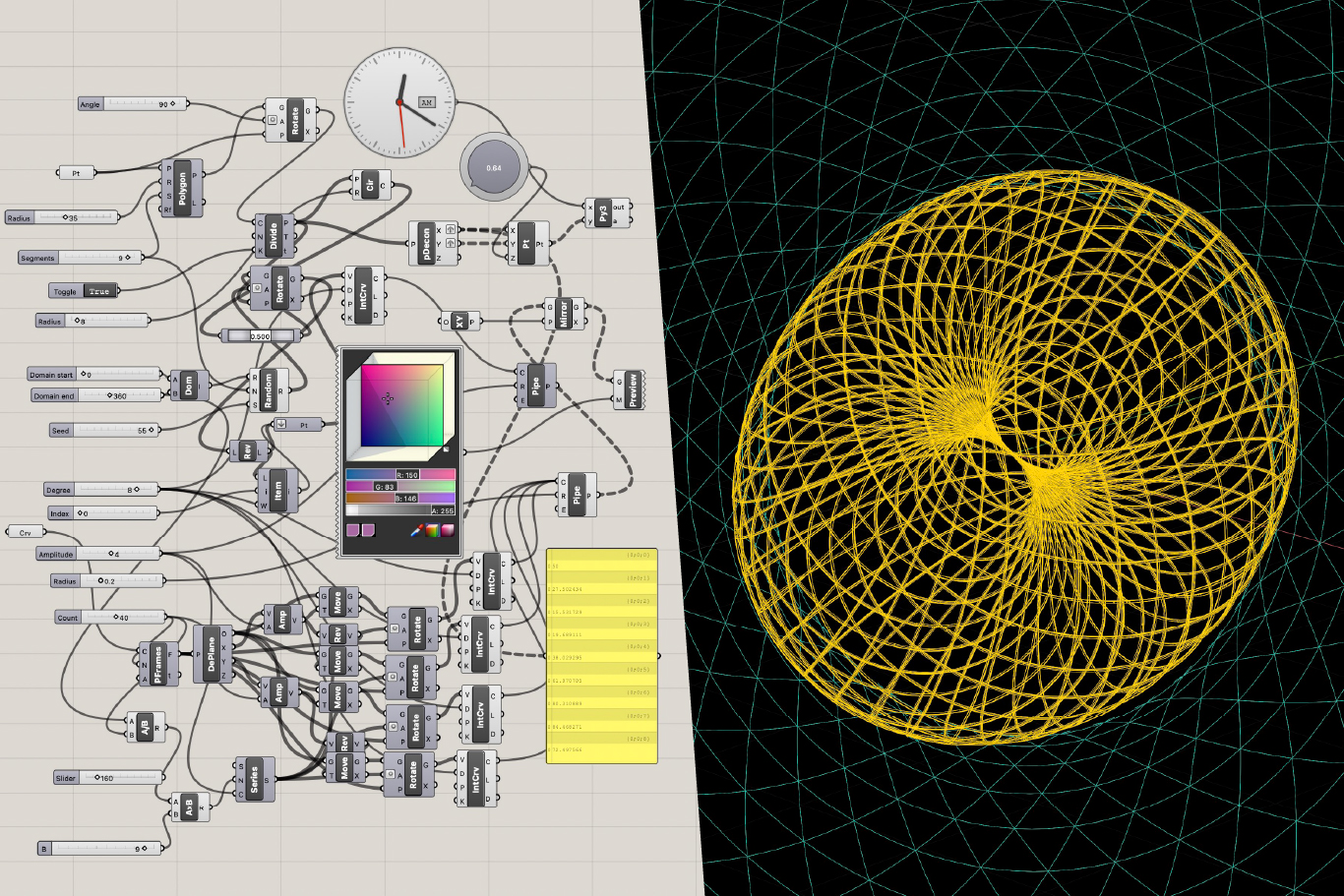
James shared physical reference objects during the call — a Frank Lloyd Wright circular design, a Sufi rug from Istanbul, and a Moroccan piece featuring a rainbow iris/eye — all converging around the same symbolic territory (10:42). The 3D parametric model James demonstrated showed a striking natural resonance with the Tibetan mandala when viewed head-on, capturing both the mandala and taurus ingredients simultaneously.
James worked live in both the 3D model and Adobe Illustrator, building a fractal rotation system using diamond and circle shapes to approximate the mandala geometry (26:39). Key directions to continue exploring:
Forest also flagged logo adaptability as an important consideration — the final mark needs to work on white backgrounds, black backgrounds, and in grayscale (43:09).
Forest noted enthusiasm about the animation possibilities once the static logo is finalized (16:08). The parametric model structure makes it well-suited for animated variations on the website.
The conversation shifted to broader project strategy, with Forest proposing a two-track parallel path before the baby arrives: finalizing the logo and establishing a look-and-feel and brand kit, while also moving toward a Phase 1 website draft (49:56). If copy isn't ready, lorem ipsum placeholders are an acceptable bridge.
Forest noted that after the baby comes, the first ~three weeks will be largely unavailable, but he intends to return to the project and continue seeing clients. The goal is to preserve momentum by having something tangible in place before that pause.
Forest shared a meaningful shift in his working approach — he's been investing in an AI-assisted workflow built around [tag="claude"] Claude desktop and Claude Code, Obsidian for knowledge management, Chrome browser automation, and Google Workspace integration (53:34). He's also connected Claude to Obsidian directly, and is in the process of ending his Notion and ChatGPT subscriptions in favor of this consolidated stack.
James responded enthusiastically and described his own parallel setup — using Claude integrated with Obsidian as a living knowledge base, with automations that research topics, generate structured documents, and produce illustrated infographics (58:30). He also raised a significant architectural suggestion for the website:
Rather than relying on Webflow [tag="webflow"] as the primary platform, Claude + GitHub [tag="github"] could serve as the content management and development layer. The approach: design components and a style guide in Webflow, export the HTML/CSS, and host it in a GitHub repo where Claude can act as an administrator — updating copy, adding pages, and iterating on features through conversation. James built a proof-of-concept site from a voice memo in under 30 minutes, which landed as genuinely exciting for Forest (01:04:58).
The shared GitHub repo model also enables true collaboration — both Forest and James could connect their Claude desktop instances to the same repo and evolve the site together. Forest, who describes himself as a visual/canvas thinker rather than a text-doc thinker, found this approach immediately resonant (01:07:57).
Based on the conversation, the foundation Forest is building on:
Forest described his plan to upload approximately a thousand existing C-LAB files into a Claude project — what he's calling the "C-LAB brain" — to give the AI the full context needed to generate website copy, book drafts, facilitator training content, and ecourses (01:14:05). Once that knowledge base is in place, generating a first-draft content architecture becomes much more tractable.
James flagged an important caveat around AI-generated copy: the risk of producing text that reads like generic AI output — detectable by an increasingly pattern-sensitive audience (01:17:43). Forest has already noticed his own growing sensitivity to these signals (M-dashes, predictable phrasing) and confirmed his intent to use AI as a writing assistant, not an author, with all final editing done manually. A C-LAB-specific glossary of terms is also planned to give the AI a more distinctive voice to work from (01:20:37).
James confirmed that the iStock subscription credits expire April 23rd (01:13:28). Forest has time to review the video assets before then.
---
James Redenbaugh
Forest
Forest opened by sharing the weight of his current season — caring for aging, ill parents in Chicago while his wife prepares to give birth back in Bend (01:19). He acknowledged feeling frustrated by the fragmented time available for C-LAB work, and the conversation landed on a spirit of acceptance and timeline flexibility. Both agreed to continue moving forward in whatever capacity is available, with the understanding that the first few weeks after the baby arrives will essentially pause active collaboration.
The bulk of the early session was devoted to refining the logo concept through what Forest called the "ingredients" approach — distilling the logo's essence into a small set of core visual elements before combining them (05:10). The agreed-upon ingredients are:
[technology="Parametric Geometric Interfaces"]
James shared physical reference objects during the call — a Frank Lloyd Wright circular design, a Sufi rug from Istanbul, and a Moroccan piece featuring a rainbow iris/eye — all converging around the same symbolic territory (10:42). The 3D parametric model James demonstrated showed a striking natural resonance with the Tibetan mandala when viewed head-on, capturing both the mandala and taurus ingredients simultaneously.
James worked live in both the 3D model and Adobe Illustrator, building a fractal rotation system using diamond and circle shapes to approximate the mandala geometry (26:39). Key directions to continue exploring:
Forest also flagged logo adaptability as an important consideration — the final mark needs to work on white backgrounds, black backgrounds, and in grayscale (43:09).
Forest noted enthusiasm about the animation possibilities once the static logo is finalized (16:08). The parametric model structure makes it well-suited for animated variations on the website.
The conversation shifted to broader project strategy, with Forest proposing a two-track parallel path before the baby arrives: finalizing the logo and establishing a look-and-feel and brand kit, while also moving toward a Phase 1 website draft (49:56). If copy isn't ready, lorem ipsum placeholders are an acceptable bridge.
Forest noted that after the baby comes, the first ~three weeks will be largely unavailable, but he intends to return to the project and continue seeing clients. The goal is to preserve momentum by having something tangible in place before that pause.
Forest shared a meaningful shift in his working approach — he's been investing in an AI-assisted workflow built around [tag="claude"] Claude desktop and Claude Code, Obsidian for knowledge management, Chrome browser automation, and Google Workspace integration (53:34). He's also connected Claude to Obsidian directly, and is in the process of ending his Notion and ChatGPT subscriptions in favor of this consolidated stack.
James responded enthusiastically and described his own parallel setup — using Claude integrated with Obsidian as a living knowledge base, with automations that research topics, generate structured documents, and produce illustrated infographics (58:30). He also raised a significant architectural suggestion for the website:
Rather than relying on Webflow [tag="webflow"] as the primary platform, Claude + GitHub [tag="github"] could serve as the content management and development layer. The approach: design components and a style guide in Webflow, export the HTML/CSS, and host it in a GitHub repo where Claude can act as an administrator — updating copy, adding pages, and iterating on features through conversation. James built a proof-of-concept site from a voice memo in under 30 minutes, which landed as genuinely exciting for Forest (01:04:58).
The shared GitHub repo model also enables true collaboration — both Forest and James could connect their Claude desktop instances to the same repo and evolve the site together. Forest, who describes himself as a visual/canvas thinker rather than a text-doc thinker, found this approach immediately resonant (01:07:57).
Based on the conversation, the foundation Forest is building on:
Forest described his plan to upload approximately a thousand existing C-LAB files into a Claude project — what he's calling the "C-LAB brain" — to give the AI the full context needed to generate website copy, book drafts, facilitator training content, and ecourses (01:14:05). Once that knowledge base is in place, generating a first-draft content architecture becomes much more tractable.
James flagged an important caveat around AI-generated copy: the risk of producing text that reads like generic AI output — detectable by an increasingly pattern-sensitive audience (01:17:43). Forest has already noticed his own growing sensitivity to these signals (M-dashes, predictable phrasing) and confirmed his intent to use AI as a writing assistant, not an author, with all final editing done manually. A C-LAB-specific glossary of terms is also planned to give the AI a more distinctive voice to work from (01:20:37).
James confirmed that the iStock subscription credits expire April 23rd (01:13:28). Forest has time to review the video assets before then.
---
James Redenbaugh
Forest
Share additional Tibetan mandala variation image and logo visual references with James via email
Forest to email James the additional Tibetan mandala variation image and any other logo visual references discussed during the session to support ongoing logo development.
Review and send notes from the content outline document to James
Forest to review the content outline document and send notes to James so he can use it as the basis for spinning up the first-draft GitHub website.
Continue uploading C-LAB content files into Claude project to build the C-LAB brain knowledge base
Forest to continue uploading approximately a thousand existing C-LAB files into a Claude project — the 'C-LAB brain' — to give the AI full context for generating website copy, book drafts, facilitator training content, and ecourses. A C-LAB-specific glossary of terms is also planned to give the AI a more distinctive voice.
Review iStock video assets and select candidates before April 23rd credit expiration
Forest to review iStock video assets before the April 23rd credit expiration. Priority is micro/macro visual philosophy content communicating 'we live in a living universe.' James confirmed credits expire April 23rd at 01:13:28.
Test Tibetan mandala image as mask with both 360-degree and radial rainbow gradients in rainbow-on-white and rainbow-on-black versions
Test the Tibetan mandala image as a clipping mask applied to both gradient orientations (360-degree circular rainbow and radial/center-out rainbow), comparing rainbow-through-white and rainbow-through-black versions to determine which reads better. Also explore darker shading at outer circumference and dark central circle to achieve subtle eye/iris and 3D curvature effect.
Spin up GitHub repo with first-draft website based on content outline document and share with Forest for review
Create a GitHub repository with a first-draft website based on the content outline document Forest will send. Use the Claude + GitHub architecture discussed — design components and style guide from Webflow, exported to HTML/CSS hosted in GitHub where Claude can act as administrator. Share repo with Forest for visual and collaborative review. Lorem ipsum placeholders acceptable where copy isn't ready.
Comprehensive brand identity development including logo redesign with four core ingredients: mandala (Tibetan black-and-white geometric), taurus (head-on toroidal form via Grasshopper), eye (perception/cosmogenesis with stars in pupil), and rainbow (360-degree circular gradient at CAAB saturation level). Visual identity themes emphasize micro/macro philosophy, wonder and gratitude, living universe concept. Logo explorations include fractal rotation system in Illustrator using diamond and circle shapes, taurus geometry with more segments and smaller center hole, Tibetan mandala as mask testing rainbow-through-white and rainbow-through-black versions, eye effect through darker outer circumference shading and dark central circle. Logo must work on white backgrounds, black backgrounds, and grayscale. Animation potential noted for parametric model structure. Includes time-lapse photography exploration, iStock video research (credits expire April 23rd), and establishing visual language that bridges cosmic and professional aesthetics. Dual entity strategy: C-LAB (psychedelics-free) and The Church (medicine ceremonies) with shared visual DNA but distinct identities. Current iteration focus: Evolved from original C-LAB logo geometry with mosaic technique and inner glow effects. Refining C-shape with subtle triangular angle opening (narrowing toward pupil) to evoke light glare on eye while reading as C. Testing hard-edge vs soft-edge variations (preference for hard edges). Adding subtle dark shading around inner pupil and outer Taurus edge for dimensionality. Exploring gradient/drop shadow on inner thorny crown details. Design must translate well to digital screens, printed apparel, and embroidered hats. Figma collaboration space shared with Forest for direct commenting. Logo direction refined: Two variants reviewed - lattice/grid version with visible connecting lines, and minimalist positive/negative space version with geometry implied. Forest leans toward minimalist for organic feel and better scalability at small sizes (01:14:59). Both can coexist as use-case variants - full lattice for large placements, cleaner version for small applications like favicons. Refinements needed: tighten gaps in minimalist version for clearer C reading, keep rounded corners on geometric shapes. Overall geometry solid and ready for full style guide. Rainbow-colored copy direction nixed (01:20:29) - logo already carries rainbow tones, applying to typography risks over-signaling. Gradient fonts (not full spectrum) still open for exploration.
Core website development for C-LAB including retreat program information, one-on-one session scheduling, payment processing integrated with nonprofit structure, and Tally registration system integration. Development approach shifting to GitHub + Claude architecture rather than pure Webflow - design components and style guide in Webflow, export HTML/CSS, host in GitHub repo where Claude acts as content administrator enabling conversational updates and true collaboration. Six-week delivery window before Forest becomes unavailable for three months (first ~3 weeks after baby arrives). Phase 1 priorities: logo design and branding, two foundational C-LAB maps, working website version with lorem ipsum acceptable as placeholder if copy not ready. Focus on beautiful custom design with AI-augmented development and parametric geometric interfaces. Budget range $5,000-8,000 with phased approach. First-draft website to be spun up from content outline document for visual/collaborative review. Design direction confirmed: Typography selection finalized with Montserrat (primary sans serif for headlines and body) and Frances (complementary serif accent) - both Google fonts matching Holo Movement typeface combination. Interactive sections planned: Five Movements map/diagram with rollover breakouts, Three Centers/Circles/Times parallel interactive treatment. Transformation motif established as primary design concept - rainbow mandala as living symbol woven throughout site with animated transitions between contrasting old-world/new-world image pairs (industrial monocropping → permaculture garden, meta-crisis → ecological civilization). Reusable animation widget concept for contrasting image montages throughout site. HTML mockup in GitHub repo accessible to Forest for Claude-assisted iteration. Homepage architecture refined: Hero reframed as bright oasis (fractal of whole site), science section reordered to lead with Watts Connectedness Scale, AI voice patterns removed for natural prose, five movements centered on full 360° mandala (not spiral) with scroll-tied and hover/click interactivity, testimonials section with video + pulled quotes + simple attribution. Offerings section needs clear separation between C-LAB (without psychedelics) and C-LAB + psychedelics via tabs/color coding/grouped sections. Core positioning: curriculum-centric, not psychedelic-centric. Path/journey metaphor throughout site language and graphics.
Initial project discovery and planning call to understand C-LAB's vision, requirements, and budget parameters. Covers retreat offerings, future platform needs (LMS, community, membership), AI integration strategy, and phased development approach. Meeting established brand identity, dual entity strategy (C-LAB vs The Church), logo direction with four ingredients approach (mandala, taurus, eye, rainbow), visual identity themes, and six-week delivery timeline before Forest's availability window closes. Confirmed AI-assisted workflow using Claude desktop, Obsidian, GitHub, and Google Workspace integration. Established GitHub + Claude architecture for website development and collaborative content management.
Set up collaborative project workspace for C-LAB using GitHub repository as primary collaboration platform. GitHub repo will house website code and enable both teams to connect Claude desktop instances for conversational development and content updates. System enables visual/canvas-based collaboration suitable for Forest's working style, with shared access to design assets, task coordination, content organization, and timeline visibility. Replaces initial Figma/Miro canvas concept with GitHub + Claude approach for tighter integration with website development workflow. Enables both teams to stay aligned on what's being built, when, and what's needed from whom during rapid six-week development window.
Current state: GitHub mockup repo created and Forest invited with access. Figma designer space shared with Forest for direct commenting on logo variations. WhatsApp established for real-time weekend collaboration. Forest can connect Claude to repo for direct editing or use URL for reference while drafting in Google Doc.
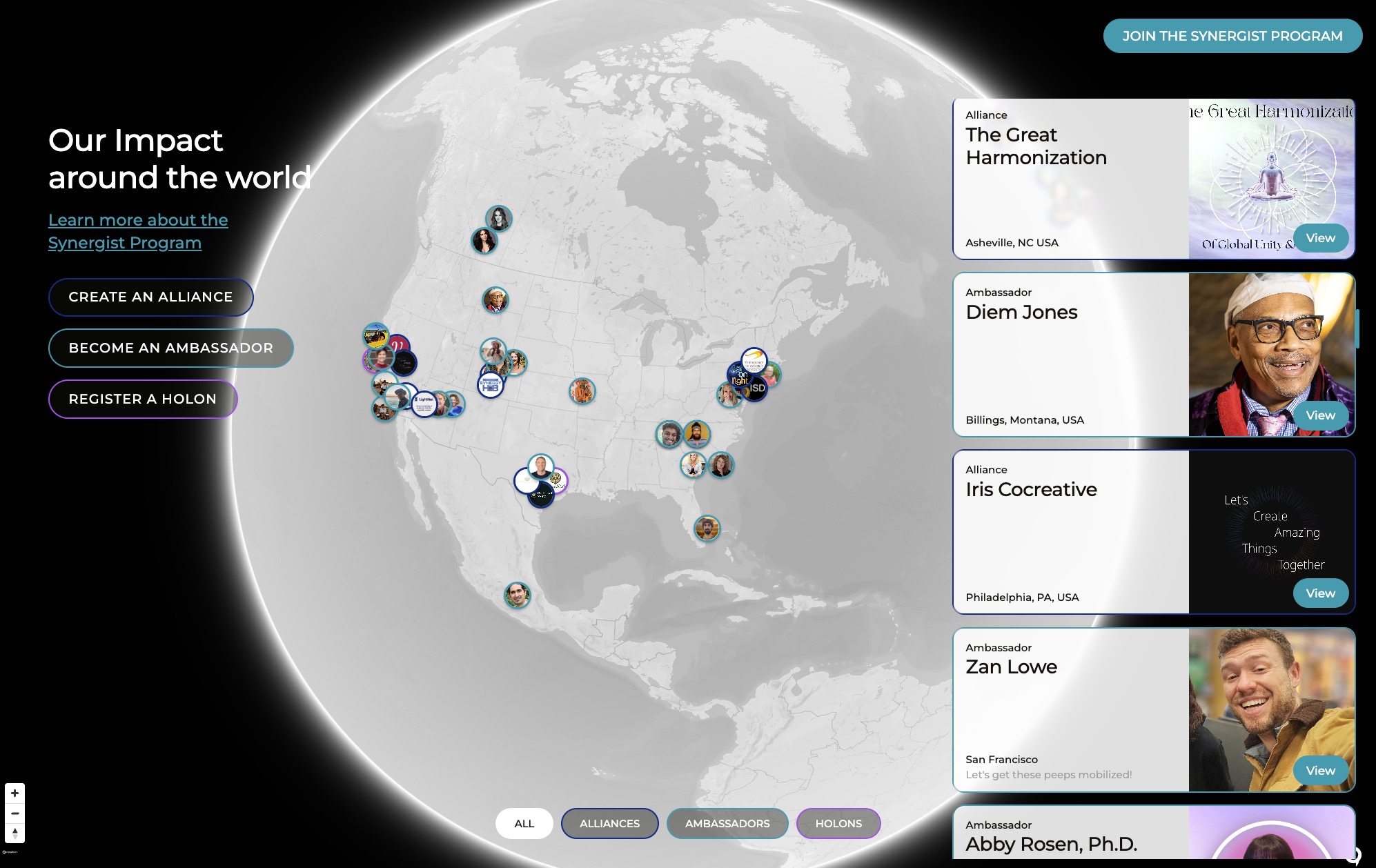
Future development of online courses (free resource library and paid content), community platform for education and community space, custom membership system, facilitator training program support tools (marketing assets, payment processing, registration, design templates, private community spaces), and advanced integrations. Includes C-LAB Local community mapping with toggled layers (members, local groups, certified facilitators) and 3D morphing globe visualization. This represents phase 2+ development beyond initial website, to be scoped and budgeted separately as C-LAB grows and additional funding becomes available. Community page will feature interactive globe map showing members across the world (39:00) with tiered privacy levels (default low-transparency with opt-in for richer profiles), involvement tiers represented via color (retreat alumni, monthly gathering attendees, facilitators), and potential mycelial-style connections between members as visual metaphor (42:16). Case studies and additional testimonial videos live on this page for deeper exploration.
Establish comprehensive AI-assisted workflow infrastructure for C-LAB using Claude desktop + Claude Code as primary AI layer, Obsidian for knowledge management and memory, GitHub for version control and collaboration, Google Workspace integration, and Chrome browser automation. Build C-LAB brain knowledge base by uploading approximately 1,000 existing C-LAB files into Claude project to enable AI-assisted generation of website copy, book drafts, facilitator training content, and ecourses. Develop C-LAB-specific glossary of terms to give AI distinctive voice. AI used as writing assistant with all final editing done manually to avoid generic AI output patterns. This infrastructure enables Forest to work in his preferred visual/canvas thinking style while maintaining quality and voice consistency. Current focus: Forest dedicating weekend to refining C-LAB second brain in Obsidian to strengthen Claude as writing assistant. Goal to generate close-to-final website copy in Google Doc before baby arrives. GitHub mockup repo shared with Forest for Claude-connected iteration or URL reference for drafting. Key insight: AI voice patterns to avoid identified including 'this is not X, it is Y' construction, uniformly short staccato sentences, and vague filler phrases (13:00). Shift toward more varied, natural prose including run-on sentences where they serve meaning (18:56). James helping rewrite hero and intro-to-five-movements copy as Forest finds this section hardest - messy and long raw material is fine at this stage (22:24).
00:00:08
James Redenbaugh: This meeting is being recorded.
00:00:30
Forest: Are you able to hear me?
00:00:33
James Redenbaugh: Yeah. Can you hear me? Yep.
00:00:35
Forest: He just came on.
00:00:37
James Redenbaugh: There we go. How's it going? Good to see you.
00:00:40
Forest: Hey, man, good to see you, too.
00:00:43
James Redenbaugh: Thanks for waiting while I get my PC set back up.
00:00:47
Forest: Hey, no worries. I think I get the sense you're a night owl sometimes and work with late into the night.
00:00:55
James Redenbaugh: I do, I do. For sure. I like the night. Yeah.
00:01:03
Forest: Were you up late last night?
00:01:05
James Redenbaugh: Not too late. Not too late. Got some good sleep, though. Good. How's Chicago?
00:01:19
Forest: Well, I mean, the weather is. Is not bad, so that's been nice. Yeah, it's a lot, man. You know, it's just. Yeah. Both of my parents are very old and sick and. Really good to be here with them. Time feels very precious, you know, and it's. You know, it's. Yeah, it's just. There's a lot happening all the same on many different levels. Like there's just the practical kind of health care management side of things, and then there's, you know, just the emotional side of things. Just dealing with my own emotions that are coming up around everything and then, you know, just trying to carve out as much quality time with them as I can.
00:02:19
James Redenbaugh: Yeah.
00:02:21
Forest: And then on top of that, you know, I got a very pregnant wife back in Bend. There's a lot to tend to around the pregnancy because she's going to be giving birth very soon and. And then on top of it, you know, I've got. I've got work, I got a lot of clients that I'm still seeing and trying to carve out a little bit of time for this, which feels, you know, so important to me.
00:02:48
James Redenbaugh: And.
00:02:52
Forest: Yeah, I was been preparing for this meeting with, you know, just trying to kind of protect little bits of time here and there as much as I can, and just really feeling the. There's just such a desire to have just a nice chunk of uninterrupted time to focus on this because I'm really excited about it and that's just not what's happening right now. So feeling my frustration around that and then kind of having to find my way back into a place of acceptance, you know, adjusting and within myself and something I need to talk with you about. It's just adjusting expectations and timelines.
00:03:44
James Redenbaugh: Yeah, it sounds good. Well, I'm here for you and let's see what's. What's possible, what we can do. Let's see where we're at and what's needed and what. What wants to come into being.
00:04:04
Forest: Sounds Good.
00:04:05
James Redenbaugh: Thanks for, thanks for sharing all that. Sounds like a full life and a beautiful life and I'm grateful get to, to get to witness you in this moment.
00:04:19
Forest: Thanks. Yeah, thanks. And I appreciate your understanding around it. It's just unusually, just unusually beautiful and challenging time. So. Yeah, just appreciate your, you know, us finding a way to continue to, to work together in the midst of it all.
00:04:45
James Redenbaugh: No problem. My pleasure.
00:04:48
Forest: Yes.
00:04:52
James Redenbaugh: So what has been present with you around C Lab? I sent you a lot of logo options and this copy doc. What have you had time to sit with at least?
00:05:10
Forest: Yeah, I mean if you haven't added any more anything else to the Figma page, then I've seen all of the kind of logo ideas that you were playing with and I, I think I responded to that. But yeah, I, I feel like there's a, there's some kind of unfolding emergent process there that, where there is a growing clarity around kind of what I'm aiming for with the logo and that, you know, the, the Taurus thing that you created is absolutely gorgeous. You know, you're the one that was your favorite logo. It's absolutely gorgeous. It doesn't feel right for me for C Lab and it's absolutely beautiful, you know, so, you know, like in terms of logo direction, I'd love to continue to explore that with you and I've been trying to think about like what would really help us to kind of move this thing in a direction, you know, click. Giving you more clarity around how to move this thing forward.
00:06:34
James Redenbaugh: And.
00:06:36
Forest: You know, like I said in that email, the, the I. My sense is, is something that, you know, it's almost like if that if we're looking at that Taurus head on, you know, kind of like the existing logo, there's a way in which it can appear both two dimensional and three dimensional. And I really liked your idea in one of our last sessions around moving that. It doesn't have to be the C shape. I mean I'm open to it being a C shape, but I liked your idea of like it doesn't have to be a C shape. We could actually just let the typography carry that, you know, the C period Lab. But yeah, if, you know, if I were to boil it down to four or five year words, it would be Mandala Taurus an eye like ey E and definitely that rainbow color. That part I'm clear on. And I think the, the other so Taurus mandala eye as in perception to see. And then I think that last piece is related to Cosmos or cosmogenesis,.
00:08:06
James Redenbaugh: You.
00:08:07
Forest: Know, that somehow it's becomes, and, you know, both the Taurus and, and the mandala capture this, but somehow it's capturing like, oh, wow. There was a moment where nothing existed. And, you know, like Terence McKenna talks about, you know, material. The materialist scientists say, give us one free miracle and we'll explain the rest. So that moment of like, everything emerging from nothing, and now we have this, you know, evolutionary unfolding, manifest universe. And there's a way in which that kind of mandala, fractal, Taurus, you know, rainbow is like, symbolically represents. Yeah. Whatever this magical, mysterious, you know, force is that is. Yeah. Behind it all.
00:09:15
James Redenbaugh: Awesome. I made a poem about that prior unity for Jeff's magazine a couple weeks ago.
00:09:31
Forest: By the way, I saw, I saw your submission on. I, I read your thing in the magazine.
00:09:37
James Redenbaugh: Oh, thanks.
00:09:38
Forest: Yeah, it was really cool, man.
00:09:42
James Redenbaugh: Yeah. This was one of the things in there with these, these words that emerge from nothing. And they, they're all about that back before the beginning.
00:09:59
Forest: Because I saw you had posted a few different pieces of, of your artwork, of your creativity. Is this a, another edition?
00:10:08
James Redenbaugh: No, it's a, it's one of them. It's the website linked from there. It said we dot once that were dot one we once were one.
00:10:17
Forest: That's awesome.
00:10:19
James Redenbaugh: But it's, it's kind of hard to find on there.
00:10:22
Forest: Okay, that's really cool. I like that a lot.
00:10:27
James Redenbaugh: Yeah. I was stoked to be included in that.
00:10:31
Forest: Yeah. Nice to see you being. I appreciate what you wrote and the artwork that you put up there. You did a really good job.
00:10:42
James Redenbaugh: Thank you so much. I've got a show and tell today. Some things that reminded me of our, of our logo conversation. This is a Frank Lloyd Wright design made of circles and obviously has a lot of that toroidal energy. I really like the simplicity of it.
00:11:09
Forest: That's very cool. I did too.
00:11:12
James Redenbaugh: And then we've got this one. Classic Sufi rug. I got this in Istanbul.
00:11:21
Forest: Nice.
00:11:24
James Redenbaugh: And there's one more thing over here. Let me grab it. A friend of mine brought me back this from Morocco.
00:11:44
Forest: Oh, wow. That's cool. That's very cool.
00:11:50
James Redenbaugh: The eye. The rainbow iris.
00:11:53
Forest: The rainbow eye. Iris. Iris, yeah, the, the rainbow eye. I IR us iris.
00:12:05
James Redenbaugh: Yeah.
00:12:05
Forest: Cool.
00:12:12
James Redenbaugh: And yeah. So I, I, I thought there was a couple directions that we could take the logo conversation from here. 1. And we could see what, what resonates the most with you. One is I really like these words that you mentioned where you feel like you've gotten it distilled down to these core concepts. And we could do an exercise today and after the call as well. I can run with it to kind of visualize the aesthetic elements of each of those things and then say, okay, these are our ingredients. And here's like, the essence visually of each of these. And these could also become icons on the website for other things. And then we look at combining them. So, like, what is the mandala? What is the rainbow? You know, what are these. These different ingredients? Put them on paper and put them together. So it can kind of be informed by what's come up already. But also kind of taking a step back and looking at what are. What's a palette, a visual palette that we could create. And the other approach, you know, we haven't had the chance to. To do this yet. And one of the reasons I like to build these. These 3D models here, I'll share this whole screen over here is because they're highly editable. And I've got my.
00:14:05
Forest: That is beautiful, man.
00:14:08
James Redenbaugh: Thanks.
00:14:09
Forest: That is stunning.
00:14:13
James Redenbaugh: So this is our shape over here. It's actually three dimensions.
00:14:17
Forest: Okay.
00:14:19
James Redenbaugh: And then we can also look at it from multiple perspectives at once or just top down. And then over on the right here is the math that creates it. And so I can tweak the parameters.
00:14:41
Forest: Oh, wow. That's crazy. No way.
00:14:44
James Redenbaugh: Yeah. And it changes the math.
00:14:48
Forest: That's insane.
00:14:52
James Redenbaugh: So it's all. It's all just made of math. And each of these nodes is a different, you know, simple function. Like this creates a polygon. This rotates those polygons, and all the wires just basically carry numbers or coordinates and then puts it together, including into color. So the colors are derived by the angle.
00:15:21
Forest: That's insane.
00:15:22
James Redenbaugh: Of their position from the center. And yeah, we can turn on and off different pieces. So we just see, you know, the.
00:15:36
Forest: Oh, wow, look at that.
00:15:38
James Redenbaugh: The shapes or the pipes or whatever.
00:15:44
Forest: That's awesome.
00:15:47
James Redenbaugh: So I'm happy to play with that with you here. I'm scaling each of these little tectonic pieces, So there might be something in here that that can work. And I'm happy to explore this direction as well.
00:16:08
Forest: That is awesome. Yeah. As you're playing with it, you know, got my wheels spinning on, like, once we have finalized, you know, whatever the static logo is going to be, how many fun possibilities there would be for animating that.
00:16:28
James Redenbaugh: Yeah, definitely.
00:16:31
Forest: Yeah. That's badass.
00:16:39
James Redenbaugh: So which of those two directions do you think you want to explore first? They're not mutually exclusive. But what resonates with you as A.
00:16:55
Forest: Starting place between the ingredients piece and this piece. Yeah, I mean, I think. I think we can do both. The ingredients piece, I think is for me. For me, in my mind at least, is pretty straightforward, at least to get us started. So maybe we could take a minute and run through that.
00:17:17
James Redenbaugh: Yeah,.
00:17:20
Forest: I. I think one of the images that I sent you was that Tibetan mandala, the black and white mandala image.
00:17:29
James Redenbaugh: Yeah.
00:17:30
Forest: Does that ring a bell?
00:17:32
James Redenbaugh: Yep. I'm gonna bring that up.
00:17:36
Forest: Okay.
00:17:41
James Redenbaugh: And. I'm just gonna drop some things in here.
00:17:51
Forest: Oh, yeah. Cool. So thanks for adding that. And can I. I'm gonna send you one other variation of that I just found. Just email. It. Looks like they actually used the same eye, but then brought in, like a kind of nature, psychedelic nature collage thing here that to you, it's got a little bit of a similarity to that image I sent you from Samantha Sweetwater's book, the COVID of her book. I can resend that if you need that.
00:18:38
James Redenbaugh: Cool.
00:18:46
Forest: Yeah. And the. The image to the right of the Tibetan mandala, the one that's the river with the, you know, kind of the before and after at some point, kind of when we move from talking about the logo to talking about, like, potential design direction for the website and just kind of the brand identity. Want to just take a minute and talk about that image? The river image? But, yeah. Cool, cool. So, yeah, in terms of the ingredients, I think that the, you know, when I think of. Of that first word, mandala, there's something about that particular, this Tibetan mandala, that really stands out in my mind, really resonates. And it's interesting because as you were kind of flipping through some of the different variations on that 3D model, there was one of them that actually reminded me quite a bit of this black and white Tibetan mandala. You're playing with some of the dials, but you can start to see already with what you've got up. There's a lot of similarity there.
00:20:13
James Redenbaugh: Yeah.
00:20:15
Forest: So there's, you know, I like what's emerging there in terms of, you know, the ingredient of mandala. Yeah, there you go. But it's got the. That kind of diamond shape that the. That black and white Tibetan Mandela has, which. It's surprise. It surprises me, but it's. Oh, that one's, I guess, more of a kind of triangular slash diamond. But, yeah, you can see there's a resonance there. So I like how this is capturing both the mandala ingredient as well as the Taurus ingredient. Are you able to easily adjust the.
00:21:03
James Redenbaugh: The.
00:21:05
Forest: The Kind of the donut hole. Are you able to make it smaller in the 3D model?
00:21:11
James Redenbaugh: Yeah, of course.
00:21:14
Forest: Just curious to see what happens if that was a little smaller. Huh.
00:21:25
James Redenbaugh: I gotta be careful. When I go to zero, it freaks out because you can't divide by zero.
00:21:32
Forest: Right.
00:21:35
James Redenbaugh: Max is way too high.
00:21:49
Forest: Yeah. I mean, close enough for now, but.
00:21:52
James Redenbaugh: Oh, wait. I'm just. That's the wrong slider. Sorry. I think I'm in the wrong area. It's freaking out.
00:22:21
Forest: It's okay. We don't. If we actually don't need to spend more. More time on the donut hole. Unless it's just super easy. It was just a kind of a side thought.
00:22:36
James Redenbaugh: But. Yeah, continue your thought. And we could come back to this when it resolves.
00:22:41
Forest: Yeah. Just simply that the ingredients are. I feel like what you already like the. The 3D model is when we're looking at it head on, there's very deep resonance with this particular black and white Tibetan mandala, which for whatever reason is resonating for me and the Taurus.
00:23:06
James Redenbaugh: Yeah.
00:23:11
Forest: So I feel like that captures those two ingredients well. And then.
00:23:22
James Redenbaugh: The.
00:23:26
Forest: Yeah. I guess there's also something in the C on the left there. It's kind of the. It's the rainbow one that's underneath the C with the flare in the middle of it. Yep.
00:23:45
James Redenbaugh: Can you zoom in on that?
00:23:52
Forest: I think that. So it's interesting because that's also the diamond mandala shape. Right. But the difference is, is that it. Instead of it being like a rainbow blend around the 360, it's a rainbow kind of, you know, from the center out. Do you know? I'm saying I didn't describe that well, but.
00:24:14
James Redenbaugh: No, I know exactly what you mean.
00:24:16
Forest: So that's also a direction that, you know, if it's not too difficult to kind of mock up, I'd be also curious to see, you know.
00:24:30
James Redenbaugh: Yeah.
00:24:30
Forest: What that looks like.
00:24:36
James Redenbaugh: We can also play in two dimensions. Real quick. Quick. Over here as well.
00:24:42
Forest: Okay.
00:24:46
James Redenbaugh: Just to see what this might conjure. So. Oops. My shortcuts are so different on my PC to it.
00:25:12
Forest: Yeah, yeah, yeah.
00:25:14
James Redenbaugh: Becoming a PC person. I didn't. Didn't see that happening. Yeah.
00:25:19
Forest: What inspired that?
00:25:23
James Redenbaugh: I wanted an Nvidia graphics card to be able to do more intense rendering and play with AI stuff and do animation and video. And I also wanted more power. My MacBook was getting pretty old and it's just so much more cost effective to get a PC.
00:25:46
Forest: Yeah.
00:25:49
James Redenbaugh: And so went with that. So I still have my MacBook for when I travel and stuff like that. But the PC has given me a lot more power and speed and control. And I like the idea that it's upgradable. You know, with the Mac, we're so locked in.
00:26:08
Forest: Yeah, it's definitely a downside to the max.
00:26:11
James Redenbaugh: Yeah. So I'm going to build a little fractal here. That we can then tweak real quick. So make that a group.
00:26:33
Forest: What program are you in?
00:26:39
James Redenbaugh: This is Illustrator now.
00:26:40
Forest: Oh, it is. I thought it was.
00:27:12
James Redenbaugh: Just kind of do a simple version of what we're seeing here.
00:27:28
Forest: Wow, look at you go. That's cool, man. It.
00:28:17
James Redenbaugh: Count this real quick.
00:28:43
Forest: Pretty cool, man. It's awesome.
00:28:47
James Redenbaugh: Yeah, I. I love coming back to Illustrator for simple stuff. Of course, I could do this in Grasshopper, but it's just, you know, rotating and scaling create these fractals and this over here isn't, you know, a perfect fractal transformation, but I just wanted to try this out real quick.
00:29:13
Forest: And then I guess it can do a similar kind of pattern with other shapes. Right. Like circles or ovals.
00:29:22
James Redenbaugh: Exactly. And the way I've done this, I can go in here and replace that diamond with a circle and now it circles.
00:29:36
Forest: Cool.
00:29:41
James Redenbaugh: Copy that. Do. And then I just wanted to play with. Oops. Not that. Giving this a rainbow kind of thing. So real quick. Just. It.
00:31:15
Forest: I'm gonna run to the bathroom. Be right back.
00:31:16
James Redenbaugh: Yeah, go for.
00:32:35
Forest: Check that out. Very cool.
00:32:39
James Redenbaugh: Yeah,.
00:32:50
Forest: One sec. It's really cool to see how well versed you are in these tools. I. There was a time where I was. This is 20, 25 years ago. I was pretty skilled with Illustrator and Photoshop. I wouldn't know what I'm doing anymore, but. Nice. Cool to see you doing that.
00:33:51
James Redenbaugh: I stuck with it so you didn't have to.
00:33:53
Forest: I appreciate that.
00:33:56
James Redenbaugh: No problem. Yeah. I started Illustrator when I was 12.
00:34:03
Forest: Is that right?
00:34:07
James Redenbaugh: And really fell in love with it.
00:34:10
Forest: Yeah, it's very, very cool.
00:34:13
James Redenbaugh: It.
00:34:40
Forest: And are you going to use the. That as a mask? Is that how you're doing that?
00:34:45
James Redenbaugh: Exactly. Just to see what this reverse rainbow might like.
00:35:04
Forest: Cool.
00:35:13
James Redenbaugh: Cool.
00:35:14
Forest: Yeah. I've got a. A bunch of things I'd love to talk with you. Lay them out.
00:35:33
James Redenbaugh: Yeah. And we can. We can spend as much or as little time as you want on mobile forms. We can also talk about strategy and website and structure and stuff like that too.
00:35:48
Forest: Okay. Yeah. If we had hours and hours, I'd love to just sit here and play with logos.
00:35:57
James Redenbaugh: But.
00:36:02
Forest: Yeah, there's a number of things I'd Love to be able to talk through with you.
00:36:08
James Redenbaugh: Sure. What's top of mind?
00:36:15
Forest: Well, I mean, just to finish the thought on the ingredients piece.
00:36:23
James Redenbaugh: The.
00:36:26
Forest: The. So that image that I sent you, the CAAB logo, that's to the right of the sea with the flare coming through it right now, that's my favorite rainbow gradient is just that level of that. Those colors and that level of saturation.
00:36:50
James Redenbaugh: Cool.
00:36:52
Forest: So, you know, just trying to break this down into the ingredients. I would say in terms of rainbow, if we're going to go with something that has that kind of. It's not from the center out gradient, but kind of the 360 gradient, like that logo, that is really working for me. Yep.
00:37:14
James Redenbaugh: Okay.
00:37:14
Forest: So, you know, I'd say the ingredients are Tibetan mandala. Black and white would be the mandala ingredient. The Taurus, that head on Taurus that you're building in that 3D model would be the Taurus ingredient. The rainbow green. The rainbow ingredient is the one I just pointed to.
00:37:40
James Redenbaugh: Yeah.
00:37:42
Forest: And then in terms of the. If you zoom in on those two eyes, the most recent ones I sent you, particularly the one on the left there.
00:38:00
James Redenbaugh: Yeah.
00:38:02
Forest: What I like about this is that I'm not. It has the, the two ingredients. Number one, the. The eye. Right. Itself. And it also has the cosmogenesis piece with the stars and the pupil. So I think that's all the ingredients.
00:38:31
James Redenbaugh: Cool.
00:38:32
Forest: And, you know, we may end up finding a logo that includes all of the ingredients. Or I'm also open to, you know, that being just trying to squeeze too many things into one logo and, you know, maybe it only has a few of those ingredients.
00:38:57
James Redenbaugh: Cool.
00:38:58
Forest: But I do get curious, like if you look at the eye just focusing on the, the eyepiece, not the stars in the pupil. You know, with the, that 3D Taurus that you're building and with the Tibetan mandala, if we have a black, you know, some kind of dark inner circle, then we're already moving in the direction of like something that kind of looks like an eye. And I'm just wondering if there's some way because, you know, with. When you really look close at an eye, it's like it has the black pupil at the center. And then there's a way in which it gets. It's a little bit darker around the, the outside circumference of the circle.
00:39:56
James Redenbaugh: Yeah.
00:39:58
Forest: And what's cool about that is, you know, it will simultaneously potentially help this logo to look like an eye. And it's also the kind of shading or could potentially also be the Kind of shading or shadow work that gives it a little bit more of that three dimensional curve.
00:40:25
James Redenbaugh: Yeah. So there's a question of does the. Does the rainbow go like this around or does it go. Is it radial?
00:40:48
Forest: Right, that's the word. Exactly.
00:40:50
James Redenbaugh: Like the iris. And maybe there's a combination of both. Who knows?
00:41:11
Forest: Who knows? Yeah. But yeah, in terms of general directions. Yeah. One is kind of from the center out and one is more of a. Like a 360 rainbow.
00:41:28
James Redenbaugh: And when it comes to the Taurus itself. Did this start responding again? I think that this number has to be larger than the other one. Well, which of these. Feels like the correct Taurus geometry? It seems like you're drawn to the ones that have more pieces and maybe a smaller center.
00:42:19
Forest: I think so.
00:42:23
James Redenbaugh: Cool.
00:42:26
Forest: But yeah, I mean, because that 3D model you built is so powerful and so easy to adjust. I'd be curious to see if you. Variations.
00:42:37
James Redenbaugh: Yeah, let me restart it.
00:42:43
Forest: I think the other thing, if it's not too complicated, I'd be curious to see is if you take that. If you imagine taking that Tibetan mandala image that I sent you and using that as a mask.
00:43:01
James Redenbaugh: Mm.
00:43:05
Forest: What that would look like with the rain.
00:43:09
James Redenbaugh: Sure.
00:43:11
Forest: You know, the radio Rainbow and the 360 Rainbow. Because if we're using that as a mask, I'd be curious to see what it looks like with the rainbow colors coming through the white and then also the rainbow colors coming through the black. So that, you know, we have one version that's rainbow with black triangles and one version that's rainbow with white triangles. Because, you know, another consideration which I have in the back of my mind is just like, how do we have a logo that works seamlessly on, you know, a white background and a black background as well as something that might also, you know, work in. In black and white or grayscale. Yeah.
00:45:35
James Redenbaugh: Interesting.
00:46:22
Forest: Do you have a hard stop at half past? I guess it'd be 9:30 your time.
00:46:31
James Redenbaugh: I do today. Yes.
00:46:33
Forest: Okay. Just wondering if maybe we could move on.
00:46:38
James Redenbaugh: Yeah, yeah. I'll play with these things and. And share with you what comes up.
00:46:44
Forest: That'd be awesome.
00:46:46
James Redenbaugh: For sure. Yeah, I'll be excited to. I can make the geometry of this in Illustrator as well. So we could play with it more precisely.
00:46:56
Forest: Okay. But at this point are you. You have a better sense of the ingredients.
00:47:05
James Redenbaugh: Yeah. Yeah.
00:47:09
Forest: Okay.
00:47:11
James Redenbaugh: I really like these. These forms, especially the white on black. They would make really powerful meditation objects as well. I feel like I could just get lost in here.
00:47:34
Forest: Yeah.
00:47:43
James Redenbaugh: Cool. I used to make a lot of mandalas and it's been.
00:47:47
Forest: Did you.
00:47:49
James Redenbaugh: It's been a while. Yeah. Let's talk about the website structure. Yeah, sure.
00:48:03
Forest: Let me. Before we move on to website structure, I just want to see if. I think there was some kind of more meta comments I wanted to make about design.
00:48:16
James Redenbaugh: Sure.
00:48:17
Forest: I mean, not just specifically the logo, although that was. That's an important piece. Let me find my doc. Happen to it here. Okay. I got too many things open. Let's see. Okay. So just kind of a meta comment, You know, there. I don't want to rule out the possibility that we might be able to have, you know, like a. A phase one website up before the kid comes or a rough draft of the Phase 1 website up before the kid comes. You know, that would be amazing. And I'm also just aware of how much I'm juggling right now. And so in kind of in. In. In my mind, James, and you know, see how this lands on you. But in my mind, just to take the pressure off a little bit, couple of things I wanted to share with you. Number one is, you know, just because the kid comes doesn't mean. And this is something you may already be fully aware of. And I'm just going through my own process of coming to terms with this. Just because the kid comes doesn't mean that the project is over or that I'm not going to have any time to work on it. It's just going to mean that the kid is going to be center stage for a while.
00:49:56
James Redenbaugh: Yeah.
00:49:59
Forest: When I'm going to have time to work on this thing and how often I'm gonna. Is going to be more unpredictable. So I will be able to be available and continue to move this thing forward. But I think especially for. In those first three weeks, I'm basically not going to be available at all. And then after that I'm going to be going back to work and seeing clients. And I'm hoping that there's a way that I can also be carving out time for this. That's my intention. And you know, I would love to between now and when the kid comes, you know, and I, I welcome your guidance on this because, you know, these are probably two things we're continuing to work on as a parallel path, but just maybe focusing more on design. Just like what, you know, trying to finalize the logo. Starting to really move towards some kind of look and feel for the website as well as moving towards, you know, some kind of brand kit.
00:51:22
James Redenbaugh: Yeah.
00:51:24
Forest: And you know, if we need to. From you know, playing with design for the website. If. If I'm not able to get you copy, then, you know, just throwing some lorem Ipsum in there as placeholders.
00:51:44
James Redenbaugh: Yeah.
00:51:48
Forest: Thoughts on that?
00:51:50
James Redenbaugh: What did you think of the. The copy doc that I sent over? The outline?
00:51:58
Forest: Yeah. So I actually spent quite a bit of time going through it and I don't think we're going to have time to go through all the notes that I took. There's a lot here that I wanted. I want to share with you, but I thought it was extremely helpful, so thank you for that.
00:52:23
James Redenbaugh: And.
00:52:27
Forest: I. That was one of the other updates I wanted to give you is just let me close this door. There's construction happening.
00:52:34
James Redenbaugh: Sure.
00:52:42
Forest: So I am really. I've been doubling down on my AI education just because I'm really seeing that if I do this, if I use my old familiar methods for developing this website, it's going to take me a lot longer than it will if I spend the time to go through the learning curve with AI and then use those systems to develop the website, which is also going to be giving me the systems that I need to be developing a lot of other things going forward. So it just. It's become very clear to me.
00:53:33
James Redenbaugh: It's.
00:53:34
Forest: This is like it's time well spent. So I have been. I just wanted to kind of give you an update on the platforms because I think it's important for you to know the platforms that I'm going to be working on. And so you can just keep that in mind for how it overlaps with this web project.
00:54:04
James Redenbaugh: Yeah.
00:54:05
Forest: All right. So I'm starting to get my head around Claude Cowork and just my mind is just blown like. Like what it's capable of doing.
00:54:19
James Redenbaugh: Yeah.
00:54:20
Forest: So I've got, you know, I've got Claude Desktop set up on my Mac.
00:54:27
James Redenbaugh: I'm.
00:54:27
Forest: I'm. I'm starting to really get my head around CO work and starting to, you know, work with co work and starting to have IT do things for me. I've also connected Claude to a Chrome browser, so I have that functionality, I guess, to automate, you know, different things on the web, which I'm going to be cautious about because I know there's some risk there. But I just wanted to start to go through that learning curve too, when you start to use Cowork to automate things through a web browser. And then I also have Cowork set up. I'm in the process of setting up Claude with Caab's Google Workspace and I've also actually just yesterday got Claude connected to Obsidian.
00:55:49
James Redenbaugh: Yeah. Awesome.
00:55:52
Forest: And I don't know if you've been tracking the updates on Obsidian, but they just added a new feature that's a lot like. It's that Canvas feature. It's a lot like the. That program that you set me up with that you have all the logos.
00:56:13
James Redenbaugh: And stuff on figma.
00:56:16
Forest: Yeah, it's basically like Figma. So now there's Obsidian and then within that they have a mind mapping tool and then they've got like a Figma Canvas tool. So I'm looking forward to diving in and getting proficient with those tools. But I do have Claude cowork set up connected to Obsidian now. So. Just wanted to let you know, like, those are the platforms that I'm imagining kind of building these systems on. And just wondering. And then also like ending my Notion account and ending my Chat GPT account.
00:57:00
James Redenbaugh: Yeah.
00:57:01
Forest: And just wondering if, you know, because you know a lot more about this stuff than I do. Like, is that, does that make sense? Does that seem like a smart kind of foundation to build all of these, you know, AI assisted systems for C Lab on.
00:57:22
James Redenbaugh: Totally. Yeah. You're doing, you're doing the thing. Sounds like you're taking my online course that I haven't created about getting into AI.
00:57:34
Forest: Okay, okay.
00:57:36
James Redenbaugh: Well, because.
00:57:38
Forest: Go ahead.
00:57:39
James Redenbaugh: Yeah. Those are all the things I love. Obsidian. Obsidian can become the memory of the, the brain of Claude so that you can have ongoing conversations with control over the memory and memory that you can contribute to. And I just, I love how open source Obsidian is and how it, you know, it just creates files on your desktop and you can do whatever you want with those. So I'm all the time having Plod create new documents for me in there, do research. I even built automations with Nano Banana that will like these little agents that run on my computer that analyze the documents that Claude's built and create instructions for creating infographics. And then Nano Banana creates infographics for those concepts. So, you know, I can click a button and illustrate anything in my awesome Obsidian. I'll show you real quick. A lot of these came out really, really interesting. So I'm like researching aboriginal dream time and these different ancestral views on time and space. Time, space, matter and intelligence were kind of these four ingredients that I wanted to look at the world through and see how different traditions relate to those things.
00:59:29
Forest: That's awesome, James. Love it.
00:59:31
James Redenbaugh: And some of these are just like so cool and detailed.
00:59:38
Forest: And so it's creating these graphics based on the, the copy Below it.
00:59:45
James Redenbaugh: Yeah. So Claude did the research, and then I had Claude like, reanalyze the research and create the, the illustrations.
00:59:57
Forest: That's insane.
00:59:59
James Redenbaugh: Yeah. And I'm a very visual thinker, so it helps me. I do digest and cognize things. And as I kind of learn new tools, integrate new things into my workflow, I'll have Claude create documents in here so that it's easy. You know, if I come back to something like what was I using six months ago to do this thing, I can come back in and have, you know, get back into it easily. But I can also share with Claude, like, here's this whole folder of what I'm already using, you know, help me integrate this other tool into this system. Or I'm using Claude code in the terminal, which is like next level from the desktop app. There's more, it's more. There's more that you can do than you can yet do in the desktop app. Okay. And then there's all these plugins and things that you can connect to Claude, so I'm organizing them in there anyway. Great that you're using Obsidian. And something I'm doing more and more of is creating websites with the help of Claude and just hosting them in GitHub. And that's something we should consider instead of Webflow, because there's even ways that we can utilize Webflow. Like we could create a style guide and different components in Webflow and then export that HTML and CSS into a GitHub in a way that we have full control over the, the design and feeling. We're not just vibe coding a website from scratch based on whatever Claude wants to do. Yeah, but we're using Claude as a, as a website manager, as a administrator, as an updater, you know, as a, a developer who can go in and, and create a new page or update copy or things like that. So. And it gets better and better and it's not going to get any worse right. At that. It's never going to be good at like, innovating and making things that are truly novel.
01:02:44
Forest: Yeah.
01:02:45
James Redenbaugh: But it's so good at, At HTML, CSS and, and JavaScript that it's almost, you know, there's less and less of a reason to use webflow because it's so easy and fast to use Claude. I just wanted to show you one. One thing I built over the weekend. So in, in GitHub is basically just a way to store and post files on.
01:03:32
Forest: Different than like, like Google Docs or any of the things that Google offers in Their workspace?
01:03:40
James Redenbaugh: Yes, because it's built for creating apps and websites and okay. Programs and anything. And so this is a very simple repo that I have here and I just have an index HTML, so it's a one page website and I have a work in progress one and I plugged in a domain so it's publishing the code that's in the repo to this domain. And this. I was doing voice attacks on Claude on my mobile about an idea I was having about this sense making project and I was like, well, you know, why don't you go ahead and draft a website for this? No. Yeah. And then I just, I didn't even use cloud code or cloud desktop or the terminal or anything. I copied the HTML into GitHub. I plugged in this domain that I bought for $3 and within 30 minutes I have this website which is actually pretty good.
01:04:58
Forest: It's pretty good, man.
01:05:00
James Redenbaugh: It's, it's not a bad starting place at all.
01:05:06
Forest: My mind is blown right now, that is.
01:05:12
James Redenbaugh: And then it can, you know, it can get more complex. So like at the same time I'm working on. This site, I'm just prototyping it right now to, As a simple dashboard for managing my own time and my own day and my task lists. And I just wanted something simple. I wanted a little space to share, to like record every day about my intentions and what I'm working on. I wanted to see the timelines, the, the time zones of the different people I'm working with around the world up here.
01:05:55
Forest: Oh cool.
01:05:58
James Redenbaugh: And this, this I made in like an hour or two. And I actually have a login. You know, I, I can store data, I can add things in here, I can move things around and it all saves and wow it and I could access it on my phone and every day it tells me the Vedic astrology significance of the day over here.
01:06:24
Forest: I know way.
01:06:27
James Redenbaugh: And I can just have conversations with Claude to add features to this as I go along and it helps that I know code and then I can give it code snippets to, to work with or I can give it precise design feedback. But fundamentally it's just coming out of conversations with, with Claude. And so you know, I could take the, the content outline document and have Claude draft a website, you know, a first draft of the website and put it on GitHub and we could look at it and click around with it.
01:07:23
Forest: And that would be really helpful for me because I'm also a visual kind of learner and creator.
01:07:31
James Redenbaugh: Mm. And if it's in a GitHub repo. You could connect that repo to your cloud desktop app and I could connect it to mine and we can both, you know, have. Have conversations with it at the same time and evolve it.
01:07:57
Forest: That would be so helpful and awesome because I work much better on a canvas than I do in a text editor.
01:08:08
James Redenbaugh: Cool.
01:08:09
Forest: Yeah, Great. That's very exciting. So should I. Would it be also helpful? Sounds like it might be helpful for me to add to these kind of foundational platforms. Claude co work Obsidian, Chrome, Google Workspace and GitHub.
01:08:28
James Redenbaugh: Yeah.
01:08:30
Forest: Okay.
01:08:32
James Redenbaugh: Yeah.
01:08:33
Forest: Any others that you think are just foundational? I mean, for, you know, someone at my, my level not.
01:08:41
James Redenbaugh: Yeah, yeah. Good. I mean, there's. There, there's so much in Claude alone. I think if you want to get into the terminal, like, here's what it, here's what it looks like. You know, it's a much simpler interface, but it's a more powerful and raw way to interact directly with Claude code.
01:09:31
Forest: I don't think for that.
01:09:34
James Redenbaugh: Yeah, then I wouldn't worry about it. You know, there's. There's so much that you can do in the cloud desktop app and they're releasing new features all the time. Okay. I would play with Mid Journey if you haven't. Okay, done that yet.
01:09:53
Forest: As a image generator,.
01:09:57
James Redenbaugh: But the, the Google Gemini is very powerful for that as well.
01:10:02
Forest: Okay.
01:10:03
James Redenbaugh: Gemini is better at editing images and producing really precise results. Mid Journey is better at creating more artistic images.
01:10:28
Forest: And have you. Sorry to interrupt. Have you played around with. I just started taking a look at Gamma. Take a look at Gamma, man. It's. I mean, again, you know more about this stuff than I do, but it looks pretty awesome.
01:10:51
James Redenbaugh: Cool.
01:10:56
Forest: I mean, to me, it looks like the kind of thing that once we have the brand assets defined in most of these pro programs could probably do this, but it seems like it's. They've kind of a specialized niche for creating slide decks and websites and things like that.
01:11:21
James Redenbaugh: Yeah, check it out. Looks beautiful.
01:11:24
Forest: Yeah. Man, I could just rap with you all day. I feel so, so much aliveness around this conversation we're having around AI and I really like your idea of maybe moving away from workflow and doing something through Claude for management and admin and for building management. Admin for the website. That was one of the questions I had for you, actually.
01:12:00
James Redenbaugh: So, yeah.
01:12:02
Forest: You named it before I did. I have not yet had a chance to look at the iStock videos. Is that what it is? I stock and does that. Is there a hard deadline like, is at the end of the month here,.
01:12:23
James Redenbaugh: I haven't used my credit, so I'm going to have to get another month, so.
01:12:34
Forest: Well, if it wasn't for me, would you be getting another month?
01:12:38
James Redenbaugh: Yeah, because I don't want to lose my credits.
01:12:41
Forest: Okay.
01:12:43
James Redenbaugh: And I'll, I'll use them for other things, so. But I'll see if I can just. I can downgrade my account. The, the dumb thing is they, they, they want you to keep paying or else you lose your credits. And it's really about these credits.
01:12:58
Forest: I hate that model.
01:12:59
James Redenbaugh: But, yeah,.
01:13:02
Forest: Okay.
01:13:03
James Redenbaugh: But they have a lot of great stuff.
01:13:04
Forest: I have a lot of. I have more time to look through the videos there for the time stuff.
01:13:12
James Redenbaugh: Yep.
01:13:12
Forest: So like another month maybe.
01:13:14
James Redenbaugh: Yeah.
01:13:17
Forest: Okay.
01:13:28
James Redenbaugh: Oh, wait. Or not. April 23rd, it expires.
01:13:36
Forest: Okay, great. I can do it by then. I just, I thought it was the end of this month and I'm like, I'm not sure I'm gonna have time to get to that, but.
01:13:46
James Redenbaugh: I thought it was too. April 23rd.
01:13:49
Forest: Okay. Okay, cool. So in our final few minutes here, I just wanted to touch on that wonderful document that you sent me and the C Lab architecture.
01:14:05
James Redenbaugh: Great. So.
01:14:11
Forest: That document you sent was super helpful, and I think it'll be even more helpful if that somehow gets turned into some kind of, you know, web, you know, site. Because again, I, I do better actually like working on a canvas than I do on a text document. It's just really helpful for me to be able to see things. But basically I am in the beginning stages of. Now that I've gotten clear on all these platforms, you know, CO work, Obsidian, all that kind of stuff. I am working with Quad CO work and it's stepping me through a process. You know, basically what I'm. I'm wanting to build is like, what are the essential foundational pieces that Claude co work needs so that it will then allow me to, you know, based on that data set or that knowledge set, whatever you call, will have the information it needs to help me to, like, write the copy for the website, for example, as well as, like, I want to write a book and some of these other big, bigger projects that I have in mind. And so I'm in the process now of basically taking all of any, any content that I've generated around C Lab, which is. I think I've got like a thousand files or something, and I'm going to be uploading that into a. I guess it's a project on Claude and creating some kind of, like, I think it called it the C Lab brain, which gives it all the parameters it needs and all the information it needs so that I can start to build out, you know, the website copy, the. The book, the facilitator training, ecourses, things like that. So once I have a chance to upload all that information and. And really kind of get these building blocks in place, I'm thinking it's going to really help to then be able to generate rough draft website copy.
01:16:51
James Redenbaugh: Cool.
01:16:53
Forest: Yeah.
01:16:53
James Redenbaugh: Great. Yeah. I sent you a blog post I wrote with. With AI. On writing with AI.
01:17:13
Forest: Awesome.
01:17:13
James Redenbaugh: Check. Check it out. I wrote it like six months ago and I should probably update it because things are changing so fast. But it helps. It helps better understand what AI's great at and where the limitations are.
01:17:42
Forest: Yeah.
01:17:43
James Redenbaugh: Because the risk of using AI to create copy is it can start to sound and feel like lots of other AI generated copy that's out there. And totally we're going to develop more sensitivities to it. So even if we can't tell now what's AI generated and what's not, our ability to sense those things will and will increase. We'll start noticing there are these little patterns that we notice more and more.
01:18:29
Forest: I already actually read your document.
01:18:32
James Redenbaugh: Oh, great.
01:18:33
Forest: And it totally resonates. And I'm already seeing like a sensitivity I have to anything that's written that has a bunch of hyphens in it.
01:18:41
James Redenbaugh: Yeah. The M dashes.
01:18:43
Forest: Yeah. There's lots of kind of signature AI things. And it's interesting. It's like there's a pattern recognition that's starting to happen and it's connecting in with my kind of trust survival system. This is all very subtle, but, like, I'll open up somebody's writing and there's something that's already scanning is this AI. And if I sense that it is, there's a way that it. Yeah, it just like I don't value it as much. And then there's also. It touches just subtly but significantly on like trust issues because I'm not actually interacting with the person like. Well, but who is this person actually?
01:19:31
James Redenbaugh: Yeah.
01:19:31
Forest: Do they actually think. What do they actually feel like this. That's not who I'm interacting with right now.
01:19:39
James Redenbaugh: Exactly.
01:19:41
Forest: So it's interesting how it starts to touch in on the Trust Safety survival system. So, yeah, to your point, I. I would only be using AI as a way to help me kind of generate and refine ideas and I would be doing all the final editing on it.
01:20:03
James Redenbaugh: Yeah.
01:20:04
Forest: Manually.
01:20:05
James Redenbaugh: Yeah. Yeah. It's Like a writing assistant instead of a, instead of an author.
01:20:12
Forest: Exactly. And I think the other, the other thing that is going to help is, is not only, you know, figuring out the right tone, which AI will be able to reproduce, but I'm also going to be creating a glossary of terms which is going to really help to give it a signature CAAB feel.
01:20:37
James Redenbaugh: Yeah. Yeah, great.
01:20:42
Forest: Yeah, you know, there's, there's, there's more, but I'm aware that we're at the, the end of our, our time together today, so I can save it for the next one.
01:20:54
James Redenbaugh: All right, great. Well, you know, feel free to book another time with me and we'll, I'll continue chewing on these logo ideas and I'll spin up a GitHub repo or the first draft based on this content outline. If you have notes on that outline that you want to share with me, please do. And yeah, I'm excited to see what, what emerges next.
01:21:22
Forest: Yeah, me too, me too. Appreciate you, James.
01:21:28
James Redenbaugh: Great. Wonderful.
01:21:31
Forest: Really enjoying the co creative. Continuing to really enjoy the co creative process, if you do.
01:21:38
James Redenbaugh: Very glad to hear.
01:21:40
Forest: Yeah.
01:21:40
James Redenbaugh: Well, blessings on your time with your parents and best of luck with, with everything big and beautiful and wild that's unfolding for you right now. Yeah, thank you. And it feels like this is. It looks like a big Taurus to me. And the C lab development is a part of it. It's, it seems, you know, in one way inconvenient that you don't have all the time in the world to just be with the, you know, creating your website. But on the other hand, it's, it's emerging from this black hole that is. That is life and death and birth and everything. So, yeah, it's all good.
01:22:40
Forest: It is, it's all good. My, my, my. I love to create and I love to just be able to carve out days of time to disappear into a creative process. And so this is a really big adjustment to me. For me, being someone who's now married and has a kid on the way, I have not quite yet found my way to being at peace with it. It's still very much an inner conflict of, you know. Yeah, it's an adjustment I'm going through.
01:23:18
James Redenbaugh: I'll get there, I imagine.
01:23:21
Forest: Yeah.
01:23:22
James Redenbaugh: So. Well, good luck. I'll be in touch. I'll talk to you soon.
01:23:27
Forest: Yeah, thanks, man. Take it easy. Talk again soon.
01:23:30
James Redenbaugh: Ciao.








.svg%20(1).png)


.png)