

The first live meditation session with the chapel's video conferencing system revealed significant problems (01:27). Sarah reported that participants were unexpectedly kicked out during the hour-long meditation, though they could still see themselves on screen but had lost control of their microphone and camera (02:02). Marlene noted that approximately 14 people were in the session when everyone froze, and she glimpsed an error message related to Zoom being canceled (02:33).
James investigated the backend data from Daily Call and discovered that no participant had a duration longer than 20 minutes (05:25). The root cause was immediately identified: the chapel video room had been configured to automatically eject participants after 1200 seconds (20 minutes), likely left over from testing protocols (07:14). James adjusted the setting to a two-hour maximum to prevent accidental room abandonment while solving the disconnection problem.
[technology="Video Conferencing Solutions"]
The team acknowledged they had never previously tested an hour-long session with participants sitting silently with eyes closed, making this a unique edge case that exposed the timeout issue (04:11).
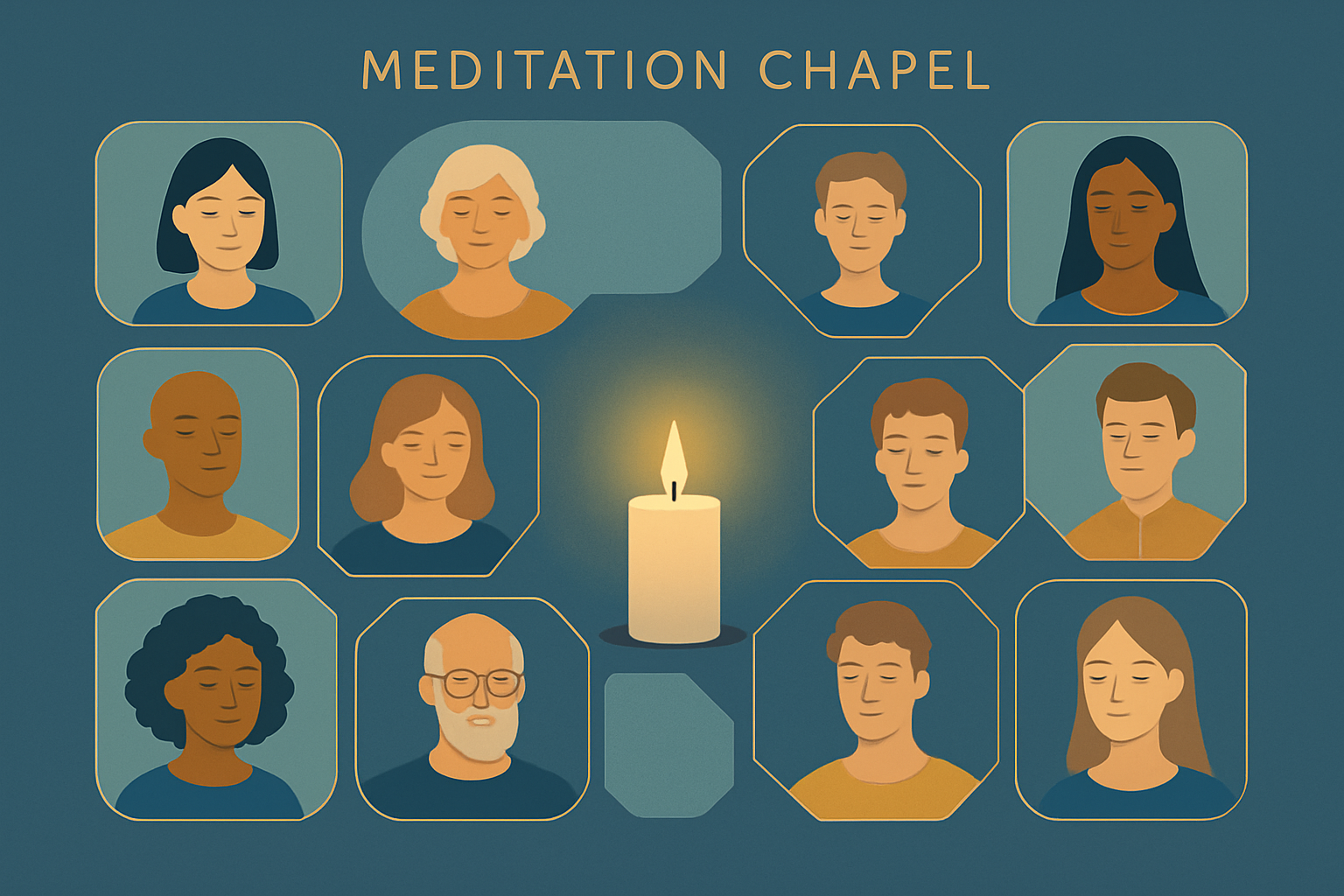
Marlene described how the circular layout broke down with more than 8-10 participants, with circles overlapping each other and names appearing too large and misaligned with their corresponding video feeds (09:46). The 12-person test revealed faces appearing extremely small—described as penny or 50-cent euro coin sized—making it difficult to see participants clearly (20:01).
The fundamental design challenge centered on balancing multiple requirements: seeing participants clearly including their gestures and background context, maintaining the sacred aesthetic of the monastery space, and scaling to accommodate 50+ people during Bay of Practice sessions (21:39).
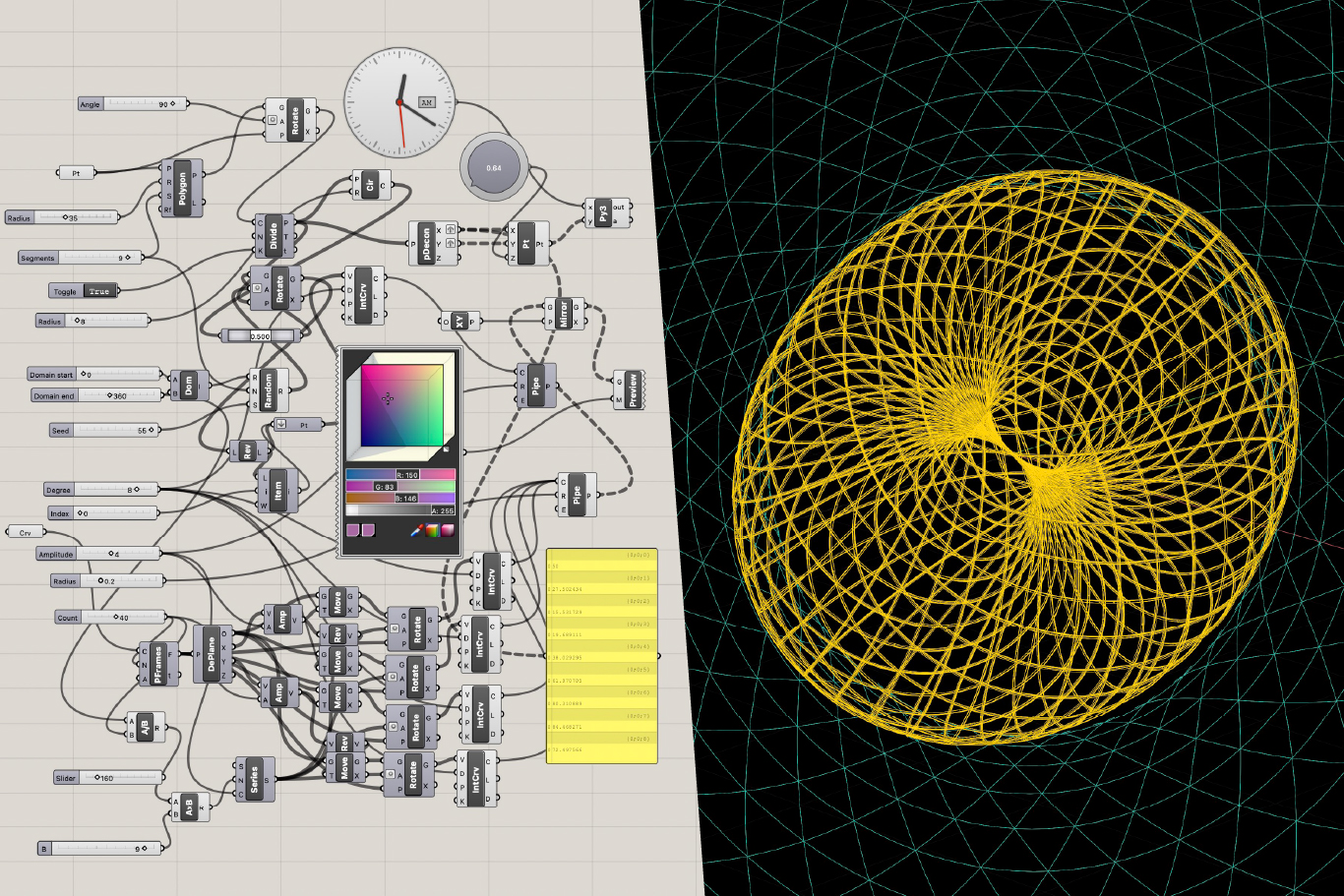
James demonstrated various geometric approaches using a parametric design tool. The team explored several formations:
[technology="Parametric Geometric Interfaces"]
The initial circular approach proved too limiting, so James proposed oval-shaped windows that would show more context while maintaining an elegant aesthetic (41:29). This evolved into rounded rectangles that felt like "windows in a plane or an old TV" according to Marlene (42:22), which the team found appealing for its balance of form and function.
For larger groups, James demonstrated a honeycomb or cellular formation that could accommodate up to 45 people (47:12). Sarah suggested a tiered approach: one ring for up to 12 people, two rings for up to 24 people, and then transitioning to the honeycomb pattern for larger gatherings (47:55). This would prevent individual windows from becoming too small at any stage.
The team agreed that windows should maintain a minimum size roughly equivalent to standard Zoom participant windows (approximately 3cm by 5cm) regardless of screen size, with the system adapting based on individual displays (40:28).
Marlene raised the ongoing challenge of integrating a virtual candle into the meditation space, noting this would take several weeks to solve technically (48:34). The candle needs to feel like an organic part of the unified space rather than something "stuck on top of a nice picture" as Sarah described (50:49). The team discussed whether the candle should remain stationary in the center or behave as a dynamic element like participant windows, leaning toward a central, fixed position (49:41).
Marlene reported echo problems when the facilitator's microphone remained unmuted during participant introductions, suggesting that even hosts need to mute when not speaking (51:51). James noted that Zoom likely has superior automatic noise cancellation for users without headphones and committed to investigating whether similar capabilities could be added.
The team emphasized the importance of seeing participants' full context—including gestures, hands, and subtle environmental details—rather than just tightly cropped faces, as this helps people feel connected despite being physically distant (28:24).
With Christmas holidays approaching, the team established January 5th as the target date for the next meditation chapel session (53:02). James indicated that significant improvements could be implemented within the week, with ongoing refinements communicated via WhatsApp (53:11). The immediate priority is implementing the timeout fix, adjusting the layout to show only first names, and refining the geometric formations based on participant count.
James
Sarah and Marlene
The first live meditation session with the chapel's video conferencing system revealed significant problems (01:27). Sarah reported that participants were unexpectedly kicked out during the hour-long meditation, though they could still see themselves on screen but had lost control of their microphone and camera (02:02). Marlene noted that approximately 14 people were in the session when everyone froze, and she glimpsed an error message related to Zoom being canceled (02:33).
James investigated the backend data from Daily Call and discovered that no participant had a duration longer than 20 minutes (05:25). The root cause was immediately identified: the chapel video room had been configured to automatically eject participants after 1200 seconds (20 minutes), likely left over from testing protocols (07:14). James adjusted the setting to a two-hour maximum to prevent accidental room abandonment while solving the disconnection problem.
[technology="Video Conferencing Solutions"]
The team acknowledged they had never previously tested an hour-long session with participants sitting silently with eyes closed, making this a unique edge case that exposed the timeout issue (04:11).
Marlene described how the circular layout broke down with more than 8-10 participants, with circles overlapping each other and names appearing too large and misaligned with their corresponding video feeds (09:46). The 12-person test revealed faces appearing extremely small—described as penny or 50-cent euro coin sized—making it difficult to see participants clearly (20:01).
The fundamental design challenge centered on balancing multiple requirements: seeing participants clearly including their gestures and background context, maintaining the sacred aesthetic of the monastery space, and scaling to accommodate 50+ people during Bay of Practice sessions (21:39).
James demonstrated various geometric approaches using a parametric design tool. The team explored several formations:
[technology="Parametric Geometric Interfaces"]
The initial circular approach proved too limiting, so James proposed oval-shaped windows that would show more context while maintaining an elegant aesthetic (41:29). This evolved into rounded rectangles that felt like "windows in a plane or an old TV" according to Marlene (42:22), which the team found appealing for its balance of form and function.
For larger groups, James demonstrated a honeycomb or cellular formation that could accommodate up to 45 people (47:12). Sarah suggested a tiered approach: one ring for up to 12 people, two rings for up to 24 people, and then transitioning to the honeycomb pattern for larger gatherings (47:55). This would prevent individual windows from becoming too small at any stage.
The team agreed that windows should maintain a minimum size roughly equivalent to standard Zoom participant windows (approximately 3cm by 5cm) regardless of screen size, with the system adapting based on individual displays (40:28).
Marlene raised the ongoing challenge of integrating a virtual candle into the meditation space, noting this would take several weeks to solve technically (48:34). The candle needs to feel like an organic part of the unified space rather than something "stuck on top of a nice picture" as Sarah described (50:49). The team discussed whether the candle should remain stationary in the center or behave as a dynamic element like participant windows, leaning toward a central, fixed position (49:41).
Marlene reported echo problems when the facilitator's microphone remained unmuted during participant introductions, suggesting that even hosts need to mute when not speaking (51:51). James noted that Zoom likely has superior automatic noise cancellation for users without headphones and committed to investigating whether similar capabilities could be added.
The team emphasized the importance of seeing participants' full context—including gestures, hands, and subtle environmental details—rather than just tightly cropped faces, as this helps people feel connected despite being physically distant (28:24).
With Christmas holidays approaching, the team established January 5th as the target date for the next meditation chapel session (53:02). James indicated that significant improvements could be implemented within the week, with ongoing refinements communicated via WhatsApp (53:11). The immediate priority is implementing the timeout fix, adjusting the layout to show only first names, and refining the geometric formations based on participant count.
James
Sarah and Marlene
Building a second-tier membership platform for Interbeing Monastery focused on deepening community connection and enabling self-generated engagement circles. Based on member surveys showing appetite for spontaneous practice sessions, informal connection spaces, and member-led study groups. Platform will enable members to create their own Holons (circles), host discussions, run short courses, and connect through intelligent matching. Will eventually absorb and replace Communiverse, integrating directly into the monastery page. Uses Webflow front-end with Supabase backend, Stripe/PayPal for payments, includes profile creation with AI-generated content, 9-domain assessment system, and cross-platform synchronization capabilities.
Phased approach to resolve persistent video conferencing issues in Circle platform while building toward custom solution. Phase 1: Sarah and Manon assess Circle's back-end video capabilities and explore embedding Daily.co Meditation Chapel into Circle for better stability. Phase 2: Embed Circle into monastery site so monastery remains primary entry point. Phase 3: Full migration to custom platform when replication becomes more streamlined. The Meditation Chapel (built on Daily.co) is working well with 60+ regulars and generating real inspiration, but Circle's video has sound issues, unclear permissions, and confusing interface that diminishes member engagement.
Reworking evolve World website with intelligent multilingual strategy. Using custom geolocation script to auto-redirect users in Germany, Austria, Switzerland, and Luxembourg to German versions while showing English elsewhere by default. Pages existing in only one language (e.g., evolve Magazin) will auto-redirect with friendly pop-ups explaining language and pointing to translated content where available. Some pages like homepage will feature parallel bilingual content. English remains structural primary language while honoring German-first content creation. Includes calendar CMS evolution for clickable homepage calendar with Airtable sync to solve event discoverability issues.
00:00:01
James Redenbaugh: Good to see you.
00:00:01
Sarah: Hi, Firefly.
00:00:02
Marlene: This meeting is being recorded.
00:00:09
James Redenbaugh: How are you?
00:00:12
Sarah: Pretty good.
00:00:14
Marlene: A bit tired, but good overall. Good. How are you?
00:00:20
Sarah: Same.
00:00:24
James Redenbaugh: But I don't have an excuse. It's not so late for me over here.
00:00:30
Sarah: But it's kind of early, isn't it? Or not so bad.
00:00:34
James Redenbaugh: It's one no problem.
00:00:39
Marlene: That should be no problem. Despite you have a good excuse.
00:00:45
James Redenbaugh: Yeah, I just haven't had time to make a coffee yet. Back to back. So what, what. What brings us here today?
00:00:57
Sarah: A few things to get the monastery finished off. We had a test. Well, the first. We had the first people in the meditation chapel today and it didn't go so well. There's quite a few things that didn't work. I sent you a few pictures. I don't sure if you've seen them yet.
00:01:27
James Redenbaugh: No, I didn't see that. Let me see.
00:01:28
Sarah: You can have a look in WhatsApp. So there's a couple of things. One is that the layout of the page was not really working. And then the second thing is, which is a little more mysterious, people were getting kicked out during the meditation and not realizing they were kicked out because they could see themselves still on the screen. But they lost control. All of them?
00:02:02
Marlene: Yeah.
00:02:02
Sarah: The microphone and the camera, for example. And other people could see that they were gone. And apparently most frozen, actually. Yeah.
00:02:14
Marlene: Yeah. I think everyone flew out. Yeah, yeah. But you. You weren't aware right at the beginning because you looked, okay, there's still the circle. Then at the end, okay, there's nothing happening. Everyone is frozen.
00:02:33
Sarah: Yeah.
00:02:34
Marlene: And I saw in between a line which said something with zoom was canceled or something like that. But I couldn't really read it because there were pictures above it and things like that.
00:02:53
Sarah: But something kind of crashed in that video platform.
00:02:59
James Redenbaugh: Yeah. That's bad.
00:03:06
Sarah: Yes.
00:03:08
James Redenbaugh: It has been a long time since we have worked.
00:03:13
Sarah: So I wonder if it seems.
00:03:16
Marlene: Because we also tested it before in more internal group. But it feels like it could be that if you are more than eight or nine. We were 14 or something this morning, I think.
00:03:30
Sarah: Yeah.
00:03:31
Marlene: That it then doesn't work. That was our sense of.
00:03:36
Sarah: And the other thing we've never tested is we've never sat for an hour with our eyes closed doing nothing. So whether somewhere the program says nothing's happening and it just stops. So these two things were new for today. We don't hear you now, James.
00:04:11
James Redenbaugh: Hear me now.
00:04:12
Marlene: Yeah, yeah, yep.
00:04:16
James Redenbaugh: In the back and see.
00:04:20
Sarah: Oh no, you're breaking up. Actually, can you try one more time?
00:04:25
James Redenbaugh: Yeah. Is that better?
00:04:35
Sarah: That sounds better.
00:04:36
James Redenbaugh: Can you hear me now?
00:04:38
Marlene: Yeah, yeah, yeah.
00:04:42
James Redenbaugh: Okay. Hopefully that works. I'm looking in the back of Daily Call and I can see. 12 participants, the join times and the durations. Okay, interesting. See? So this must have been a meeting.
00:05:11
Marlene: Yep.
00:05:12
James Redenbaugh: And. Nobody has a duration limit longer than 20 minutes. Is that because everyone was kicked out after 20 minutes or.
00:05:25
Sarah: Must be.
00:05:27
Marlene: Yeah, yeah, yeah. That makes. That was somehow the time.
00:05:33
James Redenbaugh: Strange. So this is the join time. This one is 21. They joined at 5:19. And then people are coming back into the room and staying for no more than 20 minutes at a time.
00:05:55
Sarah: So something maximum.
00:05:57
James Redenbaugh: Yeah, something seems to be happening at the 20 minute mark. That's a good clue.
00:06:06
Sarah: Yeah.
00:06:11
James Redenbaugh: And make sure which room this is in the chapel video room. Is there. An obvious problem? Yes. Well, good news is problems easy to fix. Yeah, it's. It's set to eject people after 1200 seconds, which is 20 minutes. We don't want that. We probably had that on for testing to make sure that we didn't leave rooms open by mistake.
00:07:14
Sarah: Yeah.
00:07:19
James Redenbaugh: Maybe we can set a max of like two hours in case somebody leaves it on. Well, that should fix that problem. Sorry, we didn't catch that beforehand. We should have done longer tests. But were some. Do you think that all the kicks were because of that or do you think that there were also other issues?
00:07:54
Sarah: I have no idea. I mean that when we look at the data here, it's just these one minute ones. What is that all about?
00:08:03
James Redenbaugh: Oh, wait, these are. These are other meetings. So that must have been other.
00:08:08
Sarah: Ah, okay. They're very short ones.
00:08:10
James Redenbaugh: Cool. Yeah. So yeah, somebody was out after eight minutes. That was useful.
00:08:18
Sarah: That was me.
00:08:19
Marlene: Yeah.
00:08:19
Sarah: Yeah. I took myself out.
00:08:22
James Redenbaugh: Huh.
00:08:24
Sarah: But otherwise it's very consistent. Yeah. Maybe at the end, because here it's all very short.
00:08:33
James Redenbaugh: But this was all at 6:30 UTC. So maybe that was near the end of the meeting or.
00:08:40
Marlene: Yeah.
00:08:41
Sarah: Oh yeah. And they had to change.
00:08:43
Marlene: We start at 6:30, but that could be at 7:30. And people. Then we finished the meditation and then people tried to get in again.
00:08:52
James Redenbaugh: Mm.
00:08:57
Marlene: And we told them we now meet in our original zoom room.
00:09:03
James Redenbaugh: Must be. Okay. What other. What other issues were there? I see the screenshots of the arrangement. That's easy to fix.
00:09:22
Marlene: Yeah. But it was not like I expected. After. After we were 8 or 10, the circles moved across each other. So it was not one circle with 12 people or two circles or something. The circles went into each other and.
00:09:46
Sarah: The names on top of each other.
00:09:49
Marlene: Yeah. Also the names were written very big so that it. That the names moved away from the right circle.
00:09:58
James Redenbaugh: Yeah, maybe we don't. Do we want to see names the whole time?
00:10:03
Marlene: Yeah, but we need only the first name.
00:10:06
Sarah: Yeah.
00:10:13
James Redenbaugh: Okay.
00:10:20
Marlene: There is a whole issue. Go ahead, Sarah.
00:10:23
Sarah: Go for it. No, you go, Marlene. I think it's the same thing.
00:10:27
Marlene: And there is an issue around showing people in. In a round window, which first, if you look at it, it looks somehow nice. But what we came to this morning was then you only see the face in a very like. Like a little moon, so to say. And your face is in. In the moon, and you don't see anything more of a person. Like here, you can see people gesturing or talking and things like that. And that is not. That is in this little circles. Really feels a bit strange. So we were speaking back and forth. If we should try to do. Not to do it in a circle or two circles, but to change the hive form, which was meant to be when there's a bigger group, as far as I understood.
00:11:28
James Redenbaugh: Okay.
00:11:32
Marlene: Could you show all this to us?
00:11:37
James Redenbaugh: Show you which.
00:11:38
Marlene: The hive. I don't remember how it looked or I don't remember if I even saw it once.
00:11:48
Sarah: I think it's two different things. What we talked about last time was that when I don't remember the amount, but let's say when there were more than 12 people on the screen, the formation of the circle would shift to a honeycomb. This was something we spoke about. And now what I understand you, Marlena, is saying, is actually changing the physical shape of the window of each participant so that it's not a circle. But what's that? Not a hexagon. Pentagon. No, not a pentagon. Hexagon. What is it, six sided? Yeah.
00:12:34
James Redenbaugh: Hexagon. Yeah.
00:12:36
Marlene: Yeah, that's true. That's true. Yeah, you're right.
00:12:39
James Redenbaugh: I think that the hexagon would actually. It would actually crop more than the circle, because I think so. Circle. Any polygon is going to cut off the sides.
00:12:52
Sarah: Yeah.
00:12:52
James Redenbaugh: And then the circle is limited by the top. But then a hexagon would.
00:12:57
Sarah: It takes more angles out.
00:12:59
James Redenbaugh: Take even more. And I want to show you guys something as another possibility. Let me see if I can find this real quick. Random file. Here.
00:15:40
Marlene: This was. Would drive me crazy.
00:15:48
Sarah: That was also a bit bubble to say how.
00:15:50
James Redenbaugh: What. Here we go. So this is the code I'm using to, wow, create the geometry. And. So.
00:16:42
Sarah: See the square boxes, the green ones?
00:16:49
James Redenbaugh: Let me make this a little easier. So there's the yellow circles, but then also the Green boxes. And can't change the number of people. Been a while since I opened this. Fun. No, I got. This is an earlier version where I didn't figure it out, but basically I'm thinking instead of having everybody in the. In the circles, I could just have them in the. In the rectangles like this. So we could still be in a circle together, but see the whole screen.
00:18:50
Marlene: And.
00:18:51
Sarah: What. Yeah, totally. I'm just trying to count how many rectangles this is.
00:18:57
James Redenbaugh: Right now there's 30 people, which is.
00:19:01
Marlene: But that feels very small then. Because when you think we Normally we have at zoom most. Most of the time we have 26 on one page. And then it changes to another page and that's already small. But maybe we can adjust something like 20 or so there. What would you say, Sarah?
00:19:28
Sarah: Yeah, I'm just wondering. Because this morning you said there were 12 people on the. In these circles and they were quite small. Like, I wouldn't. My screen wouldn't fit more than.
00:19:52
Marlene: That. Actually.
00:19:55
Sarah: They were like. Like this.
00:20:01
Marlene: Yeah. Like a penny or something.
00:20:03
Sarah: Exactly like a penny. I mean. Or maybe a euro. A little bigger, but. Yeah.
00:20:12
Marlene: A little bigger than.
00:20:14
Sarah: Yeah.
00:20:14
Marlene: Maybe €50.
00:20:24
Sarah: And. Yes. So I'm just wondering if. Am we in a Bay of practice? We have 50 plus people in the meditation room at the same time. So. There needs to be another solution. And there is something very elegant in the honeycomb. Sorry. Because it is. Evolves kind of. Look. But I. I appreciate this, the circles in the circle, but it would seem that then at a certain point it has to snap to some kind of honeycomb or grid.
00:21:39
James Redenbaugh: Yeah.
00:21:40
Sarah: M.
00:21:50
James Redenbaugh: Well, I can play with this. I gotta get back into this code to figure out how to make it work the way I want it to. But I think that. It would be nice to see more people and. And to be in a circle. We could ever even give people the option to switch to change views.
00:22:20
Sarah: I think we don't need to get that fancy. It's really just to keep it very simple, but that we really want to see clearly everybody and get a sense, like Marlena said, of their gestures and also the background that somehow this helps people a lot to feel kind of. Kind of paradoxically to feel together. And this is really important. So it's. It's a double thing. It's. We're actually talking about two changes. One is how to give more space like that the windows are bigger and it would seem wider. Like a rectangle. It's not a rectangle. A hexagonal rectangle. And the Second is not to have like, if we are going with the. The faces or the people in a ring, that it's maximum, I think 12 in the circle before it snaps to a honeycomb formation. Because they get too small.
00:23:31
James Redenbaugh: Yeah. Okay.
00:23:38
Sarah: And then the question is like. There's a third question then is like on Zoom, you have whatever 30 or 25 maximum on an average screen. And then there's. You have pages where you can shift. So what's the solution? When we get more than, let's say 30, do we also have pages or do people then start shrinking and we have a kind of enormous mosaic of smaller and smaller faces.
00:24:21
Marlene: How far does this go? Because then if we are 30 and they cover all the. The part. All parts of the monastery, that feels also strange. I would say.
00:24:42
James Redenbaugh: There.
00:24:42
Marlene: There should stay some background of the mon.
00:24:51
James Redenbaugh: Yeah.
00:24:53
Sarah: So it's quite a complicated riddle. Yeah.
00:25:02
Marlene: And with the names, it could be like this page. You are just showing in that size, but only the first name. That's enough.
00:25:11
James Redenbaugh: Okay.
00:25:25
Marlene: And was there anything related to that? Sarah, what you remember.
00:25:34
Sarah: What do you mean around this topic? The topic of the meditation chapel?
00:25:43
Marlene: No, the topic of how. What is the right order? What is the right size?
00:25:50
Sarah: I think that's the main elements that we need to see more of each person, including the room. We need to.
00:26:02
Marlene: One issue around that was. And I think that would fit. If we go with this direction. We were just speaking about that it would be good to have the possibility that two people can sit in front of one computer and both are seen in a good way. It's clear that it's not that the same as if one person were sitting there, but that. That should be a possibility. For example, if we have a couple or if some friends. Two friends are together or something like that.
00:26:40
Sarah: Which points to the rectangle.
00:26:43
Marlene: Yeah.
00:26:44
James Redenbaugh: Okay.
00:26:52
Marlene: Maybe we briefly discuss this because I'm a bit. I know that it was asked for that. That people could also see their backgrounds so that that one feels. Okay. A bit of the home of everyone is also part of that dialogue. And I'm a bit back and forth about that because with the monastery we want to have a space where. Yeah. Where the sacredness of the room is also present, design wise, or how one should say that. And if we now have the same as Zoom with all this kind of different backgrounds and stuff in the back, I'm a bit back and forth. I can understand that. But it's also what we got used by Zoom too at the beginning. Everyone found that very much disturbing to have all this kind of different kinds of things in the background of someone. So it's also a habit which we got used to. You know what I mean?
00:28:08
James Redenbaugh: Yeah.
00:28:09
Marlene: So I'm a bit back and forth if we should just try to put zoom in this concept or if there's also an openness of. It's important that one can see people in their aliveness.
00:28:24
Sarah: Yes, exactly.
00:28:26
Marlene: That's the most important thing. More if I as then. If. Then I can see their shelf or their picture or whatever in the background.
00:28:37
Sarah: Nice ovals you're working with.
00:28:41
James Redenbaugh: Yeah. I wonder if we were in ovals instead what that could be like.
00:28:48
Sarah: Yeah, I agree with you, Melena. It's. I guess it's more a vague sense that people are somewhere more than seeing the books on their shelves or the. Yeah. And. And maybe more than anything the hands. And is it possible to try less faces on the screen, James? Or.
00:29:23
James Redenbaugh: That's a. Yeah.
00:29:34
Sarah: There we go. That looks cool.
00:29:42
James Redenbaugh: Yeah. Ovals could be neat.
00:29:45
Sarah: Yeah.
00:29:46
James Redenbaugh: Especially if they didn't overlap.
00:29:48
Sarah: Exactly.
00:30:11
James Redenbaugh: The whole thing could be oval as well.
00:30:39
Marlene: Somehow.
00:30:39
Sarah: Very helpful to see what you do. What you're doing.
00:30:44
James Redenbaugh: What.
00:30:45
Sarah: It's very helpful to see what you're actually the reality of what you're doing.
00:30:57
James Redenbaugh: We could take up the whole rectangle of the screen which would give people more room, see. And then. Space to be ovoid. Would that be too weird?
00:31:39
Sarah: Me right now. It looks cool. I'm just trying to. I'm opening actually the meditation room as it is now just to try to imagine it. There's something nice in that. It puts the. The room that you designed in kind of in the center in a way.
00:32:33
Marlene: But isn't it very close to that how it is now? Oh, no. Oh. It's more an oval as. Not a circle, but an oval. Right?
00:32:49
Sarah: Yeah.
00:32:50
Marlene: Yeah, yeah, yeah. Now I see.
00:33:06
Sarah: I think this is a good start. This looks pretty good to me. What do you think, Elena?
00:33:14
Marlene: Yeah, I. I noticed.
00:33:17
Sarah: And what is it possible to. What would happen when the. Now it's 12 people. What would happen when the 13th person comes in.
00:33:39
James Redenbaugh: Like that? You can actually quit fit quite a few in there like this.
00:33:52
Sarah: Oh, they go over the edge. And is it possible to. That after 12 people it. It stops being in the ring but goes to a different formation or it's a ring inside a ring or. Because to my mind they get too small.
00:34:20
James Redenbaugh: Yeah.
00:34:24
Sarah: Like I said, over more than 1214 this. The faces get too small and. Yeah.
00:35:02
James Redenbaugh: Let me try this real quick. How do we feel about a two ring situation?
00:36:47
Sarah: Is it possible that the ovals are all the same size? So it's.
00:37:27
James Redenbaugh: Kind of like that. How's that?
00:37:52
Sarah: Yeah, I think they're all kind of too small to see. To feel like we see everyone clearly, that there should be 40 people.
00:38:08
James Redenbaugh: Tell me again, this would be 40 people at once.
00:38:13
Sarah: Yeah. And I wonder if we can make less people in each circle, but more circles, more rings, Less people in nature. Ring and moorings.
00:38:28
James Redenbaugh: Yeah.
00:38:29
Sarah: Yeah, I can.
00:38:30
James Redenbaugh: I can play with that. I'm just kind of. I want to actually recreate the logic over here because I'm just kind of hacking things at this point. But I think I understand that desire and the. The constraints now.
00:39:02
Sarah: Yeah. I'm just thinking, like, right now on my screen, if I look at you guys, you're maybe like, I don't know, two centimeters by three and a half. Like the square, the rectangle that you're in in zoom. On my screen right now, Is it similar for you, Malena?
00:39:27
Marlene: No, for me, it's more than 2cm. I would say.
00:39:33
Sarah: We have a small screen. Really? Oh, yeah.
00:39:39
Marlene: The big rectangle, you mean, Right?
00:39:40
Sarah: No, no, you. You're right. My rectangle.
00:39:43
Marlene: Oh, my rectangle. Yeah. Yeah. That's three. That's three. That's about three. Yeah. Mm.
00:39:51
James Redenbaugh: You guys are three by five and a half.
00:39:56
Sarah: Yeah. So maybe a bit bigger on your screen, James?
00:40:00
James Redenbaugh: I have a big screen.
00:40:01
Sarah: Yeah. But to me, this is kind of the minimum size.
00:40:10
James Redenbaugh: Yeah. Cool. Well, I wonder also if I could set a. Set a minimum size, and then depending on people's screen sizes, it adapts.
00:40:28
Sarah: Yep.
00:40:33
James Redenbaugh: I'll play with this. But in general, we like the. We like the oval possibilities.
00:40:38
Sarah: Yeah.
00:40:39
James Redenbaugh: Could also be rectangles in a circle. We want to see the context of people. I wonder also if.
00:41:10
Sarah: Oh, yeah.
00:41:29
James Redenbaugh: Like, instead of a full oval, We could just kind of round the corner so it feels like an oval, but you still get a lot of context.
00:41:55
Marlene: So it's a rectangle with round corners. So to say.
00:41:58
James Redenbaugh: Mm.
00:41:59
Marlene: Mm.
00:42:01
James Redenbaugh: As opposed to, like, this. It's not that big a difference, but it. You have a lot more.
00:42:12
Marlene: But it's a different feeling.
00:42:14
James Redenbaugh: Yeah.
00:42:17
Marlene: It's like window in a plane or something.
00:42:22
Sarah: Exactly.
00:42:23
Marlene: Yeah. Yeah.
00:42:24
Sarah: Or an old tv.
00:42:26
Marlene: Yeah.
00:42:26
Sarah: Yeah.
00:42:27
Marlene: But somehow I like that.
00:42:31
James Redenbaugh: Cool. I like it, too. I'll make it perfect. Yeah, it's nice.
00:42:53
Marlene: Do you like it too, Sarah?
00:42:57
Sarah: I'm not totally convinced, but yeah. It's also a bit abstract, I mean, at this stage, but when I see it like that, that shape, then I think, ah, then I Think, ah, maybe the honeycomb formation actually fits better because it's more like cells or something.
00:43:33
James Redenbaugh: And actually the actual aspect ratio, these video. We could do it like this. Yeah. Then it is a lot like tree cells or something.
00:44:15
Sarah: Yeah. But then we have potentially the issue that Malena mentioned before, which is that we don't see the image of the room.
00:44:28
James Redenbaugh: True.
00:44:31
Sarah: I wonder if there could be some empty.
00:44:37
James Redenbaugh: Yeah. What if it was like. Let's say that's the screen. And they go around like that.
00:45:28
Marlene: Mm.
00:45:49
James Redenbaugh: Or there's something over here. So it's like we're. In a room together, but orienting to some greater whole.
00:46:14
Sarah: And I suppose it's necessary that all the windows are the same shape.
00:46:27
James Redenbaugh: Probably.
00:46:28
Marlene: Yeah.
00:46:30
James Redenbaugh: Why? What are you thinking?
00:46:32
Sarah: No, just to follow the cellular structure. I mean, they're usually not exactly perfect. So there's an organic kind of look that everyone is a little bit different and it makes it not look so. Like if you squint your eyes at this formation, it looks also can look like a brick wall or something. Like.
00:47:12
James Redenbaugh: This is 45 people.
00:47:14
Sarah: Yes. And is it possible that it. That this is reserved for. If it is 45 people, that we have rings until like one ring until 12 people, then two rings until 24 people and then it goes to this.
00:47:46
James Redenbaugh: Yeah.
00:47:51
Sarah: What do you think, Malena?
00:47:55
Marlene: Sorry, I was a bit distracted.
00:47:58
Sarah: So if it was 12 people in one ring, then once more people come. Let's say 24. That's two rings. Maybe there's even a third ring for the next. And then if we get more than. I don't know what is the amount, but 30 or 40, it becomes this, the last one that James just did.
00:48:24
Marlene: Yeah. Yeah. And. And we think. Have to think about or to think that also with. Is that we plan to have a candle in there.
00:48:33
Sarah: Yeah.
00:48:34
Marlene: We still have that issue that we did not solve with the computer, but that's what we are thriving for. And that will not take several months, but maybe several weeks. So that we have a candle in there. And that could be nice to have it in the middle first and then when we have this kind of cellular overview, then it needs a place there too.
00:49:02
Sarah: Would it be possible or make sense if the candle was one of the windows that behaves like a person.
00:49:12
Marlene: Or.
00:49:13
Sarah: It should be stationary. Because then it would be in the ring and then it would.
00:49:23
Marlene: Yeah. It would change its places depending on how much people are arriving. My. My vision was somehow that's in the middle of the room. But yeah, that's just the first idea.
00:49:39
Sarah: Yeah.
00:49:41
Marlene: So in the middle of the circle. Not. Not part of the circle. Yeah. Would you agree, Sarah?
00:49:53
Sarah: Yeah. That was also what I had originally imagined. But.
00:50:04
James Redenbaugh: It.
00:50:05
Sarah: It's difficult me. For me to kind of imagine. I always like to try things and see how they actually feel.
00:50:12
Marlene: Yeah, yeah, yeah.
00:50:13
Sarah: So it's a bit theoretical.
00:50:15
Marlene: Yeah, exactly. Exactly. I'm open for that.
00:50:18
Sarah: Yeah. But there is also something I also appreciate. It's good for you to get as much information as possible, James. There's something where at the moment we have faces. We have this background like the room and then we want to add the candle. That it does that. It feels like one thing. And that's what we're also somehow fighting for or searching for. And not just something stuck on top of a nice picture.
00:50:48
James Redenbaugh: Yeah.
00:50:49
Sarah: But that. It feels like a whole. Like you. That earlier. So whatever is the formation that somehow does that.
00:50:59
Marlene: Yeah, yeah, that, that, that. That. It really feeds seamless into that space and not on the top of a. Yeah. Wall or something.
00:51:12
James Redenbaugh: Guys, I got to run and let somebody into my house real quick.
00:51:16
Sarah: Yeah, do that.
00:51:17
Marlene: Yeah. We also.
00:51:18
Sarah: I think we have to go in five minutes actually, also.
00:51:21
Marlene: Yeah, yeah. And I have one. One thing or do you first need to go, James? And then we go then real quick. Real quick. The thing was, I think. I think there was an echo this morning when my cat his mic off his microphone open while everyone was introducing his herself. And my sense was that that doesn't work so that you always have to mute yourself even if you are leading.
00:51:51
James Redenbaugh: Okay.
00:51:54
Sarah: It was his mic picking up the sound of everybody.
00:52:00
James Redenbaugh: Yeah.
00:52:00
Marlene: Yeah.
00:52:02
James Redenbaugh: Interesting. Yeah. Zoom probably has better automatic noise cancellation if you're not wearing headphones. I'll see if there. There might be something for that.
00:52:16
Marlene: Yeah.
00:52:16
Sarah: Yeah. I also have a few smaller things just generally about the monastery. But I'll find another moment, James.
00:52:24
James Redenbaugh: Cool. We did a bunch of updates there. I can text you about it.
00:52:29
Sarah: Awesome. Let's just keep in touch with WhatsApp then.
00:52:33
James Redenbaugh: Cool.
00:52:34
Marlene: Yeah. And then maybe a timeline because now we have Christmas. We wanted to do the meditation this morning in the. This week in the meditation chapel, which we won't do for now. Then we have Christmas holiday. Then we start again at January 5th. And I would give then it another chance with. If you think, James, you have it done until then.
00:53:02
James Redenbaugh: Yeah, definitely. There might be some small. Some quick improvements we could make this week as well.
00:53:11
Marlene: Yeah. So we will figure that out. But that we Somehow thrive for the 5th of January to start the next round of.
00:53:20
Sarah: Yeah.
00:53:21
James Redenbaugh: Okay, great. I'll talk to you guys soon.
00:53:24
Marlene: Yeah, thanks. Okay. Thank you.
00:53:26
James Redenbaugh: Ciao.
00:53:26
Marlene: Bye.
00:53:27
Sarah: Bye. Ciao.








.svg%20(1).png)


.png)